








PTIN renewal for 2027 is open, and paid federal tax return preparers should act before their current numbers expire on December 31, 2026. The IRS issued a fresh reminder on November 4. For a tax practice, the useful next step is to confirm each affected person’s renewal and keep evidence that the process finished.
A PTIN is a preparer tax identification number. This article explains the current reminder and five practical checks for professional firms, with a short section for business owners choosing a preparer. It distinguishes the government’s requirements from suggested internal controls that can make a busy filing season easier to manage.
The announcement concerns an annual administrative requirement. It does not introduce a new income-tax deduction or change a client’s return deadline. A practice should connect the reminder to staffing and recordkeeping decisions without presenting it as a new tax law.
Table of contents
- What the IRS reminder means
- Five checks for your tax practice
- A worked team budget
- Build a renewal register that protects privacy
- Handle exceptions before allocating work
- What small-business clients should ask
- Keep the process separate from client bookkeeping
- Frequently asked questions
- Conclusion
What the IRS reminder means for PTIN renewal
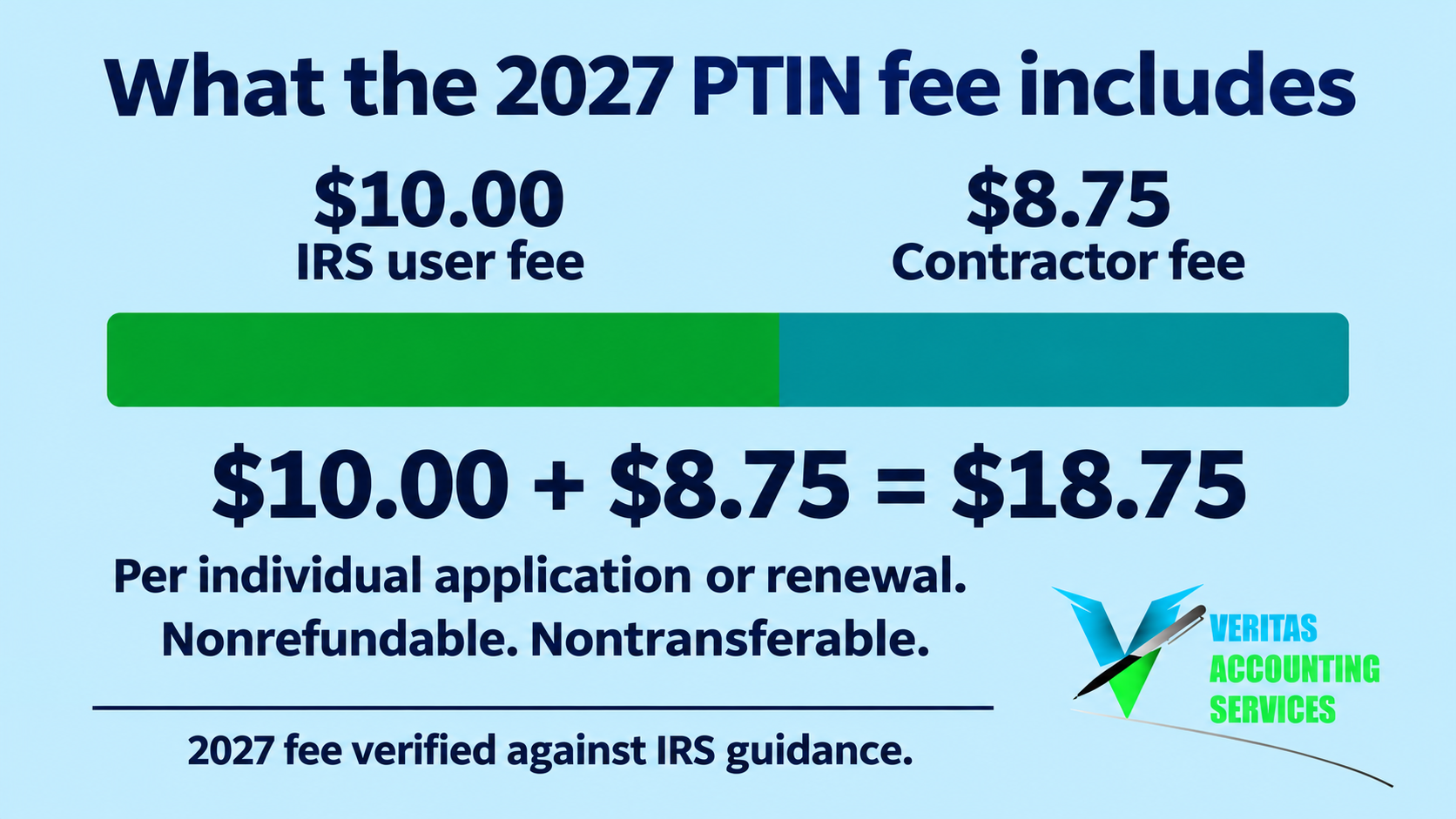
The November 4 IRS reminder confirms the annual renewal requirement and a 2027 application or renewal fee of $18.75. The fee cannot be refunded or transferred. The IRS describes online renewal as generally taking around 15 minutes; that is an estimate rather than a promise for every applicant.
The calendar year matters. A preparer handling a client’s 2026 income-tax return during 2027 needs to think about the preparer’s authorization for the year the work is performed. The tax year printed on a client return and the renewal year in a preparer’s account answer different questions.
For PTIN renewal, place the year next to every internal status. A green tick saying renewed is less useful than a dated record stating which year was confirmed. This simple distinction helps prevent a prior-year receipt from being accepted as current evidence.
Give PTIN renewal coordination to one named person in the firm, while leaving each individual responsible for their own application. The coordinator’s task is to gather completion evidence and track open issues. It is not to guess answers to personal application questions or treat the firm’s overall readiness as proof about every team member.
Our business compliance calendar guide explains how owners, reviewers and evidence can sit together in a deadline tracker. Use that approach here with a specific preparer-year record, rather than adding another vague reminder labeled tax season.
Five checks for your tax practice
1. Review the people and work covered
Start PTIN renewal planning with actual duties. IRS guidance generally covers paid preparation of all or substantially all of a federal return or refund claim, subject to listed exceptions. Enrolled agents also need a valid PTIN. An individual’s job title alone is a poor basis for deciding which requirement applies.
The IRS guidance on who needs a PTIN distinguishes substantive return preparation from purely clerical assistance. Someone preparing returns may need their own number even when another professional reviews and signs. An office cannot share a single PTIN among multiple people.
Create a roster with a short description of each person’s planned work. For example, distinguish organizing invoices, entering information, making tax determinations and preparing returns. Ask the responsible tax professional to resolve borderline roles using the IRS guidance before assigning them a simple yes or no status.
For PTIN renewal, record the reasoning behind the roster decision. A note such as role reviewed by practice manager is better when accompanied by the duty description and review date. If responsibilities change later, the record should prompt a fresh assessment rather than preserve an outdated conclusion.
Apply the same review to seasonal workers and external support arrangements. Describe the work and agreed handoff clearly instead of assuming the employment label settles the issue. Our white-label accounting discussion provides context for organizing professional support; individual regulatory requirements still need their own review.
2. Confirm the individual can reach the right account
Before beginning PTIN renewal, ask each affected person to check access to their existing account through the official IRS route. Discovering a forgotten login or obsolete email address in November leaves more room to resolve it than discovering the problem during the first client assignment.
Keep access testing separate from collecting credentials. A coordinator can record that access works without asking anyone to put a password, verification code or identity document into a shared spreadsheet. The practical objective is a reliable completion process with a narrow evidence trail.
The IRS application checklist identifies personal, business and applicable professional information that applicants may need. Prepare those details privately. Check names, contact information and credential details carefully, rather than copying an old staff list into an application without review.
For PTIN renewal, mark an access problem as an open issue with an owner and next action. Do not label it complete because a support request was sent. Account recovery, an application submission and a confirmed renewal are separate events in the firm’s workflow.
If help is needed, use the assistance routes linked from the official PTIN pages. Avoid creating a second account simply to get around a problem without checking the official instructions. A rushed workaround can leave the coordinator unsure which account or record should be reviewed.
3. Check the fee, year and completion evidence
The IRS renewal assistance FAQs break the 2027 total into a $10 IRS user fee and an $8.75 contractor fee. Together they equal $18.75 for an individual application or renewal. This is a small cash item, but it still deserves the correct year and supporting record.
Treat the payment record and the renewal result as related evidence. A bank or card entry explains a payment. The account’s confirmation explains the outcome of the application process. As an internal control, retain enough information to connect the individual, relevant year and completion result without circulating unnecessary personal details.
For PTIN renewal, agree who checks that evidence and where it will be retained. A coordinator should be able to answer a narrow question: which affected individuals have a confirmed 2027 renewal, and which still require follow-up? A folder of unlabeled receipts cannot answer that question reliably.
Set the PTIN renewal reimbursement policy before staff begin, if the firm intends to reimburse them. Specify what receipt is needed, who approves the claim and how duplicate claims will be prevented. This is a management recommendation, not a statement that the IRS requires employers to reimburse the fee or permits a particular tax deduction.
4. Separate PTIN, e-file and credential records
PTIN renewal should sit beside, rather than replace, other professional checks. A PTIN identifies an individual paid preparer. An EFIN identifies an approved electronic filing provider, which may be an individual or firm. Completing one process should not be treated as proof that every other registration or credential is current.
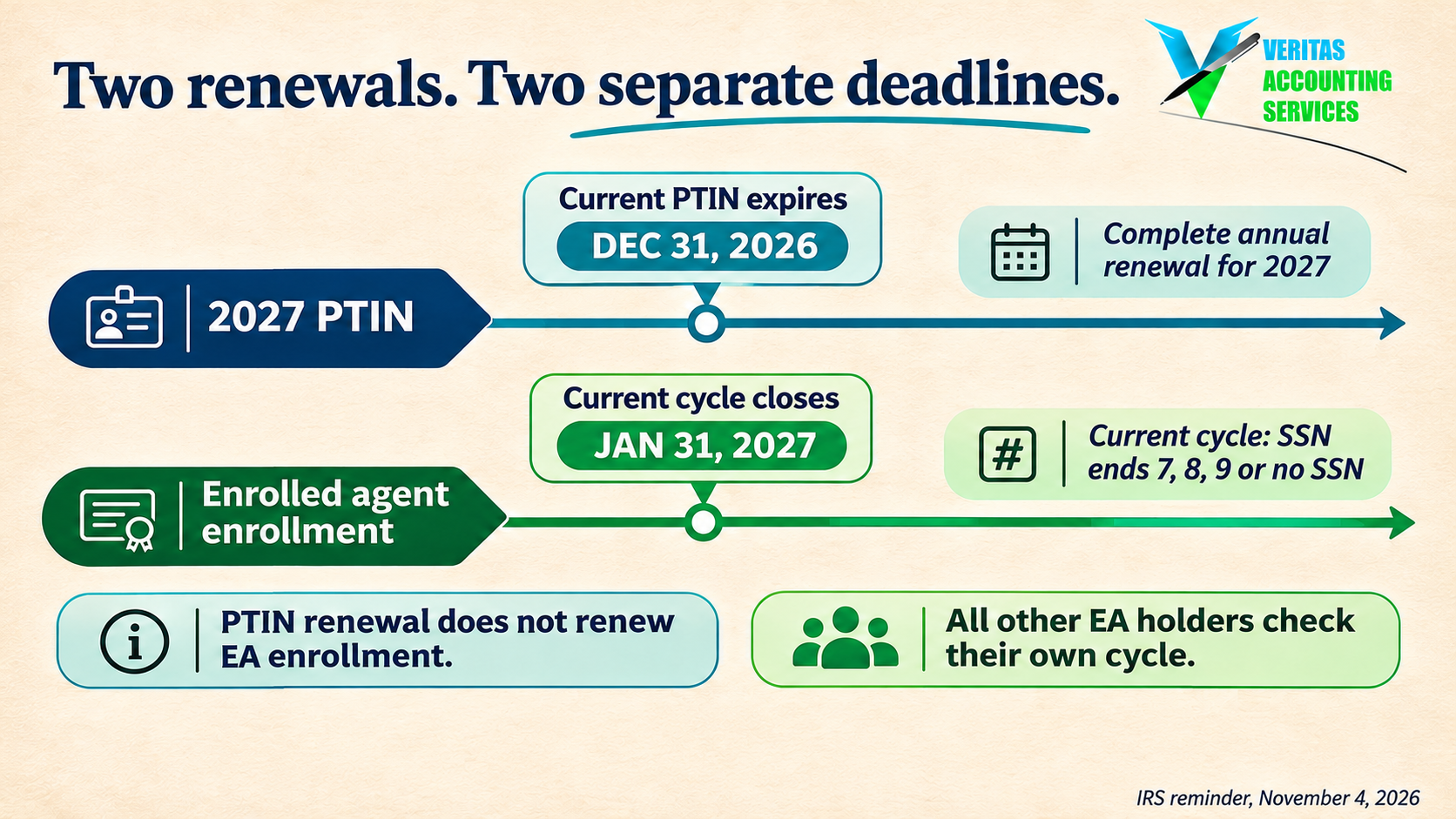
Enrolled agent enrollment has its own renewal cycle. The IRS enrolled agent status page identifies the current cycle as October 1, 2026, through January 31, 2027, for SSNs ending in 7, 8 or 9 and those without an SSN. Other enrolled agents should check their own cycle.
For PTIN renewal, do not substitute the January enrollment deadline for the December PTIN expiration. Keep the two items on separate lines with their respective evidence. An enrollment renewal receipt is not automatically the PTIN confirmation the coordinator is looking for.
Avoid keeping unnecessary identity details in a broadly shared calendar. A coordinator can track applicable enrollment review without displaying an individual’s full SSN. The person responsible for the credential should confirm the relevant cycle through their own records and official guidance.
5. Review readiness before allocating client work
Close the PTIN renewal review with an evidence check, rather than a reminder email alone. Compare the affected-person roster against the completion records. Investigate names that appear in one list but not the other, and record who will resolve each open issue.
Keep the review proportionate. A small practice might use one controlled register and a restricted evidence folder. A larger team may prefer its existing workflow system. The important question is whether someone can distinguish a verified result from an assumption when allocating work.
For PTIN renewal, use a clear handoff between the individual and the coordinator. The individual completes the application and supplies the agreed evidence. The coordinator checks the year and updates the roster. A reviewer looks at unresolved items before the practice treats the seasonal staffing plan as ready.
Do not equate a current PTIN with unlimited qualifications or a guarantee about the quality of a client’s return. Treat it as one specific requirement in a broader professional engagement review. Responsibilities, experience, review arrangements and the scope of services still need clear discussion.
A worked team budget
Suppose a practice has reviewed its staffing duties and determined that six people each need a 2027 renewal. Assume all six are ordinary current-year renewals at $18.75 each, with no prior-year applications or other credential charges included. These are hypothetical planning figures, not a Veritas client example.
The PTIN renewal budget is six multiplied by $18.75, or $112.50. If four people have confirmed completion, their fees total $75.00. The remaining two represent $37.50 of planned fees. The table separates a spending estimate from the evidence that work can be assigned.
| Planning item | People | Illustrative fee total |
|---|---|---|
| Confirmed 2027 renewals | 4 | $75.00 |
| Renewals still requiring follow-up | 2 | $37.50 |
| Total planned renewals | 6 | $112.50 |
For PTIN renewal, a budget marked fully funded does not mean all six applications are finished. Likewise, four receipts in a folder do not establish the status of the other two individuals. Ask what each figure represents before using it to make a staffing decision.
This example intentionally excludes EA enrollment fees, continuing education, software and other practice costs. Keep those items in separate budget lines. Combining them into a single preparer compliance charge can make a small renewal balance difficult to reconcile or explain.
Build a renewal register that protects privacy
A useful PTIN renewal register can contain the individual’s name, work-role review, applicable year, status, evidence location, reviewer and next action. These are suggested internal fields, not an IRS-prescribed form. Choose a location with access appropriate to the information retained.
Use meaningful PTIN renewal statuses. Not started, access issue, submitted awaiting confirmation and confirmed describe different follow-up needs. Define what evidence moves an item to confirmed so that one reviewer does not accept an informal message while another expects a completion record.
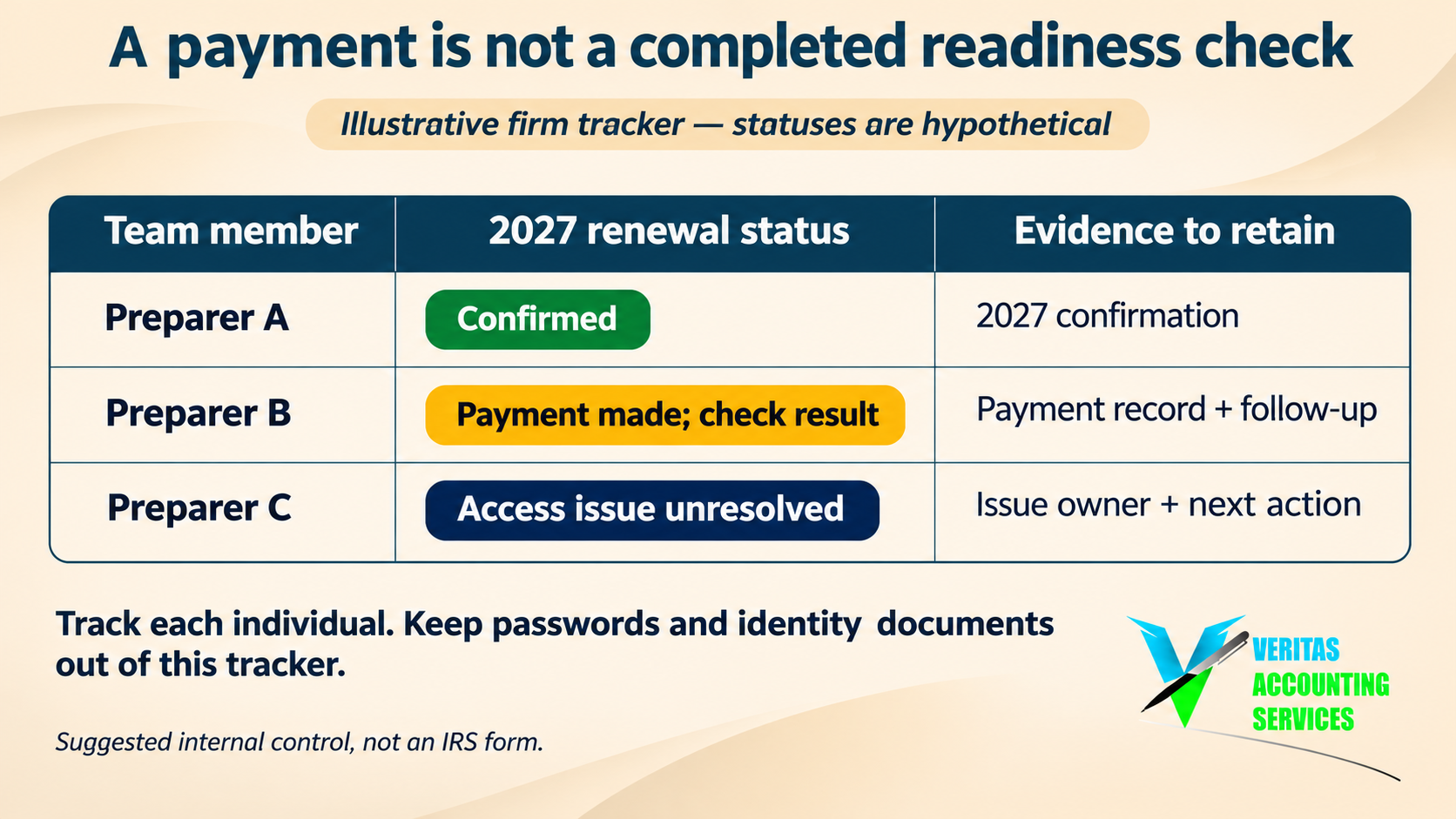
Keep PTIN renewal evidence separate from the staff’s private application inputs. The coordinator generally needs to know the relevant year and result for the readiness review. Passwords, recovery codes and copies of identity documents do not belong in an ordinary team tracker.
Name evidence files consistently and avoid overwriting a prior-year record with the new one. Add a review date so the tracker shows when someone last checked the evidence. A small naming convention can make an annual process easier to repeat without relying on one person’s memory.
Our tax information security guide explains the broader reason to control access and verify requests before sharing. Apply those principles to the preparer’s own information as carefully as to client records.
Handle exceptions before allocating work
An unresolved PTIN renewal is an issue to investigate. Write down what is missing, who is responsible and the next reasonable follow-up date. A specific note such as account access unresolved is more useful than a general red flag that gives the coordinator no action to take.
The IRS assistance FAQs address expired years and voluntary inactive status. They explain that an inactive holder cannot prepare federal returns for compensation. Past-year gaps can require a different review from an ordinary annual renewal, so refer those cases to the official guidance rather than assuming one payment cures every issue.
For PTIN renewal, keep a factual exception log. Record the question and the official assistance used without storing a lengthy personal history in the team’s shared notes. If the answer changes the person’s planned duties or availability, update the staffing record as well.
The IRS estimates paper applications can take about six weeks. Treat that as processing guidance, not a guaranteed completion date. When considering the paper route, allow for the actual circumstances and use the current Form W-12 instructions instead of assuming the online estimate applies.
What small-business clients should ask
A business owner does not normally need PTIN renewal simply because the business hires an outside preparer. The relevant requirement attaches to the individual preparer’s work. A useful client question is who will prepare the return, who will review it and how the engagement’s responsibilities are documented.
Ask the firm how it checks current preparer readiness, rather than requesting personal account screenshots. The answer should distinguish the firm’s professional process from the client’s own obligations to supply complete records and approve accurate information. Clear roles make the engagement easier to manage.
PTIN renewal is one conversation within that wider handoff. Give the preparer a concise list of the entities, returns and periods expected, and ask who will resolve open questions. Avoid treating a registration number as a substitute for discussing the work you actually need.
Keep the process separate from client bookkeeping
Alongside PTIN renewal, use the quieter preparation period to organize client records, with separate owners. Our CPA firm bookkeeping cleanup article considers the operational cost of incomplete books. That is a different problem from confirming a preparer’s annual registration.
For PTIN renewal, close the preparer checklist on its own evidence. For client bookkeeping, track reconciliations, missing statements and unresolved classifications separately. One completed workstream should not hide an incomplete item in the other.
At the next team meeting, review exceptions rather than reading every completed row aloud. Confirm who will obtain each missing record and when the coordinator should check again. This keeps the discussion useful while preserving the distinction between a government requirement and the firm’s chosen operating procedure.
Frequently asked questions
When should I complete PTIN renewal for 2027?
Current PTINs expire December 31, 2026. Complete the annual process for 2027 before undertaking covered paid preparation in that year. Schedule the task early enough to address access or application problems instead of assuming every case finishes immediately.
Is the 2027 fee charged once per firm?
No. The $18.75 amount applies to an individual application or renewal. PTINs belong to individuals and cannot be shared by an office. Use the affected-person roster when estimating the firm’s planned reimbursements.
Does PTIN renewal also renew enrolled agent enrollment?
No. These are separate processes with different calendars. The current EA enrollment cycle closes January 31, 2027, for the specified group; that does not extend the current PTIN’s December expiration.
Does every bookkeeper need a PTIN?
No. The IRS distinguishes purely clerical assistance from covered return preparation. Review actual duties, including any substantive tax decisions, using the official scenarios. Do not decide solely from a job title.
Is a card charge enough for the firm’s tracker?
As a suggested control, check the renewal confirmation as well as payment evidence. Record the individual and applicable year. A charge helps reconcile spending; a confirmed outcome helps establish which readiness item has been completed.
What should I do if my account is inaccessible?
Use the assistance routes on the official IRS PTIN pages. Record the issue and follow-up owner internally, while keeping passwords and verification codes private. Keep the item open until its actual outcome is known.
Conclusion
Treat PTIN renewal as a short annual process with a clear finish: the right individual, the right year and retained confirmation. Start with the work-role review, check account access, complete the application, separate other credential obligations and reconcile the readiness roster.
Before the next staffing meeting, identify any unresolved cases and assign the next action. A supported completion record gives the practice a stronger basis for planning than a reminder sent to everyone with no follow-up.
This article provides general US federal preparer information reviewed November 5, 2026, following the IRS November 4 reminder. It is not individualized advice or a statement that a PTIN establishes professional qualifications. Check current IRS instructions and any separate licensing requirements relevant to the individual.
GET IN TOUCH
Schedule a FREE Call
Connect on our Socials!