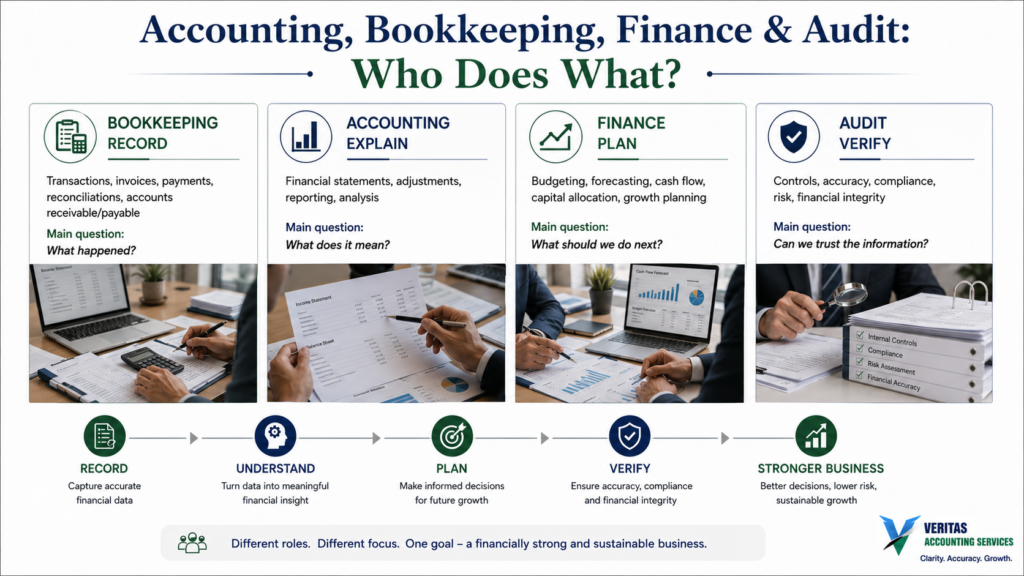
Accounting, bookkeeping, finance, and audit form the core of a financially well-managed business. When these four functions work together, they provide accurate information, better control, compliance, and a stronger foundation for sustainable growth.
These functions are related, but they are not the same. Each has a specific purpose, and understanding how they work together can help business owners, CFOs, and finance leaders make better decisions.
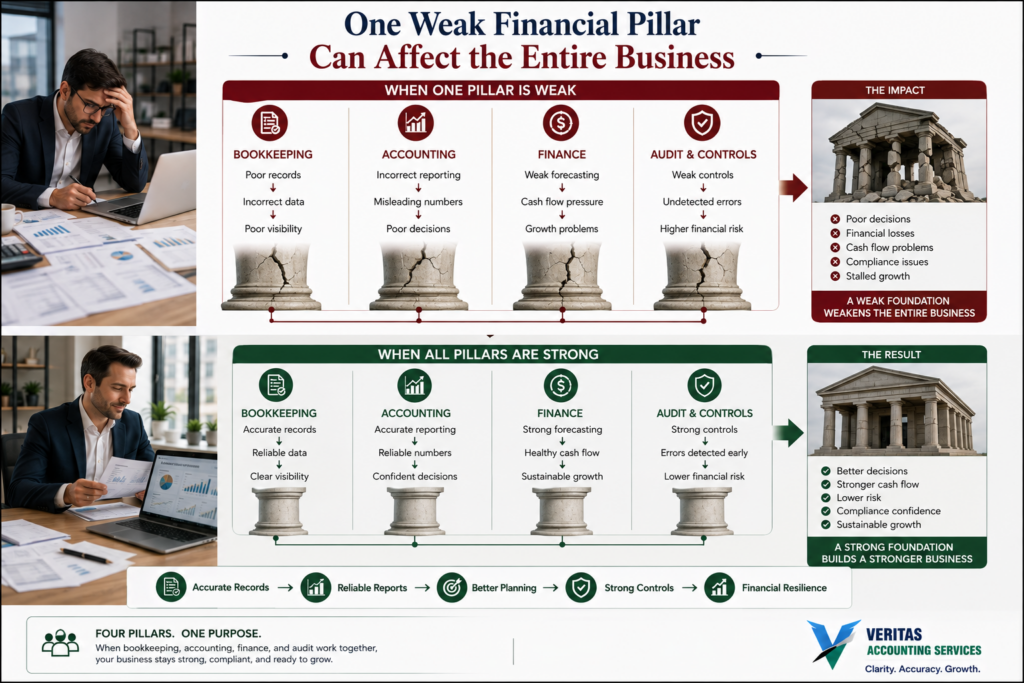
When one area is neglected, businesses can face inaccurate reporting, cash flow problems, compliance risks, and costly financial surprises.
Pillar 1: Bookkeeping — Building the Financial Foundation
Bookkeeping is the starting point of the financial process. It focuses on systematically recording the company’s day-to-day financial transactions.
This includes:
Sales and revenue
Vendor payments
Payroll expenses
Bank reconciliations
Accounts receivable
Accounts payable
Credit card transactions
If the underlying records are inaccurate, every report built from those records can become unreliable.
Why Bookkeeping Matters
Good bookkeeping provides:
Better visibility into cash flow
Accurate bank and credit card reconciliations
Proper expense classification
Reliable financial information
Better preparation for tax and financial reporting
Poor bookkeeping can result in incorrect financial statements, missed deductions, cash flow uncertainty, and compliance problems.
For a growing business, organized bookkeeping also creates a financial structure that can scale with the company.
Bookkeeping is not primarily about strategy. It creates the reliable financial foundation that allows strategy to work.
Pillar 2: Accounting — Turning Transactions Into Understanding
Bookkeeping records financial activity. Accounting takes that information and turns it into meaningful financial information.
Accounting may involve:
Preparing financial statements
Recording accrual adjustments
Revenue recognition
Expense matching
Asset depreciation
Financial analysis
Tax and reporting alignment
A simple way to understand the difference is:
Bookkeeping records what happened.
Accounting helps explain what it means.
Why Accounting Matters
Strong accounting helps businesses maintain:
Accurate profit and loss statements
Reliable balance sheets
Consistent financial reporting
Better tax positioning
More informed business decisions
Depending on the business and reporting requirements, accounting may also involve applying appropriate accounting standards and reporting frameworks.
Without proper accounting oversight, businesses can make decisions based on misleading financial information.
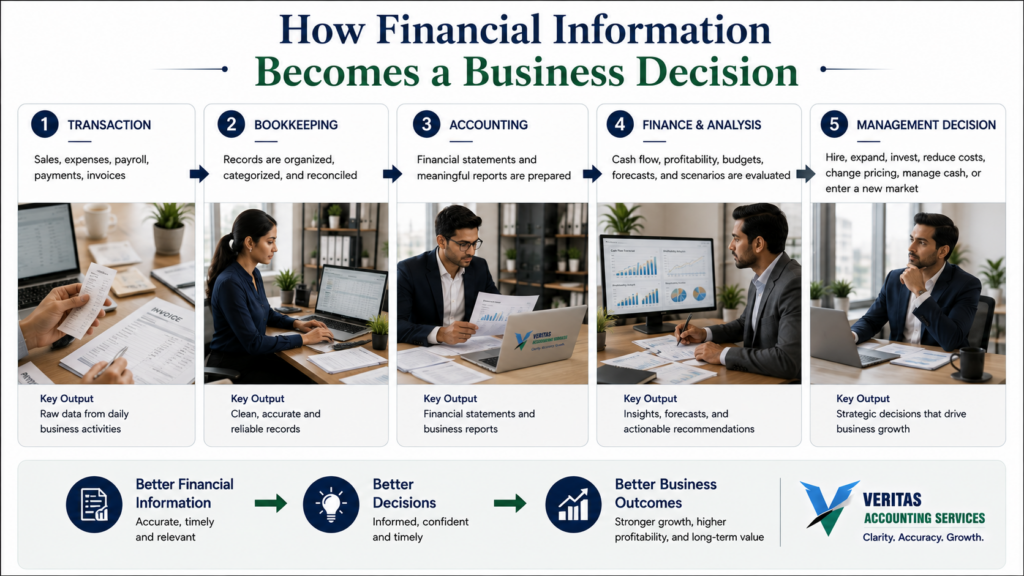
Accounting therefore acts as a bridge between daily business activity and management decision-making.
Pillar 3: Finance — Turning Information Into Action
Finance looks beyond historical transactions.
While bookkeeping and accounting primarily help explain what has already happened, finance focuses heavily on planning for what comes next.
Core finance activities can include:
Budgeting
Financial forecasting
Cash flow planning
Capital allocation
Debt management
Risk assessment
Scenario analysis
Investment decisions
Finance helps answer important questions such as:
Can the business afford to expand?
How much working capital is required?
Should profits be reinvested?
Should debt be reduced?
What happens if revenue declines?
What level of sales is required to reach break-even?
Why Financial Planning Matters
A business can show a profit and still experience serious cash flow problems.
For example, a company may have strong sales but have too much money tied up in receivables or inventory.
Financial planning helps management understand these situations before they become critical.
Good finance management helps businesses allocate resources wisely, prepare for uncertainty, and make more informed growth decisions.
Pillar 4: Audit — Strengthening Trust and Control
Audit provides an additional layer of review and assurance.
Depending on the type of engagement, auditing can examine areas such as:
Financial statement reliability
Internal controls
Fraud risk
Regulatory compliance
Operational processes
Financial accuracy
Audits may be performed internally or by independent external professionals, depending on the organization’s requirements and objectives.
Why Audit Matters
A strong audit or review process can help:
Identify errors
Highlight control weaknesses
Reduce fraud exposure
Improve financial reporting
Strengthen stakeholder confidence
Investors, lenders, regulators, and business partners may rely on credible financial information when making decisions.
Even businesses that are not legally required to undergo an audit can benefit from periodic internal reviews.
Audit is not simply about finding mistakes.
It is about creating discipline, accountability, and confidence in the financial information used by the business.
How the Four Pillars Work Together
These four functions are most effective when they operate as one connected financial system.
Bookkeeping → Accurate financial records
Accounting → Reliable financial reporting
Finance → Planning and strategic decisions
Audit → Review, control, and confidence
Consider what happens when one area is weak.
Poor bookkeeping can lead to inaccurate accounting.
Inaccurate accounting can produce unreliable financial reports.
Unreliable reports can lead to poor financial decisions.
Weak controls can increase the risk of errors or fraud.
The four pillars therefore support one another.
Financial strength is not created by one department or one professional. It comes from the quality of the entire financial system.
Common Misunderstandings About Financial Functions
1. Bookkeeping and Accounting Are the Same
They are connected, but they serve different purposes.
Bookkeeping focuses on recording transactions, while accounting focuses on organizing, interpreting, and reporting financial information.
2. Finance Is Only Important for Large Companies
Every business makes financial decisions.
Even a small business needs to think about cash flow, budgets, pricing, expenses, investments, and future growth.
3. Audit Is Only Necessary When Required
Mandatory audits are only one reason businesses use audit procedures.
Internal reviews can also help identify weaknesses, improve controls, and reduce financial risk.
4. Profit Automatically Means Financial Success
Profit is important, but it is only one part of financial health.
Cash flow, debt, working capital, compliance, controls, and financial planning also matter.
What Happens When a Pillar Is Neglected?
Each financial function protects the business from different risks.
Weak Bookkeeping Can Lead To:
Incorrect financial records
Missed transactions
Poor reconciliations
Tax reporting problems
Limited cash flow visibility
Weak Accounting Can Lead To:
Misleading financial statements
Incorrect financial analysis
Reporting problems
Poor management decisions
Weak Finance Can Lead To:
Cash shortages
Poor capital allocation
Excessive borrowing
Expansion mistakes
Weak financial forecasting
Weak Audit and Controls Can Lead To:
Undetected errors
Fraud exposure
Control weaknesses
Compliance concerns
Reduced stakeholder confidence
A business does not necessarily experience all these problems at once. But weaknesses in one area can eventually affect the others.
The Advantage of Connecting All Four
Modern businesses can bring these functions together using technology and structured processes.
Examples include:
Cloud accounting platforms
Automated bank reconciliation
Financial dashboards
Budgeting systems
Internal control procedures
Regular management reporting
Periodic financial reviews
Technology can make financial processes faster, but technology alone does not guarantee accurate information.
Audit provides an additional layer of review and control.
Together, they create a stronger financial management framework.
When Should a Business Strengthen Its Financial Structure?
Businesses should reassess their financial systems when significant changes occur.
For example:
Revenue is growing rapidly
The company is hiring more employees
New investors become involved
The business enters new markets
International operations begin
Cash flow becomes unpredictable
Debt increases
Regulatory requirements become more complex
Growth without adequate financial infrastructure can create unnecessary risk.
Building stronger systems before problems appear is often easier than trying to repair them after the business has become more complex.
The Leadership Perspective
For founders, CEOs, and business owners, accounting, bookkeeping, finance, and audit should not be viewed only as administrative functions.
They can become strategic assets.
A strong financial structure can help a business:
Understand its true profitability
Improve cash flow management
Make better investment decisions
Prepare for expansion
Improve financial transparency
Reduce unnecessary risk
Strengthen investor and lender confidence
Build scalable processes
The numbers become much more useful when leadership understands what they are saying and knows how to act on them.
Financial Success Requires More Than Profit
Generating revenue is only one part of building a financially successful business.
A stronger business understands:
Where money comes from.
Where money goes.
What is actually profitable.
How much cash is available.
What risks exist.
What needs to change.
Where the business should invest next.
That requires more than transaction recording.
It requires reliable bookkeeping, meaningful accounting, forward-looking finance, and appropriate review and controls.
The Bottom Line
Accounting, bookkeeping, finance, and audit each serve a different purpose, but together they create a stronger financial foundation.
Bookkeeping provides accurate records.
Accounting creates financial clarity.
Finance supports planning and growth.
Audit strengthens control and confidence.
Businesses that invest in these four areas are better positioned to understand their financial position, manage risk, and make informed decisions.
Financial success is not simply about making money.
It is about understanding, managing, protecting, and strategically using that money.
And that starts with building the right financial foundation.
Frequently Asked Questions
What is the difference between bookkeeping and accounting?
Bookkeeping focuses primarily on recording financial transactions, while accounting organizes, analyzes, interprets, and reports that financial information.
Why is finance important for a small business?
Finance helps businesses plan cash flow, manage resources, evaluate investments, prepare budgets, and make decisions about future growth.
Does every business need an audit?
Not every business is legally required to undergo an audit. However, internal reviews and appropriate control procedures can still provide valuable benefits.
Can a business be profitable but have cash flow problems?
Yes. Profit and cash flow are different measures. A profitable business can experience cash shortages because of receivables, inventory, debt payments, or other cash requirements.
Why should these four functions work together?
Bookkeeping provides the underlying records, accounting turns them into useful financial information, finance uses that information for planning, and audit or review processes help verify accuracy and strengthen controls.
Getting new customers is important, but it is not the only way to grow a business.
Many companies spend heavily on advertising, lead generation, sales campaigns, and promotions while overlooking an opportunity that is already in front of them: their existing customers.
These customers already know your business. They have experienced your product or service and have already made the decision to trust you.
That makes existing customers one of the most practical opportunities for increasing revenue without constantly increasing acquisition spending.
The goal is not to sell something to every customer at every opportunity. Instead, understand what customers actually need and find additional ways to help them.
When businesses approach their customer relationships this way, revenue growth can become more sustainable.
Why Existing Customers Matter
A new customer requires marketing, sales conversations, follow-ups, and often a significant acquisition cost.
Existing customers are different.
They already have a relationship with your business and understand at least some of the value you provide.
They may already know:
Your products
Your service quality
Your pricing
Your communication style
Your expertise
Your customer support
This creates opportunities for repeat purchases, upgrades, complementary services, renewals, and referrals.
For many businesses, existing customers can become an important part of a sustainable revenue strategy.
Stop Thinking About One Customer as One Sale
One of the biggest mistakes businesses make is treating a customer relationship as a single transaction.
A customer may purchase one product today but have several other needs tomorrow.
For example:
A bookkeeping client may later need payroll.
A website client may need maintenance.
A software customer may need additional users.
A business using tax preparation services may later need financial planning.
The important question is not:
“What else can I sell?”
Instead, ask:
“What other problems can I solve for this customer?”
That small change in thinking can completely change your approach to growth.
Your existing customers should be viewed as ongoing relationships rather than completed transactions.
Understand What Your Customers Need
Before offering additional products or services, understand your customers better.
Review:
What they currently purchase
What problems they originally wanted to solve
What questions they regularly ask
What challenges they are currently facing
What services they purchase elsewhere
What they may need as their business grows
Your customer conversations can be particularly valuable.
A customer may mention a problem casually during a meeting that reveals an opportunity for your business to help.
Listen carefully.
Sometimes the best opportunities with existing customers are hidden inside ordinary conversations.
Use Cross-Selling
Cross-selling means offering something that naturally complements what the customer already purchased.
For example:
A customer purchasing accounting software may need bookkeeping support.
A customer buying equipment may need maintenance.
A website customer may need hosting or ongoing support.
A bookkeeping client may need payroll services.
The key is relevance.
A cross-sell should make the customer’s life easier or solve another genuine problem.
If the additional product has no connection to the customer’s needs, it will feel like an unnecessary sales pitch.
The strongest cross-selling opportunities come from understanding what existing customers are already trying to accomplish.
Use Upselling Carefully
Upselling means offering a higher-value version of an existing product or service.
Examples include:
Basic package → Premium package
Standard support → Priority support
Monthly service → Full-service package
Basic product → Advanced product
Upselling works best when the customer receives a clear benefit from upgrading.
Don’t simply encourage customers to spend more.
Explain what additional value they receive and why the upgrade may be useful for their situation.
When handled properly, upselling can increase the value of existing customers while improving the service they receive.
Create Recurring Revenue
Another way to increase revenue is to identify services customers genuinely need on an ongoing basis.
Depending on the business, this could include:
Monthly subscriptions
Maintenance plans
Support packages
Retainers
Memberships
Annual contracts
Regular consulting
Monitoring services
For example, a business that provides a one-time accounting cleanup could offer ongoing bookkeeping afterward.
A website developer could offer monthly maintenance.
A consultant could provide an ongoing advisory package.
The objective is not to force customers into recurring contracts.
It is to identify genuine recurring needs and create a convenient solution.
Recurring services can also make revenue more predictable while increasing the long-term value of existing customers.
Build Better Packages
Customers don’t always know which individual services they need.
Packages can make the buying decision easier.
For example:
Basic
Core service for customers with simple requirements.
Growth
Core service plus additional support.
Premium
Core service plus strategic advice and priority support.
Packages can help customers understand the difference between service levels while giving the business more opportunities to serve different needs.
They can also make it easier for existing customers to move into a broader relationship with your business.
Look at Customer Data
Your customer data can reveal opportunities you may not notice during daily operations.
Review:
Purchase history
Invoice history
Service usage
Renewal dates
Support requests
Customer feedback
Previous conversations
Look for patterns.
Suppose customers who purchase one service frequently purchase another six months later.
That could become a natural cross-selling opportunity.
If customers regularly ask for a service you don’t currently provide, that could also reveal a potential new offering.
Your customer data can tell you where opportunities already exist.
For existing customers, purchase history can be especially useful because it shows what they have already trusted your business to provide.
Timing Matters
Even a useful offer can fail if it reaches the customer at the wrong time.
Think about when customers naturally need additional support.
For example:
Annual renewals
Business expansion
Seasonal demand
Equipment maintenance
Tax deadlines
Contract renewals
Product upgrades
Create a simple customer calendar around these events.
Instead of sending random promotional messages, contact customers when the offer is actually relevant.
This makes the conversation more useful and less sales-focused.
Timing is particularly important when communicating with existing customers because you already have information about their previous purchases and interactions.
Ask Better Questions
Good questions can uncover opportunities without making the conversation feel like a sales call.
Instead of asking:
“Would you like to buy another service?”
ask:
What is currently taking the most time?
What is your biggest business challenge right now?
What are you planning to improve this year?
Is there anything you are still handling manually?
Are you using another provider for related services?
What would make our service more useful?
The answers can reveal problems your business is capable of solving.
Listening is often more effective than immediately presenting another offer.
This approach also helps existing customers feel that your business is interested in their success rather than simply trying to increase their spending.
Build a Customer Review Process
Don’t wait for customers to ask for additional services.
Create a regular review process.
For example, every quarter, review:
Current services
Customer satisfaction
Recent concerns
Upcoming needs
Possible upgrades
Related services
Renewal opportunities
This turns customer growth into a process rather than something that happens by chance.
It can also help identify unhappy customers before they decide to leave.
A regular review gives you a structured opportunity to understand existing customers and identify where additional value can be created.
Retention Comes First
Increasing revenue from existing customers is difficult if those customers don’t stay.
Retention should therefore be part of the strategy.
Focus on:
Consistent service
Clear communication
Fast problem-solving
Realistic expectations
Regular feedback
Customer appreciation
A customer who stays for five years has far more potential value than one who leaves after the first purchase.
Retention protects the revenue you’ve already worked to generate.
It also gives your business more time to identify additional ways to serve existing customers.
Turn Happy Customers Into Referrals
Your existing customers can also help you find new business.
When a customer has had a positive experience, ask whether they know someone who could benefit from your service.
A simple referral process can generate new opportunities without relying entirely on paid advertising.
The most important part is timing.
Ask after delivering meaningful value rather than immediately after a transaction.
A satisfied customer is more likely to recommend a business they genuinely trust.
Referrals can therefore create a valuable cycle:
Good service → Happy customer → Referral → New customer
Personalize Your Offers
Not every customer needs the same thing.
Avoid sending the same promotion to everyone.
Instead, group customers based on:
Industry
Purchase history
Company size
Service usage
Customer age
Business stage
Previous interactions
For example, a new customer may need onboarding support, while a long-term customer may benefit from an upgrade or additional service.
Personalization makes offers more relevant.
It also shows customers that your business understands their situation.
The more you understand your existing customers, the easier it becomes to present relevant solutions rather than generic promotions.
Don’t Turn Every Interaction Into a Sales Pitch
There is an important difference between expanding a relationship and constantly trying to sell.
If every email, meeting, and phone call contains another offer, customers may begin to feel that the relationship is purely transactional.
Sometimes the best thing you can say is:
“You don’t need this right now.”
That honesty can strengthen trust.
When customers believe your recommendations are based on their needs, they are more likely to listen when you make a genuine suggestion.
Trust is especially valuable with existing customers because long-term relationships can produce more value than individual transactions.
Track More Than Customer Count
A growing customer count does not automatically mean a growing business.
Track metrics such as:
Average revenue per customer
Repeat purchase rate
Customer lifetime value
Retention rate
Renewal rate
Upsell revenue
Cross-sell revenue
Referral revenue
These numbers show whether your customer relationships are becoming more valuable over time.
A business with fewer customers but strong retention and high customer value can sometimes be healthier than a business constantly chasing new leads.
When reviewing performance, separate revenue from new customers from revenue generated by existing customers.
That gives management a clearer picture of where growth is actually coming from.
A Simple Growth Framework
You don’t need dozens of new products to increase customer value.
Start with a simple process.
Step 1: Understand
Identify what customers currently purchase.
Step 2: Listen
Find out what additional problems they are experiencing.
Step 3: Identify
Look for related products or services that can solve those problems.
Step 4: Create
Develop simple packages, upgrades, subscriptions, or complementary services.
Step 5: Offer
Present the right solution at the right time.
Step 6: Measure
Track additional revenue, retention, satisfaction, and repeat purchases.
Step 7: Improve
Use customer feedback to refine the offering.
This creates a repeatable system for increasing the value of existing customers.
What Businesses Should Avoid
Trying to increase revenue from customers can backfire if done poorly.
Avoid:
Selling Irrelevant Products
An offer should solve a genuine customer problem.
Overcomplicating Pricing
Customers should quickly understand what they’re buying.
Ignoring Service Quality
Additional sales cannot compensate for poor customer experience.
Sending Too Many Promotions
Constant selling can reduce trust.
Assuming Everyone Wants More
Some customers only need your existing service. Respect that.
Measuring Sales Alone
A short-term revenue increase isn’t worthwhile if customer satisfaction and retention decline.
The Goal Is More Customer Value
The strongest businesses don’t simply ask how much they can sell.
They ask how much value they can create.
If a customer has another problem you can solve, there is an opportunity.
If the customer is growing and needs additional support, there is an opportunity.
If the customer is spending too much time on something your business can handle more efficiently, there is an opportunity.
Revenue should be the result of solving those problems.
That approach creates healthier relationships and more sustainable growth.
For existing customers, the best additional sale is often the one that makes their business easier, faster, safer, or more profitable.
Final Thoughts
New customers will always matter.
But businesses don’t need to depend entirely on finding someone new every time they want to increase revenue.
Their existing customer base may already contain significant opportunities.
Understand customer needs. Listen to their challenges. Offer relevant complementary services. Create useful upgrades. Build recurring services where there is a genuine need. Improve retention and encourage referrals.
Most importantly, stop thinking about customers as completed transactions.
Think of them as ongoing relationships.
The next stage of growth may not require hundreds of new customers.
It may simply require creating more value for the customers you already have.
When businesses consistently serve existing customers better, revenue growth can become a natural result of stronger relationships rather than a constant race to find the next buyer.
Frequently Asked Questions
How can businesses increase revenue from existing customers?
Businesses can offer relevant complementary services, upgrades, recurring solutions, renewals, and products that solve additional customer problems.
What is cross-selling?
Cross-selling means offering a related product or service that complements something the customer has already purchased.
What is upselling?
Upselling means offering a higher-value version of an existing product or service when the additional features provide meaningful benefits.
Why is customer retention important?
Customers who stay longer have more opportunities to make repeat purchases, purchase additional services, and refer other customers.
How can customer data identify new opportunities?
Purchase history, service usage, renewal dates, support requests, and feedback can reveal patterns that indicate what customers may need next.
Remote work has changed where people work, but it has not changed what people expect from a good workplace.
Employees still want to feel trusted, supported, recognized, and connected to their team. The challenge is that remote companies cannot depend on office conversations, shared lunches, or quick chats at someone’s desk to create those connections.
That is why building a strong remote company culture requires more than scheduling regular video meetings.
A healthy remote company culture is created through everyday actions: how managers communicate, how employees are recognized, how decisions are made, how new people are welcomed, and how teams stay connected when they work from different locations.
What Is Remote Company Culture?
Remote company culture is the way people communicate, collaborate, make decisions, solve problems, and work together when they are not physically in the same workplace.
It is not simply a remote work policy.
A company’s culture shows up in questions such as:
Can employees ask questions comfortably?
Do managers trust their teams?
Are expectations clear?
Do people feel comfortable sharing ideas?
Is good work recognized?
Can employees easily find the information they need?
Do people understand what the company stands for?
A strong remote company culture makes employees feel like part of a team even when everyone is working from different places.
Remote Company Culture Doesn’t Happen Automatically
One of the biggest mistakes companies make is assuming that culture will naturally develop after hiring a remote team.
It usually doesn’t.
In a traditional office, employees have countless informal interactions throughout the day. They talk before meetings, walk over to a colleague’s desk, have lunch together, or simply exchange a few words while getting coffee.
Remote employees don’t have those same opportunities.
If a company doesn’t intentionally create opportunities for communication and connection, employees can gradually become disconnected from the wider team.
Building remote company culture therefore requires deliberate effort.
Start With Trust
A strong remote company culture starts with trust.
Remote employees don’t need someone constantly checking whether they are online. They need clear expectations and the freedom to complete their work.
Instead of focusing on:
“Are you online?”
managers should focus on:
“Are we on track to achieve the expected result?”
Trust becomes easier when employees clearly understand:
Their responsibilities
Deadlines
Expected outcomes
Communication standards
Availability requirements
Decision-making authority
When expectations are clear, employees can work independently without feeling constantly monitored.
That independence can become one of the biggest advantages of remote work.
Create Clear Communication Rules
Communication is one of the most important parts of remote company culture.
Without clear communication, employees may either receive too little information or become overwhelmed by messages and meetings.
Neither situation is productive.
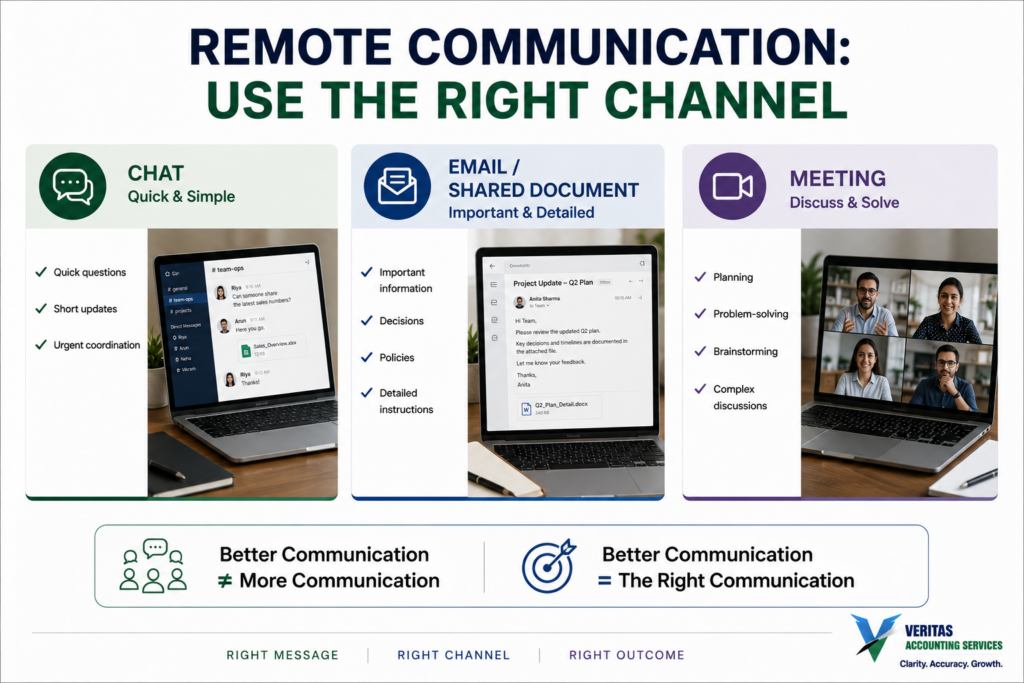
Create simple rules for different types of communication.
Use Chat For:
Quick questions
Short updates
Urgent matters
Simple coordination
Use Email or Shared Documents For:
Important information
Formal communication
Decisions
Detailed instructions
Use Meetings For:
Discussions
Planning
Problem-solving
Topics that require real-time collaboration
The objective isn’t more communication.
The objective is better communication.
Don’t Make Every Meeting Mandatory
Video calls can help strengthen remote company culture, but too many meetings can have the opposite effect.
Employees can spend much of their day moving from one call to another while struggling to complete their actual work.
Before scheduling a meeting, ask:
“Does this really need to be a meeting?”
If not, consider using:
A written update
A shared document
A project management comment
A recorded video
A quick message
When meetings are necessary, give them a clear purpose and agenda.
A good remote company culture gives employees both opportunities for connection and enough uninterrupted time to work.
Create Space for Informal Conversations
Not every interaction should be about deadlines, projects, and performance.
People also need opportunities to talk about things that aren’t directly related to work.
Companies can create informal opportunities through:
Virtual coffee chats
Team celebrations
Informal group discussions
Birthday messages
Interest-based chat groups
Short team catch-ups
Online social activities
These activities should not feel forced.
The purpose is simply to give people opportunities to know the individuals behind the job titles.
Small conversations can make a remote company culture feel much more human.
Make New Employees Feel Included
Joining a remote company can feel very different from joining an office.
A new employee cannot simply look around and figure out who does what.
That makes onboarding especially important.
New employees should understand:
Who their manager is
Who they can approach with questions
How communication works
Which meetings they should attend
Where important information is stored
What their first priorities are
How their performance will be evaluated
Assigning an experienced team member as a point of contact can also help.
It gives new employees someone they can approach with smaller questions without feeling uncomfortable.
A thoughtful onboarding process is one of the first building blocks of a strong remote company culture.
Recognize Good Work
When employees work remotely, their contributions can sometimes become less visible.
A person who consistently solves problems or helps customers may not receive the same recognition they would naturally receive in an office.
Managers should therefore make recognition intentional.
For example:
Mention achievements during team meetings
Share wins in the team communication channel
Thank employees for solving difficult problems
Celebrate milestones
Recognize people who help colleagues
Recognition doesn’t always need to involve money.
A genuine and specific thank-you can have a meaningful impact.
Instead of saying:
“Great job.”
say:
“Thank you for identifying that reporting issue before it affected the client. That saved the team a lot of time.”
Specific recognition makes people feel seen.
Give Employees a Voice
A healthy remote company culture should not be created entirely from the top down.
Employees should have opportunities to share:
Ideas
Concerns
Suggestions
Process improvements
Feedback
Managers can use regular one-on-one meetings, surveys, or team discussions to collect feedback.
But asking for feedback is only useful when the company is willing to act on it.
If employees repeatedly share suggestions and never see any change, they may eventually stop speaking up.
Listening matters.
Acting on useful feedback matters even more.
Document How the Company Works
Remote teams depend heavily on shared information.
If important knowledge exists only in someone’s memory, private messages, or individual files, employees may struggle to find what they need.
Create a central place for important information such as:
SOPs
Policies
Training materials
Project information
Client procedures
Team responsibilities
Frequently asked questions
This becomes even more important as the company grows.
Good documentation supports remote company culture because employees don’t have to depend on one particular person for every answer.
It also protects valuable knowledge when employees leave.
Focus on Outcomes, Not Online Activity
One common mistake in remote management is confusing activity with productivity.
An employee can be online all day without producing meaningful results.
Another employee may complete important work efficiently while spending less time visibly online.
Managers should therefore focus on outcomes.
Set clear goals and measure whether expected work is being completed.
Ask:
What needs to be completed?
Who owns it?
When is it due?
What does success look like?
Are there obstacles?
What support is required?
This creates accountability without unnecessary micromanagement.
A remote company culture becomes healthier when employees know they are trusted to deliver results.
Build Culture Around Shared Values
Company values should be more than words on a website.
They should influence everyday decisions.
If a company says it values accountability, managers should take responsibility when something goes wrong.
If it values customer service, employees should see that reflected in decisions.
If it values learning, employees should receive opportunities to improve their skills.
If it values transparency, important information should not be unnecessarily hidden.
This is how remote company culture becomes real.
Values become meaningful when employees see them in action.
Don’t Forget the Human Side
Remote work can be flexible and productive, but it can also become isolating.
Some employees may spend most of their working day alone.
Managers should therefore create an environment where employees feel comfortable saying:
“I’m having trouble with this.”
without worrying that asking for help will be viewed negatively.
Managers should also pay attention to workload, communication problems, and signs of disengagement.
This does not mean constantly monitoring employees.
It means creating an environment where people know support is available when they need it.
Give Teams Opportunities to Meet
Remote doesn’t necessarily have to mean never meeting in person.
When practical, companies can organize:
Annual team events
Planning sessions
Training days
Department meetings
Company retreats
These gatherings aren’t essential for every remote business, but when possible, meeting face-to-face can strengthen relationships.
The purpose shouldn’t be to recreate the office.
It should be to create meaningful connections that make future remote collaboration easier.
Measure Your Culture
Company culture can seem difficult to measure, but employee feedback can provide useful signals.
Ask employees questions such as:
Do you understand what is expected from you?
Do you feel comfortable asking for help?
Do you feel connected to your team?
Do you receive useful feedback?
Do you feel recognized?
Do you have the information needed to do your job?
Do you trust your manager?
What is one thing we could improve?
You don’t need a complicated survey.
A few honest questions can reveal problems before they become bigger issues.
Regular feedback also shows employees that their experience matters.
Common Remote Culture Mistakes
Even companies with good intentions can make mistakes when building remote company culture.
Too Many Meetings
More meetings don’t automatically create stronger relationships.
Constant Monitoring
Tracking every online activity can reduce trust and increase stress.
Forced Social Activities
Not everyone enjoys virtual games or informal calls. Give employees choices.
Poor Documentation
If information is scattered across emails, chats, and individual files, employees will struggle to find answers.
Inconsistent Communication
If some employees receive important information while others don’t, teams can quickly become disconnected.
Ignoring Remote Employees
Remote employees should not feel like outsiders simply because they aren’t physically present.
A Simple Framework for Remote Company Culture
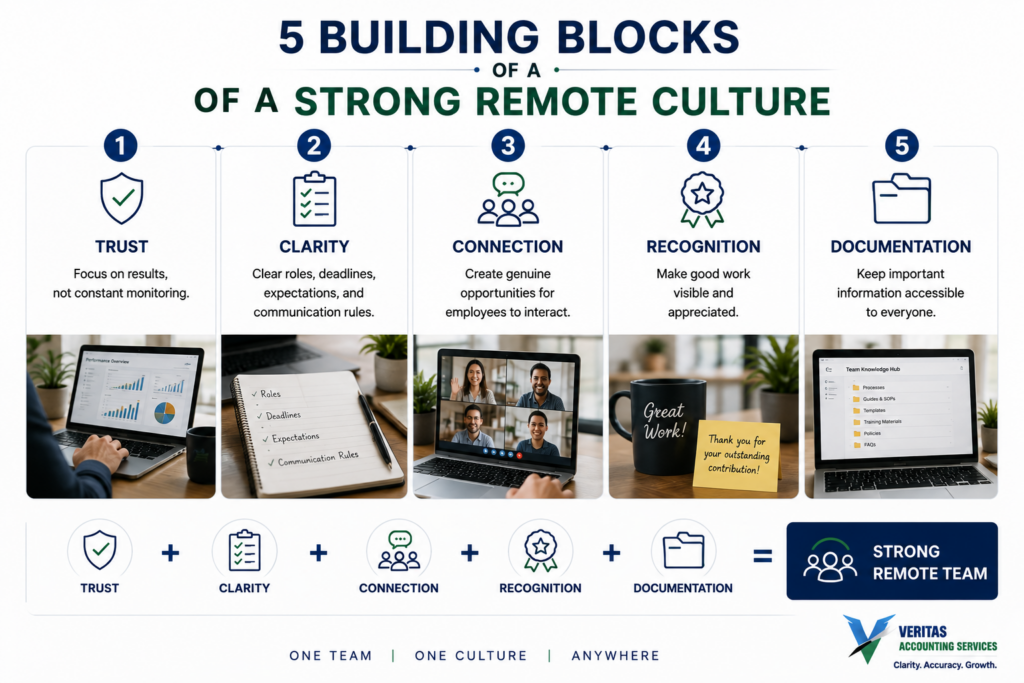
If you’re building a remote team, start with five areas.
1. Trust
Give employees responsibility and judge performance based on results.
2. Clarity
Make roles, deadlines, expectations, and communication standards clear.
3. Connection
Create genuine opportunities for employees to interact beyond daily tasks.
4. Recognition
Make good work visible and appreciated.
5. Documentation
Make important information easy for everyone to find.
These five areas provide a practical foundation for remote company culture.
Culture Is Built Every Day
There is no single activity that creates a great remote workplace.
Culture is built through hundreds of small decisions.
How does a manager respond to a mistake?
How quickly does a new employee receive help?
Does someone’s contribution get recognized?
Do employees feel trusted?
Can people ask questions without hesitation?
Can everyone access important information?
These everyday experiences become the culture.
Technology can make remote work possible, but technology alone cannot create connection.
Video calls, chat platforms, project management software, and shared documents are simply tools.
The culture comes from how people use them.
Final Thoughts
Building a remote company culture isn’t about trying to recreate an office through video calls.
It is about creating an environment where people can communicate clearly, work independently, collaborate effectively, and feel connected to the organization.
Trust your employees.
Set clear expectations.
Document important processes.
Create space for human connection.
Recognize good work.
Listen to your team.
And make culture part of everyday management rather than treating it as a once-a-year initiative.
A strong remote company culture doesn’t happen because everyone attends the same Zoom meeting.
It happens when employees feel that they are part of something, even when they are working from different places.
That is the real goal of building remote company culture.
As a business grows, work becomes harder to manage consistently. A small team can rely on verbal instructions, but a growing team needs documented processes.
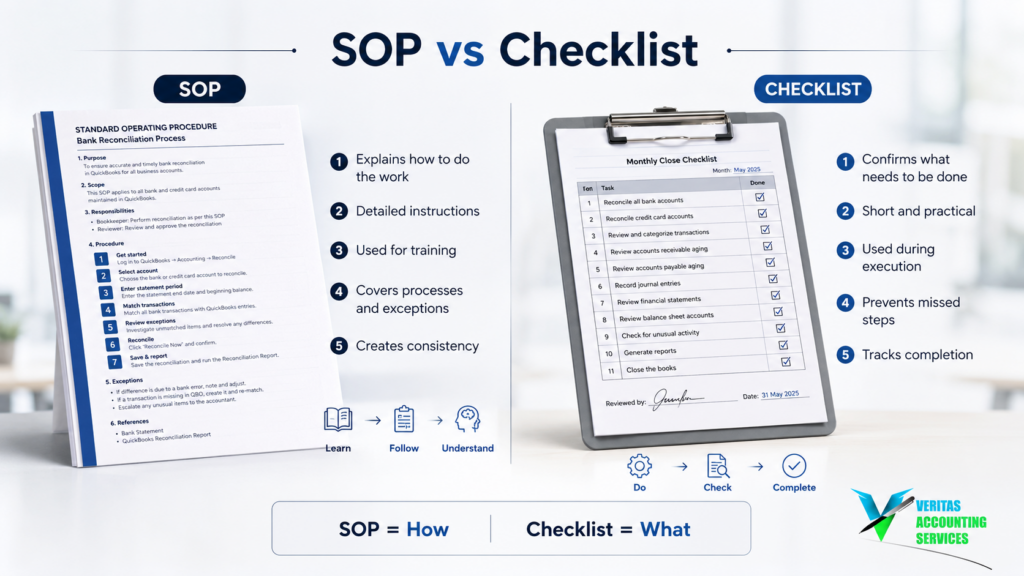
SOP vs Checklist is a useful distinction because the two tools solve different problems. An SOP explains how work should be performed. A checklist confirms that the required work was completed.
Understanding SOP vs Checklist can help your business reduce errors, train employees, and create repeatable processes.
What Is an SOP?
SOP stands for Standard Operating Procedure.
An SOP is a documented set of instructions explaining how a particular task or process should be performed.
A typical SOP may explain:
What needs to be done
Why the process is important
Who is responsible
When it should happen
What tools are required
What steps should be followed
What to do when something goes wrong
Who reviews the completed work
For example, a bookkeeping company might have an SOP for month-end accounting. It could explain how to review transactions, reconcile accounts, record adjustments, review financial statements, and complete the month-end closing process.
An SOP turns individual knowledge into a repeatable company process.
What Is a Checklist?
A checklist is a short list of actions that need to be completed.
A month-end checklist might include:
Bank accounts reconciled
Credit cards reconciled
Accounts receivable reviewed
Accounts payable reviewed
Payroll recorded
Financial statements reviewed
Reports completed
A checklist does not normally explain every detail. It reminds the employee what must be done.
SOP vs Checklist: The Main Difference
The simplest way to understand SOP vs Checklist is to think about two questions.
An SOP answers:
“How should I do this?”
A checklist answers:
“What do I need to complete?”
For example, a client onboarding SOP could explain how to collect information, create the client profile, obtain software access, assign responsibilities, and complete the first review.
The related checklist could confirm:
Agreement signed
Client information received
Documents received
Software access provided
Opening balances reviewed
First meeting completed
That is the core SOP vs Checklist difference.
SOP vs Checklist: Quick Comparison
SOP
Checklist
Explains how to perform a process
Confirms tasks are completed
Provides detailed instructions
Provides reminders
Useful for training
Useful for execution
Helps standardize procedures
Helps prevent missed steps
Can explain exceptions
Usually follows defined steps
Best for complex work
Best for repetitive work
The right choice depends on the process.
When Should You Use an SOP?
An SOP is useful when a process is complex, important, or difficult to learn.
Create one when:
A process has several steps
New employees need training
Several people perform the same task
Important decisions are involved
The process has exceptions
Errors could be costly
Only one employee knows how to perform it
Payroll, client onboarding, month-end accounting, and quality control are common examples.
In these situations, the detailed procedure provides the knowledge employees need.
When Is a Checklist Enough?
A checklist may be enough when employees already understand the process.
An office closing checklist, for example, might say:
Lock the entrance
Shut down equipment
Check meeting rooms
Secure documents
Check windows
Set the security system
There is little value in creating a long document for a simple task.
This is an important point in SOP vs Checklist: documentation should match the complexity of the work.
SOP vs Checklist in Accounting
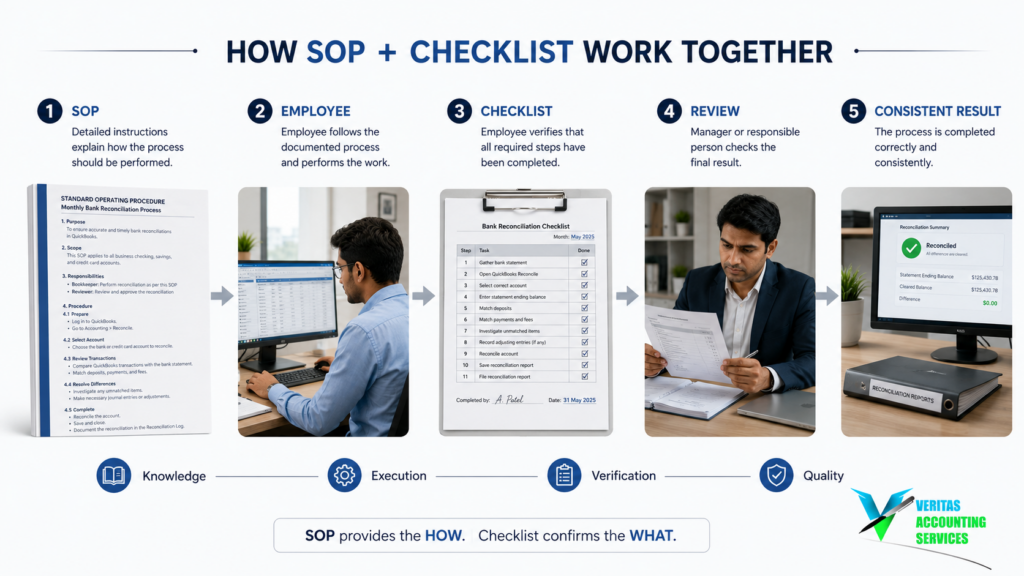
Accounting is a good example of how the two tools can work together.
A month-end SOP could explain how to reconcile bank accounts, review credit cards, check receivables and payables, record adjustments, and review financial statements.
The checklist could then confirm:
Bank reconciliation completed
Credit card reconciliation completed
Receivables reviewed
Payables reviewed
Adjustments recorded
Financial statements reviewed
Reports finalized
The SOP explains the method. The checklist confirms completion.
This practical combination makes the SOP vs Checklist concept easier to apply in daily operations.
SOP vs Checklist for Employee Training
If the main goal is training, an SOP is usually more useful.
A checklist can tell a new employee what tasks exist, but it may not explain how the company expects those tasks to be performed.
For example, “Complete bank reconciliation” is a checklist item. An SOP can explain where to obtain the statement, how to investigate differences, how to handle outstanding items, and who reviews the work.
Once the employee understands the procedure, the checklist can support regular execution.
SOP vs Checklist for Reducing Errors
Both tools reduce errors, but they address different causes.
An SOP helps prevent mistakes caused by not knowing the correct process.
A checklist helps prevent mistakes caused by forgetting a required step.
If an employee does not know how to process a refund, better instructions are needed. If an experienced employee knows the process but sometimes forgets to document approval, a checklist may help.
This distinction is one of the most useful parts of SOP vs Checklist.
Why Growing Businesses Need SOPs
As a company grows, founders cannot personally explain every process to every employee.
With five employees, answering questions may be manageable. With 50 employees, it becomes inefficient.
SOPs document important knowledge so employees can refer to the same process instead of repeatedly asking the founder.
They can improve training, consistency, accountability, and independence.
Why Growing Businesses Need Checklists
More employees also mean more tasks, deadlines, and opportunities to miss small steps.
A checklist provides a simple control for repetitive work such as:
Month-end closing
Payroll
Client onboarding
Employee onboarding
Payment processing
Bank reconciliation
Quality control
Employees do not need to reread a long procedure every time they perform a familiar task. A checklist gives them a quick completion check.
When You Need Both
Some processes need both tools.
Consider employee onboarding. The SOP can explain how documents are collected, systems are created, access is approved, and training is completed.
The checklist can confirm:
Employment documents received
Payroll setup completed
Email created
Software access provided
Training scheduled
Manager assigned
The SOP provides instructions. The checklist provides execution control.
This is often the best answer when a business is deciding between SOP vs Checklist for an important recurring process.
Don’t Create an SOP for Everything
More documentation does not automatically mean better processes.
Before creating an SOP, ask:
Does the process require explanation?
Could someone make an expensive mistake without instructions?
Are several decisions involved?
Would a new employee need training?
Do different employees need to follow the same method?
If yes, an SOP may be appropriate.
If the process is simple and already understood, a checklist may be enough.
Don’t Use a Checklist When Employees Need Instructions
The opposite mistake is also common.
A business may create a checklist for a complicated process and expect employees to figure out the details.
For example:
Review payroll
Approve payroll
Process payroll
Record payroll
These items do not explain how the work should be performed.
If the process involves important decisions, financial information, compliance, or multiple systems, an SOP is more appropriate.
A checklist cannot replace proper instructions.
How to Create a Useful SOP
A practical SOP can include:
Purpose
Explain why the process exists.
Owner
Identify who is responsible.
Frequency
Explain when it should happen.
Tools
List the required software and documents.
Procedure
Explain the steps in order.
Exceptions
Explain what to do when something goes wrong.
Review
Identify who checks the completed work.
Keep it practical. Employees should be able to use it without unnecessary detail.
How to Create a Useful Checklist
A good checklist should be short and action-oriented.
For example, a weekly accounts receivable checklist could include:
Review outstanding invoices
Identify overdue accounts
Send payment reminders
Record received payments
Investigate unusual balances
Report significant issues
The employee should be able to understand the required action immediately.
SOP vs Checklist: A Simple Decision
Choose an SOP when the process is complex, employees need training, multiple people perform the task, important decisions are involved, or errors could be costly.
Choose a checklist when the process is simple, employees already understand it, tasks are repetitive, and the main risk is forgetting a step.
Use both when the process is important, recurring, and needs both clear instructions and completion control.
The best SOP vs Checklist choice depends on complexity, risk, and frequency.
Review important SOPs and checklists periodically.
Ask:
Is the process still correct?
Are responsibilities accurate?
Are software instructions current?
Have steps changed?
Have new risks appeared?
Can anything be simplified?
Your documentation should evolve with the business.
SOP vs Checklist: The Best Approach
The goal is not to create more documents. The goal is to make important work repeatable.
An SOP gives employees the knowledge they need. A checklist gives them a practical way to execute that knowledge consistently.
Together, they can help businesses reduce errors, improve training, increase accountability, reduce founder dependency, and improve operational efficiency.
That is why SOP vs Checklist is an important conversation for growing businesses.
Final Thoughts
SOPs and checklists solve different problems.
An SOP answers:
“How should this process be performed?”
A checklist answers:
“Have we completed everything?”
If employees repeatedly ask how something should be done, create an SOP.
If employees know what to do but sometimes forget steps, create a checklist.
If the process is important, repetitive, and requires consistency, use both.
The real value is not the document itself. It is the consistency and independence those tools create.
For a growing business, that can mean fewer mistakes, faster training, better accountability, and less dependence on the founder.
Once you understand SOP vs Checklist, it becomes much easier to decide what each process actually needs.
Frequently Asked Questions
What is the difference between an SOP and a checklist?
An SOP explains how a process should be performed, while a checklist confirms that required tasks have been completed.
Is an SOP better than a checklist?
Not necessarily. An SOP is better for complex processes and training, while a checklist is useful for simple and repetitive tasks.
Can an SOP and checklist be used together?
Yes. Many businesses use an SOP for detailed instructions and a checklist for regular execution.
When should a small business create an SOP?
Create an SOP when a process is important, repeated frequently, difficult to learn, or dependent on one employee’s knowledge.
How long should an SOP be?
There is no fixed length. It should contain enough information for the employee to perform the process correctly without unnecessary detail.
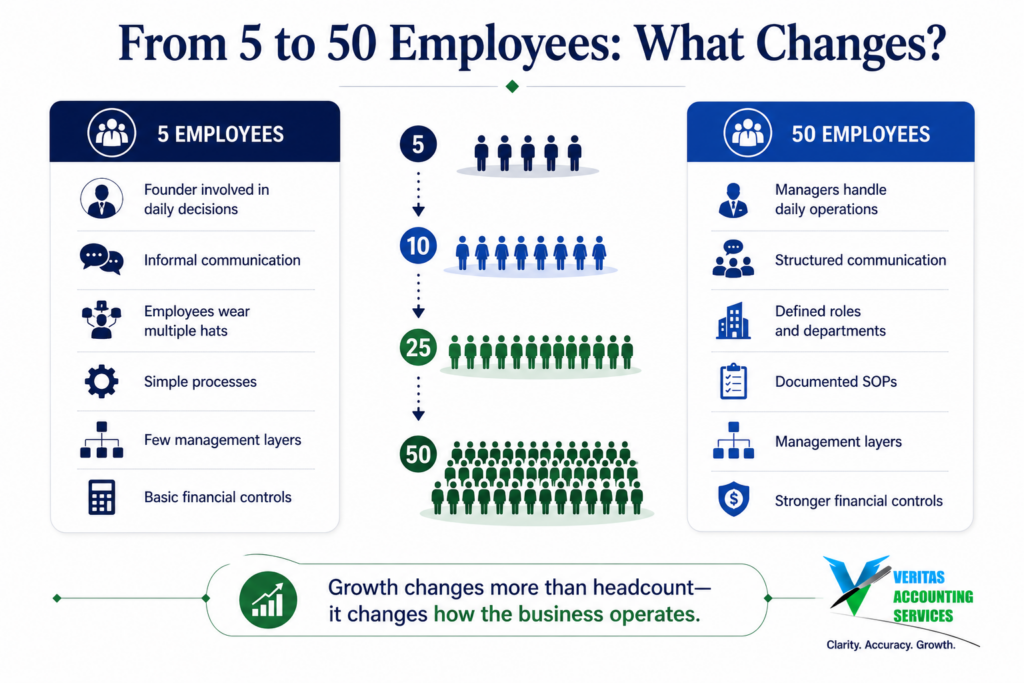
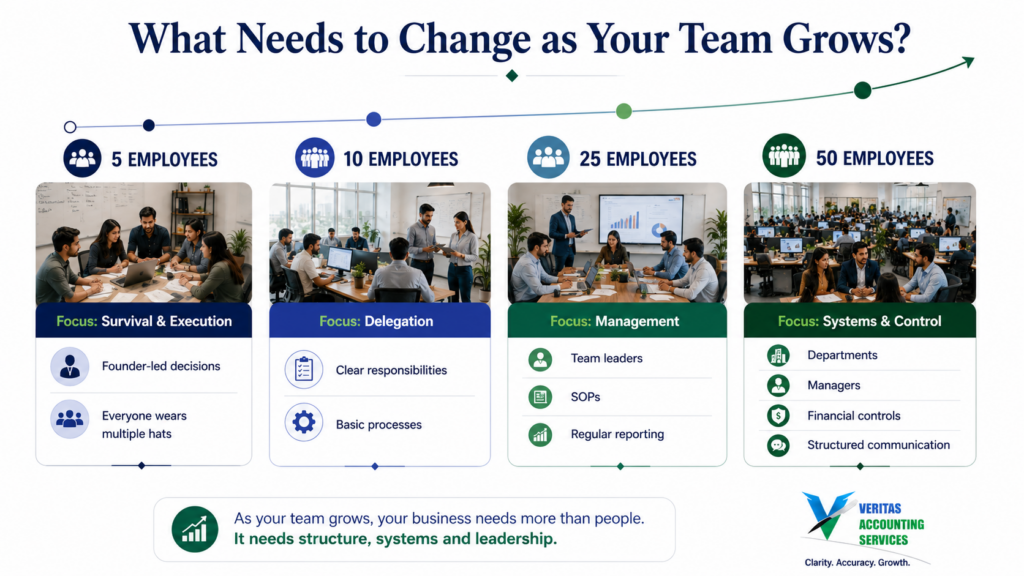
Going from 5 employees to 50 is a major milestone.
It means more customers, more revenue, more responsibilities, and usually more opportunities. But it also changes the way the business needs to operate.
The systems that worked perfectly when you had five people may start creating problems when you have 20. The informal communication that worked with 10 employees may become inefficient at 30. And the founder who could personally approve every decision may become a bottleneck at 50.
This is one of the less obvious challenges of business growth.
Adding employees is relatively straightforward. Building the structure needed to manage those employees effectively is much harder.
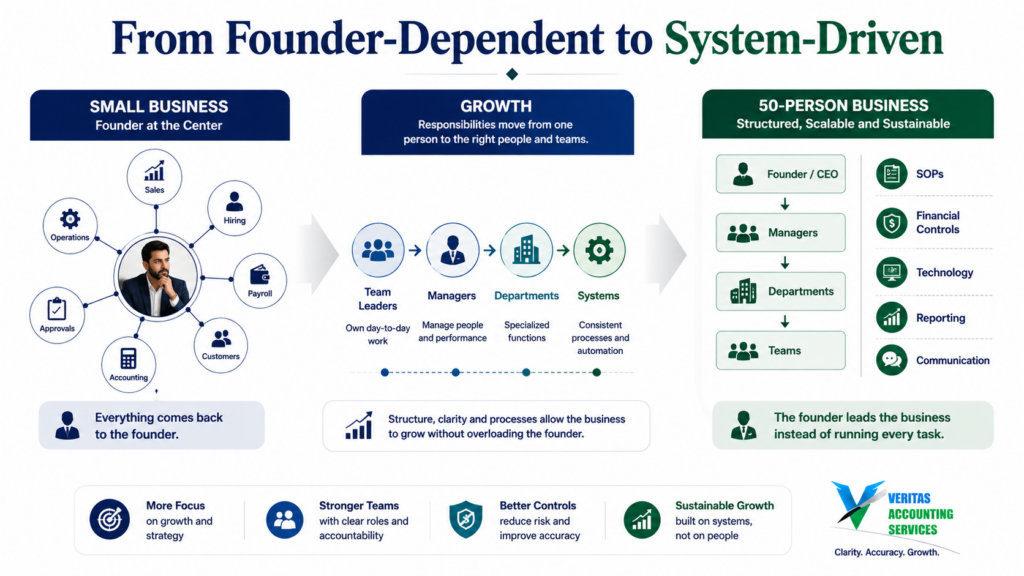
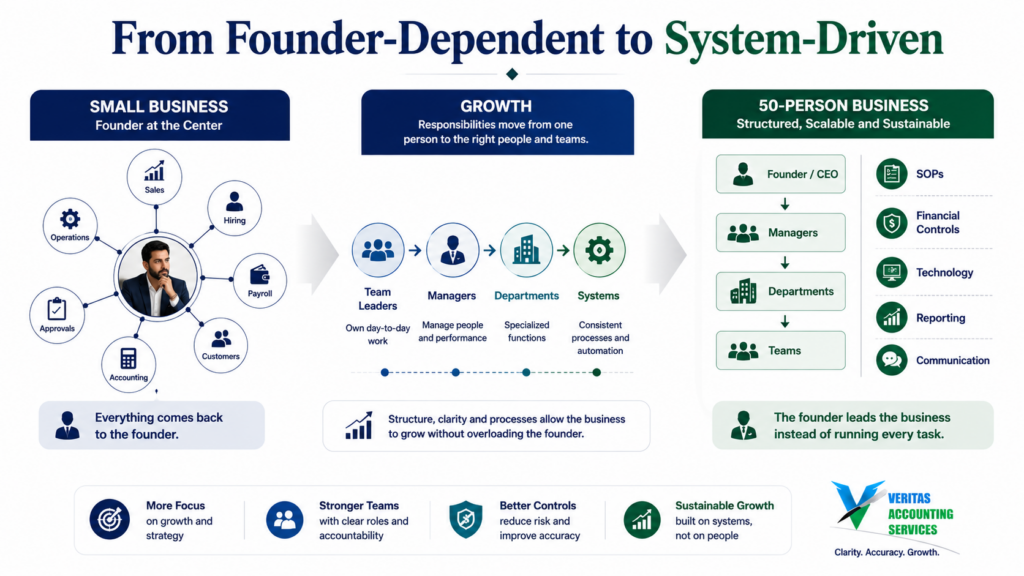
As business growth accelerates, companies need to evolve from founder-led operations toward organized systems, defined responsibilities, reliable financial controls, and management processes that can work without everything going through one person.
The transition from 5 to 50 employees is therefore not simply about hiring 45 additional people.
It is about building a different business.
What Works With 5 Employees May Not Work With 50
When a business has five employees, communication is usually simple.
Everyone knows what everyone else is doing.
The founder may speak directly with every team member.
Questions can be answered quickly.
Approvals can happen informally.
Financial information may exist in a few spreadsheets.
Processes may live in the founder’s head.
That can work at a small scale
But as business growth continues, these informal systems begin to break down.
At 50 employees, there are more people, more decisions, more transactions, more customers, and more opportunities for mistakes.
The business needs structure.
That doesn’t mean creating unnecessary bureaucracy.
It means creating enough structure to allow the business to operate consistently as complexity increases as business growth continues.
1. The Founder Cannot Manage Everything Personally
One of the first major changes is delegation.
With five employees, a founder might personally handle:
Hiring
Customer complaints
Payments
Financial approvals
Sales decisions
Vendor relationships
Employee questions
At 50 employees, this approach becomes difficult to sustain.
If every decision requires the founder’s involvement, growth eventually slows down.
Employees wait for approvals.
Managers cannot move quickly.
The founder spends more time solving small operational issues and less time working on strategy.
Business growth requires founders to move from doing everything to building people and systems that can do things without them.
The goal isn’t to lose control.
The goal is to create appropriate levels of responsibility.
2. Management Layers Become More Important
A five-person business may not need formal management layers.
A 50-person company probably does.
You may need:
Team leaders
Department managers
Operations managers
Finance leadership
HR responsibility
Senior operational roles
This creates a management structure between the founder and individual employees.
The founder should increasingly focus on questions such as:
Where is the company going?
What markets should we enter?
What investments should we make?
What risks should we manage?
Meanwhile, managers can focus on executing those priorities.
Without delegation and management structure, business growth can create a situation where the founder becomes the approval point for almost everything.
That’s not scalable.
3. Informal Processes Need to Become SOPs
When there are five employees, someone can simply explain how something works.
“Just ask me if you have a question.”
At 50 employees, that approach creates inconsistency.
What happens when the person who knows the process leaves?
What happens when a new employee joins?
What happens when the business opens another location?
This is where Standard Operating Procedures become valuable.
Document processes for important activities such as:
Client onboarding
Invoicing
Expense approvals
Purchasing
Payroll
Customer service
Employee onboarding
Bank reconciliations
Month-end closing
Sales processes
Good SOPs don’t need to be complicated.
They simply need to explain what should happen, who is responsible, and what standards need to be followed.
Business growth becomes easier to manage when important knowledge isn’t stored only in people’s heads.
4. Financial Controls Need to Become Stronger
Financial controls that are acceptable for a five-person business may not be appropriate for a 50-person company.
As transaction volume increases, the opportunity for mistakes also increases.
You may now have:
Multiple bank accounts
More credit cards
Larger payroll
More vendors
Higher customer balances
More purchasing activity
Larger expense volumes
More financial approvals
At this stage, businesses should consider controls such as:
Separation of responsibilities
Approval limits
Bank reconciliation procedures
Credit card reviews
Vendor approval processes
Payment authorization
Regular financial reporting
The objective is not to make the business slower.
Good controls should make the business safer while allowing routine decisions to happen efficiently.
5. Payroll Becomes a Bigger Part of Financial Management
Going from five employees to 50 dramatically changes the financial importance of payroll.
Payroll is no longer simply a recurring administrative payment.
It becomes one of the company’s largest operating costs.
Management needs to understand:
Total payroll cost
Benefits
Overtime
Payroll taxes
Hiring costs
Department-level staffing costs
Revenue generated per team or department
This information can help answer important questions.
Is the company hiring faster than revenue is growing?
Which departments are becoming more expensive?
Can the business support additional employees?
Are certain teams understaffed or overstaffed?
As business growth continues, payroll data becomes increasingly important for financial planning. The culture that helped create early business growth should evolve without losing the principles that made the company successful.
6. Financial Reporting Needs to Become More Regular
A small business owner may look at the bank balance and have a reasonable understanding of the company’s financial position.
That becomes much harder as the organization grows.
At 50 employees, management should have regular access to financial reports.
Depending on the business, these may include:
Profit and loss statement
Balance sheet
Cash-flow report
Accounts receivable aging
Accounts payable aging
Budget vs. actual
Department performance
Key performance indicators
The goal is not to create dozens of reports.
The goal is to provide management with the information required to make decisions.
Accurate and timely financial reporting gives leadership a clearer view of whether growth is actually creating profitability.
7. Cash Flow Becomes More Important as the Business Gets Larger
Growth can consume cash.
You may need to hire employees before receiving customer payments.
You may need to purchase inventory before generating sales.
You may extend credit to customers.
You may invest in equipment, software, offices, or additional locations.
This means a profitable business can still experience cash-flow pressure.
As business growth accelerates, cash-flow forecasting becomes increasingly valuable.
Management should understand expected:
Cash Inflows
Customer collections
Financing
Other operating receipts
Cash Outflows
Payroll
Suppliers
Taxes
Loans
Rent
Capital expenditures
Other operating expenses
A forward-looking cash-flow forecast can help management identify potential shortages before they become emergencies.
8. Technology Should Replace Manual Work Where Practical
A five-person business can survive with spreadsheets and manual processes.
A 50-person business may find those same processes increasingly difficult to manage.
This is where technology becomes important.
Depending on the business, systems may be needed for:
Accounting
Payroll
CRM
Project management
Expense management
Inventory
Customer support
Document management
Reporting
The purpose isn’t to buy software simply because the business is growing.
The purpose is to reduce repetitive work, improve accuracy, and give employees access to consistent information.
The right technology can allow a 50-person company to operate more efficiently than a much smaller company relying entirely on manual processes.
9. Communication Needs Structure
With five employees, communication can happen naturally.
People talk across desks.
The founder can call everyone into a quick meeting.
Everyone generally knows what’s happening.
At 50 employees, communication requires more structure.
Consider:
Regular team meetings
Department meetings
Management meetings
Written procedures
Project management tools
Company-wide updates
Clear reporting lines
Employees should know:
Who do I report to?
Who approves my work?
Where do I find information?
Who handles this type of problem?
Clear communication reduces confusion and prevents the founder from becoming the central information hub.
10. Hiring Needs to Become More Strategic
When a company has five employees, one poor hiring decision can still create problems.
At 50 employees, hiring mistakes can become significantly more expensive.
Recruitment should therefore become more structured.
Businesses should define:
Job responsibilities
Required skills
Reporting structure
Performance expectations
Compensation structure
Onboarding process
Training requirements
You should also think about the skills the company will need six or twelve months from now—not only the skills required today.
Business growth creates new roles.
A company that once needed generalists may eventually need specialists in finance, HR, operations, marketing, technology, or compliance.
11. The Founder Needs Better Financial Visibility
As the company grows, the founder should spend less time entering transactions and more time understanding what the numbers are saying.
Important questions may include:
Which departments are profitable?
What is our cash position?
Are margins improving?
How much does each new employee cost?
How quickly are customers paying?
Are operating expenses growing too quickly?
Can we afford another location?
How much cash will expansion require?
This is where accounting moves beyond bookkeeping.
Reliable accounting data becomes a management tool.
Business growth becomes easier to manage when founders have accurate financial information before making major decisions.
12. Your Organizational Structure Must Catch Up With Your Growth
A company with five employees can often operate around personalities.
A company with 50 employees needs roles.
People need to know who is responsible for what.
A simple organizational structure can clarify:
Founder / CEO
↓
Department Heads
↓
Managers / Team Leaders
↓
Employees
The exact structure will vary by company.
The important point is that responsibility should be clear.
When nobody clearly owns a task, problems are often passed between departments.
When too many people own the same task, accountability can disappear.
Clear responsibility supports efficient business growth.
13. Culture Needs to Be Intentional
Culture can happen naturally when a company is small.
As the company grows, culture needs more deliberate attention.
New employees don’t automatically understand how the founders think.
They need to understand:
Company values
Expectations
Communication standards
Customer service principles
Decision-making approach
Performance expectations
This doesn’t mean creating a long list of corporate slogans.
It means making expectations clear and reinforcing them through hiring, onboarding, management, and leadership behavior.
The culture that helped create early business growth should evolve without losing the principles that made the company successful.
The 5-to-50 Transition Is About Systems, Not Just People
It is tempting to think:
“We need more employees because we’re growing.”
But adding employees without improving systems can create more complexity rather than solving it.
If five people use a confusing process, adding 45 more people doesn’t fix the process.
It magnifies the problem.
That is why businesses approaching 50 employees should review:
Organizational structure
SOPs
Technology
Financial controls
Reporting
Communication
Hiring
Management
Cash-flow planning
The objective is to make the organization capable of handling greater complexity.
A Simple 5-to-50 Business Growth Checklist
As your team expands, ask:
People
Do employees have clearly defined responsibilities?
Management
Do managers have enough authority to make routine decisions?
Processes
Are important workflows documented?
Finance
Are financial records current and reconciled?
Reporting
Does management receive useful financial reports regularly?
Cash Flow
Do you have a forward-looking cash-flow forecast?
Technology
Are employees still relying heavily on spreadsheets and manual processes?
Controls
Are payments, expenses, and financial responsibilities appropriately controlled?
Communication
Do employees know where to go for information and decisions?
Strategy
Is the founder spending enough time on the future rather than solving daily operational problems?
If several answers are “no,” the business may be growing faster than its infrastructure.
Final Thoughts
Going from 5 to 50 employees is an exciting achievement.
But business growth business growth changes almost everything.
The founder’s role changes.
Management becomes more important.
Processes need to be documented.
Financial controls become more critical.
Technology becomes more valuable.
Communication needs structure.
Financial reporting needs to become more sophisticated.
And decisions increasingly need to be made through systems rather than personal involvement.
The goal isn’t to make a growing company feel like a large corporation.
The goal is to create enough structure that the business can continue growing without becoming increasingly dependent on the founder.
At Veritas Accounting Services, we help business growth strengthen their bookkeeping, accounting, financial reporting, and financial management processes as their operations become more complex.
Because the best time to build scalable systems isn’t after growth creates problems.
It is before those problems become expensive.
Frequently Asked Questions
What changes when a business grows from 5 to 50 employees?
The business typically needs stronger management structures, documented processes, financial controls, technology, communication systems, business growth, payroll processes, and regular financial reporting.
Why do small-business systems stop working as companies grow?
Small-business systems often depend on informal communication and founder involvement. As employee numbers and transaction volumes increase, those methods become difficult to manage consistently. business growth. The culture that helped create early business growth should evolve without losing the principles that made the company successful.
When should a business start documenting its processes?
Important processes should be documented before they become difficult to manage. Businesses experiencing rapid growth should prioritize SOPs for financial, operational, HR, customer, and administrative processes.
Does a growing business- business growth need a finance team?
Not necessarily a large internal team. Depending on complexity, a business may use a combination of internal employees, outsourced accounting support, and specialized financial professionals.
Why is cash-flow forecasting important during business growth?
Growth can require cash before revenue is collected. Hiring employees, purchasing inventory, expanding facilities, and investing in equipment can all create cash requirements that may not be obvious from the profit and loss statement alone.
Most business owners think of accounting as a process that happens in the background.
Sales are recorded. Expenses are categorized. Bank accounts are reconciled. Financial statements are prepared. Tax returns are filed.
Then the books are closed and everyone moves on.
But your accounting records contain far more information than what is needed for tax compliance.
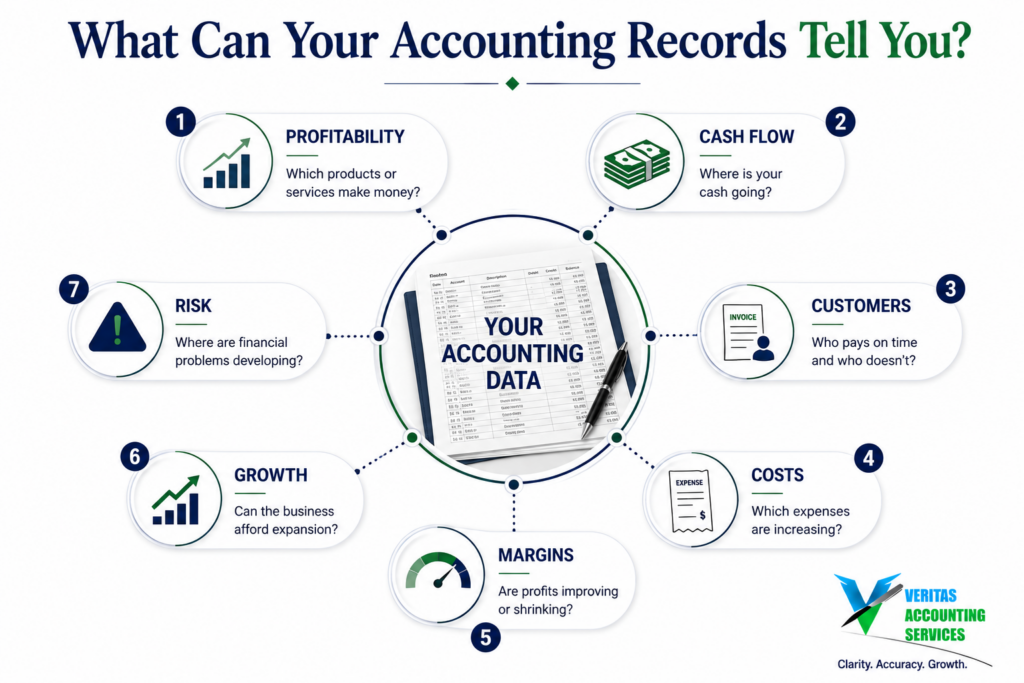
They can tell you which products are profitable, where your cash is going, which expenses are increasing, whether customers are paying on time, whether margins are improving, and whether your current growth is actually creating value.
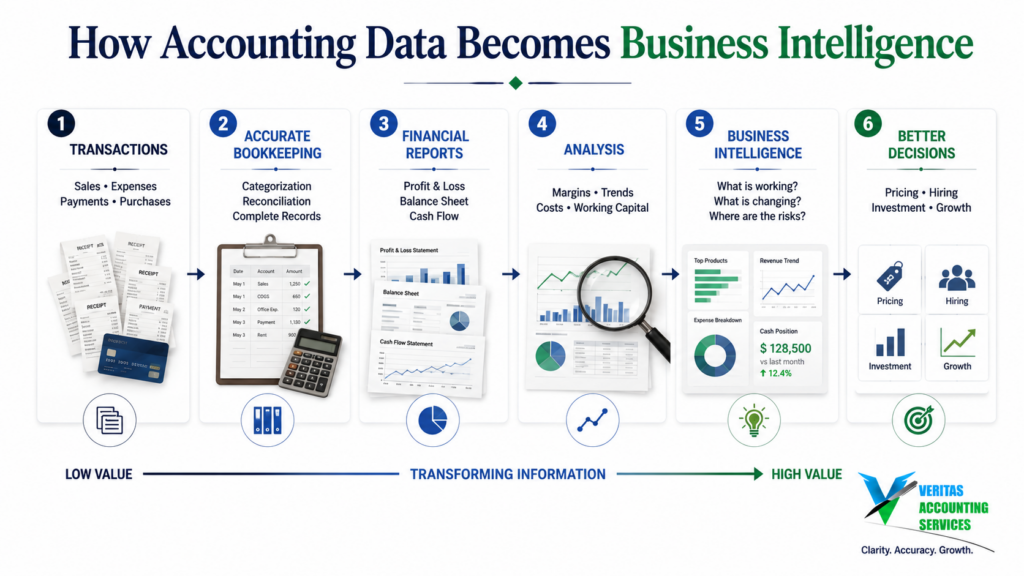
In other words, your books can become a source of business intelligence.
The difference is what you do with the information.
Accurate accounting tells you what happened.
Analysis helps you understand why it happened.
Business intelligence helps you use that information to make better decisions about what happens next.
For growing businesses, that difference can be significant.
Accounting Is More Than Recording Transactions
Bookkeeping begins with individual transactions.
A customer makes a payment.
A supplier sends an invoice.
An employee is paid.
A business purchases equipment.
A bank charges a fee.
Each transaction is recorded in the accounting system.
Individually, these transactions may not tell you much.
But once thousands of transactions are organized and categorized correctly, patterns begin to appear.
You can see:
Revenue trends
Expense trends
Profit margins
Cash-flow movements
Customer balances
Supplier obligations
Asset growth
Debt levels
Operating costs
This is where business intelligence begins to emerge from accounting.
The accounting system is not just storing historical information.
It is creating the financial data needed to understand how the business operates.
1. Your Books Can Show Where Your Profit Is Coming From
A business can have strong revenue and weak profitability.
Imagine a company generates $2 million in annual sales.
That sounds impressive.
But suppose its gross margin has fallen from 40% to 28%.
Revenue increased, but the economics of the business became less attractive.
Without regular financial analysis, management may focus on the revenue increase and miss the declining margin.
Business intelligence can help identify this change.
By comparing revenue, direct costs, gross profit, and operating expenses over time, management can determine whether growth is actually improving profitability.
This becomes even more valuable when you analyze profitability by:
Product
Service
Customer
Location
Sales channel
Business division
Total revenue tells only part of the story.
Understanding where the profit is actually being generated tells you much more.
2. Your Accounting Data Can Explain Where Cash Is Going
Profit and cash are not the same thing.
A profitable company can still experience cash-flow problems.
Why?
Because money may be tied up in:
Accounts receivable
Inventory
Prepaid expenses
Equipment
Debt repayments
Other working capital requirements
Your accounting records can help explain these movements.
For example, suppose sales have increased by 30%, but accounts receivable has increased by 60%.
That could indicate that customers are taking longer to pay.
Revenue is growing, but cash may not be arriving at the same speed.
That is valuable information.
Business intelligence helps management look beyond the income statement and understand how profitability connects with cash flow.
3. Your Financial Statements Can Become Management Tools
Many businesses prepare financial statements because their accountant requires them.
That is understandable.
But financial statements can be much more useful when management reviews them regularly.
A monthly profit and loss statement can help answer:
Is revenue increasing?
Are gross margins changing?
Which expenses are rising?
Are operating costs growing faster than revenue?
Is the business becoming more profitable?
A balance sheet can answer different questions:
How much cash do we have?
How much do customers owe us?
How much do we owe suppliers?
How much debt do we carry?
Is working capital improving?
A cash-flow report can help explain:
Where cash came from
Where cash went
Whether operations are generating cash
Whether financing is supporting the business
When these reports are reviewed together, business intelligence becomes much more useful.
4. Find Out Which Products and Services Actually Make Money
One of the most useful applications of accounting data is profitability analysis.
Suppose a company sells ten different products.
Three products generate 60% of total revenue.
It would be easy to assume those three products are the most valuable.
But what if two of them have very low margins?
The business could be investing significant time, inventory, advertising, and customer service resources into products that generate relatively little contribution.
Accounting data can help management investigate these differences.
A trucking company may monitor fuel costs and revenue per mile.
An e-commerce company may focus on contribution margin, advertising costs, inventory turnover, and marketplace expenses.
A professional services firm may track utilization, billable hours, realization, and client profitability.
Business intelligence becomes useful when the numbers being monitored actually connect with how the business operates.
7. Accounting Data Can Improve Forecasting
Historical financial information provides the foundation for forecasting.
If you know how revenue, payroll, rent, marketing, inventory, and other expenses have behaved over the past several months, you have a starting point for planning the future.
Forecasting can help answer questions such as:
How much cash might we have three months from now?
Can we afford another employee?
How much inventory can we purchase?
Can we take on additional debt?
What happens if revenue falls by 10%?
What happens if revenue grows by 20%?
Business intelligence turns historical accounting data into a resource for forward-looking planning.
Of course, historical trends do not guarantee future results.
But making decisions with historical data, assumptions, and scenarios is generally more useful than relying entirely on intuition.
8. Better Accounting Data Can Improve Pricing Decisions
Pricing is one of the most important decisions a business makes.
Yet many businesses set prices based on competitors, market expectations, or simple cost-plus calculations without fully understanding their own economics.
Your accounting records can provide a better foundation.
You can analyze:
Direct product costs
Labor costs
Overhead
Payment fees
Shipping
Advertising
Discounts
Returns
Customer acquisition costs
This helps management understand the actual cost of delivering a product or service.
You may discover that one service is significantly more profitable than another.
Or you may discover that a product that appears profitable becomes unprofitable after advertising, fulfillment, returns, and other variable costs are included.
That information can support better pricing decisions.
9. Accounting Can Help You Identify Problems Earlier
Financial problems often appear in the numbers before they become obvious operationally.
For example:
Revenue is rising, but margins are falling.
That could indicate increasing product costs, discounting, pricing problems, or an unfavorable sales mix.
Accounts receivable is increasing faster than sales.
That could indicate slower collections or changing customer payment behavior.
Operating expenses are growing faster than revenue.
That could signal that the business is becoming less efficient.
Cash is falling despite reported profits.
That may indicate working capital pressure, debt payments, inventory investment, or other cash-flow issues.
Business intelligence helps management notice these patterns early.
The earlier a problem is identified, the more options management usually has to address it.
10. Business Intelligence Is Only as Good as Your Accounting
This is one of the most important principles to understand.
You cannot build reliable analysis from unreliable accounting data.
If your books contain:
Unreconciled bank accounts
Duplicate transactions
Incorrect classifications
Missing expenses
Incorrect customer balances
Old outstanding items
Unrecorded liabilities
Incorrect inventory values
then your reports may not accurately represent the business.
And if the underlying numbers are wrong, the conclusions drawn from those numbers may also be wrong.
This is why business intelligence begins with accounting.
Before investing heavily in dashboards, advanced analytics, or complicated reporting systems, businesses should make sure the underlying accounting records are accurate and current.
Good intelligence requires good data.
From Bookkeeping to Business Intelligence
Think of your financial system as a progression:
Transactions
↓
Accurate Bookkeeping
↓
Reconciled Accounts
↓
Financial Statements
↓
Financial Analysis
↓
Business Intelligence
↓
Better Business Decisions
Each stage depends on the previous one.
If transactions are recorded incorrectly, the financial statements may be wrong.
If financial statements are wrong, analysis becomes unreliable.
If analysis is unreliable, management decisions can suffer.
The technology used to display information is therefore only one part of the equation.
The quality of the underlying accounting data matters just as much.
You Don’t Need a Complicated Dashboard
Some business owners hear the phrase business intelligence and immediately think of expensive software, complicated dashboards, and data analysts.
That isn’t always necessary.
For many small and medium-sized businesses, useful business intelligence can begin with a well-maintained accounting system and a handful of meaningful reports.
For example, management may only need a monthly dashboard showing:
Revenue
Gross profit
Net profit
Cash balance
Accounts receivable
Accounts payable
Major expenses
Key business KPIs
The objective is not to collect as much information as possible.
The objective is to identify the information that actually helps management make better decisions.
A simple report that gets reviewed every month can be more valuable than an impressive dashboard that nobody uses.
What Business Owners Should Ask Their Accounting Data
Instead of only asking:
“How much did we make?”
Start asking:
“Why did profit change?”
“Which products generate the best margins?”
“Which customers are most profitable?”
“Where is our cash tied up?”
“Which expenses are increasing fastest?”
“Are we collecting customer balances quickly enough?”
“Can we afford our next growth initiative?”
“What could happen to cash flow if revenue declines?”
These questions transform accounting from a record-keeping function into a decision-making resource.
The Role of Technology
Modern accounting software has made financial information much more accessible.
Cloud accounting platforms can connect with:
Banks
Payment processors
Payroll systems
E-commerce platforms
Expense-management tools
Inventory systems
Reporting applications
This can reduce manual work and improve the speed at which financial information becomes available.
But technology alone does not create business intelligence.
A software system can process thousands of transactions.
It cannot automatically understand which numbers matter most to your business strategy.
That requires appropriate accounting structure, accurate records, meaningful KPIs, and management interpretation.
Technology makes information easier to access.
Good accounting makes that information trustworthy.
From Numbers to Decisions
The real value of accounting appears when financial information changes a business decision.
Perhaps the numbers show that one product line has declining margins.
Management changes pricing.
Perhaps accounts receivable is increasing.
The company improves its collection process.
Perhaps a particular expense category is growing too quickly.
Management reviews the underlying costs.
Perhaps cash flow forecasts show that expansion would create a temporary funding gap.
The company arranges financing before the problem occurs.
This is the difference between simply looking at numbers and using them.
Business intelligence turns accounting information into action.
Final Thoughts
Your accounting records are not simply a history of what happened.
They are a source of information about how your business works.
When the books are accurate and current, they can reveal profitability trends, cash-flow pressure, customer behavior, cost increases, pricing opportunities, and areas that deserve management attention.
That is why business intelligence begins long before the dashboard.
It begins with accurate transactions.
It begins with reconciled accounts.
It begins with reliable financial statements.
And it begins with accounting.
At Veritas Accounting Services, we believe bookkeeping should do more than keep your records organized.
Your financial information should help you understand the business, identify opportunities, recognize risks, and make better decisions.
Your books already contain valuable information.
The question is whether you’re using it.
Frequently Asked Questions
How does accounting support business intelligence?
Accounting provides structured financial data about revenue, expenses, assets, liabilities, cash flow, customers, and other business activities. When that information is analyzed, it can help management identify trends and make better decisions.
What accounting data is useful for business intelligence?
Useful information can include revenue, gross profit, operating expenses, accounts receivable, accounts payable, cash flow, inventory, customer balances, product profitability, and other business-specific KPIs.
Why is accurate bookkeeping important for business intelligence?
Accurate bookkeeping creates reliable financial data. If transactions are missing, incorrectly categorized, or unreconciled, the financial reports and analysis built from those records may also be unreliable.
Can small businesses use business intelligence?
Absolutely. Small businesses do not necessarily need complicated technology. Regular financial reporting, a few meaningful KPIs, accurate bookkeeping, and consistent analysis can provide valuable business intelligence.
How can financial reports help business owners?
Financial reports help owners understand profitability, cash flow, expenses, liabilities, and financial trends. Reviewing these reports regularly can support decisions about pricing, hiring, investment, cost control, and growth.
Accounting shouldn’t simply tell you what happened last month.
It should help you understand why it happened—and what you should do next.
When accurate accounting is combined with meaningful analysis, your books can become one of the most valuable sources of business intelligence your company has.
Selling on an online marketplace can make a business look extremely successful.
Orders are coming in. Revenue is increasing. Sales reports show impressive numbers. Products are reaching customers across different cities and countries.
But there is a question many e-commerce sellers don’t ask often enough:
How much are we actually making after every cost is taken out?
A product that sells for $100 may not generate anything close to $100 of profit.
Between marketplace commissions, payment processing, fulfillment, storage, advertising, returns, refunds, product costs, and other operating expenses, the amount left for the business can be surprisingly small.
This is why marketplace fees deserve much more attention than they usually receive.
The problem is not necessarily that marketplace fees are too high. The bigger problem is that sellers often look at them individually rather than understanding their combined impact on profitability.
You can increase sales and still see your margins decline.
You can have a product that sells extremely well and still lose money on every order.
And you can grow revenue while quietly making the business financially weaker.
For e-commerce businesses, profitable growth requires looking beyond sales volume and understanding what each order actually contributes to the bottom line.
Revenue Is Not the Same as Profit
One of the easiest mistakes in e-commerce is confusing revenue with profitability.
Imagine your marketplace shows $100,000 in monthly sales.
That sounds impressive.
But now consider what happens before that money becomes business profit.
You may have:
Product costs
Marketplace commissions
Payment processing fees
Fulfillment charges
Storage costs
Advertising
Shipping
Returns
Refunds
Packaging
Software
Customer service
Payroll
Other operating expenses
After all those costs, your actual profit could be significantly lower.
This is why marketplace fees should be analyzed as part of the complete cost structure rather than viewed as isolated deductions from marketplace statements.
Revenue tells you how much customers spent.
Profit tells you what the business actually kept.
Those are very different numbers.
What Are Marketplace Fees?
Marketplace fees are the charges a seller pays to an online platform for using its marketplace, payment infrastructure, fulfillment services, advertising tools, or other services.
Depending on the platform and selling arrangement, marketplace fees may include:
Referral or commission fees
Payment processing charges
Listing fees
Subscription fees
Fulfillment fees
Storage fees
Advertising charges
Return-related fees
Refund administration charges
Currency conversion charges
Other service fees
Not every marketplace charges all of these.
The important point is that sellers need to understand the complete fee structure associated with each platform they use.
A product may appear profitable when you look only at its selling price and product cost.
Once all marketplace-related costs are included, the picture may change considerably.
1. Commission Fees Can Take a Significant Share of Sales
Most marketplaces charge sellers some form of commission or referral fee.
The percentage may vary depending on:
Product category
Selling price
Marketplace
Seller plan
Customer location
Promotional arrangements
A percentage-based fee can become substantial as sales increase.
For example, suppose you sell $200,000 of products in a month and the applicable marketplace commission averages 15%.
That represents:
$200,000 × 15% = $30,000
The business generated $200,000 in sales, but $30,000 has already gone toward one category of marketplace cost.
That doesn’t necessarily mean the marketplace is charging too much.
The platform may be providing access to millions of customers, payment processing, infrastructure, trust, logistics, or other valuable services.
The real question is whether your pricing and product economics are designed to support those costs.
2. Fulfillment Costs Can Change the Economics
For businesses using marketplace fulfillment services, fulfillment costs can become another major component of the cost per order.
Depending on the arrangement, sellers may pay for:
Picking
Packing
Shipping
Handling
Returns
Storage
Special handling
These costs can vary significantly depending on product size, weight, destination, and fulfillment method.
A product with a healthy margin before fulfillment may become much less attractive after fulfillment costs are included.
This is particularly important for businesses selling products with:
Large dimensions
Heavy weight
Low selling prices
Low unit margins
High return rates
A seller should therefore calculate profitability using the actual fulfillment cost rather than relying solely on the product’s selling price and purchase cost.
3. Advertising Can Quietly Reduce Your Margin
Advertising is another area where e-commerce sellers can lose sight of profitability.
Advertising can be extremely valuable.
It can help products reach customers, increase sales, launch new products, and improve visibility.
But higher sales do not automatically mean higher profits.
Suppose a product generates $50,000 in marketplace sales.
That sounds strong.
But what if $10,000 was spent on advertising to generate those sales?
Now the economics look different.
This is why looking only at advertising metrics such as revenue generated or return on ad spend may not provide the complete picture.
Only then can you understand how much the sale actually contributes to the business.
4. Returns and Refunds Can Distort Your Numbers
Returns are particularly important for businesses selling online.
A marketplace report may show a large number of orders and strong gross sales, while refunds and returns reduce the amount the business actually keeps.
Returns can also create additional costs.
For example:
Return shipping
Restocking
Damaged inventory
Refund processing
Customer service
Lost selling fees
Unsellable inventory
If returns are consistently high for a particular product, simply looking at gross sales can make the product appear more profitable than it really is.
Businesses should therefore monitor profitability after returns and refunds rather than evaluating products solely on completed orders.
5. Payment Processing and Other Small Charges Add Up
Not every cost is large enough to immediately attract attention.
A payment processing charge here.
A currency conversion fee there.
A small storage charge.
A return-related adjustment.
A software fee.
A marketplace subscription.
Individually, these amounts may seem insignificant.
Collectively, they can have a meaningful impact on margins.
This is one reason marketplace fees should be reviewed regularly rather than only when something appears unusually expensive.
Small percentages applied to large sales volumes can create significant annual costs.
The Product That Sells the Most May Not Be Your Most Profitable Product
This is one of the most important lessons for marketplace businesses.
Imagine you sell two products.
Product A
Sales: $100,000 Gross profit before marketplace costs: $30,000 Total marketplace and variable costs: $20,000 Contribution: $10,000
Product B
Sales: $60,000 Gross profit before marketplace costs: $25,000 Total marketplace and variable costs: $8,000 Contribution: $17,000
Product A generates more revenue.
But Product B generates more contribution.
If management focuses only on sales volume, Product A may look like the clear winner.
If management focuses on profitability, Product B tells a different story.
This is why marketplace sellers should analyze profitability at the product or SKU level whenever practical.
Calculate Your Real Profit Per Order
A simple order-level calculation can reveal problems quickly.
Imagine a product sells for $100.
Cost
Amount
Selling Price
$100
Product Cost
$40
Marketplace Commission
$15
Payment Processing
$3
Fulfillment
$12
Advertising
$8
Other Variable Costs
$5
Contribution
$17
The product appears to generate $100 in sales.
But after the major variable costs, only $17 remains.
And that $17 may still need to contribute toward fixed business costs such as salaries, software, rent, professional fees, and other overhead.
That means the product’s true net profit may be considerably lower.
This calculation should be performed regularly for important products rather than relying only on the marketplace’s headline sales figures.
Why Marketplace Fees Can Be Difficult to Track
One reason marketplace profitability is difficult to analyze is that the money doesn’t always flow through the accounting system in a simple way.
A marketplace may combine:
Sales
Refunds
Commissions
Advertising
Shipping
Fulfillment
Taxes
Other adjustments
into statements or settlement reports.
The amount deposited into the bank may therefore be very different from the gross sales reported by the marketplace.
For example:
Marketplace Sales: $50,000
Less:
Marketplace Fees: $7,500
Less:
Advertising: $4,000
Less:
Refunds: $2,500
Less:
Other Adjustments: $1,000
Net Settlement: $35,000
If the accounting records simply record the $35,000 bank deposit as sales, management may lose visibility into the actual economics of the marketplace.
This is why proper marketplace reconciliation matters.
Your Bookkeeping Needs to Reflect the Real Marketplace Activity
Accurate bookkeeping is especially important for e-commerce businesses because marketplace settlements can contain many different types of transactions.
A good accounting process should help separate and identify:
Gross sales
Marketplace commissions
Payment fees
Fulfillment costs
Advertising
Refunds
Returns
Taxes
Other marketplace adjustments
This creates better financial reporting.
It also makes it easier to understand where money is actually going.
Remote bookkeeping services can be particularly useful for growing e-commerce businesses that have multiple marketplaces, payment processors, currencies, or high transaction volumes.
Accurate books aren’t just useful for tax preparation.
They help management understand profitability.
Don’t Look at ROAS Without Looking at Margin
Return on ad spend, or ROAS, is commonly used by e-commerce businesses to evaluate advertising performance.
But ROAS alone can be misleading.
Imagine an advertising campaign generates $10,000 of revenue from $2,000 of advertising.
The ROAS is 5x.
That sounds excellent.
But suppose the product has:
$4,000 product cost
$1,500 marketplace fees
$1,000 fulfillment
$500 other variable costs
The business may have only a small amount left after all those expenses.
A strong advertising metric does not automatically mean a strong financial result.
The better question is:
How much profit did the advertising actually help generate?
This is where product-level margin analysis becomes much more valuable than looking at advertising metrics in isolation.
How to Protect Your Marketplace Margins
Marketplace fees are often unavoidable.
The goal is not necessarily to eliminate them.
The goal is to understand them and manage the economics of your business around them.
Here are several practical strategies.
Review Fees Regularly
Don’t assume your fee structure has remained unchanged.
Review marketplace statements and fee schedules periodically.
Track Profitability by Product
Know which products generate healthy contribution margins and which products are consuming cash.
Include Advertising in Your Product Economics
Don’t evaluate products without considering the marketing spend required to generate sales.
Monitor Returns
A high-return product may have a very different margin from what the original sale suggests.
Review Fulfillment Costs
Look for products where shipping, handling, or storage costs are disproportionately high.
Revisit Pricing
If your costs have increased but prices haven’t changed, your margin may be shrinking.
Reconcile Marketplace Statements
Make sure marketplace activity is properly reflected in your accounting records.
Compare Marketplaces
A product that is profitable on one platform may not produce the same economics on another.
More Sales Can Sometimes Mean Less Profit
This sounds strange, but it happens.
Imagine you make $5 of contribution on every order.
Selling 1,000 units generates $5,000 of contribution.
Selling 10,000 units generates $50,000.
That sounds great.
But what if the increased sales require:
Heavy discounting
Higher advertising
Expensive fulfillment
Additional customer service
Higher return rates
More storage
Your contribution per order may fall significantly.
If the business focuses only on revenue growth, management may not notice the deterioration until it becomes serious.
This is why profitable growth is more important than revenue growth alone.
The goal isn’t simply to sell more.
The goal is to sell more while preserving healthy economics.
When Should You Review Your Marketplace Profitability?
Don’t wait until profits disappear.
A profitability review is particularly important when:
Sales are growing rapidly
Marketplace fees have changed
Advertising spend is increasing
Product prices have changed
Fulfillment costs have increased
Return rates are rising
You launch a new marketplace
You add new products
Your gross margin is declining
Cash flow doesn’t seem to match sales growth
Regular analysis helps identify problems while there is still time to correct them.
Final Thoughts
Marketplace selling can create tremendous opportunities for e-commerce businesses.
You can reach customers at scale without building the entire sales infrastructure yourself.
But that convenience comes at a cost.
Marketplace fees, fulfillment, advertising, payment processing, returns, storage, and other selling expenses can gradually reduce the amount your business actually keeps from each sale.
The important thing is not to avoid marketplaces.
It’s to understand the economics.
Know your real cost per order.
Know your contribution margin.
Know which products are profitable.
Know how much advertising is required to generate each sale.
And make sure your accounting records reflect the complete marketplace activity rather than only the deposits reaching your bank account.
Revenue tells you how much you sold.
Your margins tell you whether those sales are actually building a profitable business.
At Veritas Accounting Services, we help e-commerce businesses organize marketplace transactions, reconcile sales and fees, and turn financial data into information that management can use.
Because selling more is good.
Selling more profitably is better.
Frequently Asked Questions
What are marketplace fees?
Marketplace fees are charges that online selling platforms may apply for services such as commissions, payment processing, fulfillment, storage, advertising, listings, subscriptions, returns, and other seller services. marketplace fees
How do marketplace fees affect profit margins?
Marketplace fees reduce the amount of revenue remaining after a sale. When combined with product costs, advertising, fulfillment, returns, and other variable expenses, they can significantly reduce the contribution margin of an order.
Why are my marketplace sales increasing but profits decreasing?
Growing sales do not automatically mean growing profits. Higher advertising costs, marketplace fees, fulfillment expenses, discounts, returns, marketplace fees and product costs can increase faster than revenue.
How can I reduce marketplace costs?
Start by identifying every major cost associated with each marketplace. Review product-level profitability, advertising spend, fulfillment costs, returns, pricing, and marketplace fees structures. Some costs can potentially be reduced through operational or pricing changes.
Should marketplace fees be recorded separately in accounting?
In many cases, separating major marketplace-related expenses provides better visibility into the economics of the business. The exact accounting treatment should be determined based on the business, applicable accounting framework, and tax requirements.
How often should I review marketplace profitability?
Growing e-commerce businesses should review profitability regularly rather than waiting until year-end. Monthly analysis is often useful for identifying changes in marketplace fees, advertising costs, returns, fulfillment expenses, and product margins.
When most businesses are just getting started, founders wear every hat imaginable.
You’re the CEO, salesperson, marketer, customer support representative, operations manager, recruiter—and somewhere between all of that, you’re also trying to manage the finances.
At first, this makes perfect sense.
There may not be enough revenue to hire specialists, and understanding every part of the business helps you make better decisions during the early stages.
But success changes everything.
More customers bring more invoices.
More employees mean payroll.
More suppliers create more bills.
More sales generate more bank transactions.
New products, software subscriptions, taxes, compliance requirements, and reporting obligations all begin demanding your attention.
The financial side of the business becomes significantly more complicated.
Yet many founders continue trying to manage everything themselves.
Not because they enjoy bookkeeping or financial reporting—but because they believe hiring financial experts is something they can postpone until the business becomes “much bigger.”
Unfortunately, delaying financial expertise often costs far more than hiring it.
Financial mistakes rarely happen because business owners don’t work hard.
They happen because growing businesses eventually become too complex for one person to manage effectively.
The earlier founders recognize this, the easier it becomes to build a business that can grow without financial confusion.
Why Founders Delay Hiring Financial Experts
Almost every founder has said one of these things:
“I’ll hire someone after we grow a little more.”
“I’ll organize the books next month.”
“I know roughly where the money is.”
“We’re too small to need financial experts.”
“I’ll deal with taxes when filing season comes.”
These thoughts are understandable.
In the early stages, every dollar matters.
Hiring financial experts can feel like an expense rather than an investment.
But here’s the reality.
The longer a growing business operates without reliable financial systems, the more expensive the cleanup usually becomes.
Late bookkeeping.
Incorrect tax treatment.
Cash flow surprises.
Missed deductions.
Poor pricing decisions.
Unreconciled bank accounts.
Delayed financial reports.
These problems rarely appear overnight.
They develop gradually while the founder is focused on serving customers and growing revenue.
By the time the problems become visible, they are often affecting profitability, cash flow, and business decisions.
Veritas Expert Insight
Successful founders don’t wait until financial problems appear before involving financial experts. They build reliable financial systems early so they can make confident decisions as the business grows.
1. You No Longer Know Your Real Cash Position
Many founders check the bank balance before making a decision.
While this works in the earliest stages, the bank balance alone rarely tells the complete story.
Money sitting in the account may already be committed to:
Payroll
Supplier payments
Loan repayments
Tax liabilities
Rent
Software subscriptions
Upcoming inventory purchases
Without accurate bookkeeping and cash flow reporting, it’s easy to believe the business has more available cash than it actually does.
Financial experts help business owners understand not only how much cash is available today, but also how much cash the business will need next week, next month, and next quarter.
That level of visibility supports better business decisions and reduces financial surprises.
2. Your Bookkeeping Is Always Behind
Many growing businesses experience the same pattern.
Receipts accumulate.
Bank reconciliations are delayed.
Transactions remain uncategorized.
Questions about expenses are postponed.
Financial statements become several months out of date.
When bookkeeping falls behind, management gradually loses visibility over the business.
Business owners begin making decisions based on estimates rather than reliable numbers.
Financial experts help establish consistent bookkeeping processes so financial information stays current throughout the year instead of being reconstructed at tax time.
Accurate bookkeeping also makes tax preparation, budgeting, forecasting, and financing significantly easier.
3. Tax Planning Happens Only Once a Year
Many founders think about taxes only when filing deadlines approach.
By then, many opportunities may already have passed.
Good tax planning happens throughout the year.
Business purchases.
Entity structure.
Timing of income.
Investment decisions.
Owner compensation.
Capital expenditure.
Expansion plans.
These decisions often have tax consequences long before returns are prepared.
They help businesses understand how today’s decisions may affect future tax obligations.
That proactive approach often provides far greater value than trying to reduce taxes after the financial year has already ended.
4. You’re Making Important Decisions Without Reliable Numbers
Growing businesses make important decisions constantly.
Should we hire another employee?
Can we afford a larger office?
Is this product profitable?
Should we increase prices?
Can we expand internationally?
Can we purchase new equipment?
Should we invest in marketing?
Without reliable financial information, these decisions often become educated guesses.
Financial experts help convert accounting records into meaningful business information.
Instead of relying on instinct alone, founders gain access to reports that explain:
Profitability
Cash flow
Gross margins
Customer performance
Operating costs
Financial trends
Working capital
Better information generally leads to better business decisions.
5. You’re Spending Too Much Time Managing the Numbers
Founders should understand their numbers.
That doesn’t necessarily mean they should personally maintain every accounting record.
Imagine spending several hours every week:
Downloading bank statements
Categorizing transactions
Reconciling accounts
Following up for invoices
Searching for receipts
Correcting bookkeeping errors
Preparing spreadsheets
Now multiply that across an entire year.
That is time no longer available for:
Building customer relationships
Improving products
Developing strategy
Hiring employees
Increasing sales
Growing the business
Financial experts allow founders to remain informed about the financial health of the business without becoming responsible for every bookkeeping task themselves.
The goal is not to remove the founder from the numbers.
The goal is to remove the founder from routine administrative work while providing better financial information than they could realistically produce alone.
The Cost of Waiting Is Often Invisible
One of the biggest challenges is that delaying financial experts rarely creates an immediate crisis.
Instead, the cost appears gradually.
Perhaps invoices are sent a little later than they should be.
Bank reconciliations remain unfinished.
Tax planning opportunities are missed.
Expenses are categorized incorrectly.
Cash flow becomes harder to predict.
Management reports arrive weeks late.
None of these issues seem catastrophic on their own.
Together, however, they create uncertainty.
And uncertainty makes it harder for founders to make confident decisions.
The irony is that many businesses hire financial experts only after problems become visible.
In reality, their greatest value comes from preventing those problems from developing in the first place.
Financial Experts Do More Than Keep the Books
Many founders assume financial experts simply record transactions.
Modern financial support goes much further.
Depending on the stage of the business, financial experts may assist with:
Bookkeeping
Financial reporting
Cash flow management
Budgeting
Forecasting
Payroll support
Business performance analysis
Tax planning
Internal controls
Virtual CFO services
Financial strategy
The role evolves as the business grows.
Early on, accurate bookkeeping may be enough.
Later, management reporting, forecasting, KPI analysis, and strategic financial advice become increasingly valuable.
The objective isn’t simply maintaining accounting records.
It’s helping founders make better business decisions with reliable financial information. 6. Growth Has Increased Your Financial Complexity
Growth is a positive sign.
But every stage of growth introduces additional financial responsibilities.
What once involved one bank account and a few monthly transactions may now include:
Multiple bank accounts
Business credit cards
Payroll
Loans
Inventory
Fixed assets
Online payment platforms
Multiple revenue streams
Sales tax or VAT obligations
Foreign currency transactions
More suppliers and customers
Each of these adds another layer of complexity.
Many founders continue using the same financial processes that worked when the business was much smaller.
Unfortunately, the business has outgrown those systems.
Financial experts help growing companies adapt their financial processes before complexity turns into confusion.
Rather than reacting to problems later, they build systems that continue supporting the business as it expands.
7. You’re Always Reacting Instead of Planning
One question separates growing businesses from mature businesses:
Are you making financial decisions before problems happen—or after?
Many founders spend most of their time reacting.
A supplier payment is overdue.
Cash is unexpectedly tight.
Tax deadlines arrive suddenly.
Payroll becomes stressful.
Profit margins start shrinking.
These situations often develop because management lacks forward-looking financial information.
Financial experts help shift businesses from reactive management to proactive planning.
Instead of asking:
“Can we afford this today?”
Founders begin asking:
“How will this decision affect cash flow over the next six months?”
That change in thinking often leads to stronger, more sustainable growth.
Planning becomes easier when management has reliable numbers instead of assumptions.
8. Investors and Lenders Expect Better Financial Information
If you plan to raise investment, apply for financing, or expand into larger markets, your financial records become increasingly important.
Banks, investors, and lenders rarely make decisions based on estimates.
They want reliable financial information.
This often includes:
Current financial statements
Cash flow reports
Balance sheets
Profit and loss statements
Business forecasts
Supporting schedules
Tax records
If your bookkeeping is several months behind or financial reports are inconsistent, obtaining funding can become much more difficult.
Financial experts help ensure the information required by lenders, investors, and other stakeholders is available when needed—not created in a rush after a request arrives.
Good financial reporting builds credibility.
9. You Need Better Advice, Not Just Better Accounting
Bookkeeping records what has already happened.
Growing businesses also need help deciding what should happen next.
Questions like these become more common:
Can we afford another employee?
Should we increase prices?
Is this product profitable?
Which customers generate the highest margins?
Can we expand internationally?
Should we lease or purchase equipment?
How much working capital do we need?
These questions require more than bookkeeping.
They require financial analysis.
Financial experts help transform accounting data into useful business insights.
Instead of simply reporting the past, they help management understand the future implications of today’s decisions.
That is where financial expertise creates real business value.
When Should You Hire Financial Experts?
Many founders ask this question too late.
A better question is:
What financial challenges am I already facing today?
You should seriously consider hiring financial experts when:
Bookkeeping regularly falls behind.
Financial reports are delayed.
You don’t know your true cash position.
Payroll and tax obligations are becoming more complex.
You’re spending several hours each week managing accounting tasks.
The business is growing faster than your financial systems.
You’re making important decisions without reliable financial information.
You need budgeting, forecasting, or cash flow planning.
You’re preparing for expansion, investment, or financing.
Waiting until problems become serious often makes the transition more difficult.
Building financial systems before they are urgently needed usually produces better long-term results.
Do You Need a Full-Time Finance Team?
Not necessarily.
Many founders assume the only alternative to doing everything themselves is hiring full-time accounting employees.
Today, there are more flexible options.
Many businesses successfully work with outsourced financial experts who provide support based on the company’s actual needs.
Depending on the stage of growth, this may include:
Monthly bookkeeping
Accounts payable
Accounts receivable
Payroll support
Financial reporting
Budget preparation
Cash flow forecasting
Management reporting
Virtual CFO services
This approach allows businesses to access professional financial expertise without immediately building a larger internal finance department.
As the business grows, the level of support can grow alongside it.
Why Outsourced Financial Experts Make Sense
For many growing businesses, outsourced financial experts provide an effective balance between cost, flexibility, and experience.
Instead of hiring multiple specialists immediately, businesses gain access to experienced professionals who already understand accounting systems, reporting processes, and financial controls.
Some of the advantages include:
Flexible support as the business grows
Access to experienced professionals
Better financial reporting
Improved bookkeeping accuracy
Stronger internal processes
Reduced administrative workload
More time for founders to focus on customers and growth
Most importantly, founders gain reliable financial information that supports better decision-making.
The objective is not simply outsourcing accounting work.
It is building a stronger financial foundation for future growth.
Common Mistakes Founders Make Before Hiring Financial Experts
Many businesses delay financial support because they believe they can manage “just a little longer.”
Some common mistakes include:
Waiting until tax season to organize the books.
Making hiring decisions without reviewing cash flow.
Assuming the bank balance equals available cash.
Ignoring small bookkeeping errors until they become major cleanup projects.
Delaying financial reporting because “nothing has changed.”
These habits can gradually reduce visibility into the business.
Financial experts help create consistent financial processes that reduce these risks before they become expensive problems.
Why Financial Systems Matter More as You Grow
Growth is exciting.
But growth without financial systems can become stressful.
The more customers, employees, suppliers, and transactions your business has, the more important reliable financial information becomes.
Accurate bookkeeping supports:
Better cash flow management
Stronger budgeting
More reliable forecasting
Better tax planning
Faster decision-making
Greater confidence during expansion
Financial experts don’t slow growth.
They help businesses grow with better financial control.
Final Thoughts
Every founder starts by doing more than one job.
That determination often helps build the business in the early days.
But there comes a point where continuing to manage every financial task personally begins limiting growth rather than supporting it.
Hiring financial experts isn’t about giving up control.
It’s about gaining better information, stronger financial systems, and more time to focus on leading the business.
The earlier reliable financial processes are established, the easier it becomes to manage growth, improve profitability, and make confident business decisions.
At Veritas Accounting Services, we help businesses build that financial foundation through bookkeeping, accounting, tax support, management reporting, and Virtual CFO services tailored to each stage of growth.
The goal isn’t simply to keep your books updated.
It’s to help you make smarter business decisions with financial information you can trust.
Frequently Asked Questions
When should a founder hire financial experts?
A founder should consider hiring financial experts when bookkeeping starts falling behind, financial reports are delayed, cash flow becomes difficult to manage, or business growth creates more financial complexity than one person can comfortably handle.
What do financial experts do?
Financial experts may provide bookkeeping, accounting, financial reporting, budgeting, forecasting, cash flow management, tax planning support, business analysis, and Virtual CFO services depending on the needs of the business.
Are financial experts only for large businesses?
No. Small and growing businesses often benefit the most because they gain access to professional financial support before financial problems become larger and more expensive to resolve.
Can outsourced financial experts replace an in-house finance team?
For many small and medium-sized businesses, outsourced financial experts can provide the level of support needed without immediately hiring a full internal finance department. As the business grows, the support can be expanded accordingly.
Why do founders delay hiring financial experts?
Many founders believe they can manage the finances themselves for a little longer, want to reduce costs, or feel the business is still too small. However, delaying financial expertise often leads to missed opportunities, outdated financial records, and decisions based on incomplete information.
Focus on Growing Your Business—Not Every Financial Task
You don’t have to do everything yourself forever.
The right financial support gives you accurate books, meaningful reports, stronger cash flow visibility, and more confidence when making important business decisions.
At Veritas Accounting Services, we help growing businesses with bookkeeping, accounting, tax support, and Virtual CFO services so founders can spend less time managing spreadsheets—and more time building their business.
Growth is exciting, but it also creates more financial work.
More customers mean more invoices. More sales often mean more payment platforms. More employees bring payroll and expense management. More suppliers create additional bills. New locations or markets may introduce new bank accounts, currencies, tax requirements, and reporting needs.
At some point, bookkeeping that once took a few hours each month can become a significant operational responsibility.
For many growing companies, hiring another full-time employee is not necessarily the first or best solution. Remote bookkeeping services can provide access to experienced accounting support without requiring the business to build a larger in-house finance department immediately.
Modern cloud accounting platforms have made this approach increasingly practical. Bank transactions, invoices, receipts, bills, payroll information, and financial reports can all be managed securely through digital systems.
But remote bookkeeping is not simply about moving bookkeeping outside the office.
When implemented properly, it can help a growing business build better financial records, stronger processes, and clearer financial visibility.
So, when do remote bookkeeping services make sense—and what should business owners consider before making the move?
What Are Remote Bookkeeping Services?
Remote bookkeeping services allow bookkeeping professionals to manage some or all of a company’s accounting records without working physically from the client’s office.
Instead of exchanging paper files, businesses generally use cloud-based accounting and document-management systems.
A remote bookkeeping team may handle tasks such as:
Recording and categorizing transactions
Bank and credit card reconciliations
Accounts payable
Accounts receivable
Maintaining supporting schedules
Month-end bookkeeping
Financial reporting
Payroll-related bookkeeping
Bookkeeping cleanup
Management reporting support
The exact scope depends on the business.
Some companies need only monthly reconciliations and financial statements. Others require ongoing support across multiple bank accounts, payment platforms, entities, or locations.
That flexibility is one reason remote bookkeeping services can work particularly well for businesses whose financial operations are becoming more complex as they grow.
Why Growing Businesses Often Outgrow Their Bookkeeping
In the early stages of a business, bookkeeping can look relatively simple.
There may be one bank account, a few customers, limited expenses, and perhaps one owner managing most financial activity.
Growth changes that quickly.
Imagine a business that expands from $500,000 to $3 million in annual revenue.
It may now have:
Multiple bank and credit card accounts
More customer invoices
Higher transaction volumes
Additional suppliers
Payroll
Loans
Fixed assets
Online payment processors
Inventory
New tax obligations
More complicated month-end reporting
The bookkeeping process that worked when the company was small may no longer provide management with reliable information.
This is usually the point where business owners need to make a decision:
Should we continue managing bookkeeping internally, hire another employee, or outsource some of the accounting function?
For many businesses, remote bookkeeping services offer a practical middle ground.
1. Remote Bookkeeping Can Reduce the Need for Additional Fixed Overhead
Hiring an in-house bookkeeper involves more than salary.
Depending on the location and employment arrangement, the total cost may also include payroll-related costs, employee benefits, recruitment, training, equipment, software, office resources, and management time.
A growing company may need 30 or 50 hours of bookkeeping support each month but not enough work to justify another full-time employee.
Remote bookkeeping services can allow the business to purchase the level of support it actually requires.
This does not mean outsourcing is automatically cheaper in every situation.
A large company requiring continuous daily accounting support may find that an internal team makes more sense.
The important question is whether the company’s current workload genuinely requires another full-time position.
If not, remote support can provide additional financial capacity without immediately adding another permanent layer of overhead.
2. You Are No Longer Limited to Your Local Hiring Market
Traditional hiring restricts businesses largely to professionals available within commuting distance.
Remote work changes that.
A company can potentially work with bookkeeping professionals who understand its accounting platform, industry, and reporting requirements regardless of physical location.
This can be particularly valuable when the business requires experience with systems such as:
QuickBooks Online
Xero
Hubdoc
E-commerce platforms
Payment processors
Cloud payroll systems
Expense-management applications
Good bookkeeping requires more than entering transactions.
A bookkeeper needs to understand how transactions flow through the business, how accounts should reconcile, what supporting documentation is needed, and how financial information should ultimately appear in reports.
Remote bookkeeping services can broaden the pool of professionals available to the business rather than limiting hiring to one geographic area.
3. Your Books Can Stay More Consistently Updated
One common problem in growing businesses is that bookkeeping gradually falls behind.
The owner is busy.
The internal administrator has other responsibilities.
Bank reconciliations are postponed.
Uncategorized transactions accumulate.
Accounts receivable is not reviewed regularly.
By the time management receives financial statements, the information may already be several weeks or months old.
That reduces the usefulness of the numbers.
A structured remote bookkeeping process can establish clear recurring responsibilities.
For example:
Weekly
Review transactions
Update accounts payable
Review accounts receivable
Identify missing information
Monthly
Reconcile bank accounts
Reconcile credit cards
Review balance sheet accounts
Record adjustments
Prepare financial reports
Consistency matters.
A perfectly prepared profit and loss statement three months late may be far less useful than reliable monthly reporting delivered on time.
This is where remote bookkeeping services can provide more than administrative support—they can help establish financial discipline.
4. Remote Bookkeeping Services Can Scale With the Business
Bookkeeping requirements rarely remain constant.
A company may begin with one bank account and later have five.
An e-commerce business may add Amazon, Shopify, Stripe, PayPal, or additional marketplaces.
A service company may hire employees and introduce payroll.
A business may expand internationally and begin dealing with foreign currencies.
Transaction volume can increase dramatically without management noticing how much additional accounting work has been created.
Remote bookkeeping services can often scale alongside these changes.
The scope may initially cover basic monthly bookkeeping and later expand to include:
Accounts payable
Accounts receivable
Payroll coordination
Multi-currency bookkeeping
Inventory-related accounting
Management reports
Cash flow reporting
Month-end closing support
This flexibility can be particularly useful during periods of rapid growth when building a complete internal finance department immediately may not be practical.
5. Cloud Technology Makes Remote Bookkeeping Practical
Remote bookkeeping would have been far more difficult when accounting depended heavily on paper files and desktop systems stored on one office computer.
Cloud technology changed that.
Modern accounting platforms allow authorized users to access financial information securely from different locations.
Bank feeds can import transactions.
Invoices can be issued electronically.
Receipts can be uploaded digitally.
Bills can move through approval workflows.
Reports can be generated without waiting for physical files to reach an accountant.
Remote bookkeeping services can therefore become part of a connected financial workflow rather than simply an external person entering data.
Business owners sometimes view bookkeeping primarily as a compliance requirement.
But accurate bookkeeping should also help management understand the business.
Reliable monthly accounts can help answer questions such as:
Is revenue actually translating into profit?
Which expenses are increasing?
How much cash is available?
Which customers owe money?
How much does the business owe suppliers?
Are margins improving or declining?
Can the business afford another employee?
Is the company generating enough cash to fund growth?
Remote bookkeeping services should therefore not be evaluated only by how many transactions are entered.
The real value comes from the quality of the financial information produced.
If management receives accurate and timely financial statements, bookkeeping becomes part of the decision-making process.
Growth becomes easier to manage when owners can see what is happening financially rather than relying primarily on the bank balance.
Veritas Expert Insight
Good bookkeeping does more than record what happened. It gives management reliable financial information to understand what is happening now and make better decisions about what comes next.
7. Business Owners Get More Time to Run the Business
Many business owners start by doing their own bookkeeping.
Initially, this makes sense.
There may not be enough activity to justify outsourcing or hiring.
But the owner eventually becomes one of the most expensive people in the company to perform routine bookkeeping work.
Consider an owner spending five hours every week:
Categorizing transactions
Finding receipts
Reconciling accounts
Following up on invoices
Correcting bookkeeping errors
That is more than 250 hours per year.
The question is not only what bookkeeping costs.
It is also:
What else could the owner accomplish with those 250 hours?
Remote bookkeeping services can help shift routine financial administration away from the owner while still keeping management informed about the numbers.
The owner does not lose financial control.
Ideally, they gain better financial visibility while spending less time maintaining the underlying records.
What Can a Remote Bookkeeper Actually Handle?
The responsibilities of a remote bookkeeper vary according to the company’s needs.
Common services can include:
Bank and Credit Card Reconciliations
Matching accounting records against financial institution statements and investigating differences.
Transaction Categorization
Recording transactions consistently within the appropriate chart of accounts.
Accounts Payable
Recording bills, maintaining supplier balances, and supporting payment processes.
Reviewing accounts and completing recurring procedures before financial reports are prepared.
Financial Statements
Preparing or supporting reports such as the profit and loss statement and balance sheet.
Supporting Schedules
Maintaining records for items such as loans, fixed assets, prepaid expenses, and other balance sheet accounts where appropriate.
The strongest remote bookkeeping services generally operate through a clearly defined scope rather than an informal arrangement where responsibilities are unclear.
Is Remote Bookkeeping Secure?
This is an important question.
Remote bookkeeping is not automatically secure simply because cloud software is being used.
Security depends on the systems, controls, and people involved.
Businesses should consider measures such as:
Multi-factor authentication
Individual user access
Appropriate permission levels
Secure document-sharing systems
Strong password practices
Controlled access to banking information
Regular review of authorized users
Clear internal approval procedures
Whenever possible, bookkeeping professionals should receive the level of access necessary to perform their work rather than unrestricted access to everything.
For example, viewing bank transactions for reconciliation does not necessarily mean a bookkeeper needs unrestricted authority to initiate payments.
Remote bookkeeping services should therefore be supported by sensible internal controls and clearly defined responsibilities.
Remote Bookkeeping vs. In-House Bookkeeping
Neither model is automatically right for every business.
Area
Remote Bookkeeping
In-House Bookkeeping
Location
Works remotely
Works from the business location
Talent pool
Broader geographic access
Primarily local hiring
Staffing
Can often scale with workload
Usually requires hiring
Infrastructure
Typically cloud-based
Internal or cloud-based
Cost structure
Often service-based
Salary and employment costs
Communication
Online meetings and digital workflows
Direct in-person access
Flexibility
Often easier to adjust scope
Depends on team capacity
Best fit
Digital and growing businesses
Businesses needing substantial on-site support
The right choice depends on transaction volume, complexity, management needs, internal resources, and how much day-to-day physical presence the role requires.
When Remote Bookkeeping May Not Be the Best Choice
Despite the advantages, remote bookkeeping services are not right for every company.
An in-house role may make more sense when:
The business handles significant physical paperwork every day
The bookkeeper must perform substantial on-site administrative duties
Accounting processes depend heavily on physical inventory or documentation
The organization is large enough to support a full internal accounting department
Some businesses also use a hybrid model.
For example, an internal employee may handle day-to-day administrative activities while a remote accounting team handles reconciliations, month-end closing, reporting, or specialist work.
The objective should not be to outsource for the sake of outsourcing.
It should be to design a finance function that fits the business.
How to Choose a Remote Bookkeeping Provider
Price should not be the only consideration.
Before selecting a provider, ask:
What accounting systems do they use?
The provider should understand your existing software or be able to recommend an appropriate workflow.
What exactly is included?
Clarify whether the engagement covers reconciliations, AP, AR, payroll-related bookkeeping, financial reports, cleanup, or other tasks.
How often will the books be updated?
Weekly and monthly expectations should be clear.
Who reviews the work?
Understanding the review process can be just as important as knowing who enters transactions.
How will questions be handled?
There should be an organized process for resolving unclear transactions and requesting documents.
What financial reports will you receive?
Good remote bookkeeping services should ultimately provide useful financial information—not simply a completed transaction register.
How is financial information protected?
Ask about access controls, document sharing, passwords, permissions, and other security procedures.
A strong provider should be able to explain the workflow
clearly before the engagement begins.
Why Growing Businesses Work With Veritas Accounting Services
As a business grows, bookkeeping requirements often evolve from basic transaction recording into a broader financial management process.
Veritas Accounting Services supports businesses with remote bookkeeping services designed around their accounting needs and existing financial systems.
Depending on the engagement, support may include bookkeeping, reconciliations, accounts payable and receivable, financial reporting, cleanup work, and management accounting support.
We work with cloud accounting platforms such as QuickBooks Online and Xero and support businesses operating across different industries and markets.
Our objective is not simply to maintain accounting records.
It is to help businesses build reliable financial information that management can actually use.
As financial needs become more sophisticated, bookkeeping can also connect with budgeting, cash flow forecasting, management reporting, and Virtual CFO support.
That allows the finance function to evolve alongside the business.
Final Thoughts
Growth creates complexity.
The bookkeeping process that worked when a business was small may not work once transaction volumes, employees, customers, bank accounts, payment platforms, and reporting requirements increase.
That does not always mean the next step is another full-time employee.
Remote bookkeeping services can give growing companies access to experienced accounting support, scalable processes, modern cloud technology, and more consistent financial reporting without immediately building a larger internal finance department.
The greatest benefit, however, is not simply outsourcing bookkeeping work.
It is creating financial records that management can trust.
When the books are current, reconciliations are complete, balance sheet accounts are understood, and financial reports are available on time, business owners can make decisions with greater confidence.
Remote bookkeeping services make the most sense when they do more than save time.
They should help create a stronger financial foundation for the next stage of growth.
Frequently Asked Questions
What are remote bookkeeping services?
Remote bookkeeping services allow professional bookkeepers to maintain a company’s accounting records from another location using cloud accounting software, digital documents, online banking information, and secure communication systems.
What does a remote bookkeeper do?
A remote bookkeeper may handle transaction categorization, bank and credit card reconciliations, accounts payable, accounts receivable, supporting schedules, month-end bookkeeping, and financial reporting depending on the agreed scope.
Are remote bookkeeping services suitable for small businesses?
Yes, they can be particularly useful for small and growing businesses that require professional bookkeeping support but may not need another full-time accounting employee.
Are remote bookkeeping services secure?
They can be operated securely when appropriate controls are used, including multi-factor authentication, controlled permissions, secure document sharing, individual user accounts, and appropriate internal approval procedures.
When should a business consider remote bookkeeping services?
A business may consider remote bookkeeping when transaction volume is increasing, bookkeeping is falling behind, owners are spending too much time maintaining records, financial reports are delayed, or the company needs additional accounting expertise without immediately expanding its internal team.
Ready to Spend Less Time Managing the Books?
Your bookkeeping should become more organized as your business grows—not more stressful.
With the right systems and accounting support, you can keep your records current, improve financial visibility, and spend more time focusing on customers, operations, and growth.
Veritas Accounting Services provides remote bookkeeping services to businesses looking for reliable accounting support and stronger financial processes.
Better books. Better visibility. Better business decisions.
Artificial intelligence can answer a tax question in seconds.
Ask whether an expense is deductible, how depreciation works, whether your business may need to collect sales tax, or what a complicated tax term means, and an AI tool can often provide a detailed explanation almost instantly.
That is impressive—and genuinely useful.
But there is a major difference between receiving general tax information and receiving advice that is appropriate for your specific circumstances.
AI tax advice can explain concepts, summarize general rules, help business owners understand terminology, and identify questions worth discussing with an accountant or tax professional. What it cannot safely assume is that a general tax rule applies exactly to your situation.
Tax outcomes depend heavily on context.
Your country. Your state or region. Your tax residency. Your business structure. Your income. Your transaction history. Your documentation. Your previous elections. Your filing status. The applicable tax year.
Sometimes one seemingly minor fact can completely change the answer.
That is why the biggest risk with AI and taxes is not necessarily that artificial intelligence knows nothing about taxation.
The bigger risk is that the answer can sound completely reasonable even when an important part of your situation is missing.
Before relying on AI tax advice for an important financial decision, business owners need to understand where technology is helpful—and where professional judgment still matters.
AI Tax Advice Is Very Good at Explaining Tax Concepts
Let’s start with what AI can do well.
Artificial intelligence can be an excellent educational tool.
For example, it can help explain:
The difference between a tax deduction and a tax credit
How depreciation generally works
What VAT or GST means
The basic concept of permanent establishment
Differences between common business structures
What estimated taxes are
Basic bookkeeping and accounting terminology
Questions to prepare before meeting your accountant
This can make complicated financial topics much easier for business owners to understand.
Used correctly, AI tax advice can help you become a better-informed client. You can understand the basic terminology before meeting your accountant and spend more time discussing how the rules actually apply to your business.
The problem begins when general information is treated as the final answer for a specific transaction.
Tax rules rarely operate in isolation.
Veritas Expert Insight
AI can help you understand a tax rule. Applying that rule correctly requires understanding the taxpayer, transaction, jurisdiction, timing, documentation, and surrounding facts.
1. AI Doesn’t Automatically Know Your Complete Tax Situation
Suppose you ask:
“Can I deduct this business expense?”
You may expect a simple yes-or-no answer.
But a tax professional may first ask several questions.
What was purchased?
Why was it purchased?
Who used it?
Was there any personal use?
Which business or individual paid for it?
When was it purchased?
Was it capital or revenue in nature?
Do you have supporting documentation?
Which country’s tax rules apply?
The answer can change depending on those facts.
AI tax advice is only as useful as the information and context available to the system. The difficulty is that business owners do not always know which details are important enough to mention.
You might provide what appears to be a complete explanation while unintentionally leaving out the one fact that changes the tax treatment.
This is one reason professional experience matters.
A good tax professional does not simply answer questions.
They ask questions first.
The quality of AI tax advice therefore depends not only on what the technology knows, but also on whether the person asking the question has supplied all the facts needed to reach a meaningful conclusion.
2. Tax Rules Depend on Where You Are
There is no single global tax system.
A business operating in the United States may face federal, state, and sometimes local tax requirements.
A UK business may need to consider corporation tax, VAT, PAYE, and other applicable requirements.
A company operating internationally may encounter several tax systems simultaneously.
Even a seemingly simple question can therefore produce different answers depending on location.
Consider:
“Do I need to charge tax on this sale?”
The answer may depend on:
Seller location
Customer location
Product or service
Customer type
Sales volume
Marketplace involvement
Registration status
Applicable thresholds
Local rules
For international businesses, AI tax advice becomes particularly sensitive to jurisdiction because a single transaction may involve more than one country.
A technically correct explanation based on one jurisdiction could be completely inappropriate for a business operating somewhere else.
Before acting on tax information, identify exactly which country’s—and, where applicable, which state or regional—rules apply.
3. The Tax Year Matters More Than You Think
Tax laws change.
Rates change.
Thresholds change.
Credits can be introduced or expire.
Temporary provisions may disappear.
Filing procedures can change.
New legislation can affect how existing rules operate.
An answer that was correct for one tax year may not necessarily be correct for another.
This creates another important limitation when relying on AI tax advice.
Imagine an AI tool correctly explains a deduction based on rules that applied previously. The response may sound professional and convincing, but if the law has subsequently changed, relying on that answer could lead to the wrong tax treatment.
Always identify the relevant tax year.
For important decisions, AI tax advice should also be checked against current guidance from the appropriate tax authority or another authoritative source.
This matters particularly when you are reading older online discussions, archived guidance, or articles that do not clearly identify the period to which the information relates.
In tax, an outdated answer can be just as problematic as an incorrect one.
4. Your Business Structure Can Completely Change the Answer
Two business owners can generate exactly the same amount of profit and still have very different tax situations.
Why?
Because structure matters.
A sole proprietor, partnership, corporation, LLC, limited company, or another type of entity may be subject to different rules depending on the jurisdiction.
Business structure can affect:
How profits are taxed
How owners receive compensation
Which tax returns are required
How losses are treated
Payroll obligations
Distribution treatment
Available elections
Compliance responsibilities
Reporting requirements
Consider someone asking:
“How much tax will I pay on $200,000 of business profit?”
There may simply not be enough information to provide a meaningful answer.
Which entity earned the profit?
Where is the business located?
Where does the owner live?
How is the owner compensated?
Does the owner have other income?
Are there applicable deductions, credits, losses, or elections?
Reliable AI tax advice requires much more context than a single revenue or profit number.
A professional advisor will normally establish the relevant structure and surrounding circumstances before attempting to calculate or explain the tax consequences.
5. AI May Miss the Importance of One Small Detail
Tax professionals learn to ask questions because small facts can have significant consequences.
Imagine a business owner says:
“I sold a property.”
That sounds straightforward.
But an advisor may need to know:
Was it personally owned or owned by a business?
Was it used in the business?
Was it rented?
How long was it held?
What was the original cost?
Were improvements made?
Was depreciation previously claimed?
Were there selling costs?
Were insurance proceeds involved?
Was there debt attached?
Was the property located in another jurisdiction?
The answers can materially influence the analysis.
The same principle applies to business vehicles, equipment, investments, employee benefits, owner distributions, international transactions, and many other areas.
AI tax advice can produce an answer based on the information supplied. The difficulty is recognizing which information has not been supplied.
Sometimes the most valuable part of professional tax advice is not immediately giving an answer.
It is knowing which questions must be answered first.
6. AI Cannot Create Missing Documentation
Tax compliance does not depend only on understanding rules.
It also depends on evidence.
A business may have incurred a legitimate expense, but that does not mean documentation becomes irrelevant.
Depending on the transaction and applicable requirements, businesses may need to maintain:
Invoices
Receipts
Contracts
Mileage records
Payroll documents
Bank statements
Asset records
Loan documents
Transaction records
Other supporting evidence
AI can remind you that documentation may be necessary.
It cannot make missing evidence exist.
This is another practical limitation of AI tax advice.
Good bookkeeping and record keeping remain essential because the quality of your financial records directly affects the quality of your tax reporting.
If hundreds of transactions have been incorrectly categorized during the year, asking an AI tool about deductions at year-end does not repair the underlying accounting records.
Technology can help organize information.
It cannot retroactively create reliable documentation for transactions that were never properly recorded or supported.
7. Tax Planning Requires More Than Finding Deductions
Ask AI how to reduce business taxes and you may receive a long list of potential ideas.
Buy equipment.
Contribute to retirement plans.
Accelerate certain expenses.
Defer income.
Review your business structure.
Consider available credits.
Some suggestions may be worth exploring.
But good tax planning should never be reduced to collecting as many deductions as possible.
A decision that reduces taxes could create a cash flow problem.
An asset purchase may generate a tax benefit but still be a poor business investment.
Changing a business structure may affect payroll, compliance, administration, financing, and future exit planning.
Deferring income may or may not make sense depending on what management expects next year.
This is where AI tax advice needs to be combined with financial judgment.
Good tax planning considers the wider financial picture, including:
Current cash flow
Future profitability
Business structure
Capital requirements
Investment plans
Owner objectives
Financing requirements
Expected future tax position
The objective is not simply to achieve the smallest possible tax bill this year.
The objective is to make financially sound decisions while managing tax efficiently and complying with applicable law.
AI tax advice may identify potential strategies, but deciding whether those strategies make sense requires understanding the entire financial situation.
8. Cross-Border Tax Makes Context Even More Important
International business adds another layer of complexity.
A company may be incorporated in one country, managed from another, employ people in a third, sell to customers in several others, and process payments through international platforms.
Now a seemingly simple tax question may involve:
Corporate residency
Permanent establishment
Withholding tax
VAT or GST
Sales tax
Transfer pricing
Tax treaties
Foreign tax credits
Payroll obligations
Intercompany transactions
AI can help explain each of these concepts individually.
Applying them to an actual international business can be considerably more complicated.
For cross-border businesses, AI tax advice should therefore be treated as a starting point for investigation rather than the final conclusion.
For example, imagine an online business asking whether selling to customers in another country creates a tax obligation.
The answer may depend on what is being sold, how it is delivered, where employees are located, whether inventory is stored locally, the type of customer, sales volume, and the rules of the countries involved.
There may not be one universal answer.
This is an area where AI tax advice can help businesses understand the questions involved, but jurisdiction-specific professional advice may still be necessary.
9. A Confident Answer Is Not the Same as a Correct Answer
This may be the most important point in the entire discussion.
People naturally associate confidence with expertise.
If an answer is detailed, organized, professionally written, and filled with technical terminology, it feels authoritative.
But presentation does not prove accuracy.
An AI system may misunderstand a question, overlook an exception, work with incomplete context, or provide information that needs to be verified against current guidance.
The danger becomes greater when the person asking the question does not know enough about taxation to recognize what might be missing.
When evaluating AI tax advice, distinguish between these two statements:
“Here is a general explanation of how this tax rule works.”
and:
“This is definitely how the rule applies to my tax return.”
Those are very different conclusions.
The first can be extremely useful.
The second may require significantly more information, documentation, research, and professional judgment.
Never assume that confidence of presentation guarantees correctness of conclusion.
10. AI Should Support Your Tax Professional, Not Replace Judgment
The strongest use of artificial intelligence in taxation may not be replacing accountants.
It may be helping accountants and clients work more efficiently.
AI can potentially assist with:
Research preparation
Summarizing documents
Organizing information
Identifying questions
Explaining terminology
Reviewing large datasets
Drafting routine communications
Improving administrative workflows
That can allow tax professionals to spend more time on areas requiring experience, analysis, and judgment.
Similarly, business owners can use AI tax advice to educate themselves before speaking with an advisor.
Instead of spending part of a meeting asking what depreciation means, for example, the business owner can arrive understanding the basic concept and use the meeting to discuss how depreciation applies to a particular asset and business situation.
That creates a much more productive relationship between technology and professional expertise.
AI handles information efficiently.
Professionals provide context, judgment, interpretation, and accountability.
A Better Way to Use AI Tax Advice
AI does not need to be avoided.
It needs to be used appropriately.
If you use AI for tax research, consider following this process.
1. Specify the Jurisdiction
Identify the country and, where relevant, the state, province, or region.
Do not simply ask:
“Is this deductible?”
Instead, explain where the taxpayer and business are located.
2. Specify the Tax Year
Do not assume that the same rule applies every year.
State the year clearly when asking the question.
3. Explain the Entity Structure
State whether the business operates as a sole proprietorship, partnership, corporation, LLC, limited company, or another structure.
4. Provide the Important Transaction Facts
Explain what actually happened rather than asking only a broad theoretical question.
5. Ask What Information Is Missing
One of the most useful questions you can ask is:
“What additional facts could change this answer?”
This can expose assumptions that were not obvious in the initial response.
6. Verify Important Information
AI tax advice should not be the only source used for a material decision.
Check significant conclusions against current guidance from the relevant tax authority or another authoritative source.
7. Confirm Significant Decisions Professionally
Before making material tax elections, restructuring a business, entering a major transaction, or filing a complicated position, consider obtaining professional advice appropriate to your circumstances.
AI tax advice becomes much more useful when it forms part of this process rather than becoming the entire process.
Use AI to understand.
Use authoritative information to verify.
Use professional judgment to decide.
What AI Cannot Know Unless You Tell It
There is another practical issue business owners should remember.
Artificial intelligence does not automatically know everything happening inside your business.
It may not know that:
You changed your business structure during the year.
An asset was partly used personally.
An owner took distributions.
A previous tax election was made.
You have operations in another state or country.
An employee works remotely from another jurisdiction.
You received income through another entity.
A transaction involved a related party.
Documentation is incomplete.
Your future business plans affect today’s decision.
Each of these details could potentially matter.
This is why personalized tax work usually begins by gathering information.
The quality of AI tax advice depends heavily on the quality and completeness of the facts provided.
If the facts are incomplete, the answer may also be incomplete—even when it sounds convincing.
AI Tax Advice Cannot See the Full Financial Picture
Tax decisions often interact with other areas of business finance.
Imagine an AI tool suggests purchasing equipment before year-end because a tax deduction may be available.
From a tax perspective, that might be worth considering.
But what if the company has limited cash?
What if it needs that cash to fund payroll in January?
What if the equipment is not actually required for another 18 months?
What if financing the purchase creates additional financial pressure?
A tax strategy should not be evaluated independently from the business itself.
Cash flow, profitability, debt, working capital, investment requirements, and future plans all matter.
This is another reason AI tax advice works best as part of a broader financial decision-making process.
Saving $20,000 in tax by making an unnecessary $100,000 expenditure does not automatically make the expenditure a good business decision.
Tax efficiency matters.
So does economic reality.
AI Tax Advice Still Needs Reliable Accounting Data
There is another issue that is sometimes overlooked.
Tax advice is only as good as the financial information behind it.
Suppose your accounting records contain:
Duplicate transactions
Unreconciled bank accounts
Incorrect loan balances
Personal expenses recorded as business expenses
Missing fixed assets
Incorrect payroll entries
Unrecorded liabilities
Even an excellent tax analysis based on those numbers could produce the wrong conclusion.
Before relying heavily on AI tax advice or professional tax planning, businesses should make sure their underlying bookkeeping is accurate.
This is why bookkeeping, accounting, and tax planning should not operate as completely separate functions.
Reliable financial statements support better tax planning.
And better information leads to better decisions.
AI + Accountant Is Stronger Than AI vs. Accountant
The conversation around artificial intelligence is often framed incorrectly.
People ask:
“Will AI replace accountants?”
A better question is:
“How can accountants and businesses use AI more effectively?”
An experienced professional using modern technology can potentially work faster, analyze more information, automate repetitive processes, and spend more time on higher-value advisory work.
Business owners benefit too.
They gain faster access to information while still having professional expertise available for complex decisions.
AI tax advice can therefore be valuable without becoming the final authority on every tax question.
Technology and professionals perform different roles.
AI can help retrieve, summarize, explain, and organize information.
A tax professional can evaluate facts, recognize exceptions, consider competing rules, ask follow-up questions, and apply professional judgment.
The combination can be considerably more powerful than treating the discussion as AI versus accountants.
Final Thoughts
Artificial intelligence is transforming accounting and taxation.
Businesses should not ignore it.
Used properly, AI can make tax information easier to understand, help business owners research unfamiliar concepts, improve administrative efficiency, and support professionals with routine work.
But taxes are highly dependent on facts.
Your location matters.
Your entity matters.
Your tax year matters.
Your documentation matters.
Your transactions matter.
Your previous decisions matter.
And your future plans may matter too.
That is why AI tax advice should be treated as a powerful information and research tool—not an automatic replacement for personalized professional advice.
AI tax advice can help you understand possibilities, identify questions, and prepare for a more productive conversation with your advisor. But important tax positions should still be evaluated using complete facts, current rules, reliable financial records, and appropriate professional judgment.
At Veritas Accounting Services, we believe technology works best when combined with accurate financial records, professional experience, and informed judgment.
The future of accounting and tax will undoubtedly involve more artificial intelligence.
But knowing the tax rule is only the beginning.
Knowing how that rule applies to your situation is where context and professional judgment still matter.
Frequently Asked Questions
Is AI tax advice reliable?
AI tax advice can be useful for understanding general tax concepts, but reliability depends on the accuracy and completeness of the information provided, the applicable jurisdiction, the tax year, and the complexity of the issue. Important conclusions should be verified against current authoritative guidance and, where appropriate, with a qualified professional.
Can I use AI instead of a tax accountant?
AI can help explain tax terminology, summarize general concepts, and prepare questions. However, it does not automatically have your complete financial history, documentation, previous elections, business objectives, or all the jurisdiction-specific facts required for every tax decision.
Can AI tax advice help with tax planning?
Yes. AI tax advice can help explain potential planning concepts and identify areas worth reviewing. However, an actual tax strategy should consider cash flow, business structure, financial objectives, applicable law, documentation, and the taxpayer’s complete circumstances.
Why can AI give the wrong tax answer?
An answer may be unreliable when information is incomplete, the wrong jurisdiction or tax year is assumed, an exception applies, the question is misunderstood, or current rules have not been adequately verified. AI tax advice should therefore be checked before being used for a significant decision.
What is the safest way to use AI for taxes?
Use AI tax advice for education, preliminary research, understanding terminology, and preparing better questions. Verify important information using current authoritative sources and obtain professional advice when a decision could have significant tax or financial consequences.
Using AI for Tax Questions? Use It Wisely.
AI can give you information in seconds.
But your tax situation is much more than a question entered into a prompt.
AI tax advice is most valuable when it helps you understand the issue, identify the right questions, and prepare for a better financial or tax decision—not when it is treated as unquestionable personalized advice.
Veritas Accounting Services combines technology with bookkeeping, accounting, tax support, and financial expertise to help businesses understand their numbers and make informed decisions.
Use AI to ask better questions. Use reliable information and professional judgment to make better decisions.