






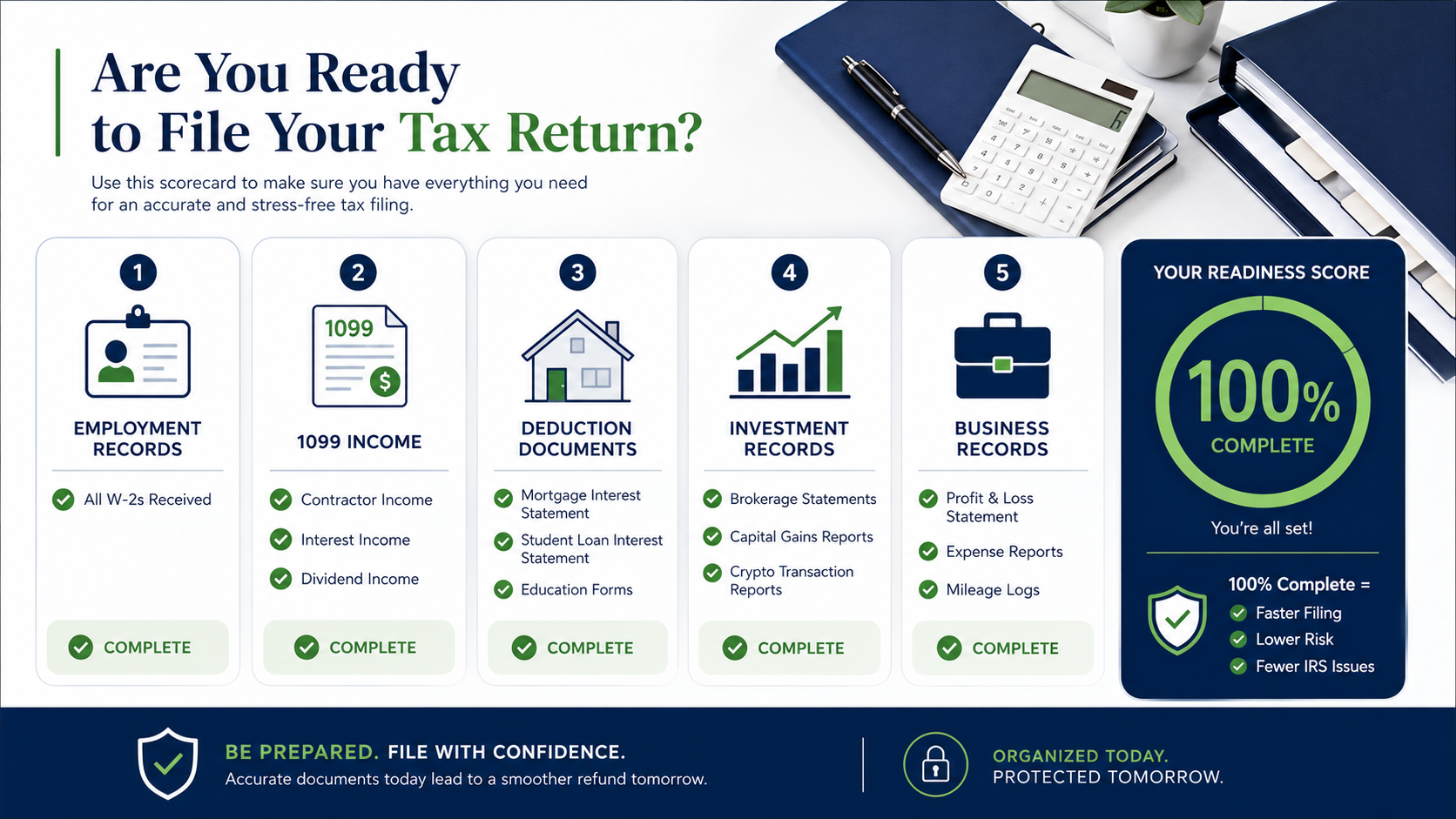

5 Important Tax Documents That Can Delay Your Return and Trigger Filing Problems
Many taxpayers assume that complicated tax laws are the biggest obstacle to filing an accurate return. In reality, tax professionals often face a much simpler challenge: missing tax documents.
Whether you’re an employee, freelancer, investor, or business owner, incomplete records can delay return preparation, increase the risk of IRS notices, and even lead to amended returns later.
Before filing your next return, make sure you have all required tax documents in hand. A few missing forms can create weeks of delays and unnecessary stress.
Let’s look at the five most important tax documents that commonly cause filing problems.
Why Missing Tax Documents Cause Filing Delays
A tax return is only as accurate as the information provided.
When taxpayers fail to provide complete tax documents, several issues may occur:
- Incorrect income reporting
- Missing deductions
- Delayed tax preparation
- IRS matching notices
- Amended returns
- Delayed refunds
The IRS receives copies of many tax documents directly from employers, banks, brokers, and financial institutions. If the information on your return does not match IRS records, your return may be flagged for review.
This is why collecting all tax documents before filing is essential.
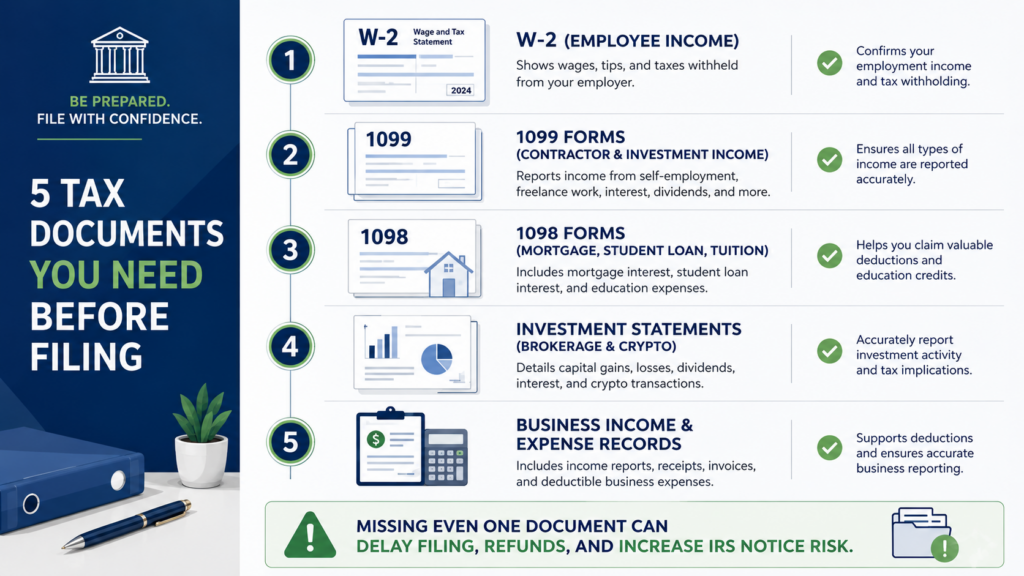
Tax Document #1 – Form W-2
For employees, Form W-2 is one of the most important tax documents.
This form reports:
- Wages earned
- Federal tax withheld
- Social Security wages
- Medicare wages
- State tax withholding
Many taxpayers mistakenly believe they received only one W-2 when they actually worked for multiple employers during the year.
Before filing, verify that you have received every W-2 associated with your Social Security number.
Common W-2 Problems
- Multiple employers forgotten
- Incorrect Social Security numbers
- Missing state withholding information
- Waiting to receive corrected forms
Even one missing W-2 can create reporting discrepancies.
Tax Document #2 – Form 1099 Series
The Form 1099 family creates more filing surprises than almost any other category of tax documents.
Common forms include:
Form 1099-NEC
Reports nonemployee compensation and contractor income.
Form 1099-MISC
Reports miscellaneous income.
Form 1099-INT
Reports interest income.
Form 1099-DIV
Reports dividend income.
Form 1099-K
Reports payment platform transactions.
Taxpayers often overlook smaller forms because they believe the amounts are insignificant.
However, the IRS receives these tax documents and expects them to be reported accurately.
Tax Document #3 – Form 1098
Form 1098 reports expenses that may generate valuable tax deductions.
Common examples include:
Mortgage Interest Statement (Form 1098)
Used to claim mortgage interest deductions when applicable.
Student Loan Interest Statement (Form 1098-E)
May allow eligible taxpayers to claim student loan interest deductions.
Tuition Statement (Form 1098-T)
Supports education-related tax benefits.
Many taxpayers focus heavily on income tax documents but overlook forms that support deductions and credits.
That mistake can increase tax liability unnecessarily.
Tax Document #4 – Brokerage and Investment Statements
Investment income reporting has become significantly more complex.
Investors may receive tax documents reporting:
- Capital gains
- Dividend income
- Interest income
- Mutual fund distributions
- Cryptocurrency transactions
Many brokerage firms issue corrected tax documents after their initial release.
Filing too early without final investment statements may require an amended return later.
Common Investment Reporting Issues
- Missing brokerage statements
- Unreported capital gains
- Cryptocurrency activity
- Reinvested dividends
Investors should confirm that all year-end tax documents have been received before filing.
Tax Document #5 – Business Income and Expense Records
Self-employed individuals and business owners often create the largest filing delays.
Unlike employees who receive W-2s, business owners must maintain their own records.
Important tax documents may include:
- Profit and loss statements
- Expense reports
- Bank statements
- Credit card records
- Mileage logs
- Accounting reports
Poor bookkeeping often results in:
- Missing deductions
- Inaccurate income reporting
- Extended preparation time
- Higher tax bills
Good recordkeeping throughout the year makes tax season significantly easier.
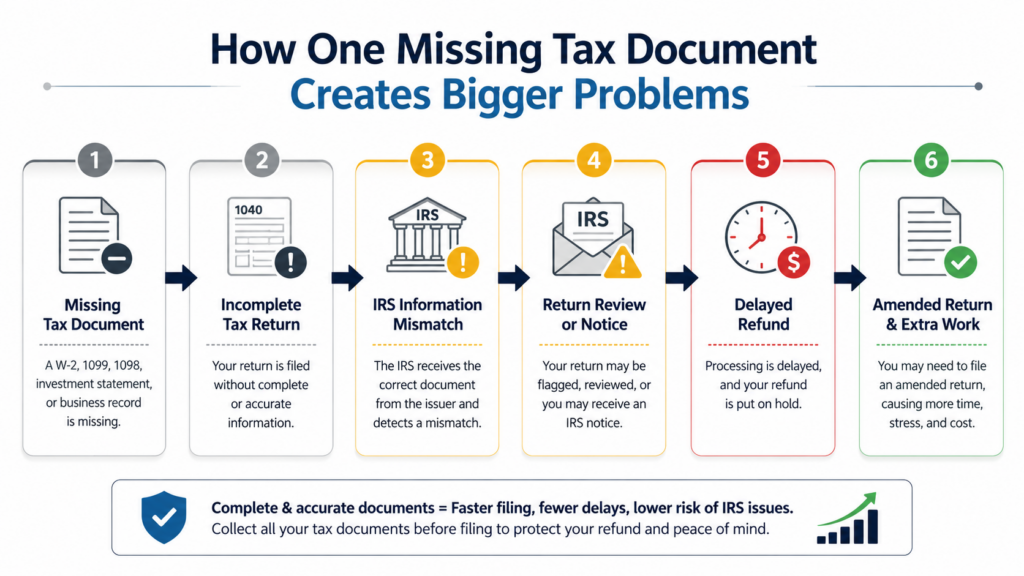
Many taxpayers focus solely on getting their refunds quickly.
However, filing before receiving all tax documents can create serious problems.
Potential consequences include:
- Refund delays
- IRS notices
- Amended returns
- Additional tax assessments
- Interest and penalties
Waiting a little longer for complete documentation is often far better than correcting errors later.
Best Practices for Organizing Tax Documents
The easiest way to reduce filing problems is to build a document collection system.
Consider creating folders for:
Employment Records
- W-2s
- Pay stubs
Investment Records
- Brokerage statements
- Dividend reports
Business Records
- Income reports
- Expense documentation
Deduction Records
- Mortgage interest
- Student loan interest
- Charitable contributions
Keeping tax documents organized throughout the year can save significant time during filing season.
Frequently Asked Questions
What happens if I forget a tax document?
You may need to file an amended return if the omitted information affects your tax liability.
Can the IRS detect missing tax documents?
Yes. The IRS receives copies of many tax documents directly from employers, banks, brokers, and payment processors.
Should I file if I’m waiting for one tax document?
Generally, it is best to wait until all expected tax documents are received before filing.
Which tax documents are most commonly missed?
Forms 1099, investment statements, and self-employment records are among the most frequently overlooked items.
Can missing tax documents delay my refund?
Yes. Incorrect or incomplete returns may trigger IRS reviews that delay processing and refunds.
Conclusion
Tax filing delays are often caused by something surprisingly simple: missing documents.
Whether it’s a forgotten W-2, overlooked 1099, missing mortgage statement, investment report, or incomplete business records, small documentation gaps can create significant problems.
Before filing your return, take time to verify that all documents have been received and reviewed. A complete file not only speeds up preparation but also reduces the risk of IRS notices, amended returns, and delayed refunds.
The most successful tax seasons start with organized records long before the filing deadline arrives.
Call to Action
At Veritas Accounting Services, we help individuals, business owners, and professionals stay organized, compliant, and prepared throughout the year.
If you need assistance with tax preparation, bookkeeping, or financial record management, contact our team today and make tax season simpler and stress-free.
GET IN TOUCH
Schedule a FREE Call









Connect on our Socials!
