






From 5 to 50 Employees: What Changes as Your Business Grows?
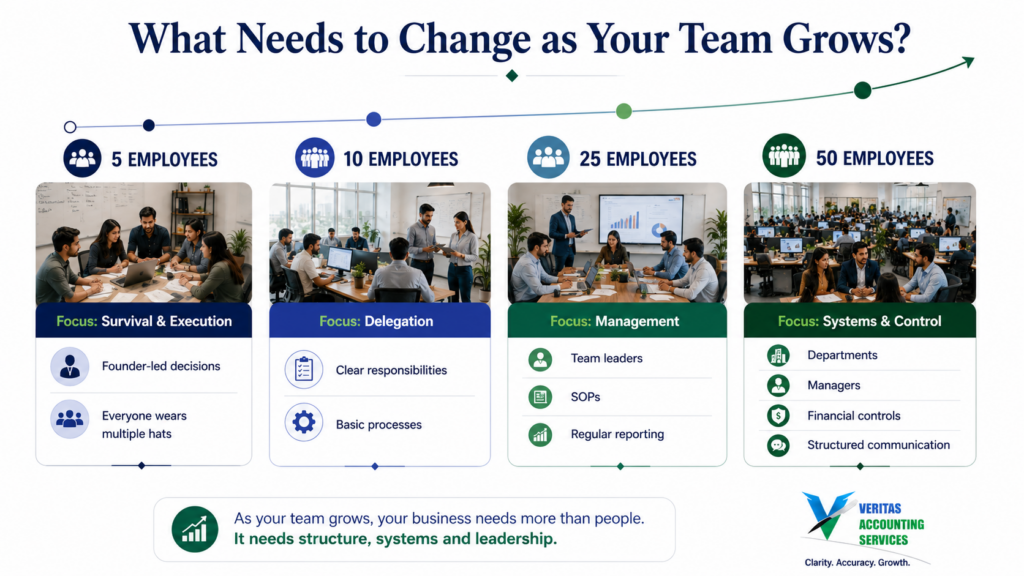
Going from 5 employees to 50 is a major milestone.
It means more customers, more revenue, more responsibilities, and usually more opportunities. But it also changes the way the business needs to operate.
The systems that worked perfectly when you had five people may start creating problems when you have 20. The informal communication that worked with 10 employees may become inefficient at 30. And the founder who could personally approve every decision may become a bottleneck at 50.
This is one of the less obvious challenges of business growth.
Adding employees is relatively straightforward. Building the structure needed to manage those employees effectively is much harder.
As business growth accelerates, companies need to evolve from founder-led operations toward organized systems, defined responsibilities, reliable financial controls, and management processes that can work without everything going through one person.
The transition from 5 to 50 employees is therefore not simply about hiring 45 additional people.
It is about building a different business.
What Works With 5 Employees May Not Work With 50
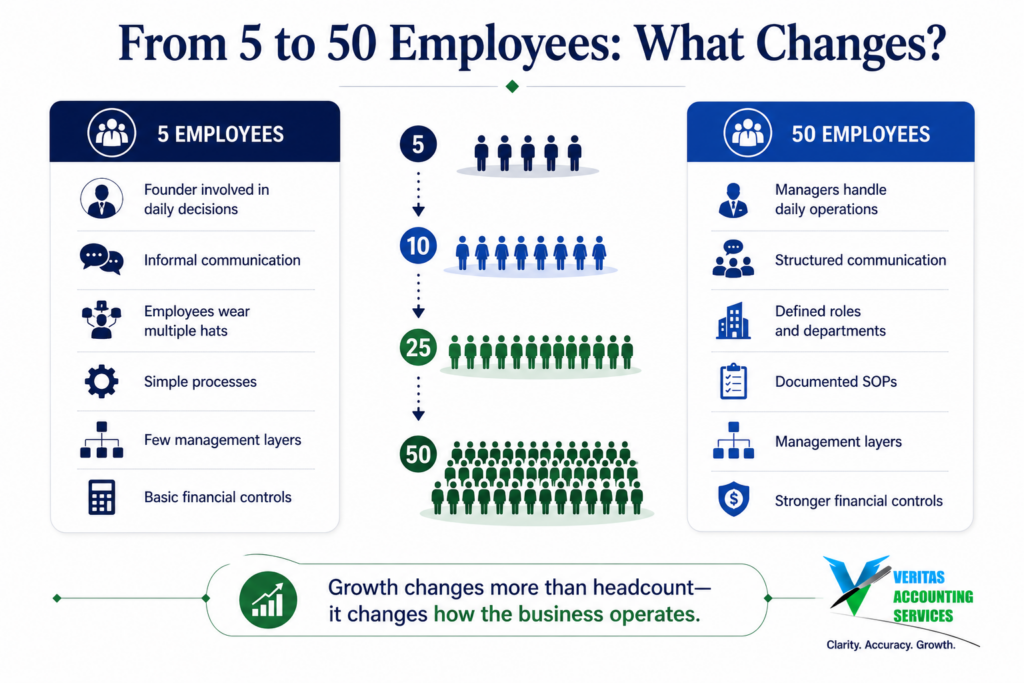
When a business has five employees, communication is usually simple.
Everyone knows what everyone else is doing.
The founder may speak directly with every team member.
Questions can be answered quickly.
Approvals can happen informally.
Financial information may exist in a few spreadsheets.
Processes may live in the founder’s head.
That can work at a small scale
But as business growth continues, these informal systems begin to break down.
At 50 employees, there are more people, more decisions, more transactions, more customers, and more opportunities for mistakes.
The business needs structure.
That doesn’t mean creating unnecessary bureaucracy.
It means creating enough structure to allow the business to operate consistently as complexity increases as business growth continues.
1. The Founder Cannot Manage Everything Personally
One of the first major changes is delegation.
With five employees, a founder might personally handle:
- Hiring
- Customer complaints
- Payments
- Financial approvals
- Sales decisions
- Vendor relationships
- Employee questions
At 50 employees, this approach becomes difficult to sustain.
If every decision requires the founder’s involvement, growth eventually slows down.
Employees wait for approvals.
Managers cannot move quickly.
The founder spends more time solving small operational issues and less time working on strategy.
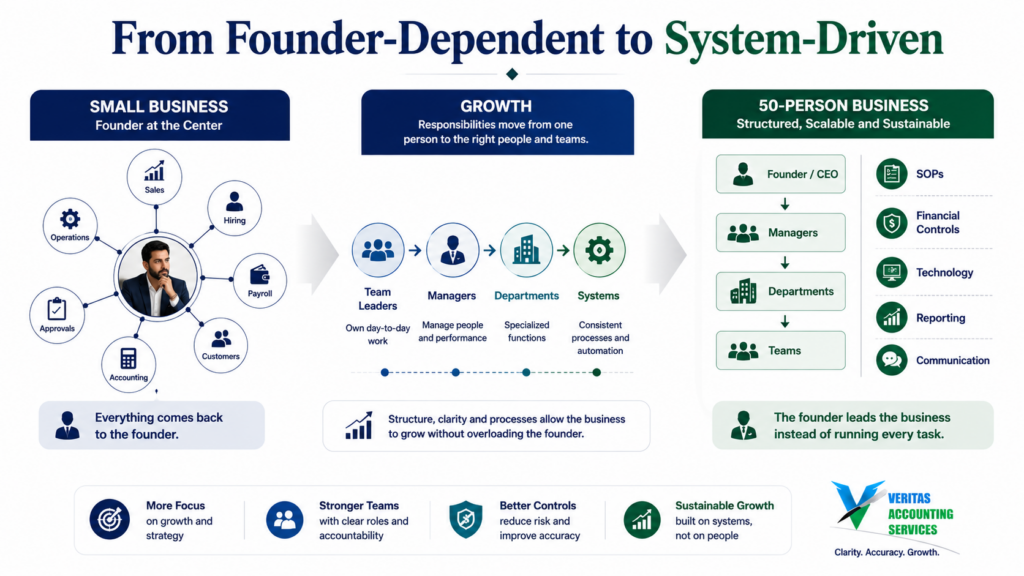
Business growth requires founders to move from doing everything to building people and systems that can do things without them.
The goal isn’t to lose control.
The goal is to create appropriate levels of responsibility.
2. Management Layers Become More Important
A five-person business may not need formal management layers.
A 50-person company probably does.
You may need:
- Team leaders
- Department managers
- Operations managers
- Finance leadership
- HR responsibility
- Senior operational roles
This creates a management structure between the founder and individual employees.
The founder should increasingly focus on questions such as:
Where is the company going?
What markets should we enter?
What investments should we make?
What risks should we manage?
Meanwhile, managers can focus on executing those priorities.
Without delegation and management structure, business growth can create a situation where the founder becomes the approval point for almost everything.
That’s not scalable.
3. Informal Processes Need to Become SOPs
When there are five employees, someone can simply explain how something works.
“Just ask me if you have a question.”
At 50 employees, that approach creates inconsistency.
What happens when the person who knows the process leaves?
What happens when a new employee joins?
What happens when the business opens another location?
This is where Standard Operating Procedures become valuable.
Document processes for important activities such as:
- Client onboarding
- Invoicing
- Expense approvals
- Purchasing
- Payroll
- Customer service
- Employee onboarding
- Bank reconciliations
- Month-end closing
- Sales processes
Good SOPs don’t need to be complicated.
They simply need to explain what should happen, who is responsible, and what standards need to be followed.
Business growth becomes easier to manage when important knowledge isn’t stored only in people’s heads.
4. Financial Controls Need to Become Stronger
Financial controls that are acceptable for a five-person business may not be appropriate for a 50-person company.
As transaction volume increases, the opportunity for mistakes also increases.
You may now have:
- Multiple bank accounts
- More credit cards
- Larger payroll
- More vendors
- Higher customer balances
- More purchasing activity
- Larger expense volumes
- More financial approvals
At this stage, businesses should consider controls such as:
- Separation of responsibilities
- Approval limits
- Bank reconciliation procedures
- Credit card reviews
- Vendor approval processes
- Payment authorization
- Regular financial reporting
The objective is not to make the business slower.
Good controls should make the business safer while allowing routine decisions to happen efficiently.
5. Payroll Becomes a Bigger Part of Financial Management
Going from five employees to 50 dramatically changes the financial importance of payroll.
Payroll is no longer simply a recurring administrative payment.
It becomes one of the company’s largest operating costs.
Management needs to understand:
- Total payroll cost
- Benefits
- Overtime
- Payroll taxes
- Hiring costs
- Department-level staffing costs
- Revenue generated per team or department
This information can help answer important questions.
Is the company hiring faster than revenue is growing?
Which departments are becoming more expensive?
Can the business support additional employees?
Are certain teams understaffed or overstaffed?
As business growth continues, payroll data becomes increasingly important for financial planning.
The culture that helped create early business growth should evolve without losing the principles that made the company successful.
6. Financial Reporting Needs to Become More Regular
A small business owner may look at the bank balance and have a reasonable understanding of the company’s financial position.
That becomes much harder as the organization grows.
At 50 employees, management should have regular access to financial reports.
Depending on the business, these may include:
- Profit and loss statement
- Balance sheet
- Cash-flow report
- Accounts receivable aging
- Accounts payable aging
- Budget vs. actual
- Department performance
- Key performance indicators
The goal is not to create dozens of reports.
The goal is to provide management with the information required to make decisions.
Accurate and timely financial reporting gives leadership a clearer view of whether growth is actually creating profitability.
7. Cash Flow Becomes More Important as the Business Gets Larger
Growth can consume cash.
You may need to hire employees before receiving customer payments.
You may need to purchase inventory before generating sales.
You may extend credit to customers.
You may invest in equipment, software, offices, or additional locations.
This means a profitable business can still experience cash-flow pressure.
As business growth accelerates, cash-flow forecasting becomes increasingly valuable.
Management should understand expected:
Cash Inflows
- Customer collections
- Financing
- Other operating receipts
Cash Outflows
- Payroll
- Suppliers
- Taxes
- Loans
- Rent
- Capital expenditures
- Other operating expenses
A forward-looking cash-flow forecast can help management identify potential shortages before they become emergencies.
8. Technology Should Replace Manual Work Where Practical
A five-person business can survive with spreadsheets and manual processes.
A 50-person business may find those same processes increasingly difficult to manage.
This is where technology becomes important.
Depending on the business, systems may be needed for:
- Accounting
- Payroll
- CRM
- Project management
- Expense management
- Inventory
- Customer support
- Document management
- Reporting
The purpose isn’t to buy software simply because the business is growing.
The purpose is to reduce repetitive work, improve accuracy, and give employees access to consistent information.
The right technology can allow a 50-person company to operate more efficiently than a much smaller company relying entirely on manual processes.
9. Communication Needs Structure
With five employees, communication can happen naturally.
People talk across desks.
The founder can call everyone into a quick meeting.
Everyone generally knows what’s happening.
At 50 employees, communication requires more structure.
Consider:
- Regular team meetings
- Department meetings
- Management meetings
- Written procedures
- Project management tools
- Company-wide updates
- Clear reporting lines
Employees should know:
Who do I report to?
Who approves my work?
Where do I find information?
Who handles this type of problem?
Clear communication reduces confusion and prevents the founder from becoming the central information hub.
10. Hiring Needs to Become More Strategic
When a company has five employees, one poor hiring decision can still create problems.
At 50 employees, hiring mistakes can become significantly more expensive.
Recruitment should therefore become more structured.
Businesses should define:
- Job responsibilities
- Required skills
- Reporting structure
- Performance expectations
- Compensation structure
- Onboarding process
- Training requirements
You should also think about the skills the company will need six or twelve months from now—not only the skills required today.
Business growth creates new roles.
A company that once needed generalists may eventually need specialists in finance, HR, operations, marketing, technology, or compliance.
11. The Founder Needs Better Financial Visibility
As the company grows, the founder should spend less time entering transactions and more time understanding what the numbers are saying.
Important questions may include:
- Which departments are profitable?
- What is our cash position?
- Are margins improving?
- How much does each new employee cost?
- How quickly are customers paying?
- Are operating expenses growing too quickly?
- Can we afford another location?
- How much cash will expansion require?
This is where accounting moves beyond bookkeeping.
Reliable accounting data becomes a management tool.
Business growth becomes easier to manage when founders have accurate financial information before making major decisions.
12. Your Organizational Structure Must Catch Up With Your Growth
A company with five employees can often operate around personalities.
A company with 50 employees needs roles.
People need to know who is responsible for what.
A simple organizational structure can clarify:
Founder / CEO
↓
Department Heads
↓
Managers / Team Leaders
↓
Employees
The exact structure will vary by company.
The important point is that responsibility should be clear.
When nobody clearly owns a task, problems are often passed between departments.
When too many people own the same task, accountability can disappear.
Clear responsibility supports efficient business growth.
13. Culture Needs to Be Intentional
Culture can happen naturally when a company is small.
As the company grows, culture needs more deliberate attention.
New employees don’t automatically understand how the founders think.
They need to understand:
- Company values
- Expectations
- Communication standards
- Customer service principles
- Decision-making approach
- Performance expectations
This doesn’t mean creating a long list of corporate slogans.
It means making expectations clear and reinforcing them through hiring, onboarding, management, and leadership behavior.
The culture that helped create early business growth should evolve without losing the principles that made the company successful.
The 5-to-50 Transition Is About Systems, Not Just People
It is tempting to think:
“We need more employees because we’re growing.”
But adding employees without improving systems can create more complexity rather than solving it.
If five people use a confusing process, adding 45 more people doesn’t fix the process.
It magnifies the problem.
That is why businesses approaching 50 employees should review:
- Organizational structure
- SOPs
- Technology
- Financial controls
- Reporting
- Communication
- Hiring
- Management
- Cash-flow planning
The objective is to make the organization capable of handling greater complexity.
A Simple 5-to-50 Business Growth Checklist
As your team expands, ask:
People
Do employees have clearly defined responsibilities?
Management
Do managers have enough authority to make routine decisions?
Processes
Are important workflows documented?
Finance
Are financial records current and reconciled?
Reporting
Does management receive useful financial reports regularly?
Cash Flow
Do you have a forward-looking cash-flow forecast?
Technology
Are employees still relying heavily on spreadsheets and manual processes?
Controls
Are payments, expenses, and financial responsibilities appropriately controlled?
Communication
Do employees know where to go for information and decisions?
Strategy
Is the founder spending enough time on the future rather than solving daily operational problems?
If several answers are “no,” the business may be growing faster than its infrastructure.
Final Thoughts
Going from 5 to 50 employees is an exciting achievement.
But business growth business growth changes almost everything.
The founder’s role changes.
Management becomes more important.
Processes need to be documented.
Financial controls become more critical.
Technology becomes more valuable.
Communication needs structure.
Financial reporting needs to become more sophisticated.
And decisions increasingly need to be made through systems rather than personal involvement.
The goal isn’t to make a growing company feel like a large corporation.
The goal is to create enough structure that the business can continue growing without becoming increasingly dependent on the founder.
At Veritas Accounting Services, we help business growth strengthen their bookkeeping, accounting, financial reporting, and financial management processes as their operations become more complex.
Because the best time to build scalable systems isn’t after growth creates problems.
It is before those problems become expensive.
Frequently Asked Questions
What changes when a business grows from 5 to 50 employees?
The business typically needs stronger management structures, documented processes, financial controls, technology, communication systems, business growth, payroll processes, and regular financial reporting.
Why do small-business systems stop working as companies grow?
Small-business systems often depend on informal communication and founder involvement. As employee numbers and transaction volumes increase, those methods become difficult to manage consistently. business growth. The culture that helped create early business growth should evolve without losing the principles that made the company successful.
When should a business start documenting its processes?
Important processes should be documented before they become difficult to manage. Businesses experiencing rapid growth should prioritize SOPs for financial, operational, HR, customer, and administrative processes.
Does a growing business- business growth need a finance team?
Not necessarily a large internal team. Depending on complexity, a business may use a combination of internal employees, outsourced accounting support, and specialized financial professionals.
Why is cash-flow forecasting important during business growth?
Growth can require cash before revenue is collected. Hiring employees, purchasing inventory, expanding facilities, and investing in equipment can all create cash requirements that may not be obvious from the profit and loss statement alone.
Schedule a FREE Call
GET IN TOUCH