






Growing Fast but Running Out of Cash? Here’s Why
Business owners often assume that increasing sales automatically lead to more cash in the bank.
Unfortunately, that isn’t always true.
Many successful businesses experience serious cash flow problems during periods of rapid growth. Sales increase, customers keep placing orders, profits look healthy, yet payroll becomes stressful, suppliers demand payment, and the bank balance continues shrinking.
At first glance, this seems impossible.
How can a growing business struggle with cash?
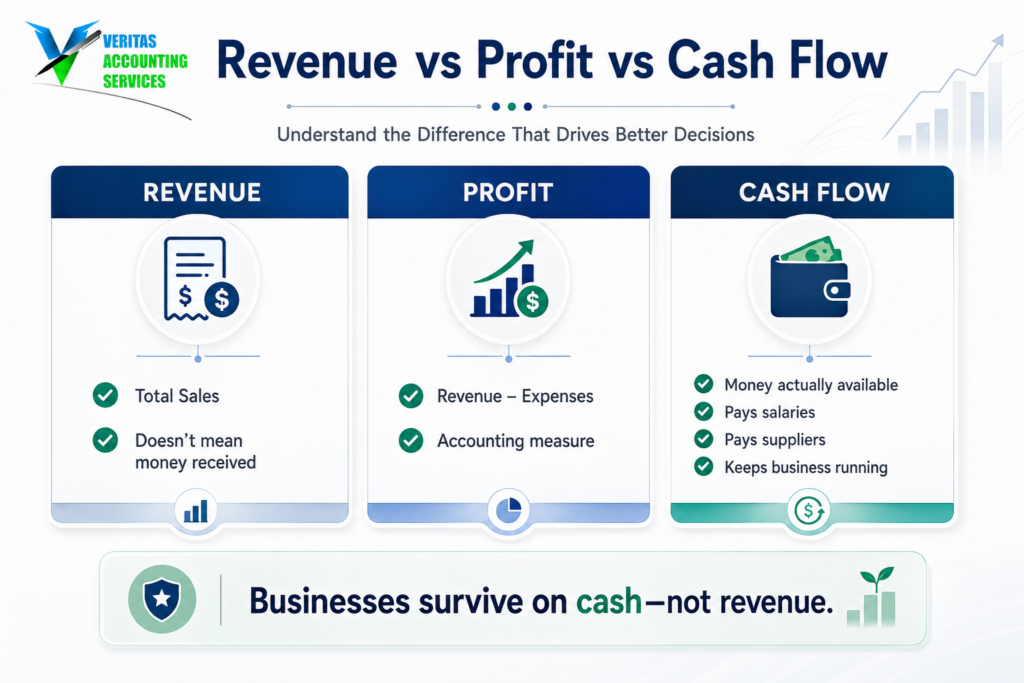
The answer lies in understanding the difference between revenue, profit, and cash flow.
Revenue shows how much you’ve sold.
Profit measures what remains after expenses.
Cash represents the money actually available to operate the business.
A company can report record-breaking sales while still facing significant cash flow problems if cash isn’t arriving at the right time or is being consumed faster than it comes in.
Understanding why this happens is the first step toward building a financially stronger business.
Why Revenue Doesn’t Equal Cash
One of the biggest misconceptions among entrepreneurs is believing that revenue automatically becomes available cash.
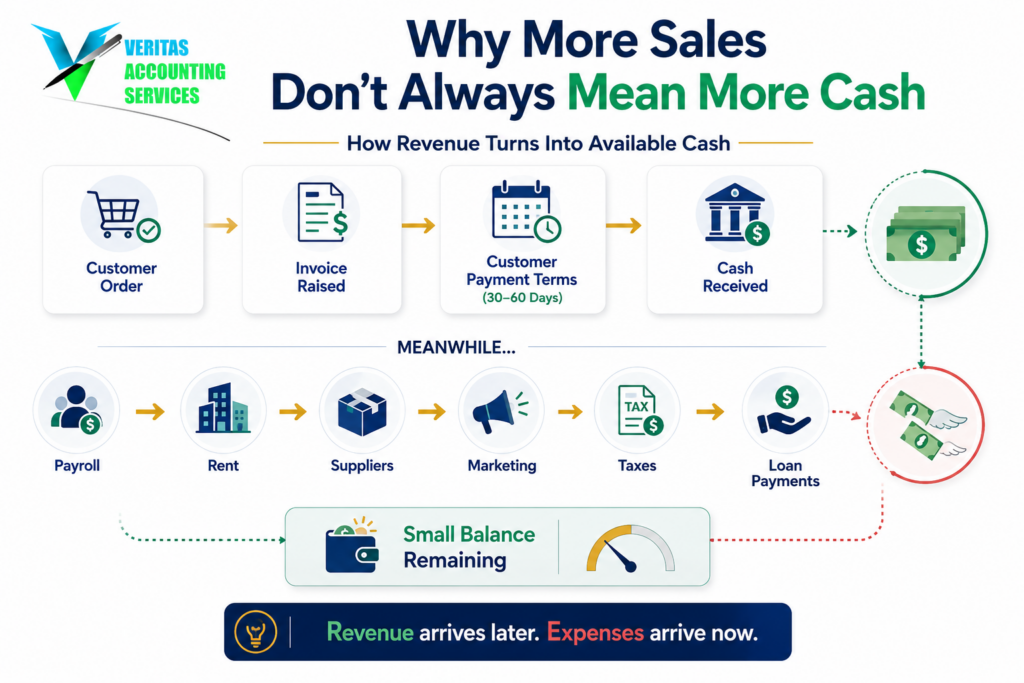
Imagine a business that invoices customers for $500,000 during the month.
The sales look impressive.
However, if those customers have 60-day payment terms, very little of that money may actually be sitting in the company’s bank account today.
Meanwhile, the business must continue paying:
- Employee salaries
- Rent
- Marketing costs
- Software subscriptions
- Loan repayments
- Inventory purchases
- Taxes
This timing gap is one of the most common causes of cash flow problems.
Financial statements may show healthy growth, but the business still lacks enough cash to fund daily operations.
This is why experienced finance professionals focus just as much on cash flow as they do on revenue.
Customers Pay Later, Bills Come First
Most businesses don’t receive payment immediately after making a sale.
Instead, they offer payment terms such as:
- 15 days
- 30 days
- 45 days
- 60 days
Some industries wait even longer.
While businesses wait for customers to pay, their own expenses continue without delay.
Suppliers expect payment.
Employees expect salaries.
Governments expect taxes.
Landlords expect rent.
The result is a growing gap between money leaving the business and money coming in.
As sales increase, this gap often becomes larger rather than smaller.
Ironically, growth itself can increase cash flow problems if receivables are not managed carefully.
Businesses that monitor outstanding invoices, follow up on overdue accounts, and shorten collection periods generally maintain healthier cash positions.
Inventory Can Quietly Drain Cash
Inventory is another major reason growing businesses suddenly experience financial pressure.
Consider an e-commerce business preparing for higher demand.
To avoid stock shortages, management purchases additional inventory months before it is sold.
Although this decision supports future sales, it immediately reduces available cash.
The inventory may remain in a warehouse for weeks or even months before generating revenue.
During that time, the business has already paid suppliers, freight companies, customs duties, storage costs, and insurance expenses.
The cash has left the business, but sales haven’t yet generated replacement cash.
Many retail, manufacturing, and e-commerce businesses underestimate how much working capital becomes tied up in inventory.
Effective inventory management is therefore one of the most important tools for reducing cash flow problems.
Rapid Growth Increases Operating Costs
Growth creates opportunities, but it also creates expenses.
As businesses expand, they often invest in:
- New employees
- Additional office space
- Larger warehouses
- Better technology
- Increased advertising
- New equipment
- Professional services
Most of these costs must be paid before they generate additional revenue.
For example, hiring five new employees increases payroll immediately.
However, the additional sales those employees generate may not appear for several months.
This timing difference places pressure on available cash.
Without careful planning, businesses may experience cash flow problems despite reporting excellent sales growth.
Successful companies understand that growth requires funding.
The faster a business grows, the greater its working capital requirements become.
Borrowing Can Create Hidden Cash Pressure
Business loans often help finance expansion.
However, loan repayments affect cash differently than they affect profit.
When a company repays the principal portion of a loan:
- Cash decreases.
- Profit does not.
Many business owners overlook this difference.
Financial statements may still show healthy profits while loan repayments steadily reduce available cash each month.
The same applies to equipment financing, vehicle loans, and other debt obligations.
Borrowing can support growth, but repayment schedules should always be considered when evaluating future cash needs.
Ignoring debt obligations during planning frequently contributes to unexpected cash flow problems.
Why Cash Flow Forecasting Matters More Than Ever
One of the biggest differences between businesses that survive rapid growth and those that struggle is financial visibility.
Many companies only review historical financial statements. While these reports explain what happened last month, they do not show what is likely to happen next month.
This is where cash flow forecasting becomes invaluable.
A well-prepared cash flow forecast estimates:
- Expected customer receipts
- Supplier payments
- Payroll obligations
- Tax payments
- Loan repayments
- Capital expenditures
- Planned investments
By forecasting cash movements in advance, business owners can identify potential shortfalls before they become emergencies.
Instead of reacting to cash flow problems, they can take proactive steps to improve liquidity.
Growing businesses should review cash flow forecasts regularly rather than waiting until year-end.
Practical Ways to I
Key Financial Indicators Every Business Should Monitor
Growing companies should not rely solely on revenue when evaluating performance.
Several financial indicators provide early warning signs of potential cash flow problems.
These include:
Operating Cash Flow
Measures whether day-to-day operations are generating sufficient cash and observe whether there is any cash flow problems.
Accounts Receivable Days
Shows how long customers take to pay.
Long collection periods often create liquidity challenges.
Inventory Turnover
Indicates how efficiently inventory converts into sales.
Low turnover may suggest excessive capital tied up in stock.
Current Ratio
Measures the business’s ability to meet short-term obligations.
Working Capital
Represents the funds available to operate the business on a daily basis.
Monitoring these indicators regularly helps identify cash flow problems and other problems before they affect operations.
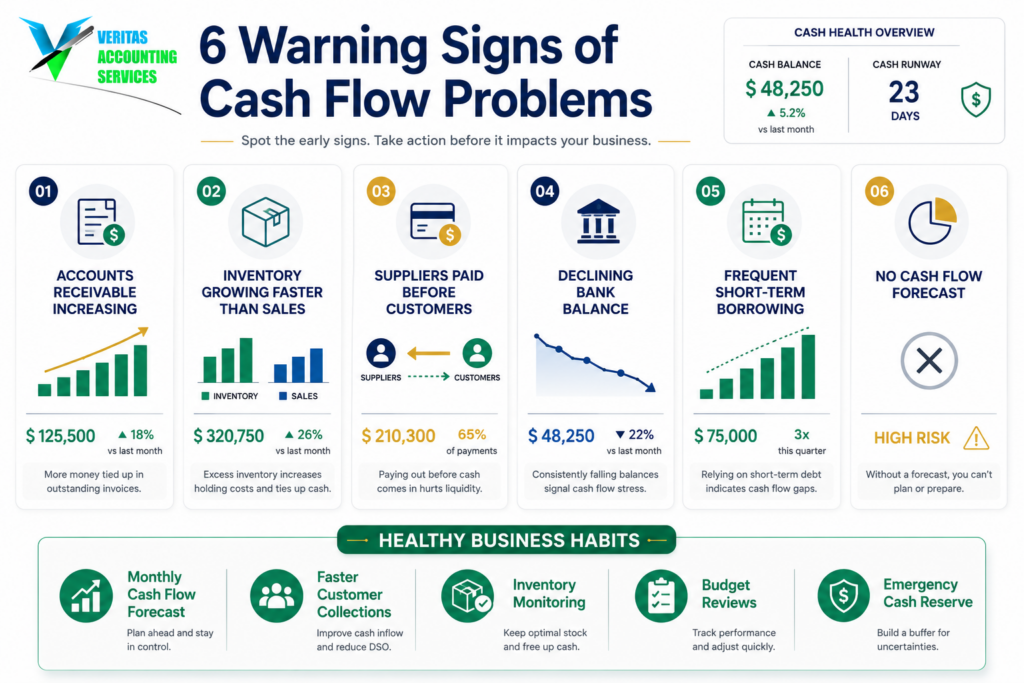
Why a Virtual CFO Can Make a Difference
Many small and medium-sized businesses have excellent accountants but lack strategic financial guidance.
A Virtual CFO provides more than bookkeeping or tax compliance.
They help businesses:
- Prepare cash flow forecasts
- Monitor key performance indicators
- Improve budgeting
- Evaluate financing options
- Strengthen working capital
- Support expansion decisions
- Build long-term financial strategies
Rather than reacting to financial challenges, a Virtual CFO helps business owners anticipate them and cash flow problems.
For companies experiencing rapid growth, this strategic support often becomes one of the most valuable investments they make.
Frequently Asked Questions
Why do profitable businesses experience cash shortages?
Profit is calculated using accounting principles, while cash flow measures the actual movement of money.
A profitable business can still experience cash flow problems if customer payments are delayed, inventory levels increase, or operating costs grow faster than cash collections.
What is the difference between revenue and cash flow?
Revenue represents sales earned during a period.
Cash flow represents the money actually received and available to operate the business.
The two are closely related but not the same.
How often should a cash flow forecast be updated?
Most growing businesses should review and update their cash flow forecast at least monthly.
Businesses experiencing rapid growth or seasonal fluctuations may benefit from weekly reviews.
Can bookkeeping improve cash flow?
Yes.
Accurate bookkeeping provides reliable financial information that helps business owners monitor receivables, expenses, inventory, and profitability, making it easier to manage cash effectively and overcome cash flow problems.
When should a business consider hiring a Virtual CFO?
Businesses should consider Virtual CFO services when they need financial forecasting, budgeting, strategic reporting, or guidance for growth but are not ready to hire a full-time CFO.
Conclusion
Business growth is exciting, but it often creates financial challenges that many entrepreneurs do not anticipate.
Higher sales do not automatically produce stronger cash flow.
Delayed customer payments, increasing inventory, expansion costs, debt repayments, and poor forecasting can all contribute to cash flow problems, even when profitability appears healthy.
The businesses that grow successfully are those that monitor cash as carefully as they monitor revenue.
By understanding where cash goes, forecasting future needs, and implementing strong financial controls, business owners can support sustainable growth without unnecessary financial stress.
Ultimately, revenue drives growth—but cash keeps the business alive.
Call to Action
At Veritas Accounting Services, we help businesses strengthen cash flow through accurate bookkeeping, financial reporting, budgeting, forecasting, and Virtual CFO services.
Whether you’re experiencing rapid growth or planning your next stage of expansion, our team can help you build a stronger financial foundation.
Contact us today to discover how better financial management can support long-term business success.
GET IN TOUCH
Schedule a FREE Call