Before You Expand Overseas, Make Sure These 10 Things Are Ready
Expanding into another country can be one of the most exciting stages of business growth.
A new market can bring new customers, larger revenue opportunities, access to talent, stronger supplier relationships, and greater geographic diversification.
But international growth also introduces complexity.
Taxes may work differently. Banking becomes more complicated. Employees may create local obligations. Customers may pay in different currencies. Accounting systems must handle foreign transactions, and regulatory requirements can vary significantly between countries.
This is why cross-border expansion should never begin with sales alone.
Before entering another market, businesses need to understand whether their financial, tax, accounting, and operational infrastructure is ready to support international growth.
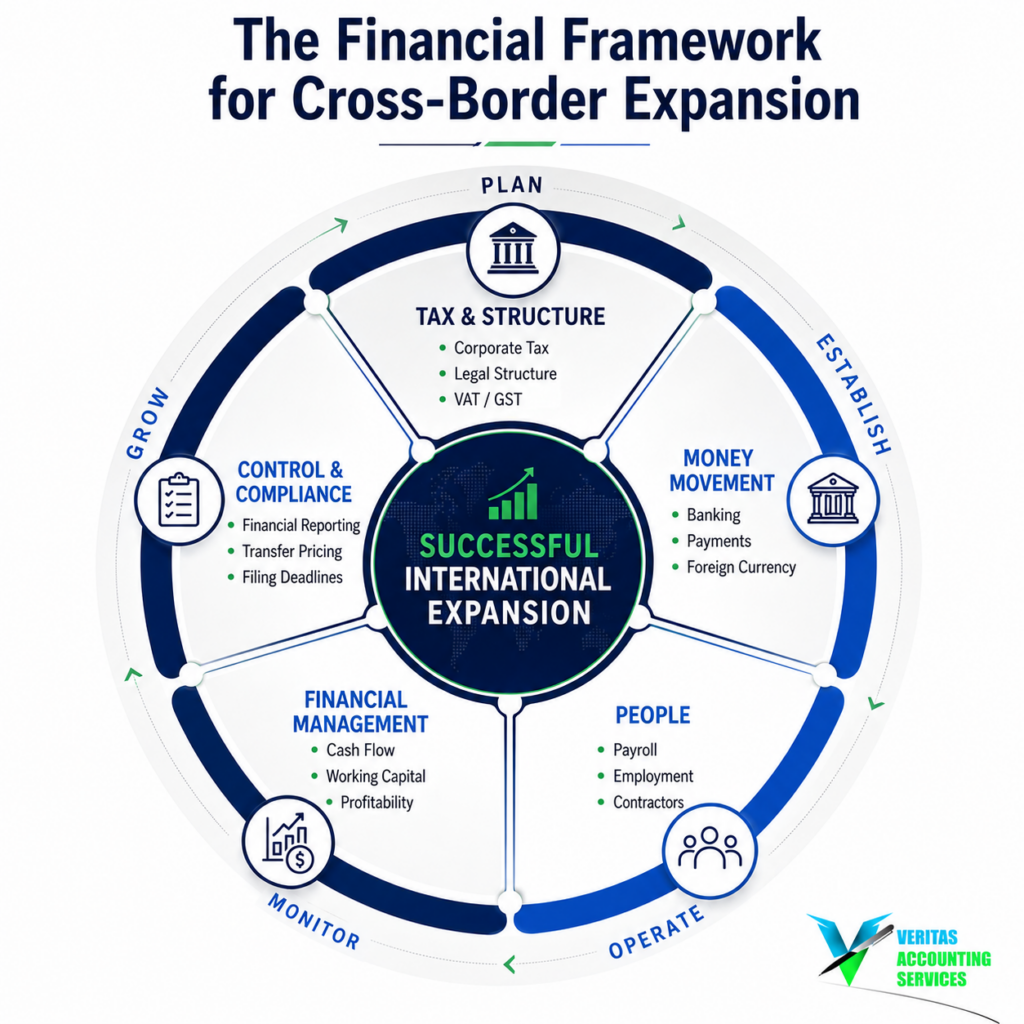
A successful cross-border expansion requires much more than registering a company and opening a bank account. It requires planning how money will move, how transactions will be recorded, where taxes may arise, how employees will be managed, and how management will maintain financial visibility across multiple countries.
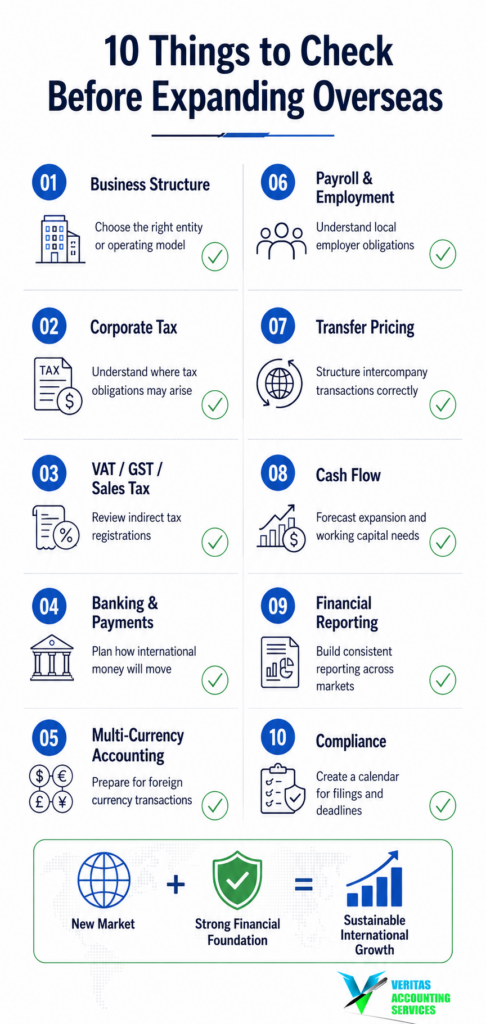
Before your business takes the next international step, make sure these 10 areas are ready.
Why Cross-Border Expansion Requires More Than a Growth Plan
International expansion often begins with an opportunity.
Perhaps customers from another country are already buying from you.
Maybe you have identified a promising new market.
Perhaps you want to establish an overseas team, distribution center, subsidiary, or e-commerce presence.
The commercial opportunity may be clear.
The financial consequences may not be.
Cross-border expansion can introduce questions involving corporate structure, taxation, VAT or GST, payroll, banking, foreign currencies, transfer pricing, financial reporting, and regulatory compliance.
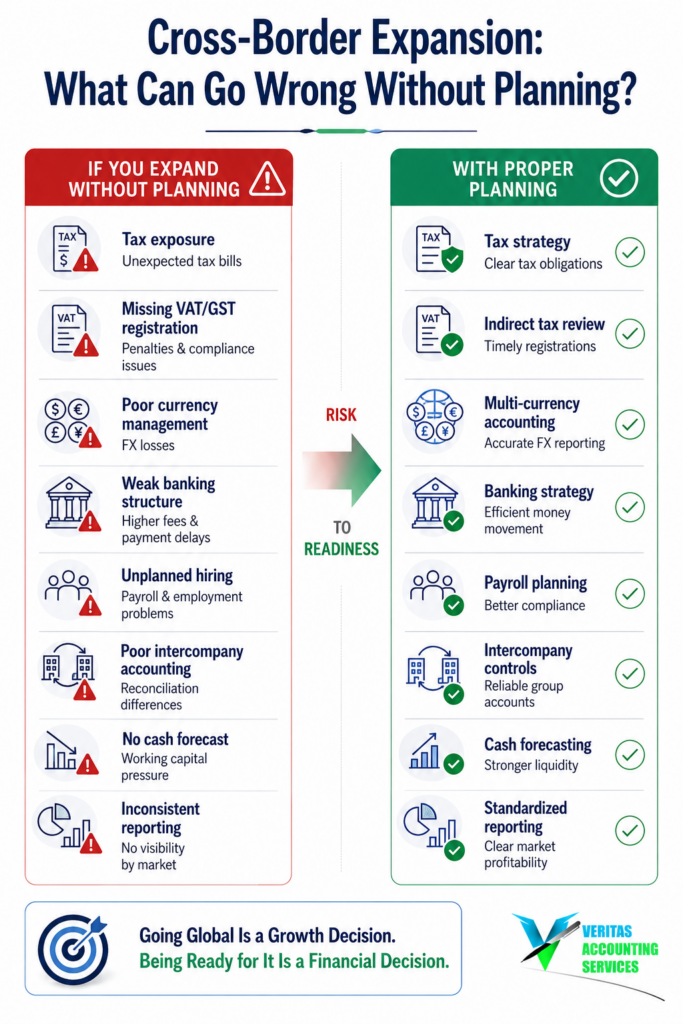
Ignoring these issues does not make them disappear.
It simply means they may surface later—when fixing them becomes more expensive.
That is why financial planning should begin before the first major international transaction.
Veritas Expert Insight
International growth should not be planned around sales alone. Before entering a new country, understand how the expansion will affect tax, cash flow, accounting, compliance, and profitability.
1. Choose the Right Legal and Business Structure
One of the first cross-border expansion decisions is how your business will operate in the new country.
Depending on the jurisdiction and business model, options might include operating directly from the existing company, establishing a branch, forming a subsidiary, working through a local entity, or using independent distributors or service providers.
The structure you choose can affect:
Corporate taxation
Legal liability
Banking
Local registrations
Profit repatriation
Payroll
Financial reporting
Compliance obligations
Do not choose a structure simply because it is easy to establish.
The cheapest structure to register may not be the most appropriate structure for long-term operations.
Before making the decision, consider what the business expects to look like in that market three or five years from now—not just during the first few months.
Professional legal and tax advice in the relevant jurisdictions is essential because requirements vary significantly between countries.
2. Understand Where Your Business May Owe Tax
Cross-border expansion can change where a business becomes subject to tax.
A company may begin operating internationally without realizing that its activities could create tax obligations in another jurisdiction.
Depending on applicable laws and tax treaties, factors such as physical presence, employees, offices, management activities, agents, warehouses, or other business operations can become relevant.
Businesses should understand:
Corporate income tax requirements
Permanent establishment considerations
Withholding taxes
Tax treaties
Local registration requirements
Tax filing deadlines
Rules affecting the movement of profits between countries
International tax rules can be complex, and they vary by jurisdiction.
The important point is to investigate potential tax exposure before establishing significant operations.
Tax planning after the structure has already been created provides fewer options than planning before cross-border expansion begins.
3. Check VAT, GST and Sales Tax Requirements
Corporate income tax is only one part of international taxation.
Depending on where you sell and what you sell, your business may also face VAT, GST, sales tax, or similar indirect tax obligations.
This is particularly important for:
E-commerce businesses
SaaS companies
Digital service providers
International retailers
Importers
Exporters
Businesses selling through online marketplaces
Registration requirements may depend on sales levels, customer location, product type, business presence, or other jurisdiction-specific rules.
Do not assume that having no physical office means there are no indirect tax responsibilities.
As part of cross-border expansion, businesses should identify where registrations may be required, how taxes should be collected, what documentation needs to be maintained, and when returns and payments are due.
Getting this right from the beginning is considerably easier than correcting several years of inaccurate treatment later.
4. Set Up International Banking and Payment Systems
International growth changes how money moves through your business.
You may begin receiving customer payments in several currencies while paying overseas suppliers, employees, contractors, and tax authorities from different accounts.
Before cross-border expansion, map the entire movement of funds.
Ask:
Which currencies will customers use?
Do we need local bank accounts?
Which payment gateways will be used?
How will foreign suppliers be paid?
What banking fees will arise?
How long will international settlements take?
How will funds move between entities?
Who will approve international payments?
A poor banking structure can create unnecessary fees, delays, reconciliation problems, and cash flow uncertainty.
Your banking arrangements should therefore be designed around the actual operating model rather than added piece by piece after expansion begins.
5. Build a Multi-Currency Accounting System
Once a business begins operating in multiple currencies, bookkeeping becomes more complicated.
A $10,000 invoice does not necessarily remain worth the same amount in your reporting currency between the invoice date and payment date.
Exchange rates move.
That can create realized and unrealized foreign exchange gains or losses.
Your accounting system may need to manage:
Foreign currency invoices
Foreign bank accounts
Exchange rates
Supplier payments
Customer receipts
Currency conversion fees
Intercompany transactions
Foreign exchange gains and losses
Multi-currency accounting should be designed before transaction volume becomes significant.
This part of cross-border expansion is frequently underestimated because individual foreign transactions initially appear simple.
Complexity increases quickly when several currencies, payment gateways, bank accounts, and legal entities become involved.
Accurate bookkeeping is therefore essential for maintaining reliable consolidated financial information.
6. Understand Payroll and Employment Requirements
Hiring employees in another country introduces another major area of responsibility.
Employment rules vary significantly between jurisdictions.
Businesses may need to understand:
Payroll registration
Employer taxes
Employee withholding
Social security obligations
Employment contracts
Benefits
Leave requirements
Pension or retirement obligations
Employee classification
Using contractors instead of employees does not automatically remove these concerns.
Worker classification rules can also vary between jurisdictions.
Workforce planning should therefore be part of the cross-border expansion strategy from the beginning.
Before hiring internationally, understand both the full financial cost of the employee and the compliance infrastructure required to support them.
7. Review Transfer Pricing and Intercompany Transactions
As international businesses create multiple entities, transactions often begin moving between related companies.
One entity may provide management services to another.
A parent company may lend money to a subsidiary.
One entity may own intellectual property used by another.
Inventory may move between related companies.
These transactions cannot simply be recorded at arbitrary values.
Transfer pricing rules generally require related-party transactions to follow appropriate pricing principles, subject to the rules applicable in the relevant jurisdictions.
Businesses involved in cross-border expansion should therefore maintain clear documentation for intercompany arrangements.
This can include:
Management fees
Intercompany loans
Royalties
Inventory transfers
Shared expenses
Service charges
The more countries and entities involved, the more important consistent intercompany accounting becomes.
Poorly managed intercompany transactions can create reconciliation differences, inaccurate financial reporting, and tax compliance risks.
8. Forecast Cash Flow and Working Capital
International growth consumes cash.
Businesses may need to invest in inventory, employees, marketing, legal advice, registrations, technology, warehouses, offices, and professional services before the new market generates meaningful revenue.
Payment cycles may also be different.
Customers in one country may pay within 15 days while customers elsewhere routinely take 60 days.
Suppliers may require deposits.
International transfers may take longer.
Taxes may need to be paid before cash is received from customers.
A cross-border expansion forecast should therefore consider:
Initial setup costs
Monthly operating expenses
Hiring costs
Inventory requirements
Customer payment terms
Supplier payment terms
Tax payments
Foreign exchange movements
Minimum cash reserves
Revenue growth does not automatically mean healthy cash flow.
A new international market can be profitable on paper while still creating serious working capital pressure.
9. Build Reliable Financial Reporting and Internal Controls
As operations become international, management can lose visibility surprisingly quickly.
One entity uses one accounting system.
Another uses a spreadsheet.
A foreign subsidiary closes its books two weeks later.
Different teams categorize expenses differently.
Intercompany balances do not reconcile.
Suddenly, management cannot answer a simple question:
How profitable is each market?
Strong financial reporting should be part of cross-border expansion from day one.
Businesses should establish:
Consistent chart of accounts
Monthly closing procedures
Standard accounting policies
Intercompany reconciliation
Management reporting
Approval controls
Expense policies
Cash controls
KPI reporting
Management should be able to view both local performance and consolidated group performance.
Without consistent reporting, international growth can increase revenue while reducing financial visibility.
10. Create a Calendar for Ongoing Compliance
Registering in a new country is only the beginning.
International businesses may face recurring filing obligations throughout the year.
Depending on the jurisdiction and structure, these could involve:
Corporate tax returns
VAT or GST returns
Payroll filings
Annual accounts
Company filings
Estimated tax payments
Regulatory reports
License renewals
Transfer pricing documentation
One missed deadline may result in penalties.
Multiple jurisdictions multiply that risk.
Every cross-border expansion plan should therefore include a centralized compliance calendar showing what must be filed, where, when, and by whom.
Assign responsibility clearly.
Do not rely on someone remembering a deadline.
The Cross-Border Expansion Checklist
Before entering another country, management should be able to answer yes to these questions:
Have we selected an appropriate legal structure?
Do we understand potential corporate tax exposure?
Have we reviewed VAT, GST, or sales tax obligations?
Is our banking and payment structure ready?
Can our accounting system handle multiple currencies?
Do we understand local employment and payroll requirements?
Are intercompany transactions properly structured?
Have we forecast cash flow and working capital?
Can we produce reliable financial reports by country?
Do we have a compliance calendar and clear responsibilities?
If several answers are still uncertain, the business may not yet be financially ready for cross-border expansion.
That does not mean abandoning the opportunity.
It means doing the preparation before committing significant capital.
Where a Virtual CFO Can Help
International growth creates decisions that cross several financial disciplines.
Management must understand not only tax and accounting, but also cash flow, profitability, foreign exchange exposure, investment requirements, and financial risk.
A Virtual CFO can help connect these areas.
For example, before cross-border expansion, a Virtual CFO can help management:
Build financial projections
Estimate expansion costs
Forecast cash requirements
Develop market-level KPIs
Analyze profitability
Compare expansion scenarios
Establish management reporting
Coordinate financial information across entities
Tax advisors, lawyers, accountants, payroll professionals, and local specialists may still be required.
The CFO perspective helps ensure those individual decisions fit within the company’s broader financial strategy.
Don’t Measure International Success by Revenue Alone
Imagine a company enters a new country and generates $1 million in additional sales.
That sounds successful.
But what if the new market also creates:
$500,000 of direct costs
$250,000 of additional overhead
$80,000 of logistics expenses
$50,000 of foreign exchange losses
$60,000 of additional compliance and professional costs
The revenue number alone tells you very little.
Management should evaluate cross-border expansion using measures such as:
Gross margin by market
Contribution margin
Customer acquisition cost
Operating profit
Working capital
Cash conversion cycle
Foreign exchange impact
Return on invested capital
The objective is not simply to become international.
The objective is to build profitable and sustainable international operations.
Final Thoughts
Cross-border expansion can create enormous opportunities for a growing business.
But international growth also introduces financial complexity that should not be underestimated.
The businesses that manage expansion well usually prepare their financial infrastructure before transaction volumes increase.
They understand tax exposure.
They establish appropriate banking.
They implement multi-currency accounting.
They prepare for payroll and employment obligations.
They document intercompany transactions.
They forecast cash requirements.
And they build reporting systems capable of showing whether international operations are actually profitable.
Successful cross-border expansion is therefore not simply about entering another country.
It is about building a financial structure capable of supporting the business once it gets there.
At Veritas Accounting Services, we support businesses with bookkeeping, accounting, multi-currency financial management, financial reporting, and Virtual CFO services to help management maintain financial clarity as operations become more complex.
International growth creates opportunity.
Good financial planning helps ensure that opportunity translates into sustainable business value.
Frequently Asked Questions
What is cross-border expansion?
Cross-border expansion occurs when a business extends its commercial operations into another country through activities such as international sales, employees, subsidiaries, branches, distribution, or other forms of market presence.
What should a business consider before expanding internationally?
Businesses should review legal structure, taxation, indirect taxes, banking, currencies, payroll, transfer pricing, cash flow, financial reporting, and ongoing compliance before entering a new market.
Why is multi-currency accounting important for international businesses?
Multi-currency accounting helps businesses correctly record foreign currency transactions, bank balances, customer invoices, supplier payments, and foreign exchange gains or losses.
Does international expansion create additional tax obligations?
It can. Tax obligations depend on the countries involved, business activities, legal structure, tax treaties, and applicable local rules. Businesses should obtain jurisdiction-specific professional advice before establishing operations.
How can a Virtual CFO support cross-border expansion?
A Virtual CFO can help with financial forecasting, cash flow planning, profitability analysis, KPI development, management reporting, scenario analysis, and evaluating the financial impact of international growth.
Planning Your Next International Move?
Cross-border expansion should create growth—not financial confusion.
Before committing significant resources to a new country, make sure your accounting, cash flow, reporting, tax coordination, and financial systems are ready for the additional complexity.
Veritas Accounting Services helps growing businesses build stronger financial systems and gain the financial visibility needed to make informed international expansion decisions.
Plan before you expand. Build the financial foundation first, and let international growth follow.