





Why Remote Bookkeeping Makes Sense for Growing Businesses
Growth is exciting, but it also creates more financial work.
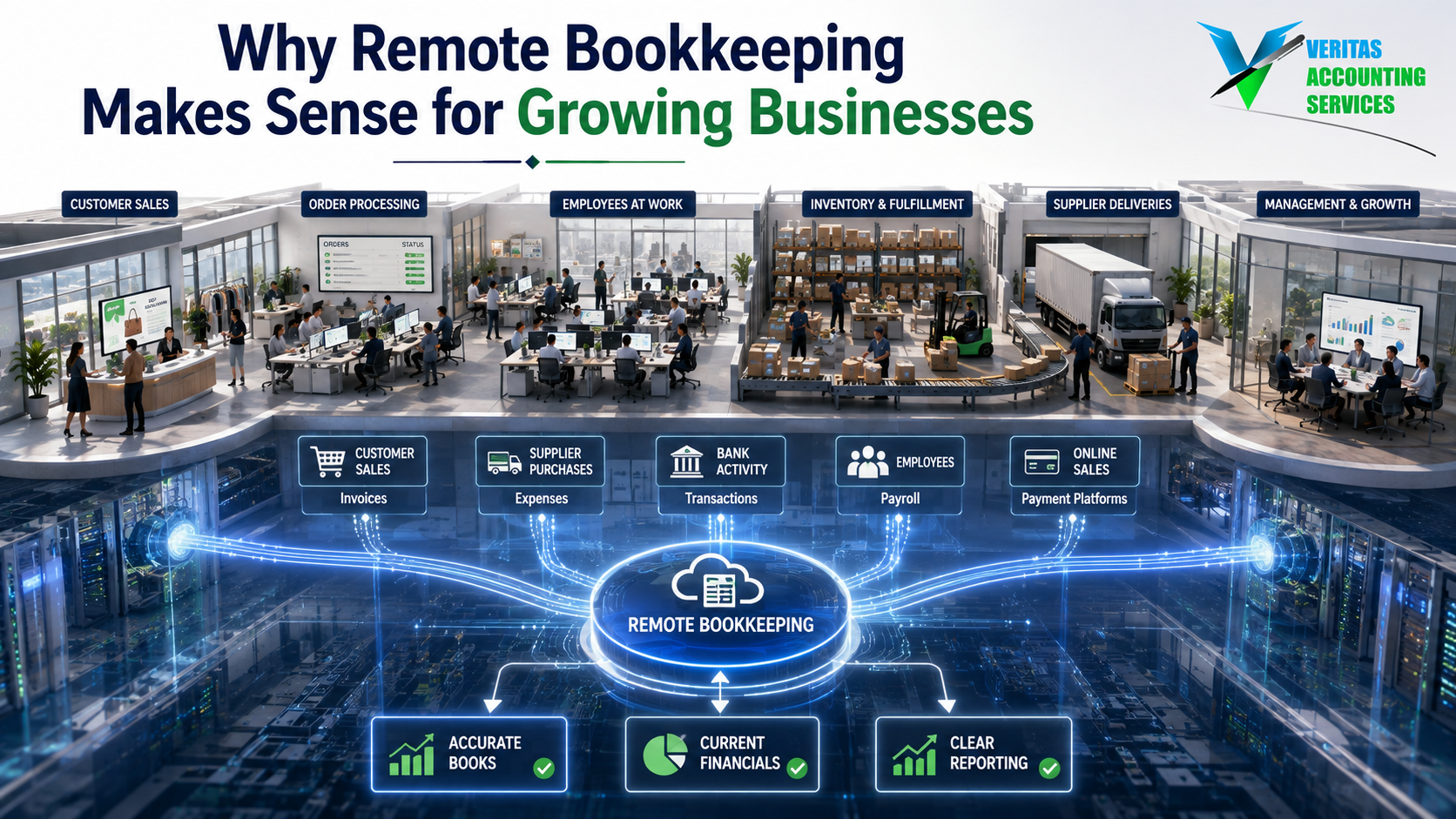
More customers mean more invoices. More sales often mean more payment platforms. More employees bring payroll and expense management. More suppliers create additional bills. New locations or markets may introduce new bank accounts, currencies, tax requirements, and reporting needs.
At some point, bookkeeping that once took a few hours each month can become a significant operational responsibility.
For many growing companies, hiring another full-time employee is not necessarily the first or best solution. Remote bookkeeping services can provide access to experienced accounting support without requiring the business to build a larger in-house finance department immediately.
Modern cloud accounting platforms have made this approach increasingly practical. Bank transactions, invoices, receipts, bills, payroll information, and financial reports can all be managed securely through digital systems.
But remote bookkeeping is not simply about moving bookkeeping outside the office.
When implemented properly, it can help a growing business build better financial records, stronger processes, and clearer financial visibility.
So, when do remote bookkeeping services make sense—and what should business owners consider before making the move?
What Are Remote Bookkeeping Services?
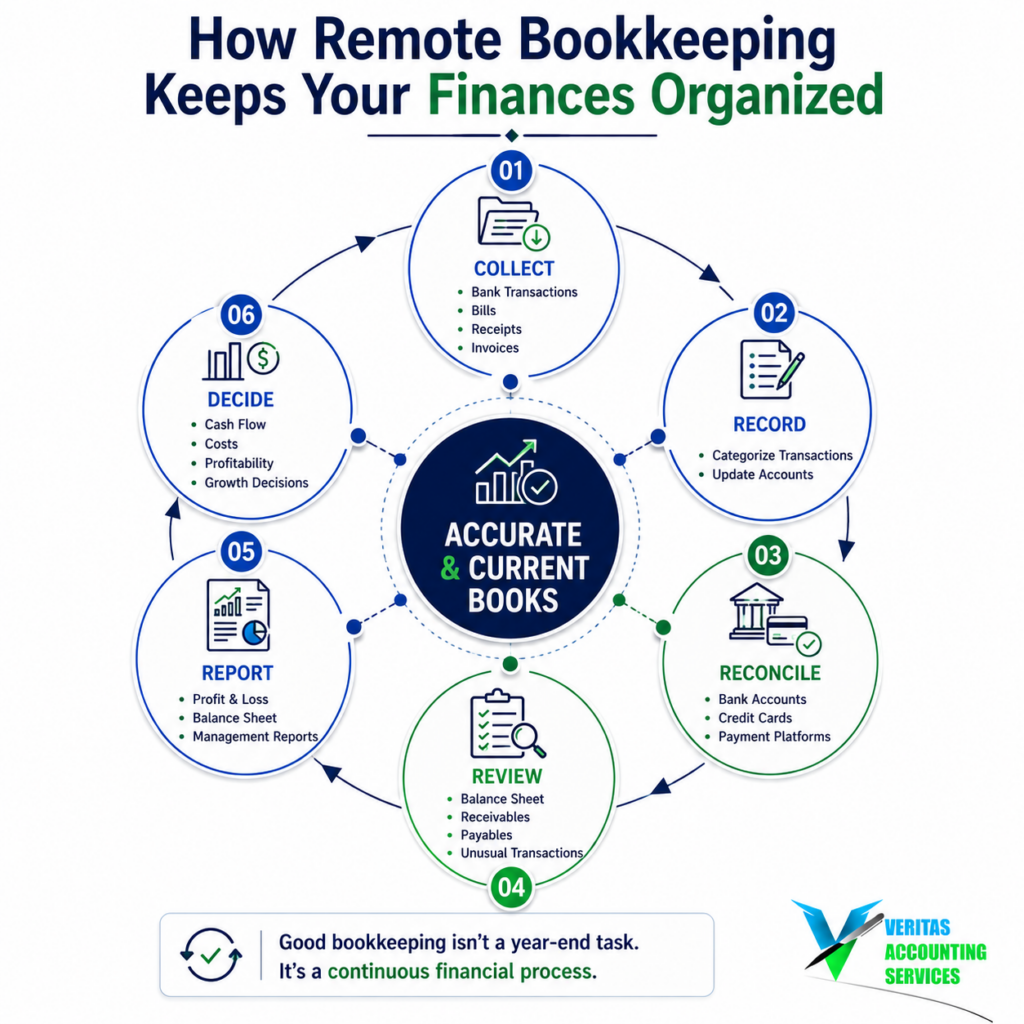
Remote bookkeeping services allow bookkeeping professionals to manage some or all of a company’s accounting records without working physically from the client’s office.
Instead of exchanging paper files, businesses generally use cloud-based accounting and document-management systems.
A remote bookkeeping team may handle tasks such as:
- Recording and categorizing transactions
- Bank and credit card reconciliations
- Accounts payable
- Accounts receivable
- Maintaining supporting schedules
- Month-end bookkeeping
- Financial reporting
- Payroll-related bookkeeping
- Bookkeeping cleanup
- Management reporting support
The exact scope depends on the business.
Some companies need only monthly reconciliations and financial statements. Others require ongoing support across multiple bank accounts, payment platforms, entities, or locations.
That flexibility is one reason remote bookkeeping services can work particularly well for businesses whose financial operations are becoming more complex as they grow.
Why Growing Businesses Often Outgrow Their Bookkeeping
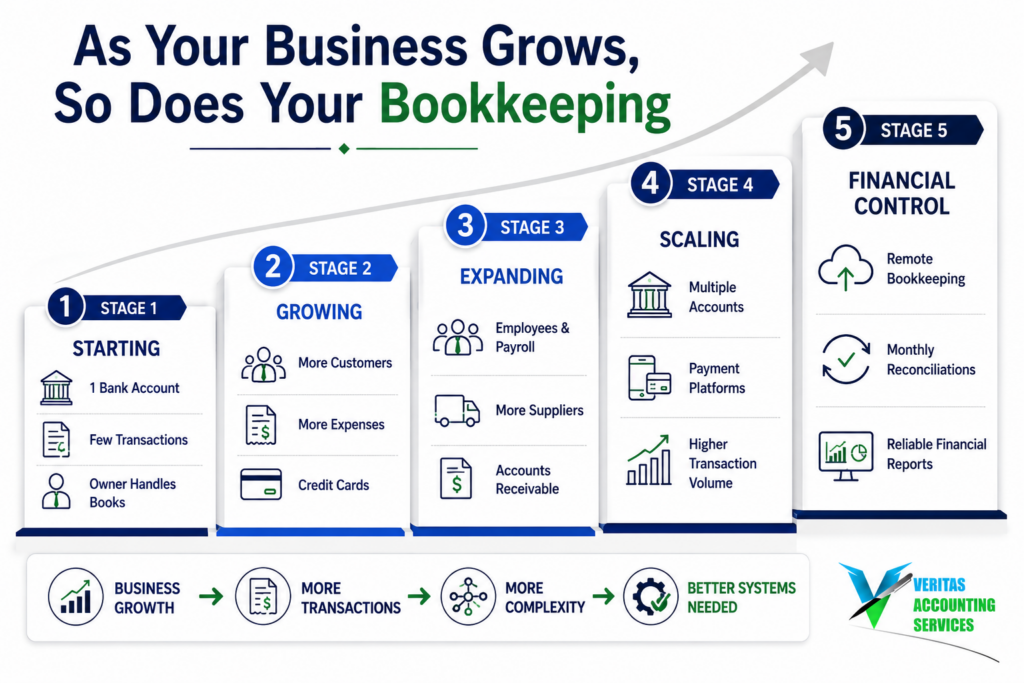
In the early stages of a business, bookkeeping can look relatively simple.
There may be one bank account, a few customers, limited expenses, and perhaps one owner managing most financial activity.
Growth changes that quickly.
Imagine a business that expands from $500,000 to $3 million in annual revenue.
It may now have:
- Multiple bank and credit card accounts
- More customer invoices
- Higher transaction volumes
- Additional suppliers
- Payroll
- Loans
- Fixed assets
- Online payment processors
- Inventory
- New tax obligations
- More complicated month-end reporting
The bookkeeping process that worked when the company was small may no longer provide management with reliable information.
This is usually the point where business owners need to make a decision:
Should we continue managing bookkeeping internally, hire another employee, or outsource some of the accounting function?
For many businesses, remote bookkeeping services offer a practical middle ground.
1. Remote Bookkeeping Can Reduce the Need for Additional Fixed Overhead
Hiring an in-house bookkeeper involves more than salary.
Depending on the location and employment arrangement, the total cost may also include payroll-related costs, employee benefits, recruitment, training, equipment, software, office resources, and management time.
A growing company may need 30 or 50 hours of bookkeeping support each month but not enough work to justify another full-time employee.
Remote bookkeeping services can allow the business to purchase the level of support it actually requires.
This does not mean outsourcing is automatically cheaper in every situation.
A large company requiring continuous daily accounting support may find that an internal team makes more sense.
The important question is whether the company’s current workload genuinely requires another full-time position.
If not, remote support can provide additional financial capacity without immediately adding another permanent layer of overhead.
2. You Are No Longer Limited to Your Local Hiring Market
Traditional hiring restricts businesses largely to professionals available within commuting distance.
Remote work changes that.
A company can potentially work with bookkeeping professionals who understand its accounting platform, industry, and reporting requirements regardless of physical location.
This can be particularly valuable when the business requires experience with systems such as:
- QuickBooks Online
- Xero
- Hubdoc
- E-commerce platforms
- Payment processors
- Cloud payroll systems
- Expense-management applications
Good bookkeeping requires more than entering transactions.
A bookkeeper needs to understand how transactions flow through the business, how accounts should reconcile, what supporting documentation is needed, and how financial information should ultimately appear in reports.
Remote bookkeeping services can broaden the pool of professionals available to the business rather than limiting hiring to one geographic area.
3. Your Books Can Stay More Consistently Updated
One common problem in growing businesses is that bookkeeping gradually falls behind.
The owner is busy.
The internal administrator has other responsibilities.
Bank reconciliations are postponed.
Uncategorized transactions accumulate.
Accounts receivable is not reviewed regularly.
By the time management receives financial statements, the information may already be several weeks or months old.
That reduces the usefulness of the numbers.
A structured remote bookkeeping process can establish clear recurring responsibilities.
For example:
Weekly
- Review transactions
- Update accounts payable
- Review accounts receivable
- Identify missing information
Monthly
- Reconcile bank accounts
- Reconcile credit cards
- Review balance sheet accounts
- Record adjustments
- Prepare financial reports
Consistency matters.
A perfectly prepared profit and loss statement three months late may be far less useful than reliable monthly reporting delivered on time.
This is where remote bookkeeping services can provide more than administrative support—they can help establish financial discipline.
4. Remote Bookkeeping Services Can Scale With the Business
Bookkeeping requirements rarely remain constant.
A company may begin with one bank account and later have five.
An e-commerce business may add Amazon, Shopify, Stripe, PayPal, or additional marketplaces.
A service company may hire employees and introduce payroll.
A business may expand internationally and begin dealing with foreign currencies.
Transaction volume can increase dramatically without management noticing how much additional accounting work has been created.
Remote bookkeeping services can often scale alongside these changes.
The scope may initially cover basic monthly bookkeeping and later expand to include:
- Accounts payable
- Accounts receivable
- Payroll coordination
- Multi-currency bookkeeping
- Inventory-related accounting
- Management reports
- Cash flow reporting
- Month-end closing support
This flexibility can be particularly useful during periods of rapid growth when building a complete internal finance department immediately may not be practical.
5. Cloud Technology Makes Remote Bookkeeping Practical
Remote bookkeeping would have been far more difficult when accounting depended heavily on paper files and desktop systems stored on one office computer.
Cloud technology changed that.
Modern accounting platforms allow authorized users to access financial information securely from different locations.
Bank feeds can import transactions.
Invoices can be issued electronically.
Receipts can be uploaded digitally.
Bills can move through approval workflows.
Reports can be generated without waiting for physical files to reach an accountant.
Remote bookkeeping services can therefore become part of a connected financial workflow rather than simply an external person entering data.
A typical system might connect:
Bank → Accounting Software → Bookkeeping → Reconciliation → Financial Reporting
The objective is not to use technology simply because it exists.
The objective is to reduce unnecessary manual work while improving the accuracy and availability of financial information.
6. Better Bookkeeping Creates Better Financial Visibility
This is perhaps the most important benefit.
Business owners sometimes view bookkeeping primarily as a compliance requirement.
But accurate bookkeeping should also help management understand the business.
Reliable monthly accounts can help answer questions such as:
- Is revenue actually translating into profit?
- Which expenses are increasing?
- How much cash is available?
- Which customers owe money?
- How much does the business owe suppliers?
- Are margins improving or declining?
- Can the business afford another employee?
- Is the company generating enough cash to fund growth?
Remote bookkeeping services should therefore not be evaluated only by how many transactions are entered.
The real value comes from the quality of the financial information produced.
If management receives accurate and timely financial statements, bookkeeping becomes part of the decision-making process.
Growth becomes easier to manage when owners can see what is happening financially rather than relying primarily on the bank balance.
Veritas Expert Insight
Good bookkeeping does more than record what happened. It gives management reliable financial information to understand what is happening now and make better decisions about what comes next.
7. Business Owners Get More Time to Run the Business
Many business owners start by doing their own bookkeeping.
Initially, this makes sense.
There may not be enough activity to justify outsourcing or hiring.
But the owner eventually becomes one of the most expensive people in the company to perform routine bookkeeping work.
Consider an owner spending five hours every week:
- Categorizing transactions
- Finding receipts
- Reconciling accounts
- Following up on invoices
- Correcting bookkeeping errors
That is more than 250 hours per year.
The question is not only what bookkeeping costs.
It is also:
What else could the owner accomplish with those 250 hours?
Remote bookkeeping services can help shift routine financial administration away from the owner while still keeping management informed about the numbers.
The owner does not lose financial control.
Ideally, they gain better financial visibility while spending less time maintaining the underlying records.
What Can a Remote Bookkeeper Actually Handle?
The responsibilities of a remote bookkeeper vary according to the company’s needs.
Common services can include:
Bank and Credit Card Reconciliations
Matching accounting records against financial institution statements and investigating differences.
Transaction Categorization
Recording transactions consistently within the appropriate chart of accounts.
Accounts Payable
Recording bills, maintaining supplier balances, and supporting payment processes.
Accounts Receivable
Recording invoices, tracking customer balances, and helping management identify overdue receivables.
Month-End Bookkeeping
Reviewing accounts and completing recurring procedures before financial reports are prepared.
Financial Statements
Preparing or supporting reports such as the profit and loss statement and balance sheet.
Supporting Schedules
Maintaining records for items such as loans, fixed assets, prepaid expenses, and other balance sheet accounts where appropriate.
The strongest remote bookkeeping services generally operate through a clearly defined scope rather than an informal arrangement where responsibilities are unclear.
Is Remote Bookkeeping Secure?
This is an important question.
Remote bookkeeping is not automatically secure simply because cloud software is being used.
Security depends on the systems, controls, and people involved.
Businesses should consider measures such as:
- Multi-factor authentication
- Individual user access
- Appropriate permission levels
- Secure document-sharing systems
- Strong password practices
- Controlled access to banking information
- Regular review of authorized users
- Clear internal approval procedures
Whenever possible, bookkeeping professionals should receive the level of access necessary to perform their work rather than unrestricted access to everything.
For example, viewing bank transactions for reconciliation does not necessarily mean a bookkeeper needs unrestricted authority to initiate payments.
Remote bookkeeping services should therefore be supported by sensible internal controls and clearly defined responsibilities.
Remote Bookkeeping vs. In-House Bookkeeping
Neither model is automatically right for every business.
| Area | Remote Bookkeeping | In-House Bookkeeping |
|---|---|---|
| Location | Works remotely | Works from the business location |
| Talent pool | Broader geographic access | Primarily local hiring |
| Staffing | Can often scale with workload | Usually requires hiring |
| Infrastructure | Typically cloud-based | Internal or cloud-based |
| Cost structure | Often service-based | Salary and employment costs |
| Communication | Online meetings and digital workflows | Direct in-person access |
| Flexibility | Often easier to adjust scope | Depends on team capacity |
| Best fit | Digital and growing businesses | Businesses needing substantial on-site support |
The right choice depends on transaction volume, complexity, management needs, internal resources, and how much day-to-day physical presence the role requires.
When Remote Bookkeeping May Not Be the Best Choice
Despite the advantages, remote bookkeeping services are not right for every company.
An in-house role may make more sense when:
- The business handles significant physical paperwork every day
- The bookkeeper must perform substantial on-site administrative duties
- Management requires continuous face-to-face interaction
- Accounting processes depend heavily on physical inventory or documentation
- The organization is large enough to support a full internal accounting department
Some businesses also use a hybrid model.
For example, an internal employee may handle day-to-day administrative activities while a remote accounting team handles reconciliations, month-end closing, reporting, or specialist work.
The objective should not be to outsource for the sake of outsourcing.
It should be to design a finance function that fits the business.
How to Choose a Remote Bookkeeping Provider
Price should not be the only consideration.
Before selecting a provider, ask:
What accounting systems do they use?
The provider should understand your existing software or be able to recommend an appropriate workflow.
What exactly is included?
Clarify whether the engagement covers reconciliations, AP, AR, payroll-related bookkeeping, financial reports, cleanup, or other tasks.
How often will the books be updated?
Weekly and monthly expectations should be clear.
Who reviews the work?
Understanding the review process can be just as important as knowing who enters transactions.
How will questions be handled?
There should be an organized process for resolving unclear transactions and requesting documents.
What financial reports will you receive?
Good remote bookkeeping services should ultimately provide useful financial information—not simply a completed transaction register.
How is financial information protected?
Ask about access controls, document sharing, passwords, permissions, and other security procedures.
A strong provider should be able to explain the workflow
clearly before the engagement begins.
Why Growing Businesses Work With Veritas Accounting Services
As a business grows, bookkeeping requirements often evolve from basic transaction recording into a broader financial management process.
Veritas Accounting Services supports businesses with remote bookkeeping services designed around their accounting needs and existing financial systems.
Depending on the engagement, support may include bookkeeping, reconciliations, accounts payable and receivable, financial reporting, cleanup work, and management accounting support.
We work with cloud accounting platforms such as QuickBooks Online and Xero and support businesses operating across different industries and markets.
Our objective is not simply to maintain accounting records.
It is to help businesses build reliable financial information that management can actually use.
As financial needs become more sophisticated, bookkeeping can also connect with budgeting, cash flow forecasting, management reporting, and Virtual CFO support.
That allows the finance function to evolve alongside the business.
Final Thoughts
Growth creates complexity.
The bookkeeping process that worked when a business was small may not work once transaction volumes, employees, customers, bank accounts, payment platforms, and reporting requirements increase.
That does not always mean the next step is another full-time employee.
Remote bookkeeping services can give growing companies access to experienced accounting support, scalable processes, modern cloud technology, and more consistent financial reporting without immediately building a larger internal finance department.
The greatest benefit, however, is not simply outsourcing bookkeeping work.
It is creating financial records that management can trust.
When the books are current, reconciliations are complete, balance sheet accounts are understood, and financial reports are available on time, business owners can make decisions with greater confidence.
Remote bookkeeping services make the most sense when they do more than save time.
They should help create a stronger financial foundation for the next stage of growth.
Frequently Asked Questions
What are remote bookkeeping services?
Remote bookkeeping services allow professional bookkeepers to maintain a company’s accounting records from another location using cloud accounting software, digital documents, online banking information, and secure communication systems.
What does a remote bookkeeper do?
A remote bookkeeper may handle transaction categorization, bank and credit card reconciliations, accounts payable, accounts receivable, supporting schedules, month-end bookkeeping, and financial reporting depending on the agreed scope.
Are remote bookkeeping services suitable for small businesses?
Yes, they can be particularly useful for small and growing businesses that require professional bookkeeping support but may not need another full-time accounting employee.
Are remote bookkeeping services secure?
They can be operated securely when appropriate controls are used, including multi-factor authentication, controlled permissions, secure document sharing, individual user accounts, and appropriate internal approval procedures.
When should a business consider remote bookkeeping services?
A business may consider remote bookkeeping when transaction volume is increasing, bookkeeping is falling behind, owners are spending too much time maintaining records, financial reports are delayed, or the company needs additional accounting expertise without immediately expanding its internal team.
Ready to Spend Less Time Managing the Books?
Your bookkeeping should become more organized as your business grows—not more stressful.
With the right systems and accounting support, you can keep your records current, improve financial visibility, and spend more time focusing on customers, operations, and growth.
Veritas Accounting Services provides remote bookkeeping services to businesses looking for reliable accounting support and stronger financial processes.
Better books. Better visibility. Better business decisions.
Schedule a FREE Call
GET IN TOUCH