






Are Marketplace Fees Quietly Destroying Your Profit Margins?
Selling on an online marketplace can make a business look extremely successful.
Orders are coming in. Revenue is increasing. Sales reports show impressive numbers. Products are reaching customers across different cities and countries.
But there is a question many e-commerce sellers don’t ask often enough:
How much are we actually making after every cost is taken out?
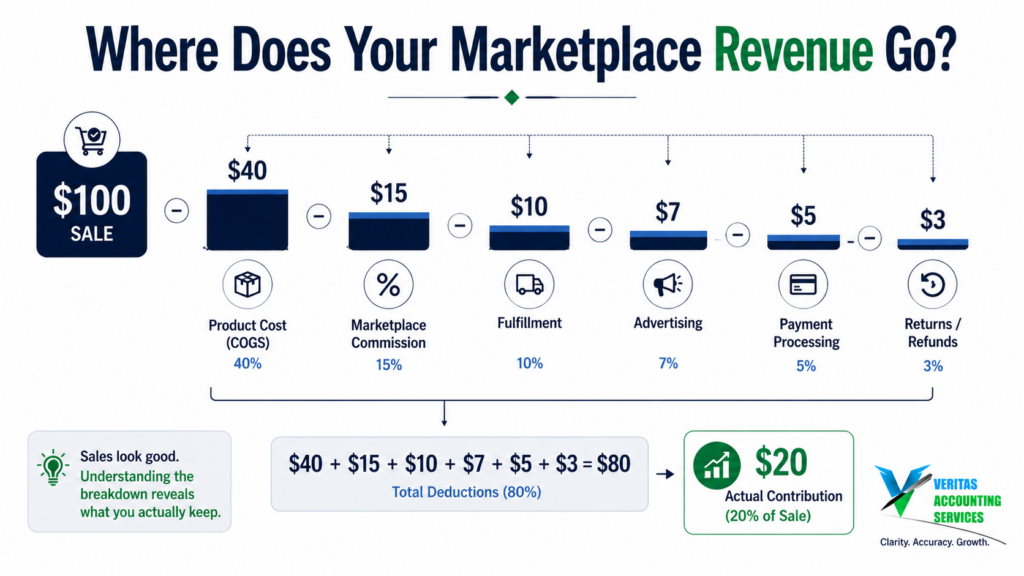
A product that sells for $100 may not generate anything close to $100 of profit.
Between marketplace commissions, payment processing, fulfillment, storage, advertising, returns, refunds, product costs, and other operating expenses, the amount left for the business can be surprisingly small.
This is why marketplace fees deserve much more attention than they usually receive.
The problem is not necessarily that marketplace fees are too high. The bigger problem is that sellers often look at them individually rather than understanding their combined impact on profitability.
You can increase sales and still see your margins decline.
You can have a product that sells extremely well and still lose money on every order.
And you can grow revenue while quietly making the business financially weaker.
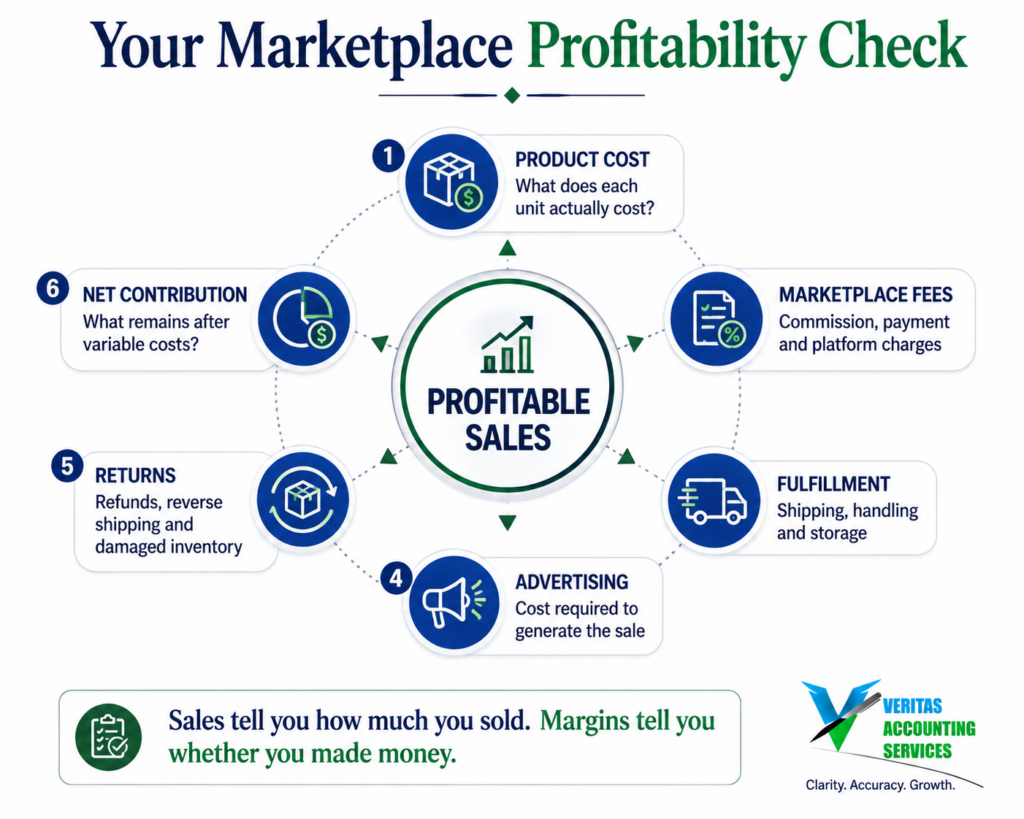
For e-commerce businesses, profitable growth requires looking beyond sales volume and understanding what each order actually contributes to the bottom line.
Revenue Is Not the Same as Profit
One of the easiest mistakes in e-commerce is confusing revenue with profitability.
Imagine your marketplace shows $100,000 in monthly sales.
That sounds impressive.
But now consider what happens before that money becomes business profit.
You may have:
- Product costs
- Marketplace commissions
- Payment processing fees
- Fulfillment charges
- Storage costs
- Advertising
- Shipping
- Returns
- Refunds
- Packaging
- Software
- Customer service
- Payroll
- Other operating expenses
After all those costs, your actual profit could be significantly lower.
This is why marketplace fees should be analyzed as part of the complete cost structure rather than viewed as isolated deductions from marketplace statements.
Revenue tells you how much customers spent.
Profit tells you what the business actually kept.
Those are very different numbers.
What Are Marketplace Fees?
Marketplace fees are the charges a seller pays to an online platform for using its marketplace, payment infrastructure, fulfillment services, advertising tools, or other services.
Depending on the platform and selling arrangement, marketplace fees may include:
- Referral or commission fees
- Payment processing charges
- Listing fees
- Subscription fees
- Fulfillment fees
- Storage fees
- Advertising charges
- Return-related fees
- Refund administration charges
- Currency conversion charges
- Other service fees
Not every marketplace charges all of these.
The important point is that sellers need to understand the complete fee structure associated with each platform they use.
A product may appear profitable when you look only at its selling price and product cost.
Once all marketplace-related costs are included, the picture may change considerably.
1. Commission Fees Can Take a Significant Share of Sales
Most marketplaces charge sellers some form of commission or referral fee.
The percentage may vary depending on:
- Product category
- Selling price
- Marketplace
- Seller plan
- Customer location
- Promotional arrangements
A percentage-based fee can become substantial as sales increase.
For example, suppose you sell $200,000 of products in a month and the applicable marketplace commission averages 15%.
That represents:
$200,000 × 15% = $30,000
The business generated $200,000 in sales, but $30,000 has already gone toward one category of marketplace cost.
That doesn’t necessarily mean the marketplace is charging too much.
The platform may be providing access to millions of customers, payment processing, infrastructure, trust, logistics, or other valuable services.
The real question is whether your pricing and product economics are designed to support those costs.
2. Fulfillment Costs Can Change the Economics
For businesses using marketplace fulfillment services, fulfillment costs can become another major component of the cost per order.
Depending on the arrangement, sellers may pay for:
- Picking
- Packing
- Shipping
- Handling
- Returns
- Storage
- Special handling
These costs can vary significantly depending on product size, weight, destination, and fulfillment method.
A product with a healthy margin before fulfillment may become much less attractive after fulfillment costs are included.
This is particularly important for businesses selling products with:
- Large dimensions
- Heavy weight
- Low selling prices
- Low unit margins
- High return rates
A seller should therefore calculate profitability using the actual fulfillment cost rather than relying solely on the product’s selling price and purchase cost.
3. Advertising Can Quietly Reduce Your Margin
Advertising is another area where e-commerce sellers can lose sight of profitability.
Advertising can be extremely valuable.
It can help products reach customers, increase sales, launch new products, and improve visibility.
But higher sales do not automatically mean higher profits.
Suppose a product generates $50,000 in marketplace sales.
That sounds strong.
But what if $10,000 was spent on advertising to generate those sales?
Now the economics look different.
This is why looking only at advertising metrics such as revenue generated or return on ad spend may not provide the complete picture.
You also need to consider:
Product Cost + Marketplace Fees + Fulfillment + Advertising + Other Variable Costs
Only then can you understand how much the sale actually contributes to the business.
4. Returns and Refunds Can Distort Your Numbers
Returns are particularly important for businesses selling online.
A marketplace report may show a large number of orders and strong gross sales, while refunds and returns reduce the amount the business actually keeps.
Returns can also create additional costs.
For example:
- Return shipping
- Restocking
- Damaged inventory
- Refund processing
- Customer service
- Lost selling fees
- Unsellable inventory
If returns are consistently high for a particular product, simply looking at gross sales can make the product appear more profitable than it really is.
Businesses should therefore monitor profitability after returns and refunds rather than evaluating products solely on completed orders.
5. Payment Processing and Other Small Charges Add Up
Not every cost is large enough to immediately attract attention.
A payment processing charge here.
A currency conversion fee there.
A small storage charge.
A return-related adjustment.
A software fee.
A marketplace subscription.
Individually, these amounts may seem insignificant.
Collectively, they can have a meaningful impact on margins.
This is one reason marketplace fees should be reviewed regularly rather than only when something appears unusually expensive.
Small percentages applied to large sales volumes can create significant annual costs.
The Product That Sells the Most May Not Be Your Most Profitable Product
This is one of the most important lessons for marketplace businesses.
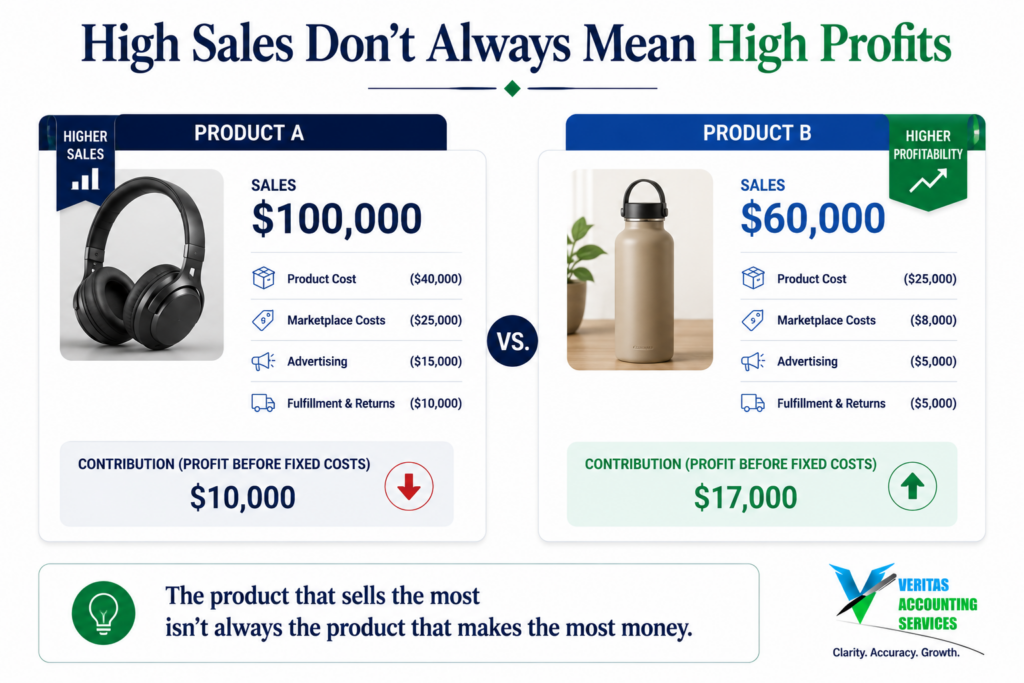
Imagine you sell two products.
Product A
Sales: $100,000
Gross profit before marketplace costs: $30,000
Total marketplace and variable costs: $20,000
Contribution: $10,000
Product B
Sales: $60,000
Gross profit before marketplace costs: $25,000
Total marketplace and variable costs: $8,000
Contribution: $17,000
Product A generates more revenue.
But Product B generates more contribution.
If management focuses only on sales volume, Product A may look like the clear winner.
If management focuses on profitability, Product B tells a different story.
This is why marketplace sellers should analyze profitability at the product or SKU level whenever practical.
Calculate Your Real Profit Per Order
A simple order-level calculation can reveal problems quickly.
Imagine a product sells for $100.
| Cost | Amount |
|---|---|
| Selling Price | $100 |
| Product Cost | $40 |
| Marketplace Commission | $15 |
| Payment Processing | $3 |
| Fulfillment | $12 |
| Advertising | $8 |
| Other Variable Costs | $5 |
| Contribution | $17 |
The product appears to generate $100 in sales.
But after the major variable costs, only $17 remains.
And that $17 may still need to contribute toward fixed business costs such as salaries, software, rent, professional fees, and other overhead.
That means the product’s true net profit may be considerably lower.
This calculation should be performed regularly for important products rather than relying only on the marketplace’s headline sales figures.
Why Marketplace Fees Can Be Difficult to Track
One reason marketplace profitability is difficult to analyze is that the money doesn’t always flow through the accounting system in a simple way.
A marketplace may combine:
- Sales
- Refunds
- Commissions
- Advertising
- Shipping
- Fulfillment
- Taxes
- Other adjustments
into statements or settlement reports.
The amount deposited into the bank may therefore be very different from the gross sales reported by the marketplace.
For example:
Marketplace Sales: $50,000
Less:
Marketplace Fees: $7,500
Less:
Advertising: $4,000
Less:
Refunds: $2,500
Less:
Other Adjustments: $1,000
Net Settlement: $35,000
If the accounting records simply record the $35,000 bank deposit as sales, management may lose visibility into the actual economics of the marketplace.
This is why proper marketplace reconciliation matters.
Your Bookkeeping Needs to Reflect the Real Marketplace Activity
Accurate bookkeeping is especially important for e-commerce businesses because marketplace settlements can contain many different types of transactions.
A good accounting process should help separate and identify:
- Gross sales
- Marketplace commissions
- Payment fees
- Fulfillment costs
- Advertising
- Refunds
- Returns
- Taxes
- Other marketplace adjustments
This creates better financial reporting.
It also makes it easier to understand where money is actually going.
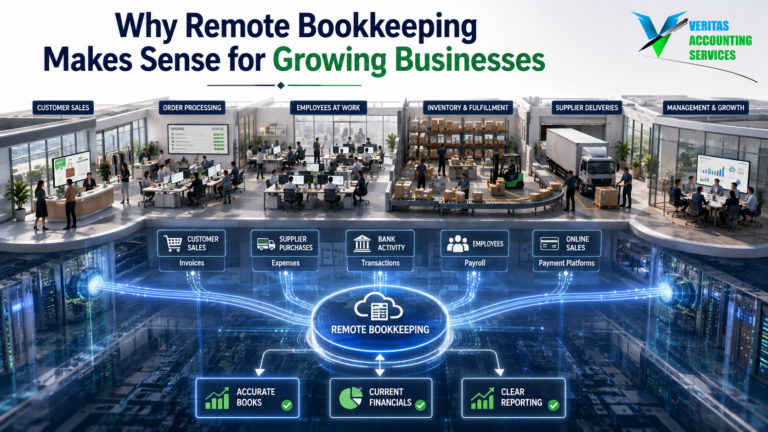
Remote bookkeeping services can be particularly useful for growing e-commerce businesses that have multiple marketplaces, payment processors, currencies, or high transaction volumes.
Accurate books aren’t just useful for tax preparation.
They help management understand profitability.
Don’t Look at ROAS Without Looking at Margin
Return on ad spend, or ROAS, is commonly used by e-commerce businesses to evaluate advertising performance.
But ROAS alone can be misleading.
Imagine an advertising campaign generates $10,000 of revenue from $2,000 of advertising.
The ROAS is 5x.
That sounds excellent.
But suppose the product has:
- $4,000 product cost
- $1,500 marketplace fees
- $1,000 fulfillment
- $500 other variable costs
The business may have only a small amount left after all those expenses.
A strong advertising metric does not automatically mean a strong financial result.
The better question is:
How much profit did the advertising actually help generate?
This is where product-level margin analysis becomes much more valuable than looking at advertising metrics in isolation.
How to Protect Your Marketplace Margins
Marketplace fees are often unavoidable.
The goal is not necessarily to eliminate them.
The goal is to understand them and manage the economics of your business around them.
Here are several practical strategies.
Review Fees Regularly
Don’t assume your fee structure has remained unchanged.
Review marketplace statements and fee schedules periodically.
Track Profitability by Product
Know which products generate healthy contribution margins and which products are consuming cash.
Include Advertising in Your Product Economics
Don’t evaluate products without considering the marketing spend required to generate sales.
Monitor Returns
A high-return product may have a very different margin from what the original sale suggests.
Review Fulfillment Costs
Look for products where shipping, handling, or storage costs are disproportionately high.
Revisit Pricing
If your costs have increased but prices haven’t changed, your margin may be shrinking.
Reconcile Marketplace Statements
Make sure marketplace activity is properly reflected in your accounting records.
Compare Marketplaces
A product that is profitable on one platform may not produce the same economics on another.
More Sales Can Sometimes Mean Less Profit
This sounds strange, but it happens.
Imagine you make $5 of contribution on every order.
Selling 1,000 units generates $5,000 of contribution.
Selling 10,000 units generates $50,000.
That sounds great.
But what if the increased sales require:
- Heavy discounting
- Higher advertising
- Expensive fulfillment
- Additional customer service
- Higher return rates
- More storage
Your contribution per order may fall significantly.
If the business focuses only on revenue growth, management may not notice the deterioration until it becomes serious.
This is why profitable growth is more important than revenue growth alone.
The goal isn’t simply to sell more.
The goal is to sell more while preserving healthy economics.
When Should You Review Your Marketplace Profitability?
Don’t wait until profits disappear.
A profitability review is particularly important when:
- Sales are growing rapidly
- Marketplace fees have changed
- Advertising spend is increasing
- Product prices have changed
- Fulfillment costs have increased
- Return rates are rising
- You launch a new marketplace
- You add new products
- Your gross margin is declining
- Cash flow doesn’t seem to match sales growth
Regular analysis helps identify problems while there is still time to correct them.
Final Thoughts
Marketplace selling can create tremendous opportunities for e-commerce businesses.
You can reach customers at scale without building the entire sales infrastructure yourself.
But that convenience comes at a cost.
Marketplace fees, fulfillment, advertising, payment processing, returns, storage, and other selling expenses can gradually reduce the amount your business actually keeps from each sale.
The important thing is not to avoid marketplaces.
It’s to understand the economics.
Know your real cost per order.
Know your contribution margin.
Know which products are profitable.
Know how much advertising is required to generate each sale.
And make sure your accounting records reflect the complete marketplace activity rather than only the deposits reaching your bank account.
Revenue tells you how much you sold.
Your margins tell you whether those sales are actually building a profitable business.
At Veritas Accounting Services, we help e-commerce businesses organize marketplace transactions, reconcile sales and fees, and turn financial data into information that management can use.
Because selling more is good.
Selling more profitably is better.
Frequently Asked Questions
What are marketplace fees?
Marketplace fees are charges that online selling platforms may apply for services such as commissions, payment processing, fulfillment, storage, advertising, listings, subscriptions, returns, and other seller services. marketplace fees
How do marketplace fees affect profit margins?
Marketplace fees reduce the amount of revenue remaining after a sale. When combined with product costs, advertising, fulfillment, returns, and other variable expenses, they can significantly reduce the contribution margin of an order.
Why are my marketplace sales increasing but profits decreasing?
Growing sales do not automatically mean growing profits. Higher advertising costs, marketplace fees, fulfillment expenses, discounts, returns, marketplace fees and product costs can increase faster than revenue.
How can I reduce marketplace costs?
Start by identifying every major cost associated with each marketplace. Review product-level profitability, advertising spend, fulfillment costs, returns, pricing, and marketplace fees structures. Some costs can potentially be reduced through operational or pricing changes.
Should marketplace fees be recorded separately in accounting?
In many cases, separating major marketplace-related expenses provides better visibility into the economics of the business. The exact accounting treatment should be determined based on the business, applicable accounting framework, and tax requirements.
How often should I review marketplace profitability?
Growing e-commerce businesses should review profitability regularly rather than waiting until year-end. Monthly analysis is often useful for identifying changes in marketplace fees, advertising costs, returns, fulfillment expenses, and product margins.
Schedule a FREE Call
GET IN TOUCH