






Your Books Are More Than Records—They’re Business Intelligence
Most business owners think of accounting as a process that happens in the background.
Sales are recorded. Expenses are categorized. Bank accounts are reconciled. Financial statements are prepared. Tax returns are filed.
Then the books are closed and everyone moves on.
But your accounting records contain far more information than what is needed for tax compliance.
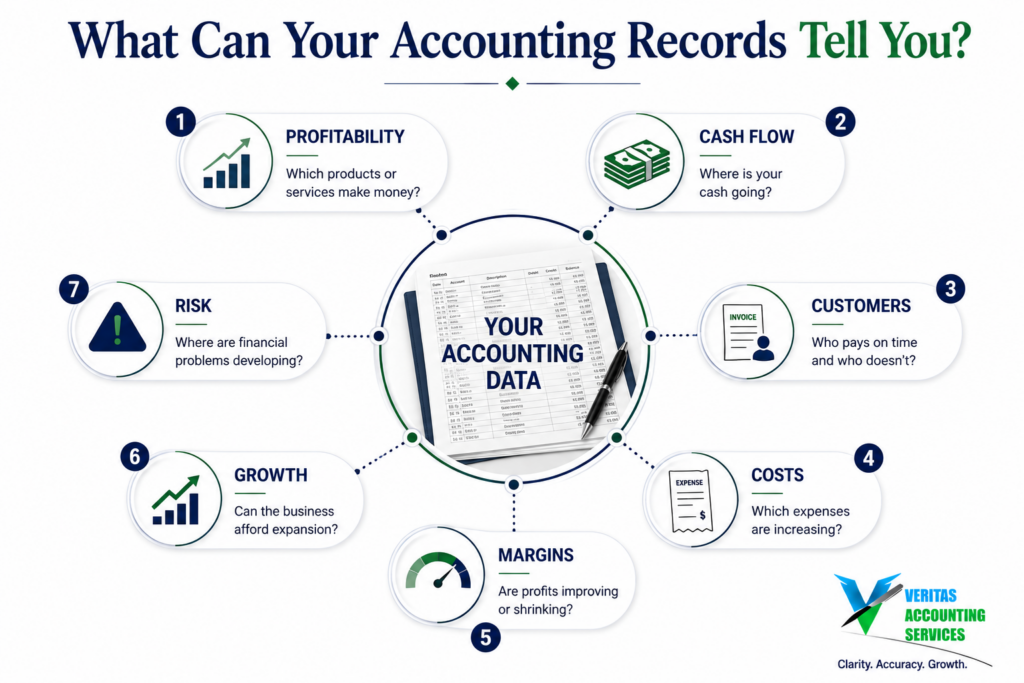
They can tell you which products are profitable, where your cash is going, which expenses are increasing, whether customers are paying on time, whether margins are improving, and whether your current growth is actually creating value.
In other words, your books can become a source of business intelligence.
The difference is what you do with the information.
Accurate accounting tells you what happened.
Analysis helps you understand why it happened.
Business intelligence helps you use that information to make better decisions about what happens next.
For growing businesses, that difference can be significant.
Accounting Is More Than Recording Transactions
Bookkeeping begins with individual transactions.
A customer makes a payment.
A supplier sends an invoice.
An employee is paid.
A business purchases equipment.
A bank charges a fee.
Each transaction is recorded in the accounting system.
Individually, these transactions may not tell you much.
But once thousands of transactions are organized and categorized correctly, patterns begin to appear.
You can see:
- Revenue trends
- Expense trends
- Profit margins
- Cash-flow movements
- Customer balances
- Supplier obligations
- Asset growth
- Debt levels
- Operating costs
This is where business intelligence begins to emerge from accounting.
The accounting system is not just storing historical information.
It is creating the financial data needed to understand how the business operates.
1. Your Books Can Show Where Your Profit Is Coming From
A business can have strong revenue and weak profitability.
Imagine a company generates $2 million in annual sales.
That sounds impressive.
But suppose its gross margin has fallen from 40% to 28%.
Revenue increased, but the economics of the business became less attractive.
Without regular financial analysis, management may focus on the revenue increase and miss the declining margin.
Business intelligence can help identify this change.
By comparing revenue, direct costs, gross profit, and operating expenses over time, management can determine whether growth is actually improving profitability.
This becomes even more valuable when you analyze profitability by:
- Product
- Service
- Customer
- Location
- Sales channel
- Business division
Total revenue tells only part of the story.
Understanding where the profit is actually being generated tells you much more.
2. Your Accounting Data Can Explain Where Cash Is Going
Profit and cash are not the same thing.
A profitable company can still experience cash-flow problems.
Why?
Because money may be tied up in:
- Accounts receivable
- Inventory
- Prepaid expenses
- Equipment
- Debt repayments
- Other working capital requirements
Your accounting records can help explain these movements.
For example, suppose sales have increased by 30%, but accounts receivable has increased by 60%.
That could indicate that customers are taking longer to pay.
Revenue is growing, but cash may not be arriving at the same speed.
That is valuable information.
Business intelligence helps management look beyond the income statement and understand how profitability connects with cash flow.
3. Your Financial Statements Can Become Management Tools
Many businesses prepare financial statements because their accountant requires them.
That is understandable.
But financial statements can be much more useful when management reviews them regularly.
A monthly profit and loss statement can help answer:
- Is revenue increasing?
- Are gross margins changing?
- Which expenses are rising?
- Are operating costs growing faster than revenue?
- Is the business becoming more profitable?
A balance sheet can answer different questions:
- How much cash do we have?
- How much do customers owe us?
- How much do we owe suppliers?
- How much debt do we carry?
- Is working capital improving?
A cash-flow report can help explain:
- Where cash came from
- Where cash went
- Whether operations are generating cash
- Whether financing is supporting the business
When these reports are reviewed together, business intelligence becomes much more useful.
4. Find Out Which Products and Services Actually Make Money
One of the most useful applications of accounting data is profitability analysis.
Suppose a company sells ten different products.
Three products generate 60% of total revenue.
It would be easy to assume those three products are the most valuable.
But what if two of them have very low margins?
The business could be investing significant time, inventory, advertising, and customer service resources into products that generate relatively little contribution.
Accounting data can help management investigate these differences.
You can compare:
Revenue → Direct Costs → Gross Profit → Variable Costs → Contribution
This can reveal which products deserve more attention and which may need pricing changes, cost reductions, or even discontinuation.
Business intelligence becomes especially powerful when financial information is combined with operational data.
5. Your Customers May Not Be Equally Valuable
Revenue by customer can also reveal important information.
Imagine two customers each generate $100,000 in annual revenue.
At first glance, they appear equally valuable.
But Customer A pays on time, requires little support, and purchases high-margin services.
Customer B regularly pays late, requires significant support, negotiates heavily on price, and generates lower margins.
The revenue is identical.
The business value is not.
Accounting data can help identify differences in:
- Revenue
- Gross margin
- Payment behavior
- Outstanding balances
- Discounts
- Service costs
This gives management a more complete picture of customer profitability.
Not every large customer is necessarily a great customer.
6. Watch Your Key Business Numbers
Business intelligence does not require hundreds of complicated metrics.
In many cases, a small set of carefully selected KPIs can provide excellent visibility.
Depending on the business, useful financial KPIs may include:
Revenue Growth
Shows how quickly sales are increasing or decreasing.
Gross Profit Margin
Shows how much revenue remains after direct costs.
Net Profit Margin
Shows the percentage of revenue remaining after operating expenses and other costs.
Accounts Receivable Days
Helps management understand how quickly customers are paying.
Operating Expense Ratio
Shows how operating expenses compare with revenue.
Cash Balance
Provides a basic view of available liquidity.
Working Capital
Helps management understand short-term financial strength.
The right KPIs depend on the business model.
A trucking company may monitor fuel costs and revenue per mile.
An e-commerce company may focus on contribution margin, advertising costs, inventory turnover, and marketplace expenses.
A professional services firm may track utilization, billable hours, realization, and client profitability.
Business intelligence becomes useful when the numbers being monitored actually connect with how the business operates.
7. Accounting Data Can Improve Forecasting
Historical financial information provides the foundation for forecasting.
If you know how revenue, payroll, rent, marketing, inventory, and other expenses have behaved over the past several months, you have a starting point for planning the future.
Forecasting can help answer questions such as:
- How much cash might we have three months from now?
- Can we afford another employee?
- How much inventory can we purchase?
- Can we take on additional debt?
- What happens if revenue falls by 10%?
- What happens if revenue grows by 20%?
Business intelligence turns historical accounting data into a resource for forward-looking planning.
Of course, historical trends do not guarantee future results.
But making decisions with historical data, assumptions, and scenarios is generally more useful than relying entirely on intuition.
8. Better Accounting Data Can Improve Pricing Decisions
Pricing is one of the most important decisions a business makes.
Yet many businesses set prices based on competitors, market expectations, or simple cost-plus calculations without fully understanding their own economics.
Your accounting records can provide a better foundation.
You can analyze:
- Direct product costs
- Labor costs
- Overhead
- Payment fees
- Shipping
- Advertising
- Discounts
- Returns
- Customer acquisition costs
This helps management understand the actual cost of delivering a product or service.
You may discover that one service is significantly more profitable than another.
Or you may discover that a product that appears profitable becomes unprofitable after advertising, fulfillment, returns, and other variable costs are included.
That information can support better pricing decisions.
9. Accounting Can Help You Identify Problems Earlier
Financial problems often appear in the numbers before they become obvious operationally.
For example:
Revenue is rising, but margins are falling.
That could indicate increasing product costs, discounting, pricing problems, or an unfavorable sales mix.
Accounts receivable is increasing faster than sales.
That could indicate slower collections or changing customer payment behavior.
Operating expenses are growing faster than revenue.
That could signal that the business is becoming less efficient.
Cash is falling despite reported profits.
That may indicate working capital pressure, debt payments, inventory investment, or other cash-flow issues.
Business intelligence helps management notice these patterns early.
The earlier a problem is identified, the more options management usually has to address it.
10. Business Intelligence Is Only as Good as Your Accounting
This is one of the most important principles to understand.
You cannot build reliable analysis from unreliable accounting data.
If your books contain:
- Unreconciled bank accounts
- Duplicate transactions
- Incorrect classifications
- Missing expenses
- Incorrect customer balances
- Old outstanding items
- Unrecorded liabilities
- Incorrect inventory values
then your reports may not accurately represent the business.
And if the underlying numbers are wrong, the conclusions drawn from those numbers may also be wrong.
This is why business intelligence begins with accounting.
Before investing heavily in dashboards, advanced analytics, or complicated reporting systems, businesses should make sure the underlying accounting records are accurate and current.
Good intelligence requires good data.
From Bookkeeping to Business Intelligence
Think of your financial system as a progression:
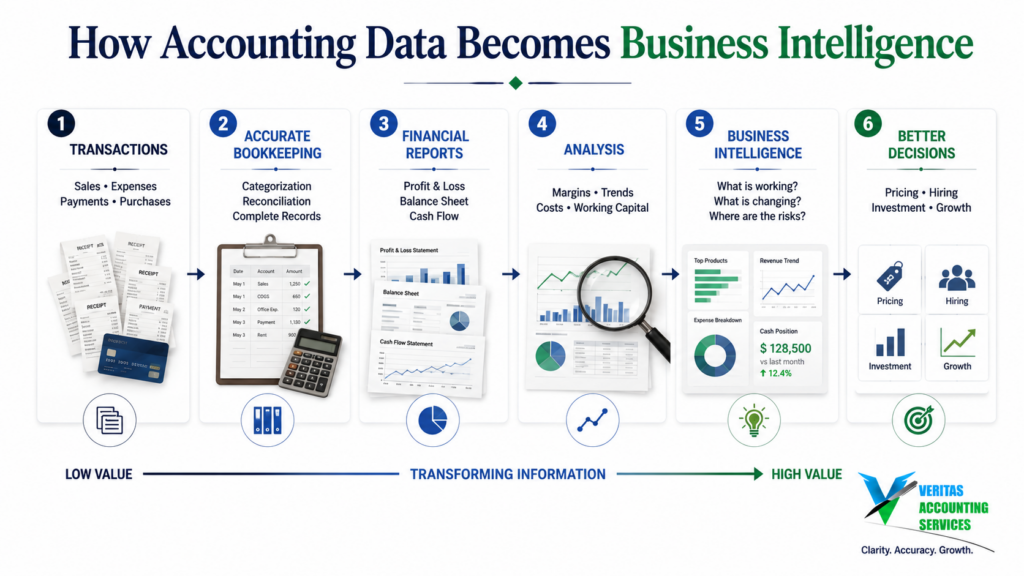
Transactions
↓
Accurate Bookkeeping
↓
Reconciled Accounts
↓
Financial Statements
↓
Financial Analysis
↓
Business Intelligence
↓
Better Business Decisions
Each stage depends on the previous one.
If transactions are recorded incorrectly, the financial statements may be wrong.
If financial statements are wrong, analysis becomes unreliable.
If analysis is unreliable, management decisions can suffer.
The technology used to display information is therefore only one part of the equation.
The quality of the underlying accounting data matters just as much.
You Don’t Need a Complicated Dashboard
Some business owners hear the phrase business intelligence and immediately think of expensive software, complicated dashboards, and data analysts.
That isn’t always necessary.
For many small and medium-sized businesses, useful business intelligence can begin with a well-maintained accounting system and a handful of meaningful reports.
For example, management may only need a monthly dashboard showing:
- Revenue
- Gross profit
- Net profit
- Cash balance
- Accounts receivable
- Accounts payable
- Major expenses
- Key business KPIs
The objective is not to collect as much information as possible.
The objective is to identify the information that actually helps management make better decisions.
A simple report that gets reviewed every month can be more valuable than an impressive dashboard that nobody uses.
What Business Owners Should Ask Their Accounting Data
Instead of only asking:
“How much did we make?”
Start asking:
“Why did profit change?”
“Which products generate the best margins?”
“Which customers are most profitable?”
“Where is our cash tied up?”
“Which expenses are increasing fastest?”
“Are we collecting customer balances quickly enough?”
“Can we afford our next growth initiative?”
“What could happen to cash flow if revenue declines?”
These questions transform accounting from a record-keeping function into a decision-making resource.
The Role of Technology
Modern accounting software has made financial information much more accessible.
Cloud accounting platforms can connect with:
- Banks
- Payment processors
- Payroll systems
- E-commerce platforms
- Expense-management tools
- Inventory systems
- Reporting applications
This can reduce manual work and improve the speed at which financial information becomes available.
But technology alone does not create business intelligence.
A software system can process thousands of transactions.
It cannot automatically understand which numbers matter most to your business strategy.
That requires appropriate accounting structure, accurate records, meaningful KPIs, and management interpretation.
Technology makes information easier to access.
Good accounting makes that information trustworthy.
From Numbers to Decisions
The real value of accounting appears when financial information changes a business decision.
Perhaps the numbers show that one product line has declining margins.
Management changes pricing.
Perhaps accounts receivable is increasing.
The company improves its collection process.
Perhaps a particular expense category is growing too quickly.
Management reviews the underlying costs.
Perhaps cash flow forecasts show that expansion would create a temporary funding gap.
The company arranges financing before the problem occurs.
This is the difference between simply looking at numbers and using them.
Business intelligence turns accounting information into action.
Final Thoughts
Your accounting records are not simply a history of what happened.
They are a source of information about how your business works.
When the books are accurate and current, they can reveal profitability trends, cash-flow pressure, customer behavior, cost increases, pricing opportunities, and areas that deserve management attention.
That is why business intelligence begins long before the dashboard.
It begins with accurate transactions.
It begins with reconciled accounts.
It begins with reliable financial statements.
And it begins with accounting.
At Veritas Accounting Services, we believe bookkeeping should do more than keep your records organized.
Your financial information should help you understand the business, identify opportunities, recognize risks, and make better decisions.
Your books already contain valuable information.
The question is whether you’re using it.
Frequently Asked Questions
How does accounting support business intelligence?
Accounting provides structured financial data about revenue, expenses, assets, liabilities, cash flow, customers, and other business activities. When that information is analyzed, it can help management identify trends and make better decisions.
What accounting data is useful for business intelligence?
Useful information can include revenue, gross profit, operating expenses, accounts receivable, accounts payable, cash flow, inventory, customer balances, product profitability, and other business-specific KPIs.
Why is accurate bookkeeping important for business intelligence?
Accurate bookkeeping creates reliable financial data. If transactions are missing, incorrectly categorized, or unreconciled, the financial reports and analysis built from those records may also be unreliable.
Can small businesses use business intelligence?
Absolutely. Small businesses do not necessarily need complicated technology. Regular financial reporting, a few meaningful KPIs, accurate bookkeeping, and consistent analysis can provide valuable business intelligence.
How can financial reports help business owners?
Financial reports help owners understand profitability, cash flow, expenses, liabilities, and financial trends. Reviewing these reports regularly can support decisions about pricing, hiring, investment, cost control, and growth.
Better Books. Better Information. Better Decisions.
Accounting shouldn’t simply tell you what happened last month.
It should help you understand why it happened—and what you should do next.
When accurate accounting is combined with meaningful analysis, your books can become one of the most valuable sources of business intelligence your company has.
Schedule a FREE Call
GET IN TOUCH