








Payroll Deposit Mistakes: A Simple Guide to Better Records
Payroll tax deposits generally become due under rules tied to when wages are paid, rather than when a quarterly return is filed. Paying employees on time is only one part of the process. A business also needs the correct deposit schedule, enough cash for the tax payment and evidence that the deposit reached the right tax account.
The words monthly and semiweekly can be misleading. They describe sets of deposit rules, not an instruction to match the employee pay cycle. A business that pays workers once a month can still need to deposit under the semiweekly rules. A large liability can create an earlier next-business-day obligation.
This guide focuses on ordinary federal employment taxes reported on Form 941. It explains five practical checks, a worked example and a manageable verification routine. Agricultural payroll, Form 944, nonpayroll withholding, federal unemployment tax and state obligations can have different requirements. Confirm the rules for the actual return and tax year before scheduling a payment.
Table of contents
- Separate deposits from returns and paydays
- Five checks before the next payroll
- A worked semiweekly example
- Build a payment verification routine
- Keep oversight when payroll is outsourced
- Plan cash for payroll tax deposits
- What to do when a payment looks wrong
- Frequently asked questions
- Conclusion
Payroll tax deposits are separate from return filing
The IRS employment-tax deposit overview distinguishes depositing from reporting. Deposits move the required money to the Treasury. Returns report wages, tax liabilities and payments for the reporting period. A filing deadline does not generally give an employer permission to hold taxes until that date.
Payroll tax deposits generally include withheld federal income tax and the relevant employee and employer Social Security and Medicare taxes. Keep this obligation separate from federal unemployment tax, which has its own rules. State withholding and unemployment accounts also need their own review rather than being folded into one assumed federal deadline.
Another distinction is the wage-payment date versus the accounting accrual date. An expense may be accrued before wages are actually paid. For the deposit rules discussed here, the IRS bases the liability timing on payment of wages. A payroll calendar therefore needs the actual pay date, not just the period employees worked.
For payroll tax deposits, keep three dates visible: the wage-payment date, the tax-deposit deadline and the return-filing deadline. Add the payment provider’s processing cutoff as a separate operational detail. Combining everything into one calendar item called payroll makes it harder to see which obligation has actually been completed.
Our payroll compliance overview covers the broader operating process. The narrower question here is how a Form 941 employer determines, funds and verifies a federal deposit after a tax liability arises.
Five checks before the next payroll
1. Confirm the return type and lookback period
Payroll tax deposits start with the employer’s actual filing requirements. Do not assume Form 941, Form 944 and other employment-tax returns use identical lookback rules. A recent change in filing status is a reason to check the instructions, not simply carry forward the old payroll software setting.
For an employer that has filed only Form 941, the ordinary lookback period covers four quarters beginning July 1 of the second preceding year and ending June 30 of the preceding year. Under the 2026 guidance, that is July 1, 2024, through June 30, 2025, for the 2026 deposit schedule.
The IRS Employer’s Tax Guide for 2026 describes the threshold. A lookback total of $50,000 or less generally produces a monthly schedule; more than $50,000 generally produces a semiweekly schedule. Use the specified taxes reported on the returns, not gross wages, net pay or sales revenue.
For payroll tax deposits, retain the four returns and a short calculation supporting the schedule. Identify any Form 944 history or other special situation before applying the ordinary Form 941 example. Review the schedule before each calendar year and reassess when an overriding rule changes it during the year.
2. Apply the schedule to actual wage-payment dates
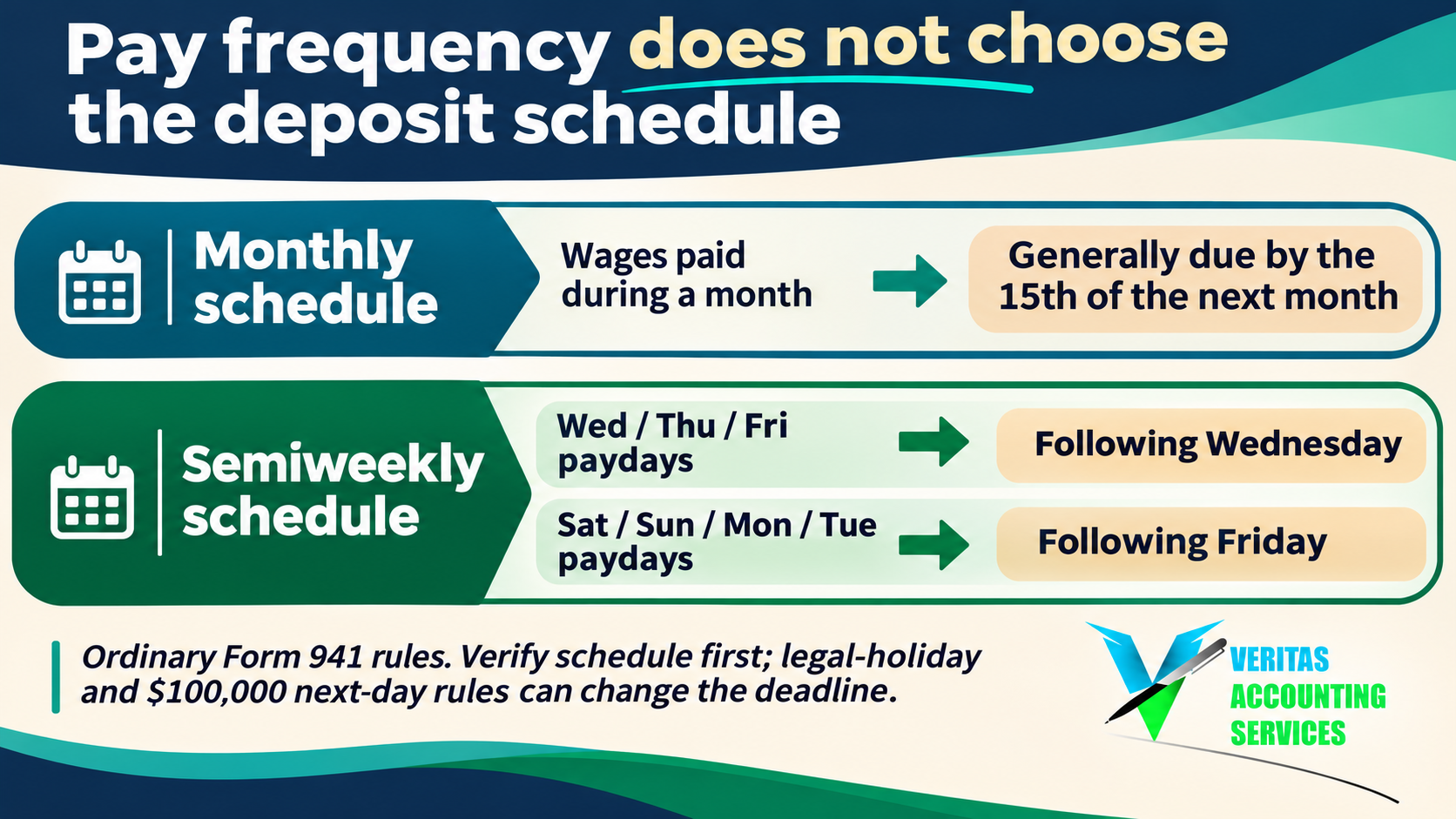
Under the ordinary monthly rules, payroll tax deposits for wages paid during a month generally are due by the 15th of the following month. That is a deposit schedule, not a requirement to file Form 941 monthly. The quarterly return remains a separate reporting task.
For a semiweekly depositor, liabilities from Wednesday, Thursday and Friday paydays generally are due the following Wednesday. Liabilities from Saturday, Sunday, Monday and Tuesday paydays generally are due the following Friday. The label does not mean every employer must make exactly two deposits every week.
For payroll tax deposits, map each actual payday to its deposit period. A monthly employee payday can generate only one ordinary deposit for that month while still following the semiweekly timing rule. Conversely, multiple paydays can fall into the same deposit period and need to be considered together.
Legal holidays and business-day rules can change the result. The federal deposit rules use legal holidays in the District of Columbia; a different statewide holiday does not automatically postpone a federal deadline. Semiweekly depositors also have a minimum-business-day rule following the close of the period. Verify the actual calendar rather than copying an unadjusted weekday pattern.
3. Check the next-day rule before relying on the ordinary date
Payroll tax deposits can become due sooner when an employer accumulates at least $100,000 in taxes on a day during a deposit period. The IRS requires the deposit by the next business day. This rule can apply to either a monthly or a semiweekly depositor.
Review the accumulated liability, not just one employee’s withholding or the current payroll’s net cash payment. Publication 15 explains how accumulation works within the deposit period and how it restarts after the threshold is reached. Do not add unrelated periods together or ignore earlier wages within the relevant period.
For payroll tax deposits, large bonuses, an extra payroll or a growing workforce should trigger a deadline review before the ordinary calendar is accepted. The threshold is based on tax liability and is determined before certain nonrefundable credits reduce it. A software display of a lower net payment is not a substitute for that analysis.
A monthly depositor that triggers the $100,000 rule becomes a semiweekly depositor on the next day and remains so for at least the rest of that calendar year and the following year. New employers should not assume a zero lookback guarantees monthly treatment throughout the year. Ask the payroll adviser to review both the immediate deadline and future schedule setting.
4. Distinguish a valid payment-with-return exception from an assumption
Some smaller employers can pay with a timely filed return instead of making deposits when the conditions are met. For Form 941, the IRS describes an exception where the preceding quarter’s or current quarter’s employment-tax liability is less than $2,500, provided there is no $100,000 next-day obligation during the current quarter.
This is a liability test, not a test of the balance left after partial payments. Payroll tax deposits do not become optional just because the return shows a small remaining balance. Form 944 and other situations have their own conditions, so use the actual instructions rather than a general small-business label.
If eligibility is uncertain, review it before choosing to wait. The IRS Form 941 and 944 deposit topic explains the distinction. A mistaken decision to pay with a return can create a deposit problem even if the employer eventually sends the full tax amount.
For payroll tax deposits, record the reason for an exception alongside the supporting return figures and the person who reviewed it. Recheck when payroll grows. An exception that applied in a quieter quarter should not silently become a permanent setting for the business.
5. Verify the payment route, cutoff and settlement details
Federal payroll tax deposits must use an electronic funds transfer. Current IRS guidance lists options including the business tax account, Direct Pay for businesses and EFTPS. A trusted provider or financial institution may also arrange the transfer, sometimes with fees or a different processing cutoff.
Choose the correct tax form, period, employer identification number and payment date. A payment to the wrong period can leave an apparent unpaid liability even though money left the bank. Keep the confirmation and check the final payment status rather than treating an initial request as the end of the process.
For payroll tax deposits, verify the current cutoff for the actual method and amount before initiating the transfer. IRS pages and payment options can be updated at different times; do not assume one generic deadline covers every channel, same-day payment or provider. Build an internal lead time that leaves room to resolve a rejection.
If a same-day arrangement becomes necessary, ask the financial institution or payroll adviser about the supported process, availability and costs. Do not assume that an ordinary bank transfer is the correct federal tax deposit. This guide is an operating review, not an instruction to initiate a payment without checking the account details.
A worked semiweekly example
Suppose a business is correctly classified as a semiweekly Form 941 depositor. It incurs $7,000 of covered tax liability on a Wednesday payday and another $3,000 on a Friday payday. Assume both wage dates fall in the same quarter, all requirements are otherwise met, no relevant legal holiday changes the deadline and the next-day rule does not apply.
The payroll tax deposits calculation for that Wednesday-through-Friday period is $7,000 plus $3,000, or $10,000. Under the ordinary semiweekly rule, that amount is due by the following Wednesday. The example concerns tax liabilities, not gross wages, net employee payments or a percentage applied to sales.
| Record | Wednesday payday | Friday payday | Following Wednesday |
|---|---|---|---|
| Tax liability arising on wage date | $7,000 | $3,000 | No new liability assumed |
| Deposit for this example | None assumed | None assumed | $10,000 due |
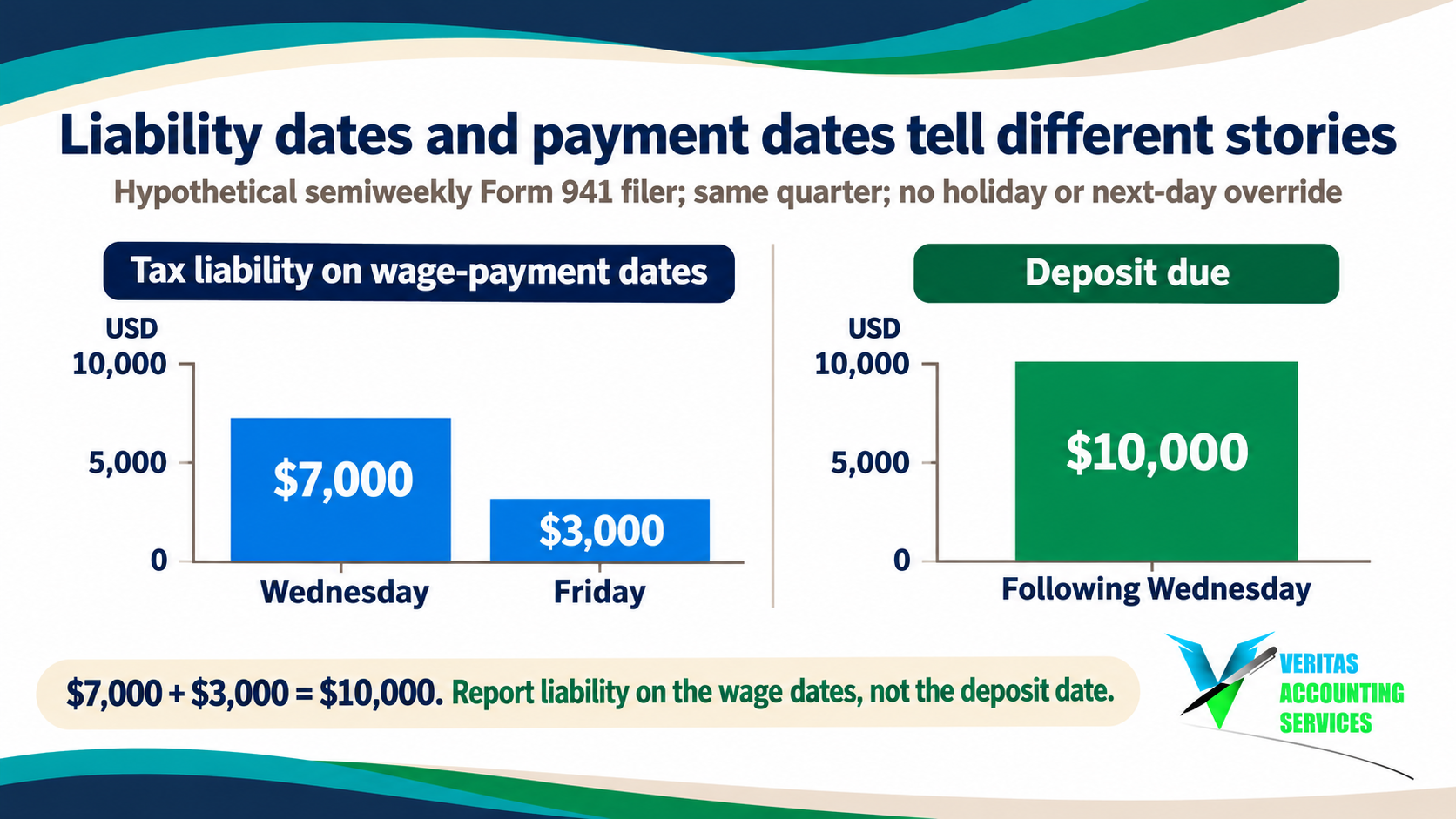
The liability dates remain Wednesday and Friday even if one deposit covers both amounts. Semiweekly Form 941 depositors report liabilities on Schedule B, which is a liability record rather than a list of bank-payment dates. Moving both liabilities to the deposit date can create a mismatch in the reporting trail.
For payroll tax deposits, quarter boundaries also matter. Publication 15 explains that paydays falling in different quarters can require separate deposits even when they occur in the same semiweekly period. Do not use the combined example without checking that assumption.
Finally, separate the payroll tax deposits due from the proof of payment. The $10,000 total does not show that a payment was initiated or completed. The business still needs the correct electronic transfer and a matching confirmation. That distinction is useful whether payroll is handled internally or by a provider.
Build a payment verification routine
For payroll tax deposits, create a short register with the wage dates, covered liability, deposit period, due date, responsible person and payment reference. Keep the schedule calculation and any special-rule review with it. The register should explain why the amount and deadline are correct, rather than merely list planned payments.
Compare that register with the payment confirmation and bank activity. Check the employer identification number, tax form, tax period, amount and settlement date. If the provider withdraws a combined amount for wages, fees and taxes, retain the breakdown so one bank debit is not mistaken for an individual tax deposit receipt.
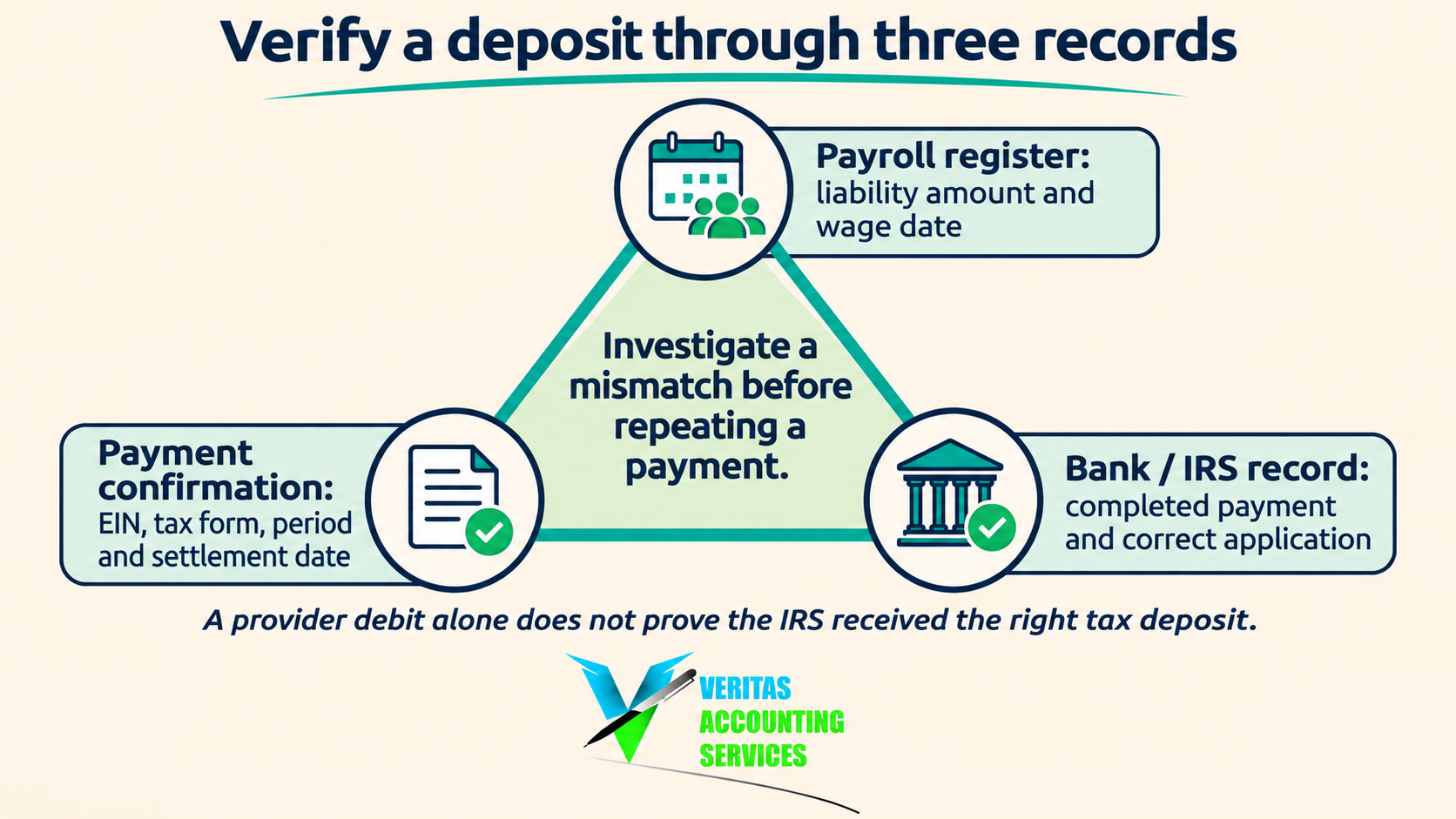
Payroll tax deposits also need a link to the reporting records. Reconcile the quarter’s liability schedule, deposits and any valid adjustments before filing. When a difference remains, identify whether it concerns timing, amount, application or a reporting entry. Do not force the records to agree by changing a date without evidence.
Our bookkeeping and tax records guide provides related operating context. Clear records make review faster, but they must include the payment’s purpose and tax period as well as a bank amount. Keep unresolved items visible until someone has checked them.
Keep oversight when payroll is outsourced
Outsourcing can improve administration, but it does not mean the employer can stop checking payroll tax deposits. The IRS outsourcing guidance warns that, with an ordinary payroll service arrangement, the employer remains responsible if the provider fails to deposit required taxes. Different third-party arrangements can affect responsibility, so understand the arrangement actually used.
Agree who calculates the liability, who schedules the payment and who verifies it. Keep the business’s own access to relevant tax records and make sure important IRS correspondence reaches the employer. A provider’s internal completed label should be supported by the relevant payment evidence.
For payroll tax deposits, a useful handoff is a short confirmation containing the form, period, amount and payment reference. Review exceptions such as a returned payment, late funding or a payroll change after approval. A clear escalation owner prevents a problem from remaining between the provider and the business without action.
Plan cash for payroll tax deposits
Payroll tax deposits belong in the cash forecast alongside employee net pay and other payroll costs. Approval should consider the full funding requirement and the relevant dates. A business can have enough cash for employee payments while still lacking money for the associated tax deposit.
Use a forecast that separates liabilities from operating expenses. Employee withholding is not extra revenue available for suppliers or owner withdrawals. Employer payroll taxes also need proper classification. Our business expense classification guide explains the importance of recording transactions according to what they represent.
For payroll tax deposits, flag bonuses and unusual pay runs before releasing the payroll. They may change the funding requirement or trigger an earlier deadline. Our tax savings versus cash flow discussion explains why an accounting or tax entry does not replace a cash plan.
What to do when a payment looks wrong
Investigate promptly if payroll tax deposits appear missing, rejected or applied to the wrong period. Gather the payroll register, confirmation, bank details and any IRS notice. Confirm what actually happened before initiating another payment, so an uncertain status does not produce an avoidable duplicate.
Penalties can apply to late, insufficient or improperly made deposits, subject to applicable exceptions and relief rules. Some unpaid withheld taxes can also create personal-responsibility issues under the trust fund recovery rules when the relevant responsibility and willfulness conditions are met. Do not treat employee withholding as ordinary working capital.
Ask the preparer or payroll adviser to review the specific remedy and deadline. Paying, correcting a report, tracing a transfer and requesting penalty relief are different actions. Preserve the evidence and follow the instructions relevant to the problem rather than assuming one extra deposit resolves every mismatch.
Frequently asked questions
Are payroll tax deposits due only when Form 941 is filed?
Generally, no. Deposits and filing are separate obligations. Most employers must follow their monthly or semiweekly deposit rules, with special rules and exceptions considered separately. An eligible payment-with-return exception needs to be established from the actual facts.
Does paying employees twice a month make me a semiweekly depositor?
No. The deposit schedule generally comes from the applicable lookback rules, not the employee pay frequency. A next-day obligation can override ordinary timing and can change a monthly depositor’s future schedule.
What happens if a deposit date is a holiday?
Check the federal business-day rules and the relevant District of Columbia legal holidays. Semiweekly depositors also have a minimum-business-day rule after the close of the deposit period. A statewide holiday alone does not automatically extend the federal deadline.
Is money withdrawn by my payroll provider proof the IRS was paid?
Not by itself. The withdrawal may include several payroll components. Match the tax amount to payment details and the relevant bank or IRS record. Keep evidence of the correct employer account, tax form, period and payment status.
Can a new employer always use monthly timing?
The ordinary lookback rules generally treat pre-business quarters as zero, which usually starts a Form 941 employer on monthly timing. The $100,000 next-day rule can still apply. Review large or unusual payrolls before relying on the ordinary date.
Conclusion
Reliable payroll tax deposits require more than a payroll approval. Confirm the return type and schedule, map actual wage dates, check overrides, fund the payment and verify the result against supporting records.
Before the next payroll, assign one person to confirm the deposit deadline and one clear check for the completed payment. That small operating habit can make differences easier to spot before the quarter’s return is prepared.
This article provides general US federal tax information reviewed November 3, 2026. It is not individualized advice. Confirm the rules for the relevant tax year, employer and circumstances, and review state requirements separately.
GET IN TOUCH
Schedule a FREE Call
Connect on our Socials!
