







5 Proven Checks to Avoid Mistakes on Your New Equipment
A printer, scanner or office chair can create a surprisingly awkward bookkeeping question: should you record the purchase as an expense or an asset? The de minimis safe harbor can simplify the federal tax treatment of qualifying small purchases. For a business without an applicable financial statement, the threshold is generally $2,500 per invoice or separately substantiated item, provided the other requirements are met.
The price alone does not establish de minimis safe harbor eligibility. Your accounting policy, book treatment, invoice detail and annual tax election also matter. Reviewing them together helps your bookkeeper and tax preparer reach the same conclusion.
Table of contents
- What the de minimis safe harbor does
- Five practical checks before claiming a deduction
- A $3,700 invoice example
- What happens above the threshold?
- Make the process easier for your team
- Frequently asked questions
- Conclusion
What the de minimis safe harbor does
Some business purchases provide value beyond the current year. Their cost may normally need to be capitalized, meaning recorded as an asset and recovered under the applicable tax rules rather than immediately deducted as an ordinary expense.
The de minimis safe harbor offers a simpler route for qualifying lower-cost tangible property. Tangible property means physical items, such as a business printer or office furniture. This election addresses a specific capitalization question; it does not make personal purchases deductible or remove other applicable tax requirements.
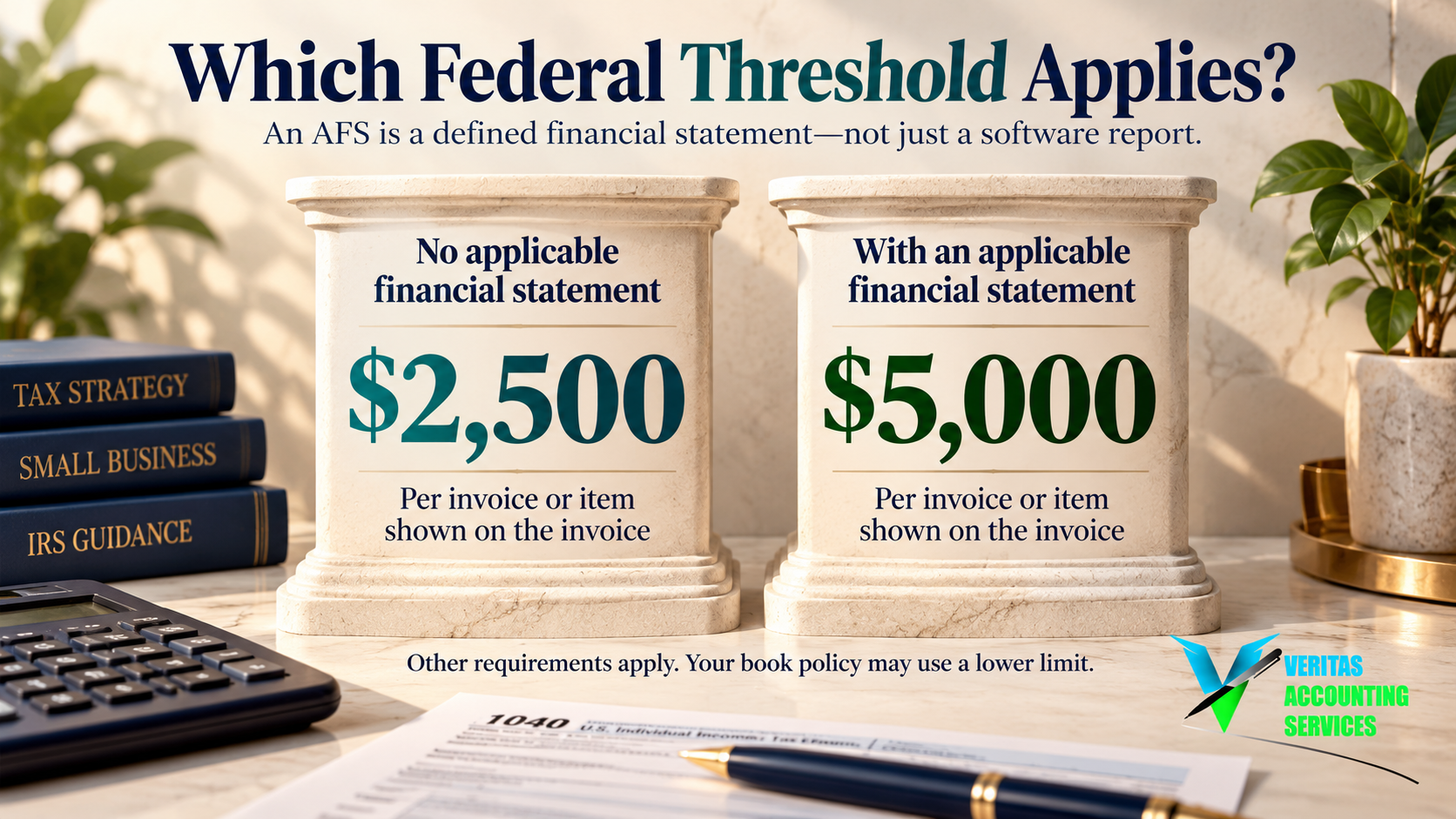
Two federal thresholds are relevant. A business without an applicable financial statement generally uses $2,500. A business with one generally uses $5,000. These are per-invoice or per-item limits supported by the invoice, rather than one annual spending allowance. Your own accounting policy may set a lower limit.
IRS Notice 2015-82 increased the non-AFS threshold to $2,500 for tax years beginning on or after January 1, 2016. This is an established rule, not a newly announced 2026 tax break.
Five practical checks before claiming a deduction
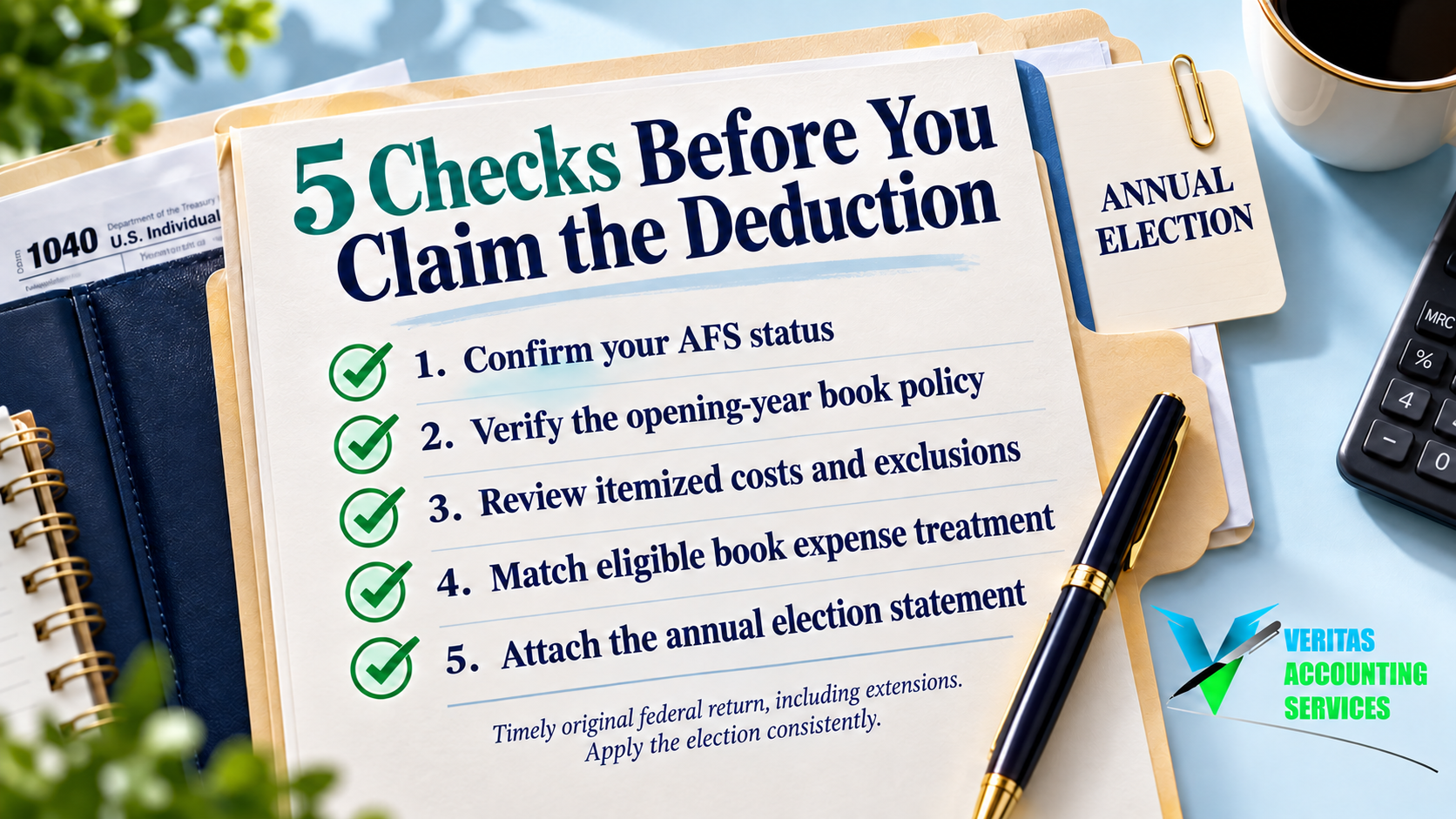
1. Confirm whether you have an applicable financial statement
An applicable financial statement, or AFS, has a defined meaning. A profit-and-loss report downloaded from bookkeeping software does not automatically qualify. Certain audited financial statements and specified regulatory statements can qualify under the rules.
Before using the higher threshold, ask your tax preparer to confirm your status. Keep the answer with the annual tax workpapers. This small step avoids building an entire expense policy around a limit your business cannot use.
2. Check the policy that existed at the start of the year
The de minimis safe harbor depends on qualifying accounting procedures in place at the beginning of the tax year. A calendar-year business reviewing 2026 purchases should establish what procedure existed at the start of 2026, rather than creating a year-end document and pretending it applied earlier.
Businesses with an AFS need written procedures. Businesses without one are not required to have a written policy, but still need an existing, consistent procedure and the corresponding book treatment. Writing it down is useful evidence and makes staff training easier.
For example, a policy that expenses qualifying items costing $1,000 or less does not automatically support deducting a $2,200 item under this election simply because the federal ceiling is higher. Review the actual policy instead of assuming every business uses the maximum.
3. Read the full invoice and check the exclusions
The de minimis safe harbor can operate per item when the invoice substantiates separate items. Save the detailed supplier invoice; a bank-feed entry showing only the total payment leaves important information missing.
Include relevant additional acquisition costs shown on the same invoice when testing the limit. Delivery or installation charges may need to be allocated reasonably across the items. A $2,450 item plus $100 of allocable same-invoice delivery costs can cross a $2,500 threshold.
Do not split one purchase into artificial invoice fragments to fit the limit. The Treasury regulation contains an anti-abuse rule. It also excludes inventory and land, among other specified items. Costs connected with property produced or acquired for resale may require separate capitalization analysis.
4. Match the purchase to its actual book treatment
The de minimis safe harbor requires qualifying amounts to be expensed for the relevant financial accounting or book-and-record purposes. Your tax return should not claim this election while the underlying records show incompatible treatment.
Give the bookkeeper the policy before asking for a year-end expense reclassification. Check the invoice, account coding and business purpose together. Keep personal spending separate, and obtain advice before applying the rule to mixed-use property or more complicated purchases.
Veritas’s guide to classifying business expenses explains why clear categories matter. Consistent coding also helps management distinguish routine operating spending from larger investment decisions.
5. Arrange the annual de minimis safe harbor election
Using the de minimis safe harbor requires an annual election statement attached to the timely filed original federal tax return, including extensions. It is not enough to select an expense account in your bookkeeping software.
The de minimis safe harbor statement identifies the taxpayer and states the election under Section 1.263(a)-1(f). The election applies to all expenditures meeting its criteria for that year; it is not a choice to select only whichever eligible purchases produce the preferred result.
Ask the preparer to include this item on the return checklist and retain the filed statement. The annual election itself is not an accounting-method change requiring Form 3115. A separate change to an established accounting method may raise different questions.
A $3,700 invoice example
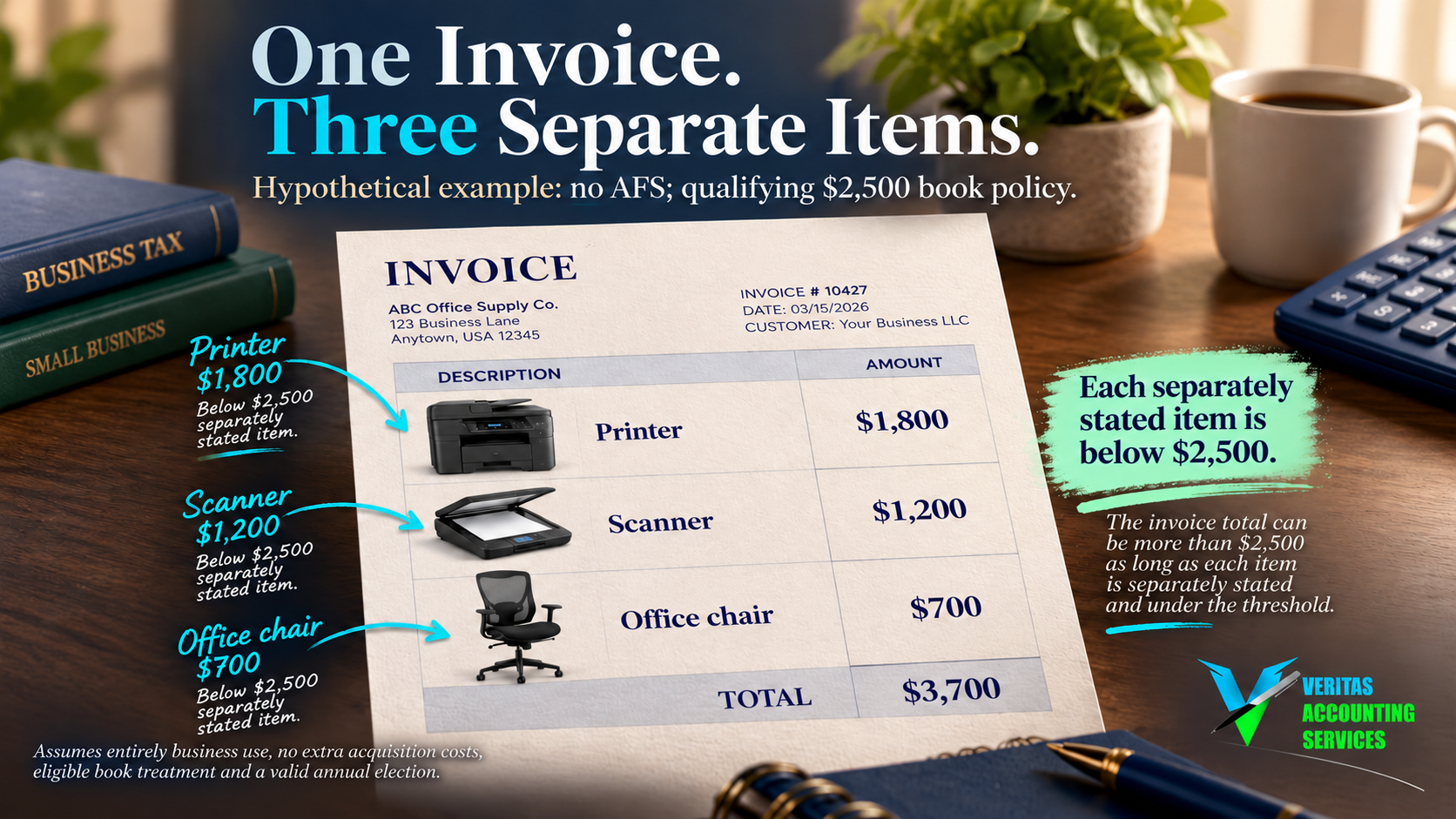
Suppose a consulting business has no AFS. At the beginning of its calendar tax year, it has a consistent procedure to expense qualifying tangible items costing $2,500 or less. It purchases three separate business items on one detailed invoice:
| Item | Separately stated cost |
|---|---|
| Printer | $1,800 |
| Scanner | $1,200 |
| Office chair | $700 |
| Total | $3,700 |
Assume the items are entirely for business use, there are no additional acquisition costs, the business expenses them consistently in its books, and it makes a valid annual election.
Each separate item falls below $2,500. The de minimis safe harbor can therefore apply even though the invoice total is $3,700. The business would retain the itemized invoice, evidence of its procedure and the filed election statement.
This example illustrates eligibility, not guaranteed tax savings. A $3,700 deduction does not mean the IRS refunds $3,700. Its effect depends on taxable income, entity structure and other relevant tax rules. The purchase still uses business cash.
What happens above the threshold?
A purchase above the de minimis safe harbor limit does not automatically become nondeductible. It simply needs analysis under other applicable rules. Depending on the facts, the treatment might involve repair expenses, materials and supplies, capitalization, depreciation or another eligible provision.
Similarly, a $2,600 item does not qualify for a $2,500 partial deduction under this election. The threshold tests eligibility; it is not a deductible allowance you subtract from every purchase price. Avoid posting the first $2,500 to expenses and capitalizing only the difference without support.
For larger purchases, read what to consider before buying equipment for tax reasons. The business need, cash cost and relevant recovery rules deserve their own review.
The IRS small-business tax guide also explains the election and, for Schedule C filers, reporting qualifying amounts among other expenses. That reporting guidance should not be applied mechanically to a corporation’s different return.
Make the process easier for your team
Turn the de minimis safe harbor review into a repeatable purchasing process. Create a shared folder for itemized invoices and a short note explaining the item’s business use. Assign one person to resolve unclear purchases before the monthly books close.
Keep a review list with the supplier, date, item description, total relevant cost, book account and any unresolved question.
Review the policy with the preparer before the next tax year begins. If the existing limit is impractical, discuss an appropriate prospective procedure and how staff should apply it. Avoid backdating changes or treating an undocumented assumption as an established policy.
The same habits support reliable bookkeeping and tax records. They also make it easier to assess tax savings alongside cash flow, so a convenient deduction does not become a reason to buy unnecessary equipment.
Frequently asked questions
Does every purchase below $2,500 qualify?
No. The de minimis safe harbor has requirements beyond price, including eligible property, the accounting procedure, book treatment and annual election. The amount must also satisfy the relevant business-expense rules. Personal purchases do not become deductible because they are inexpensive.
Is the de minimis safe harbor limit $2,500 for the entire year?
No. For a business without an AFS, the federal threshold generally applies per invoice or per separately substantiated item. There is no single $2,500 annual pool under this election. Consistent application and the other eligibility conditions still matter.
Can I just add the election to an amended return?
The ordinary procedure requires a timely original return, including extensions. If the election was missed, ask a qualified tax adviser whether relief is available for the specific circumstances. Do not assume an amended return alone fixes the problem.
Will my state follow the same treatment?
This article covers federal income tax. Confirm the treatment for each relevant state separately. Federal eligibility does not, by itself, establish the state result or eliminate any book-to-tax adjustments your preparer needs.
Conclusion
The de minimis safe harbor is useful when your purchase records, opening-year procedure, book treatment and tax return work together. Start with one recent equipment invoice and trace those links before extending the approach across all purchases.
Keep the decision practical: buy what the business needs, document why it qualifies and confirm the election with your preparer. A clear process is easier to defend and easier for your team to follow.
This article provides general federal tax information, reviewed October 22, 2026. The appropriate treatment depends on your facts and applicable law.
GET IN TOUCH
Schedule a FREE Call
Connect on our Socials!
