








Your Simple Guide to Contractor Tax Mistakes and New Rules
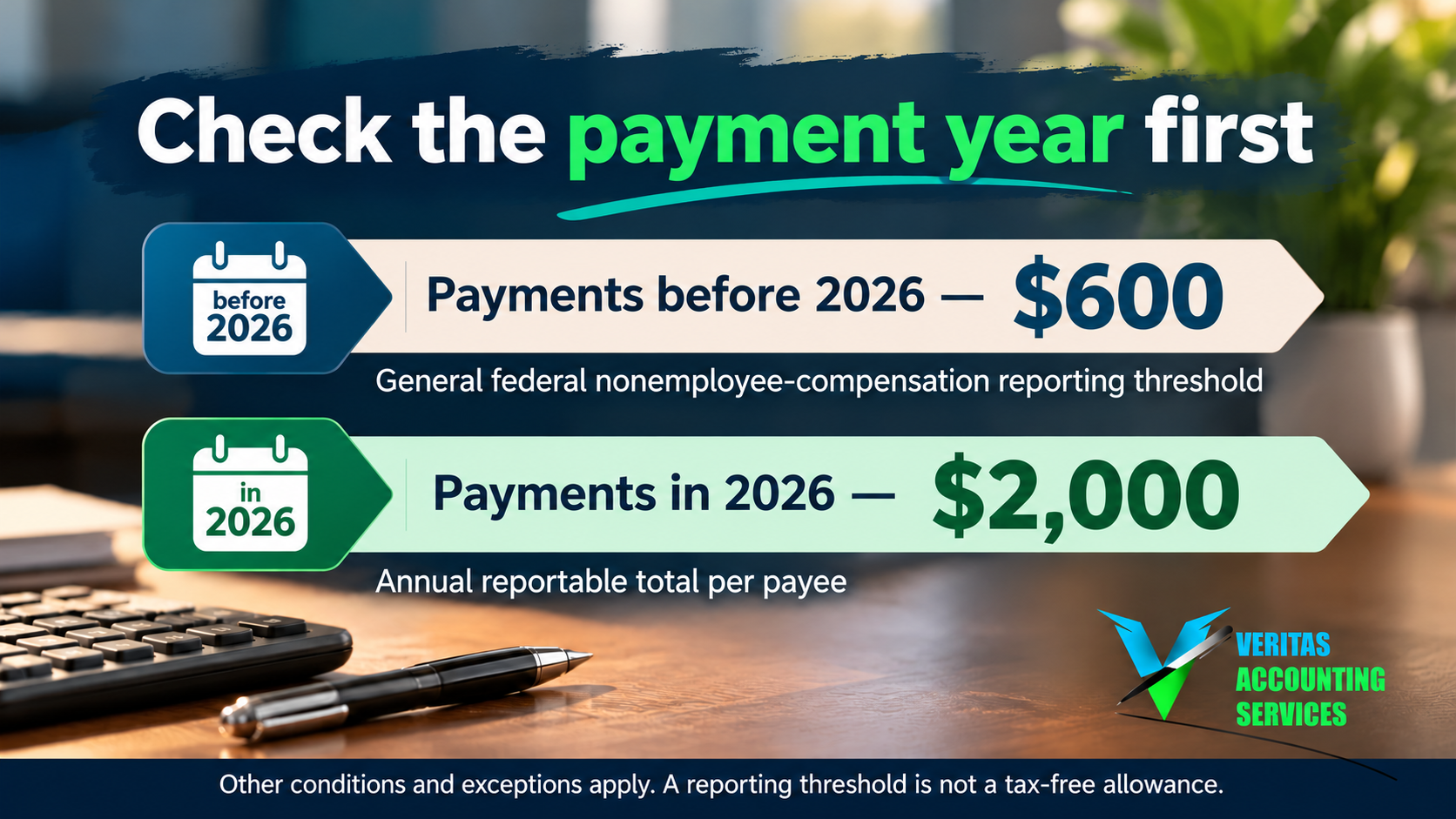
Contractor tax forms need a fresh review for payments made in 2026. The general federal Form 1099-NEC reporting threshold is now $2,000, compared with $600 for payments made before 2026. That change does not make smaller payments tax-free, remove the need for accurate books or settle every reporting question.
The IRS information-return guidance confirms the payment-year distinction and the separate reporting rule when backup withholding has occurred. Use the correct year and payment facts before deciding whether a form is required. An old checklist can lead to the wrong result in either direction.
For a US small-business owner, the useful task is to connect the vendor record, the service provided, the payment route and the annual reportable total. This guide explains five practical checks for ordinary domestic service payments. Foreign payees, unusual transactions and state reporting require their own review.
Table of contents
- What changed for 2026
- What contractor tax forms actually do
- Five checks before deciding what to file
- A worked annual-total example
- Build a useful vendor review file
- Plan the filing process
- Common mistakes to avoid
- Frequently asked questions
- Conclusion
What changed for 2026
The IRS states that the reporting threshold for Form 1099-NEC is $2,000 for payments made in 2026. For payments made before 2026, the threshold was $600. For later years, check the applicable inflation-adjusted amount rather than assuming that either figure remains correct indefinitely.
The change concerns information reporting. It is not a new deduction for the payer or a tax exemption for the person receiving the money. Whether an expense is deductible and whether a recipient must report income are separate questions from the requirement to issue an information return.
When reviewing contractor tax forms, identify the year of the payments first. A form prepared during the following filing season generally reports the preceding calendar year’s transactions. Do not use the year when someone opens the software as a substitute for the payment year being reported.
This article reviews a rule relevant to the 2026 payment year, rather than announcing a new October-only concession. The IRS newsroom’s latest general planning reminders are a reason to check your process now; they do not change the effective date of this threshold.
Other information returns have their own payment categories and thresholds. Do not apply the Form 1099-NEC amount to every type of Form 1099 simply because the form names look similar. A payment for rent, interest or legal settlement proceeds can raise a different reporting question.
What contractor tax forms actually do
Form 1099-NEC reports qualifying nonemployee compensation. The IRS contractor-payment page describes four general conditions: payment to a nonemployee, services for a trade or business, an eligible type of recipient and reportable payments reaching the applicable annual threshold.
That is why a vendor’s total balance alone cannot make the decision. You need to know what was paid for, who received it and how it was paid. A personal household purchase does not become a trade-or-business service payment merely because the business owner made it.
Contractor tax forms also serve a different purpose from the vendor’s invoice. The invoice describes the commercial transaction; the information return reports a qualifying payment to the IRS and the recipient. Keep both records when relevant, rather than treating one as a replacement for the other.
For contractor tax forms, the payer and recipient have separate responsibilities. A contractor should not conclude that business income disappears because no form arrives. Likewise, a business should not conclude that an otherwise deductible expense is automatically disallowed solely because it falls below a reporting threshold. The actual tax and substantiation rules still matter.
There is also a difference between creating a draft form, filing it with the IRS and furnishing a statement to the recipient. A completed screen in the bookkeeping system is not proof that both delivery obligations have been satisfied. Build those separate checks into the workflow.
Five checks before deciding what to file
1. Confirm the worker’s status
Before preparing contractor tax forms, start with the relationship, not the preferred form. The IRS independent-contractor explanation says classification depends on the facts, including the right to control the work. Calling someone a freelancer in an agreement does not settle the federal employment-tax question.
A Form W-9 does not convert an employee into an independent contractor. That distinction matters for contractor tax forms. Neither does paying through accounts payable or having the worker submit invoices. If the arrangement raises a classification concern, ask for an appropriate review before choosing contractor tax forms.
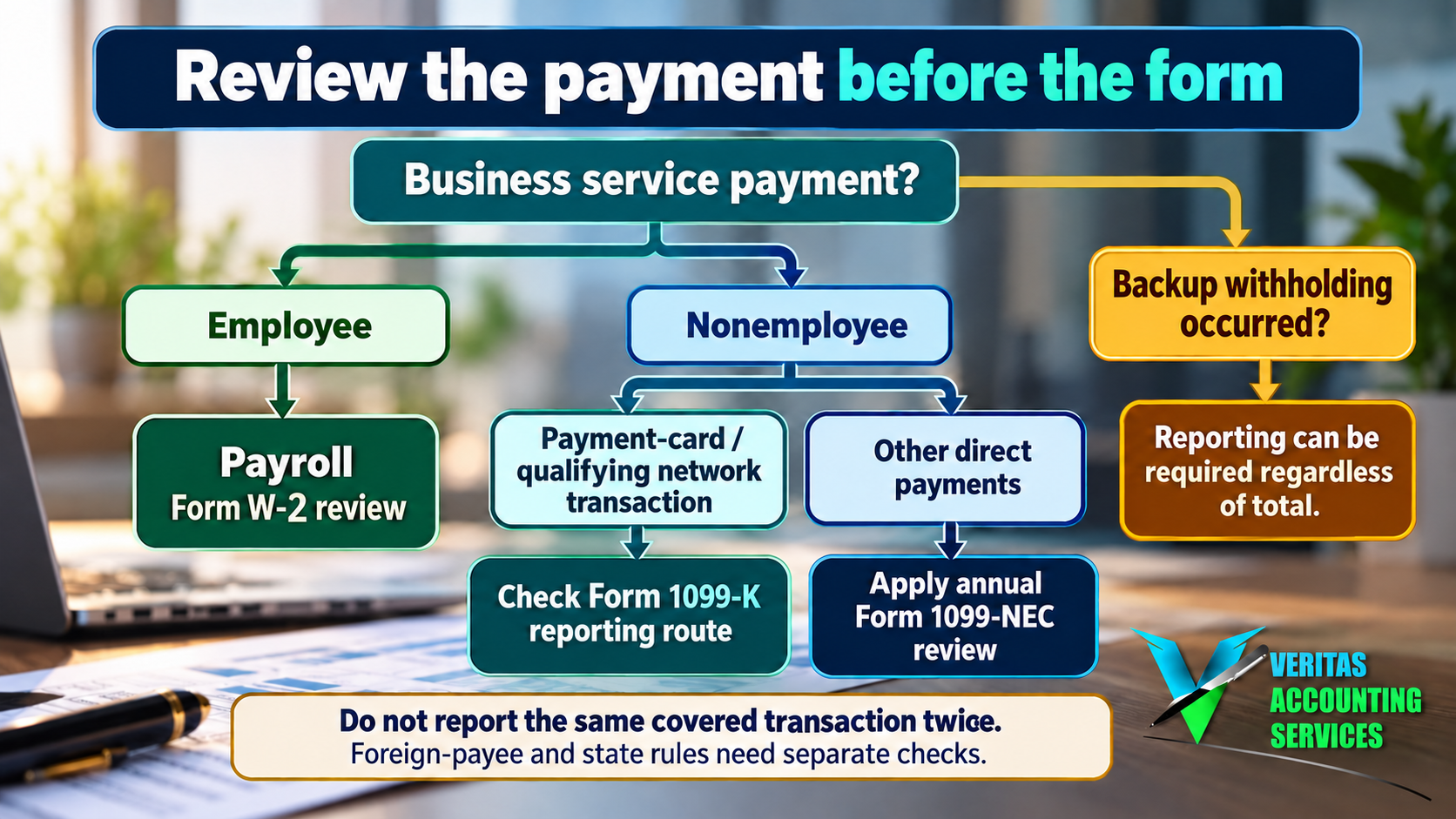
For employees, payroll and Form W-2 reporting belong in the review. For genuine nonemployees, proceed to the service-payment and payee checks. Our payroll pitfalls guide provides related operational context, while the IRS remains the authority for the federal classification analysis.
Keep the reasoning with the engagement records. A short note identifying what was reviewed, who resolved an uncertainty and when the facts changed can be more useful than a generic checkbox saying “contractor.” Review a relationship again if the actual working arrangement changes materially.
2. Verify the payee’s tax information
Collect the correct name, taxpayer identification number and relevant tax classification through an appropriate process. The IRS Form W-9 page links the form and instructions used to request this information from a US person. The completed form is normally given to the requester, not sent to the IRS as a routine vendor-onboarding submission.
For contractor tax forms, the trading name on an invoice may not be the correct name to pair with the tax identification number. The W-9 instructions distinguish the owner’s name and the business name for a sole proprietor or disregarded entity. Do not guess from a logo or website address.
The letters “LLC” do not, by themselves, tell you the federal tax classification. Read the completed information and resolve inconsistencies before using it. Similarly, do not assume that every corporate payee is exempt from every type of information reporting; payments for legal services are a familiar area needing specific attention.
Foreign-payee documentation and withholding can follow different rules. Do not require a foreign service provider to sign a US-person certification merely to fit the domestic process. Flag the case for the appropriate analysis instead of forcing it into the ordinary W-9 checklist.
Protect the records used for contractor tax forms. They may contain personal tax identifiers even when the vendor operates under a business name. Give staff access according to their job, use the agreed secure transfer method and avoid placing full identification numbers in broadly shared spreadsheets.
3. Separate the payment routes
The way a vendor was paid can affect the reporting route. The IRS third-party-filer FAQs explain that a transaction reportable under both the ordinary business-payment provisions and the payment-settlement provisions should be reported only on Form 1099-K, not duplicated on Form 1099-NEC or Form 1099-MISC.
This distinction matters when preparing contractor tax forms from a vendor ledger. Credit-card transactions and qualifying third-party-network transactions need to be identified separately from direct payments. Do not add every payment route together and automatically issue a second form for transactions belonging to the settlement-reporting system.
An app’s name alone is not enough to classify the transaction. Check how the particular payment was processed and retain the relevant evidence. Not every electronic transfer is a qualifying network transaction, and an ordinary direct bank payment does not become one simply because it was initiated online.
For contractor tax forms, ask the preparer to resolve mixed-route cases. One vendor may receive checks, direct transfers and card payments during the same year. A useful report shows each route clearly and explains which amounts were included in the proposed nonemployee-compensation total.
4. Calculate the annual reportable total
Apply the threshold to the relevant annual total for each payee, not to each invoice individually. Several smaller service payments can reach the 2026 amount even when no single invoice is close to $2,000. Search for duplicate vendor records before deciding that two accounts represent two unrelated payees.
For contractor tax forms, reconcile the payment detail to the underlying books and payment evidence. Distinguish a draft bill from an actual payment, and flag refunds, corrections or unusual entries for the preparer. Do not silently net unrelated items together to produce a preferred reporting result.
The ordinary service-payment review can include parts and materials associated with the services, as the IRS’s reporting conditions explain. Do not assume that every amount labeled “materials” can simply be removed from a service contractor’s payment total. The actual transaction and applicable instructions determine treatment.
Track unresolved contractor tax forms separately. A vendor total near the threshold deserves a complete review, rather than a rounded estimate. Use exact supported figures and record the reason for any exclusion from the proposed filing total.
5. Check withholding, exceptions and state requirements
The threshold is not the only filing trigger. The IRS says Form 1099-NEC must also be filed for a person from whom federal income tax was withheld under the backup-withholding rules, regardless of the payment amount. This exception should remain visible when a spreadsheet filters out smaller vendor totals.
The IRS backup-withholding guidance describes situations involving missing or incorrect tax identification information and the current 24% rate. Applying the rules requires attention to the actual facts and notices. Do not treat a general statement about the rate as a complete instruction for handling a particular vendor.
Keep contractor tax forms connected to the withholding records, deposits and any related reporting obligations that apply. A missing name or identification number is not solved by typing a convenient substitute into the return. Escalate the problem and follow the applicable correction or withholding procedure.
Review state information-return obligations separately using the relevant state’s official guidance. A federal change does not prove that every state adopted the same threshold, filing channel or exception. Record who will make that check instead of assuming the federal submission settles it.
A worked annual-total example
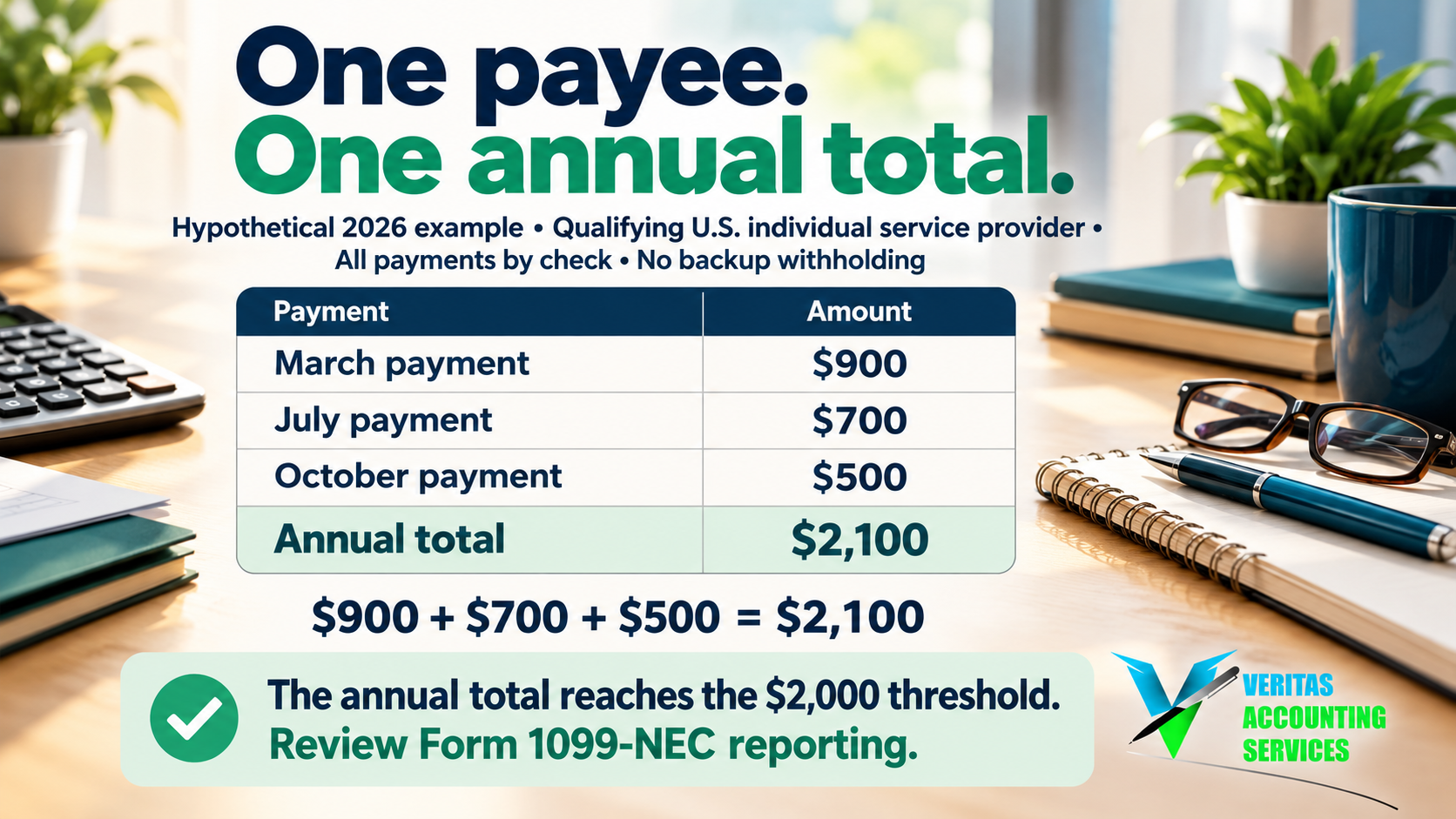
Suppose your business pays one US individual service provider by check during 2026. Assume the payments are qualifying business service payments, the payee information is correct, no exemption applies and no backup withholding occurred. These are illustrative assumptions, not details from a real client.
The business pays $900 in March, $700 in July and $500 in October. The annual total at that point is $2,100: $900 plus $700 plus $500. The amount reaches the general $2,000 reporting threshold even though each individual payment is below it.
A review of contractor tax forms should therefore consider Form 1099-NEC reporting for the full reportable amount, subject to the stated assumptions and any later activity. The threshold is not a deduction from the amount reported. You do not report only the $100 exceeding $2,000.
Before finalizing contractor tax forms, change one fact: suppose part of the vendor’s activity was processed through a payment route covered by the settlement-reporting rules. You would need to separate that activity and review the remaining direct-payment total. The original example’s simple conclusion cannot be carried over without recalculating the relevant amount.
Change another fact: suppose backup withholding occurred. The separate reporting rule may apply regardless of the total. Examples are useful because they show the method, but they work only when the assumptions match the facts being reviewed.
Build a useful vendor review file
Start with a vendor list that has one clear record for each payee. Link invoices and payment details without scattering the same supplier across abbreviations, personal names and duplicate accounts. Ask the responsible person to resolve duplicates before exporting a filing list.
A practical file for contractor tax forms should show the following:
- The payee name and the location of the securely stored tax documentation.
- The service category and any classification issue needing review.
- Payments by date, amount, payment year and payment route.
- The proposed reportable total and the reason for each excluded amount.
- Any backup withholding, exception, unresolved item or state-review assignment.
Do not include full tax identification numbers in a general management report. The preparer may need them in the secure filing process, but the owner can review progress using an internal vendor reference. This keeps the operational status useful without unnecessarily spreading sensitive data.
Review contractor tax forms alongside your expense records. Our business expense classification guide explains why consistent categories help the books. An expense label supports the review, but it does not replace the specific information-return rules.
Assign an owner to unresolved contractor tax forms. “Waiting for W-9” should identify who will follow up and the next action. A missing document discovered early is easier to investigate than one found while a final filing is being submitted.
Plan the filing process
Decide who prepares, reviews, submits and verifies contractor tax forms. Give the reviewer a clear version of the proposed data and a list of assumptions. Changes made after approval should return for review rather than quietly altering the final submission.
Contractor tax forms may need electronic filing even if the business has only a few contractors. The IRS explains that the ten-return e-filing threshold generally aggregates almost all covered information-return types, including Forms W-2. Counting only the Forms 1099-NEC can miss the relevant total.
Check the applicable calendar-year deadlines and any authorized extension or postponement against official guidance. Filing with the IRS and furnishing recipient statements are separate steps. Do not use a deadline for another form, or assume a paper process and an electronic process always have identical requirements.
For contractor tax forms, keep the submission confirmation and check the system’s acceptance or rejection result. A rejected file requires follow-up. Save evidence that recipient statements were furnished through an appropriate method, and document how corrections will be handled if an error is later found.
The IRS also describes its Information Returns Intake System, or IRIS, as a no-cost way to file Forms 1099 electronically. Check existing access and current instructions early. Choosing a free channel does not remove the need for complete data, review or confirmation.
Our business compliance calendar can help organize responsibilities and reminders. The calendar is an operating tool; the current official rules determine the actual due dates and filing requirements.
Common mistakes to avoid
The first mistake is carrying an old $600 filter into the 2026 payment review without checking the changed rule. The reverse mistake is using the 2026 threshold to reassess an earlier payment year. Contractor tax forms need a clearly labeled year before any software setting is applied.
The second mistake is deciding from the invoice amount alone. Aggregate the relevant payments to the payee, resolve duplicate vendor records and verify the payment route. A tidy-looking summary can still be wrong if its underlying categories are incomplete.
The third mistake is treating the absence of a form as proof that income is not taxable. Information reporting and income taxation have different purposes. A contractor’s own books remain important even when no information return is required from a particular customer.
The fourth mistake is assuming that software validates the legal conclusion. Software can populate contractor tax forms from the data supplied; it cannot determine an unresolved worker relationship or explain an unidentified payment route. Review the decisions before the upload, not only the spelling afterward.
Finally, do not delete records merely because the vendor falls below the general threshold. The expense, payment, classification and withholding facts can still matter. Our bookkeeping and tax records guide explains the value of a reliable supporting file.
Frequently asked questions
Is the 2026 threshold $600 or $2,000?
For the general federal Form 1099-NEC payment threshold discussed here, the IRS identifies $2,000 for payments made in 2026. The $600 amount applies to payments made before 2026. Other conditions, exceptions and payment categories still need review.
Do contractor tax forms use each invoice or the annual total?
Use the relevant annual reportable total for the payee. Multiple smaller payments can reach the threshold. Check that the total includes the correct payments and excludes transactions belonging to a different reporting route for a supported reason.
Is only the amount above the threshold reported?
No. In the hypothetical $2,100 example, reaching the threshold triggers a review of reporting the full reportable amount. The $2,000 threshold is not an allowance deducted from the reported payment total.
Can a smaller payment still require a form?
Yes. The IRS identifies reporting regardless of amount when federal income tax was withheld under the backup-withholding rules. Other facts can also require separate analysis. Do not rely on a threshold-only filter for contractor tax forms.
Does every electronic payment belong on Form 1099-K?
No. When preparing contractor tax forms, confirm the actual transaction and whether the payment-settlement reporting provisions apply. A transfer being electronic or appearing in an app is not, by itself, a complete answer. Avoid duplicating transactions covered by the Form 1099-K reporting route.
What should I do if a vendor’s information is incomplete?
Request the appropriate documentation through your secure process and flag the issue for review. Do not invent an identification number or presume an exemption. Resolve any applicable withholding and filing requirements before treating the file as ready.
Conclusion
The 2026 reporting threshold is an important change, but it is only one part of preparing contractor tax forms. Check the worker relationship, payee details, payment route, annual reportable total and any withholding or state requirements before deciding what to file.
The useful next step is to reconcile the vendor list now and assign the unresolved items. Clear source records and a reviewed filing process help turn a year-end scramble into a manageable compliance task.
This article provides general federal tax information reviewed October 28, 2026. It is not individualized advice. Confirm the payment year, current applicable instructions, special rules and state requirements before acting.
GET IN TOUCH
Schedule a FREE Call
Connect on our Socials!
