📩 Get A Quote : hello@veritasaccountingservices.com
Customer holds a card over a payment terminal at a hardware store, with a receipt on the counter.

What to Do When You Pay for Business Expenses Personally

The company card is back at the office, but you need a replacement part before your next appointment. You pay with your own card, tuck the receipt in your pocket, and get back to work. A week later the bookkeeper sees no charge on the company statement. If the business transfers money to you, the bank feed shows the repayment but gives little clue about what you originally bought. Owner-paid expenses need a short record that connects the purchase, the person who paid, and any money the business later sends back.

This guide to owner-paid expenses follows one purchase from the checkout counter through the monthly close. The five checks are simple: identify who paid, capture the evidence, agree how to record it, match any repayment, and clear open items. Use the same checks for an occasional supply run or when sorting through a small pile of receipts at month-end.

Table of contents

Identify who paid

Start with two questions. What did the business receive, and whose money went to the seller? For a store purchase, you can often answer the first from the itemized receipt. The payment method, the payer’s name, or a matching transaction from a personal account can answer the second. A supplier may put the company’s name on the receipt even though the owner used a personal card. Write both facts down so the bookkeeper can match the receipt to the right account.

Owner-paid expenses can include materials for a job, an emergency replacement part, or a small software charge that renewed on an old card. For example, a repair company owner uses a personal credit card to buy $84 of replacement parts for a service call. The hardware store received one $84 payment from the owner. The business checking account had no activity at the register. If the owner simply hands over the receipt, the bookkeeper may spend time looking for a payment that will never appear in the company’s bank feed.

For owner-paid expenses, capture the person, payment method, purchase date, and amount in the same place as the receipt. A note such as “Jordan paid personally, $84, parts for Job 217” helps someone who was away from the checkout counter understand the purchase. If the owner plans to request repayment, say so. If repayment is undecided, mark it for review. This gives the business a clearer view of cash it may need to set aside.

For recurring owner-paid expenses, find out why the personal payment keeps happening. A card that expired, a saved checkout profile, and a subscription tied to an old email account are different problems. Ask someone to update the payment method with the seller and confirm the next charge. Keep the first clean business-card receipt so the bookkeeper can tell where the change took effect. The IRS guidance on keeping records explains how reliable records support business monitoring and financial statements.

Save proof of owner-paid expenses

Save the itemized receipt or invoice, evidence of payment, and a short description of why the purchase was made. Together, those records help explain what the business received, who paid, and how the purchase relates to the business. The IRS guide to business records lists documents that can support expense entries and notes that more than one document may be needed to establish all the relevant details.
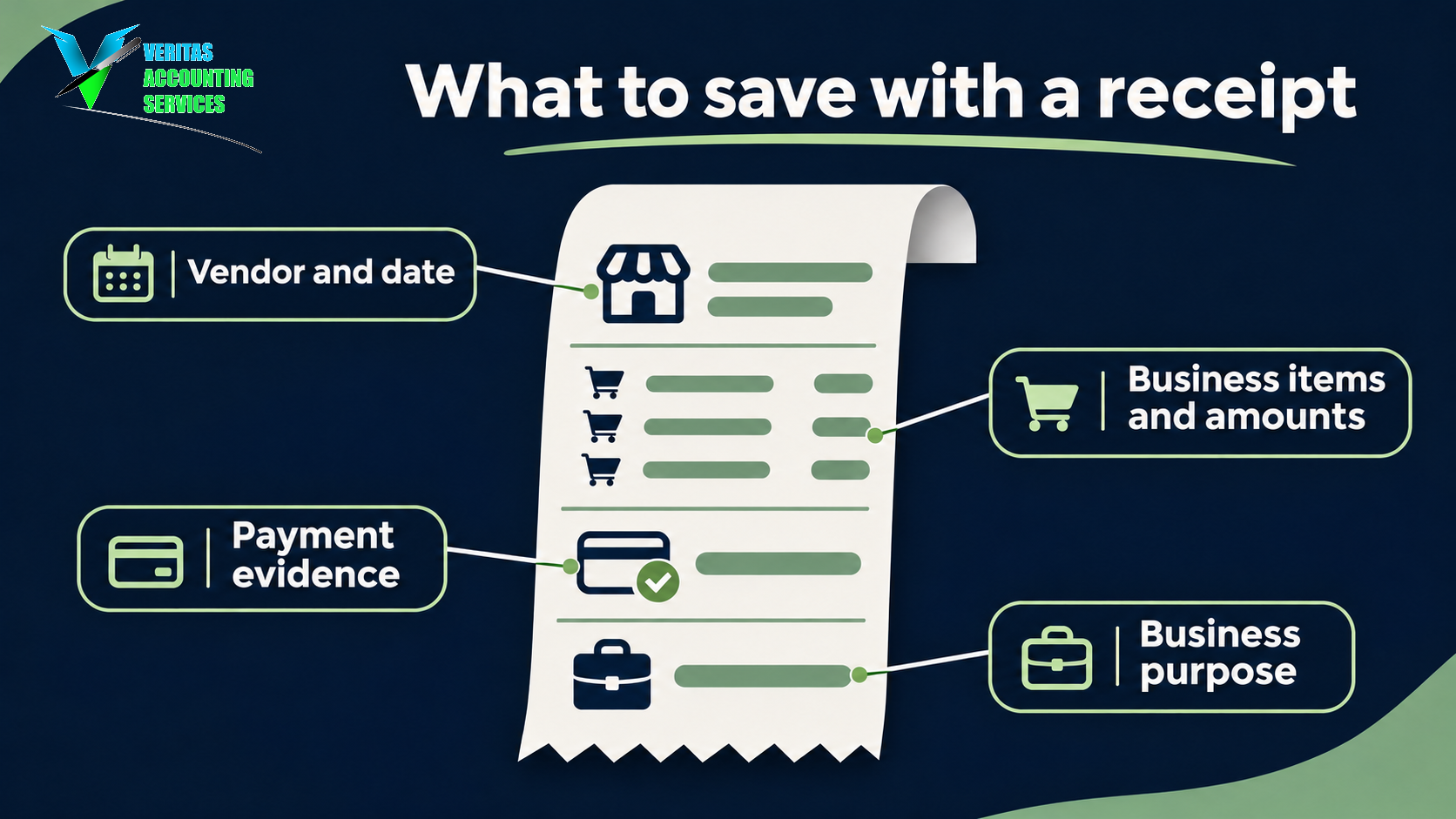
An annotated receipt shows the vendor, items, payment evidence and business purpose to save for owner-paid expenses.

For online owner-paid expenses, the vendor may send an order confirmation with no itemized invoice attached. Log into the vendor portal and save the actual receipt when available. Add a note for anyone who needs to interpret the charge later. “Twelve months of scheduling software for the dispatch team” gives the bookkeeper more information than “software.” If a card statement lists the payment processor instead of the seller, save the confirmation number or another reference that connects the two.

Avoid sharing an entire personal statement when a matching line and appropriate supporting records will do. Use your secure bookkeeping channel and ask which details your team needs to retain. Keep the vendor, date, transaction amount and relevant account reference visible where needed. If a receipt is hard to read, take a clearer photo or request a replacement while the transaction is fresh. Save the supporting evidence with the record instead of relying on a copy that might expire in a messaging app.

Owner-paid expenses need extra care when a receipt also includes personal items. Suppose the owner purchases $36 of business shipping supplies and $24 of personal items in a single $60 transaction, with the example amounts already including applicable charges. Save the $60 receipt and mark the $36 of business items. Record the split visibly so the reviewer can tie the business portion to the whole receipt. If tax, shipping or a coupon applies to the order as a whole, flag the allocation for review before anyone enters a business amount. For broader context on grouping costs in the books, see Veritas’s guide to classifying business expenses.

If the vendor later refunds part of an owner-paid expense to the owner’s card, attach the refund to the original record. Ask whether the refund arrived before or after the business repaid the owner. A refund can change the amount still to be settled, so bring both dates and both amounts to the reviewer. An open note is useful while waiting for a return to clear, especially if the owner and the bookkeeper work in different places.

Agree on the bookkeeping treatment

A receipt answers what was bought. It rarely answers how the books should reflect the owner’s payment. Give the bookkeeper enough information to choose the entry for your business, including whether the company is expected to pay the owner back, what was purchased, and whether the transaction is already recorded. The appropriate entry depends on the business structure and the nature of the item. For example, a supply purchase and a deposit on equipment may need different treatment even if the same personal card paid for both.

When handing off owner-paid expenses, ask the reviewer to keep the purchase evidence and the owner funding information together. If an invoice already exists in the system, have them start there. A common source of confusion is entering the original invoice from the inbox and then creating a second purchase from the receipt. Compare the vendor, amount, invoice number and items before approving a new record. If a payment reference can be added to the existing entry, that makes the history easier to follow.

If repayment is expected, agree where the open item will be tracked and who can approve it. If the owner intends to fund the business without repayment, document that decision for the bookkeeper. Avoid moving an item between “to repay” and “owner funded” without an explanation. A dated decision helps the people preparing the financial reports or taking over the file later.

For owner-paid expenses involving more than one business, identify which entity actually received the goods or service. If a supply order covers jobs for two companies, give the reviewer both names and explain the allocation. Simply entering the full order in whichever file is open can distort costs and make it harder to see what each business owes. Flag unusual or material items and ask your accountant about the appropriate classification and any related tax questions. The IRS guide to starting a business and keeping records includes general guidance on business records and keeping business and personal accounts separate.

Make the handoff easy to review

For owner-paid expenses, use one row per purchase or a single identifiable record in your bookkeeping software. Add the vendor, purchase date, gross receipt amount, business amount, purpose, payer, and receipt reference. Include a project or customer code if your company tracks those costs. Let the reviewer record a decision and link the bookkeeping entry in the same record. The person who enters the transaction should be able to tell when a question is still open.

Consider owner-paid expenses across a busy week. A staff member sends in a printed invoice, the owner forwards a card receipt, and the vendor sends an email marked “paid.” Give the reviewer a way to see that all three documents relate to one order. If multiple locations bought the same item at the same price, distinguish the receipts by order number, purchase date or store. A match needs evidence, since equal amounts alone can belong to separate purchases.

Match repayment to the purchase

The $84 repair company example shows how to match repayment for owner-paid expenses. Once the business approves the claim and repays the owner, its bank feed shows $84 going out. Ask the reviewer to link that transfer to the existing purchase record using the claim reference and repayment date. The owner-to-vendor payment and the business-to-owner payment answer different questions. One shows that the parts were paid for. The other shows that the business settled with the owner.
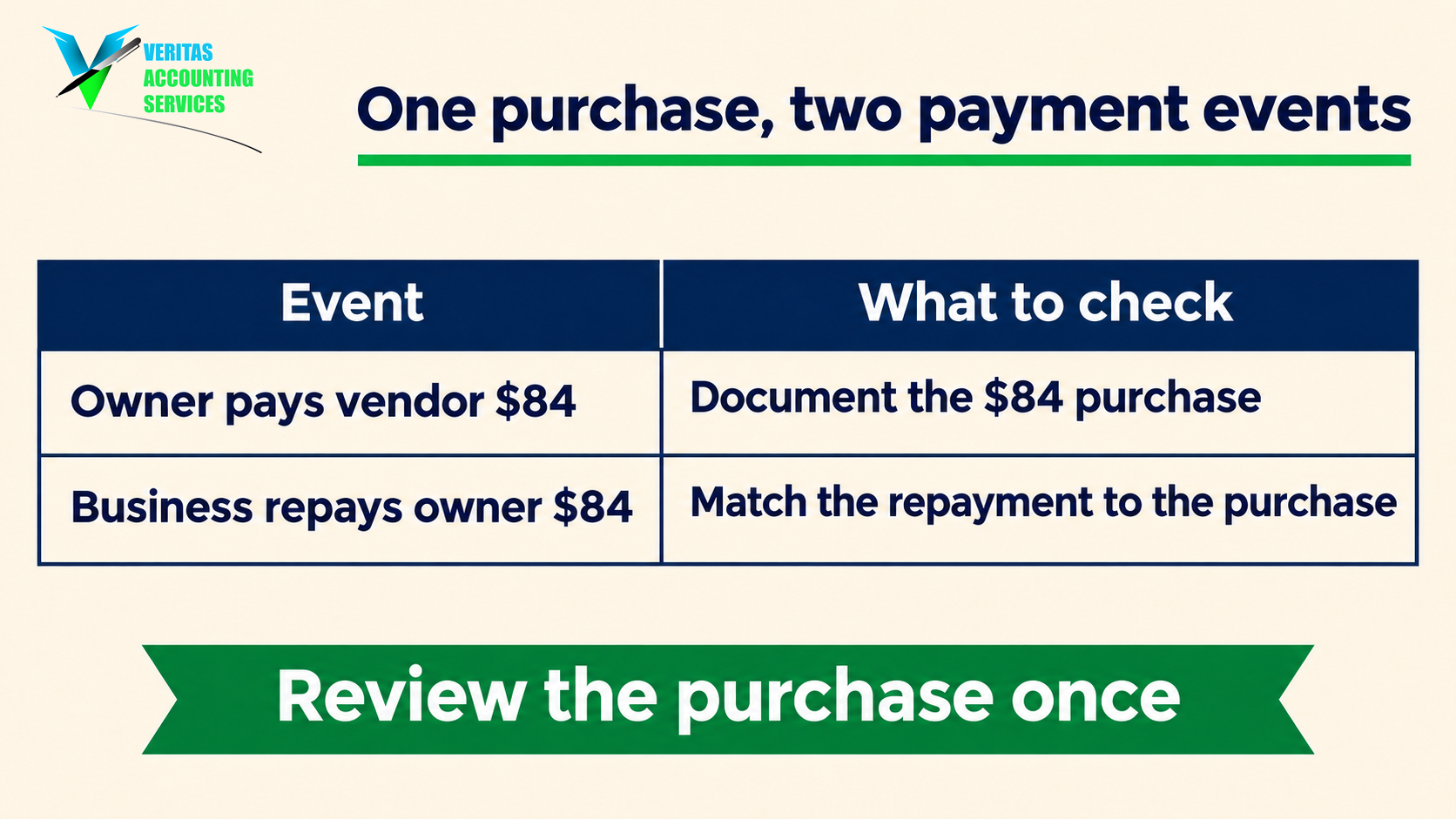
Worked table shows the owner paying the vendor $84 and the business matching its later $84 repayment to that same purchase.
EventWhat the reviewer looks for
Owner pays the vendor $84Itemized receipt, payment evidence and a purpose note for Job 217
Bookkeeper reviews the purchaseA single purchase record and a documented decision about the owner’s payment
Company sends the owner $84Bank transaction linked to the reviewed purchase and approval
Monthly reviewThe purchase appears once and the repayment status agrees with the bank

The example assumes a full repayment of a single approved purchase with no fees or refunds. If the business pays $50 first and $34 later, keep both payment references on the record and track the remaining $34 until it clears. If the business sends a combined payment for three approved owner-paid expenses, give the reviewer a list of the three purchase references with amounts adding to the transfer. The list is especially helpful when the bank displays the owner’s name and nothing else.

Duplicate entries for owner-paid expenses can distort how a job performed. If the $84 purchase has already been recorded as a job expense and a second $84 expense is entered when the owner is repaid, the job report could show $168 for one set of parts. Compare the transaction history before correcting a duplicate. A reviewer can check which entry is linked to an invoice, bank match, or closed period and preserve the useful audit trail. For a related routine on checking amounts and payment timing, see Veritas’s vendor bill review guide.

Review open items at month-end

At close, sort owner-paid expenses by status. A small business might use “evidence needed,” “awaiting review,” “approved and unpaid,” and “settled.” Give each open item a person and a follow-up date. If an owner can’t find a receipt or the vendor hasn’t processed a promised refund, keep the question visible and update the note when the answer arrives. A one-line status can save time the next month because the reviewer can pick up from the last documented action.
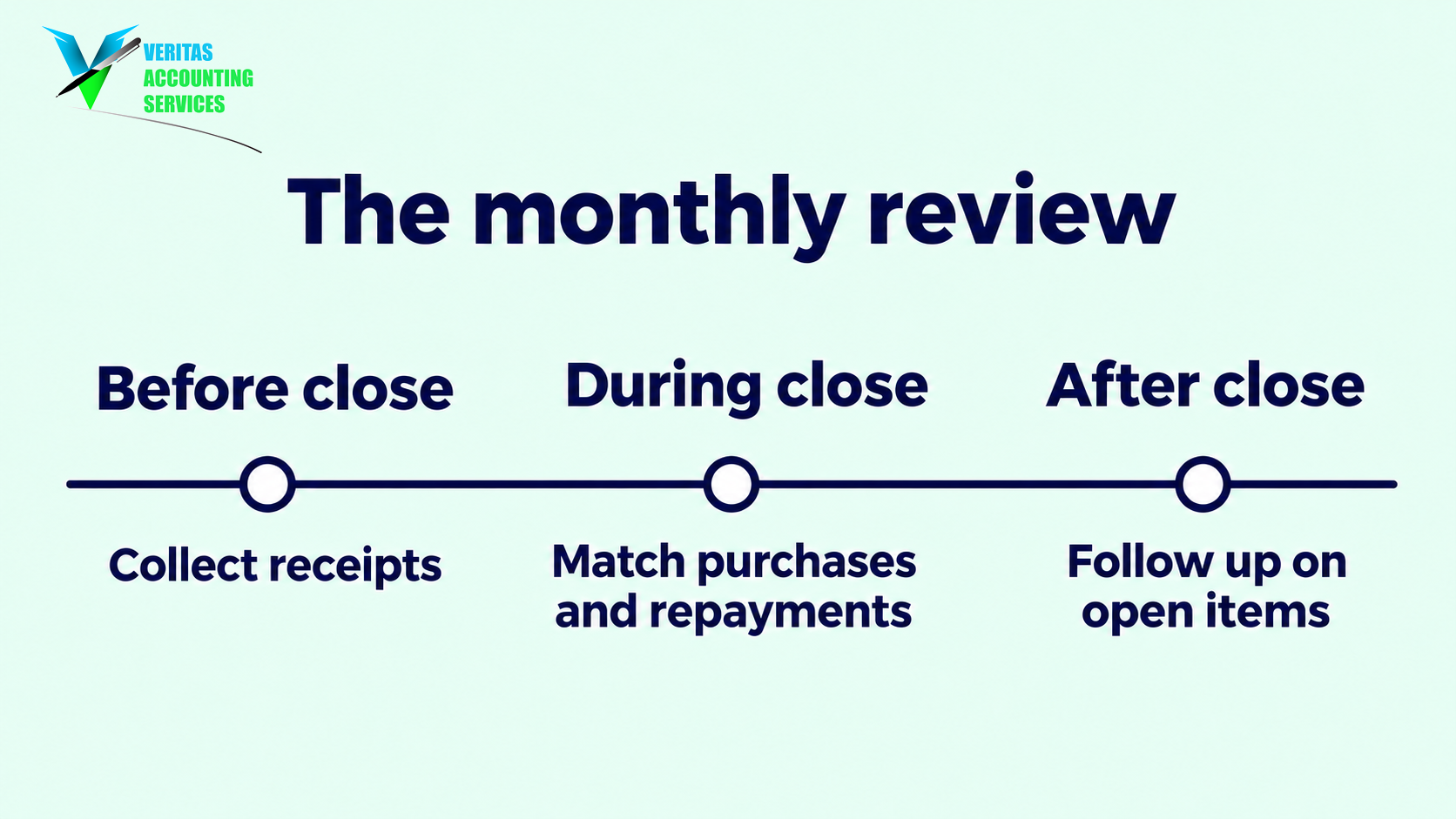
Monthly review timeline shows when to collect receipts, match purchases and repayments, and follow up on open items.

Before the close, ask for owner-paid expenses missing from the business accounts. During the close, compare the list with recorded purchases and repayments. After the close, follow up on unresolved evidence or approvals. Keep your policy for regular reporting and approvals short enough that people use it. Agree where receipts go, who can approve a repayment, and how to label the bank transfer. Veritas’s guide to good bookkeeping and tax records covers the wider recordkeeping routine.

Give the cash forecast something specific to show

Approved but unpaid owner-paid expenses are worth bringing to the cash planning discussion if the business expects to pay them soon. Say the business has approved $240 for an owner’s recent purchases and expects to pay next Friday. Put the $240 on the expected payment date in the cash forecast. When the bank transfer clears, mark it paid and remove it from future expected outflows. This helps the owner see how much cash is likely to be available for the next round of supplier bills.

If repayments build up, review the outstanding list before assuming the business has a healthy cash cushion. Also ask whether owners are regularly covering costs that should be paid from the company account. One fix might be issuing an existing authorized company card to the person who buys supplies. Another might be moving vendor autopay to the correct business account. The aim is to make owner-paid expenses occasional exceptions with a clear trail.

Check late receipts and unusual payments

If a receipt for owner-paid expenses turns up after close, save the original dates and send it to the reviewer. Explain when the purchase was made, when it came to your attention and whether any repayment has already occurred. Let your accounting team determine the right period and whether a closed report needs an adjustment. Changing the date on a document to match the month you found it makes the next review harder.

Pay particular attention to owner-paid expenses from an account used for several businesses, recurring charges that continued after an account change, and repayments for a rounded amount. A reviewer can compare the transfer with the receipts and ask what accounts for any difference. Treat the gap as an open question until it has an explanation. Keeping a short exception list helps the business spot problems without combing through every settled item again.

Frequently asked questions

Can I use a personal card for an occasional business purchase?

Start by checking your business’s policy and the card terms. If you have already made the purchase, save the receipt, evidence of payment and business purpose, then tell the bookkeeper how it was paid. For routine purchases, the IRS recommends keeping business and personal accounts separate. Keeping owner-paid expenses visible also makes it easier to move recurring charges to the business account when practical.

Is a statement line enough to explain the expense?

A statement line helps establish that a payment occurred. The vendor’s itemized receipt and a short purpose note can explain what you bought and how you used it. Keep the pieces together for owner-paid expenses. If a document is missing, request a copy and flag the item for review. Requirements can vary with the type of expense.

What if I leave the cost in the business and decide against repayment?

Tell the bookkeeper that you funded the purchase personally and currently expect no repayment. Provide the same supporting information you would give for a reimbursed purchase. Ask the bookkeeper to document that decision and apply the appropriate treatment for the entity. If the plan later changes, provide a dated update.

Should the full charge go into the books when a receipt includes personal items?

Identify the business items and record how you worked out the business portion. Save the full receipt so the reviewer can reconcile the split to the vendor total. Ask for help allocating shared charges if the receipt does not make the split clear.

What if I have already repaid myself for owner-paid expenses?

Give the reviewer both the vendor receipt and the business bank transfer. Say who approved the repayment if an approval exists. The bookkeeper can check whether the purchase already appears and whether the transfer was matched. If the bank feed recorded a second expense, have the reviewer trace it back before making a correction.

Does documenting a purchase make it deductible?

Documentation helps establish what happened. Deductibility depends on the applicable tax rules and facts about the purchase. For owner-paid expenses that raise a tax question, share the records and business context with your adviser so they can evaluate it.

Conclusion

Owner-paid expenses are easier to handle when each purchase has one clear record. Capture who paid and why, save the receipt and proof, let the reviewer decide how it belongs in the books, and link any repayment to the purchase. Check open items at month-end so a missing document or pending transfer gets a named owner and a follow-up date.

Try the routine with one of your recent owner-paid expenses. Pull the receipt and the transaction evidence, write one line about the business purpose, and ask whether it is already in the books. That gives your bookkeeper enough to start and gives you a concrete example to share the next time someone pays out of pocket.

GET IN TOUCH

Schedule a FREE Call

Contact us

Connect on our Socials!
Flower shop owner compares a bank statement with a ledger after closing.

When the Bank Balance and Your Books Disagree

A bank reconciliation check helps you explain why the balance on a business bank statement differs from the cash balance in your books. The difference may have a simple explanation. A deposit recorded on the last day of the month might show up at the bank the next morning, or the bank may have posted a fee you haven’t entered. Your job is to find evidence for each difference and decide what belongs in the books.

Consider a flower shop preparing to close the month. The bank statement ends at $9,850, while the bookkeeping report shows $10,630. The owner wants to know whether the books are missing something and whether the balance is useful for planning next week’s purchases. This guide walks through five checks with that fictional example, then shows what to save and what still needs follow-up.

Table of contents

Start the bank reconciliation check with the same period

Pull the official statement for the account and period you intend to reconcile. Write down the ending date and balance, then open the cash ledger for the same account through that date. If you have separate checking, savings and card accounts, confirm the account name and last few digits before starting. One bank reconciliation check per account keeps an error in one register from being hidden by an unrelated balance in another.

Use the statement ending balance rather than the available balance on the bank’s current homepage. An available balance can reflect activity or holds after the statement date. For example, when you reconcile October on November 4, a November 3 deposit may already be included in today’s available balance. Including it as part of October’s statement activity would make the difference harder to explain.

Compare your beginning reconciliation balance with the previous completed reconciliation. If the figures differ, look for a change to a previously cleared transaction, such as a deleted check or an edited deposit. Document the change before matching the new period. If you’re taking over an account that has never been reconciled, ask the owner or previous bookkeeper for the last reliable statement and supporting ledger. Agree on where to start and keep a list of gaps that need reconstruction.

The IRS guide to starting a business and keeping records explains checking account reconciliation and why statements and books can differ. The bank reconciliation check in this guide is a management bookkeeping routine. It compares activity and supports the records you keep. Veritas also covers how to organize the source documents behind the ledger. Good bookkeeping and tax records

Match transactions before changing anything

Work from the statement lines and match each deposit, withdrawal or transfer to supporting records. Use the amount, the reference and the business purpose together. A statement may abbreviate a payee or post a transaction on a different date from the receipt. A small gap in date can make sense, but a match needs a defensible link to the same transaction.

If two payments are the same amount, check invoice numbers or the payment confirmation before matching either one. A flower shop might pay $180 twice to the same wholesale supplier in one week. A match based on the first amount you find can leave the wrong bill showing as paid, even when total cash looks right. The bank reconciliation check should help you match the right underlying item as well as the right number.

Merchant payouts are another common source of confusion. Suppose several card sales appear in the point-of-sale report and the processor sends one deposit covering the batch. Use the payout report to connect the bank deposit to the underlying activity. For a payout that contains fees, refunds or adjustments, trace those lines to the processor’s report before changing any sales entry. If the deposit is already recorded in the books, match the imported bank-feed line to that record where appropriate. Adding it as a new sale can count the same activity twice.

Transfers need similar care. If you move $800 from business checking to business savings, look for a withdrawal in checking and a corresponding deposit in savings. Verify both legs against the transfer confirmation and match them to the records in each account. If only one side has cleared by the statement cutoff, note the timing and verify the other side in the next period. This step keeps an ordinary transfer from showing up as new sales or an expense simply because you imported two bank lines.

After you’ve matched the clear items, make two short lists. One is for entries in your books that the bank hasn’t posted by the statement date. The other is for bank entries you can’t find in your books. The next bank reconciliation check is much easier when those two lists remain separate. If you’re working with a bookkeeper, send the statement line, relevant receipt or payout report and a short description for each uncertain item. That gives them enough context to investigate without making a guess.

Separate timing from missing entries

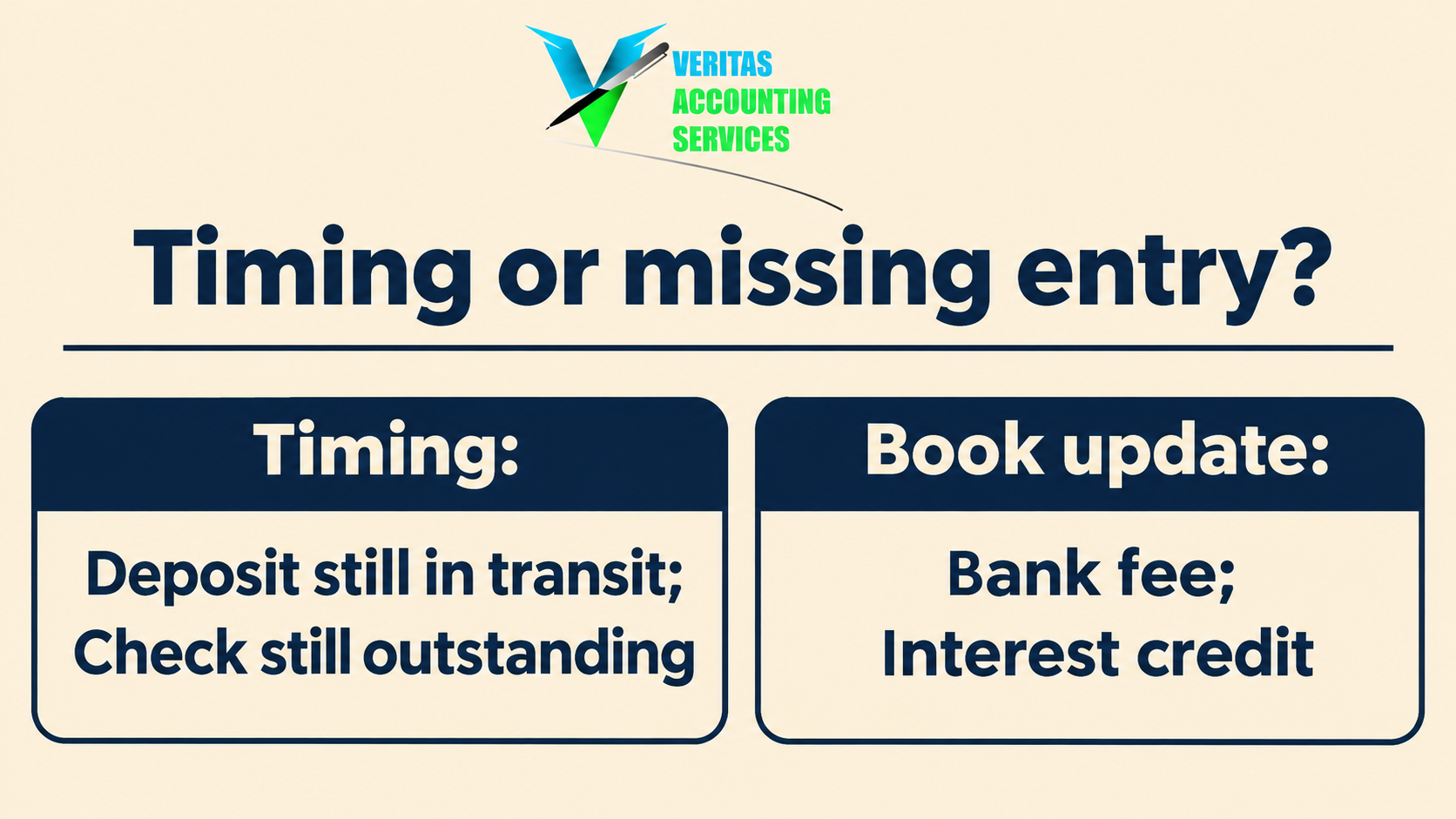
A deposit in transit is money already recorded in the books that the bank hasn’t posted by the statement cutoff. Check the deposit receipt or processor payout record, then look at the next statement or subsequent posted activity to see whether the money arrived. If you can trace the item, show it on the bank side of your bank reconciliation check. The worksheet explains the delay. You already recorded the deposit once.

An outstanding check is a payment already recorded in your books that hasn’t cleared the bank. Check the payee, number, amount and issue date against the payment record. List it on the bank side as a subtraction from the statement balance. The payment will reduce the bank balance when it clears. If a check stays outstanding longer than expected, investigate delivery and payment status before reissuing or reversing it.

A fee on the bank statement that you haven’t recorded is a different kind of item. Verify the charge and record it in the appropriate account. Bank interest credited to the account can also require a book entry. Use the actual statement date and amount, and keep the statement line with the record. A bank reconciliation check gives you a reason for the change and leaves evidence the next reviewer can follow.

If a withdrawal is unfamiliar, gather the transaction details and check with the people who use the account. Follow up with the bank promptly if you suspect an unauthorized transaction. Keep the item visible with a status, a named owner and the next review date. A quick entry to make the difference disappear can obscure the very activity you need to investigate.

A bank reconciliation check separates deposits in transit and outstanding checks from book updates such as fees and interest.

Use the bank reconciliation check to test the cutoff

Try a specific cutoff test for any large item close to month-end. Look at when the business recorded it, when the bank posted it and which date the statement ends. Suppose the shop deposited a check at closing on October 31 and the bank posted the credit on November 2. If the deposit is already in the October books and you can verify it with the deposit record, the two dates explain the difference. Your November bank reconciliation check should show the deposit clearing without a second entry.

If the records disagree about the amount, the cutoff alone won’t explain the difference. A $1,200 deposit in the books and a $1,020 bank credit require a closer look at the deposit slip, what the bank accepted and whether part of the deposit was handled separately. Record what you learned before deciding whether a book correction or a bank inquiry is appropriate. If the original transaction is unclear, ask the person who handled the deposit while they can still recall what happened.

Work through the two balances

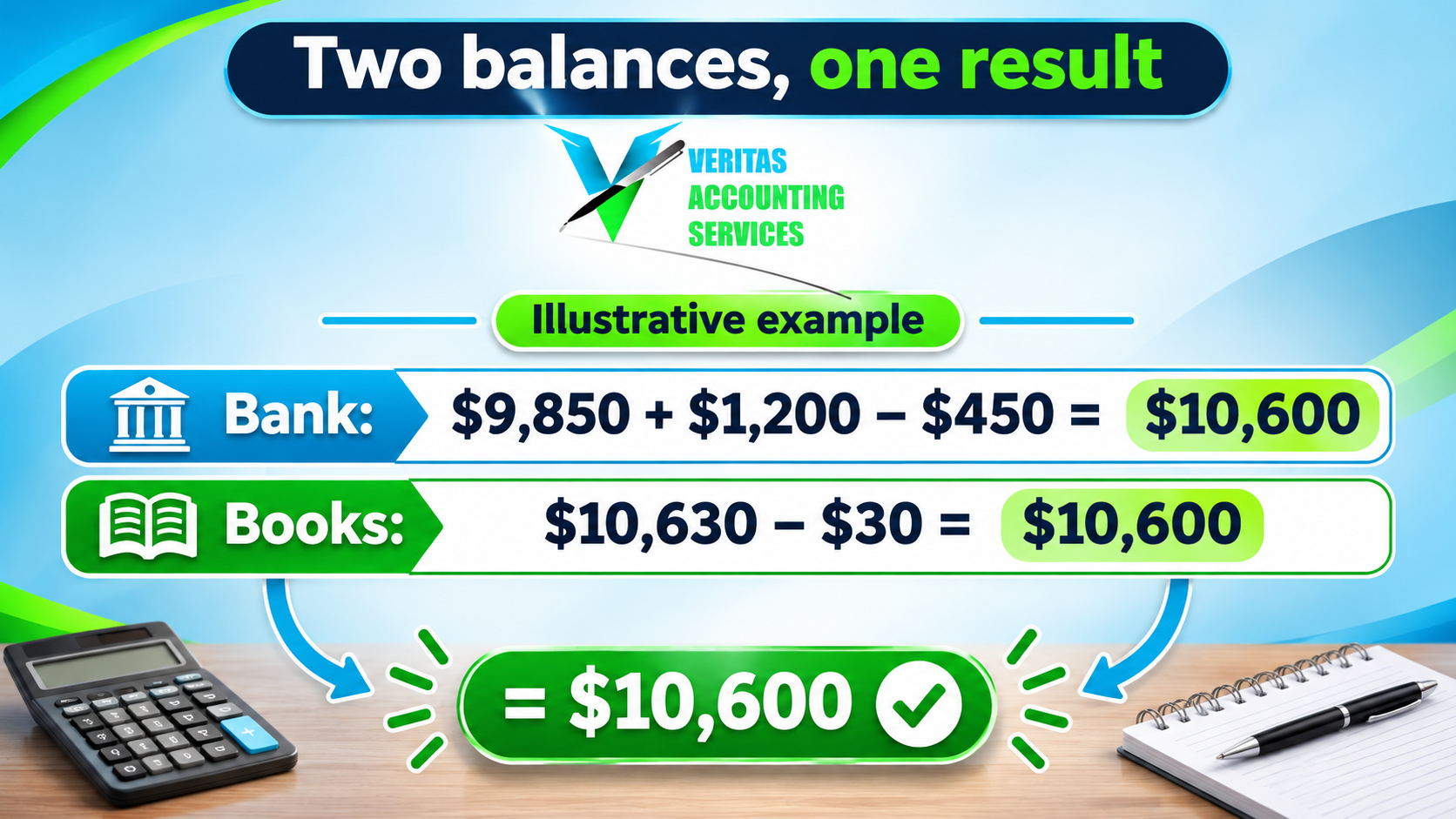
Here is the shop’s bank reconciliation check for the fictional month. The $1,200 deposit was recorded before the statement closed and appeared at the bank afterward. A $450 supplier check was recorded but had yet to clear. The bank also deducted a $30 fee that the shop hadn’t entered.

SideStarting balanceAdjustmentsAdjusted balance
Bank statement$9,850Add $1,200 deposit in transit and subtract $450 outstanding check$10,600
Books$10,630Subtract $30 bank fee$10,600
Worked example shows the adjusted bank and book balances both reaching $10,600.

On the bank side, $9,850 plus $1,200 equals $11,050. Subtracting $450 gives $10,600. On the book side, $10,630 minus the $30 fee gives the same $10,600. The fee is the bookkeeping change in this example. The deposit and check stay on the timing list until they clear. Keep the two sides visible so the reviewer can see why each adjustment was made.

The starting difference was $780. That number by itself gives the owner little information. The bank reconciliation check breaks it into items with different next steps. The shop needs to enter the fee, confirm the deposit posted and monitor the check. It can assign those steps separately and avoid changing entries for transactions already recorded.

Use the bank reconciliation check in cash planning

The $10,600 adjusted amount explains the statement-date balance after considering the listed items. To decide whether to pay a supplier today, also look at the bank’s current available funds, holds, payments still in transit and upcoming commitments. A deposit in transit might help explain the books even if you can’t spend it today. Review payroll and rent before deciding how much cash you can commit. A bank reconciliation check and a cash forecast answer related questions at different points in time. Veritas cash flow management guide

For example, if the owner schedules a supplier payment based on the adjusted month-end figure alone, a pending withdrawal could reduce the money available for the batch. Check which transactions already affect the available balance so you don’t subtract them twice. Then bring the reconciled records into your next payment review and confirm any new bills or bank activity since month-end. Veritas vendor payment review

Review open items before closing

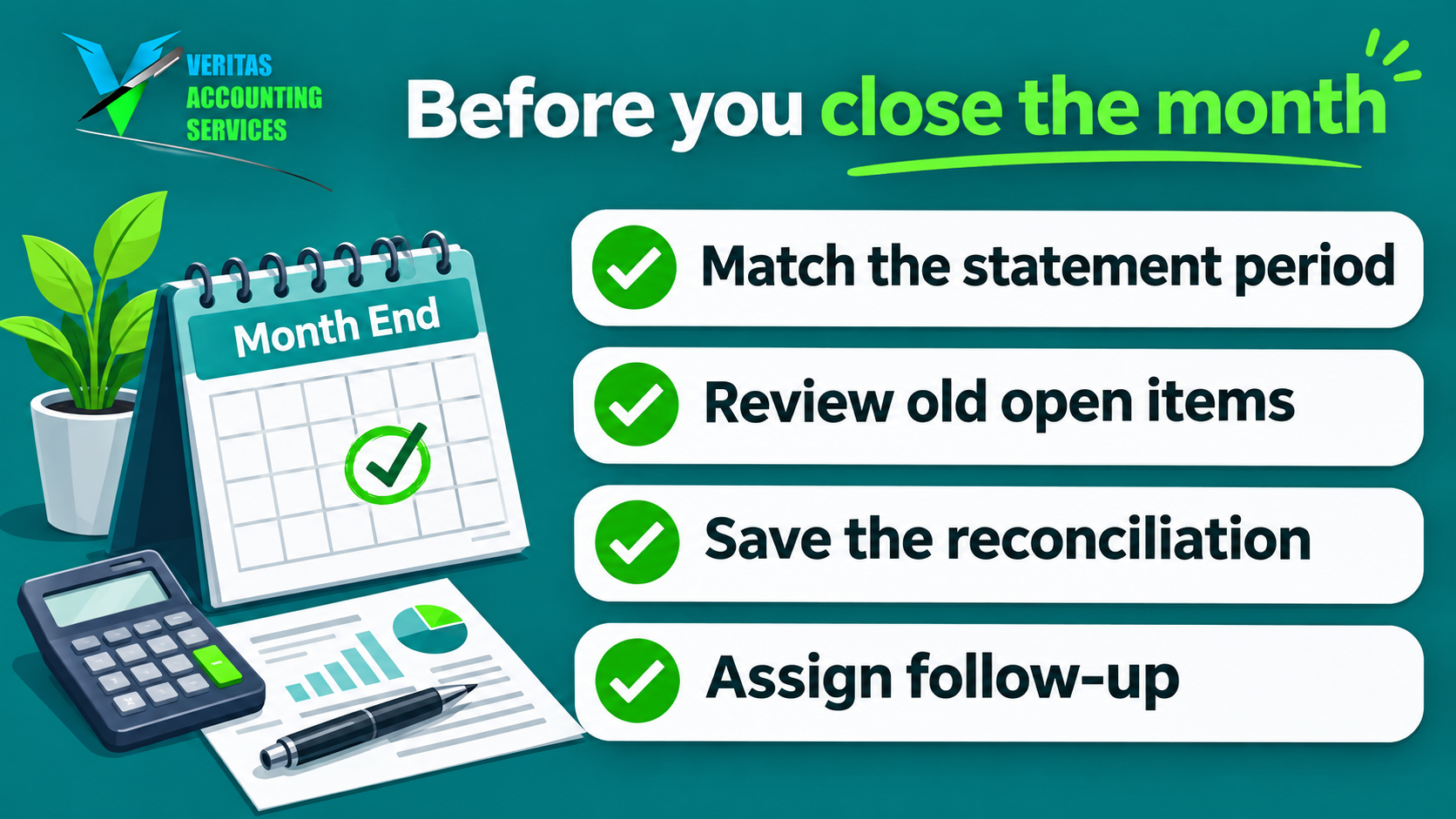
A bank reconciliation check can balance while legitimate timing items remain open. Give each item a date, reference, amount and expected clearing date or next step. Review older items before carrying them forward. An old deposit may signal that you need to locate a receipt or talk to your bank. An uncleared check may require contact with the payee. Document what happened before taking corrective action. If an old amount needs to be reversed, confirm with your bookkeeper how to handle it and keep the original record traceable.

Save the statement, reconciliation report and supporting notes in a folder for the account and month. Include links or references for deposits in transit, payment confirmations and corrections. The IRS business recordkeeping overview explains how records support financial statements and items reported on tax returns. A saved bank reconciliation check makes it easier to explain what was known when the month was closed. Veritas guide to common bookkeeping problems

Month-end checklist covers statement period, old open items, saving the reconciliation and assigning follow-up.

If you work alone, do a second pass focused on unfamiliar payments, duplicate amounts and older open items. If two people share the work, have one prepare the reconciliation and the other review adjustments and evidence where practical. Give the reviewer enough context to tell a timing difference from an actual correction. A short note such as “$450 check issued October 28, supplier confirmed receipt November 4, still open as of review” is more useful than “check pending.”

Track what happens after the statement date

Use a separate follow-up date for each open item. For the flower shop, a deposit should be easy to find once it posts, so the owner can check the next day’s bank activity and note the actual clearing date. The supplier check may take longer. The owner can first confirm delivery, then look for it on the next statement. Record those outcomes against the original items so the next bank reconciliation check shows what changed.

If you correct a ledger entry, save the reason, the original reference and the revised record. For instance, if the $30 fee was entered after the first review, run the book balance again before marking the month complete. This final bank reconciliation check catches a correction posted to the wrong bank account or the wrong date. The reviewer can then see both the original issue and the evidence that it was resolved.

Hand off the bank reconciliation check

Keep a standard folder structure and pick a regular review date. Set one person to retrieve statements and payout reports, one person to prepare or review the bank reconciliation check, and a backup who knows where the files are. A concise handoff should show the period, adjusted balance, unresolved items, and who needs to answer each question. Include the next check date if you need to wait for a statement or a supplier response.

When the same mismatch keeps returning, look at how the transaction first enters the system. If every processor payout needs manual reconstruction, save the batch report when the payout arrives. If transfers repeatedly show up as expenses, agree on a matching method and check both accounts together. If deposits routinely lack support, make it part of closing the shop to save the deposit confirmation with the day’s receipts. Use each bank reconciliation check to identify a recurring cause you can address upstream.

Frequently asked questions

Can I rely on a bank feed instead of doing a bank reconciliation check?

A bank feed can help import and match transactions. Compare the result with the bank statement for the actual period and confirm the statement ending balance. Feed activity can miss an item, show it late or suggest the wrong match. Review exceptions, confirm transfers and keep the statement with the final reconciliation. That gives you a clear record of what you checked even if you change bookkeeping systems later.

What if my bank reconciliation check is off by a small amount?

Start with the amount and date. Look for a fee, rounding, a partial payment or a transaction recorded with the digits in the wrong order. Verify against the underlying record before correcting anything. If you still can’t explain it, record the difference as unresolved and ask your bookkeeper how to proceed. A small difference can point to a repeatable issue, such as the way fees are being recorded.

Do I have to wait for every check to clear before closing?

You can document a verified outstanding check on the reconciliation and follow up afterward. Keep the amount and payee visible, and confirm how it clears in the next bank reconciliation check. If the check appears lost, stale or disputed, check the facts with the payee and bank before sending a replacement. Once resolved, document which payment actually settled the obligation.

How often should I run a bank reconciliation check?

Monthly is a practical starting point for many small businesses because a regular statement provides a cutoff. If your business has frequent deposits or a tight cash position, you can also match activity weekly and use the month-end statement to finish the formal review. Choose a routine that fits the volume and gives someone enough time to investigate exceptions before records are used for decisions.

Conclusion

A bank reconciliation check works best when every difference has a reason and a next action. Start with the same statement date, match transactions, and separate delayed bank activity from missing book entries. Compare both adjusted balances, then save the evidence and assign follow-up on the items that are still open. The result gives you a clearer record of the month and a more reliable starting point for cash planning.

GET IN TOUCH

Schedule a FREE Call

Contact us

Connect on our Socials!

A hardware shop owner checks a delivery invoice at the receiving counter beside the headline Pay vendor bills with a plan.

Vendor Bills and a Simple Routine for Better Cash Planning

A vendor payment review gives a small business owner one place to answer a deceptively simple question: which bills should leave the bank this week? The answer takes more than opening the latest supplier emails. Some invoices are already paid, some are due before your next review, and some need a delivery check or a credit before you send money. Meanwhile, a healthy bank balance on Monday can look very different after payroll on Wednesday.

You can build a weekly routine around five checks: collect the bills, verify what you owe, sort the list, test the batch against available cash and match each payment afterward. The goal is to know what is due, who owns each exception and what cash remains after the run. The examples below use a fictional US hardware shop, but the routine also works for a service business that buys materials or pays subcontractors.

Table of contents

Collect the bills in one place

Start the vendor payment review with a complete list. Give suppliers a single billing address or portal and have anyone who receives a bill elsewhere route it there. Decide who checks that inbox when the usual person is out. If a supplier emails a bill and later mails a paper copy, attach the copy to the existing record so the second arrival doesn’t become a second payable.

For each bill, capture the vendor, invoice number, invoice date, due date, amount, open balance and the person who can confirm the purchase. Include a status that tells the next person what to do: awaiting receipt, ready to approve, approved, scheduled, paid or disputed. If you rely on a spreadsheet, give each row a link or file reference to the actual bill and keep one shared working copy. If you use bookkeeping software, check whether a bill is already in the system before entering it from email.

An open bill list is only as complete as your intake process. Add a short check for recurring bills expected before the next run, such as a lease or a regular supplier delivery. If you expect a bill and can’t find it, put the expected amount in your cash forecast as an estimate and assign someone to request the invoice. Keep the forecast entry distinguishable from an approved bill. This makes the missing invoice visible without turning an estimate into permission to pay it.

Keep the invoice with its supporting documents as you go. The IRS guide to business records explains how supporting records identify the business expense and document payment. Your vendor payment review can make those records easier to find later by linking them to the bill while the people who received the goods still remember the details. For more on making this habit part of ordinary bookkeeping, see why good tax records start with good bookkeeping.

Verify what you owe

Before a bill joins the vendor payment review batch, compare what the supplier billed with what you ordered and what arrived. A hardware shop could match the invoice to a purchase order and the signed receiving slip. A service business might match it to a statement of work and a manager’s confirmation that a milestone was delivered. Smaller purchases may have fewer documents, but someone should still be able to explain what was bought and confirm that the amount is right.

For example, suppose the shop ordered 20 boxes of fasteners and received 18. The invoice lists 20. Ask the supplier whether the other two boxes are on the way or whether it will issue a corrected bill or credit. Record the reason for the hold, who contacted the supplier and when to follow up. If you and the supplier agree to pay the undisputed amount first, record that agreement and keep the remaining amount visible until it is resolved. Don’t silently clear the entire balance when a partial payment goes out.

Check the supplier statement for credits and prior payments as well. The statement helps you identify what the supplier thinks is open. Your records can reveal a payment in transit, a credit they haven’t applied or a missing invoice. Follow up on the mismatch with supporting documents. If the vendor payment review leaves someone responsible for the follow-up and gives them a date, the same unresolved item is less likely to show up week after week without explanation.

Treat a request to change the payee or bank details as a separate exception. Use a phone number or contact you already trust to confirm the change independently. If possible, have another person review the change and the first payment. A familiar logo and email signature do not verify the destination. The FBI’s business email compromise guidance specifically recommends verifying changes to payment procedures or account numbers. A routine bill can stay open while you confirm where the money should go.

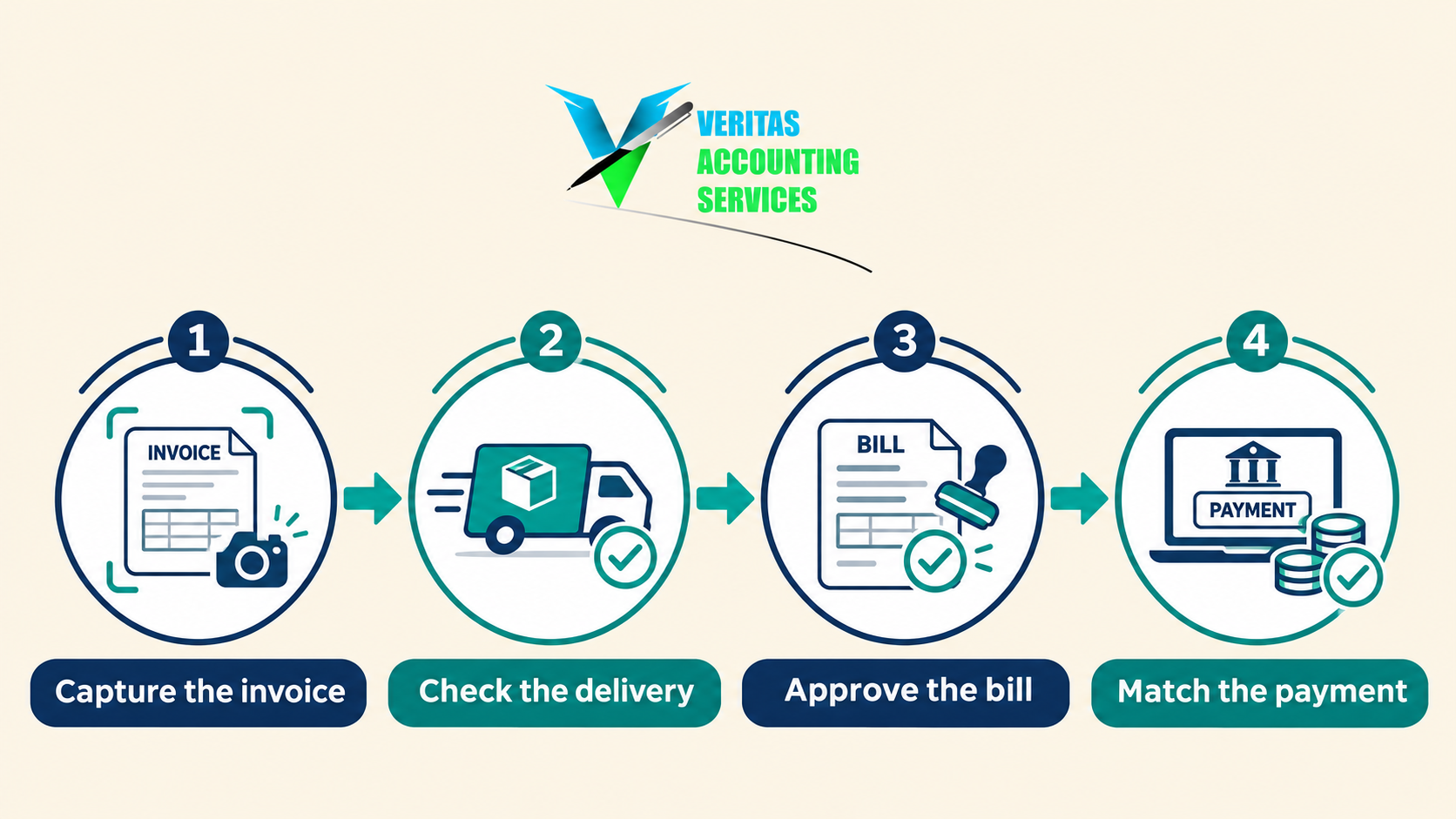
A vendor payment review diagram shows invoice capture, delivery check, bill approval and payment matching.

Sort the vendor payment review

Build your list around due dates and the next payment run. A bill due next Tuesday may belong in Friday’s run if you only pay on Fridays. Consider how long each payment method takes and whether your terms require the vendor to receive payment by the due date. Leave time for weekends, holidays and the approval process. Keep a separate exception list so that a disputed bill or suspicious account change doesn’t accidentally enter the approved batch.

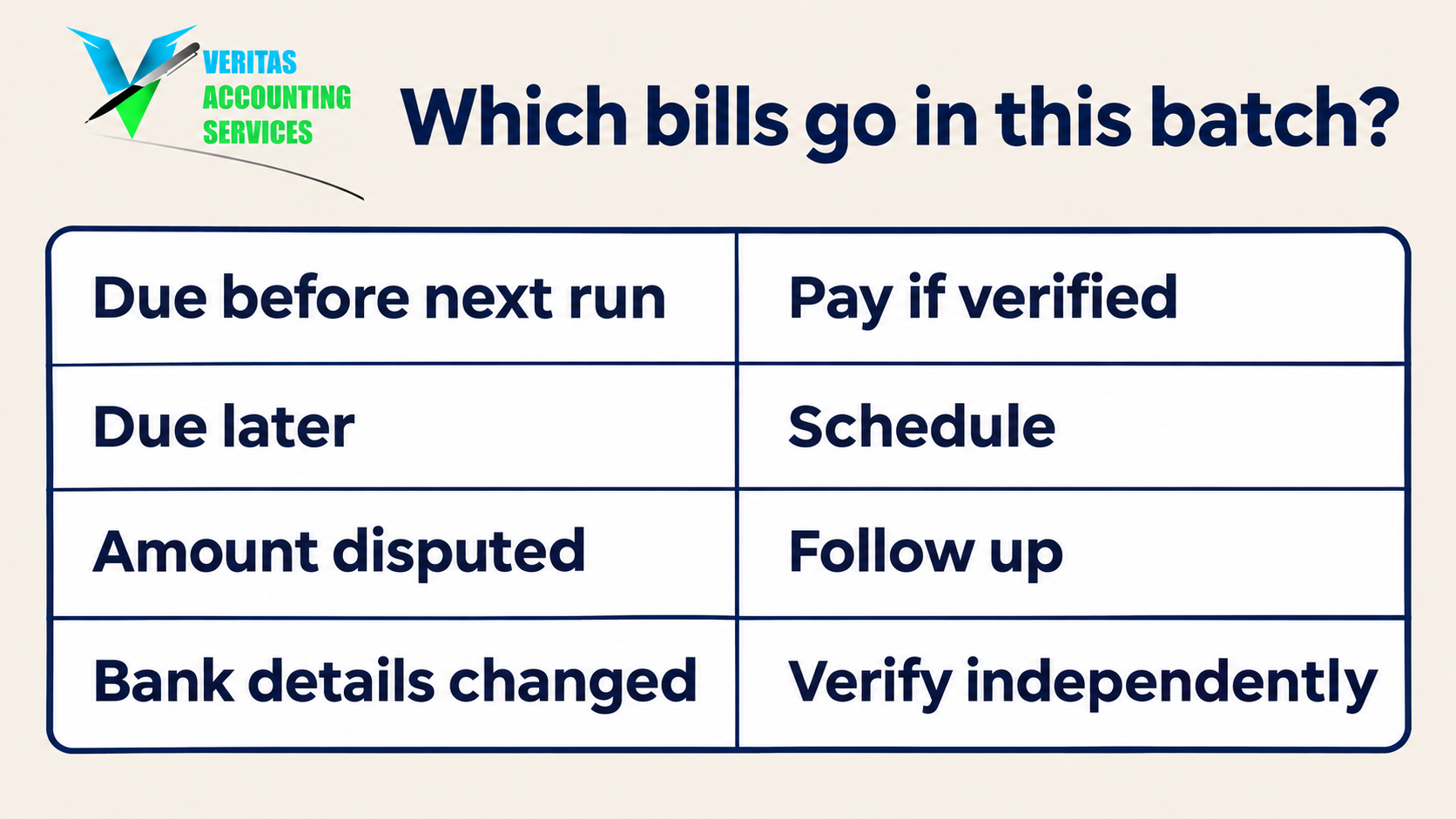
A simple way to organize a vendor payment review is to give every open item one next action:

What you seeWhat to do
Due before the next runPay in this batch if verified, approved and funded.
Due after the next runSchedule the bill and confirm the next review date.
Amount or delivery disputedDocument the issue and follow up with the vendor.
Payment details changedVerify the destination independently before release.

An overdue balance deserves a look, even if you can’t pay it today. First check whether it is genuinely unpaid or simply unmatched. If it’s unpaid and you need more time, contact the supplier early, propose a specific plan and document any agreement. Record the amount and date promised so the next vendor payment review reflects what you told the supplier. Don’t assume that changing a due date in your books changes the contract.

There may be trade-offs among bills that are all due soon. One supplier could provide the materials you need to finish a customer job. Another might offer an early payment discount. A practical vendor payment review records the reason for each decision and considers the cost of postponement, the supplier relationship and the effect on near-term cash. Treat an early payment discount as an option to evaluate. Check the actual terms, how much cash the early payment uses and whether that leaves enough for commitments that arrive first.

If the list seems to change every time you open it, separate status from payment date. For example, a verified $700 invoice can be approved today and scheduled for next Thursday. A $500 invoice with a quantity dispute stays on hold, with its original due date visible and a separate follow-up date. Keeping those dates distinct helps you explain to a teammate why two invoices due on the same day are moving through the vendor payment review differently.

A table sorts bills due soon, bills due later, disputes and changed bank details into their next actions.

Test the batch against available cash

A vendor payment review needs a cash check before you release the batch. Start with cash you can actually use and look ahead to the next scheduled review. Account for pending withdrawals, payroll, rent and other commitments that fall in that window. Check whether pending withdrawals already affect the balance you’re using so you don’t subtract them twice. Treat expected deposits separately and ask what happens if a large receipt arrives a few days late. The SBA guide to managing business finances discusses using financial information to manage cash flow. For a broader view, see Veritas’s guide to cash flow management.

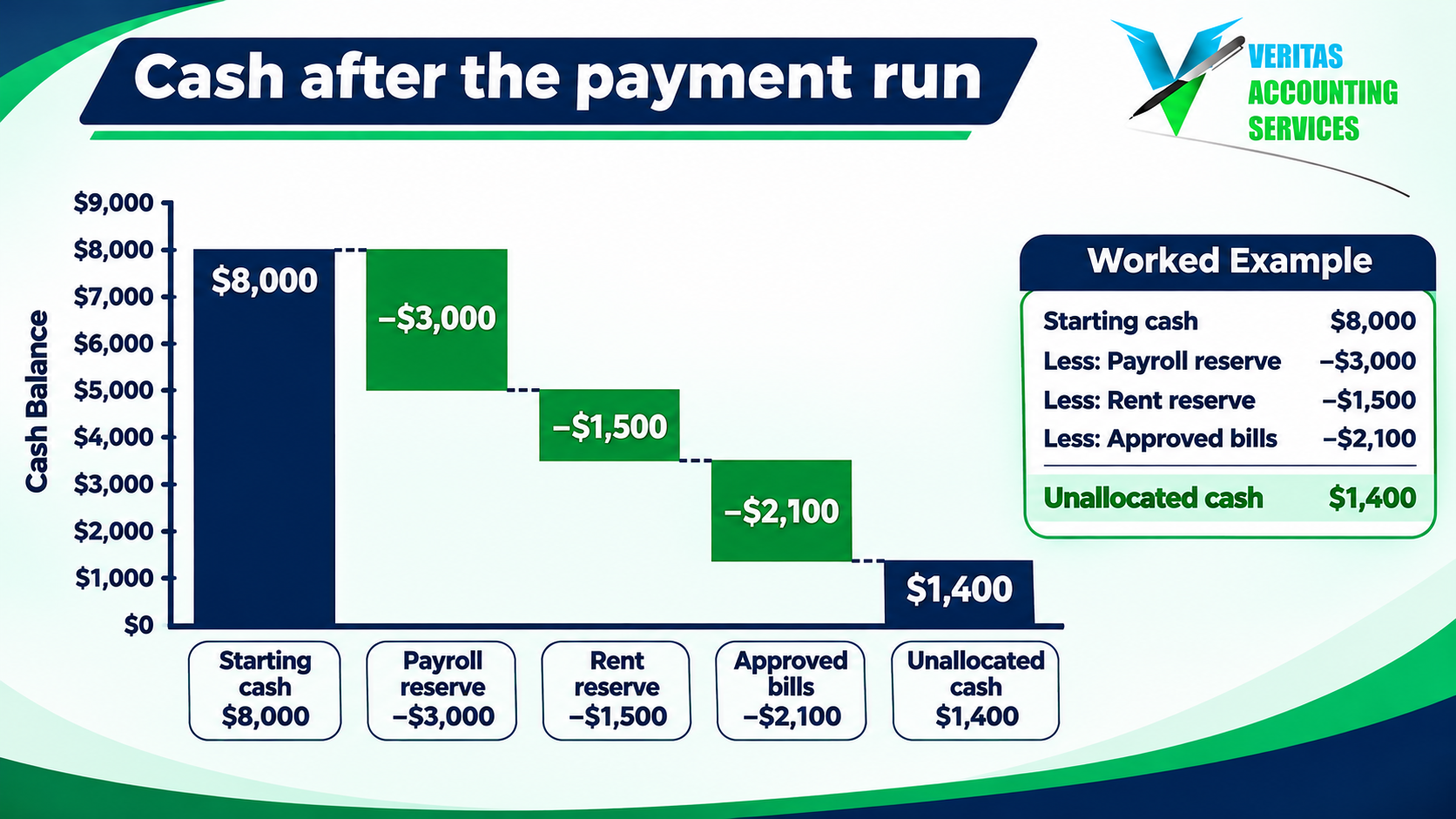
Suppose the hardware shop has $8,000 of usable cash on Monday. Before the next review, it plans to reserve $3,000 for payroll and $1,500 for rent. The verified bills in this run total $2,100. It has $1,400 left unallocated after setting aside those amounts. That figure is a planning balance for the commitments shown. If a $900 utility payment was omitted, the revised balance would be $500. If the owner requires a $1,000 buffer, the batch as shown meets it, but the revised plan with utilities falls short by $500.

A fictional cash example subtracts $3,000 payroll, $1,500 rent and $2,100 approved bills from $8,000, leaving $1,400 unallocated.

Give the owner an actionable cash decision

Use the vendor payment review to show both the amounts and the timing. The shop might expect a $2,400 customer receipt later in the week. Show the plan with that receipt arriving on time and with it arriving late. If the batch only works with money that hasn’t arrived, the owner needs to decide whether to wait for cleared funds, ask a supplier for agreed terms or change the batch. Make those decisions before releasing payments and check what each one means for the actual due date and delivery schedule.

Also distinguish a current cash forecast from an accounting report. The open bills list answers what you owe and when it falls due. A cash forecast also includes expected receipts and commitments that may not appear as vendor bills. A profit report answers a different question about business performance for a period. The vendor payment review brings the first two views together for a particular decision. It won’t explain every reason why cash and profit differ. The Veritas article on tax savings and cash flow explores another example of why a cash decision needs its own analysis.

For the first few runs, write down what surprised you. Maybe freight invoices normally arrive after the goods, or a payment platform deducts a recurring fee on a different date from the invoice. Add a reminder for predictable omissions and keep one owner for each uncertain item. A reliable vendor payment review becomes easier to run once you’ve resolved the recurring causes of last-minute changes.

Match payments and close the loop

Before releasing a batch, have the approver review the actual payees, amounts and dates against the approved list. If one person runs the business alone, take a separate pass after preparation and check the final bank screen against the list before submitting. Make sure a bill marked scheduled hasn’t already been set up in the bank portal. Save the payment confirmation and record which invoices the payment covers. When one transfer pays several invoices, the reference should make it possible to trace each invoice to its share of that transfer.

After release, use the next vendor payment review to check which transactions cleared. Match a bank-feed payment to the existing bill payment in your bookkeeping system when appropriate. Creating a new expense from an imported withdrawal after the bill and its payment have already been recorded can double count the cost. Follow up on returned transfers and uncleared checks, keep their status clear and check with your bank or supplier before issuing a replacement. The IRS guide to starting a business and keeping records discusses supporting documents and bank reconciliation. Veritas also covers the problems that build up when bookkeeping falls behind.

Give exceptions their own short handoff. A useful line might read: “Invoice 1843, missing two boxes, Taylor to contact supplier Monday, review again Tuesday.” If the supplier confirms a credit, link the confirmation to the original bill and check how the credit is applied in the books. If a payment failed, keep a record of both the original attempt and the corrected payment. The next person should be able to tell which amount remains open without reading an entire email thread.

Make the vendor payment review easy to hand over

Set a recurring time for the vendor payment review and designate a backup. A lean routine can start with a brief meeting or an approval note that shows cash available, proposed payments, exceptions and decisions needed. Give the owner a batch total and enough detail to understand any unusual payment. The person checking the list should know who approves a new vendor, how to confirm changed instructions and where to find the confirmation afterward.

At month-end, compare open bills and major supplier statements, and look for old deposits, unapplied credits, repeat invoice numbers and balances that seem out of date. The vendor payment review handles the weekly decisions; a month-end look can uncover older items that never make it into the current run. If the cleanup gets complicated, bring the invoice, statement and bank record together before making adjustments. That’s more useful to your bookkeeper than an instruction to clear all old balances.

When you start, keep a short record of what you changed in each vendor payment review. For example, an owner might move the normal run from Friday to Thursday after learning that a supplier needs a full business day for processing. Update the schedule, tell the backup and keep the old confirmation available for matching. If the vendor payment review still generates repeated urgent requests, sort them by cause. Missing invoices call for better intake, while late approvals may call for a clearer cutoff. A single adjustment based on a recurring cause can save more effort than adding another sign-off to every routine bill.

Frequently asked questions

Do I need accounting software for a vendor payment review?

You can start with a shared list if it captures the bill, open balance, due date, approval and payment reference. Decide who edits it and where the supporting documents live. As invoice volume or the number of approvers grows, software can make it easier to control access, track changes and match payments. Keep a process for reviewing what the software imports or suggests.

How should a vendor payment review handle possible duplicates?

Search the supplier name, invoice number and amount, and check your payment history before entering or paying it. Differences in formatting can hide duplicates, such as a leading zero in the invoice number. Conversely, recurring bills can have the same amount and still be separate obligations. Check the service dates and documents. Mark a potential duplicate for investigation so the vendor payment review doesn’t silently drop a legitimate bill or pay the same obligation twice.

Should I track unpaid bills if I use cash basis bookkeeping?

An owner can keep an operational list of bills due even when payments drive the timing of many entries under the business’s accounting method. The list supports scheduling and cash planning. Ask your bookkeeper how to enter and report those bills in your system so that your management list and financial or tax reports are used for the right purpose. The vendor payment review itself does not determine whether or when an item is deductible.

How often should I do a vendor payment review?

Weekly is a starting point if it gives you enough time to meet your terms and review approvals. A business with daily replenishment, tight cash or frequent urgent purchases may need a shorter cycle. Keep a clear exception process for bills that can’t wait, and apply the same verification and approval steps to those payments. A payment outside the normal run should still appear in your records before the next person prepares a batch.

Conclusion

A vendor payment review works when every bill has an owner, a status and a next action. Start with the bills due before the next run. Confirm what you received, resolve mismatches, set aside cash for other commitments and check the final payment details. After the batch goes out, keep the confirmations and match the transactions as they clear. This gives the owner a clear view of which suppliers have been paid, what remains open and how much cash is available for the next decision.

GET IN TOUCH

Schedule a FREE Call

Contact us

Connect on our Socials!
A bakery owner stands beside fresh bread in natural morning light, with the headline Plan for the year ahead and the faithful Veritas Accounting Services logo.

Tax Bracket Mistakes: A Simple Guide to Better Planning

The 2027 tax brackets are now available following the IRS announcement on November 5, 2026. For business owners, the useful response is to update the assumptions in a personal tax projection, rather than apply a new percentage to business revenue. Start with the correct year, filing status and taxable income, then review the result alongside other taxes and payments.

This guide focuses on federal ordinary individual income tax. It explains a single-filer example and five practical checks for an owner’s planning worksheet. It does not calculate a company’s complete tax liability or assume that every owner has the same filing status, income sources or deductions.

Understanding the 2027 tax brackets matters when planning cash. A clear estimate can support decisions about reserves and owner withdrawals. A spreadsheet using an outdated table, the wrong income figure or one flat rate can make an apparently precise answer unreliable.

Table of contents

What changed in the IRS announcement

The November 5 IRS announcement sets out annual inflation adjustments for tax year 2027. The IRS says these amounts generally affect returns filed in 2028. Publication in 2026 does not turn the figures into 2026 tax-year amounts.

For 2027 tax brackets, treat that date distinction as the first control in the file. A worksheet labeled next return can be misunderstood by a bookkeeper, an owner and a preparer. Put the actual income year in the heading and retain the source date beside the assumptions.

The release also lists basic standard deductions of $16,600 for single filers and married individuals filing separately, $33,200 for married filing jointly, and $24,925 for heads of household. Those are starting reference amounts; individual eligibility and additional amounts require their own review.

The IRS standard deduction guidance explains that the deduction reduces income subject to tax and is unavailable in some circumstances. It is not a credit that reduces the tax bill dollar for dollar. Do not automatically subtract it without checking the person’s situation.

Our year-end tax planning discussion describes a wider review of business results and planned transactions. Here, the narrower task is to refresh the bracket assumptions while keeping the current-year close and next-year forecast clearly separated.

Read the 2027 tax brackets correctly

The 2027 tax brackets apply different rates to successive layers of taxable income. Moving into a higher layer does not make that higher rate apply to every dollar below it. The IRS explanation of marginal rates describes this layered approach.

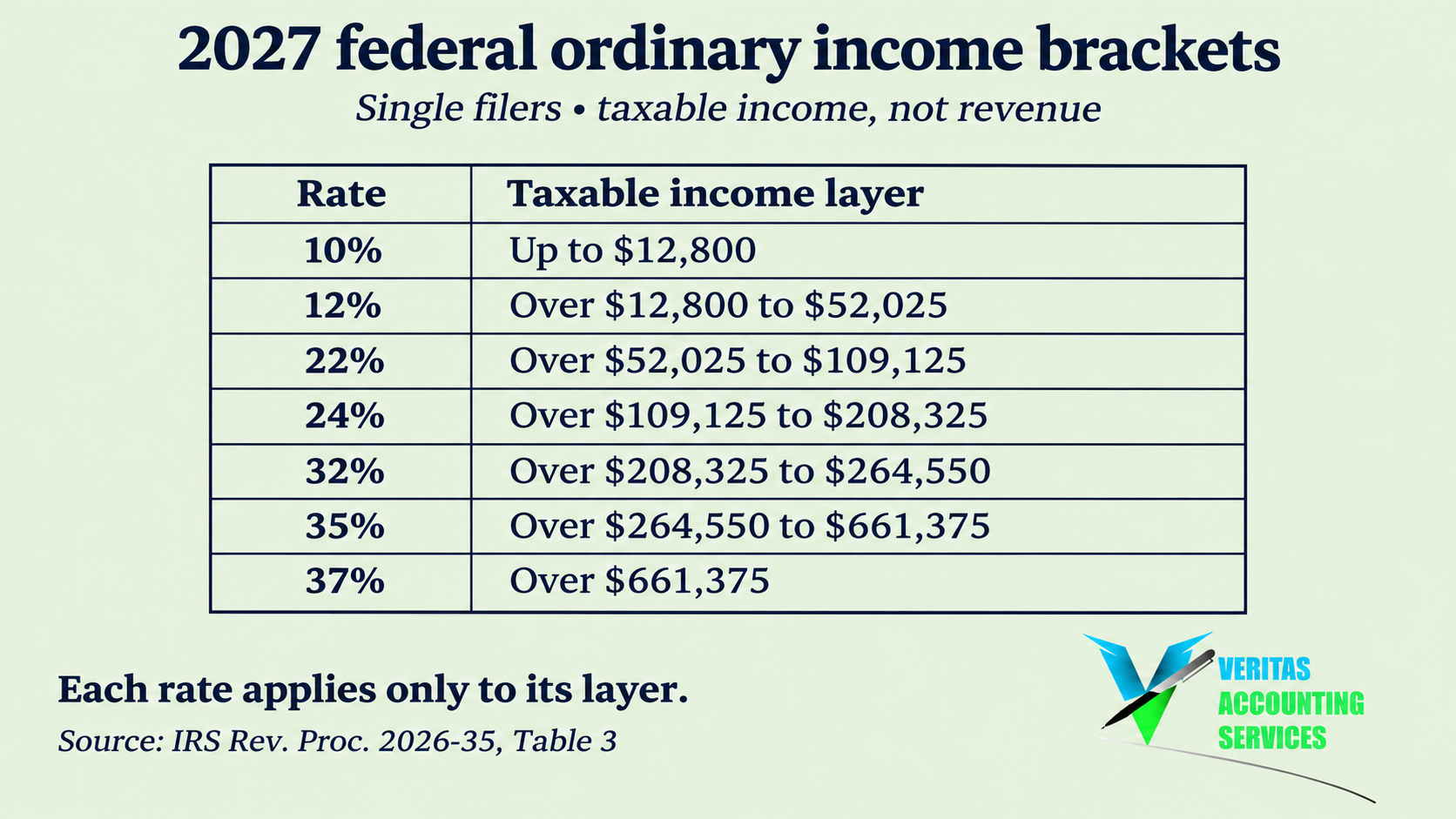
The following table of 2027 tax brackets is for single filers, using the unmarried-individual table in Revenue Procedure 2026-35. It covers ordinary income under that schedule. Do not substitute this table for a different filing status or for income subject to special rates.

Rate2027 taxable income layer for a single filer
10%Up to $12,800
12%Over $12,800 through $52,025
22%Over $52,025 through $109,125
24%Over $109,125 through $208,325
32%Over $208,325 through $264,550
35%Over $264,550 through $661,375
37%Over $661,375
2027 tax brackets reference table for single filers shows seven ordinary taxable income layers and states that each rate applies only to its layer.

When using 2027 tax brackets, distinguish a marginal rate from an average calculation. The marginal rate describes the rate on the next dollar within the relevant layer. Dividing a calculated tax amount by the income used in the example answers a different question.

Also distinguish taxable income from sales, bank deposits and bookkeeping profit. Before relying on a figure, ask where it came from and what adjustments it includes. A number can be correctly copied from the profit and loss statement yet still be the wrong input for an individual bracket calculation.

The 2027 tax brackets table is a reference, not an instruction to multiply an owner’s draws by a rate. Mark its scope on any exported worksheet. That short label helps prevent the same figures from being reused later for a corporation, a different filing status or a different year.

A worked example with separate income layers

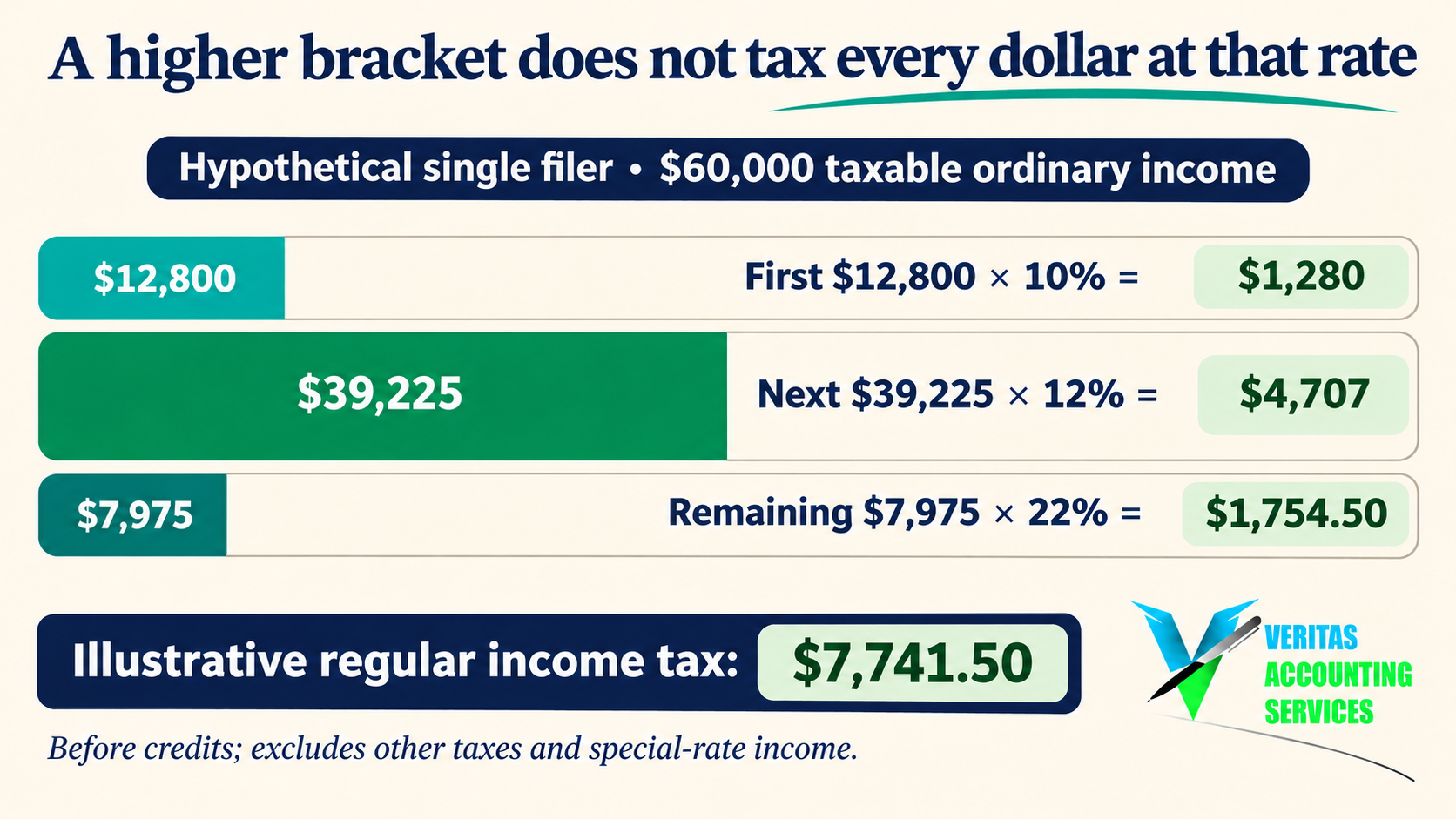
Suppose an individual is a single filer with exactly $60,000 of taxable ordinary income for 2027. Assume the appropriate deductions and adjustments have already been reflected in that taxable-income figure. The example is hypothetical, not a Veritas client case or a complete return calculation.

Using the 2027 tax brackets, the first $12,800 produces $1,280 at 10%. The next $39,225, from $12,800 to $52,025, produces $4,707 at 12%. The remaining $7,975 produces $1,754.50 at 22%.

The sum is $7,741.50 of illustrative regular federal income tax before credits. The example excludes self-employment tax, alternative minimum tax, special-rate income and any other taxes or adjustments. It demonstrates the layers; it does not establish what a particular owner should pay.

Hypothetical single-filer calculation uses $60,000 taxable ordinary income: $1,280 plus $4,707 plus $1,754.50 equals $7,741.50 regular income tax before credits and other taxes.

Compare that with multiplying all $60,000 by 22%, which gives $13,200. The difference is $5,458.50. That difference illustrates an incorrect calculation, not an available tax saving or a refund someone can claim.

For 2027 tax brackets, keep the calculation visible rather than hiding it inside a single percentage cell. A reviewer should be able to follow the layer widths, rates and total. Clear arithmetic makes a discussion about the remaining assumptions much easier.

When reviewing the 2027 tax brackets example, do not subtract the standard deduction again. The starting figure is already taxable income, after the assumed relevant deductions. If a worksheet starts with income before those deductions, it needs a different sequence and a documented reconciliation.

This example also shows why a bracket label alone cannot set a cash reserve. Before choosing a transfer amount, the owner and adviser still need to consider the rest of the projection, payments already made and the timing of available cash.

Five checks before updating your worksheet

1. Lock the income year and source

Build the 2027 tax brackets into a separately identified 2027 assumptions sheet. Keep the 2026 model intact so current-year questions can still be answered using its own assumptions. Changing every rate cell in a shared workbook can silently alter an earlier forecast.

Record the source document, table number, date checked and person who checked it. These are suggested internal review fields, not an IRS-prescribed worksheet. They give the next reviewer a short route back to the underlying authority.

If a spreadsheet contains both actual results and projections, make the boundary visible. A November actual-results column and a full-year forecast column answer different questions. Their labels should remain clear when the page is printed or attached to an email.

For the 2027 tax brackets, a useful change note states which assumption changed and which calculations depend on it. Avoid a vague updated for IRS changes note that leaves the reviewer searching through the entire file to understand the revision.

2. Match the individual and filing status

Confirm whose projection you are preparing before choosing a table. A business with two owners may need two separate individual analyses. One owner’s personal assumptions should not be copied across simply because both people receive information from the same accounting file.

The 2027 tax brackets shown above are specifically for a single filer. Record the applicable status and ask the preparer to resolve uncertainty. Do not use the single-filer thresholds as a convenient substitute while leaving the worksheet labeled final.

Keep personal information proportionate to the task. A working budget may need a named owner and an agreed filing-status assumption without circulating a complete prior-year return to everyone involved in bookkeeping. Give detailed tax documents only to the people who need them.

If family circumstances or ownership arrangements are changing, note the question rather than guessing its treatment. The purpose of the planning file is to make important assumptions visible so that a qualified reviewer can resolve them.

3. Reconcile the taxable-income input

Before applying 2027 tax brackets, build a clear bridge from the financial information available to the taxable-income figure being modeled. Label the bridge as a projection and identify which adjustments are confirmed, estimated or awaiting professional review.

Our bookkeeping cleanup guide explains why incomplete books create extra work later. For this worksheet, the immediate question is whether the financial starting point can be reconciled to a dated report and whether unresolved entries are visible.

Separate recurring operations from unusual transactions in the discussion. A sale, distribution, reimbursement or bank transfer may need explanation before its tax significance can be determined. The fact that an item appears as a cash movement does not settle the individual tax calculation.

For 2027 tax brackets, use a dedicated taxable-income input rather than pointing the formula directly at a revenue total. That design makes the review step explicit. It also reduces the risk that a later bookkeeping layout change feeds a different number into the model.

Keep the estimated deduction assumptions readable. Show what has already been included, so a reviewer can spot double counting. A separate notes column is often more useful than embedding a long explanation inside a formula that only its author understands.

4. Review taxes and payments outside the bracket result

The 2027 tax brackets do not calculate every part of an owner’s tax position. The IRS estimated-tax guidance explains that estimated payments can cover income tax and other taxes, including self-employment tax. A regular income-tax subtotal is therefore only one part of a payment review.

Keep separate lines for other items the adviser identifies as relevant. Also record withholding and estimated payments with their periods and supporting confirmations. Do not mix a projected annual liability with cash already paid and call the combined number tax expense.

Federal individual thresholds do not establish state tax treatment. Mark state questions for a separate review using the relevant official state authority. This article supplies no state calculation and should not be used as evidence that any state follows these amounts.

For 2027 tax brackets, the practical safeguard is a clear subtotal label. Regular federal income tax before credits and other items is much more informative than total taxes when the remaining work has not been completed.

Our estimated tax payments guide addresses payment-method and timing questions separately. Keep that review distinct from selecting an annual bracket table; the right table alone does not prove that payments are sufficient or timely.

5. Review the result before changing cash reserves

Use the 2027 tax brackets as part of a reviewed forecast, then agree what the owner will do with the result. A change to a workbook is not the same as an approved change to withdrawals, reserves or payment instructions.

Show the reviewer the prior forecast, revised forecast and explanation for the difference. Separate the effect of updated thresholds from changes in expected income or deductions. Otherwise, a lower estimate may be credited to the announcement when the real driver is a weaker sales assumption.

Set a practical review date and name the person responsible for refreshing the inputs. A projection prepared before a major contract is signed may need another look afterward. The review date is a management choice, not a filing deadline created by this article.

Keep a brief approval record explaining which version the owner used. It should be possible to reconnect a cash decision with the assumptions available at the time. That is more useful than retaining several files named latest without a clear sequence.

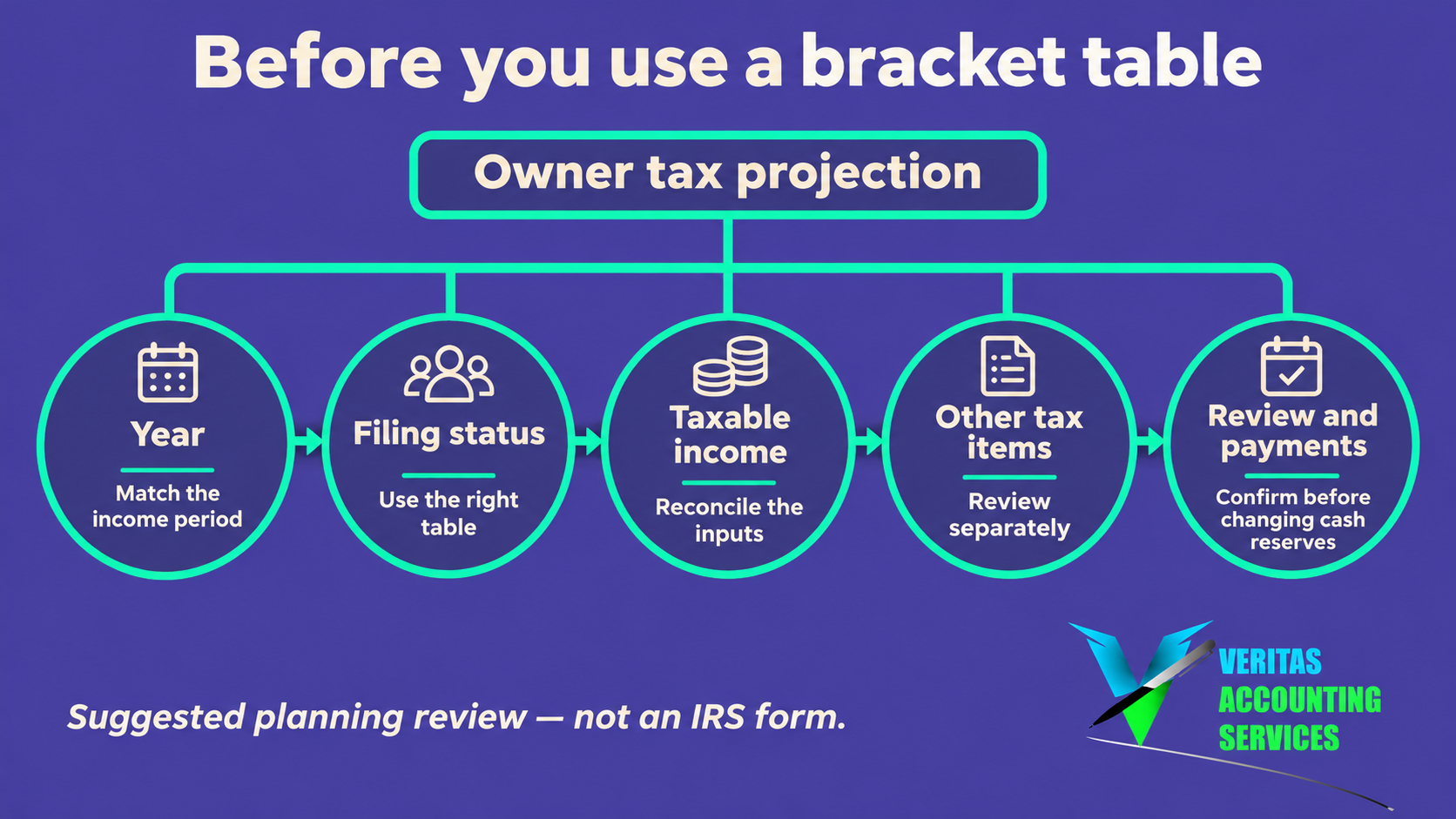
Five connected planning checks cover year, filing status, taxable income, other tax items, and review and payments, with a note that this is a suggested planning review rather than an IRS form.

Turn the estimate into a cash discussion

The 2027 tax brackets can help organize a forecast, but cash planning needs a second conversation. Ask when income is expected to be collected, which operating payments are committed and which amounts the owner is considering withdrawing. Keep those timing assumptions beside the reviewed tax estimate.

Consider an owner looking at a profitable quarter while a large customer invoice remains unpaid. The projection might indicate a future tax reserve need, but the bank balance may not yet support the proposed transfer. Identify that gap explicitly instead of treating accounting profit as cash available today.

For 2027 tax brackets, avoid a universal reserve percentage presented as advice to every reader. Different household income, deductions, payments and other tax items can change the answer. Agree a method with the adviser and explain when the assumptions should be refreshed.

A useful meeting ends with a small number of decisions: which facts remain open, which version is approved, what action is planned and who will check again. Our compliance calendar guide offers a related way to organize owners, dates and evidence without confusing a reminder with completion.

Give your adviser a useful handoff

Send the reviewed worksheet with the supporting report date, individual assumptions and unresolved questions. Explain that the 2027 tax brackets have been refreshed, then identify what has not yet been decided. A narrow question usually receives a clearer answer than a request to confirm the entire file without context.

For example, ask whether the taxable-income bridge includes the expected deduction correctly, or whether an unusual transaction needs separate treatment. Keep operational assumptions, such as expected collections, distinguishable from tax conclusions that require professional judgment.

If the adviser changes an assumption, record the reason and update the dependent calculations together. Reconcile the new total before distributing a revised version. This prevents the narrative in an email from disagreeing with the figures used in the next cash meeting. When sharing the model, export the assumption page with the calculation, so the recipient receives the context as well as the final estimate.

Frequently asked questions

Do the 2027 tax brackets apply to my 2026 income?

No. These are tax-year 2027 figures, announced in November 2026. The IRS says they generally concern returns filed in 2028. Keep a separate, correctly labeled calculation for 2026 income.

Does reaching a higher bracket raise the rate on all income?

No. Rates apply by layer. The higher rate affects the income within that higher layer under the applicable schedule, rather than replacing the rates on every lower layer.

Can I multiply business sales by my personal bracket?

That is not a reliable individual tax projection. Reconcile the appropriate taxable-income input first. Business revenue, bookkeeping profit and the owner’s taxable income should not be treated as interchangeable labels.

Do the 2027 tax brackets tell me my complete tax bill?

No. The example shows regular federal ordinary income tax before credits and other items. Other taxes, special-rate income, payments and individual circumstances need separate review before a payment decision.

Should I change my tax payments immediately?

Review the complete projection and applicable payment rules with your adviser first. A newly available table is a reason to refresh assumptions, not evidence that a specific person’s required payment has fallen.

What should I keep with my 2027 tax brackets worksheet?

Retain the official source, year, filing-status assumption, taxable-income reconciliation, review notes and approved version. These are suggested planning controls. Protect the underlying personal documents and limit access to people involved in the review.

Conclusion

Use the 2027 tax brackets to improve the quality of a planning conversation: identify the year, choose the right individual table, reconcile taxable income, separate other tax items and review the result before changing cash decisions. The most useful forecast shows its assumptions as clearly as its total.

Start by opening the current planning file and checking those five points. If an assumption is unresolved, name it and assign the next action. That gives the owner and adviser a practical basis for moving from a new IRS announcement to a more dependable budget.

This article provides general US federal tax information reviewed November 6, 2026. Examples are illustrative and do not calculate an individual’s complete liability. Confirm current IRS guidance and circumstances with your tax adviser before acting.

GET IN TOUCH

Schedule a FREE Call

Contact us

Connect on our Socials!
A small outdoor-goods shop owner counts stock with a barcode scanner and paper count sheet beside a reminder that stock on the shelf is not always a tax deduction.

Inventory Tax Mistakes: A Simple Guide to Better Records

Cost of goods sold is not automatically the amount your business spent buying stock. Under a traditional inventory method, goods still on hand affect the calculation, and buying more before year-end does not necessarily create an immediate deduction. The first question is which tax inventory method your business actually uses.

For a small retailer, a rushed stock count can leave the tax preparer with a number that looks precise but lacks support. A bank withdrawal proves money moved. It does not explain which products arrived, what they cost, whether they were sold or whether some were taken home for personal use.

This guide explains five practical checks for US businesses that buy or make goods for sale. It uses a simple retail example and separates ordinary inventory calculations from small-business exceptions. It is a federal tax records guide, rather than a complete manufacturing, financial-reporting or state-tax manual.

Table of contents

What cost of goods sold measures

Think of the calculation as a bridge between goods available and goods remaining. For a straightforward reseller using a traditional inventory method, opening inventory plus net purchases, less closing inventory, produces the cost of goods sold. Production businesses can have additional cost components, so the simple retail formula is not a complete manufacturing schedule.

This is different from the selling price. A bottle purchased for $12 and listed for $30 does not become $30 of inventory cost simply because that is the price on its label. Keep the quantity record and the cost record connected, while showing sales values separately.

The IRS small-business tax guide explains the Schedule C calculation and the distinction between gross receipts, product costs and other business expenses. Schedule C provides a useful illustration for sole proprietors; a corporation or partnership uses its own return and applicable instructions.

For cost of goods sold, the method matters before the spreadsheet. A business may qualify for a small-business inventory exception, but that does not make every stock purchase immediately deductible. The practical checks below begin with the existing method so that a useful stock count is not mistaken for a new tax election.

Our inventory costs discussion considers overstocking and working capital. The narrower question here is how quantities, costs and tax methods support the product-cost figure on a federal return.

Five checks before preparing the return

1. Identify the method already used

Ask how the prior return calculated cost of goods sold, then obtain the inventory workpapers and a short description of the current tax method. A software setting called cash basis is not a complete explanation of how the business treats stock. The return preparer should be able to connect the method to the amounts carried into the current year.

The Schedule C instructions on inventory describe an exception for qualifying small-business taxpayers. Eligibility involves the applicable gross-receipts test and the tax-shelter restriction. Annual thresholds and related rules need a current-year check; do not copy an old dollar limit from an earlier publication.

Permitted alternatives include treating inventory as nonincidental materials and supplies or using an eligible financial-accounting treatment. Those alternatives have their own requirements. Under the nonincidental-materials method, recovery generally depends on customer delivery and payment or incurrence, whichever is later; calling stock supplies does not by itself accelerate the deduction.

For cost of goods sold, write down the method rather than relying on memory. Include who confirmed it and which return or workpaper supports it. If the business grew, changed ownership structure or inherited incomplete books, flag those facts for review rather than selecting a convenient treatment during the count.

2. Reconcile opening stock and purchases

When reviewing cost of goods sold, start with last year’s closing inventory and compare it with this year’s opening amount. If they differ, identify the reason and supporting adjustment. A changed opening balance can affect the calculation even when every current-year invoice is correct.

Next, review purchases using the supplier records, credit notes and receiving information. Separate merchandise from equipment, office costs and personal purchases. An invoice may contain several types of spending, so a single bank-feed category can hide details the tax preparer needs.

Cost of goods sold should not include a personal withdrawal of merchandise as though the goods were sold to a customer. Keep a simple log when an owner takes products for home or family use. Identify the item, date, quantity and cost so the adjustment is based on evidence.

Review supplier returns and allowances as well. A credit note can sit outside the original purchase entry and leave the stock-cost report too high. Ask the bookkeeper to explain how those credits reach the purchases total rather than assuming the payment balance will correct the calculation automatically.

3. Count the goods that belong in the calculation

To support cost of goods sold, set a clear count date and agree how movements during the count will be recorded. For example, keep a separate list of receipts and dispatches while staff count shelves. That practical control helps prevent one shipment from being included twice or omitted because it moved between locations.

Physical location alone does not settle ownership. Under the ordinary inventory rules, goods owned by the business can belong in inventory while in transit or held on consignment elsewhere. Goods belonging to another party do not become yours merely because they occupy your shelves. Check the contract and title facts when ownership is unclear.

For cost of goods sold, record quantities by a recognizable product identifier and unit. A carton and an individual unit are different measures. If one location counts cases of twelve and another records individual bottles, reconcile the units before multiplying by a cost.

List stock held at fulfillment centers, warehouses and other locations. Obtain the supporting report and reconcile transfers so the same goods are not counted twice. Mark unexplained differences for follow-up, rather than hiding them in a general adjustment that no one can reconstruct later.

4. Check cost, condition and classification separately

A stock count supports cost of goods sold by establishing how many items exist. A valuation review answers what amount belongs against them under the chosen method. Keep those two tasks distinct, with someone responsible for checking the unit costs and extending quantity times cost.

For cost of goods sold, review the treatment of freight and production costs with the preparer. Inbound freight on merchandise for resale is an inventory-cost consideration. Manufacturing can require additional labor and overhead analysis. A retailer should not copy a manufacturer’s cost schedule without understanding the difference.

The owner’s own unpaid time does not create a deductible wage cost. Likewise, using a selling price instead of the applicable inventory cost can distort the total. Our expense classification guide explains why the substance of a transaction matters more than its bank description.

Keep damaged, obsolete or slow-moving products visible on a separate exception list. A weak sales outlook is a reason to investigate valuation, rather than automatically remove the full cost from taxable income. Document the condition and ask which treatment is permitted under the business’s method before posting a tax adjustment.

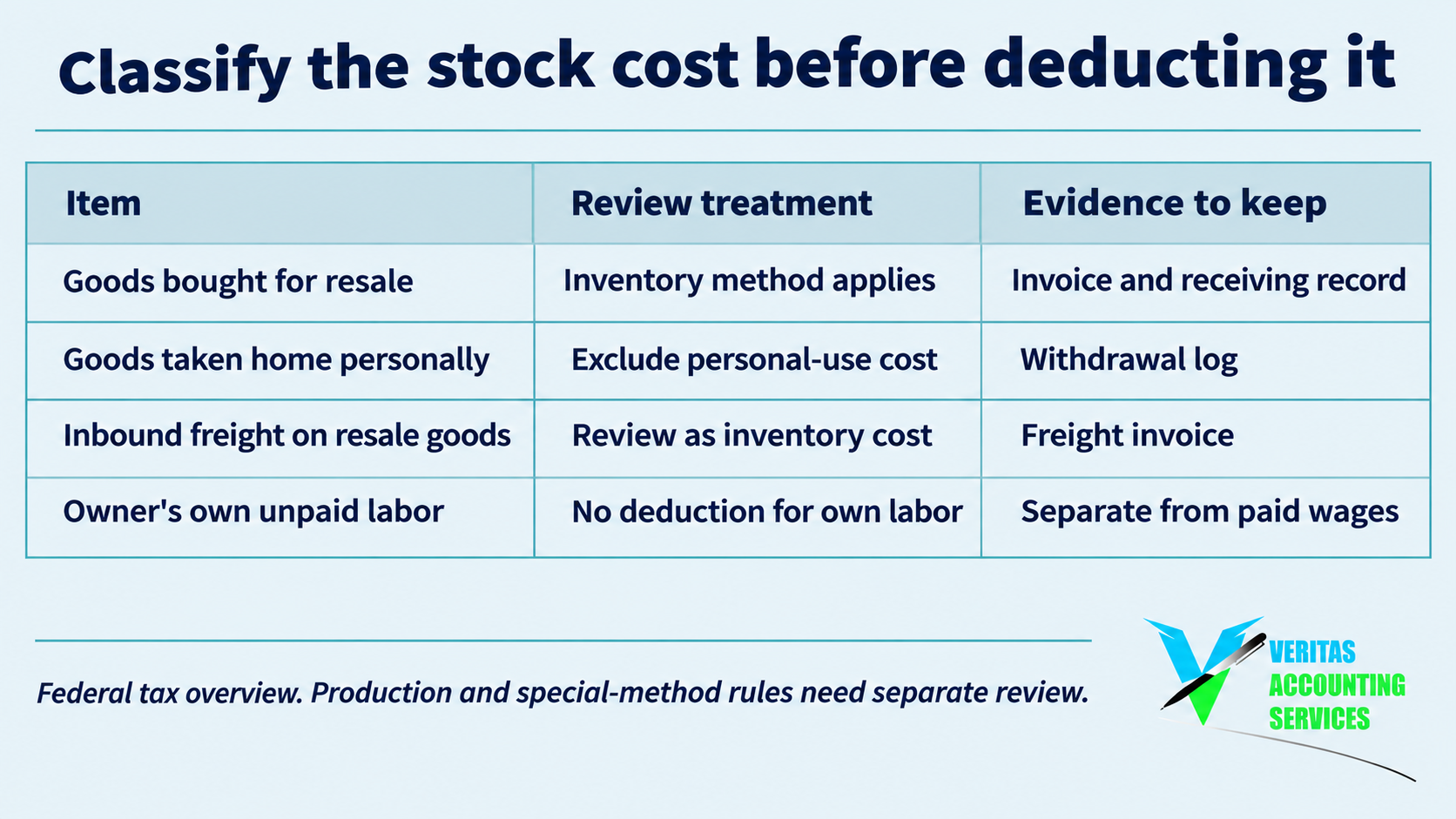
Comparison table for cost of goods sold records showing resale purchases, personal withdrawals, inbound freight and the owner's own unpaid labor, with review treatment and supporting evidence.

5. Review changes before implementing them

Before finalizing cost of goods sold, resist the temptation to switch methods simply to obtain a preferred tax result. A recurring treatment can be an accounting method, and changes can involve Form 3115 and adjustments. The IRS accounting-method guide explains why inventory methods require consistency and formal review.

For cost of goods sold, ask whether a proposed entry corrects a factual mistake, changes a valuation assumption or changes the tax method. Those are different questions. Label the proposed entry and retain the preparer’s reasoning before an approved adjustment is recorded.

The federal inventory regulation describes the small-business alternatives and their conditions. It also distinguishes an eligible inventory method from a simple decision to expense purchases. A method that matches eligible books and records needs its own analysis; it is not created by moving one entry at year-end.

Keep operational reporting useful even when a tax exception applies. The owner still needs to know which products exist, where they are and how much cash is tied up. Tax simplification and sensible stock control can work together without forcing the management report to be the tax calculation.

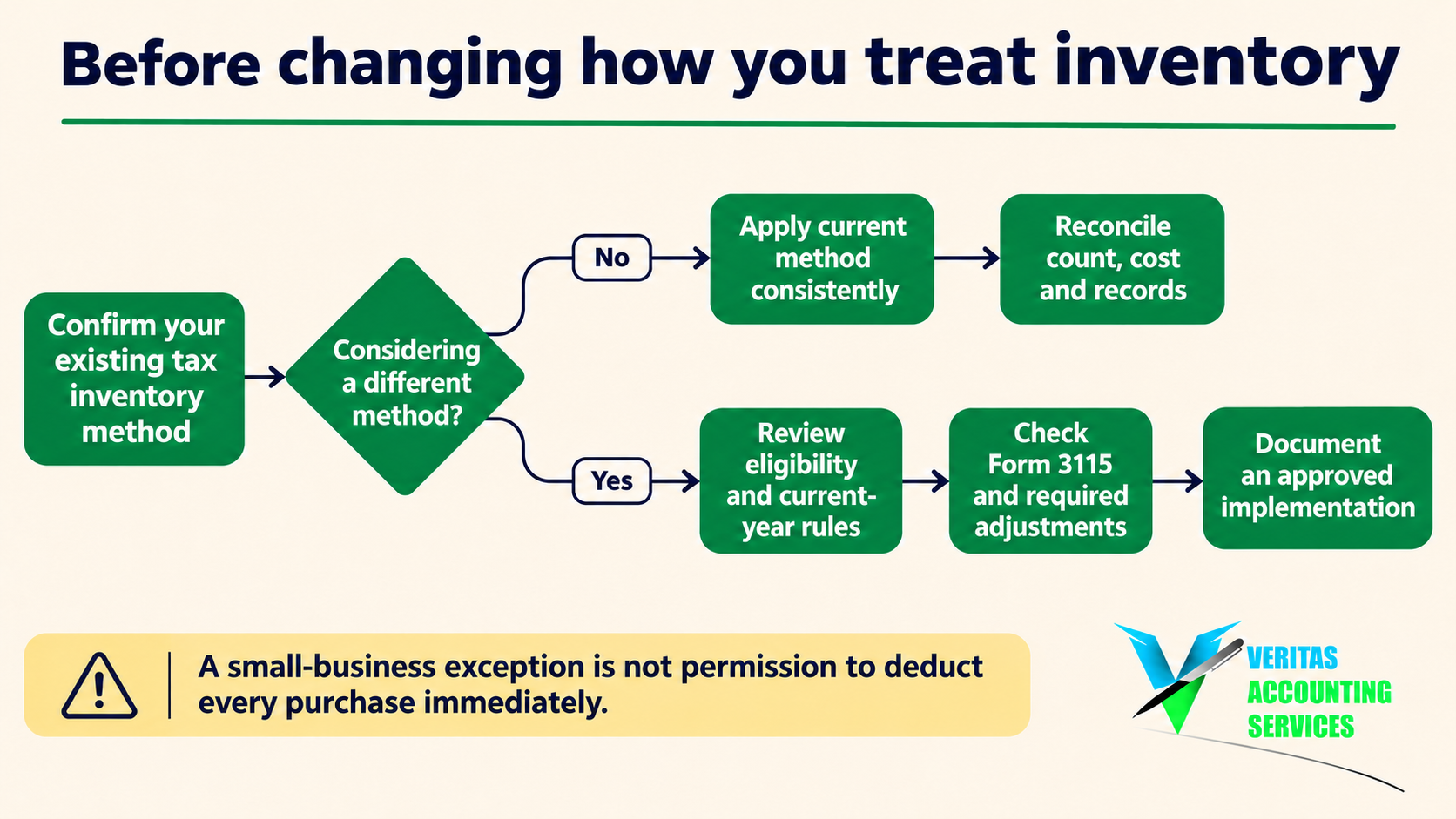
Decision tree beginning with the existing tax inventory method, distinguishing consistent application from a proposed change requiring eligibility, Form 3115 and adjustment review.

A worked retail example

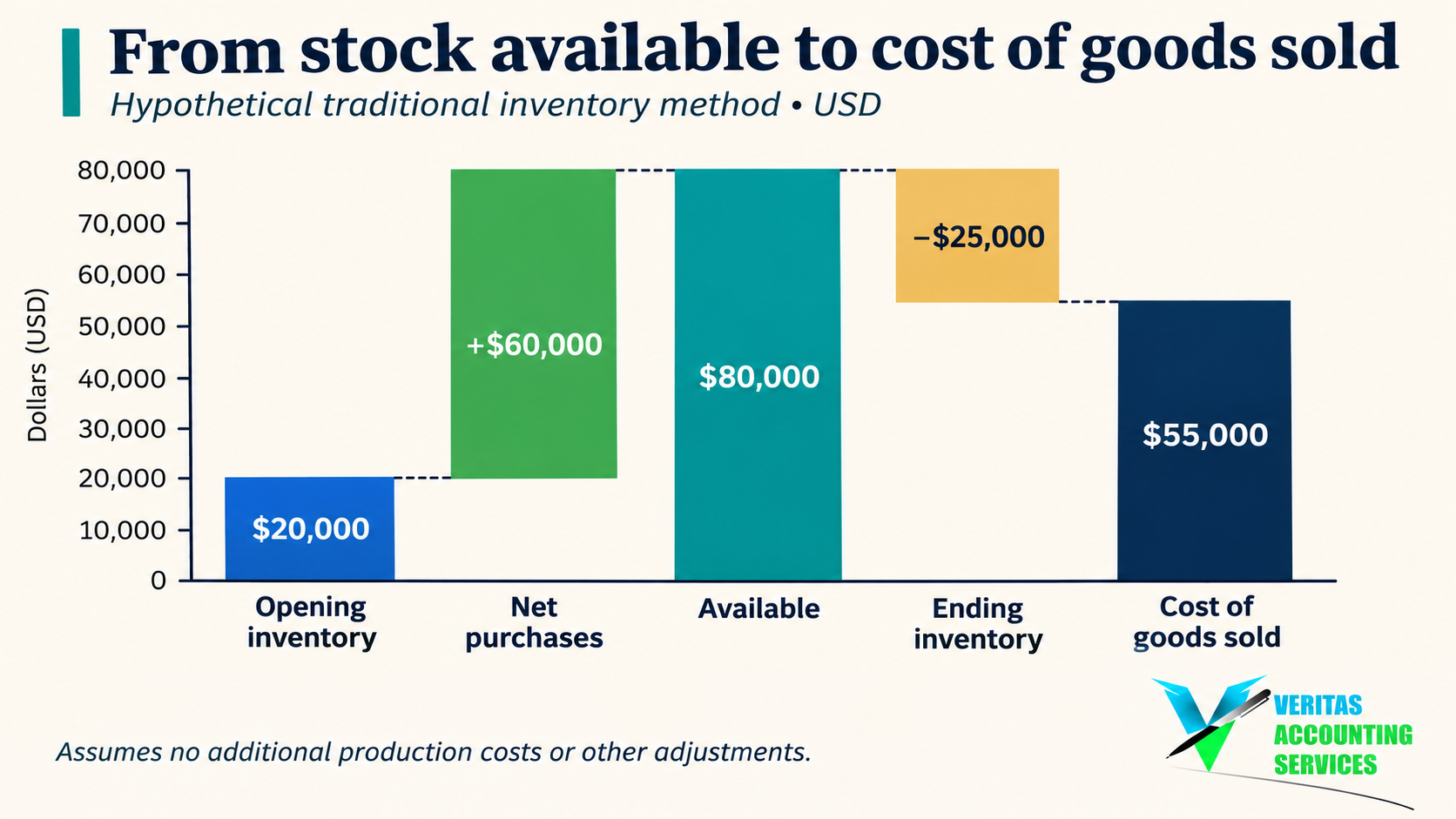
Suppose a small retailer uses a traditional inventory method and has $20,000 of opening inventory. Its net purchases of resale goods are $60,000 after the relevant purchase adjustments. A supported closing count and valuation show $25,000 remaining. Assume there are no additional production costs or other adjustments.

The cost of goods sold is $20,000 plus $60,000 less $25,000, or $55,000. The example does not calculate a tax bill. It only illustrates the product-cost calculation under the stated method, with hypothetical figures that do not describe a Veritas client.

ComponentHypothetical amount
Opening inventory$20,000
Add net purchases$60,000
Goods available$80,000
Less closing inventory$25,000
Cost of goods sold$55,000
Hypothetical cost of goods sold waterfall in USD: opening inventory $20,000 plus net purchases $60,000 gives $80,000 available, less $25,000 closing inventory gives $55,000.

Now suppose the closing inventory were mistakenly entered as $20,000 instead. With everything else unchanged, the calculation would produce $60,000. The $5,000 difference is a recordkeeping error, not an extra $5,000 of cash or a justified tax saving. Correcting the closing figure also protects the next year’s opening record.

Cost of goods sold must therefore be reviewed alongside the quantities and valuation evidence. A spreadsheet can add correctly while using the wrong inputs. Before approving the total, ask which document supports each component and whether the same cost was also deducted elsewhere.

Build a stock-count file someone can review

Create one folder for the count date with a short index. Include the location list, count sheets, supplier-cost support, adjustments and final reconciliation. Give files clear names so the reviewer can move from a summary amount to the underlying items without asking staff to repeat the count.

For cost of goods sold, a useful count sheet records the product code, description, location, quantity, unit of measure, applicable unit cost and extended value. Add the counter’s name, review date and explanation of unusual items. These are practical controls rather than a claim that the IRS mandates this exact template.

Keep evidence of ownership questions with the relevant goods. A warehouse report may show a location and quantity without explaining whose property the items are. Attach the purchase or consignment information needed for the preparer to resolve the question, and avoid substituting an assumption for missing records.

Link the final inventory report to the general ledger and the tax workpaper. If those totals differ, provide a bridge explaining the difference. A management report can present cost of goods sold for a different purpose; the reviewer needs to know which adjustments connect it to the return.

The IRS recordkeeping overview emphasizes records that support income, expenses and return entries. Our bookkeeping and tax records guide adds practical context for keeping the information organized. A readable evidence trail is more useful than a folder full of unnamed screenshots.

Investigate differences before posting adjustments

An inventory difference is a question to resolve, rather than a direction to post a single loss entry. Start by checking quantity units, receiving dates, duplicate product codes and movements between locations. Then review the cost assigned to the items and the accounting period involved.

For cost of goods sold, distinguish a missing supplier credit from missing physical stock. One affects the cost record; the other may involve a count problem, an unrecorded sale, damage or another event. Each explanation needs its own support and may lead to a different correction.

Keep a cost of goods sold exception register with the amount, possible reason, evidence requested, responsible person and resolution. Keep the original report and the approved revised version. That makes it possible to explain a change without reconstructing it from the final journal entry alone.

Avoid forcing cost of goods sold to produce the margin you expected. An unusual margin can prompt investigation, but it is not proof that the inventory total must be changed. Pricing, discounts, sales mix and recording differences can all be useful questions for the review.

Connect inventory decisions to cash flow

The business can spend cash on goods before the tax method permits recovery of their cost. That timing difference makes a stock purchase different from a guaranteed current deduction. Consider expected sales and funding needs before placing a large order for tax reasons.

For cost of goods sold, keep the cash forecast separate from the tax calculation. Supplier payment terms affect when money leaves the bank; product movement affects what remains available to sell. Neither report should be silently substituted for the other.

Our tax savings versus cash flow discussion explains this broader decision. A good purchasing decision should make commercial sense before any possible tax effect. Review slow-moving lines and future commitments while the count information is still current.

Questions to take to your tax preparer

When reviewing cost of goods sold, ask the preparer to confirm the inventory method, the relevant tax-year rules and the records still missing. Bring the prior closing balance, current count, purchase adjustments and unresolved ownership or valuation questions. The aim is a supported calculation, rather than a request to approve a number without context.

For cost of goods sold, ask which costs are recovered through inventory and which belong elsewhere. Confirm that personal withdrawals and duplicate deductions have been addressed. If a method change is proposed, request the implementation steps and any required filing review before the books are changed.

Agree who will supply the remaining evidence and when. A short list of open questions is easier to complete than a general request to clean up inventory. Retain the final explanation with the workpapers so next year’s opening position is understandable.

Frequently asked questions

Is cost of goods sold the same as inventory purchases?

No. Under a traditional inventory method, opening stock, closing stock and applicable purchase adjustments affect the result. Production businesses can have additional costs. Start with the method actually used rather than treating the total supplier payments as the final deduction.

Can a small business deduct all unsold stock immediately?

Not automatically. A qualifying small-business exception permits specified inventory methods, each with conditions. The nonincidental-materials alternative does not simply allow an immediate deduction when goods are bought. Check eligibility and the selected method with the preparer.

Should I value stock using its selling price?

Not just because a price tag is available. Use the valuation basis permitted under the business’s inventory method and retain cost support. A management report showing potential sales revenue serves a different purpose from a supported tax inventory figure.

Do products at a fulfillment warehouse count?

Review ownership and the applicable method. Under ordinary inventory rules, your owned goods may belong in inventory even when held elsewhere. Reconcile the warehouse report with your own locations and transfers so items are not omitted or counted twice.

What if the count reveals damaged or obsolete goods?

Document the items, quantities and condition, then review the permitted tax treatment. Slow sales alone do not establish a particular write-down. Keep the operational concern visible while the tax preparer considers the method and evidence.

Can software calculate cost of goods sold for me?

Software can calculate from its settings and recorded transactions. It cannot resolve missing goods, mixed units or an unsupported method by itself. Review inputs, exceptions and the reconciliation before accepting a report as the return figure.

Conclusion

Reliable cost of goods sold starts with the inventory method and ends with evidence someone else can follow. Connect opening balances, purchases, ownership, quantities and permitted costs before relying on the final total.

Before the next count, prepare a location list and identify who will check quantities, costs and exceptions. A clear handoff gives your bookkeeper and tax preparer a useful starting point and helps you understand the money still sitting on the shelves.

This article provides general US federal tax information reviewed November 4, 2026. It is not individualized advice. Confirm the applicable tax year, business facts and current return instructions; state requirements and financial-reporting rules can differ.

GET IN TOUCH

Schedule a FREE Call

Contact us

Connect on our Socials!
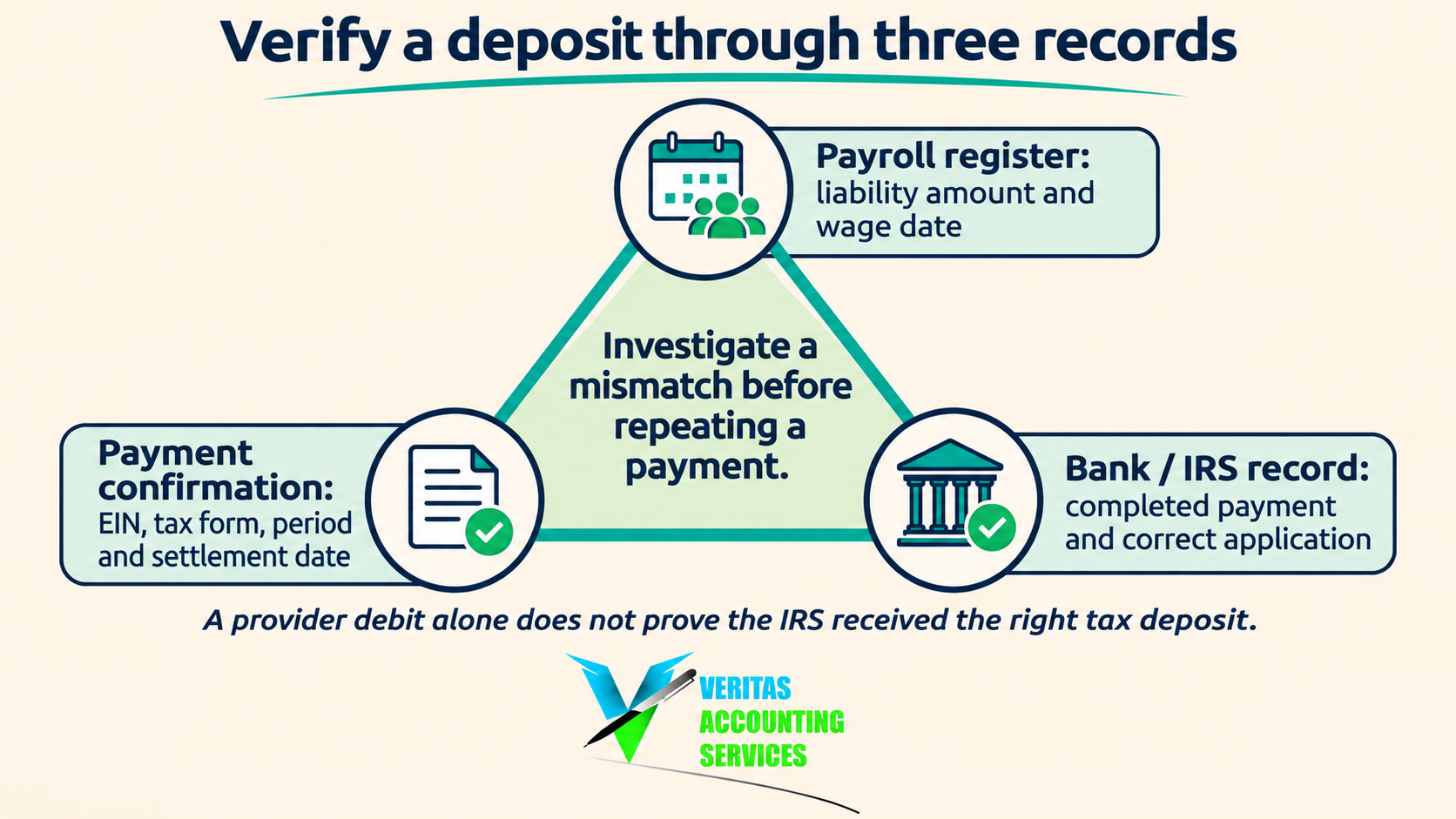
A bakery owner in an apron holds a clipboard at a quiet service counter after closing, beside a reminder to plan tax payments and verify records.

Payroll Deposit Mistakes: A Simple Guide to Better Records

Payroll tax deposits generally become due under rules tied to when wages are paid, rather than when a quarterly return is filed. Paying employees on time is only one part of the process. A business also needs the correct deposit schedule, enough cash for the tax payment and evidence that the deposit reached the right tax account.

The words monthly and semiweekly can be misleading. They describe sets of deposit rules, not an instruction to match the employee pay cycle. A business that pays workers once a month can still need to deposit under the semiweekly rules. A large liability can create an earlier next-business-day obligation.

This guide focuses on ordinary federal employment taxes reported on Form 941. It explains five practical checks, a worked example and a manageable verification routine. Agricultural payroll, Form 944, nonpayroll withholding, federal unemployment tax and state obligations can have different requirements. Confirm the rules for the actual return and tax year before scheduling a payment.

Table of contents

Payroll tax deposits are separate from return filing

The IRS employment-tax deposit overview distinguishes depositing from reporting. Deposits move the required money to the Treasury. Returns report wages, tax liabilities and payments for the reporting period. A filing deadline does not generally give an employer permission to hold taxes until that date.

Payroll tax deposits generally include withheld federal income tax and the relevant employee and employer Social Security and Medicare taxes. Keep this obligation separate from federal unemployment tax, which has its own rules. State withholding and unemployment accounts also need their own review rather than being folded into one assumed federal deadline.

Another distinction is the wage-payment date versus the accounting accrual date. An expense may be accrued before wages are actually paid. For the deposit rules discussed here, the IRS bases the liability timing on payment of wages. A payroll calendar therefore needs the actual pay date, not just the period employees worked.

For payroll tax deposits, keep three dates visible: the wage-payment date, the tax-deposit deadline and the return-filing deadline. Add the payment provider’s processing cutoff as a separate operational detail. Combining everything into one calendar item called payroll makes it harder to see which obligation has actually been completed.

Our payroll compliance overview covers the broader operating process. The narrower question here is how a Form 941 employer determines, funds and verifies a federal deposit after a tax liability arises.

Five checks before the next payroll

1. Confirm the return type and lookback period

Payroll tax deposits start with the employer’s actual filing requirements. Do not assume Form 941, Form 944 and other employment-tax returns use identical lookback rules. A recent change in filing status is a reason to check the instructions, not simply carry forward the old payroll software setting.

For an employer that has filed only Form 941, the ordinary lookback period covers four quarters beginning July 1 of the second preceding year and ending June 30 of the preceding year. Under the 2026 guidance, that is July 1, 2024, through June 30, 2025, for the 2026 deposit schedule.

The IRS Employer’s Tax Guide for 2026 describes the threshold. A lookback total of $50,000 or less generally produces a monthly schedule; more than $50,000 generally produces a semiweekly schedule. Use the specified taxes reported on the returns, not gross wages, net pay or sales revenue.

For payroll tax deposits, retain the four returns and a short calculation supporting the schedule. Identify any Form 944 history or other special situation before applying the ordinary Form 941 example. Review the schedule before each calendar year and reassess when an overriding rule changes it during the year.

2. Apply the schedule to actual wage-payment dates

Under the ordinary monthly rules, payroll tax deposits for wages paid during a month generally are due by the 15th of the following month. That is a deposit schedule, not a requirement to file Form 941 monthly. The quarterly return remains a separate reporting task.

For a semiweekly depositor, liabilities from Wednesday, Thursday and Friday paydays generally are due the following Wednesday. Liabilities from Saturday, Sunday, Monday and Tuesday paydays generally are due the following Friday. The label does not mean every employer must make exactly two deposits every week.

For payroll tax deposits, map each actual payday to its deposit period. A monthly employee payday can generate only one ordinary deposit for that month while still following the semiweekly timing rule. Conversely, multiple paydays can fall into the same deposit period and need to be considered together.

Legal holidays and business-day rules can change the result. The federal deposit rules use legal holidays in the District of Columbia; a different statewide holiday does not automatically postpone a federal deadline. Semiweekly depositors also have a minimum-business-day rule following the close of the period. Verify the actual calendar rather than copying an unadjusted weekday pattern.

Ordinary payroll tax deposits timeline comparing monthly wages with the following month's 15th and semiweekly payday groups with their following Wednesday or Friday, subject to holiday and next-day overrides.

3. Check the next-day rule before relying on the ordinary date

Payroll tax deposits can become due sooner when an employer accumulates at least $100,000 in taxes on a day during a deposit period. The IRS requires the deposit by the next business day. This rule can apply to either a monthly or a semiweekly depositor.

Review the accumulated liability, not just one employee’s withholding or the current payroll’s net cash payment. Publication 15 explains how accumulation works within the deposit period and how it restarts after the threshold is reached. Do not add unrelated periods together or ignore earlier wages within the relevant period.

For payroll tax deposits, large bonuses, an extra payroll or a growing workforce should trigger a deadline review before the ordinary calendar is accepted. The threshold is based on tax liability and is determined before certain nonrefundable credits reduce it. A software display of a lower net payment is not a substitute for that analysis.

A monthly depositor that triggers the $100,000 rule becomes a semiweekly depositor on the next day and remains so for at least the rest of that calendar year and the following year. New employers should not assume a zero lookback guarantees monthly treatment throughout the year. Ask the payroll adviser to review both the immediate deadline and future schedule setting.

4. Distinguish a valid payment-with-return exception from an assumption

Some smaller employers can pay with a timely filed return instead of making deposits when the conditions are met. For Form 941, the IRS describes an exception where the preceding quarter’s or current quarter’s employment-tax liability is less than $2,500, provided there is no $100,000 next-day obligation during the current quarter.

This is a liability test, not a test of the balance left after partial payments. Payroll tax deposits do not become optional just because the return shows a small remaining balance. Form 944 and other situations have their own conditions, so use the actual instructions rather than a general small-business label.

If eligibility is uncertain, review it before choosing to wait. The IRS Form 941 and 944 deposit topic explains the distinction. A mistaken decision to pay with a return can create a deposit problem even if the employer eventually sends the full tax amount.

For payroll tax deposits, record the reason for an exception alongside the supporting return figures and the person who reviewed it. Recheck when payroll grows. An exception that applied in a quieter quarter should not silently become a permanent setting for the business.

5. Verify the payment route, cutoff and settlement details

Federal payroll tax deposits must use an electronic funds transfer. Current IRS guidance lists options including the business tax account, Direct Pay for businesses and EFTPS. A trusted provider or financial institution may also arrange the transfer, sometimes with fees or a different processing cutoff.

Choose the correct tax form, period, employer identification number and payment date. A payment to the wrong period can leave an apparent unpaid liability even though money left the bank. Keep the confirmation and check the final payment status rather than treating an initial request as the end of the process.

For payroll tax deposits, verify the current cutoff for the actual method and amount before initiating the transfer. IRS pages and payment options can be updated at different times; do not assume one generic deadline covers every channel, same-day payment or provider. Build an internal lead time that leaves room to resolve a rejection.

If a same-day arrangement becomes necessary, ask the financial institution or payroll adviser about the supported process, availability and costs. Do not assume that an ordinary bank transfer is the correct federal tax deposit. This guide is an operating review, not an instruction to initiate a payment without checking the account details.

A worked semiweekly example

Suppose a business is correctly classified as a semiweekly Form 941 depositor. It incurs $7,000 of covered tax liability on a Wednesday payday and another $3,000 on a Friday payday. Assume both wage dates fall in the same quarter, all requirements are otherwise met, no relevant legal holiday changes the deadline and the next-day rule does not apply.

The payroll tax deposits calculation for that Wednesday-through-Friday period is $7,000 plus $3,000, or $10,000. Under the ordinary semiweekly rule, that amount is due by the following Wednesday. The example concerns tax liabilities, not gross wages, net employee payments or a percentage applied to sales.

RecordWednesday paydayFriday paydayFollowing Wednesday
Tax liability arising on wage date$7,000$3,000No new liability assumed
Deposit for this exampleNone assumedNone assumed$10,000 due
Hypothetical payroll tax deposits bar chart showing tax liabilities of $7,000 on Wednesday and $3,000 on Friday, compared with a $10,000 deposit due the following Wednesday under the stated assumptions.

The liability dates remain Wednesday and Friday even if one deposit covers both amounts. Semiweekly Form 941 depositors report liabilities on Schedule B, which is a liability record rather than a list of bank-payment dates. Moving both liabilities to the deposit date can create a mismatch in the reporting trail.

For payroll tax deposits, quarter boundaries also matter. Publication 15 explains that paydays falling in different quarters can require separate deposits even when they occur in the same semiweekly period. Do not use the combined example without checking that assumption.

Finally, separate the payroll tax deposits due from the proof of payment. The $10,000 total does not show that a payment was initiated or completed. The business still needs the correct electronic transfer and a matching confirmation. That distinction is useful whether payroll is handled internally or by a provider.

Build a payment verification routine

For payroll tax deposits, create a short register with the wage dates, covered liability, deposit period, due date, responsible person and payment reference. Keep the schedule calculation and any special-rule review with it. The register should explain why the amount and deadline are correct, rather than merely list planned payments.

Compare that register with the payment confirmation and bank activity. Check the employer identification number, tax form, tax period, amount and settlement date. If the provider withdraws a combined amount for wages, fees and taxes, retain the breakdown so one bank debit is not mistaken for an individual tax deposit receipt.

Three-record verification diagram linking the payroll register, payment confirmation and bank or IRS record, with a reminder to investigate mismatches before repeating a payment.

Payroll tax deposits also need a link to the reporting records. Reconcile the quarter’s liability schedule, deposits and any valid adjustments before filing. When a difference remains, identify whether it concerns timing, amount, application or a reporting entry. Do not force the records to agree by changing a date without evidence.

Our bookkeeping and tax records guide provides related operating context. Clear records make review faster, but they must include the payment’s purpose and tax period as well as a bank amount. Keep unresolved items visible until someone has checked them.

Keep oversight when payroll is outsourced

Outsourcing can improve administration, but it does not mean the employer can stop checking payroll tax deposits. The IRS outsourcing guidance warns that, with an ordinary payroll service arrangement, the employer remains responsible if the provider fails to deposit required taxes. Different third-party arrangements can affect responsibility, so understand the arrangement actually used.

Agree who calculates the liability, who schedules the payment and who verifies it. Keep the business’s own access to relevant tax records and make sure important IRS correspondence reaches the employer. A provider’s internal completed label should be supported by the relevant payment evidence.

For payroll tax deposits, a useful handoff is a short confirmation containing the form, period, amount and payment reference. Review exceptions such as a returned payment, late funding or a payroll change after approval. A clear escalation owner prevents a problem from remaining between the provider and the business without action.

Plan cash for payroll tax deposits

Payroll tax deposits belong in the cash forecast alongside employee net pay and other payroll costs. Approval should consider the full funding requirement and the relevant dates. A business can have enough cash for employee payments while still lacking money for the associated tax deposit.

Use a forecast that separates liabilities from operating expenses. Employee withholding is not extra revenue available for suppliers or owner withdrawals. Employer payroll taxes also need proper classification. Our business expense classification guide explains the importance of recording transactions according to what they represent.

For payroll tax deposits, flag bonuses and unusual pay runs before releasing the payroll. They may change the funding requirement or trigger an earlier deadline. Our tax savings versus cash flow discussion explains why an accounting or tax entry does not replace a cash plan.

What to do when a payment looks wrong

Investigate promptly if payroll tax deposits appear missing, rejected or applied to the wrong period. Gather the payroll register, confirmation, bank details and any IRS notice. Confirm what actually happened before initiating another payment, so an uncertain status does not produce an avoidable duplicate.

Penalties can apply to late, insufficient or improperly made deposits, subject to applicable exceptions and relief rules. Some unpaid withheld taxes can also create personal-responsibility issues under the trust fund recovery rules when the relevant responsibility and willfulness conditions are met. Do not treat employee withholding as ordinary working capital.

Ask the preparer or payroll adviser to review the specific remedy and deadline. Paying, correcting a report, tracing a transfer and requesting penalty relief are different actions. Preserve the evidence and follow the instructions relevant to the problem rather than assuming one extra deposit resolves every mismatch.

Frequently asked questions

Are payroll tax deposits due only when Form 941 is filed?

Generally, no. Deposits and filing are separate obligations. Most employers must follow their monthly or semiweekly deposit rules, with special rules and exceptions considered separately. An eligible payment-with-return exception needs to be established from the actual facts.

Does paying employees twice a month make me a semiweekly depositor?

No. The deposit schedule generally comes from the applicable lookback rules, not the employee pay frequency. A next-day obligation can override ordinary timing and can change a monthly depositor’s future schedule.

What happens if a deposit date is a holiday?

Check the federal business-day rules and the relevant District of Columbia legal holidays. Semiweekly depositors also have a minimum-business-day rule after the close of the deposit period. A statewide holiday alone does not automatically extend the federal deadline.

Is money withdrawn by my payroll provider proof the IRS was paid?

Not by itself. The withdrawal may include several payroll components. Match the tax amount to payment details and the relevant bank or IRS record. Keep evidence of the correct employer account, tax form, period and payment status.

Can a new employer always use monthly timing?

The ordinary lookback rules generally treat pre-business quarters as zero, which usually starts a Form 941 employer on monthly timing. The $100,000 next-day rule can still apply. Review large or unusual payrolls before relying on the ordinary date.

Conclusion

Reliable payroll tax deposits require more than a payroll approval. Confirm the return type and schedule, map actual wage dates, check overrides, fund the payment and verify the result against supporting records.

Before the next payroll, assign one person to confirm the deposit deadline and one clear check for the completed payment. That small operating habit can make differences easier to spot before the quarter’s return is prepared.

This article provides general US federal tax information reviewed November 3, 2026. It is not individualized advice. Confirm the rules for the relevant tax year, employer and circumstances, and review state requirements separately.

GET IN TOUCH

Schedule a FREE Call

Contact us

Connect on our Socials!

A freelance business owner holding a tape measure stands in the doorway of a dedicated home office lit by morning sunlight.

Your Simple Guide to Home Office Mistakes and Better Records

A home office deduction may be available when a qualifying part of your home is used for business. Owning a desk, working remotely or paying household bills does not establish eligibility by itself. Check how the space is used, why it qualifies and which calculation method fits the facts before putting an amount on the return.

For a US sole proprietor, the main questions are practical: Is this an actual business area? Is its use regular and, where required, exclusive? Does it meet a qualifying business-use test? After those questions, you can compare the simplified option with actual expenses and apply the relevant income limitation.

This guide focuses on a sole proprietor filing Schedule C. It does not treat a corporate shareholder, partner, employee, daycare provider or landlord as having identical rules. The examples are hypothetical and the discussion covers federal tax. State treatment and unusual arrangements need their own review.

Table of contents

Home office deduction: start with eligibility

The IRS business-use-of-home overview describes several ways a home can qualify. For an ordinary office, these include exclusive and regular use as a principal place of business or as a place to meet clients in the normal course of business. A separate unattached structure has another qualifying route.

A home office deduction also has special rules for certain inventory storage and daycare uses. Those exceptions have conditions; they are not a general waiver for every room with a laptop. Identify the relevant route before comparing amounts or choosing a tax-software category.

Imagine a consultant who sends proposals from a dining table that the family uses for meals. The work may be genuine, but the same area also serves a personal purpose. Contrast that with a separately identifiable area used only and regularly for the consultant’s business. The second arrangement still needs the remaining tests reviewed, but the space-use facts are different.

For the home office deduction, describe what happens in the space rather than relying on the room’s name. A room labeled office on a floor plan can still be used personally. Conversely, qualifying space need not be an entire enclosed room with a permanent wall around it.

Illustrative floor-plan comparison for the home office deduction showing a dedicated work area, a mixed-use dining table and inventory storage with separate exception requirements.

The IRS Publication 587 provides more detail. The currently available edition is for 2025. This article uses its general eligibility, allocation and recordkeeping principles alongside current IRS topic and simplified-option guidance; it does not apply an old annual equipment limit to a later return.

Five checks before choosing a method

1. Identify the business and the person claiming the expense

A home office deduction begins with a trade or business, not simply an activity performed at home. Make clear which business uses the area and who is preparing the claim. Managing personal investments or handling household paperwork should not be mixed into the explanation of an operating business.

If you operate through a corporation, do not copy a sole proprietor’s Schedule C entry into your personal return. Reimbursements and entity arrangements raise separate issues. Partners also have specific reporting and reimbursement considerations. The correct starting point is the actual legal and tax structure.

The simplified option does not create a personal deduction for ordinary employee home-office expenses. The IRS simplified-option page specifically distinguishes employee expenses from qualifying self-employment use. Someone can have wages and a separate business, so identify which activity actually uses the space instead of deciding from employment status alone.

Our accountable plan guide explains the separate employer reimbursement process. Use it for that question rather than assuming a corporate reimbursement and an owner’s home office deduction follow the same filing route.

2. Confirm regular use and the exclusive-use requirement

For the home office deduction, regular use requires more than occasional or incidental business activity. Explain the normal pattern: what work happens there, when it happens and how the area supports the business. The IRS evaluates the facts and circumstances; there is no universal shortcut based on owning a particular desk.

Exclusive use means the identified area is used only for the business when that requirement applies. A shared family recreation space generally fails this test even if substantial work also happens there. A photo taken with personal items removed does not change the actual pattern of use.

The IRS allows a room or another separately identifiable area, without requiring a permanent partition. Measure the area you can support. Do not claim an entire bedroom merely because a small work area occupies one corner while the rest continues to serve personal purposes.

For a home office deduction involving inventory or product samples, check the exception carefully. Publication 587 describes requirements including a wholesale or retail selling business, regular storage, a suitable separately identifiable area and the home as the business’s only fixed location. Daycare has its own rules. Ask about the applicable exception instead of assuming exclusivity never matters.

3. Explain why the location qualifies

Regular and exclusive use does not complete every home office deduction test. An ordinary office also needs a qualifying business-use basis, such as being the principal place of business. The IRS considers the importance of activities at different locations and the time spent at those locations.

A home office can qualify as the principal place of business when it is used exclusively and regularly for administrative or management activities and there is no other fixed location where substantial administrative or management activities are conducted for that business. This can matter for an owner who performs customer work elsewhere.

Examples of administrative work include billing, maintaining records, ordering supplies and arranging appointments. Keep the description specific to the business. The important question is not whether the home contains the biggest workspace, but whether the relevant legal conditions fit the actual activities and locations.

For the home office deduction, tell the preparer about any outside office, workshop or recurring business location. Using a home address on invoices is not conclusive. Meeting clients at home and using a separate structure are additional routes with their own conditions, rather than reasons to ignore the eligibility analysis.

4. Measure the space and document changes

The home office deduction calculation needs defensible measurements. Keep a simple sketch showing the qualifying area and explain the measurement method. Under actual expenses, you also need an appropriate business-use allocation. Do not copy a percentage from a previous return after the layout or use has changed.

Dates matter as well as area. Record when qualifying use began, ended or changed. If a former office becomes a guest room, or you move during the year, the prior full-year calculation may no longer fit. Give those dates to the preparer before the worksheet is finalized.

For the simplified home office deduction, part-year use or area changes involve average monthly allowable square footage. IRS guidance limits the area counted for any month to 300 square feet and counts a month only when there are at least 15 days of qualified use. A full-year example should not be applied automatically to a room first used near year-end.

If another person or another qualifying business uses the space, flag that too. The same square feet cannot simply be claimed twice. Publication 587 discusses allocation and multiple-business situations; a shared household does not multiply the available area without regard to actual use.

5. Review the method, income limit and earlier claims together

A home office deduction is not necessarily the largest amount produced by a calculator. Compare the available methods only after eligibility is established. Then review income limitations, prior actual-expense carryovers and any depreciation history that could affect the decision.

The IRS allows a choice between simplified and actual-expense methods for a tax year. Its guidance says the choice is made on a timely filed original return and cannot later be changed to the other method for that same year. A different method may be chosen for a subsequent year.

For the home office deduction, explain any previous claims before deciding that a simpler worksheet solves everything. The simplified method has different carryover and depreciation treatment. A preparer needs the earlier records to understand those effects, even if the current year’s area measurement seems straightforward.

Compare simplified and actual expenses

The IRS simplified-option comparison explains the central difference. The simplified calculation generally uses $5 for each eligible square foot, with a maximum of 300 square feet. This creates a maximum full-year calculation of $1,500 before the income limit and other applicable adjustments.

The simplified home office deduction changes the calculation and recordkeeping burden; it does not relax eligibility. A personally used area does not become qualifying because the standard rate is easy to apply. For the home office deduction, keep the space, dates and business-use explanation even if you do not allocate household bills under this method.

Actual expenses use qualifying costs and an appropriate business allocation. Direct costs relating only to the qualifying business area and indirect costs benefiting the home generally receive different treatment. An expense unrelated to the business part should not be included merely because it appears on the same household statement.

QuestionSimplified optionActual-expense method
Starting calculation$5 times eligible area, subject to the 300-square-foot cap and adjustmentsQualifying actual costs and supported business allocation
EligibilityBusiness-use tests still applyBusiness-use tests still apply
Depreciation of the homeNo home depreciation for simplified yearsReview business-use depreciation and later sale effects
Income limitationApplies; unused simplified amount does not carry forwardApplies; some disallowed expenses may carry forward
RecordsSupport eligibility, area, dates and incomeAlso support actual costs, allocation and relevant property history
Comparison of simplified and actual-expense home office deduction methods, covering calculation, home depreciation, income limits and required records.

For the home office deduction under the simplified option, do not also deduct the actual home-use costs it replaces. Otherwise allowable home-related itemized deductions remain subject to their own rules. Business equipment, supplies and other costs unrelated to the use of the home itself require separate analysis; they are not automatically absorbed into the area calculation.

The actual-expense home office deduction can involve depreciation and consequences when the home is sold. The simplified option does not generate depreciation for the years it is used, but it does not erase earlier actual-method history. Avoid treating a method switch as permission to discard old property records.

Our expense classification article explains why a clear category matters. For a home office deduction, keep household costs, ordinary operating expenses and equipment purchases distinguishable so the preparer can review each under the correct rules.

See how the income limit changes an example

Suppose an eligible sole proprietor uses 200 square feet exclusively and regularly for a qualifying business throughout the year. Assume all other requirements are met and the simplified option is properly selected. The initial calculation is 200 multiplied by $5, or $1,000.

Now assume gross income attributable to the qualified business use, reduced by business deductions unrelated to use of the home, leaves $700. The home office deduction under the simplified method cannot exceed that remaining amount. In this illustration, the allowable deduction is $700 rather than the initial $1,000 calculation.

Hypothetical simplified deduction calculation showing 200 eligible square feet times $5 equals $1,000, reduced by a $700 income limitation to a $700 deduction with $300 unused and no simplified carryforward.

The $300 difference does not become a simplified-method carryforward. That is different from the possibility of carrying forward certain disallowed actual-method expenses. The example does not establish that the simplified option is better or worse for this owner; a proper comparison requires the alternative calculation and relevant history.

A home office deduction is a deduction, not a dollar-for-dollar tax refund. The final tax effect depends on the entire return and applicable rules. No tax rate is assumed here, and the $700 result should not be described as $700 cash saved.

If the area qualified for only part of the year, the initial amount would need an area-and-date adjustment before considering the income limit. If the space failed eligibility, the arithmetic would not rescue the claim. Check the facts in the same order used in the example.

Build a useful evidence file

For the home office deduction, keep one short explanation of the business use with the measurements and dates. Include what work occurs there, how personal use is excluded where required and why the location qualifies. A reviewer should be able to understand the claim without recreating the whole year from memory.

Under actual expenses, retain the bills and supporting calculation for the amounts claimed. Distinguish a payment from an invoice, and distinguish an expense from an improvement needing different treatment. When the household pays one combined amount, document how the business portion was determined instead of posting the whole charge as business.

Keep earlier home office deduction worksheets and relevant depreciation records available. Purchase, improvement and basis documents can remain important for later calculations. Do not apply a casual document-deletion rule to property history simply because the current year uses a simplified method.

Our bookkeeping and tax records guide provides related operating context. A tidy folder helps, but the evidence must explain the business facts as well as the amount. Label uncertain items so the adviser can resolve them before filing.

Separate household cash flow from tax treatment

A home office deduction does not make a rent payment, utility bill or renovation free. The household still needs enough cash to pay the full bill. Keep the tax calculation separate from the decision about what the household and business can afford.

Before expanding the work area, identify the practical reason: more capacity, better concentration or a genuinely useful business setup. Then consider the cash commitment. Buying a larger home or remodeling solely to pursue a deduction can create costs far beyond any possible tax benefit.

For the home office deduction, avoid transferring money between personal and business accounts without a clear explanation of what it represents. The accounting entry should match the arrangement and entity. Ask the preparer how the approved deduction or reimbursement should be reflected rather than assuming every transfer is rent or an expense.

Our tax savings versus cash flow article discusses the broader distinction. Use a household budget for payment decisions and a supported tax worksheet for the deduction. Neither replaces the other.

Questions to resolve before filing

Review the home office deduction before the return is ready for signature. Confirm the business identity, actual use, qualifying route, measured area, dates and selected method. Discuss income limitations and previous claims with the person responsible for the return.

Tell that person about changes that could alter the answer: a move, shared use, another fixed office, a new entity or a room returning to personal use. These are facts to assess, not automatic disqualifications in every case. Early disclosure leaves time to choose the correct treatment.

The IRS simplified-method FAQs address elections, area changes and income limits. Use the current instructions for the return being filed. A general guide should help identify the right questions, while the final claim reflects your own facts.

Frequently asked questions

Can I claim a home office deduction for a shared dining table?

Under the ordinary exclusive-use rule, using the same area personally and for business generally prevents a claim for that area. Working many hours there does not remove the personal use. Inventory storage and daycare exceptions have separate requirements and should not be assumed to cover ordinary desk work.

Do I need a separate room?

Not necessarily. IRS guidance recognizes another separately identifiable space and does not require a permanent partition. The claimed area must still satisfy regular use, exclusive use where required and the applicable qualifying business-use test.

Is the simplified option an automatic $1,500 deduction?

No. It generally starts at $5 per eligible square foot, capped at 300 square feet. Eligibility, qualified-use dates, area changes and the income limitation can reduce or eliminate the amount. A smaller qualifying area produces a smaller starting calculation.

Can I deduct actual home-use expenses as well as the simplified amount?

You cannot combine the simplified amount with the actual home-use costs it replaces. Otherwise allowable itemized deductions and business costs unrelated to use of the home need separate treatment under their own rules. Keep those categories clear when supplying records.

Can I change methods after filing?

The IRS says the method chosen on a timely filed original return cannot later be changed to the other method for that same year. A different home office deduction method may be selected for another year. Review the decision and earlier history before filing.

Conclusion

A supportable home office deduction starts with the use of the space, not the largest possible calculation. Confirm eligibility, measure the qualifying area, document dates and compare the methods with income limits and earlier claims in view.

Start today with a simple sketch and a short description of what actually happens in the work area. Add the relevant records and take unresolved questions to your preparer before the return is finalized.

This article provides general US federal tax information reviewed November 2, 2026. It is not individualized advice. Confirm the rules for the relevant tax year, entity and facts, and review state treatment separately.

GET IN TOUCH

Schedule a FREE Call

Contact us

Connect on our Socials!
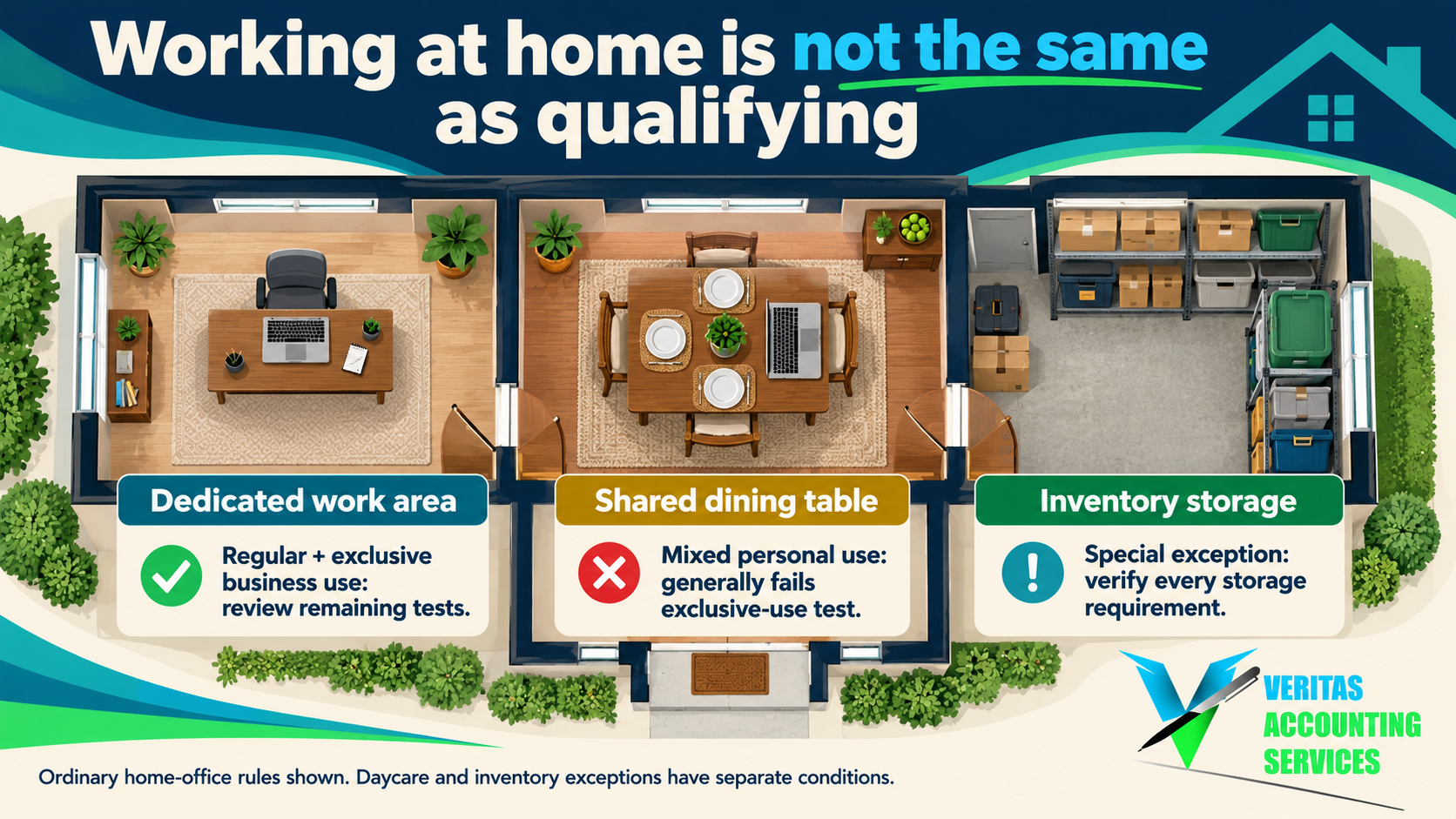
An emerald magnifying lens examines a stylized invoice beside separate payment tokens, representing a review of uncollected customer balances.

Your Simple Guide to Unpaid Invoice Mistakes and Better Records

Business bad debts can sometimes produce a federal tax deduction, but an unpaid invoice is not automatically deductible. The first question is whether the uncollected amount was already included in taxable income. A cash-method service business generally cannot deduct a fee it never received or reported as income. An accrual-method business may have a different result, subject to the other requirements.

The IRS bad-debt overview explains this starting point and the need to establish worthlessness. An old invoice, a disappointed owner and a bookkeeping write-off do not, by themselves, answer the tax question. You need to connect the debt, the income history, collection evidence and the relevant year.

This guide focuses on ordinary unpaid customer service invoices in US businesses. It explains five practical checks, a worked example and a review file you can discuss with your tax preparer. Loans, guarantees, purchased receivables, inventory transactions and personal debts can require different analysis.

Table of contents

What business bad debts mean

A business bad debt generally arises from a debt created or acquired in a trade or business, or closely related to it when the debt becomes partly or completely worthless. The business connection and the existence of a genuine debt both matter. An invoice entry is evidence to investigate, not a substitute for those facts.

For ordinary customer receivables, business bad debts concern amounts the customer owes for an actual transaction. Keep the contract, invoice, delivery or service evidence and the payment terms together. If the customer disputes whether the work was accepted or the amount is correct, resolve that issue before treating the whole balance as an uncollectible debt.

There is a difference between correcting an invoice and recognizing a bad debt. A duplicate invoice should be corrected as an error. A legitimate agreed price adjustment needs its own documentation. Neither should be disguised as a collection loss simply to clear a report.

The distinction also protects your customer relationships. A reminder based on an incorrect balance wastes time and can create avoidable disputes. Before reviewing business bad debts, make sure payments, credits and adjustments have been applied to the right customer account.

Our accounts receivable aging guide explains how to organize overdue balances for follow-up. Aging helps you identify which invoices deserve attention. It does not establish a deduction or prove that a particular debt has become worthless.

Why your tax accounting method matters

Under the cash method, income is generally reported when received, including amounts constructively received under the applicable rules. Under the accrual method, income is generally reported when earned, subject to the relevant tax rules. Your tax accounting method determines the timing; the setting on a management report is not conclusive.

The IRS accounting-methods publication explains these general differences. Its available edition is dated January 2022, so this article uses it for the basic method distinction, not for current inflation-adjusted eligibility limits. Confirm the actual method used on your return with the preparer.

For business bad debts from a cash-method service invoice, the unpaid fee itself generally has not entered taxable income. You cannot create an additional deduction for that missing fee merely because you spent time doing the work. Any actual business costs need their own normal treatment; do not count them again through the invoice balance.

For business bad debts, an accrual-method service business may already have included the fee in income even though the customer has not paid. If that receivable later becomes uncollectible, a deduction may be available after reviewing the debt, evidence, timing and applicable requirements. Prior inclusion is one condition, not the entire test.

Comparison of business bad debts for a cash-method service invoice never included in income and an accrual-method invoice previously included, with other deduction conditions preserved.

Your financial books and tax return may also use different treatments. Ask for the tax reconciliation instead of assuming a book expense automatically appears as a deduction on the return. This article addresses federal income tax treatment, not a complete financial-reporting standard or an instruction to change accounting methods.

When examining business bad debts, identify the year and amount previously included in income. A statement that “we use accrual” is less useful than a clear connection to the particular receivable. Mixed transactions and changes in method should go to the preparer for specific review.

Five checks before claiming a deduction

1. Confirm the genuine debt and business connection

Identify who owes the money, why it is owed and which business owns the receivable. Match the invoice to the underlying agreement and service records. An amount that was never legitimately due cannot be made deductible by issuing an invoice after the fact.

Business bad debts are different from personal loans that happen to involve a business owner. Family arrangements, advances to related parties, guarantees and amounts that may actually be capital contributions require their own analysis. Do not copy the customer-invoice conclusion to those transactions.

Ask the reviewer to record the scope of the decision. For example, the file might cover a specific unpaid consulting invoice rather than every balance connected with the customer. Clear scope helps prevent another account from being written off without review.

2. Reconcile the amount and prior income inclusion

Start with the original invoice and subtract payments and valid credits. Confirm that a deposit has not been posted to a different account and that a payment has not been overlooked. A current customer statement should agree with the detail being reviewed.

For business bad debts, trace the remaining receivable to its tax history. Ask whether the unpaid portion was included in gross income for the current or an earlier year. Preserve the relevant return workpaper or preparer’s confirmation rather than relying only on a software label.

If the invoice includes several different components, identify them before calculating a potential deduction. This guide’s example assumes a simple service fee without sales tax, interest or other adjustments. Real invoices may require separate treatment of amounts that were never your taxable income.

3. Establish worthlessness from the facts

Being overdue and being worthless are different conditions. The IRS describes worthlessness by reference to the surrounding facts and circumstances and the absence of a reasonable expectation of repayment. The evidence needs to explain why collection is no longer reasonably expected, not merely why the owner is frustrated.

When reviewing business bad debts, retain reasonable collection steps and the outcome. Depending on the case, the record might include reminders, responses, failed payment arrangements and verified information about the debtor’s position. No single generic checklist guarantees a conclusion for every customer.

The IRS says a court action is not necessary if you can show that a judgment would be uncollectible. That is different from a blanket statement that collection efforts are unnecessary. Discuss the facts with the appropriate adviser, including legal issues where relevant, instead of automatically suing every debtor or abandoning every difficult account.

Evidence timeline moving from balance verification through collection records and worthlessness assessment to the reviewed tax year, noting that no automatic 90-day or 180-day deduction rule applies.

Business bad debts do not become deductible simply because a report moves them into a 90-day or 180-day bucket. Aging is a prompt to investigate. Record the events supporting the conclusion and the date the reviewer assessed them.

4. Review the year and charge-off requirements

The timing of a deduction for business bad debts matters. A totally worthless debt generally belongs in the year it becomes worthless, rather than whichever year produces the largest benefit. If a potential loss relates to an earlier year, ask the preparer about the correct return and applicable claim procedures.

The IRS small-business tax guide explains the general specific charge-off method for business bad debts. Under that method, a deduction for a partly worthless business debt is limited to the amount charged off on the books during the year. A general estimate or reserve is not the same as identifying and reviewing a specific debt.

The guide distinguishes totally worthless debts: an actual book charge-off is not required in the same way, although recording one may be useful and partial-worthlessness findings can affect the result. Do not turn that distinction into permission to leave the books unexplained. Have the preparer coordinate the tax conclusion and the accounting entry.

Business bad debts can involve partial losses, later total losses or prior deductions. Keep a history of amounts previously deducted so the same loss is not claimed twice. Specialized methods and exceptions exist; this guide does not establish eligibility for them.

5. Coordinate the books, return and later receipts

For business bad debts, give the bookkeeper an approved adjustment and keep the reason with it. Give the tax preparer the same supporting schedule and identify any book-to-tax difference. The two teams should not independently calculate different losses from different versions of the customer ledger.

Business bad debts also need a recovery process. If money arrives later, identify the original invoice and any earlier deduction before deciding how to record it. A closed customer account should not cause a real bank receipt to be ignored or posted to an unexplained suspense account.

IRS guidance says recovery of a previously deducted bad debt may need to enter gross income, subject to the tax-benefit rule. The amount previously deducted and whether it reduced tax affect the result. Keep that history available so a later receipt can be reviewed accurately.

A worked unpaid-invoice example

Suppose a US service business sends a genuine $6,000 invoice for completed work. The customer pays $1,500, leaving $4,500 unpaid. Assume there are no credits, sales taxes, financing charges, insurance recoveries or other adjustments. These are hypothetical amounts, not details from a client file.

In the accrual-method version of this example, assume the business previously included the full $6,000 in taxable income. The payment reduces the receivable to $4,500: $6,000 minus $1,500. That remaining amount is the starting point for reviewing business bad debts, not an automatic deduction.

Hypothetical USD subtraction bridge for business bad debts showing a $6,000 service invoice less a $1,500 payment, leaving $4,500 for a separate deduction review.

The reviewer of business bad debts must still decide whether the remaining debt became worthless, in whole or in part, in the relevant year and whether the applicable requirements are satisfied. If only part is supportably uncollectible, treating the entire $4,500 as worthless would overstate the conclusion. Prior deductions also need to be considered.

Now change the tax method. Suppose the business instead uses the cash method and has never included the unpaid $4,500 in taxable income. Under that assumption, there is no bad-debt deduction for the missing fee itself. The $1,500 actually received and any separately deductible costs follow their own rules.

The commercial loss feels similar in both versions: the business expected more cash than it collected. The tax starting point differs because the income history differs. Business bad debts cannot be analyzed from the bank shortfall alone.

A deduction also does not put the missing $4,500 into the bank. Any tax effect depends on the complete return and the applicable rules. Do not reduce next month’s collection effort or increase spending on the assumption that a write-off will reimburse the lost sale.

Build a useful evidence file

Create one review schedule for each specific customer balance being considered. Include the business entity, customer reference, invoice date, original amount, payments, credits and remaining amount. Link each total to the supporting detail so another reviewer can reproduce it.

For business bad debts, add the tax method, prior income inclusion, collection history, facts supporting worthlessness, proposed tax year and any charge-off. Identify who prepared the schedule and who approved the conclusion. Leave unresolved questions visible rather than converting them into an unexplained final number.

The IRS recordkeeping guidance emphasizes records that support income, expenses and return items. Choose a filing system suited to your business, but make the connection between evidence and tax treatment easy to follow. An attachment named “old invoices” is less useful than a clear reviewed schedule.

Our bookkeeping and tax records guide provides related operating context. Keep source documents, collection correspondence and the approved decision accessible to the people responsible. Limit broad sharing of customer information when a status summary will do.

Do not delete the original invoice or payment history merely because the balance is written off. Later collections, corrections and tax questions may still refer to it. Apply a record-retention policy based on the actual documents and applicable requirements, not a universal deletion date copied from another business.

Keep the cash-flow decision separate

When reviewing business bad debts, the owner needs two decisions: what to expect in the cash forecast and what tax treatment is supportable. A doubtful customer balance may deserve conservative cash planning before a tax deduction is established. Document the planning assumption without presenting it as a completed tax conclusion.

Business bad debts can expose weaknesses in customer approval, deposits, payment terms or follow-up. Use the review to identify a practical process change. For instance, decide who will resolve disputed work promptly and who can authorize new services for a customer with an unresolved old balance.

There is no need to turn the tax review into a promise of a new credit policy or a particular collection result. Different customers and contracts need different decisions. What matters is that someone owns the next action and that the cash forecast reflects a realistic expectation.

Our tax savings and cash-flow discussion explains why a potential tax reduction and available cash are different measures. Keep the proposed deduction separate from the amount you need to collect to meet payroll, rent or supplier payments.

Common mistakes to avoid

One mistake is writing off every invoice older than a chosen number of days. For business bad debts, replace that automatic rule with a review of the specific balance, collection evidence and relevant tax year. A payment that is late can still be collectible.

A second mistake is deducting unpaid cash-method service income that was never reported. Check the income history before computing the loss. Time spent on a project is commercially valuable, but an expected fee is not automatically a tax basis that can be deducted.

A third mistake is counting an already recorded cost again inside the unpaid fee. Review actual expenses separately under their own rules. Our expense classification guide explains why clear categories help prevent confusion about what an entry represents.

A fourth mistake is using a bookkeeping reserve as proof of a tax deduction. Business bad debts generally require the applicable specific-debt analysis, not simply a percentage applied to the whole aging report. Keep financial-reporting estimates and the tax calculation distinguishable.

Finally, do not ignore later collections. Match receipts to the original customer record and tell the preparer about any earlier deduction. A documented recovery process helps the books and return reflect what actually happened.

Frequently asked questions

Can a cash-method business deduct an unpaid service invoice?

Generally not for the unpaid fee itself if that amount was never included in taxable income. Actual paid or incurred costs need separate review under the business’s applicable rules. Do not claim the same expense twice by including it again in a proposed invoice write-off.

Are business bad debts deductible after 90 days?

There is no automatic deduction based only on that aging category. Review the genuine debt, prior income inclusion, collection steps, worthlessness and tax year. A report’s age column is an operating signal, not a tax determination.

Must I sue the customer first?

Not necessarily. The IRS says court action is unnecessary when a judgment would be uncollectible, but reasonable collection steps and evidence still matter. Review the particular facts and any legal issues with the appropriate adviser rather than assuming a lawsuit is always required or never useful.

Can only part of a business debt be deducted?

Potentially. Under the general specific charge-off method, partly worthless business bad debts have a charge-off limitation and other requirements. Nonbusiness debts follow different rules. Give the preparer reviewing business bad debts the specific facts and any prior deductions before deciding on an amount.

What if the customer pays after the write-off?

Record the receipt, identify the original debt and review the earlier tax treatment. A recovery of a previously deducted bad debt may be taxable, subject to the tax-benefit rule. The bookkeeping label alone does not determine the answer.

Conclusion

Business bad debts require more than an overdue invoice. Confirm the actual balance, the tax method and prior income inclusion, the evidence of worthlessness, the correct year and any charge-off requirements. Coordinate the approved result between the books and the return, and keep a process for later collections.

The useful next step is to select one doubtful customer balance and assemble its supporting file. Resolve the missing facts with your preparer before treating an accounting write-off as a tax deduction.

This article provides general federal tax information reviewed October 30, 2026. It is not individualized advice. Apply the guidance for the relevant tax year, business entity and specific debt, and review state treatment separately.

GET IN TOUCH

Schedule a FREE Call

Contact us

Connect on our Socials!
A translucent teal document passes through an emerald filing-folder arch, illustrating clearer contractor-payment reporting.

Your Simple Guide to Contractor Tax Mistakes and New Rules

Contractor tax forms need a fresh review for payments made in 2026. The general federal Form 1099-NEC reporting threshold is now $2,000, compared with $600 for payments made before 2026. That change does not make smaller payments tax-free, remove the need for accurate books or settle every reporting question.

The IRS information-return guidance confirms the payment-year distinction and the separate reporting rule when backup withholding has occurred. Use the correct year and payment facts before deciding whether a form is required. An old checklist can lead to the wrong result in either direction.

For a US small-business owner, the useful task is to connect the vendor record, the service provided, the payment route and the annual reportable total. This guide explains five practical checks for ordinary domestic service payments. Foreign payees, unusual transactions and state reporting require their own review.

Table of contents

What changed for 2026

The IRS states that the reporting threshold for Form 1099-NEC is $2,000 for payments made in 2026. For payments made before 2026, the threshold was $600. For later years, check the applicable inflation-adjusted amount rather than assuming that either figure remains correct indefinitely.

The change concerns information reporting. It is not a new deduction for the payer or a tax exemption for the person receiving the money. Whether an expense is deductible and whether a recipient must report income are separate questions from the requirement to issue an information return.

When reviewing contractor tax forms, identify the year of the payments first. A form prepared during the following filing season generally reports the preceding calendar year’s transactions. Do not use the year when someone opens the software as a substitute for the payment year being reported.

This article reviews a rule relevant to the 2026 payment year, rather than announcing a new October-only concession. The IRS newsroom’s latest general planning reminders are a reason to check your process now; they do not change the effective date of this threshold.

Comparison of contractor tax forms showing the general federal nonemployee-compensation reporting threshold of $600 before 2026 and $2,000 for payments in 2026, with conditions and exceptions noted.

Other information returns have their own payment categories and thresholds. Do not apply the Form 1099-NEC amount to every type of Form 1099 simply because the form names look similar. A payment for rent, interest or legal settlement proceeds can raise a different reporting question.

What contractor tax forms actually do

Form 1099-NEC reports qualifying nonemployee compensation. The IRS contractor-payment page describes four general conditions: payment to a nonemployee, services for a trade or business, an eligible type of recipient and reportable payments reaching the applicable annual threshold.

That is why a vendor’s total balance alone cannot make the decision. You need to know what was paid for, who received it and how it was paid. A personal household purchase does not become a trade-or-business service payment merely because the business owner made it.

Contractor tax forms also serve a different purpose from the vendor’s invoice. The invoice describes the commercial transaction; the information return reports a qualifying payment to the IRS and the recipient. Keep both records when relevant, rather than treating one as a replacement for the other.

For contractor tax forms, the payer and recipient have separate responsibilities. A contractor should not conclude that business income disappears because no form arrives. Likewise, a business should not conclude that an otherwise deductible expense is automatically disallowed solely because it falls below a reporting threshold. The actual tax and substantiation rules still matter.

There is also a difference between creating a draft form, filing it with the IRS and furnishing a statement to the recipient. A completed screen in the bookkeeping system is not proof that both delivery obligations have been satisfied. Build those separate checks into the workflow.

Five checks before deciding what to file

1. Confirm the worker’s status

Before preparing contractor tax forms, start with the relationship, not the preferred form. The IRS independent-contractor explanation says classification depends on the facts, including the right to control the work. Calling someone a freelancer in an agreement does not settle the federal employment-tax question.

A Form W-9 does not convert an employee into an independent contractor. That distinction matters for contractor tax forms. Neither does paying through accounts payable or having the worker submit invoices. If the arrangement raises a classification concern, ask for an appropriate review before choosing contractor tax forms.

For employees, payroll and Form W-2 reporting belong in the review. For genuine nonemployees, proceed to the service-payment and payee checks. Our payroll pitfalls guide provides related operational context, while the IRS remains the authority for the federal classification analysis.

Keep the reasoning with the engagement records. A short note identifying what was reviewed, who resolved an uncertainty and when the facts changed can be more useful than a generic checkbox saying “contractor.” Review a relationship again if the actual working arrangement changes materially.

2. Verify the payee’s tax information

Collect the correct name, taxpayer identification number and relevant tax classification through an appropriate process. The IRS Form W-9 page links the form and instructions used to request this information from a US person. The completed form is normally given to the requester, not sent to the IRS as a routine vendor-onboarding submission.

For contractor tax forms, the trading name on an invoice may not be the correct name to pair with the tax identification number. The W-9 instructions distinguish the owner’s name and the business name for a sole proprietor or disregarded entity. Do not guess from a logo or website address.

The letters “LLC” do not, by themselves, tell you the federal tax classification. Read the completed information and resolve inconsistencies before using it. Similarly, do not assume that every corporate payee is exempt from every type of information reporting; payments for legal services are a familiar area needing specific attention.

Foreign-payee documentation and withholding can follow different rules. Do not require a foreign service provider to sign a US-person certification merely to fit the domestic process. Flag the case for the appropriate analysis instead of forcing it into the ordinary W-9 checklist.

Protect the records used for contractor tax forms. They may contain personal tax identifiers even when the vendor operates under a business name. Give staff access according to their job, use the agreed secure transfer method and avoid placing full identification numbers in broadly shared spreadsheets.

3. Separate the payment routes

The way a vendor was paid can affect the reporting route. The IRS third-party-filer FAQs explain that a transaction reportable under both the ordinary business-payment provisions and the payment-settlement provisions should be reported only on Form 1099-K, not duplicated on Form 1099-NEC or Form 1099-MISC.

This distinction matters when preparing contractor tax forms from a vendor ledger. Credit-card transactions and qualifying third-party-network transactions need to be identified separately from direct payments. Do not add every payment route together and automatically issue a second form for transactions belonging to the settlement-reporting system.

An app’s name alone is not enough to classify the transaction. Check how the particular payment was processed and retain the relevant evidence. Not every electronic transfer is a qualifying network transaction, and an ordinary direct bank payment does not become one simply because it was initiated online.

For contractor tax forms, ask the preparer to resolve mixed-route cases. One vendor may receive checks, direct transfers and card payments during the same year. A useful report shows each route clearly and explains which amounts were included in the proposed nonemployee-compensation total.

Decision tree for reviewing a business service payment, separating employee payroll, nonemployee payment routes, Form 1099-K treatment and the backup-withholding exception.

4. Calculate the annual reportable total

Apply the threshold to the relevant annual total for each payee, not to each invoice individually. Several smaller service payments can reach the 2026 amount even when no single invoice is close to $2,000. Search for duplicate vendor records before deciding that two accounts represent two unrelated payees.

For contractor tax forms, reconcile the payment detail to the underlying books and payment evidence. Distinguish a draft bill from an actual payment, and flag refunds, corrections or unusual entries for the preparer. Do not silently net unrelated items together to produce a preferred reporting result.

The ordinary service-payment review can include parts and materials associated with the services, as the IRS’s reporting conditions explain. Do not assume that every amount labeled “materials” can simply be removed from a service contractor’s payment total. The actual transaction and applicable instructions determine treatment.

Track unresolved contractor tax forms separately. A vendor total near the threshold deserves a complete review, rather than a rounded estimate. Use exact supported figures and record the reason for any exclusion from the proposed filing total.

5. Check withholding, exceptions and state requirements

The threshold is not the only filing trigger. The IRS says Form 1099-NEC must also be filed for a person from whom federal income tax was withheld under the backup-withholding rules, regardless of the payment amount. This exception should remain visible when a spreadsheet filters out smaller vendor totals.

The IRS backup-withholding guidance describes situations involving missing or incorrect tax identification information and the current 24% rate. Applying the rules requires attention to the actual facts and notices. Do not treat a general statement about the rate as a complete instruction for handling a particular vendor.

Keep contractor tax forms connected to the withholding records, deposits and any related reporting obligations that apply. A missing name or identification number is not solved by typing a convenient substitute into the return. Escalate the problem and follow the applicable correction or withholding procedure.

Review state information-return obligations separately using the relevant state’s official guidance. A federal change does not prove that every state adopted the same threshold, filing channel or exception. Record who will make that check instead of assuming the federal submission settles it.

A worked annual-total example

Suppose your business pays one US individual service provider by check during 2026. Assume the payments are qualifying business service payments, the payee information is correct, no exemption applies and no backup withholding occurred. These are illustrative assumptions, not details from a real client.

The business pays $900 in March, $700 in July and $500 in October. The annual total at that point is $2,100: $900 plus $700 plus $500. The amount reaches the general $2,000 reporting threshold even though each individual payment is below it.

A review of contractor tax forms should therefore consider Form 1099-NEC reporting for the full reportable amount, subject to the stated assumptions and any later activity. The threshold is not a deduction from the amount reported. You do not report only the $100 exceeding $2,000.

Hypothetical vendor ledger with three 2026 check payments of $900, $700 and $500, totaling $2,100 and reaching the $2,000 general reporting threshold.

Before finalizing contractor tax forms, change one fact: suppose part of the vendor’s activity was processed through a payment route covered by the settlement-reporting rules. You would need to separate that activity and review the remaining direct-payment total. The original example’s simple conclusion cannot be carried over without recalculating the relevant amount.

Change another fact: suppose backup withholding occurred. The separate reporting rule may apply regardless of the total. Examples are useful because they show the method, but they work only when the assumptions match the facts being reviewed.

Build a useful vendor review file

Start with a vendor list that has one clear record for each payee. Link invoices and payment details without scattering the same supplier across abbreviations, personal names and duplicate accounts. Ask the responsible person to resolve duplicates before exporting a filing list.

A practical file for contractor tax forms should show the following:

  • The payee name and the location of the securely stored tax documentation.
  • The service category and any classification issue needing review.
  • Payments by date, amount, payment year and payment route.
  • The proposed reportable total and the reason for each excluded amount.
  • Any backup withholding, exception, unresolved item or state-review assignment.

Do not include full tax identification numbers in a general management report. The preparer may need them in the secure filing process, but the owner can review progress using an internal vendor reference. This keeps the operational status useful without unnecessarily spreading sensitive data.

Review contractor tax forms alongside your expense records. Our business expense classification guide explains why consistent categories help the books. An expense label supports the review, but it does not replace the specific information-return rules.

Assign an owner to unresolved contractor tax forms. “Waiting for W-9” should identify who will follow up and the next action. A missing document discovered early is easier to investigate than one found while a final filing is being submitted.

Plan the filing process

Decide who prepares, reviews, submits and verifies contractor tax forms. Give the reviewer a clear version of the proposed data and a list of assumptions. Changes made after approval should return for review rather than quietly altering the final submission.

Contractor tax forms may need electronic filing even if the business has only a few contractors. The IRS explains that the ten-return e-filing threshold generally aggregates almost all covered information-return types, including Forms W-2. Counting only the Forms 1099-NEC can miss the relevant total.

Check the applicable calendar-year deadlines and any authorized extension or postponement against official guidance. Filing with the IRS and furnishing recipient statements are separate steps. Do not use a deadline for another form, or assume a paper process and an electronic process always have identical requirements.

For contractor tax forms, keep the submission confirmation and check the system’s acceptance or rejection result. A rejected file requires follow-up. Save evidence that recipient statements were furnished through an appropriate method, and document how corrections will be handled if an error is later found.

The IRS also describes its Information Returns Intake System, or IRIS, as a no-cost way to file Forms 1099 electronically. Check existing access and current instructions early. Choosing a free channel does not remove the need for complete data, review or confirmation.

Our business compliance calendar can help organize responsibilities and reminders. The calendar is an operating tool; the current official rules determine the actual due dates and filing requirements.

Common mistakes to avoid

The first mistake is carrying an old $600 filter into the 2026 payment review without checking the changed rule. The reverse mistake is using the 2026 threshold to reassess an earlier payment year. Contractor tax forms need a clearly labeled year before any software setting is applied.

The second mistake is deciding from the invoice amount alone. Aggregate the relevant payments to the payee, resolve duplicate vendor records and verify the payment route. A tidy-looking summary can still be wrong if its underlying categories are incomplete.

The third mistake is treating the absence of a form as proof that income is not taxable. Information reporting and income taxation have different purposes. A contractor’s own books remain important even when no information return is required from a particular customer.

The fourth mistake is assuming that software validates the legal conclusion. Software can populate contractor tax forms from the data supplied; it cannot determine an unresolved worker relationship or explain an unidentified payment route. Review the decisions before the upload, not only the spelling afterward.

Finally, do not delete records merely because the vendor falls below the general threshold. The expense, payment, classification and withholding facts can still matter. Our bookkeeping and tax records guide explains the value of a reliable supporting file.

Frequently asked questions

Is the 2026 threshold $600 or $2,000?

For the general federal Form 1099-NEC payment threshold discussed here, the IRS identifies $2,000 for payments made in 2026. The $600 amount applies to payments made before 2026. Other conditions, exceptions and payment categories still need review.

Do contractor tax forms use each invoice or the annual total?

Use the relevant annual reportable total for the payee. Multiple smaller payments can reach the threshold. Check that the total includes the correct payments and excludes transactions belonging to a different reporting route for a supported reason.

Is only the amount above the threshold reported?

No. In the hypothetical $2,100 example, reaching the threshold triggers a review of reporting the full reportable amount. The $2,000 threshold is not an allowance deducted from the reported payment total.

Can a smaller payment still require a form?

Yes. The IRS identifies reporting regardless of amount when federal income tax was withheld under the backup-withholding rules. Other facts can also require separate analysis. Do not rely on a threshold-only filter for contractor tax forms.

Does every electronic payment belong on Form 1099-K?

No. When preparing contractor tax forms, confirm the actual transaction and whether the payment-settlement reporting provisions apply. A transfer being electronic or appearing in an app is not, by itself, a complete answer. Avoid duplicating transactions covered by the Form 1099-K reporting route.

What should I do if a vendor’s information is incomplete?

Request the appropriate documentation through your secure process and flag the issue for review. Do not invent an identification number or presume an exemption. Resolve any applicable withholding and filing requirements before treating the file as ready.

Conclusion

The 2026 reporting threshold is an important change, but it is only one part of preparing contractor tax forms. Check the worker relationship, payee details, payment route, annual reportable total and any withholding or state requirements before deciding what to file.

The useful next step is to reconcile the vendor list now and assign the unresolved items. Clear source records and a reviewed filing process help turn a year-end scramble into a manageable compliance task.

This article provides general federal tax information reviewed October 28, 2026. It is not individualized advice. Confirm the payment year, current applicable instructions, special rules and state requirements before acting.

GET IN TOUCH

Schedule a FREE Call

Contact us

Connect on our Socials!
A sculptural teal income wave passes four navy calendars toward an emerald reserve vessel, illustrating uneven income and tax planning.

Your Simple Guide to Estimated Tax Mistakes With Uneven Income

Estimated tax payments deserve a closer look when your business earns most of its profit in a few busy months. Dividing an annual estimate into equal installments is one approach, but an annualized income calculation may better reflect when income arose. It does not automatically lower your final tax bill or erase a missed payment.

The IRS’s October 23, 2026 year-round planning reminder encourages small-business owners and self-employed taxpayers to review estimated tax payments before filing season. That reminder is timely guidance to review your position, rather than a new exemption or a new annualization rule.

This guide focuses on individual federal income tax planning for owners with uneven income. Corporate estimates, special farming and fishing rules, nonresident situations and state requirements need their own review. The practical goal is to bring your adviser a clear income timeline, an accurate payment history and enough information to compare methods.

Table of contents

Why income timing matters

A business can finish the year with healthy profit even though its first few months were quiet. A wedding photographer, summer repair business or consultant receiving a large project payment may have a very different income pattern from an owner receiving steady monthly fees.

Federal income tax generally works on a pay-as-you-go basis. That means the timing of tax paid during the year matters alongside the final annual total. A large payment near year-end may reduce an outstanding balance, but it does not necessarily remove a penalty for an earlier installment.

The IRS explanation of underpayment penalties says people receiving income unevenly may be able to vary installments using the annualized method. The word “may” matters: the result depends on the calculation and the records behind it.

Before changing estimated tax payments, separate three questions. What is your expected final tax? What amount needs to have been paid by each relevant installment date? How much cash can the business and household set aside to meet those obligations? The answers are connected, but they are not interchangeable.

Understand estimated tax payments

For many individual owners, these payments cover income that is not adequately covered by withholding. The calculation can include self-employment tax as well as income tax. A sole proprietor’s business results are only part of the picture if the household also has wages, investment income or other taxable items.

The IRS estimated tax overview describes who may need to pay and how to estimate an amount. Do not decide that no payment is needed simply because your business has no employees or you have not received an information return.

For most individuals, the general underpayment protection compares 90% of current-year tax with 100% of prior-year tax, using the smaller applicable amount. The prior return must cover a full twelve months. Higher-income taxpayers generally substitute 110% for the prior-year percentage when prior-year adjusted gross income exceeds $150,000, or $75,000 for married filing separately.

Other exceptions and special rules apply. For example, the IRS describes a general exception where tax owed after withholding and refundable credits is less than $1,000. These are screening rules, not a substitute for completing the relevant worksheet. A prior-year comparison also does not guarantee that the remaining tax bill will be small.

If the required protection amount is lower than your expected final liability, plan for the difference after estimated tax payments. Keeping a cash reserve for that balance helps prevent a mistaken assumption that “penalty protection” means “nothing more to pay.” Our discussion of tax savings and cash flow explains why the two need separate attention.

Regular and annualized methods

Under the regular installment method, the required annual payment is generally divided into equal installments. This can be straightforward when income is reasonably stable or a reliable prior-year amount provides the relevant benchmark. Equal payments are not inherently wrong for a seasonal business; compare the actual results before choosing a more complicated approach.

The annualized income installment method looks at income and relevant deductions through specified periods. It converts those period results into an annualized calculation and works through the applicable tax worksheet. An owner with little early income may have a lower required early installment than under a simple equal-payment approach.

The 2026 edition of Publication 505 includes the annualized estimated tax worksheet for current-year planning. It accounts for much more than multiplying business revenue by a flat percentage. Credits, deductions, self-employment tax and other items can affect the answer.

Comparison of regular estimated tax payments with the annualized income method, showing their starting points, payment patterns and record requirements.

For individual calendar-year annualization, the cumulative periods end in March, May, August and December. These are not four equal calendar quarters. A report for April through June alone cannot replace the cumulative January-through-May information needed for the second annualized period.

When evaluating estimated tax payments, keep the period covered and the payment due date in separate columns. This avoids using a familiar quarter-end date for the wrong purpose. Check the current year’s official schedule, along with any applicable postponement, before instructing a payment.

Cumulative annualized-income periods running from January through March, May, August and December, rather than four equal calendar quarters.

Annualizing estimated tax payments does not let you select only the most favorable month. It is a structured method with cumulative calculations and interaction between installments. Prior-period differences can affect later required amounts, so the whole sequence needs to be reviewed together.

Five practical checks

1. Identify whose tax you are reviewing

Start with the taxpayer and return involved. A single-owner business’s bank account, a partnership’s books and an individual owner’s return are different records. An owner’s federal individual estimated tax payments should not be confused with payroll deposits or a company’s separate corporate income tax obligation.

If you own a partnership or S corporation, include your share of relevant pass-through items in the review. A cash distribution does not by itself establish the taxable income for the period. Ask the preparer which interim information is needed rather than substituting money withdrawn from the business.

For a household filing jointly, coordinate estimated tax payments with both spouses’ other income and withholding. Reviewing one business in isolation can miss a large part of the actual annual liability. Keep private household details in the secure adviser file, rather than in routine team reports.

2. Put income into the correct periods

Reconcile your books before extracting the cumulative reports. Confirm the tax accounting method and any adjustments your adviser needs. Bank deposits can include loans, transfers and owner contributions, so a bank balance or deposit total alone is not a taxable-profit calculation.

For estimated tax payments, the purpose is to identify the income and deductions properly attributable to each required period. Do not move an item into a later month merely to produce a smaller installment. Preserve the underlying transaction dates and let the applicable tax rules determine treatment.

Flag unusual items separately. A large asset sale, investment gain, cancellation of debt or change in the business can require analysis beyond the ordinary operating report. A short explanation and supporting document are more useful than burying the item in a miscellaneous account.

3. Reconcile payments and withholding

List federal estimated tax payments with their actual dates, amounts, tax year and confirmations. Check whether a prior-year overpayment was applied forward. A payment recorded in the bookkeeping file should also be matched to the available payment evidence, rather than assumed to have reached the intended taxpayer’s account.

Withholding has its own timing rules. It is generally treated as paid evenly through the year for the underpayment calculation, unless actual withholding dates are used under the applicable rules. Do not automatically treat an estimated payment and additional wage withholding made on the same day as identical for penalty purposes.

If withholding may be adjusted, review the household’s facts and payroll arrangements before acting. This is not permission to run an unsupported payroll entry or relabel an owner withdrawal as wages. The adviser should compare lawful options and their practical deadlines.

4. Compare the calculations before changing cash plans

Ask for a comparison of regular installments, any applicable prior-year protection and annualized results. The calculation should show required amounts, amounts paid and remaining exposure by period. The lowest-looking percentage on a summary sheet may not be the method that applies to your facts.

Once estimated tax payments have been calculated, translate them into a cash forecast. Include operating costs, debt payments, owner needs and the remaining expected tax balance. A separate reserve can make the obligation visible without suggesting that moving money between accounts itself satisfies a tax payment.

Revisit estimated tax payments and the forecast after a major change in income. A strong autumn can alter the full-year picture, while a project delay can change available cash. Our business compliance calendar can help organize responsibility and reminders around the agreed review process.

5. Plan the filing support and state review

Current-year planning and the eventual return filing are linked. Keep the worksheet used to determine estimated tax payments, the supporting period reports and the payment confirmations together. Explain any later change in the figures so the preparer can reconcile the planning file with the final return.

Publication 505 states that using the annualized income installment method for estimated tax payments requires filing Form 2210 with the 2026 return. Its Schedule AI procedure applies across all installment dates when used for the penalty calculation; do not present just the most favorable column in isolation.

The currently available Form 2210 instructions explain the annualized method and the situations requiring the form. The version reviewed for this article is labeled 2025; it supports the procedural background, not an assertion that the final 2026 filing instructions have already been released. Use the correct final tax-year forms when preparing the return.

State estimated tax payments require a separate check against the relevant state’s official guidance. Do not copy a federal result, percentage, timing assumption or exception into a state worksheet without verifying it. Multistate owners may need more than one separate review.

A seasonal business example

Suppose a calendar-year sole proprietor has an illustrative $10,000 of business profit from January through March, another $15,000 in April and May, another $35,000 from June through August, and $60,000 during September through December. The full-year business profit is $120,000.

The cumulative business figures are therefore $10,000, $25,000, $60,000 and $120,000. The second figure includes the first period; it is not just the $15,000 earned during April and May. Those cumulative amounts are a useful starting file for the adviser.

This example deliberately does not turn the four profit figures into estimated tax payments. The owner’s filing status, other income, deductions, credits, self-employment tax, prior-year tax and withholding have not been supplied. Applying an invented flat rate would make the example look precise while leaving out facts needed for a valid answer.

What can the owner learn without that missing information? The business has an uneven income pattern, a cumulative reporting file is necessary, and a comparison of methods is worth requesting. The example establishes a review question, rather than promising a particular saving or penalty reduction.

If the adviser finds lower early estimated tax payments under annualization, later installments still need attention. The money retained earlier is not automatically permanent extra spending money. Build the later payment and final balance into the forecast before committing to equipment or additional owner withdrawals.

Build a useful review file

Give the adviser a clean package instead of a collection of screenshots. Begin with the prior-year return and the current-year cumulative reports covering the required periods. Add a short list of changes in household income, filing circumstances and business activity that may affect the result.

For estimated tax payments, the most useful supporting records usually include the following:

  • Reconciled income and expense reports, with their exact coverage dates.
  • A clear description of the accounting method and unresolved adjustments.
  • Pass-through estimates or other relevant owner income information.
  • Withholding details and federal payment confirmations.
  • Unusual transactions, expected remaining income and important assumptions.

Keep this file secure. It may contain tax identifiers, account information and personal household details. Give the operating team only the information needed to manage cash and deadlines; the complete return package belongs in the agreed secure process.

Workflow from reconciled period books through a complete tax picture and method comparison to a verified payment and saved receipt.

A simple review log for estimated tax payments can record the date, reports used, assumptions, person responsible and next review trigger. Mark forecasts as forecasts and keep the final calculation distinct from an earlier draft. That helps everyone understand why a payment instruction changed.

Good records support the comparison, but software cannot resolve missing facts by itself. Our guide to bookkeeping and tax records explains the connection between reconciled information and a more reliable tax handoff. The objective is fewer unanswered questions, not a larger stack of documents.

Avoid common mistakes

The first mistake is treating a late catch-up payment as a complete repair. The IRS calculates underpayment separately for required installments. Paying more now may be sensible, but review earlier periods rather than assuming they have disappeared from the calculation.

The second is confusing revenue, profit and taxable income. Revenue does not subtract business expenses; bookkeeping profit may still need tax adjustments; personal taxable income includes other items. Estimated tax payments need the appropriate tax picture, not whichever number is easiest to find.

The third is assuming annualization always wins. A regular method may be simpler or already provide the relevant protection. Compare the result and the recordkeeping effort before adding complexity that does not improve the decision.

The fourth is confusing the reserve with the payment. A transfer to a savings account is an internal cash-management action. The actual payment requires the correct taxpayer, tax year, payment designation and completion evidence.

Finally, do not ignore an IRS notice because the spreadsheet looks right. Compare the notice with filed information and verified estimated tax payments. Our guide to responding to an IRS notice can help frame that separate task, but the notice’s actual instructions and response deadline remain important.

Frequently asked questions

Can estimated tax payments vary during the year?

Yes. When income is uneven, the annualized income installment method may produce different required amounts for different periods. The result must come from the applicable calculation. It is not a general permission to pay only in profitable months or postpone every obligation until the year ends.

Does annualizing reduce my final income tax?

It addresses estimated tax payments and the installment calculation, including potential underpayment exposure. It does not create a deduction or credit and does not by itself reduce the final annual income tax. Review the full-year liability separately from the timing of payments.

Are the annualized periods the same as calendar quarters?

No. For the individual calendar-year worksheet discussed here, they are cumulative periods ending March, May, August and December. Use the specific worksheet and year that apply to the taxpayer. Do not substitute ordinary quarterly profit reports without checking their coverage.

Should I use last year’s return to calculate everything?

The prior-year amount can be an important benchmark, subject to the applicable conditions and higher-income rule. Current-year changes still matter for forecasting the ultimate balance. An installment protection calculation and a realistic final-tax forecast serve different purposes.

What if my business is an LLC?

The LLC label alone does not identify its federal tax treatment. Confirm how the entity is taxed and whose obligation is being calculated. Estimated tax payments for an individual owner should not be substituted for a separate corporate tax or payroll obligation.

Should I wait for filing season to review estimated tax payments?

Review the position while there is still time to make informed payment and cash decisions. Preserve the period records now and use the final applicable forms at filing. A later return preparation appointment does not make earlier payment timing irrelevant.

Conclusion

Uneven business income calls for a better timeline, rather than a guess based on the year-end bank balance. Reconcile the required cumulative periods, assemble the wider tax picture and ask for a comparison of methods before changing estimated tax payments.

The useful next step is practical: gather period reports and payment confirmations, identify unresolved items and set a review date with your adviser. Keep the final liability, installment timing and available cash visible as separate parts of one plan.

This article provides general federal tax information reviewed October 27, 2026. It is not individualized advice. Confirm the applicable tax year, entity, current forms, special rules and state requirements before acting.

GET IN TOUCH

Schedule a FREE Call

Contact us

Connect on our Socials!