








Inventory Tax Mistakes: A Simple Guide to Better Records
Cost of goods sold is not automatically the amount your business spent buying stock. Under a traditional inventory method, goods still on hand affect the calculation, and buying more before year-end does not necessarily create an immediate deduction. The first question is which tax inventory method your business actually uses.
For a small retailer, a rushed stock count can leave the tax preparer with a number that looks precise but lacks support. A bank withdrawal proves money moved. It does not explain which products arrived, what they cost, whether they were sold or whether some were taken home for personal use.
This guide explains five practical checks for US businesses that buy or make goods for sale. It uses a simple retail example and separates ordinary inventory calculations from small-business exceptions. It is a federal tax records guide, rather than a complete manufacturing, financial-reporting or state-tax manual.
Table of contents
- Understand what the calculation measures
- Five checks before preparing the return
- A worked retail example
- Build a stock-count file someone can review
- Investigate differences before posting adjustments
- Connect inventory decisions to cash flow
- Questions to take to your tax preparer
- Frequently asked questions
- Conclusion
What cost of goods sold measures
Think of the calculation as a bridge between goods available and goods remaining. For a straightforward reseller using a traditional inventory method, opening inventory plus net purchases, less closing inventory, produces the cost of goods sold. Production businesses can have additional cost components, so the simple retail formula is not a complete manufacturing schedule.
This is different from the selling price. A bottle purchased for $12 and listed for $30 does not become $30 of inventory cost simply because that is the price on its label. Keep the quantity record and the cost record connected, while showing sales values separately.
The IRS small-business tax guide explains the Schedule C calculation and the distinction between gross receipts, product costs and other business expenses. Schedule C provides a useful illustration for sole proprietors; a corporation or partnership uses its own return and applicable instructions.
For cost of goods sold, the method matters before the spreadsheet. A business may qualify for a small-business inventory exception, but that does not make every stock purchase immediately deductible. The practical checks below begin with the existing method so that a useful stock count is not mistaken for a new tax election.
Our inventory costs discussion considers overstocking and working capital. The narrower question here is how quantities, costs and tax methods support the product-cost figure on a federal return.
Five checks before preparing the return
1. Identify the method already used
Ask how the prior return calculated cost of goods sold, then obtain the inventory workpapers and a short description of the current tax method. A software setting called cash basis is not a complete explanation of how the business treats stock. The return preparer should be able to connect the method to the amounts carried into the current year.
The Schedule C instructions on inventory describe an exception for qualifying small-business taxpayers. Eligibility involves the applicable gross-receipts test and the tax-shelter restriction. Annual thresholds and related rules need a current-year check; do not copy an old dollar limit from an earlier publication.
Permitted alternatives include treating inventory as nonincidental materials and supplies or using an eligible financial-accounting treatment. Those alternatives have their own requirements. Under the nonincidental-materials method, recovery generally depends on customer delivery and payment or incurrence, whichever is later; calling stock supplies does not by itself accelerate the deduction.
For cost of goods sold, write down the method rather than relying on memory. Include who confirmed it and which return or workpaper supports it. If the business grew, changed ownership structure or inherited incomplete books, flag those facts for review rather than selecting a convenient treatment during the count.
2. Reconcile opening stock and purchases
When reviewing cost of goods sold, start with last year’s closing inventory and compare it with this year’s opening amount. If they differ, identify the reason and supporting adjustment. A changed opening balance can affect the calculation even when every current-year invoice is correct.
Next, review purchases using the supplier records, credit notes and receiving information. Separate merchandise from equipment, office costs and personal purchases. An invoice may contain several types of spending, so a single bank-feed category can hide details the tax preparer needs.
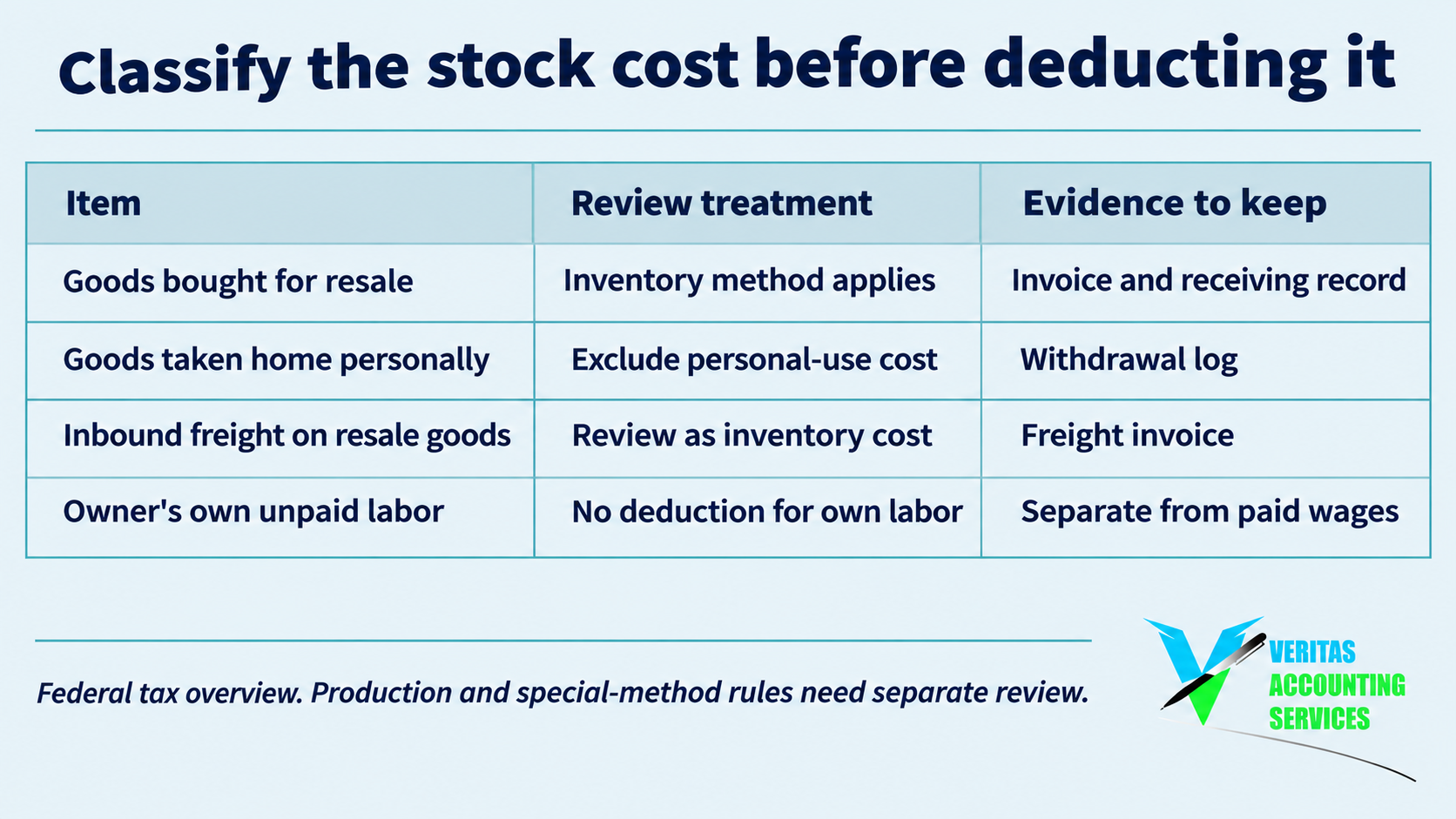
Cost of goods sold should not include a personal withdrawal of merchandise as though the goods were sold to a customer. Keep a simple log when an owner takes products for home or family use. Identify the item, date, quantity and cost so the adjustment is based on evidence.
Review supplier returns and allowances as well. A credit note can sit outside the original purchase entry and leave the stock-cost report too high. Ask the bookkeeper to explain how those credits reach the purchases total rather than assuming the payment balance will correct the calculation automatically.
3. Count the goods that belong in the calculation
To support cost of goods sold, set a clear count date and agree how movements during the count will be recorded. For example, keep a separate list of receipts and dispatches while staff count shelves. That practical control helps prevent one shipment from being included twice or omitted because it moved between locations.
Physical location alone does not settle ownership. Under the ordinary inventory rules, goods owned by the business can belong in inventory while in transit or held on consignment elsewhere. Goods belonging to another party do not become yours merely because they occupy your shelves. Check the contract and title facts when ownership is unclear.
For cost of goods sold, record quantities by a recognizable product identifier and unit. A carton and an individual unit are different measures. If one location counts cases of twelve and another records individual bottles, reconcile the units before multiplying by a cost.
List stock held at fulfillment centers, warehouses and other locations. Obtain the supporting report and reconcile transfers so the same goods are not counted twice. Mark unexplained differences for follow-up, rather than hiding them in a general adjustment that no one can reconstruct later.
4. Check cost, condition and classification separately
A stock count supports cost of goods sold by establishing how many items exist. A valuation review answers what amount belongs against them under the chosen method. Keep those two tasks distinct, with someone responsible for checking the unit costs and extending quantity times cost.
For cost of goods sold, review the treatment of freight and production costs with the preparer. Inbound freight on merchandise for resale is an inventory-cost consideration. Manufacturing can require additional labor and overhead analysis. A retailer should not copy a manufacturer’s cost schedule without understanding the difference.
The owner’s own unpaid time does not create a deductible wage cost. Likewise, using a selling price instead of the applicable inventory cost can distort the total. Our expense classification guide explains why the substance of a transaction matters more than its bank description.
Keep damaged, obsolete or slow-moving products visible on a separate exception list. A weak sales outlook is a reason to investigate valuation, rather than automatically remove the full cost from taxable income. Document the condition and ask which treatment is permitted under the business’s method before posting a tax adjustment.
5. Review changes before implementing them
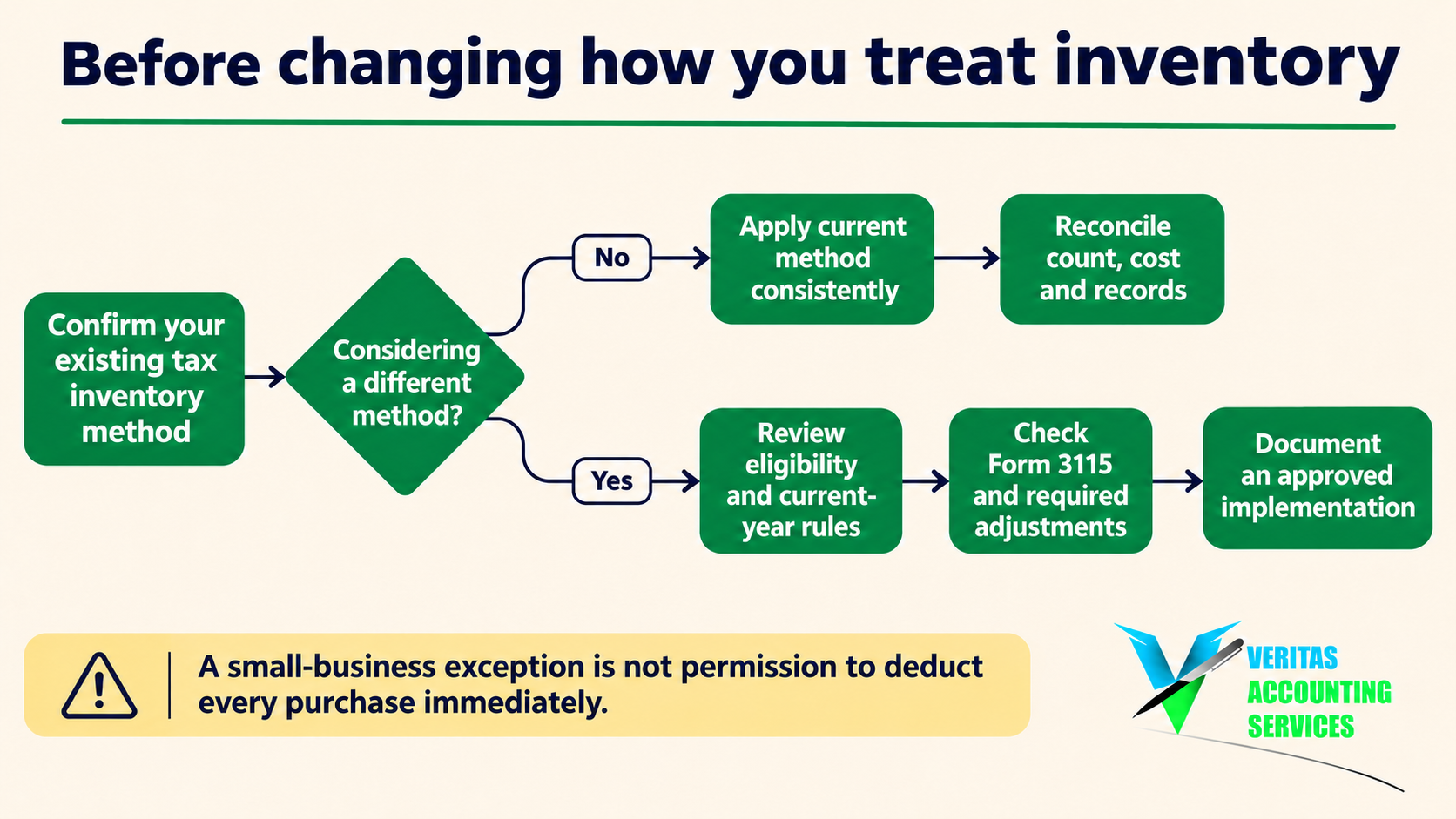
Before finalizing cost of goods sold, resist the temptation to switch methods simply to obtain a preferred tax result. A recurring treatment can be an accounting method, and changes can involve Form 3115 and adjustments. The IRS accounting-method guide explains why inventory methods require consistency and formal review.
For cost of goods sold, ask whether a proposed entry corrects a factual mistake, changes a valuation assumption or changes the tax method. Those are different questions. Label the proposed entry and retain the preparer’s reasoning before an approved adjustment is recorded.
The federal inventory regulation describes the small-business alternatives and their conditions. It also distinguishes an eligible inventory method from a simple decision to expense purchases. A method that matches eligible books and records needs its own analysis; it is not created by moving one entry at year-end.
Keep operational reporting useful even when a tax exception applies. The owner still needs to know which products exist, where they are and how much cash is tied up. Tax simplification and sensible stock control can work together without forcing the management report to be the tax calculation.
A worked retail example
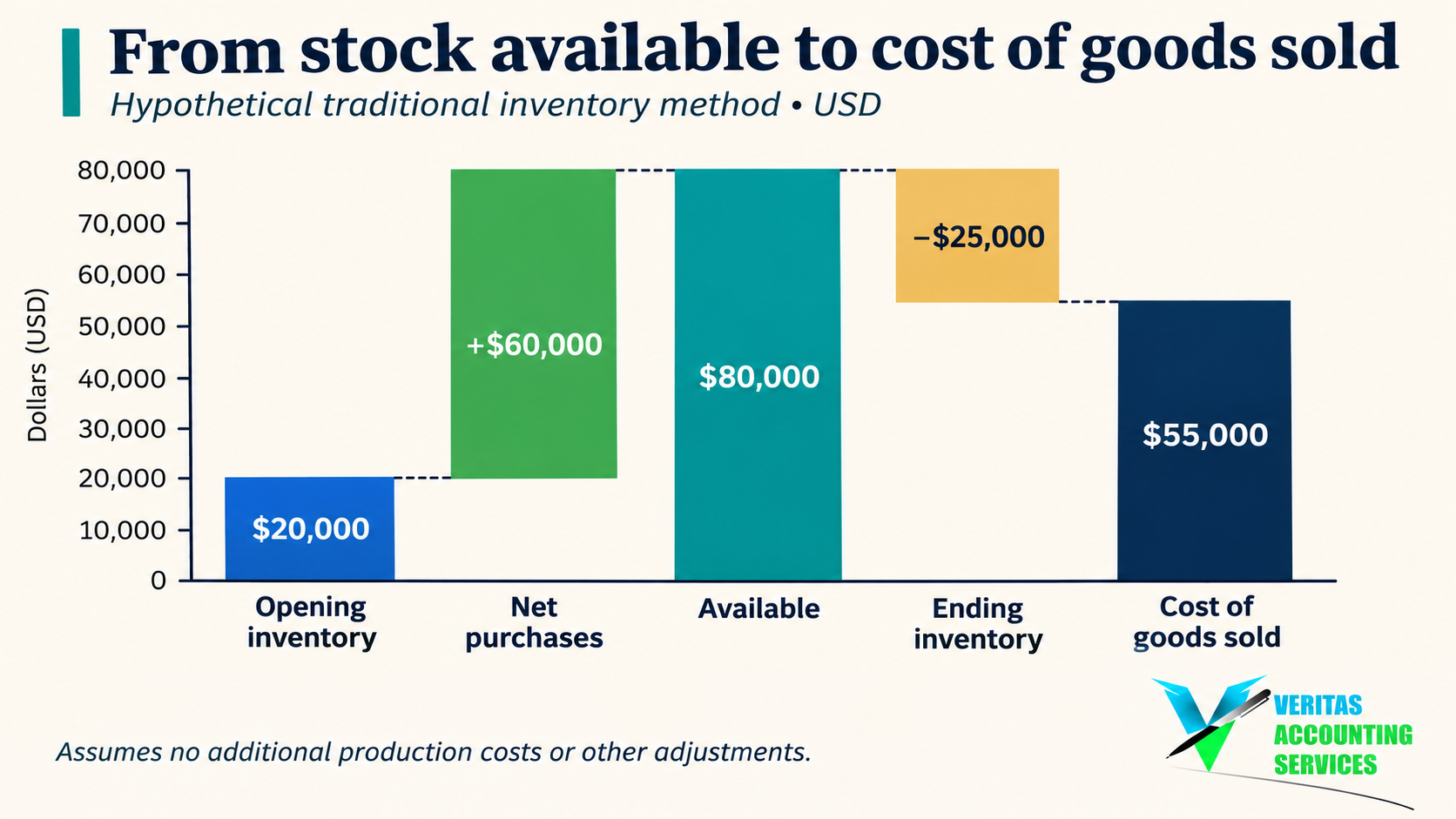
Suppose a small retailer uses a traditional inventory method and has $20,000 of opening inventory. Its net purchases of resale goods are $60,000 after the relevant purchase adjustments. A supported closing count and valuation show $25,000 remaining. Assume there are no additional production costs or other adjustments.
The cost of goods sold is $20,000 plus $60,000 less $25,000, or $55,000. The example does not calculate a tax bill. It only illustrates the product-cost calculation under the stated method, with hypothetical figures that do not describe a Veritas client.
| Component | Hypothetical amount |
|---|---|
| Opening inventory | $20,000 |
| Add net purchases | $60,000 |
| Goods available | $80,000 |
| Less closing inventory | $25,000 |
| Cost of goods sold | $55,000 |
Now suppose the closing inventory were mistakenly entered as $20,000 instead. With everything else unchanged, the calculation would produce $60,000. The $5,000 difference is a recordkeeping error, not an extra $5,000 of cash or a justified tax saving. Correcting the closing figure also protects the next year’s opening record.
Cost of goods sold must therefore be reviewed alongside the quantities and valuation evidence. A spreadsheet can add correctly while using the wrong inputs. Before approving the total, ask which document supports each component and whether the same cost was also deducted elsewhere.
Build a stock-count file someone can review
Create one folder for the count date with a short index. Include the location list, count sheets, supplier-cost support, adjustments and final reconciliation. Give files clear names so the reviewer can move from a summary amount to the underlying items without asking staff to repeat the count.
For cost of goods sold, a useful count sheet records the product code, description, location, quantity, unit of measure, applicable unit cost and extended value. Add the counter’s name, review date and explanation of unusual items. These are practical controls rather than a claim that the IRS mandates this exact template.
Keep evidence of ownership questions with the relevant goods. A warehouse report may show a location and quantity without explaining whose property the items are. Attach the purchase or consignment information needed for the preparer to resolve the question, and avoid substituting an assumption for missing records.
Link the final inventory report to the general ledger and the tax workpaper. If those totals differ, provide a bridge explaining the difference. A management report can present cost of goods sold for a different purpose; the reviewer needs to know which adjustments connect it to the return.
The IRS recordkeeping overview emphasizes records that support income, expenses and return entries. Our bookkeeping and tax records guide adds practical context for keeping the information organized. A readable evidence trail is more useful than a folder full of unnamed screenshots.
Investigate differences before posting adjustments
An inventory difference is a question to resolve, rather than a direction to post a single loss entry. Start by checking quantity units, receiving dates, duplicate product codes and movements between locations. Then review the cost assigned to the items and the accounting period involved.
For cost of goods sold, distinguish a missing supplier credit from missing physical stock. One affects the cost record; the other may involve a count problem, an unrecorded sale, damage or another event. Each explanation needs its own support and may lead to a different correction.
Keep a cost of goods sold exception register with the amount, possible reason, evidence requested, responsible person and resolution. Keep the original report and the approved revised version. That makes it possible to explain a change without reconstructing it from the final journal entry alone.
Avoid forcing cost of goods sold to produce the margin you expected. An unusual margin can prompt investigation, but it is not proof that the inventory total must be changed. Pricing, discounts, sales mix and recording differences can all be useful questions for the review.
Connect inventory decisions to cash flow
The business can spend cash on goods before the tax method permits recovery of their cost. That timing difference makes a stock purchase different from a guaranteed current deduction. Consider expected sales and funding needs before placing a large order for tax reasons.
For cost of goods sold, keep the cash forecast separate from the tax calculation. Supplier payment terms affect when money leaves the bank; product movement affects what remains available to sell. Neither report should be silently substituted for the other.
Our tax savings versus cash flow discussion explains this broader decision. A good purchasing decision should make commercial sense before any possible tax effect. Review slow-moving lines and future commitments while the count information is still current.
Questions to take to your tax preparer
When reviewing cost of goods sold, ask the preparer to confirm the inventory method, the relevant tax-year rules and the records still missing. Bring the prior closing balance, current count, purchase adjustments and unresolved ownership or valuation questions. The aim is a supported calculation, rather than a request to approve a number without context.
For cost of goods sold, ask which costs are recovered through inventory and which belong elsewhere. Confirm that personal withdrawals and duplicate deductions have been addressed. If a method change is proposed, request the implementation steps and any required filing review before the books are changed.
Agree who will supply the remaining evidence and when. A short list of open questions is easier to complete than a general request to clean up inventory. Retain the final explanation with the workpapers so next year’s opening position is understandable.
Frequently asked questions
Is cost of goods sold the same as inventory purchases?
No. Under a traditional inventory method, opening stock, closing stock and applicable purchase adjustments affect the result. Production businesses can have additional costs. Start with the method actually used rather than treating the total supplier payments as the final deduction.
Can a small business deduct all unsold stock immediately?
Not automatically. A qualifying small-business exception permits specified inventory methods, each with conditions. The nonincidental-materials alternative does not simply allow an immediate deduction when goods are bought. Check eligibility and the selected method with the preparer.
Should I value stock using its selling price?
Not just because a price tag is available. Use the valuation basis permitted under the business’s inventory method and retain cost support. A management report showing potential sales revenue serves a different purpose from a supported tax inventory figure.
Do products at a fulfillment warehouse count?
Review ownership and the applicable method. Under ordinary inventory rules, your owned goods may belong in inventory even when held elsewhere. Reconcile the warehouse report with your own locations and transfers so items are not omitted or counted twice.
What if the count reveals damaged or obsolete goods?
Document the items, quantities and condition, then review the permitted tax treatment. Slow sales alone do not establish a particular write-down. Keep the operational concern visible while the tax preparer considers the method and evidence.
Can software calculate cost of goods sold for me?
Software can calculate from its settings and recorded transactions. It cannot resolve missing goods, mixed units or an unsupported method by itself. Review inputs, exceptions and the reconciliation before accepting a report as the return figure.
Conclusion
Reliable cost of goods sold starts with the inventory method and ends with evidence someone else can follow. Connect opening balances, purchases, ownership, quantities and permitted costs before relying on the final total.
Before the next count, prepare a location list and identify who will check quantities, costs and exceptions. A clear handoff gives your bookkeeper and tax preparer a useful starting point and helps you understand the money still sitting on the shelves.
This article provides general US federal tax information reviewed November 4, 2026. It is not individualized advice. Confirm the applicable tax year, business facts and current return instructions; state requirements and financial-reporting rules can differ.
GET IN TOUCH
Schedule a FREE Call
Connect on our Socials!
