






The Shocking Truth: AI Won’t Replace Great Accountants
For decades, the accounting profession has evolved alongside technology. From spreadsheets replacing handwritten ledgers to cloud accounting transforming collaboration, every major innovation has sparked the same question: Will technology replace accountants?
Today, that question has resurfaced with artificial intelligence.
The rapid growth of AI accounting has generated excitement, curiosity, and concern in equal measure. Businesses are using AI-powered software to automate bookkeeping, process invoices, reconcile bank transactions, detect anomalies, and generate financial reports within seconds. As these tools become more sophisticated, many professionals wonder whether the role of the accountant is slowly disappearing.
The reality is very different.
AI accounting is not replacing great accountants. It is replacing repetitive work that prevents accountants from delivering their highest value. Rather than making professionals obsolete, AI is reshaping the profession by allowing accountants to spend less time processing data and more time helping businesses make smarter financial decisions.
The firms and professionals who embrace AI accounting will become more productive, more strategic, and more valuable than ever before. Those who ignore technological change may struggle—not because artificial intelligence replaced them, but because competitors learned how to combine technology with professional expertise.
The future belongs to accountants who understand both numbers and business strategy.
In this article, we’ll explore why AI accounting is transforming the profession, what artificial intelligence can genuinely do, where its limitations remain, and why experienced accountants will continue to play a critical role in business success.
Why AI Accounting Is Creating So Much Discussion
Artificial intelligence has advanced at an extraordinary pace over the past few years.
Modern accounting platforms now incorporate machine learning, predictive analytics, and automation into everyday financial processes. What once required hours of manual effort can often be completed within minutes.
This rapid progress has naturally raised concerns within the profession.
Business owners see software performing bookkeeping tasks automatically.
Accounting firms see automation reducing administrative work.
Students entering the profession hear predictions that AI accounting will eventually eliminate accounting jobs altogether.
These headlines generate attention, but they rarely explain what is actually changing.
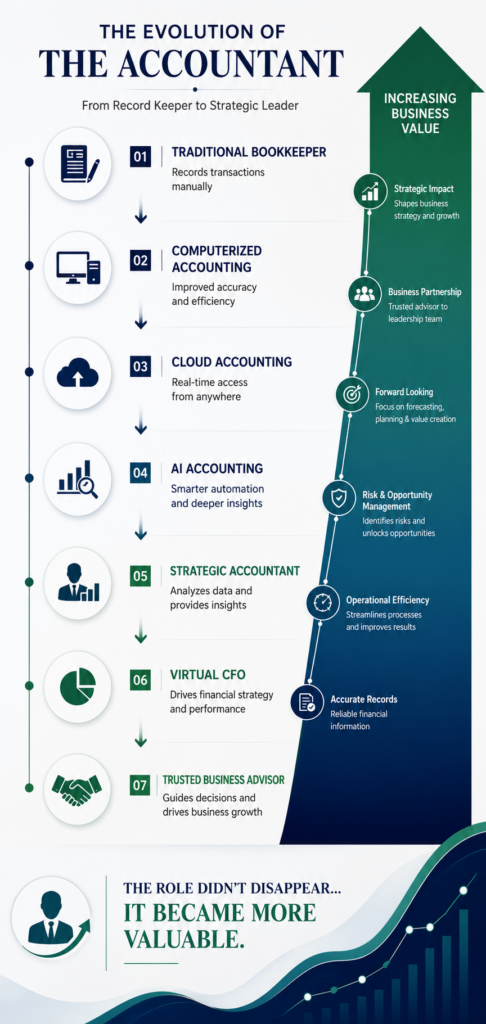
Technology has always automated routine work. Calculators replaced manual calculations. Spreadsheet software reduced paper-based bookkeeping. Cloud accounting simplified collaboration. Optical Character Recognition eliminated much of the manual data entry associated with invoices and receipts.
Each innovation changed the way accountants worked.
None of them eliminated the profession.
AI accounting represents another major step in that evolution.
Instead of replacing accountants, it changes where accountants create value.
The profession is moving away from transaction processing and toward business advisory, financial strategy, risk management, and decision support.
That shift should be viewed as an opportunity rather than a threat.

The Biggest Misconception About AI Accounting
One of the biggest misconceptions surrounding AI accounting is that accounting is simply about recording financial transactions.
In reality, bookkeeping is only one component of the profession.
Businesses don’t hire accountants merely to record expenses or prepare reports.
They rely on experienced professionals to answer questions such as:
- Why is profit increasing while cash flow is declining?
- Can the business afford to expand this year?
- Which expenses should be reduced first?
- How can tax liabilities be managed legally and efficiently?
- What financial risks should management address immediately?
These questions require judgment, commercial awareness, and practical experience.
Artificial intelligence can provide information.
It cannot fully understand a company’s long-term objectives, risk appetite, industry challenges, or the personal priorities of business owners.
That difference is significant.
Technology produces information.
Great accountants transform that information into better business decisions.
Veritas Expert Insight
AI accounting should be viewed as a productivity tool rather than a replacement for professional expertise. Businesses still need accountants who can interpret financial information, provide strategic guidance, and help leaders make informed decisions.
What AI Accounting Already Does Better Than Humans
To understand where the profession is heading, accountants must first acknowledge where artificial intelligence already excels.
Ignoring these capabilities does not protect the profession.
Understanding them does.
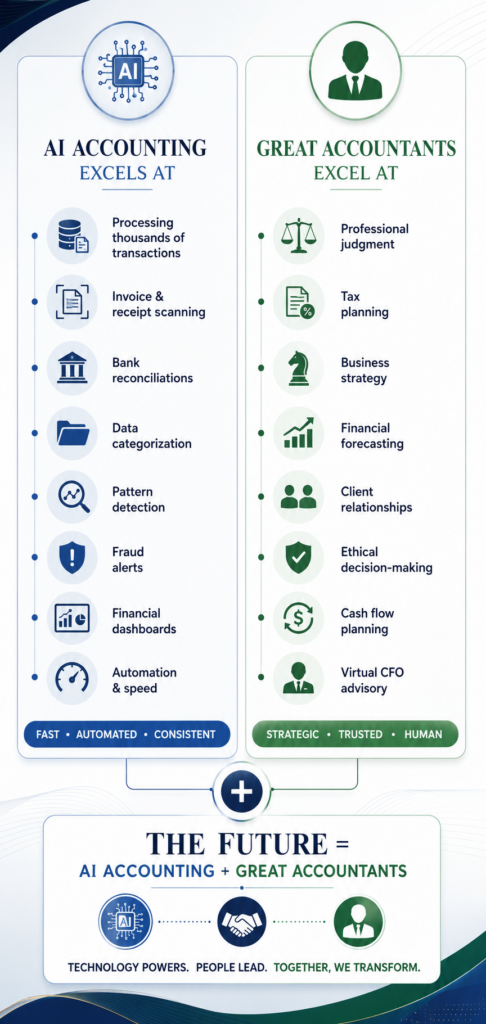
1. Transaction Processing
One of the greatest strengths of AI accounting is processing large volumes of financial transactions quickly and consistently.
Instead of manually reviewing every expense, modern systems can categorize transactions based on historical patterns, vendor information, and predefined accounting rules.
This dramatically reduces repetitive bookkeeping work while improving efficiency.
2. Invoice and Receipt Processing
AI-powered document recognition has transformed one of the most time-consuming accounting tasks.
Invoices, bills, and receipts can now be scanned automatically.
Key information—including supplier names, invoice dates, tax amounts, and payment details—is extracted within seconds.
Rather than entering data manually, accountants simply review exceptions and verify unusual transactions.
3. Bank Reconciliations
Bank reconciliations have traditionally required careful matching of deposits, withdrawals, transfers, and outstanding transactions.
AI accounting platforms can automatically match thousands of transactions using predefined rules and historical behavior.
Instead of spending hours comparing bank statements line by line, accountants can focus on investigating genuine discrepancies.
4. Identifying Patterns
Artificial intelligence is exceptionally effective at recognizing patterns hidden within large datasets.
For example, AI accounting systems can quickly identify:
- Duplicate payments
- Unusual vendor activity
- Missing invoices
- Abnormal spending trends
- Cash flow irregularities
- Potential fraud indicators
These insights help accountants investigate issues much earlier than traditional manual reviews.
5. Faster Financial Analysis
Artificial intelligence can summarize large volumes of financial information almost instantly.
Instead of manually compiling reports from multiple sources, AI accounting tools organize data, generate dashboards, and highlight significant changes automatically.
This allows accountants to spend less time preparing reports and more time discussing what the results actually mean.
The difference is important.
Preparing information is becoming increasingly automated.
Interpreting that information remains a uniquely human responsibility.
Where Artificial Intelligence Still Falls Short
Despite remarkable progress, AI accounting has clear limitations.
Technology processes information.
It does not truly understand businesses in the way experienced professionals do.
Accounting involves far more than mathematical accuracy.
Every financial decision exists within a broader commercial context.
That context often determines the correct answer.
Professional Judgment Cannot Be Automated
Accounting standards frequently require interpretation rather than simple calculations.
Two businesses may record similar transactions while requiring completely different accounting treatments because their underlying circumstances differ.
Determining the appropriate treatment requires:
- Professional skepticism
- Industry knowledge
- Regulatory understanding
- Ethical responsibility
- Commercial judgment
Artificial intelligence can recommend possible approaches.
Qualified accountants remain responsible for deciding which treatment is appropriate.
That responsibility cannot simply be delegated to software.
Business Owners Need Advice—Not Just Reports
Financial statements are valuable.
But they are only the starting point.
Most business owners are not looking for another report.
They want answers.
Questions such as:
- Should we hire more employees?
- Can we afford another location?
- Why has profitability declined?
- Are we charging enough?
- Is cash flow healthy?
- What should management prioritize next quarter?
These conversations require more than financial data.
They require someone who understands strategy, operations, and business growth.
AI accounting provides faster information.
Great accountants provide meaningful direction.
Relationships Still Matter
Trust has always been one of the accounting profession’s greatest assets.
Business owners often discuss sensitive financial matters, long-term goals, succession planning, tax concerns, funding requirements, and investment decisions with their accountant.
These conversations depend on trust, communication, confidentiality, and professional relationships developed over many years.
Artificial intelligence cannot replace that human connection.
Technology supports relationships.
It does not build them.
For decades, the accounting profession has evolved alongside technology. From spreadsheets replacing handwritten ledgers to cloud accounting transforming collaboration, every major innovation has sparked the same question: Will technology replace accountants?
Today, that question has resurfaced with artificial intelligence.
The rapid growth of AI accounting has generated excitement, curiosity, and concern in equal measure. Businesses are using AI-powered software to automate bookkeeping, process invoices, reconcile bank transactions, detect anomalies, and generate financial reports within seconds. As these tools become more sophisticated, many professionals wonder whether the role of the accountant is slowly disappearing.
The reality is very different.
AI accounting is not replacing great accountants. It is replacing repetitive work that prevents accountants from delivering their highest value. Rather than making professionals obsolete, AI is reshaping the profession by allowing accountants to spend less time processing data and more time helping businesses make smarter financial decisions.
The firms and professionals who embrace AI accounting will become more productive, more strategic, and more valuable than ever before. Those who ignore technological change may struggle—not because artificial intelligence replaced them, but because competitors learned how to combine technology with professional expertise.
The future belongs to accountants who understand both numbers and business strategy.
In this article, we’ll explore why AI accounting is transforming the profession, what artificial intelligence can genuinely do, where its limitations remain, and why experienced accountants will continue to play a critical role in business success.
Why AI Accounting Is Creating So Much Discussion
Artificial intelligence has advanced at an extraordinary pace over the past few years.
Modern accounting platforms now incorporate machine learning, predictive analytics, and automation into everyday financial processes. What once required hours of manual effort can often be completed within minutes.
This rapid progress has naturally raised concerns within the profession.
Business owners see software performing bookkeeping tasks automatically.
Accounting firms see automation reducing administrative work.
Students entering the profession hear predictions that AI accounting will eventually eliminate accounting jobs altogether.
These headlines generate attention, but they rarely explain what is actually changing.
Technology has always automated routine work. Calculators replaced manual calculations. Spreadsheet software reduced paper-based bookkeeping. Cloud accounting simplified collaboration. Optical Character Recognition eliminated much of the manual data entry associated with invoices and receipts.
Each innovation changed the way accountants worked.
None of them eliminated the profession.
AI accounting represents another major step in that evolution.
Instead of replacing accountants, it changes where accountants create value.
The profession is moving away from transaction processing and toward business advisory, financial strategy, risk management, and decision support.
That shift should be viewed as an opportunity rather than a threat.
The Biggest Misconception About AI Accounting
One of the biggest misconceptions surrounding AI accounting is that accounting is simply about recording financial transactions.
In reality, bookkeeping is only one component of the profession.
Businesses don’t hire accountants merely to record expenses or prepare reports.
They rely on experienced professionals to answer questions such as:
- Why is profit increasing while cash flow is declining?
- Can the business afford to expand this year?
- Which expenses should be reduced first?
- How can tax liabilities be managed legally and efficiently?
- What financial risks should management address immediately?
These questions require judgment, commercial awareness, and practical experience.
Artificial intelligence can provide information.
It cannot fully understand a company’s long-term objectives, risk appetite, industry challenges, or the personal priorities of business owners.
That difference is significant.
Technology produces information.
Great accountants transform that information into better business decisions.
Veritas Expert Insight
AI accounting should be viewed as a productivity tool rather than a replacement for professional expertise. Businesses still need accountants who can interpret financial information, provide strategic guidance, and help leaders make informed decisions.
What AI Accounting Already Does Better Than Humans
To understand where the profession is heading, accountants must first acknowledge where artificial intelligence already excels.
Ignoring these capabilities does not protect the profession.
Understanding them does.
1. Transaction Processing
One of the greatest strengths of AI accounting is processing large volumes of financial transactions quickly and consistently.
Instead of manually reviewing every expense, modern systems can categorize transactions based on historical patterns, vendor information, and predefined accounting rules.
This dramatically reduces repetitive bookkeeping work while improving efficiency.
2. Invoice and Receipt Processing
AI-powered document recognition has transformed one of the most time-consuming accounting tasks.
Invoices, bills, and receipts can now be scanned automatically.
Key information—including supplier names, invoice dates, tax amounts, and payment details—is extracted within seconds.
Rather than entering data manually, accountants simply review exceptions and verify unusual transactions.
3. Bank Reconciliations
Bank reconciliations have traditionally required careful matching of deposits, withdrawals, transfers, and outstanding transactions.
AI accounting platforms can automatically match thousands of transactions using predefined rules and historical behavior.
Instead of spending hours comparing bank statements line by line, accountants can focus on investigating genuine discrepancies.
4. Identifying Patterns
Artificial intelligence is exceptionally effective at recognizing patterns hidden within large datasets.
For example, AI accounting systems can quickly identify:
- Duplicate payments
- Unusual vendor activity
- Missing invoices
- Abnormal spending trends
- Cash flow irregularities
- Potential fraud indicators
These insights help accountants investigate issues much earlier than traditional manual reviews.
5. Faster Financial Analysis
Artificial intelligence can summarize large volumes of financial information almost instantly.
Instead of manually compiling reports from multiple sources, AI accounting tools organize data, generate dashboards, and highlight significant changes automatically.
This allows accountants to spend less time preparing reports and more time discussing what the results actually mean.
The difference is important.
Preparing information is becoming increasingly automated.
Interpreting that information remains a uniquely human responsibility.
Where Artificial Intelligence Still Falls Short
Despite remarkable progress, AI accounting has clear limitations.
Technology processes information.
It does not truly understand businesses in the way experienced professionals do.
Accounting involves far more than mathematical accuracy.
Every financial decision exists within a broader commercial context.
That context often determines the correct answer.
Professional Judgment Cannot Be Automated
Accounting standards frequently require interpretation rather than simple calculations.
Two businesses may record similar transactions while requiring completely different accounting treatments because their underlying circumstances differ.
Determining the appropriate treatment requires:
- Professional skepticism
- Industry knowledge
- Regulatory understanding
- Ethical responsibility
- Commercial judgment
Artificial intelligence can recommend possible approaches.
Qualified accountants remain responsible for deciding which treatment is appropriate.
That responsibility cannot simply be delegated to software.
Business Owners Need Advice—Not Just Reports
Financial statements are valuable.
But they are only the starting point.
Most business owners are not looking for another report.
They want answers.
Questions such as:
- Should we hire more employees?
- Can we afford another location?
- Why has profitability declined?
- Are we charging enough?
- Is cash flow healthy?
- What should management prioritize next quarter?
These conversations require more than financial data.
They require someone who understands strategy, operations, and business growth.
AI accounting provides faster information.
Great accountants provide meaningful direction.
Relationships Still Matter
Trust has always been one of the accounting profession’s greatest assets.
Business owners often discuss sensitive financial matters, long-term goals, succession planning, tax concerns, funding requirements, and investment decisions with their accountant.
These conversations depend on trust, communication, confidentiality, and professional relationships developed over many years.
Artificial intelligence cannot replace that human connection.
Technology supports relationships.
It does not build them.
GET IN TOUCH
Schedule a FREE Call