The Next Evolution of Business Finance: Are You Ready?
For many years, finance was viewed as a support function. Business owners expected their accountant to record transactions, prepare financial statements, reconcile bank accounts, and ensure taxes were filed correctly. While those responsibilities remain important, they no longer represent the full value that finance can bring to a growing business.
Today’s business environment is very different. Markets change quickly, customer expectations evolve, technology advances rapidly, and competition is stronger than ever. In this environment, making decisions based on outdated financial reports can mean missed opportunities, shrinking profit margins, or unexpected cash flow challenges.
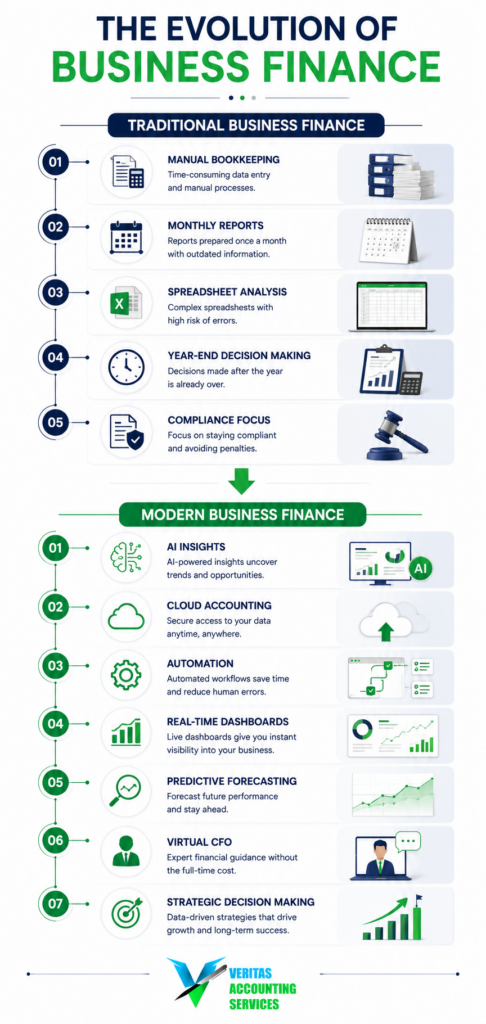
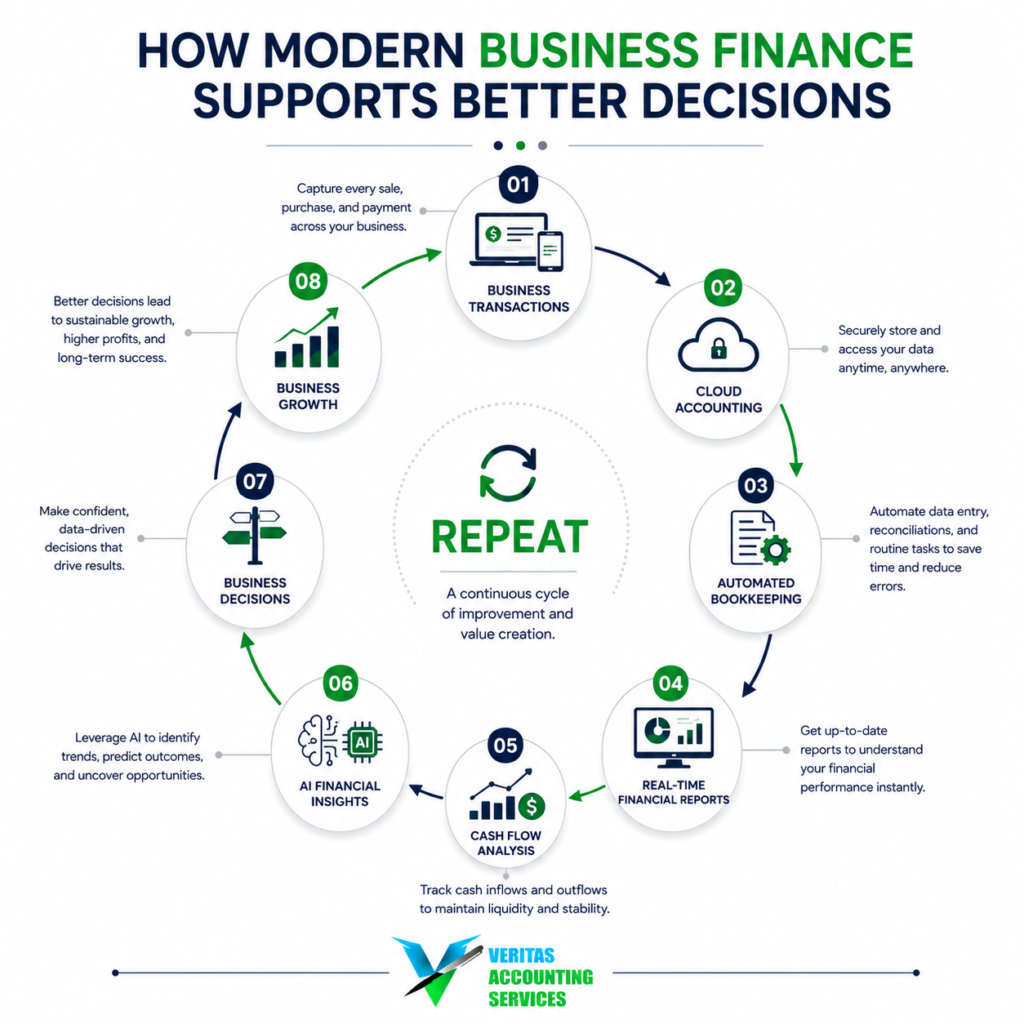
Modern business finance has moved beyond compliance. It now plays a central role in helping businesses make informed decisions, improve profitability, manage risks, and plan for sustainable growth. Rather than looking only at what happened last month, business owners are increasingly using financial information to understand what is happening today and what is likely to happen next.
Imagine running an online retail business during a busy sales season. Revenue appears strong, orders are increasing, and the business feels successful. However, advertising costs are rising faster than sales, shipping expenses have increased, and several high-value customers are delaying payments. If these issues are only identified after month-end, valuable time has already been lost.
Now imagine receiving a dashboard that highlights these trends as they develop. Instead of reacting after profits decline, you can adjust pricing, review marketing campaigns, negotiate supplier costs, or improve collection procedures before small problems become major financial challenges.
That is the direction business finance is taking.
The future is not about producing more reports. It is about producing better insights that allow business owners to act with confidence.
Business Finance Is No Longer Just About the Numbers
Successful businesses rarely fail because they lack financial reports.
More often, they struggle because they lack timely financial insight.
A Profit and Loss Statement may show that revenue increased during the year, but it doesn’t always explain why profitability declined. A Balance Sheet can show available cash, but it doesn’t reveal whether future obligations will create pressure over the coming months.
This is why business finance has become increasingly strategic.
Business owners now expect finance professionals to answer questions such as:
Which products generate the strongest margins?
Are operating expenses increasing too quickly?
Which customers contribute the highest long-term value?
Will current cash reserves support future expansion?
Where can unnecessary costs be reduced without affecting quality?
Answering these questions requires more than accurate bookkeeping.
It requires analysing trends, understanding operational performance, and translating financial information into practical business recommendations.
Finance professionals are no longer simply preparing reports. They are helping businesses interpret those reports and use them to make better decisions.
Veritas Expert Insight
One of the most common challenges we see is businesses reviewing financial statements only after month-end. Companies that monitor cash flow, profitability, and key performance indicators throughout the month often identify issues earlier and make more confident business decisions.
Smarter Decisions Begin with Better Financial Insights
Many business decisions are still based on experience and intuition.
While experience remains valuable, combining it with accurate financial information leads to better outcomes.
Consider a professional services firm deciding whether to hire additional staff.
Revenue may be increasing, but is the business generating enough consistent cash flow to support higher salaries? Will current projects continue long enough to justify the additional cost? How will the new hire affect profitability over the next twelve months?
Without reliable financial analysis, these decisions become educated guesses.
Modern business finance provides the information needed to evaluate different scenarios before committing valuable resources.
Forecasting tools can estimate future cash flow, profitability reports can identify high-performing service lines, and budgeting models can measure the financial impact of expansion plans.
Instead of relying on assumptions, management gains confidence because decisions are supported by accurate financial data.
The goal is not simply to understand where the business stands today. The goal is to understand where it is heading.
Technology Is Changing How Businesses Manage Finance
Technology has transformed almost every part of running a business, and finance is no exception.
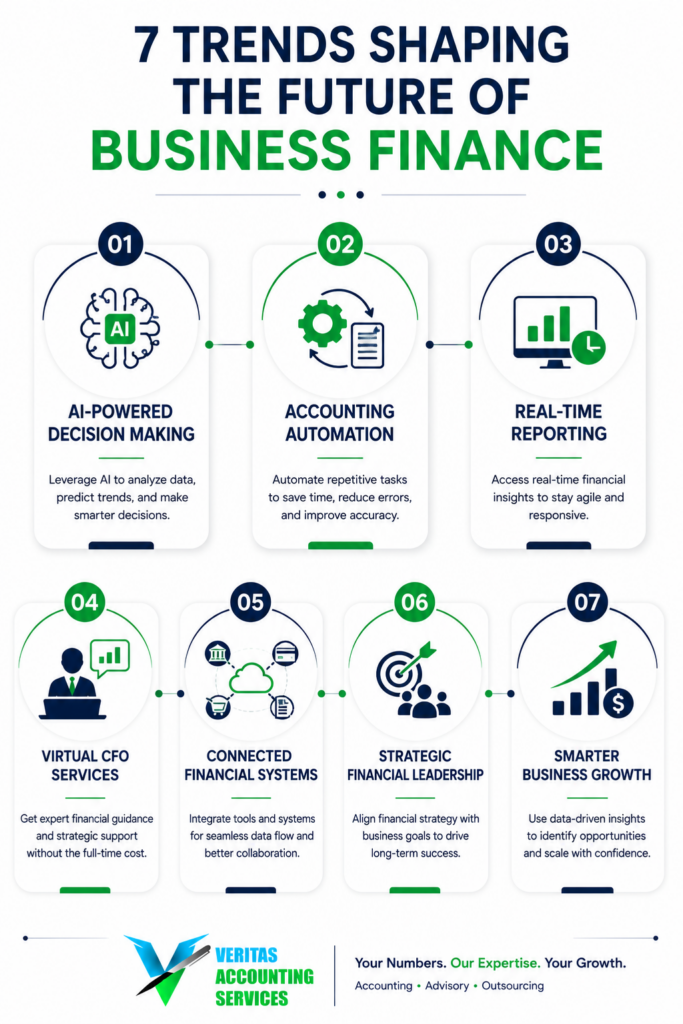
Cloud accounting platforms, artificial intelligence, automation, and integrated financial systems are changing how businesses collect, process, and analyse financial information.
Artificial intelligence, for example, can identify unusual spending patterns, detect potential cash flow issues, analyse customer payment behaviour, and highlight declining profit margins long before those trends become obvious through traditional reporting.
Instead of searching through multiple spreadsheets, business owners receive meaningful insights presented in a clear and practical way.
This allows finance teams to spend less time gathering information and more time helping management solve problems.
Technology is not replacing financial professionals.
Instead, it is strengthening business finance by improving the quality, speed, and accuracy of financial information available for decision-making.
Businesses that combine modern technology with experienced financial advisors will be far better positioned to adapt, grow, and compete in an increasingly dynamic marketplace.
Automation Creates Time for Strategic Thinking
One of the biggest challenges many finance teams face isn’t a lack of knowledge—it’s a lack of time.
Hours are often spent downloading bank statements, entering supplier invoices, matching customer payments, reconciling accounts, and correcting manual errors. While these activities are essential, they rarely contribute directly to business growth.
Automation is changing that.
Modern accounting software can import bank transactions automatically, capture receipts through mobile apps, generate recurring invoices, match payments, and perform many reconciliations with minimal manual intervention. Instead of repeating the same administrative tasks every month, finance professionals can focus on analysing results and supporting strategic decisions.
Consider a wholesale business processing hundreds of supplier invoices each month. Previously, an employee might spend several days entering invoice details manually before preparing management reports. By introducing automated invoice processing and approval workflows, those same reports can be available much earlier, giving management additional time to review performance and respond to changing business conditions.
This shift is one of the most significant developments in business finance. Automation is not simply about saving time; it is about creating time for higher-value activities such as forecasting, budgeting, profitability analysis, and financial planning.
Businesses that automate routine processes often discover another important benefit—greater consistency. Standardised workflows reduce manual errors, improve internal controls, and provide more reliable financial information for decision-making.
Real-Time Reporting Is Becoming the New Standard
Traditional financial reporting answers one important question:
“What happened?”
Modern businesses need answers to a different question:
“What is happening right now?”
Waiting until the end of the month to understand financial performance is becoming increasingly risky, particularly in industries where conditions change rapidly.
Imagine a restaurant experiencing higher sales during a holiday season. At first glance, revenue looks impressive. However, food costs have increased, labour expenses are exceeding budget, and wastage is reducing profitability.
If management discovers these issues only after month-end, the opportunity to correct them has already passed.
With real-time reporting, business owners can monitor gross profit, operating expenses, cash balances, inventory levels, and outstanding receivables every day. Instead of reacting to historical information, they can respond while there is still time to improve the outcome.
This is where business finance becomes a genuine management tool rather than an administrative requirement.
Real-time dashboards also improve communication across the organisation. Department managers, business owners, and finance teams all work from the same accurate information, making planning meetings more productive and decisions more consistent.
Veritas Expert Insight
Financial reports should never surprise business owners. If a major issue appears in the month-end reports for the first time, it usually means the business wasn’t monitoring the right performance indicators throughout the month.
Virtual CFO Services Are Redefining Financial Leadership
As businesses grow, financial decisions become more complex.
Questions about expansion, financing, pricing, staffing, and investment require more than accurate bookkeeping. They require experienced financial leadership.
Many small and medium-sized businesses cannot justify employing a full-time Chief Financial Officer, yet they still need strategic financial guidance.
This is why Virtual CFO services have become an increasingly valuable part of modern business finance.
A Virtual CFO works alongside business owners to develop budgets, forecast cash flow, monitor key performance indicators, evaluate profitability, and support long-term planning. Instead of reviewing financial statements only after they have been prepared, they help management understand what those reports mean and what actions should follow.
For example, imagine two businesses generating similar annual revenue.
The first reviews financial statements once a quarter.
The second holds monthly strategy meetings with a Virtual CFO, reviews budgets against actual performance, analyses cash flow forecasts, and evaluates business risks regularly.
Although both businesses have access to the same accounting information, the second business is far more likely to make proactive decisions, identify opportunities earlier, and maintain stronger financial stability.
The future of business finance is not simply about having more information. It is about using that information effectively.
Preparing Your Business for the Future
The future of finance is already here, but adopting every new technology immediately is neither practical nor necessary.
Instead, businesses should focus on building a strong financial foundation that supports continuous improvement.
Start by ensuring bookkeeping records are accurate and up to date. Reliable financial information is the foundation of every good decision.
Next, identify repetitive accounting tasks that can be automated. Even small improvements in efficiency can free valuable time for financial analysis and planning.
Review key performance indicators regularly rather than relying solely on annual financial statements. Monitor cash flow, profitability, operating expenses, and customer payment trends throughout the year.
Finally, seek financial advice before making significant business decisions rather than after problems arise.
The businesses that achieve sustainable growth are rarely those with the most complex financial systems.
They are the ones that consistently use financial information to guide everyday decisions.
That is the true purpose of modern business finance.
Final Thoughts
The role of finance is changing faster than ever before.
Technology, automation, artificial intelligence, and cloud-based systems are transforming how businesses collect and analyse financial information. At the same time, business owners increasingly expect finance professionals to provide practical advice that supports growth rather than simply preparing reports for compliance.
The future of business finance belongs to organisations that combine modern technology with experienced financial expertise.
Businesses that invest in better reporting, stronger financial processes, and strategic decision-making will be better positioned to improve profitability, strengthen cash flow, manage risk, and adapt to future challenges.
Finance should never be viewed as a function that simply records the past.
It should become one of the most valuable tools for shaping the future of your business.
Frequently Asked Questions
What is business finance?
Business finance is the process of managing a company’s financial resources, including budgeting, cash flow management, financial reporting, forecasting, investment decisions, and strategic planning to achieve long-term growth.
Why is business finance becoming more important?
Business finance now plays a strategic role by helping owners make informed decisions, improve profitability, manage risks, and prepare for future opportunities rather than simply meeting compliance requirements.
How does automation improve business finance?
Automation reduces manual data entry, speeds up reconciliations, improves reporting accuracy, and allows finance professionals to focus on analysis and strategic planning with Business finance instead of repetitive administrative work.
What are the benefits of a Virtual CFO?
A Virtual CFO provides expert Business finance – financial leadership through budgeting, forecasting, cash flow management, profitability analysis, and strategic guidance without the cost of employing a full-time Chief Financial Officer.
How can businesses prepare for the future of finance?
Businesses should maintain accurate bookkeeping, adopt cloud accounting, automate routine processes, monitor key performance indicators regularly, and use financial insights to support everyday decision-making.
Ready to Transform Your Business Finance?
At Veritas Accounting Services, we help businesses move beyond traditional bookkeeping by providing financial reporting, management insights, budgeting, cash flow forecasting, and Virtual CFO services that support confident decision-making.
Whether you’re a startup, an established SME, or a growing e-commerce business, our experienced team can help you build a stronger financial foundation and prepare for future growth.