






Revenue Isn’t Everything. Here’s What Really Matters.
For many business owners, revenue is the first number they look at when evaluating business performance.
Sales reports show increasing revenue. Monthly dashboards highlight record-breaking sales. Teams celebrate crossing new revenue milestones.
While these achievements are exciting, they don’t necessarily mean the business is becoming stronger.
Many businesses generate millions of dollars in revenue yet struggle to pay suppliers, delay payroll, or rely on short-term borrowing to fund daily operations. At the same time, some businesses with lower revenue consistently generate healthy profits, maintain strong cash reserves, and continue growing year after year.
The difference lies in what they measure.
Successful businesses understand that revenue is only one financial metric. To understand the true health of a business, owners must also monitor profitability, liquidity, operational efficiency, and cash flow management.
Without effective cash flow management, even a business experiencing rapid sales growth can face financial difficulties.
This is why experienced entrepreneurs, investors, and Virtual CFOs rarely judge a business solely by its revenue. They look deeper into the numbers that reveal whether the business is financially stable and capable of sustainable growth.
In this article, you’ll discover why revenue doesn’t tell the whole story and learn which financial metrics deserve your attention if you want to build a stronger, more profitable business.
Why Revenue Doesn’t Tell the Whole Story
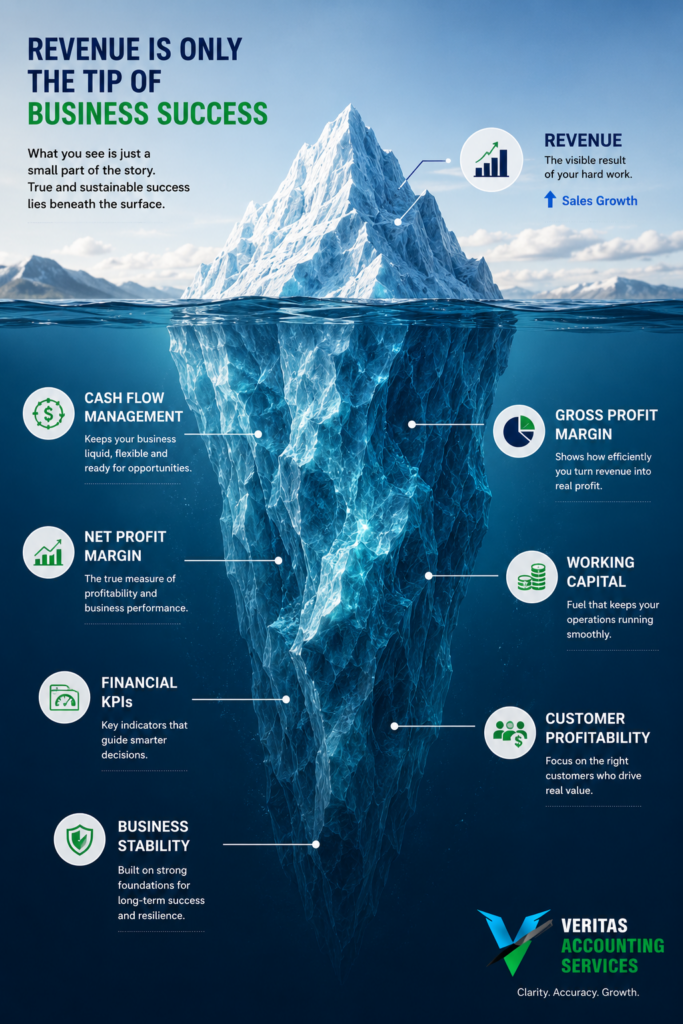
Revenue represents the total income generated from selling products or services before deducting expenses.
Although it’s an important indicator of market demand and business activity, revenue alone cannot answer several critical questions.
For example:
- Is the business generating consistent profits?
- Can it comfortably pay employees and suppliers?
- Is there enough cash available to cover daily operations?
- Are customers paying invoices on time?
- Is the business prepared for unexpected expenses?
The answers to these questions come from analyzing financial performance beyond revenue.
This is where cash flow management becomes essential.
A business can report exceptional sales while simultaneously experiencing cash shortages because revenue and cash are not the same thing.
Imagine two companies, each generating $2 million in annual revenue.
Company A
- Revenue: $2 million
- Positive operating cash flow
- Healthy profit margins
- Strong working capital
- No overdue supplier payments
- Consistent cash reserves
Company B
- Revenue: $2 million
- Negative operating cash flow
- Declining profit margins
- Frequent cash shortages
- Overdue vendor balances
- Dependence on short-term financing
On paper, both businesses appear equally successful because they generate identical revenue.
In reality, Company A has the financial strength to grow confidently, while Company B spends most of its time managing financial pressure.
The difference isn’t sales—it’s effective cash flow management and sound financial decision-making.
Looking beyond revenue enables business owners to identify potential risks before they become serious problems.
Veritas Expert Insight
Revenue tells you how much business you’re generating. Cash flow management tells you whether your business can survive, grow, and invest confidently in the future.
Cash Flow Is the Foundation of a Healthy Business
Every business depends on cash.
Employees expect salaries on time. Suppliers need to be paid. Taxes must be settled. Rent, utilities, insurance, inventory, and operating expenses continue regardless of how much revenue appears on the income statement.
That’s why cash flow management is often described as the lifeblood of a business.
Simply put, cash flow management involves monitoring, planning, and controlling how money moves into and out of your business.
When managed effectively, it helps ensure there is always enough cash available to meet financial obligations while supporting future growth.
Consider a consulting firm that completes a large project worth $300,000.
The invoice is issued immediately, and the revenue is recorded in the financial statements.
However, the client has 90-day payment terms.
For the next three months, the consulting firm must continue paying employee salaries, office rent, software subscriptions, insurance, and other operating expenses—even though the cash hasn’t yet arrived.
Without strong cash flow management, profitable businesses can still experience financial stress simply because cash is delayed.
This situation is more common than many business owners realize.
Businesses that prioritize cash flow management are better positioned to:
- Pay suppliers without delays.
- Meet payroll confidently.
- Build emergency cash reserves.
- Reduce reliance on loans and overdrafts.
- Invest in expansion opportunities.
- Navigate seasonal fluctuations.
Rather than reacting to financial challenges, these businesses anticipate them and plan accordingly.
Early Warning Signs of Poor Cash Flow
Cash flow problems rarely appear overnight.
Most businesses receive warning signs long before a financial crisis develops.
Some common indicators include:
- Consistently delaying supplier payments.
- Frequently using credit cards to cover expenses.
- Relying on overdraft facilities every month.
- Struggling to pay taxes on time.
- Increasing customer outstanding balances.
- Limited cash despite growing sales.
- Difficulty funding day-to-day operations.
Recognizing these warning signs early allows businesses to improve cash flow management before small issues become expensive problems.
Regular cash flow forecasting and monthly financial reviews help identify these risks well in advance.
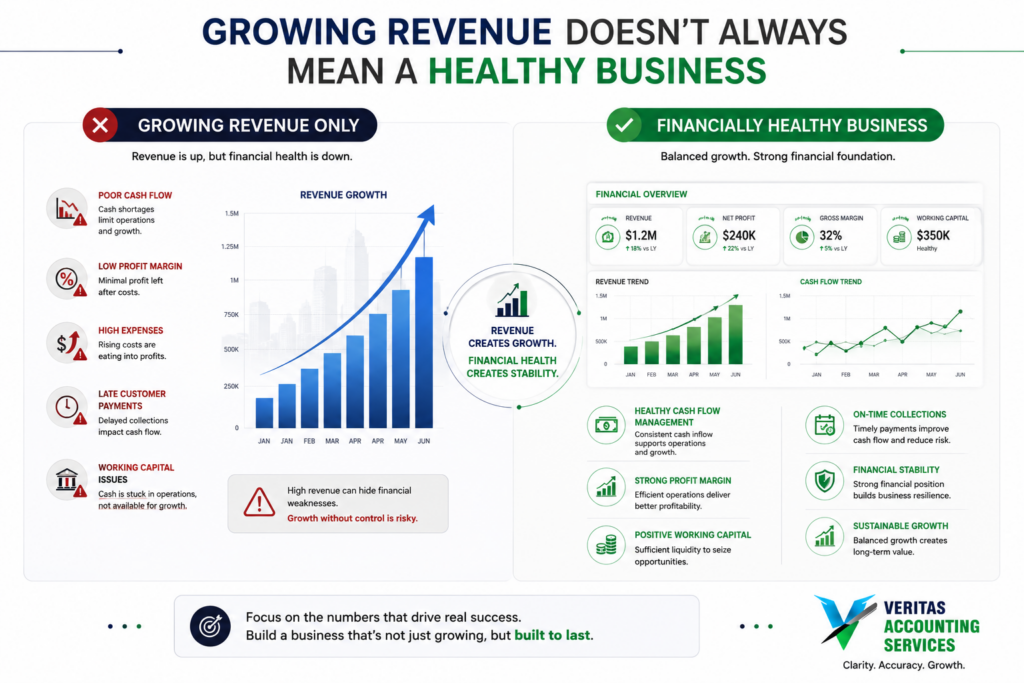
Revenue Growth Doesn’t Always Mean Financial Growth
One of the biggest misconceptions in business is believing that increasing revenue automatically leads to greater financial success.
Unfortunately, this isn’t always true.
As revenue grows, expenses often grow as well.
Businesses may hire additional employees, lease larger office space, purchase more inventory, increase marketing budgets, or invest in new technology.
If these additional costs increase faster than profits, revenue growth may actually reduce financial stability.
Similarly, businesses that offer extended credit terms may record higher sales while waiting months to receive customer payments.
Without proper cash flow management, rapid business growth can create cash shortages instead of financial strength.
This is why many successful companies focus on sustainable growth rather than simply chasing higher revenue.
Healthy growth balances increasing sales with profitability, liquidity, and effective cash flow management.
Gross Profit Margin Reveals Operational Efficiency
Revenue tells you how much your business sells.
Gross profit margin tells you how efficiently your business earns those sales.
Gross profit is the amount remaining after deducting direct costs such as inventory, raw materials, manufacturing costs, or direct labor.
A strong gross profit margin indicates that pricing strategies, supplier negotiations, and operational efficiency are working together effectively.
For example, two companies may each generate $1 million in annual revenue.
However:
- Business A: Gross Profit Margin – 58%
- Business B: Gross Profit Margin – 31%
Although their revenue is identical, Business A retains significantly more money to cover operating expenses, strengthen cash flow management, invest in growth, and improve profitability.
Monitoring gross profit margin regularly helps business owners identify:
- Rising supplier costs.
- Pricing issues.
- Production inefficiencies.
- Inventory challenges.
- Declining profitability.
When analyzed alongside cash flow management, gross profit margin provides a much clearer picture of financial performance than revenue alone.
Net Profit Margin Shows What You Actually Keep
Revenue measures the money coming into your business.
Net profit measures the money that actually stays in your business after paying operating expenses, salaries, rent, marketing costs, taxes, interest, and other business expenses.
This is one of the most important indicators of long-term financial success.
Many businesses proudly report increasing revenue while overlooking shrinking profit margins.
Common reasons include:
- Rising operating expenses.
- Poor pricing decisions.
- Excessive overhead costs.
- Inefficient business processes.
- Uncontrolled discretionary spending.
A business generating $3 million in annual revenue with a 3% net profit margin earns less than another business generating $1.5 million in revenue with a 12% net profit margin.
This demonstrates why profitability should always be reviewed together with cash flow management.
Strong profits improve financial stability, while effective cash flow management ensures those profits are available to support future growth, business investments, and unexpected challenges.
Working Capital Is Your Financial Safety Net
Revenue may show how much your business sells, but working capital determines whether your business can continue operating without interruption.
Working capital is the difference between current assets and current liabilities. It measures your ability to meet short-term financial obligations using the resources you already have.
Think of working capital as the financial cushion that keeps your business running smoothly.
Businesses with healthy working capital can:
- Pay suppliers on time.
- Meet payroll without stress.
- Purchase inventory when demand increases.
- Take advantage of new business opportunities.
- Handle unexpected expenses with confidence.
On the other hand, businesses with weak working capital often delay vendor payments, rely on overdrafts, or postpone important investments—even when revenue continues to grow.
This is why working capital and cash flow management should always be reviewed together. Strong sales may attract attention, but strong liquidity keeps the business operating.
Business owners should review their working capital every month to ensure they have enough financial flexibility to support both daily operations and future growth.
Accounts Receivable Can Strengthen or Weaken Your Cash Flow
Making a sale is only the first step.
Receiving payment is what keeps your business financially healthy.
Many businesses proudly report increasing revenue while waiting 60, 90, or even 120 days for customers to pay their invoices. During that waiting period, operating expenses continue to accumulate.
Imagine your business generates $250,000 in monthly revenue.
If customers consistently pay after 90 days, you still need enough cash to cover:
- Employee salaries
- Rent and utilities
- Inventory purchases
- Software subscriptions
- Marketing expenses
- Taxes
- Supplier payments
Without proper cash flow management, delayed collections can create unnecessary financial pressure—even when revenue continues to increase.
To improve collections, businesses should:
- Send invoices immediately.
- Clearly communicate payment terms.
- Review Accounts Receivable aging reports every month.
- Follow up on overdue invoices consistently.
- Offer convenient payment options.
Improving collection times by even two weeks can significantly strengthen cash flow management without generating a single additional sale.
Veritas Expert Insight
The easiest way to improve cash flow isn’t always increasing revenue. Often, it’s collecting existing invoices faster and improving your overall cash flow management process.
Not Every Customer Is Profitable
Many business owners focus on acquiring more customers.
Successful businesses focus on acquiring better customers.
Two customers may generate the same revenue, yet deliver completely different financial results.
For example:
Customer A
- Pays invoices within 15 days.
- Places repeat orders.
- Requires minimal support.
- Accepts standard pricing.
Customer B
- Frequently requests discounts.
- Pays invoices late.
- Requires significant administrative support.
- Generates numerous service requests.
Although both customers contribute to revenue, Customer A contributes much more to profitability and cash flow management.
Understanding customer profitability helps businesses:
- Focus on high-value relationships.
- Improve pricing decisions.
- Eliminate low-margin work.
- Allocate resources more effectively.
- Strengthen long-term profitability.
Growing revenue is important, but growing profitable revenue creates a healthier and more sustainable business.
Financial KPIs Every Business Owner Should Monitor
Revenue is only one financial metric.
To understand the complete financial picture, business owners should monitor several key performance indicators every month.
| Financial KPI | Why It Matters |
|---|---|
| Cash Flow | Ensures enough cash is available to operate and grow the business. |
| Gross Profit Margin | Measures pricing effectiveness and direct cost control. |
| Net Profit Margin | Shows how much profit the business actually keeps. |
| Working Capital | Indicates short-term financial stability. |
| Accounts Receivable Days | Measures how quickly customers pay invoices. |
| Operating Expenses | Helps identify unnecessary spending. |
| Customer Profitability | Identifies the customers that generate the greatest long-term value. |
Reviewing these KPIs together provides a complete picture of business performance.
Rather than reacting to financial problems after they occur, business owners can identify trends early and make informed decisions that strengthen profitability and cash flow management.

Why Every Growing Business Needs a Virtual CFO
As businesses grow, financial decisions become more complex.
Questions such as:
- Can we afford to hire more employees?
- Should we expand into a new market?
- Is our pricing strategy profitable?
- Do we have enough cash for future investments?
cannot be answered by looking at revenue alone.
This is where a Virtual CFO provides significant value.
A Virtual CFO transforms financial reports into strategic business insights by helping owners:
- Improve cash flow management.
- Develop realistic budgets.
- Forecast future cash requirements.
- Monitor financial KPIs.
- Improve profitability.
- Optimize working capital.
- Identify financial risks before they become major problems.
Instead of making decisions based on assumptions, business owners gain confidence by using reliable financial data.
A Virtual CFO doesn’t simply explain what happened last month—they help you prepare for what comes next.
Final Thoughts
Revenue is an important indicator of business growth, but it should never be the only measure of success.
The businesses that thrive over the long term focus on much more than sales. They monitor profitability, working capital, customer collections, operating efficiency, and cash flow management to understand the true financial health of their organization.
When business owners shift their attention from revenue alone to the financial metrics that drive long-term stability, they make better decisions, reduce financial risk, and create stronger foundations for sustainable growth.
At Veritas Accounting Services, we help businesses gain that financial clarity through accurate bookkeeping, cash flow management, management reporting, and Virtual CFO services. Our goal is to help business owners understand their numbers, improve profitability, and make confident financial decisions.
Frequently Asked Questions
Why isn’t revenue enough to measure business success?
Revenue measures sales, but it doesn’t show whether the business is profitable, financially stable, or generating enough cash to meet its obligations. Reviewing profitability, working capital, and cash flow management provides a much clearer picture.
Why is cash flow management important?
Cash flow management helps ensure your business always has enough cash to pay employees, suppliers, taxes, and operating expenses while supporting future growth.
What financial KPI should business owners monitor every month?
Every business should regularly review revenue, cash flow, gross profit margin, net profit margin, working capital, accounts receivable, and operating expenses.
Can a profitable business still run out of cash?
Yes. A business can report strong profits while experiencing cash shortages if customers delay payments or operating expenses exceed available cash. Effective cash flow management helps prevent these situations.
What does a Virtual CFO do?
A Virtual CFO helps businesses improve financial performance by providing budgeting, forecasting, KPI analysis, strategic planning, and cash flow management support.
Ready to Look Beyond Revenue?
Revenue may tell you how fast your business is growing, but the right financial metrics tell you how strong your business really is.
At Veritas Accounting Services, we help businesses strengthen cash flow management, improve financial reporting, monitor key performance indicators, and make informed decisions through our bookkeeping and Virtual CFO services.
If you’re ready to build a financially stronger business, contact Veritas Accounting Services today and discover how better financial insights can drive long-term success.
GET IN TOUCH
Schedule a FREE Call