


📩 Get A Quote : hello@veritasaccountingservices.com
multi-currency accounting

Managing Multiple Currencies? The Ultimate Guide to E-Commerce Accounting

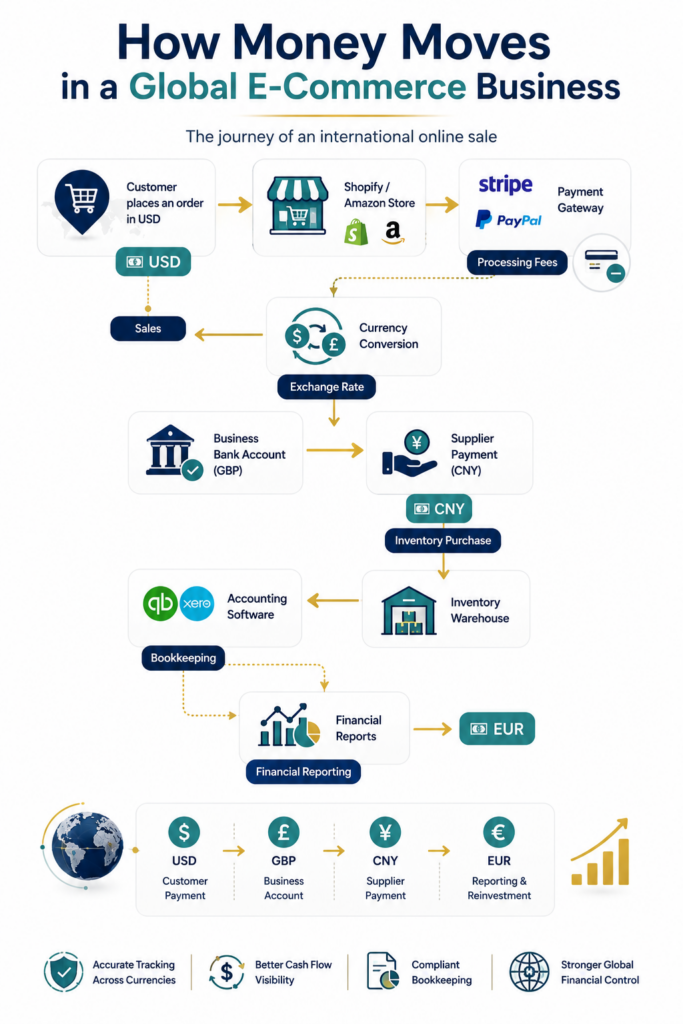
Selling products internationally has never been easier. Platforms like Shopify, Amazon, Etsy, and WooCommerce allow businesses to reach customers across the world with just a few clicks. While global expansion opens new revenue opportunities, it also introduces a significant accounting challenge—multi-currency accounting.

An online store may sell products in US dollars, receive payouts in British pounds, purchase inventory from China in Chinese yuan, pay software subscriptions in euros, and settle supplier invoices through Wise or PayPal. Every one of these transactions involves exchange rates that directly affect your financial records.

Many e-commerce businesses focus on increasing sales but overlook how foreign currency transactions influence revenue, expenses, profits, and tax reporting. As a result, financial statements become inaccurate, reconciliations take longer, and year-end tax preparation becomes far more complicated than it needs to be.

Understanding multi-currency accounting is essential for any business selling internationally. With the right systems and bookkeeping processes, businesses can maintain accurate financial records, make better decisions, and stay compliant with accounting and tax requirements.


Why Multi-Currency Accounting Matters
Multi-Currency Accounting

Traditional bookkeeping assumes that all transactions occur in a single currency. That assumption no longer applies to modern e-commerce businesses.

Today’s online sellers often:

  • Sell products in multiple countries.
  • Receive payments in different currencies.
  • Purchase inventory from overseas suppliers.
  • Pay international contractors.
  • Maintain foreign currency bank accounts.

Without proper multi-currency accounting, these transactions may be recorded incorrectly, resulting in inaccurate profit calculations and misleading financial reports.

For example, if your business purchases inventory in USD but your accounting records are maintained in GBP, the value of that inventory changes as exchange rates fluctuate. Recording the transaction using the wrong exchange rate can distort both inventory values and cost of goods sold.


How Global Sales Affect Your Accounting

International sales involve much more than currency conversion.

Every transaction affects:

Revenue Recognition

Revenue should be recorded using the applicable exchange rate on the transaction date rather than the payout date. This ensures that financial statements reflect the true value of sales when they occurred.

Customer Payments

Payment processors often receive customer payments in one currency before converting them into another. During this process, processing fees and exchange rate adjustments reduce the final amount deposited into your bank account.

Supplier Payments

If suppliers invoice you in a foreign currency, exchange rate movements between the invoice date and payment date may create additional accounting entries.

Financial Reporting

Balance Sheets and Profit & Loss Statements should consistently reflect your business’s reporting currency while accurately capturing foreign currency activity.

These differences highlight why multi-currency accounting requires more than simply converting one currency into another.


Recording Foreign Currency Transactions Correctly

One of the most common bookkeeping mistakes is recording transactions using bank deposit amounts rather than the original transaction values.

Instead, businesses should follow a structured process:

Record the Original Transaction

Sales, purchases, and invoices should first be recorded in the original transaction currency.

Apply the Correct Exchange Rate

The transaction should then be converted into the business’s reporting currency using the exchange rate applicable on the transaction date.

Record Settlement Differences

If payment occurs on a later date and exchange rates have changed, the difference should be recorded separately as a foreign exchange gain or loss rather than adjusting the original transaction.

Following this approach keeps financial reports accurate and provides a clear audit trail.


Exchange Rate Gains and Losses Explained
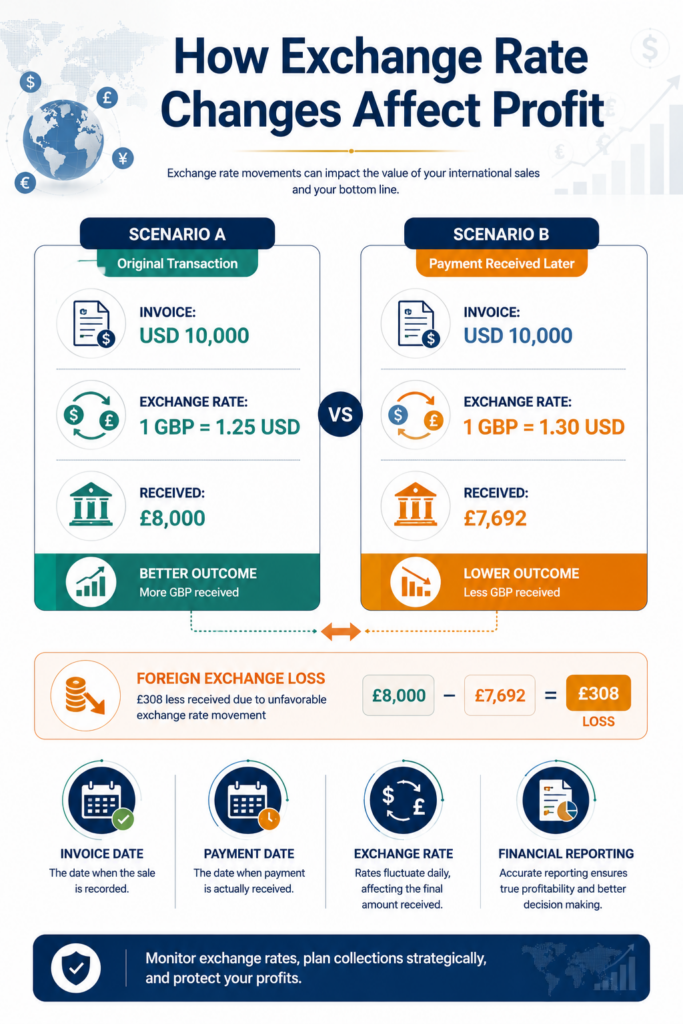
Exchange rates change every day.

These fluctuations create gains or losses whenever a transaction remains outstanding between the invoice date and payment date.

For example:

A UK-based business invoices a US customer for $10,000.

The invoice is recorded when:

  • £1 = $1.25

The customer pays two weeks later when:

  • £1 = $1.30

Although the customer pays the same number of dollars, the amount received in pounds differs because the exchange rate changed.

This difference is known as a foreign exchange gain or loss.

Businesses that ignore these adjustments often produce inaccurate financial statements and incorrect taxable income calculations.

Understanding exchange gains and losses is therefore a key component of effective multi-currency accounting.


Why Payment Processor Reports Never Match Bank Deposits

Many e-commerce business owners become concerned when Shopify, Stripe, Amazon, or PayPal reports do not match their bank deposits.

In reality, this is completely normal.

A single payout may include:

  • Customer sales
  • Shipping income
  • Sales tax collected
  • Platform commissions
  • Payment processing fees
  • Refunds
  • Chargebacks
  • Currency conversion adjustments
  • Reserve balances

Recording only the final deposit amount results in incomplete bookkeeping.

Instead, accountants should reconcile each payout against the platform’s settlement report and record every component separately.

This approach not only improves reporting accuracy but also simplifies month-end reconciliations and tax preparation.


Managing Inventory Purchased in Foreign Currencies

Inventory is often purchased in one currency and sold in another.

For example:

  • Products sourced from China may be invoiced in CNY.
  • Freight charges may be billed in USD.
  • Customs duties may be paid in GBP.
  • Sales may occur in EUR or AUD.

Each cost component contributes to the final inventory value.

Ignoring exchange rate differences during inventory purchases can understate or overstate the true cost of goods sold, directly affecting gross profit.

As businesses grow internationally, inventory accounting becomes one of the most important areas of multi-currency accounting.
Multi-Currency Accounting in QuickBooks and Xero

Modern cloud accounting software has made multi-currency accounting much easier than it was a few years ago. However, simply enabling the feature does not guarantee accurate financial reporting.

Both QuickBooks Online and Xero allow businesses to:

  • Create customer invoices in foreign currencies.
  • Record supplier bills in multiple currencies.
  • Maintain foreign currency bank accounts.
  • Track exchange rate movements.
  • Calculate foreign exchange gains and losses automatically.

These features reduce manual work, but they still require proper bookkeeping practices.

For example, exchange rates should be reviewed regularly, reconciliations should be completed monthly, and foreign currency transactions should be verified against supporting documents. Without proper oversight, automated systems can still produce inaccurate financial reports.

Software is a powerful tool, but professional review remains essential for reliable multi-currency accounting.


Common Mu


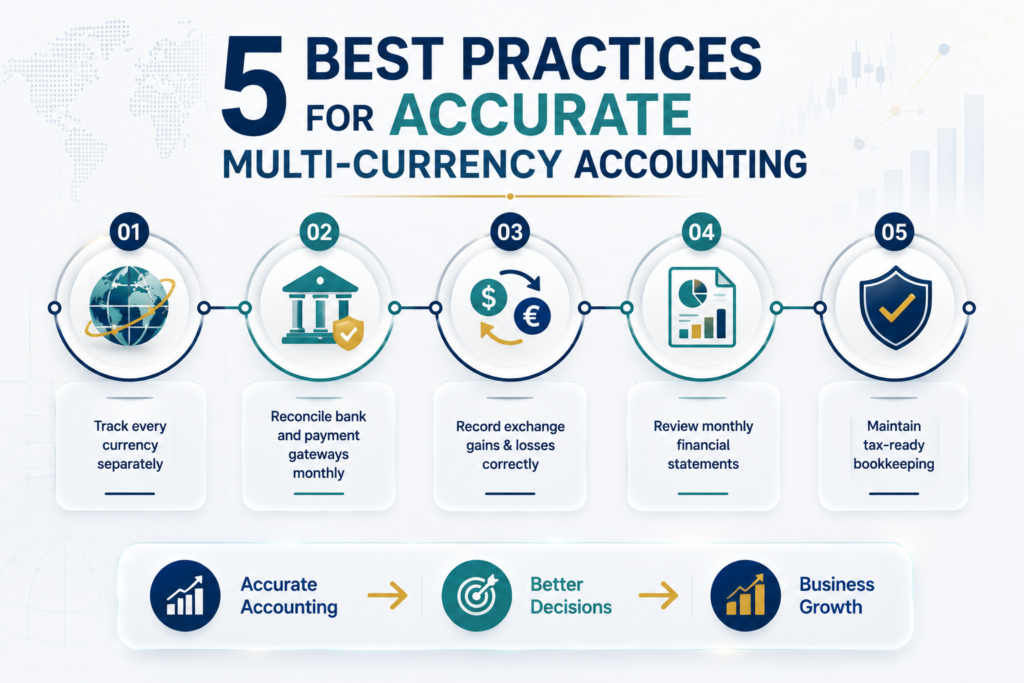
Best Practices for Multi-Currency Accounting
multi-currency accounting

Businesses selling internationally can simplify their accounting by following a few practical principles.

Maintain One Base Currency

Choose a single reporting currency for financial statements and use it consistently across your accounting system.


Separate Foreign Currency Accounts

Maintain dedicated bank or payment processor accounts for each currency whenever practical.

This makes reconciliations significantly easier.


Reconcile Every Sales Channel

If you sell through multiple platforms, reconcile each one separately.

This includes:

  • Shopify
  • Amazon
  • Etsy
  • Walmart Marketplace
  • WooCommerce
  • Stripe
  • PayPal
  • Wise

Accurate reconciliation prevents duplicated or omitted transactions.


Monitor Exchange Rate Impacts

Exchange rates affect more than international payments.

They influence:

  • Inventory costs
  • Gross margins
  • Cash flow
  • Profitability
  • Financial reporting

Review exchange gains and losses regularly rather than waiting until year-end.


Review Financial Reports Monthly

Monthly reporting allows business owners to identify unusual trends before they become costly problems.

Key reports include:

  • Profit & Loss Statement
  • Balance Sheet
  • Cash Flow Statement
  • Accounts Receivable Aging
  • Inventory Reports

Reliable financial reports lead to better business decisions.


Why Professional Bookkeeping Matters

Technology has made international selling easier, but it has also increased financial complexity.

Professional bookkeeping helps businesses:

  • Maintain accurate records.
  • Reconcile multiple sales channels.
  • Track inventory correctly.
  • Manage exchange gains and losses.
  • Prepare tax-ready financial statements.
  • Support informed business decisions.

For growing e-commerce businesses, accurate multi-currency accounting is no longer optional—it is an essential part of sustainable growth.


Frequently Asked Questions

What is multi-currency accounting?

Multi-currency accounting is the process of recording, managing, and reporting financial transactions that occur in more than one currency while maintaining accurate financial statements in a single reporting currency.


Why is multi-currency accounting important for e-commerce businesses?

Online sellers often receive payments, purchase inventory, and pay suppliers in different currencies. Proper accounting ensures accurate financial reporting, better cash flow management, and compliance with tax requirements.


Can QuickBooks Online handle multi-currency accounting?

Yes. QuickBooks Online supports customer invoices, supplier bills, bank accounts, and transactions in multiple currencies. However, businesses should still perform regular reconciliations and reviews.


Does Xero support foreign currency transactions?

Yes. Xero offers multi-currency functionality that allows businesses to record foreign currency transactions and automatically calculate exchange gains and losses.


How often should foreign currency accounts be reconciled?

Monthly reconciliation is generally recommended to maintain accurate financial records and identify discrepancies promptly.


Conclusion

International e-commerce creates exciting opportunities, but it also introduces financial complexities that many businesses underestimate.

Selling products in multiple countries means dealing with exchange rates, foreign currency payments, international suppliers, inventory purchased overseas, and payment processors that rarely match bank deposits.

Without proper multi-currency accounting, businesses risk inaccurate financial reports, reconciliation problems, and compliance challenges.

The most successful global sellers treat accounting as an ongoing business process rather than a year-end exercise. By maintaining accurate records, reconciling transactions regularly, and monitoring exchange rate impacts, they gain a clearer understanding of profitability and make better financial decisions.

Whether you sell through Shopify, Amazon, Etsy, WooCommerce, or multiple marketplaces, strong accounting systems will help your business grow with confidence.


Call to Action

Managing multiple currencies doesn’t have to be complicated.

At Veritas Accounting Services, we help e-commerce businesses with multi-currency bookkeeping, marketplace reconciliations, inventory accounting, financial reporting, and tax-ready records.

Whether you’re selling in one country or across the globe, our experienced team can help you maintain accurate financial records and support your business growth.

Contact us today to discover how professional accounting can simplify your international operations.

GET IN TOUCH

Schedule a FREE Call

The 4 Essential Pillars Behind Strong Financial Management

Accounting, bookkeeping, finance, and audit form the core of a financially well-managed business…

Stop Chasing New Customers: Grow Revenue From the Ones You Have

Getting new customers is important, but it is not the only way to grow a business. Many companies…

Beyond Zoom: How to Build a Strong Remote Company Culture

Remote work has changed where people work, but it has not changed what people expect from a good…

SOP vs Checklist: Which One Does Your Business Need?

As a business grows, work becomes harder to manage consistently. A small team can rely on verbal…

From 5 to 50 Employees: What Changes as Your Business Grows?

Going from 5 employees to 50 is a major milestone. It means more customers, more revenue, more…

Your Books Are More Than Records—They’re Business Intelligence

Most business owners think of accounting as a process that happens in the background. Sales are…

Are Marketplace Fees Quietly Destroying Your Profit Margins?

Selling on an online marketplace can make a business look extremely successful. Orders are coming…

Still Doing Everything Yourself? Here’s Why Founders Need Financial Experts

When most businesses are just getting started, founders wear every hat imaginable. You’re the…

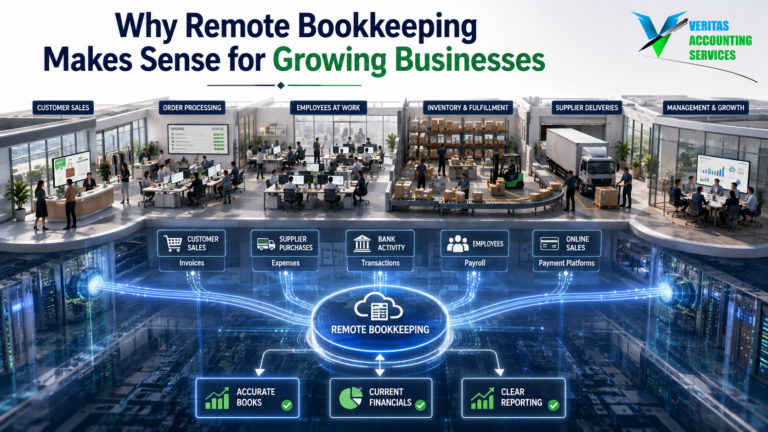
Why Remote Bookkeeping Makes Sense for Growing Businesses

Growth is exciting, but it also creates more financial work. More customers mean more invoices. More…

Sales tax

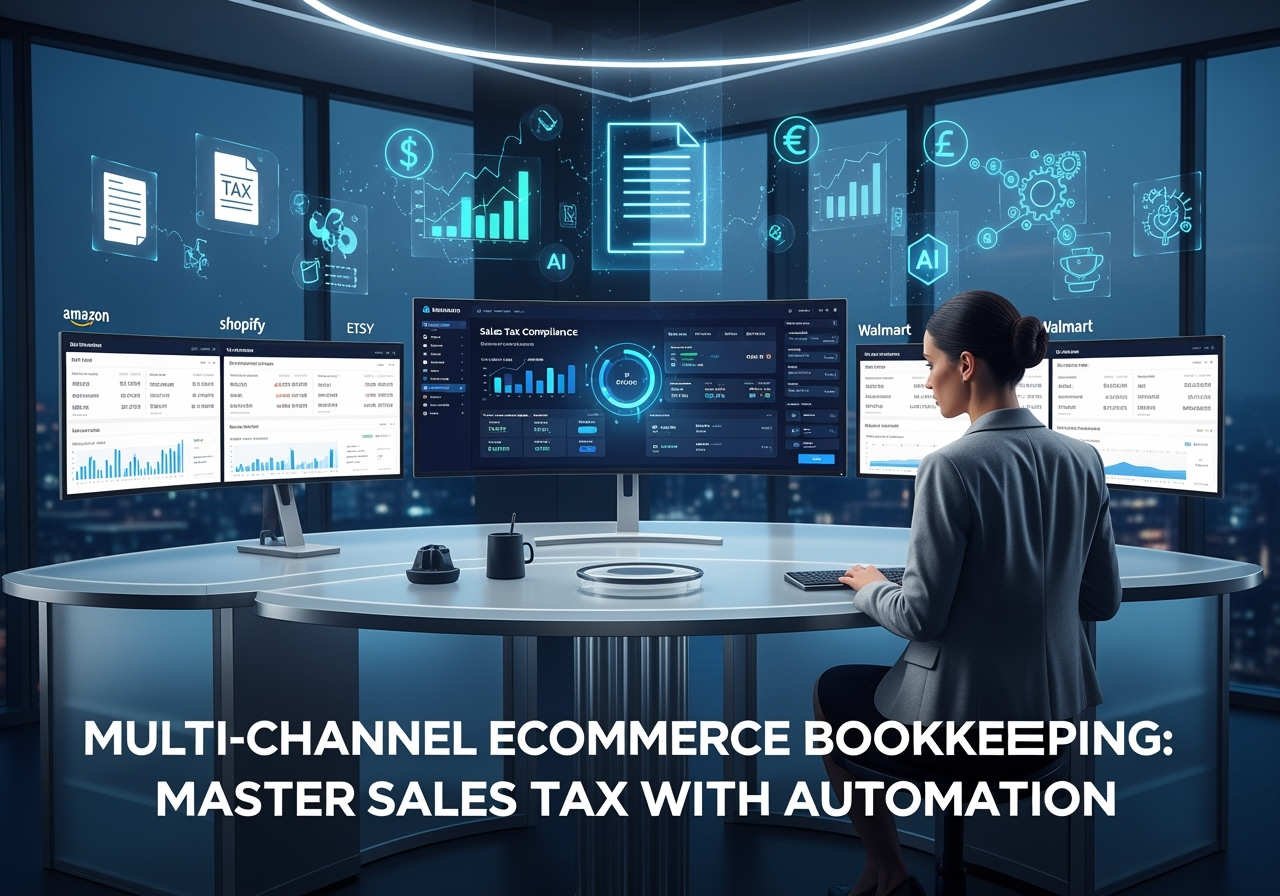
Sales Tax Survival Guide for eCommerce Bookkeepers in 2025

Mastering the New Age of Automated Compliance

The need for bookkeepers to become strategic partners in today’s eCommerce landscape has never been greater. With eCommerce businesses rapidly expanding to multiple sales channels and automation technologies advancing at lightning speed, understanding how to streamline compliance, especially for sales tax, is essential for both client success and the growth of bookkeeping practices.

Why Multi-Channel eCommerce Changes Everything

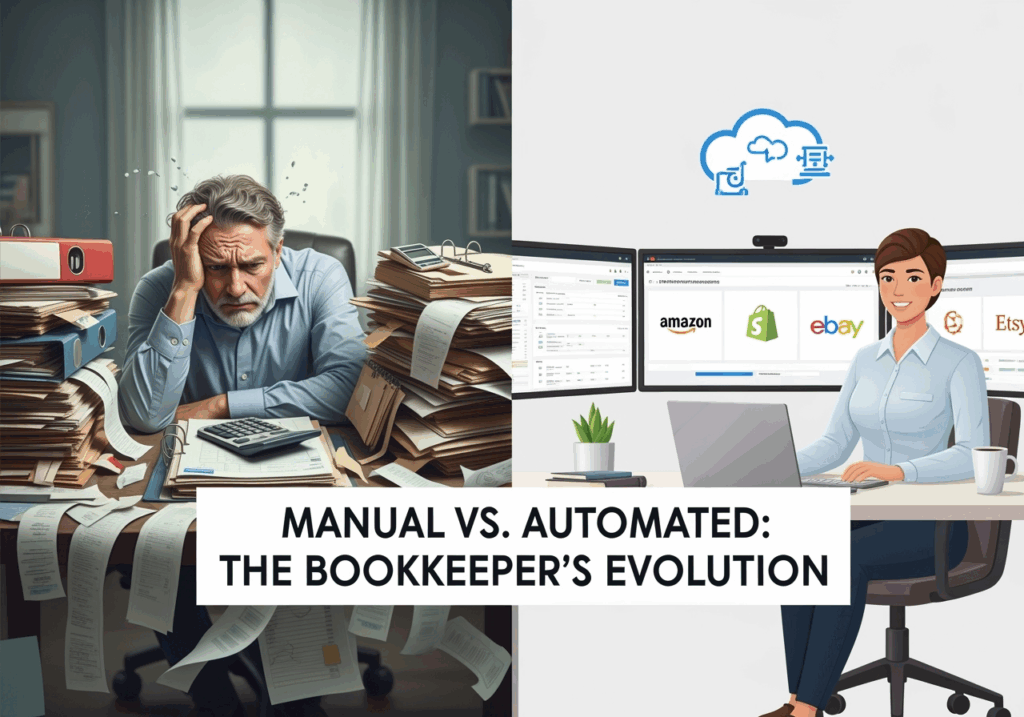
Split-screen infographic showing two sides:
Left side: Frustrated bookkeeper buried in paper ledgers and Excel sheets.
Right side: Same bookkeeper confidently managing multiple sales channels using a cloud-based dashboard with automation icons and platform logos (Amazon, Shopify, eBay, Etsy).
Caption text overlay:
“Manual vs. Automated: The Bookkeeper’s Evolution”

Moving Beyond Traditional Bookkeeping

In the past, bookkeeping focused on ledgers and periodic reconciliations for a single online platform like Shopify or Amazon. Today, thriving eCommerce businesses operate on numerous platforms—Amazon, Shopify, eBay, Etsy, Walmart, Facebook Shops, and their own websites. Each generates unique data streams, reporting requirements, and tax obligations.

Key challenge: Manual processes can’t keep up. Studies show bookkeepers relying on old methods spend significantly more time for lower accuracy—investing up to 73% more effort yet achieving only around 64% accuracy in tracking sales tax compliance for multi-channel clients.

The Opportunity: Bookkeepers must transform into orchestrators of automated systems and real-time data specialists—using technology to minimize manual work and maximize insight.

The Rise of AI in Bookkeeping

Futuristic AI interface showing categorized transactions, a glowing alert for “Nexus Trigger Detected,” and a chart projecting “Next Compliance Date.”
A hand is shown pointing to the screen with holographic-style interface.
Caption: “AI at Work: Smarter Sales Tax Compliance in Real-Time”
Use cool neon tones (blue, green) with digital interface vibes.

Artificial intelligence has revolutionized multi-channel bookkeeping. AI-powered tools can now:

  • Auto-categorize transactions across channels.
  • Detect sales tax nexus triggers in real time.
  • Predict upcoming compliance needs based on client growth.

Results from AI adoption include:

  • 89% reduction in manual data entry.
  • 94% increase in sales tax tracking accuracy.
  • Capability for a bookkeeper to handle 3x more clients without extra staff.

This shift frees professionals to move from repetitive data entry into valuable client advisory and strategic roles instead.

Common Platform-Specific Bookkeeping Challenges

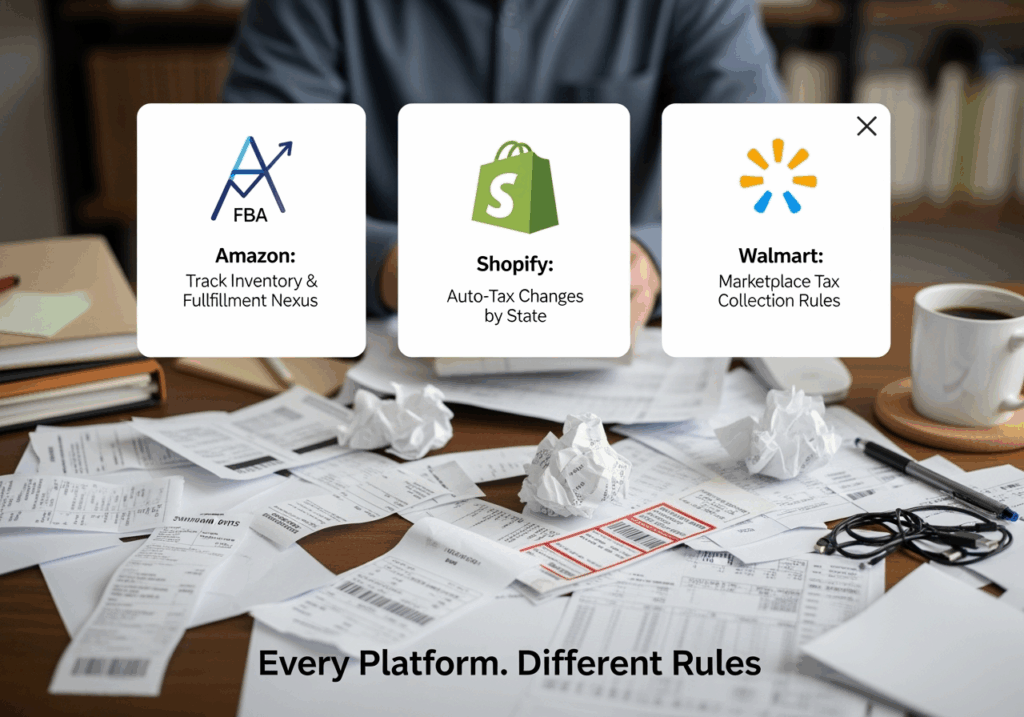
Illustrated icons or small pop-out windows for each platform (Amazon FBA, Shopify, Walmart) with text like:
•	“Amazon: Track Inventory & Fulfillment Nexus”
•	“Shopify: Auto-Tax Changes by State”
•	“Walmart: Marketplace Tax Collection Rules”
Background: A chaotic desk scene showing multiple receipts, invoices, and shipping data.
Caption: “Every Platform. Different Rules.”

Each sales platform presents unique headaches:

  • Amazon FBA: Requires inventory tracking across fulfillment centers and a deep understanding of marketplace tax collection rules.
  • Shopify: Ongoing regulatory changes make it crucial to re-examine sales tax setups, particularly as Shopify introduces automatic tax collection for relevant states.
  • Multi-channel Inventory: Managing stock and margins across platforms can quickly spiral out of control without automation.
  • General Compliance: Ensuring accurate documentation in the event of a tax audit is much more complex when multiple platforms are involved.

The Financial Impact of Multi-Channel Complexity

Two bar charts side-by-side:
•	Chart 1: Annual Compliance Costs (Single-platform vs. Multi-channel)
•	Chart 2: Time Saved & Revenue Gained through Automation
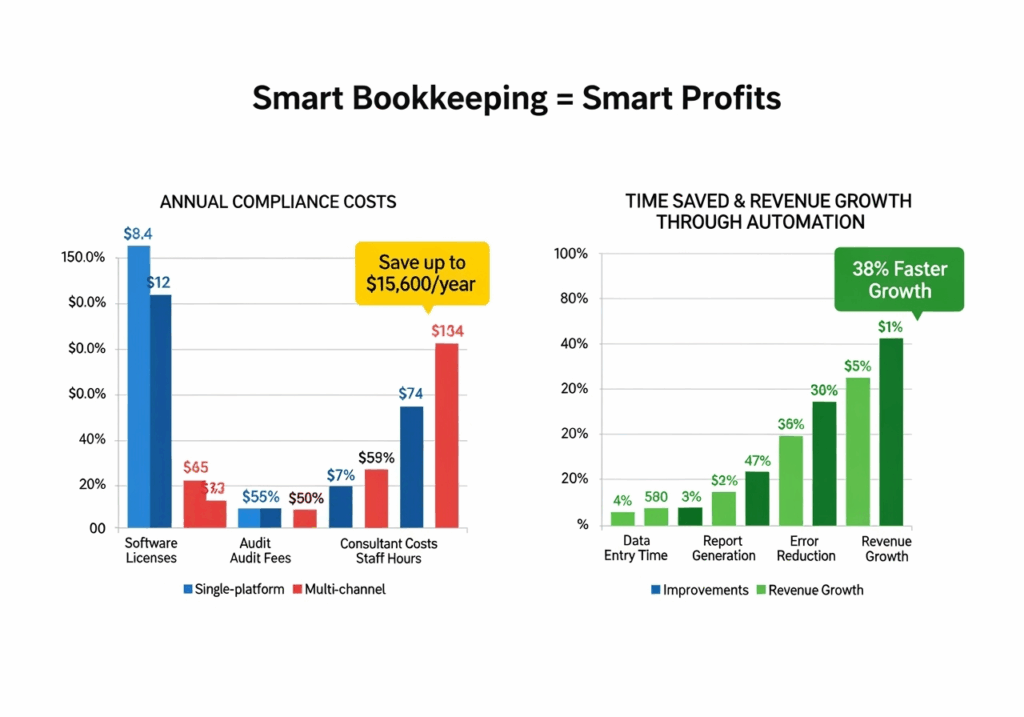
Add annotations showing key stats: “Save up to $15,600/year” and “38% Faster Growth”
Caption overlay: “Smart Bookkeeping = Smart Profits”

Bookkeepers can help clients not only avoid costly tax penalties but also directly improve operational efficiency.

  • Cost of compliance and bookkeeping: Multi-channel stores typically spend $2,400–$4,800 a year (vs. $800–$1,200 for single-platform sellers).
  • Potential savings from professional management: $8,400–$15,600 per year through streamlined, automated workflows.
  • Revenue growth advantage: Businesses on multiple channels grow revenue 38% faster than those on a single platform.

The bottom line: Effective bookkeeping turns what many see as a cost into a profit driver, enabling scalability and peace of mind.

GET IN TOUCH

Connect With Us for 1-1 Call!

Building Your Modern Bookkeeping Tech Stack

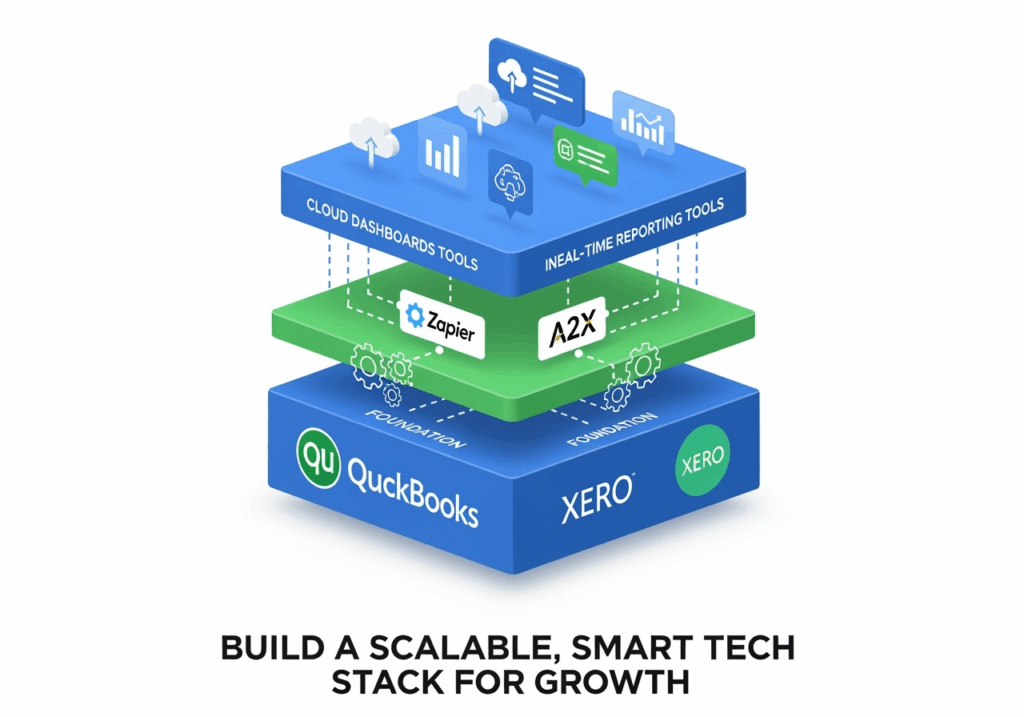
A layered stack visual metaphor: Bottom layer shows QuickBooks and Xero logos, followed by integration tools (Zapier, A2X), then cloud dashboards and custom reporting tools at the top.
Icons for each type (cloud, automation, real-time reporting).
Caption: “Build a Scalable, Smart Tech Stack for Growth”

Today’s most successful bookkeeping practices rely on much more than accounting software like QuickBooks or Xero (though these should be your foundation).

Best-in-class practices also adopt:

  • eCommerce integration and automation tools (for sales data import, inventory sync, and multi-platform reconciliation).
  • Cloud-based dashboards, for 24/7 real-time access and collaboration.
  • Custom reports, breaking down profitability and compliance status by channel.

These investments deliver transparency, scalability, and confidence for both bookkeepers and clients.

Why Automated Sales Tax Management Is Essential

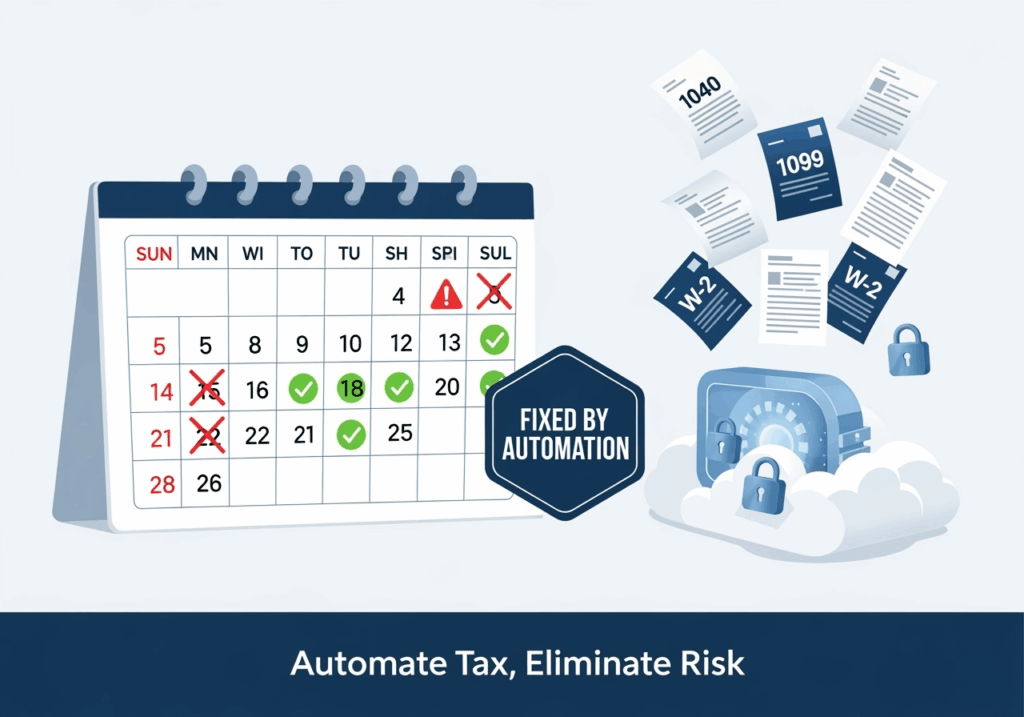
A calendar with tax deadlines, automated filing checkmarks, and warning icons removed with a “Fixed by Automation” badge.
Background: Tax forms flying into a digital cloud vault.
Caption: “Automate Tax, Eliminate Risk”

Sales tax compliance is the highest-value, most urgent service for eCommerce clients:

  • Multi-state nexus triggers: Identifying and registering for state sales tax as required by law.
  • Marketplace facilitators: Some platforms collect and remit tax, but your client is still responsible for reporting and proper record-keeping.
  • Automation platforms: Specialized sales tax apps eliminate manual tracking and ensure every filing is timely and complete.

Business impact: Clients typically see payback on automation within 4-6 months through penalty avoidance and saved time. For bookkeepers, sales tax services command premium rates but require minimal hands-on work after setup.

International Operations: A Lucrative Niche

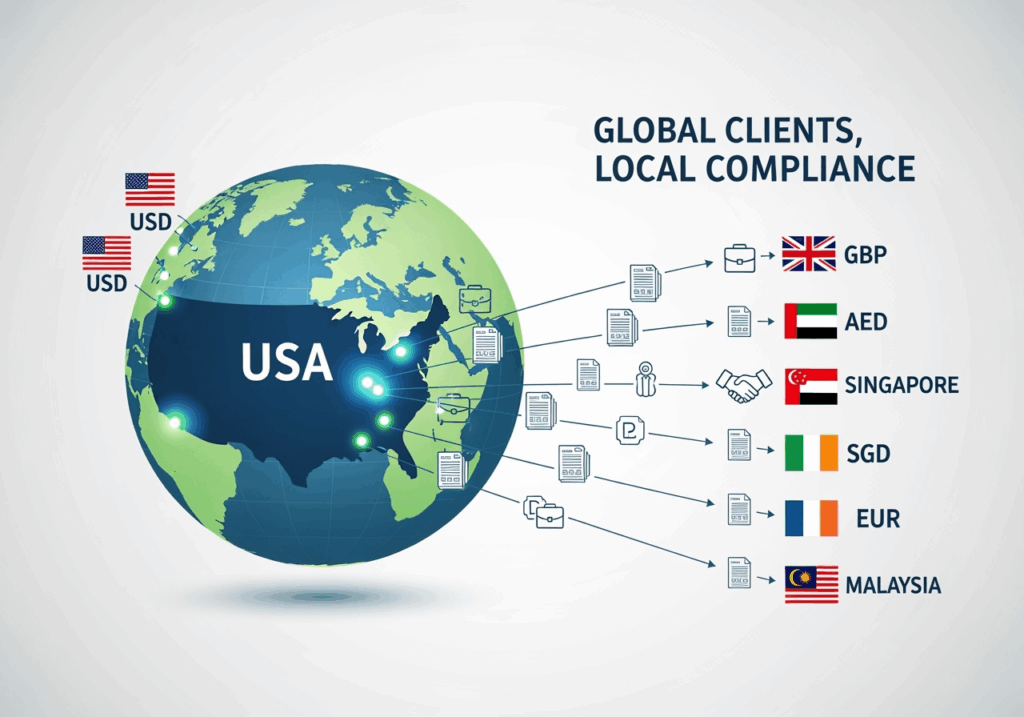
A globe showing connections between the USA and other countries with seller icons, currency symbols, tax documents, and a US flag on the destination end.
Overlay text:
“Global Clients, Local Compliance”

International sellers entering the US face even greater complexity:

  • Navigating both US and home country regulations.
  • Handling US tax ID registration.
  • Managing currency and banking requirements.

These clients see the value in premium, expert services—often investing 40–60% more than domestic-only businesses. Mastering this area can set your firm apart and substantially grow your client base.

Step-by-Step: Growing Your Multi-Channel Bookkeeping Specialization

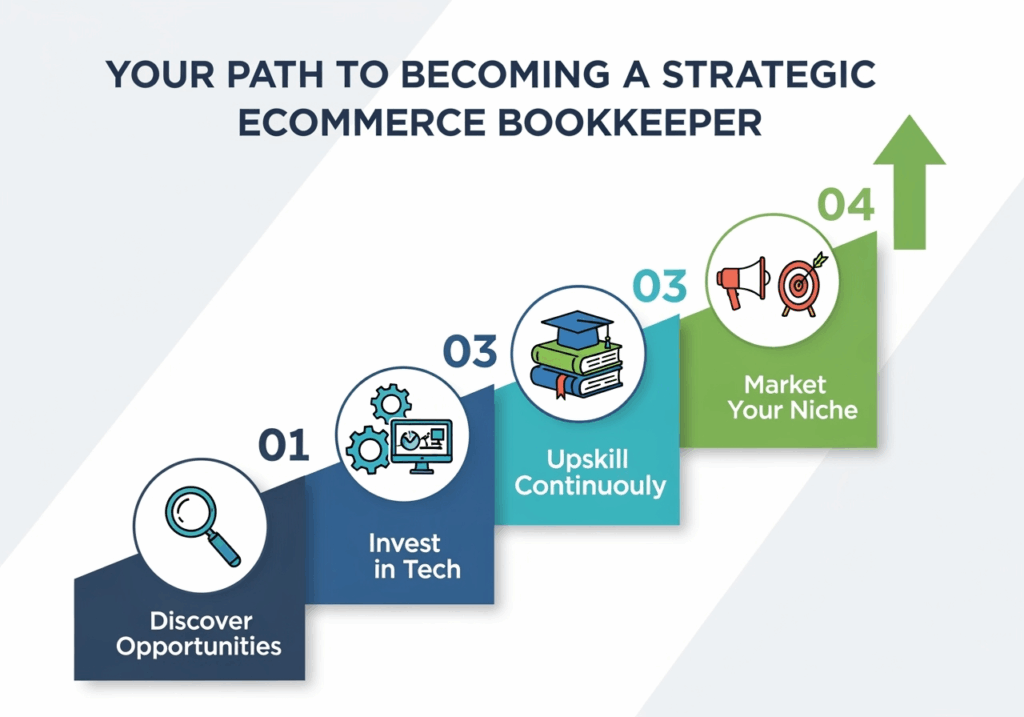
A step-style roadmap graphic with labeled milestones:
1.	Discover Opportunities
2.	Invest in Tech
3.	Upskill Continuously
4.	Market Your Niche
Caption: “Your Path to Becoming a Strategic eCommerce Bookkeeper

  1. Identify potential within your existing clients. Many may be considering new sales channels—position yourself as their go-to advisor for expansion.
  2. Invest systematically in technology. Start with core accounting integrations. Layer in automation as you add clients and revenue.
  3. Commit to continuous learning. Stay up-to-date on eCommerce trends, tax rules, and new automation tools. This fosters innovation and justified premium billing.
  4. Market your expertise. Tell your story clearly—how you help clients save time, avoid penalties, and optimize growth.

What the Future Holds?

eCommerce complexity and automation are only going to increase. Bookkeepers who future-proof their practices now will seize the biggest opportunities:

  • Combining technical skill with strategic advice.
  • Vying for top positioning in an expanding, lucrative market.
  • Serving as true partners in their clients’ growth journeys, rather than just vendors.

Why Partner with Veritas Accounting Services?

A trust-building image showing a virtual meeting between a business owner and Veritas team with charts on the screen, US and international flags, and a glowing “99.7% Compliance Accuracy” badge.
Include a quote-style overlay:
“340+ eCommerce Clients Trust Veritas for Growth & Compliance”

Choosing the right partner for your accounting and bookkeeping can be the difference between surviving and thriving in today’s eCommerce landscape. Veritas Accounting Services stands out through its deep expertise, innovative technology, and commitment to your business’s long-term success.

Built on Decades of Multi-Channel Experience

Veritas Accounting Services draws upon decades of hands-on experience, managing books and compliance for businesses with operations spanning the globe. This cross-border expertise means clients benefit from specialized knowledge in managing the challenges of international VAT, US sales tax, and complicated multi-channel reporting requirements. Whether you sell on Amazon, Shopify, Etsy, Walmart, or your own website, the Veritas team understands the pain points unique to eCommerce and knows how to navigate them smoothly.

Proprietary, Seamless Integration with Leading Software

The technology stack at Veritas is robust and highly adaptable. Clients enjoy seamless integration with industry-leading cloud platforms, including QuickBooks Online, Xero, Wave, Zoho Books, and other specialized eCommerce accounting tools. This integration not only speeds up processes, but also enables real-time reconciliation, inventory tracking, and advanced analytics across every channel you utilize—all while maintaining absolute accuracy and compliance. Automated solutions provided by Veritas eliminate manual data entry, drastically reduce errors, and free you to focus on scaling your business.

Proven Track Record: 340+ International Clients Served

When you work with Veritas, you join an expanding network of 340+ happy international brands who have successfully optimized and protected their financial operations. The results speak for themselves—Veritas clients consistently achieve a 99.7% compliance accuracy rate, drastically lowering exposure to penalties, tax audits, and administrative burden. By minimizing risk and creating transparent, audit-ready reporting, Veritas provides peace of mind so you can pursue growth with confidence.

More Than Bookkeepers—Strategic Growth Partners

Veritas doesn’t just keep your books; the team acts as your virtual CFO, advisor, and strategic partner. Their personalized process includes in-depth business analysis, proactive compliance monitoring, and recommendations on cashflow management, forecasting, and even process automation for scaling up efficiently. This level of involvement helps clients unlock hidden savings, capture new opportunities, and stay ahead of regulatory changes, both in the US and internationally.

Flexible, Scalable Services Designed for You

Whether you’re a fast-growing startup or a seasoned multinational, Veritas tailors its solutions to fit your needs. You gain the flexibility to scale services up or down as your operations evolve, thanks to the team’s experience with a wide range of business models and industries—from eCommerce and logistics to restaurants and professional services.

If you’re ready to build a future-proof, competitive, and growth-oriented practice—or need a dedicated accounting partner capable of supporting your multi-channel eCommerce ambitions—reach out to Veritas Accounting Services today at hello@veritasaccountingservices.com or call +1(678) 723-6003.

GET IN TOUCH

Schedule a FREE Call

The 4 Essential Pillars Behind Strong Financial Management

Accounting, bookkeeping, finance, and audit form the core of a financially well-managed business…

Stop Chasing New Customers: Grow Revenue From the Ones You Have

Getting new customers is important, but it is not the only way to grow a business. Many companies…

Beyond Zoom: How to Build a Strong Remote Company Culture

Remote work has changed where people work, but it has not changed what people expect from a good…

SOP vs Checklist: Which One Does Your Business Need?

As a business grows, work becomes harder to manage consistently. A small team can rely on verbal…

From 5 to 50 Employees: What Changes as Your Business Grows?

Going from 5 employees to 50 is a major milestone. It means more customers, more revenue, more…

Your Books Are More Than Records—They’re Business Intelligence

Most business owners think of accounting as a process that happens in the background. Sales are…

Are Marketplace Fees Quietly Destroying Your Profit Margins?

Selling on an online marketplace can make a business look extremely successful. Orders are coming…

Still Doing Everything Yourself? Here’s Why Founders Need Financial Experts

When most businesses are just getting started, founders wear every hat imaginable. You’re the…

Why Remote Bookkeeping Makes Sense for Growing Businesses

Growth is exciting, but it also creates more financial work. More customers mean more invoices. More…

Connect with us here!