






Managing Multiple Currencies? The Ultimate Guide to E-Commerce Accounting
Selling products internationally has never been easier. Platforms like Shopify, Amazon, Etsy, and WooCommerce allow businesses to reach customers across the world with just a few clicks. While global expansion opens new revenue opportunities, it also introduces a significant accounting challenge—multi-currency accounting.
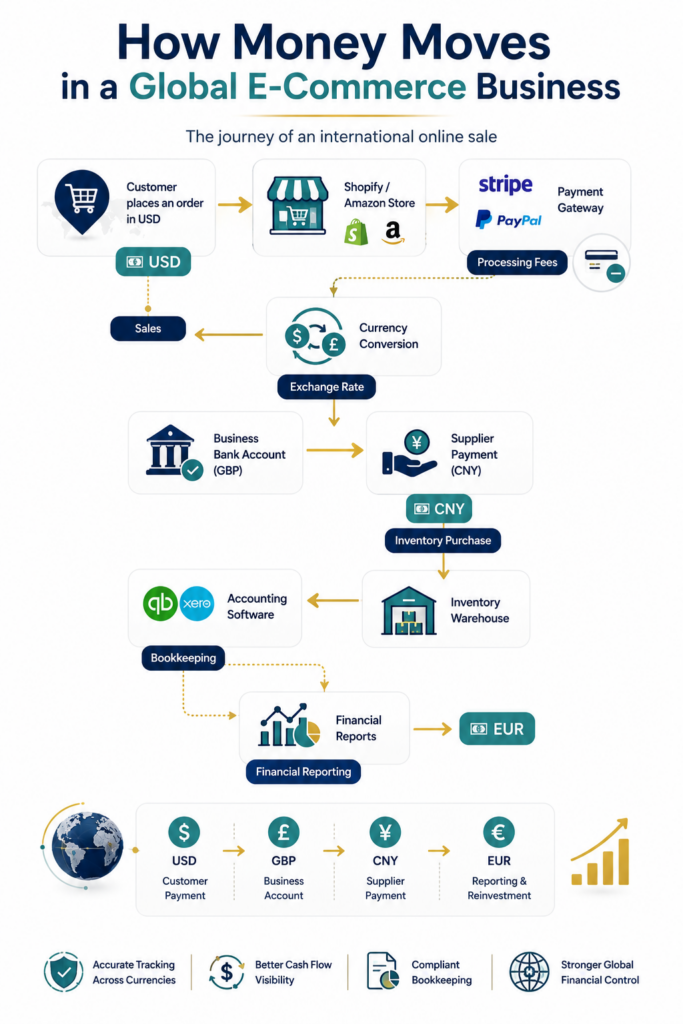
An online store may sell products in US dollars, receive payouts in British pounds, purchase inventory from China in Chinese yuan, pay software subscriptions in euros, and settle supplier invoices through Wise or PayPal. Every one of these transactions involves exchange rates that directly affect your financial records.
Many e-commerce businesses focus on increasing sales but overlook how foreign currency transactions influence revenue, expenses, profits, and tax reporting. As a result, financial statements become inaccurate, reconciliations take longer, and year-end tax preparation becomes far more complicated than it needs to be.
Understanding multi-currency accounting is essential for any business selling internationally. With the right systems and bookkeeping processes, businesses can maintain accurate financial records, make better decisions, and stay compliant with accounting and tax requirements.
Why Multi-Currency Accounting Matters
Traditional bookkeeping assumes that all transactions occur in a single currency. That assumption no longer applies to modern e-commerce businesses.
Today’s online sellers often:
- Sell products in multiple countries.
- Receive payments in different currencies.
- Purchase inventory from overseas suppliers.
- Pay international contractors.
- Maintain foreign currency bank accounts.
Without proper multi-currency accounting, these transactions may be recorded incorrectly, resulting in inaccurate profit calculations and misleading financial reports.
For example, if your business purchases inventory in USD but your accounting records are maintained in GBP, the value of that inventory changes as exchange rates fluctuate. Recording the transaction using the wrong exchange rate can distort both inventory values and cost of goods sold.
How Global Sales Affect Your Accounting
International sales involve much more than currency conversion.
Every transaction affects:
Revenue Recognition
Revenue should be recorded using the applicable exchange rate on the transaction date rather than the payout date. This ensures that financial statements reflect the true value of sales when they occurred.
Customer Payments
Payment processors often receive customer payments in one currency before converting them into another. During this process, processing fees and exchange rate adjustments reduce the final amount deposited into your bank account.
Supplier Payments
If suppliers invoice you in a foreign currency, exchange rate movements between the invoice date and payment date may create additional accounting entries.
Financial Reporting
Balance Sheets and Profit & Loss Statements should consistently reflect your business’s reporting currency while accurately capturing foreign currency activity.
These differences highlight why multi-currency accounting requires more than simply converting one currency into another.
Recording Foreign Currency Transactions Correctly
One of the most common bookkeeping mistakes is recording transactions using bank deposit amounts rather than the original transaction values.
Instead, businesses should follow a structured process:
Record the Original Transaction
Sales, purchases, and invoices should first be recorded in the original transaction currency.
Apply the Correct Exchange Rate
The transaction should then be converted into the business’s reporting currency using the exchange rate applicable on the transaction date.
Record Settlement Differences
If payment occurs on a later date and exchange rates have changed, the difference should be recorded separately as a foreign exchange gain or loss rather than adjusting the original transaction.
Following this approach keeps financial reports accurate and provides a clear audit trail.
Exchange Rate Gains and Losses Explained
Exchange rates change every day.
These fluctuations create gains or losses whenever a transaction remains outstanding between the invoice date and payment date.
For example:
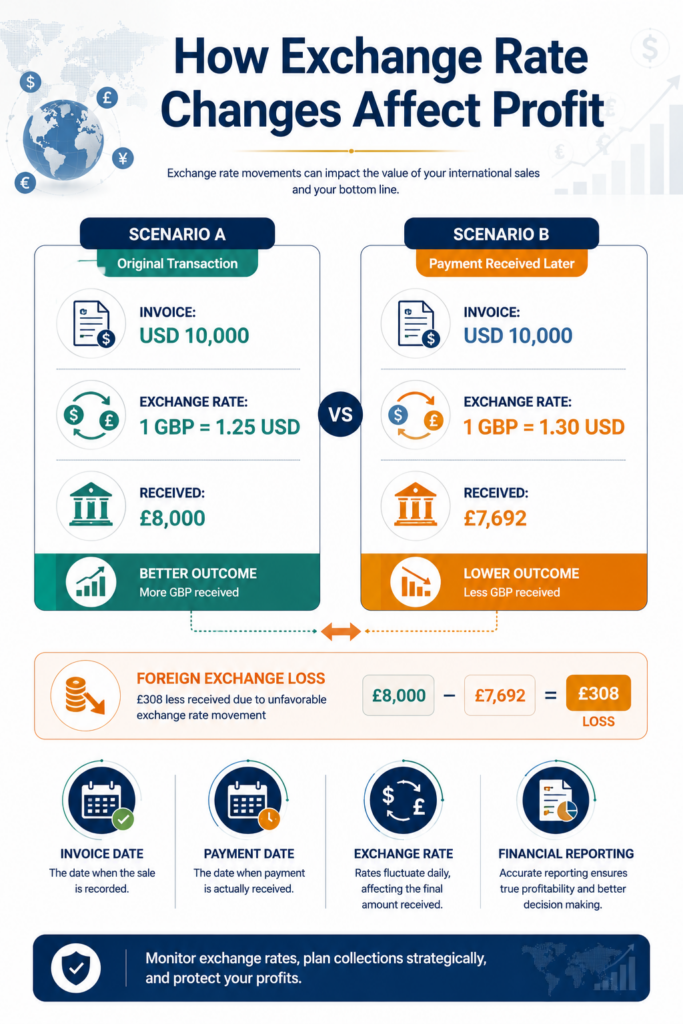
A UK-based business invoices a US customer for $10,000.
The invoice is recorded when:
- £1 = $1.25
The customer pays two weeks later when:
- £1 = $1.30
Although the customer pays the same number of dollars, the amount received in pounds differs because the exchange rate changed.
This difference is known as a foreign exchange gain or loss.
Businesses that ignore these adjustments often produce inaccurate financial statements and incorrect taxable income calculations.
Understanding exchange gains and losses is therefore a key component of effective multi-currency accounting.
Why Payment Processor Reports Never Match Bank Deposits
Many e-commerce business owners become concerned when Shopify, Stripe, Amazon, or PayPal reports do not match their bank deposits.
In reality, this is completely normal.
A single payout may include:
- Customer sales
- Shipping income
- Sales tax collected
- Platform commissions
- Payment processing fees
- Refunds
- Chargebacks
- Currency conversion adjustments
- Reserve balances
Recording only the final deposit amount results in incomplete bookkeeping.
Instead, accountants should reconcile each payout against the platform’s settlement report and record every component separately.
This approach not only improves reporting accuracy but also simplifies month-end reconciliations and tax preparation.
Managing Inventory Purchased in Foreign Currencies
Inventory is often purchased in one currency and sold in another.
For example:
- Products sourced from China may be invoiced in CNY.
- Freight charges may be billed in USD.
- Customs duties may be paid in GBP.
- Sales may occur in EUR or AUD.
Each cost component contributes to the final inventory value.
Ignoring exchange rate differences during inventory purchases can understate or overstate the true cost of goods sold, directly affecting gross profit.
As businesses grow internationally, inventory accounting becomes one of the most important areas of multi-currency accounting.
Multi-Currency Accounting in QuickBooks and Xero
Modern cloud accounting software has made multi-currency accounting much easier than it was a few years ago. However, simply enabling the feature does not guarantee accurate financial reporting.
Both QuickBooks Online and Xero allow businesses to:
- Create customer invoices in foreign currencies.
- Record supplier bills in multiple currencies.
- Maintain foreign currency bank accounts.
- Track exchange rate movements.
- Calculate foreign exchange gains and losses automatically.
These features reduce manual work, but they still require proper bookkeeping practices.
For example, exchange rates should be reviewed regularly, reconciliations should be completed monthly, and foreign currency transactions should be verified against supporting documents. Without proper oversight, automated systems can still produce inaccurate financial reports.
Software is a powerful tool, but professional review remains essential for reliable multi-currency accounting.
Common Mu
Best Practices for Multi-Currency Accounting
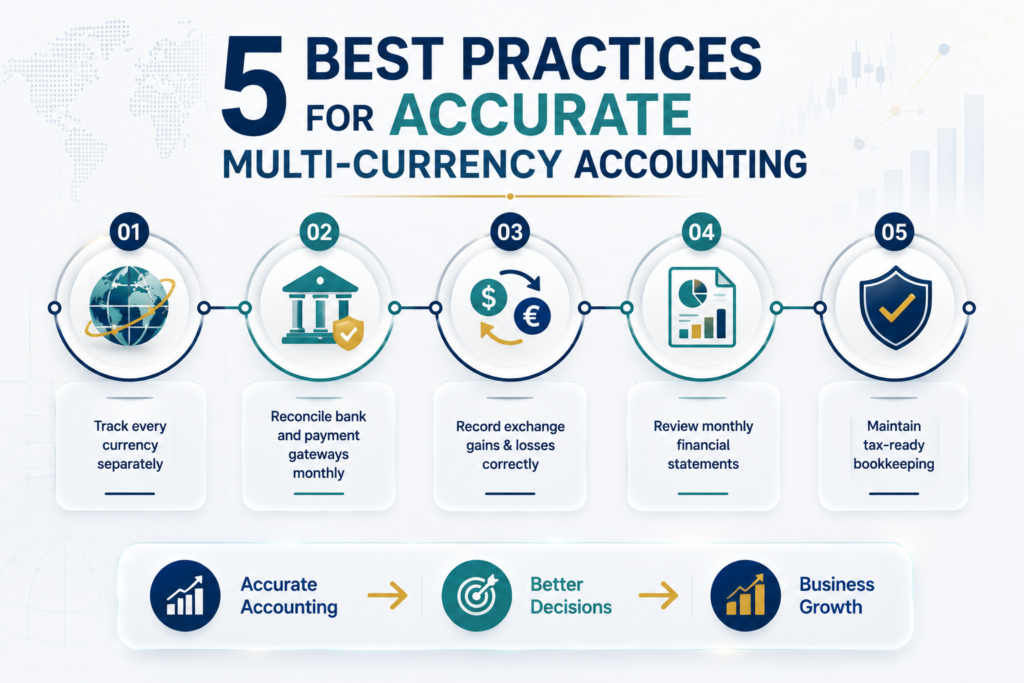
Businesses selling internationally can simplify their accounting by following a few practical principles.
Maintain One Base Currency
Choose a single reporting currency for financial statements and use it consistently across your accounting system.
Separate Foreign Currency Accounts
Maintain dedicated bank or payment processor accounts for each currency whenever practical.
This makes reconciliations significantly easier.
Reconcile Every Sales Channel
If you sell through multiple platforms, reconcile each one separately.
This includes:
- Shopify
- Amazon
- Etsy
- Walmart Marketplace
- WooCommerce
- Stripe
- PayPal
- Wise
Accurate reconciliation prevents duplicated or omitted transactions.
Monitor Exchange Rate Impacts
Exchange rates affect more than international payments.
They influence:
- Inventory costs
- Gross margins
- Cash flow
- Profitability
- Financial reporting
Review exchange gains and losses regularly rather than waiting until year-end.
Review Financial Reports Monthly
Monthly reporting allows business owners to identify unusual trends before they become costly problems.
Key reports include:
- Profit & Loss Statement
- Balance Sheet
- Cash Flow Statement
- Accounts Receivable Aging
- Inventory Reports
Reliable financial reports lead to better business decisions.
Why Professional Bookkeeping Matters
Technology has made international selling easier, but it has also increased financial complexity.
Professional bookkeeping helps businesses:
- Maintain accurate records.
- Reconcile multiple sales channels.
- Track inventory correctly.
- Manage exchange gains and losses.
- Prepare tax-ready financial statements.
- Support informed business decisions.
For growing e-commerce businesses, accurate multi-currency accounting is no longer optional—it is an essential part of sustainable growth.
Frequently Asked Questions
What is multi-currency accounting?
Multi-currency accounting is the process of recording, managing, and reporting financial transactions that occur in more than one currency while maintaining accurate financial statements in a single reporting currency.
Why is multi-currency accounting important for e-commerce businesses?
Online sellers often receive payments, purchase inventory, and pay suppliers in different currencies. Proper accounting ensures accurate financial reporting, better cash flow management, and compliance with tax requirements.
Can QuickBooks Online handle multi-currency accounting?
Yes. QuickBooks Online supports customer invoices, supplier bills, bank accounts, and transactions in multiple currencies. However, businesses should still perform regular reconciliations and reviews.
Does Xero support foreign currency transactions?
Yes. Xero offers multi-currency functionality that allows businesses to record foreign currency transactions and automatically calculate exchange gains and losses.
How often should foreign currency accounts be reconciled?
Monthly reconciliation is generally recommended to maintain accurate financial records and identify discrepancies promptly.
Conclusion
International e-commerce creates exciting opportunities, but it also introduces financial complexities that many businesses underestimate.
Selling products in multiple countries means dealing with exchange rates, foreign currency payments, international suppliers, inventory purchased overseas, and payment processors that rarely match bank deposits.
Without proper multi-currency accounting, businesses risk inaccurate financial reports, reconciliation problems, and compliance challenges.
The most successful global sellers treat accounting as an ongoing business process rather than a year-end exercise. By maintaining accurate records, reconciling transactions regularly, and monitoring exchange rate impacts, they gain a clearer understanding of profitability and make better financial decisions.
Whether you sell through Shopify, Amazon, Etsy, WooCommerce, or multiple marketplaces, strong accounting systems will help your business grow with confidence.
Call to Action
Managing multiple currencies doesn’t have to be complicated.
At Veritas Accounting Services, we help e-commerce businesses with multi-currency bookkeeping, marketplace reconciliations, inventory accounting, financial reporting, and tax-ready records.
Whether you’re selling in one country or across the globe, our experienced team can help you maintain accurate financial records and support your business growth.
Contact us today to discover how professional accounting can simplify your international operations.
GET IN TOUCH
Schedule a FREE Call