




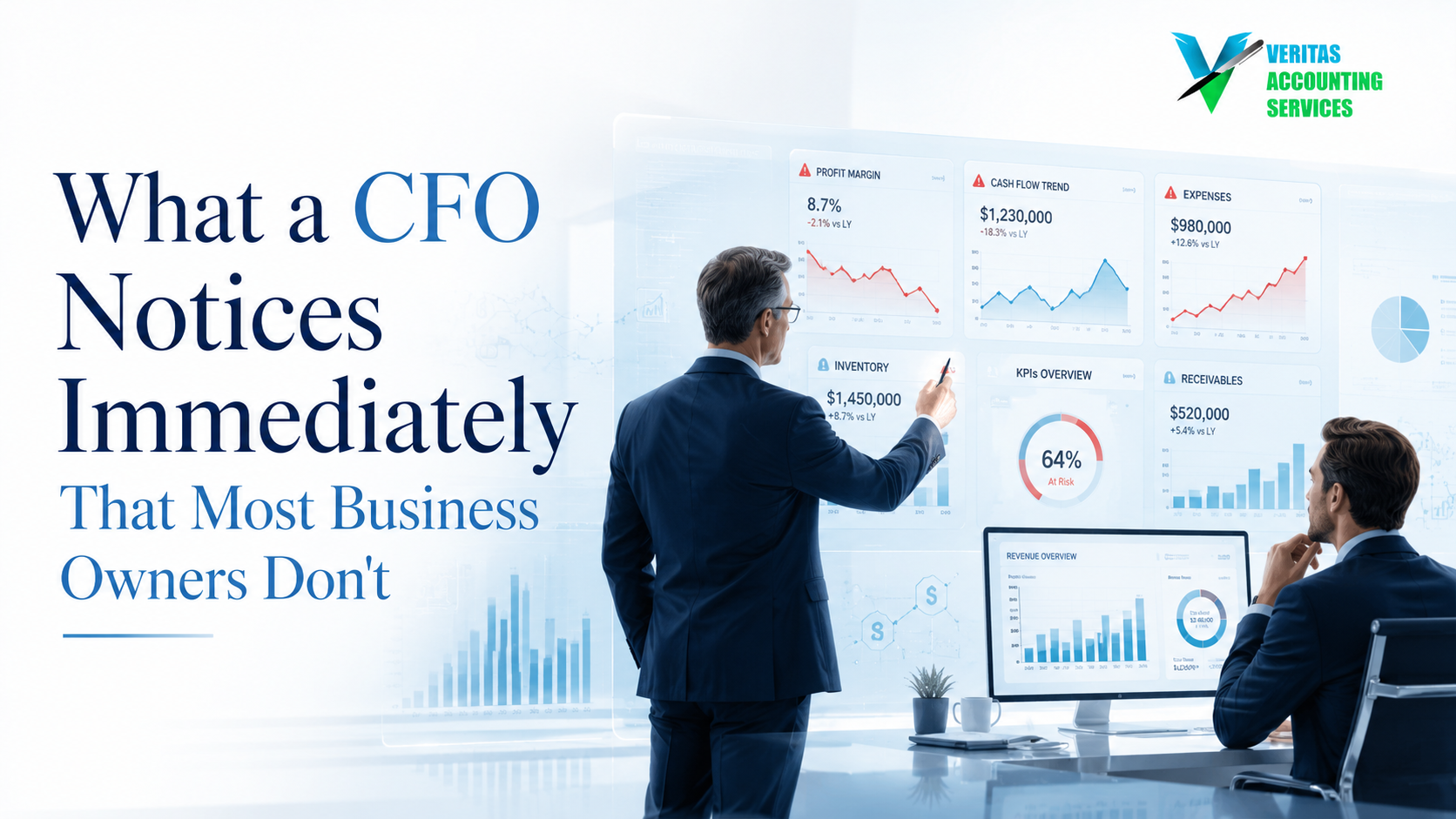

What a CFO Notices Immediately That Most Business Owners Don’t
Running a business is demanding. Every day brings new decisions—winning customers, managing employees, controlling operations, and finding ways to grow. Most business owners naturally spend their time focusing on sales, customer satisfaction, and expansion. While these priorities are essential, they often leave little time to step back and analyze the financial health of the business.
This is where the perspective changes.
A business owner usually asks, “Are we making money?”
A Chief Financial Officer asks, “Will this business still be financially strong six months from now?”
That difference in thinking is what makes CFO insights so valuable. Rather than looking only at revenue or bank balances, CFO insights uncover hidden trends, financial risks, and opportunities that influence the long-term success of a business.
Many companies don’t fail because they lack customers or innovative ideas. They struggle because important financial warning signs go unnoticed until they become serious problems. The numbers were always there—but no one interpreted them correctly.
Experienced CFOs don’t rely on guesswork. They evaluate financial statements, operational trends, and key performance indicators to understand what is really happening behind the scenes. Their ability to connect different financial metrics allows them to identify risks long before they appear on a profit and loss statement.
Whether you own a startup, an e-commerce business, a manufacturing company, or a professional services firm, understanding these CFO insights can help you make smarter business decisions and avoid costly mistakes.
Let’s look at the first things a CFO notices almost immediately.
Why Business Owners and CFOs See Businesses Differently
Entrepreneurs are naturally optimistic.
They focus on opportunities, new markets, customer relationships, and increasing revenue. Their attention is directed toward growing the business.
A CFO has a different responsibility.
Instead of asking how quickly the business can grow, they ask whether the business can grow sustainably.
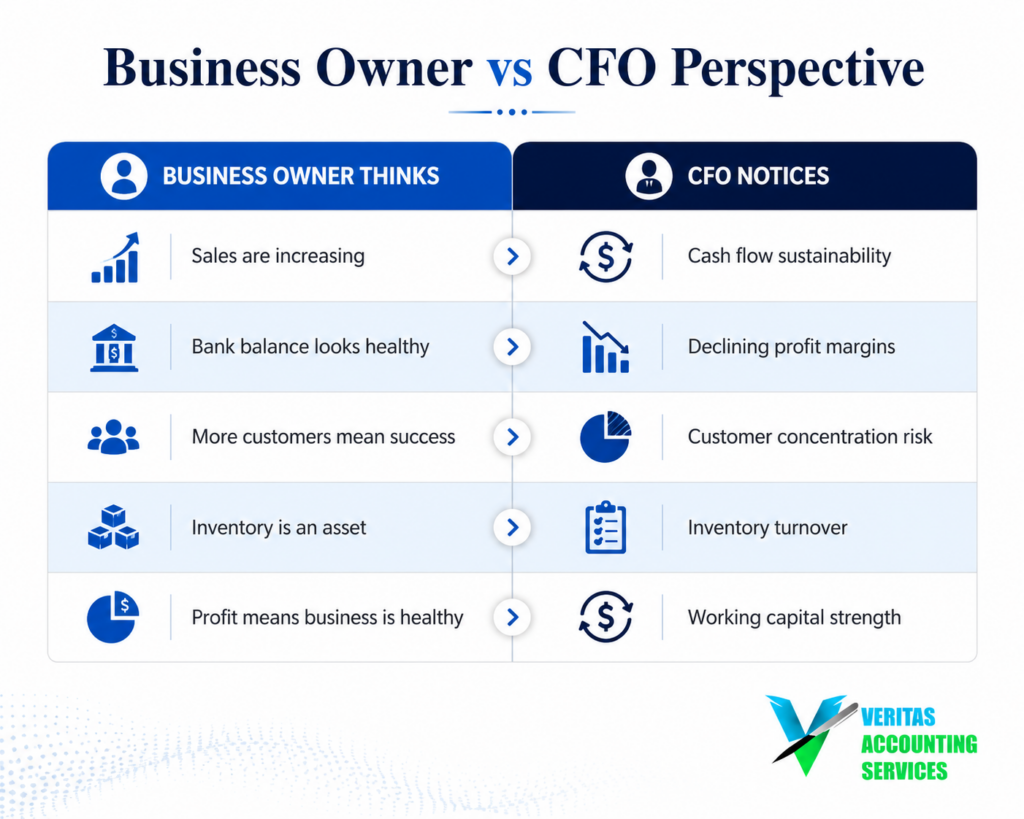
For example, a business owner may celebrate a 30% increase in sales.
A CFO immediately wants to know:
- Did profit margins improve?
- Is cash flow keeping pace with growth?
- Are operating expenses increasing faster than revenue?
- Is the business becoming too dependent on one customer?
- Will current working capital support future expansion?
These questions represent practical CFO insights that go beyond traditional bookkeeping. They reveal whether growth is creating long-term value or simply increasing financial pressure.
Business owners often look at individual numbers.
CFOs look at relationships between numbers.
That difference changes everything.
Veritas Expert Insight
Financial statements don’t just report what happened—they reveal what is likely to happen next. The ability to interpret those signals is what separates financial reporting from strategic financial leadership.
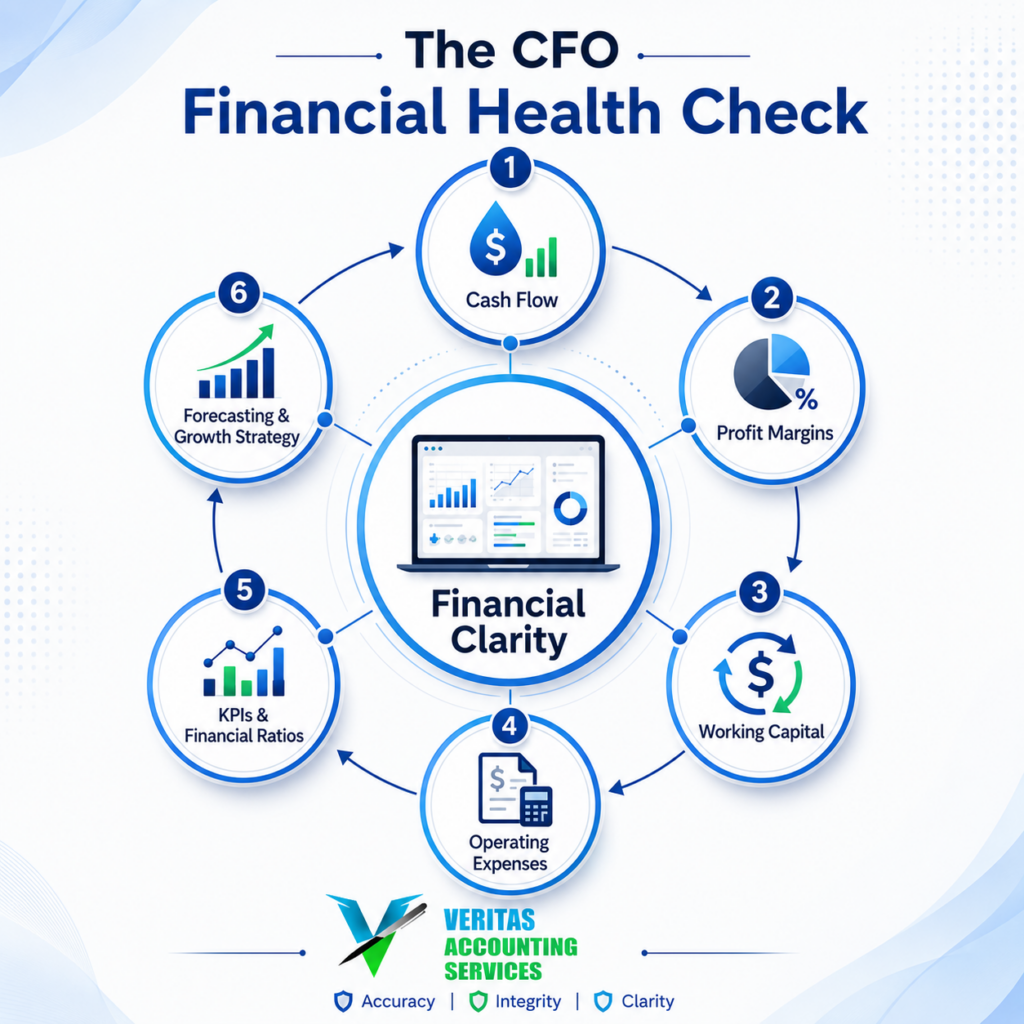
1. Cash Flow Always Comes Before Profit
One of the first CFO insights is understanding that revenue does not pay the bills.
Cash does.
Many businesses proudly report record sales while quietly struggling to meet payroll, pay suppliers, or invest in future growth.
How is that possible?
Because profit and cash are not the same thing.
Imagine a business that invoices customers for $500,000 during the month.
Its Profit & Loss Statement looks impressive.
However, most customers pay after 60 or 90 days.
Meanwhile, employee salaries, rent, inventory purchases, software subscriptions, taxes, and supplier invoices must all be paid immediately.
On paper, the business appears profitable.
In reality, cash is disappearing every week.
This is why experienced CFOs often review the Cash Flow Statement before looking at the income statement.
Strong CFO insights focus on questions such as:
- How much cash is generated from operations?
- Are customers paying on time?
- Is working capital improving or declining?
- How much cash is tied up in receivables?
- Can the business comfortably fund future growth?
Businesses rarely close because sales suddenly stop.
More often, they fail because they run out of cash.
Understanding this distinction is one of the most valuable CFO insights any business owner can learn.
2. Revenue Growth Doesn’t Always Mean Better Performance
Higher revenue usually feels like success.
But experienced CFOs know that’s only part of the story.
Imagine two companies with identical annual sales.
Each generates $3 million in revenue.
At first glance, both businesses appear equally successful.
A deeper financial review tells a different story.
Company A maintains healthy gross margins, carefully manages expenses, and consistently improves profitability.
Company B wins more customers but offers larger discounts, experiences rising supplier costs, and spends significantly more on operations.
Revenue increases every quarter.
Profit decreases every quarter.
A business owner may celebrate the growing sales.
A CFO immediately identifies shrinking margins as an early warning sign.
These CFO insights help management understand whether growth is actually improving the financial position of the company.
Healthy businesses don’t simply sell more.
They earn more from every dollar of revenue.
When margins begin declining, experienced CFOs investigate the underlying reasons before profitability suffers.
Possible causes include:
- Increased supplier costs
- Aggressive discounting
- Poor pricing strategies
- Operational inefficiencies
- Rising freight expenses
- Higher employee costs
Finding these issues early gives businesses time to respond before financial performance deteriorates.
3. Expenses That Increase Quietly Every Month
Most businesses don’t experience financial problems because of one major expense.
Instead, profitability slowly declines through dozens of small increases.
A new software subscription.
Additional marketing campaigns.
Extra administrative staff.
Higher insurance premiums.
Growing travel expenses.
Professional service fees.
Individually, these costs seem reasonable.
Collectively, they begin reducing profit margins.
One of the most practical CFO insights is identifying expense trends rather than reviewing expenses individually.
Experienced CFOs compare monthly operating costs against revenue growth.
If expenses consistently rise faster than sales, long-term profitability becomes difficult to maintain.
This doesn’t necessarily mean costs should always be reduced.
Instead, every expense should generate measurable business value.
Strong financial leadership asks:
“Is this expense helping the business become more profitable?”
If the answer is unclear, it deserves closer attention.
4. Working Capital Reveals the Business’s Financial Strength
Many business owners focus primarily on profit.
A CFO focuses equally on liquidity.
Working capital measures whether a business has enough short-term resources to meet its financial obligations.
Healthy working capital allows businesses to pay suppliers, invest in growth, purchase inventory, and manage unexpected challenges without unnecessary financial pressure.
When reviewing financial statements, one of the first CFO insights involves evaluating:
- Accounts Receivable collection periods
- Inventory turnover
- Supplier payment terms
- Current assets versus current liabilities
- Cash available for operations
A profitable business can still experience financial stress if too much money remains tied up in unpaid invoices or excess inventory.
Likewise, businesses with strong working capital often have greater flexibility to invest in new opportunities.
This is why CFOs monitor liquidity just as closely as profitability.
Strong cash management provides stability during both periods of growth and economic uncertainty.
5. Customer Concentration Can Become a Hidden Risk
Winning a large customer often feels like a significant achievement.
And it usually is.
However, experienced CFOs immediately ask another question:
“How dependent has the business become on that customer?”
Suppose one client generates 45% of total annual revenue.
If that customer changes suppliers, delays payments, reduces orders, or negotiates lower prices, the financial impact could be substantial.
Business owners often celebrate the revenue.
A CFO evaluates the risk behind that revenue.
One of the most valuable CFO insights is recognizing concentration risk before it becomes a serious problem.
Diversified revenue streams create stronger businesses.
When no single customer has excessive influence over financial performance, the business becomes more resilient and better prepared for unexpected market changes.
6. Inventory Can Be an Asset—or a Hidden Liability
Most business owners see inventory as a valuable asset because it represents products ready to be sold.
A CFO sees something different.
One of the most practical CFO insights is that inventory only creates value when it moves quickly. Inventory sitting in a warehouse for months ties up cash, increases storage costs, raises insurance expenses, and may eventually become obsolete.
When reviewing financial statements, a CFO immediately asks:
- How many days does inventory remain in stock?
- Which products haven’t sold in the last six months?
- Are we buying faster than we’re selling?
- How much cash is trapped in slow-moving inventory?
Suppose your balance sheet shows $500,000 in inventory.
That might sound impressive.
However, if nearly half of that inventory hasn’t moved for a year, it isn’t strengthening the business—it is reducing liquidity.
These CFO insights help businesses optimize purchasing decisions, improve inventory turnover, and release cash that can be invested in marketing, expansion, technology, or hiring.
Healthy inventory supports growth.
Excess inventory silently reduces profitability.
7. Debt Isn’t the Problem—Poor Debt Management Is
Many business owners worry whenever they see debt on the balance sheet.
A CFO doesn’t automatically see debt as negative.
Instead, they evaluate whether the debt is helping the business grow.
One of the most valuable CFO insights is understanding the purpose behind borrowing.
Debt used to purchase productive equipment, expand operations, or increase revenue may generate long-term value.
Debt used simply to pay monthly operating expenses usually signals a cash flow problem.
A CFO immediately evaluates questions like:
- Can operating cash comfortably cover loan repayments?
- Is the debt generating a measurable return?
- Are interest expenses increasing every quarter?
- Is borrowing replacing healthy cash flow?
Businesses often succeed because they use financing strategically.
Businesses struggle when debt becomes a substitute for profitability.
These CFO insights allow management to make smarter financing decisions before debt becomes a burden.
8. KPIs Tell the Story Behind the Financial Statements
Financial statements explain what happened.
Key Performance Indicators explain why it happened.
That is why experienced CFOs spend significant time reviewing KPIs instead of relying only on monthly profit reports.
Important KPIs include:
- Gross Profit Margin
- Net Profit Margin
- Operating Cash Flow
- Current Ratio
- Accounts Receivable Days
- Inventory Turnover
- Customer Acquisition Cost
- Customer Lifetime Value
- EBITDA Margin
- Operating Expense Ratio
Each KPI provides another layer of financial understanding.
For example, revenue may increase by 20%.
At first glance, that looks excellent.
However, if customer acquisition costs increase by 35% and gross margins decline, profitability may actually be weakening.
These are the kinds of CFO insights that help business owners move beyond surface-level reporting.
Instead of celebrating every increase in sales, they begin measuring whether growth is creating sustainable value.
Businesses that consistently monitor KPIs usually identify financial issues months before they become serious.
Veritas Expert Insight
Great financial decisions are rarely based on a single report. They come from combining accurate financial statements with meaningful KPIs, cash flow analysis, and forward-looking planning.
9. A CFO Focuses on the Future, Not Just the Past
Most accounting reports describe what has already happened.
A CFO uses those reports to predict what will happen next.
This forward-looking approach is one of the biggest differences between bookkeeping and strategic financial leadership.
Strong CFO insights are built around forecasting.
Instead of asking, “How did we perform last month?” a CFO asks:
- What will cash flow look like three months from now?
- Can the business afford planned hiring?
- Will seasonal demand affect working capital?
- Is expansion financially sustainable?
- What happens if sales decline by 15%?
Scenario planning allows businesses to prepare for multiple outcomes rather than reacting when problems arise.
This proactive mindset helps organizations avoid financial surprises and make confident decisions.
The most successful businesses don’t simply report history.
They plan for the future.
Why Every Growing Business Benefits from CFO Insights
Many small and medium-sized businesses believe that hiring a CFO is something only large corporations can afford.
That is no longer true.
Today’s businesses face rising operating costs, economic uncertainty, changing tax regulations, increasing competition, and rapid technological change.
These challenges require more than accurate bookkeeping.
They require strategic financial guidance.
This is where CFO insights create real value.
A Virtual CFO helps business owners understand financial trends, improve profitability, strengthen cash flow, prepare realistic budgets, and develop long-term growth strategies.
Instead of making decisions based on instinct alone, business owners gain access to reliable financial analysis that supports confident decision-making.
The result is better planning, stronger financial control, and improved business performance.
Final Thoughts
Successful businesses are not built solely on higher sales or bigger profits.
They are built on informed decisions.
Every financial statement contains valuable information, but numbers alone never tell the complete story.
Interpreting those numbers correctly is what creates a competitive advantage.
The best CFO insights go beyond accounting.
They reveal hidden risks before they become expensive problems.
They uncover opportunities to improve profitability.
They strengthen cash flow.
They support sustainable growth.
Most importantly, they help business owners make decisions with confidence instead of assumptions.
At Veritas Accounting Services, we believe financial reports should do more than satisfy compliance requirements.
They should provide clear direction for the future.
Our Virtual CFO services help businesses transform financial data into meaningful CFO insights, empowering owners to improve performance, manage risk, and achieve long-term success.
Because the best business decisions begin with understanding what your numbers are really saying.
Frequently Asked Questions
What are CFO insights?
CFO insights are strategic financial observations that help business owners understand profitability, cash flow, operational efficiency, and financial risks beyond standard accounting reports.
Why are CFO insights important for small businesses?
Small businesses often focus on daily operations. CFO insights help identify hidden risks, improve financial planning, strengthen cash flow, and support better business decisions before problems become costly.
How often should businesses review financial performance?
Monthly financial reviews combined with regular cash flow monitoring and KPI analysis provide timely CFO insights that support informed decision-making.
What is the difference between bookkeeping and CFO services?
Bookkeeping records financial transactions and prepares reports. CFO services analyze those reports, provide CFO insights, develop financial strategies, forecast future performance, and advise management on growth and risk management.
Can a Virtual CFO help growing businesses?
Absolutely. A Virtual CFO provides experienced financial leadership, strategic planning, budgeting, forecasting, and valuable CFO insights without the cost of employing a full-time Chief Financial Officer.
Ready to Gain Expert CFO Insights?
If you’re making business decisions based only on revenue and bank balances, you could be missing opportunities to improve profitability and reduce financial risk.
At Veritas Accounting Services, our Virtual CFO solutions provide practical CFO insights that help business owners strengthen cash flow, improve financial performance, and build sustainable growth.
GET IN TOUCH
Schedule a FREE Call