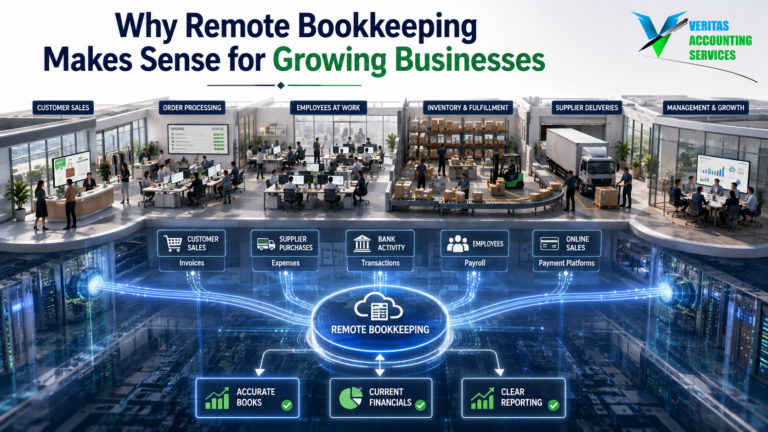







What Million-Dollar Companies Do Differently with Their Finances
Success Starts with Strong Financial Habits
Many business owners believe that reaching seven figures is simply a matter of increasing sales. While revenue growth is important, it is only one part of building a successful business.
Many companies generate impressive sales but continue to struggle with profitability, cash flow, and long-term sustainability. Others achieve steady, profitable growth because they have developed disciplined financial habits that support every business decision.
These habits are rarely complicated. Instead, they are consistent, practical, and supported by accurate financial information.
Whether you’re running a startup, an e-commerce business, a consulting firm, or a growing SME, adopting better financial habits can improve decision-making, strengthen profitability, and reduce unnecessary financial risk.
Rather than reacting to financial challenges, million-dollar companies build systems that help prevent those challenges from occurring in the first place.
They Treat Financial Reports as Decision-Making Tools
Many businesses prepare financial statements only because they are required for tax filings or year-end compliance.
Successful companies take a different approach.
They review financial reports every month because those reports provide valuable insights into business performance.
The three reports they rely on most are:
- Profit and Loss Statement
- Balance Sheet
- Cash Flow Statement
Instead of asking,
“How much revenue did we generate?”
they ask questions such as:
- Are profit margins improving?
- Which expenses are increasing?
- Are customers paying on time?
- Can we afford another employee?
- Is cash flow supporting our growth plans?
Financial reports help management identify opportunities and potential risks before they become serious problems.
Using financial information to guide business decisions is one of the most valuable financial habits successful companies develop.
They Focus on Cash Flow, Not Just Sales
Revenue attracts attention.
Cash keeps the business operating.
Million-dollar companies understand the difference.
A business may generate record sales while still experiencing financial pressure because customer payments are delayed or operating costs increase faster than collections.
For this reason, successful businesses monitor:
- Customer collections
- Supplier payments
- Payroll obligations
- Tax liabilities
- Loan repayments
- Working capital
They know that profitable businesses can still run into cash shortages if money is not flowing through the business efficiently.
Strong cash flow management is one of the financial habits that allows growing businesses to continue expanding without unnecessary financial stress.

They Build Budgets Before Spending
Successful businesses rarely make major financial decisions without first preparing a budget.
Budgets provide a roadmap for growth.
Instead of restricting spending, they help management invest in areas that generate the greatest long-term value.
A practical budget helps answer questions such as:
- Can we hire additional staff?
- Is now the right time to purchase new equipment?
- How much should we invest in marketing?
- Do we have sufficient working capital?
- What happens if revenue slows for several months?
Budgets also create accountability by allowing management to compare actual results with planned performance.
Companies that consistently follow budgeting processes generally make better financial decisions than those relying solely on intuition.
They Invest in Accurate Bookkeeping
Every financial decision depends on reliable information.
Without accurate bookkeeping, management cannot fully understand business performance.
Million-dollar companies treat bookkeeping as an investment rather than an administrative task.
Reliable bookkeeping ensures:
- Transactions are recorded accurately.
- Bank accounts are reconciled regularly.
- Financial reports remain reliable.
- Tax records stay organised.
- Management receives timely information.
Accurate records also improve forecasting, budgeting, profitability analysis, and strategic planning.
Among all financial habits, maintaining clean bookkeeping is one of the most important because every business decision depends on the quality of financial information.
They Measure What Really Matters
Revenue is only one indicator of business success.
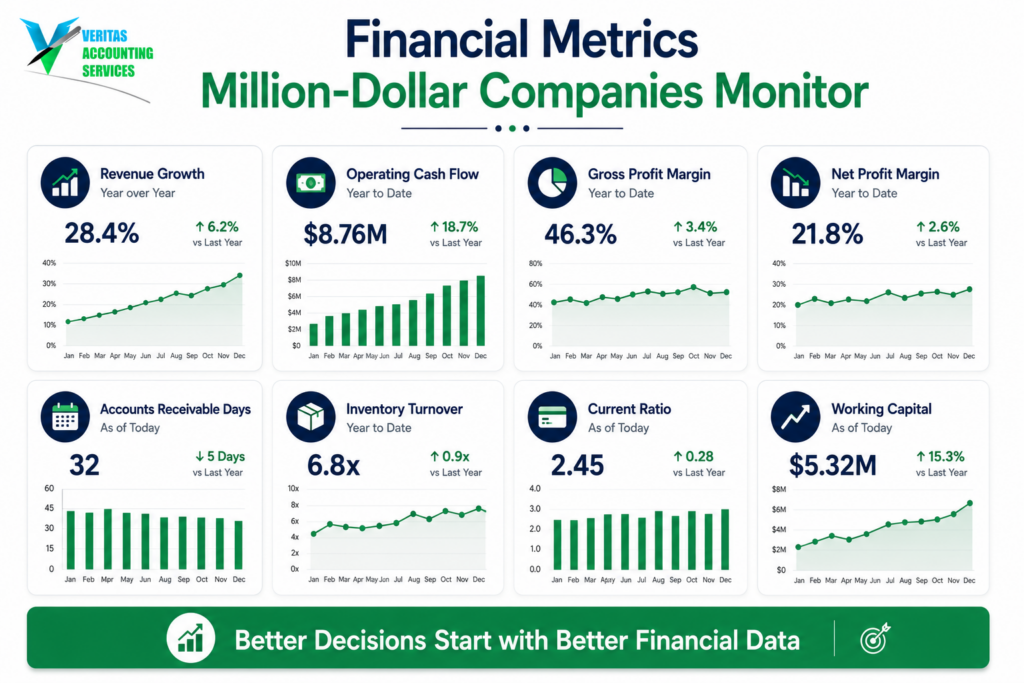
Million-dollar companies monitor a broader range of financial metrics that provide a complete picture of business performance.
Common indicators include:
- Gross Profit Margin
- Net Profit Margin
- Accounts Receivable Days
- Inventory Turnover
- Operating Cash Flow
- Current Ratio
- Working Capital
Reviewing these indicators regularly helps management identify trends early and take corrective action before problems become significant.
Instead of waiting until year-end, successful businesses continuously evaluate performance and adjust their strategies.
Consistently monitoring business performance is another example of the financial habits that support sustainable growth.
They Forecast Before Making Major Decisions
Successful businesses do not rely solely on historical financial reports. They also look ahead.
Before expanding into a new market, hiring additional employees, purchasing equipment, or launching a new product, they prepare financial forecasts to understand how these decisions may affect future performance.
A forecast helps answer questions such as:
- Will the business generate enough cash to support expansion?
- How will additional expenses affect profitability?
- What happens if sales are lower than expected?
- How much funding will be required over the next six to twelve months?
Forecasting allows management to evaluate different scenarios before committing resources. It reduces uncertainty and helps businesses make informed decisions based on financial data rather than assumptions.
This forward-looking approach is one of the financial habits that allows million-dollar companies to grow with greater confidence.
They Plan Taxes Throughout the Year
Many businesses think about taxes only when filing deadlines approach.
Successful companies take a different approach.
They review their tax position throughout the year so there are fewer surprises when returns are due.
Proactive tax planning helps businesses:
- Estimate future tax liabilities.
- Improve cash flow planning.
- Maximise available deductions.
- Maintain organised financial records.
- Reduce the risk of penalties caused by missed deadlines or inaccurate reporting.
Tax planning is not about avoiding taxes. It is about understanding obligations in advance and making informed business decisions.
Businesses that treat tax planning as an ongoing process are generally better prepared for growth and changing regulations.
They Use Technology to Improve Efficiency
Technology has transformed modern finance functions.
Cloud accounting software, automation tools, and artificial intelligence have significantly reduced the time required to complete routine accounting tasks.
Successful businesses use technology to automate repetitive activities such as:
- Invoice processing
- Expense tracking
- Receipt capture
- Bank feeds
- Payment reminders
- Routine reporting
Automation improves speed and reduces manual errors.
However, technology is only part of the solution.
Financial information still requires professional review, interpretation, and strategic analysis.
Million-dollar companies use technology to improve efficiency while relying on experienced finance professionals to support decision-making.
This balanced approach allows them to gain the benefits of innovation without sacrificing financial accuracy.
They Seek Professional Financial Advice
Growing businesses eventually reach a stage where owners cannot manage every financial decision alone.
Successful companies recognise the value of experienced advisors.
Professional accountants and Virtual CFOs contribute far more than bookkeeping and tax compliance.
They help businesses:
- Interpret financial reports.
- Improve cash flow.
- Build realistic budgets.
- Prepare financial forecasts.
- Evaluate investments.
- Monitor business performance.
- Support strategic planning.
Having access to reliable financial advice often enables business owners to identify opportunities and risks that may not be obvious from day-to-day operations.
This willingness to seek expert guidance is one of the financial habits that consistently supports sustainable business growth.
Building Better Financial Habits Starts with Small Changes
Many business owners believe they need to transform their entire finance function overnight.
In reality, long-term success usually comes from making consistent improvements over time.
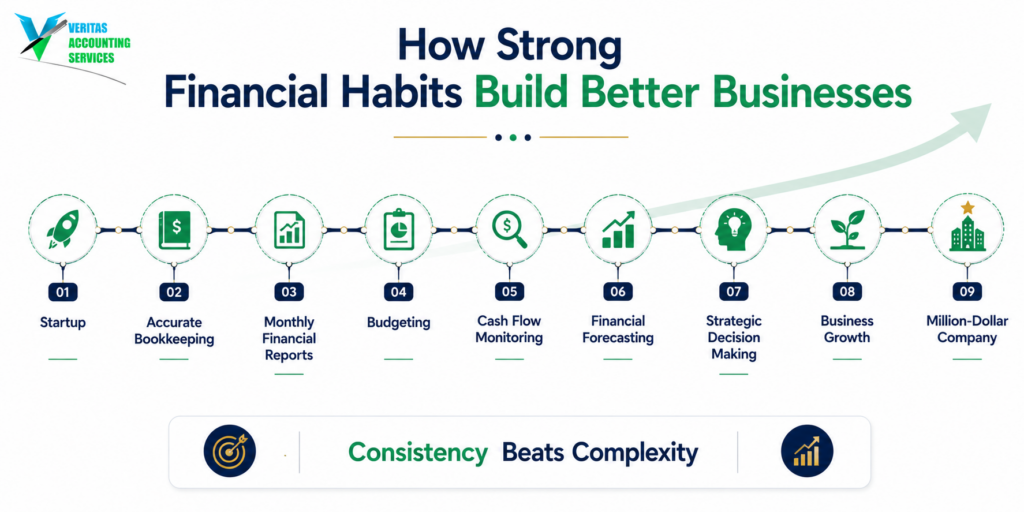
Simple actions such as reviewing monthly financial reports, preparing budgets, monitoring cash flow, and maintaining accurate bookkeeping can significantly strengthen financial performance.
As these processes become part of everyday operations, better decision-making becomes a natural outcome.
Million-dollar companies are rarely built through one major financial decision.
They are built through disciplined financial habits practiced consistently over many years.
Frequently Asked Questions
Why are financial habits important for business growth?
Strong financial habits help businesses make informed decisions, manage cash flow effectively, control costs, and identify opportunities for sustainable growth.
How often should financial reports be reviewed?
Most businesses should review their Profit and Loss Statement, Balance Sheet, and Cash Flow Statement every month. Regular reviews help identify trends and address issues before they become significant.
Is bookkeeping really that important?
Yes.
Accurate bookkeeping provides reliable financial information, supports tax compliance, improves reporting, and enables better business decisions.
What financial reports should every business monitor?
At a minimum, businesses should regularly review:
- Profit and Loss Statement
- Balance Sheet
- Cash Flow Statement
Depending on the business, management reports and KPI dashboards may also be valuable.
When should a business consider Virtual CFO services?
Businesses often benefit from Virtual CFO services when they require financial forecasting, budgeting, strategic reporting, performance analysis, or guidance during periods of growth.
Conclusion
The difference between an average business and a million-dollar company is not always the product, the industry, or even the number of customers.
More often, it is the quality of financial decision-making.
Successful businesses understand that growth requires more than increasing sales.
They invest in reliable bookkeeping, monitor financial performance regularly, manage cash flow carefully, prepare realistic budgets, forecast future results, and seek professional advice when needed.
These financial habits create stronger businesses because decisions are based on accurate information rather than assumptions.
Regardless of the size of your business today, adopting these habits can help you build a stronger financial foundation and support sustainable growth for years to come.
Call to Action
At Veritas Accounting Services, we help businesses build the financial systems needed for long-term success.
From bookkeeping and financial reporting to budgeting, forecasting, tax planning, and Virtual CFO services, our team provides practical financial support that helps business owners make informed decisions with confidence.
If you’re ready to strengthen your financial foundation, contact us today to learn how we can support your business growth.
GET IN TOUCH
Schedule a FREE Call