






Why Your Accountant Isn’t Helping You Grow: 7 Signs You Need More Than Compliance
Compliance Keeps You Safe—It Doesn’t Help You Grow
Imagine two businesses operating in the same industry.
Both have similar annual revenue.
Both submit their tax returns on time.
Both maintain accurate bookkeeping.
Five years later, one company has doubled in size while the other continues to struggle with profitability and cash flow.
What changed?
Surprisingly, it often isn’t the product, the market, or even the owner.
It’s the quality of financial guidance behind the business.
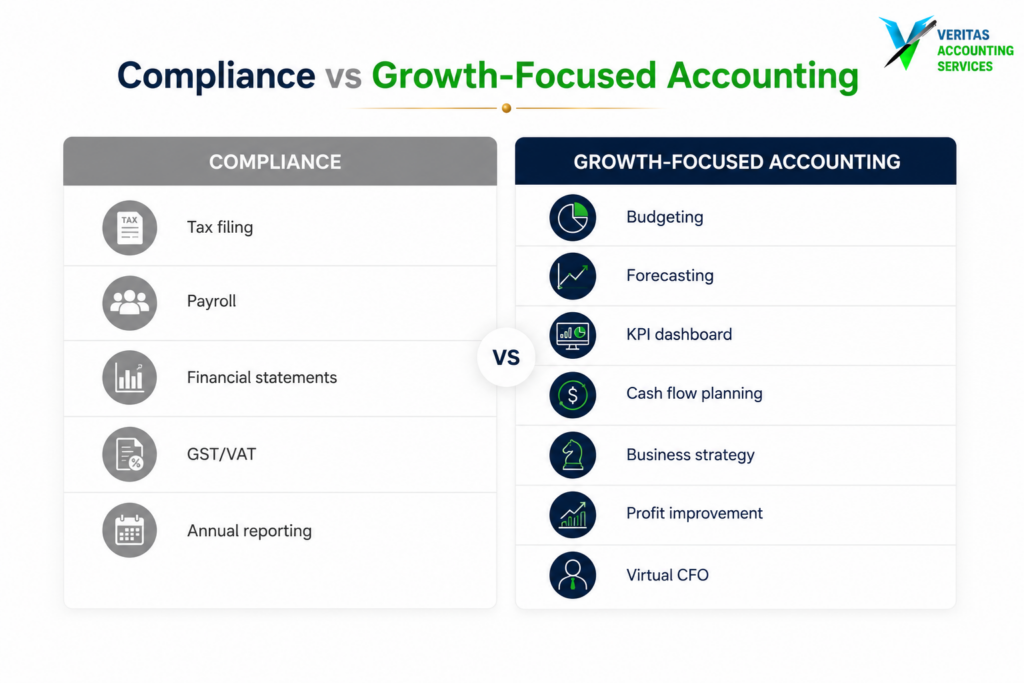
Many accountants provide excellent compliance services. They prepare financial statements, file tax returns, manage payroll, and ensure regulatory requirements are met. Those responsibilities are essential, and every business depends on them.
However, compliance alone rarely drives business growth.
Today’s business environment demands something more. Owners need timely financial insights, practical advice, and strategic planning that support better decisions throughout the year. This is where growth-focused accounting creates real value.
Rather than simply reporting what happened last year, it helps businesses understand what should happen next.
The Difference Between Recording History and Shaping the Future
Traditional accounting focuses on recording financial transactions accurately.
Growth-focused accounting goes a step further.
Instead of asking only whether the accounts balance, it asks questions such as:
- Which products generate the strongest margins?
- Why is cash flow tightening despite higher sales?
- Are operating costs increasing faster than revenue?
- Can the business afford to expand this year?
- Which customers create the highest long-term value?
These conversations transform accounting from an administrative function into a strategic business tool.
Business owners don’t simply need reports.
They need clarity.
When financial information explains why performance is changing—and what actions should be taken next—it becomes one of the most valuable resources in the business.
Financial Reports Should Answer Questions, Not Just Meet Requirements
Most businesses receive a Profit and Loss Statement and Balance Sheet every year.
Many owners glance at the figures, file the reports away, and move on.
Unfortunately, this means valuable opportunities are often missed.
Financial reports should answer practical business questions such as:
- Why did profitability decline this quarter?
- Which expenses increased unexpectedly?
- Are we collecting customer payments quickly enough?
- Which services generate the highest returns?
- Do we have enough cash to support expansion?
When reports become decision-making tools rather than compliance documents, management gains a much clearer understanding of business performance.
This is one of the biggest advantages of growth-focused accounting.
Instead of looking at numbers in isolation, business owners begin to see the story behind those numbers.
If You Only Speak to Your Accountant During Tax Season, You’re Missing Opportunities
Many business owners communicate with their accountant only once or twice a year.
Usually, the conversation begins with:
“Please send us your financial records.”
A few weeks later, tax returns are completed, financial statements are finalised, and the next discussion takes place months later.
While this process satisfies compliance requirements, it does little to improve the business.
Growing companies benefit from regular financial conversations.
Monthly or quarterly reviews often focus on:
- Cash flow performance
- Profitability trends
- Budget comparisons
- Investment opportunities
- Business risks
- Operational improvements
These discussions allow management to solve problems while there is still time to act.
Waiting until year-end often means the opportunity has already passed.
Revenue Doesn’t Guarantee Growth
One of the most common misconceptions among business owners is that higher sales automatically lead to a stronger business.
In reality, many companies experience record revenue while struggling to pay suppliers, invest in new opportunities, or maintain healthy cash flow.
Revenue measures activity.
Cash flow measures sustainability.
A business may generate impressive sales while simultaneously experiencing:
- Slow customer collections
- Rising operating costs
- Increasing inventory
- Lower profit margins
- Higher borrowing requirements
Without regular financial analysis, these warning signs often remain unnoticed until they become serious problems.
Growth-focused accounting helps business owners understand how revenue, profitability, and cash flow work together rather than viewing them as separate financial measures.
Better Decisions Begin With Better Questions
Successful businesses rarely grow because they receive better financial statements.
They grow because someone helps them ask better financial questions.
Questions like:
- Which service should we stop offering?
- Where are we losing profit?
- Should we recruit another employee now or six months from now?
- Is expansion financially sustainable?
- What happens if revenue slows by 15% next quarter?
These are strategic business questions.
Answering them requires more than historical bookkeeping.
It requires financial interpretation, forecasting, and ongoing business advice.
That is where growth-focused accounting becomes a competitive advantage rather than simply a compliance function.
Budgeting and Forecasting Turn Ambition into Action
Every business owner has goals.
Expand into a new market.
Hire more employees.
Launch a new product.
Open another location.
The challenge isn’t having ambitious plans—it’s knowing whether the business can afford them.
Many growing businesses make major decisions based on optimism rather than financial planning. While confidence is important, sustainable growth depends on understanding the financial impact before committing resources.
This is where growth-focused accounting provides real value.
Instead of simply reporting last month’s performance, it helps answer questions such as:
- How much cash will expansion require?
- Can the business support another employee?
- What happens if sales increase more slowly than expected?
- How will higher operating costs affect profitability?
Forecasting doesn’t predict the future with certainty, but it allows business owners to prepare for different scenarios. That preparation reduces financial surprises and supports more confident decision-making.
Businesses that budget and forecast regularly tend to grow more steadily because their decisions are based on financial evidence rather than assumptions.
The Right Numbers Should Drive Every Important Decision
Every successful business tracks performance.
The difference is that high-performing companies monitor the numbers that actually influence future growth.
Revenue is only one measure of success.
Equally important are indicators such as:
- Gross Profit Margin
- Operating Profit
- Cash Flow
- Customer Collection Period
- Inventory Turnover
- Working Capital
- Customer Retention
These metrics provide early warning signs that traditional financial statements may not immediately reveal.
For example, a business may celebrate record sales while gross margins continue to decline. Without reviewing key performance indicators, management may not recognise the issue until profitability has already been affected.
Growth-focused accounting transforms financial information into meaningful business intelligence.
Instead of asking, “How much did we sell?”, business owners begin asking, “Why are profits changing?” and “What should we do next?”
Those questions lead to better decisions.
Financial Advice Should Be Ongoing—Not Annual
One of the biggest misconceptions about accounting is that advice is only needed at year-end.
In reality, the most valuable financial conversations happen throughout the year.
Regular meetings create opportunities to discuss:
- Cash flow challenges
- Pricing strategies
- Rising operating costs
- Investment opportunities
- Business expansion
- Financing requirements
- Tax planning before deadlines
These discussions help businesses respond quickly to changing market conditions instead of reacting after opportunities have passed.
Growth-focused accounting is built on continuous communication rather than occasional compliance meetings.
The result is greater confidence and better financial control.
As Your Business Grows, Your Financial Needs Change
The accounting support required by a start-up is very different from the support needed by a growing business.
In the early stages, bookkeeping, payroll, and tax compliance may be enough.
As revenue increases, financial decisions become more complex.
Business owners begin asking questions such as:
- Should we recruit another manager?
- Is this expansion financially sustainable?
- Which products generate the highest margins?
- Can we improve cash flow without borrowing?
- Are we pricing our services correctly?
Answering these questions requires more than accurate bookkeeping.
It requires financial analysis, forecasting, strategic planning, and ongoing advisory support.
This is why many growing businesses choose to work with a Virtual CFO or an outsourced finance partner alongside their compliance accountant.
The Best Accountants Help You Build the Future
The purpose of accounting has evolved.
Today’s business owners expect more than financial statements and tax returns.
They want insights.
They want practical recommendations.
They want someone who understands both the numbers and the business behind those numbers.
Growth-focused accounting bridges that gap.
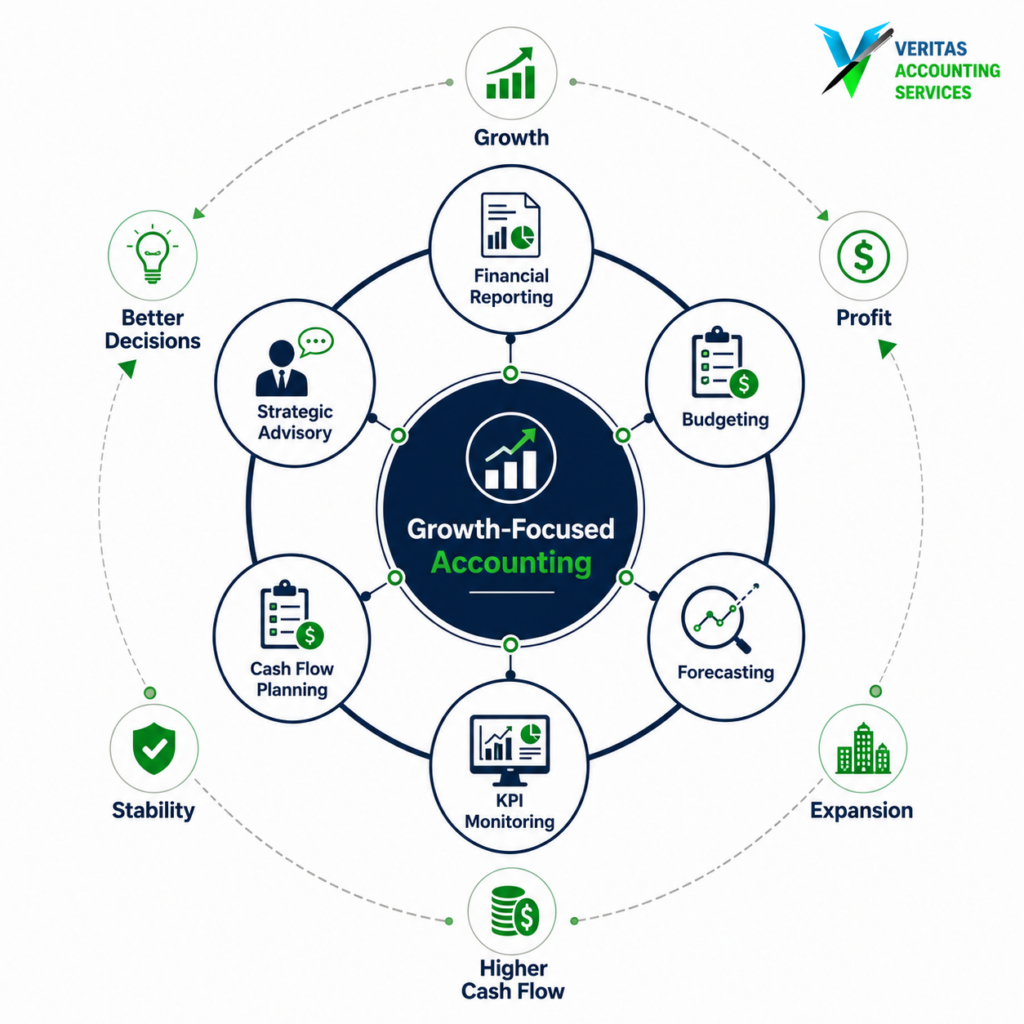
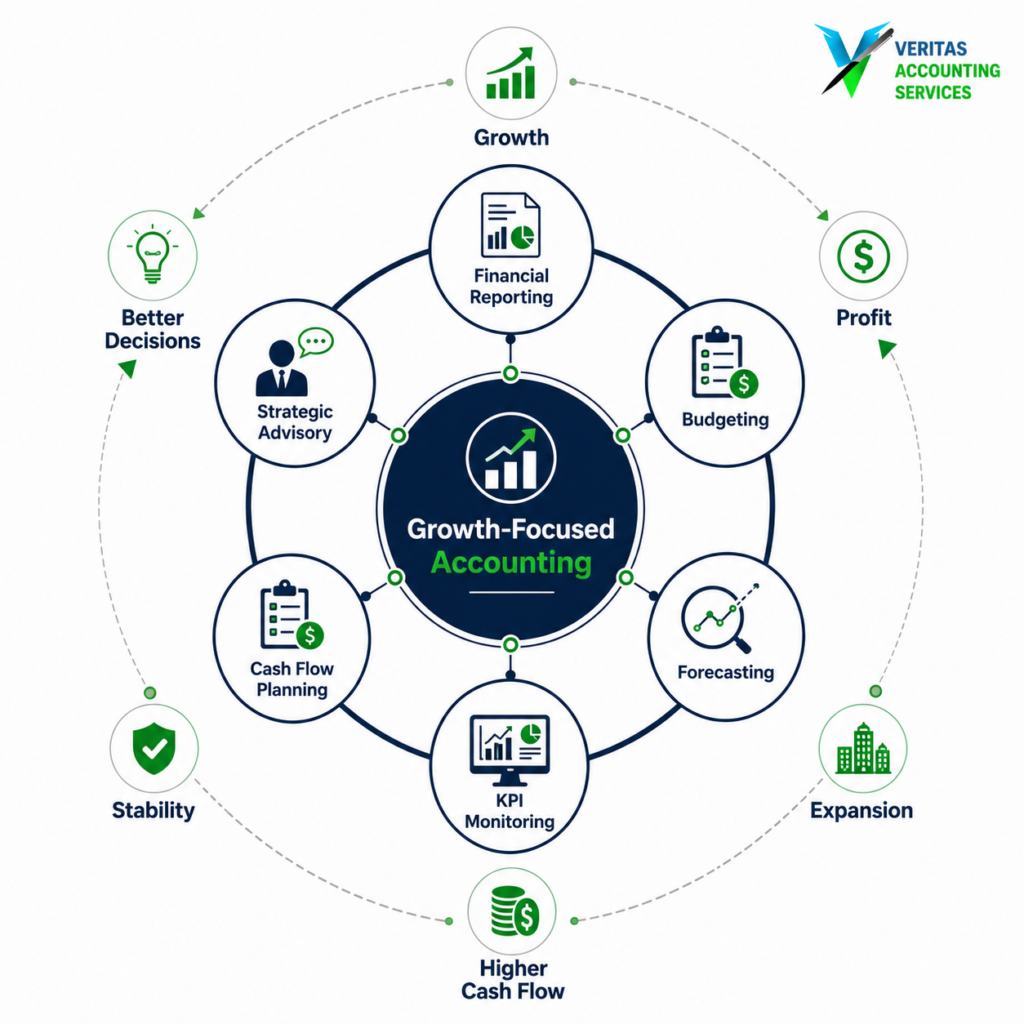
It combines reliable bookkeeping, accurate reporting, budgeting, forecasting, KPI monitoring, and strategic advice into one continuous financial process.
Rather than simply recording history, it helps shape the future.
That difference often determines whether a business merely survives—or continues to grow year after year.
Frequently Asked Questions
What is growth-focused accounting?
Growth-focused accounting combines traditional accounting services with financial planning, management reporting, budgeting, forecasting, KPI monitoring, and strategic business advice to support long-term growth.
How is growth-focused accounting different from traditional accounting?
Traditional accounting focuses primarily on compliance, tax filings, and historical reporting. Growth-focused accounting uses financial information to improve decision-making, profitability, cash flow, and business performance throughout the year.
Does every business need growth-focused accounting?
Not every business requires advanced financial advisory services immediately with Growth-focused accounting. However, businesses planning to expand, improve profitability, or make significant financial decisions often benefit from additional strategic support.
What are the benefits of working with a Virtual CFO?
A Virtual CFO provides financial expertise without the cost of employing a full-time Chief Financial Officer. Services typically include budgeting, forecasting, cash flow management, KPI reporting, financial analysis, and strategic planning and Growth-focused accounting
How often should business owners review financial performance?
Monthly reviews are generally recommended. Regular reporting helps identify trends early, improve decision-making, Growth-focused accountingand address financial issues before they become significant.
Conclusion
Tax compliance will always remain an essential part of running a successful business.
But compliance alone does not create growth, it requires Growth-focused accounting
The businesses that consistently outperform their competitors are those that use financial information as a strategic decision-making tool rather than simply a reporting requirement.
They review performance regularly.
They monitor cash flow.
They measure key performance indicators.
They prepare budgets.
They forecast future results.
Most importantly, they work with finance professionals who help them understand what the numbers mean—not just what the numbers are.
If your accountant only helps you meet deadlines, your business may be missing opportunities to improve profitability, strengthen cash flow, and plan for sustainable growth.
The right financial partner doesn’t simply keep your business compliant.
They help move your business forward.
Call to Action
At Veritas Accounting Services, we believe accounting should do more than keep your business compliant.
Our team provides bookkeeping, management reporting, budgeting, forecasting, KPI reporting, cash flow planning, and Virtual CFO services designed to help business owners make informed decisions with confidence.
If you’re looking for financial support that goes beyond year-end reporting, we’re here to help you build a stronger and more profitable business.
GET IN TOUCH
Schedule a FREE Call