






The Silent Profit Killers: Hidden Financial Leaks in Every Business
Every Business Has Hidden Financial Leaks
Most business owners believe profits disappear because sales are too low.
In reality, many profitable businesses quietly lose thousands of dollars every year through small financial inefficiencies that often go unnoticed.
These hidden financial leaks rarely appear as one large expense. Instead, they develop gradually through inefficient processes, outdated pricing, poor financial controls, and missed opportunities to improve operational efficiency.
The challenge is that these leaks become part of everyday business operations.
Over time, they reduce profitability, create unnecessary cash flow pressure, and limit the company’s ability to invest in future growth.
The good news is that most of these issues can be identified and corrected with regular financial reviews and accurate reporting.
Let’s look at some of the most common areas where businesses unknowingly lose money.
Pricing That No Longer Reflects Rising Costs
One of the largest hidden financial leaks occurs when businesses continue charging the same prices while operating costs continue to increase.
Many companies hesitate to review pricing because they worry about losing customers.
However, supplier prices, employee salaries, freight costs, software subscriptions, insurance premiums, and utilities rarely remain constant.
If selling prices remain unchanged while costs increase, profit margins gradually shrink.
This often happens so slowly that management doesn’t notice the impact until profitability begins to decline.
Successful businesses review pricing regularly by considering:
- Changes in supplier costs
- Inflation
- Labour expenses
- Competitor pricing
- Customer value
- Market demand
Pricing should be reviewed as part of an ongoing financial strategy rather than only during periods of financial pressure.
Regular pricing analysis helps eliminate one of the most common hidden financial leaks affecting growing businesses.

Poor Cash Flow Management
Revenue and cash are not the same.
A business can generate record sales while still struggling to pay suppliers or employees.
This usually happens because customer payments arrive much later than operating expenses.
Examples include:
- Slow customer collections
- Excessive credit terms
- Large inventory purchases
- Unexpected tax payments
- Loan repayments
- Seasonal fluctuations
Without proper monitoring, cash shortages often force businesses to rely on overdrafts or short-term borrowing.
The interest costs associated with emergency financing become another hidden financial leak that gradually reduces profitability.
Businesses that prepare monthly cash flow forecasts are better positioned to anticipate shortfalls before they become serious financial problems.
Software and Subscription Expenses
Modern businesses rely on dozens of software applications.
Accounting software.
CRM systems.
Project management platforms.
Marketing tools.
Payroll software.
Cloud storage.
Communication platforms.
Over time, many businesses continue paying for software that employees no longer use.
It is common to find:
- Duplicate software
- Multiple users with inactive accounts
- Free alternatives that meet business needs
- Premium features that remain unused
Although each subscription may appear relatively small, together they can represent thousands of dollars in unnecessary annual expenses.
Reviewing subscriptions every six months helps identify another category of hidden financial leaks that are surprisingly easy to eliminate.
Weak Inventory Management
Inventory should generate revenue—not quietly consume cash.
Unfortunately, many businesses purchase more inventory than they actually need.
This creates several financial challenges:
- Cash tied up in slow-moving stock
- Additional warehouse costs
- Higher insurance expenses
- Product obsolescence
- Damage and shrinkage
Poor inventory management also increases financing costs because money invested in unsold products cannot be used elsewhere in the business.
Successful companies regularly review inventory reports to identify:
- Slow-moving products
- Excess stock
- Seasonal demand changes
- Purchasing trends
Improving inventory turnover strengthens both profitability and cash flow while reducing hidden financial leaks.
Financial Leaks Often Start Small
One important lesson shared by successful businesses is that financial problems rarely begin with one major mistake.
Instead, they develop through dozens of small inefficiencies that appear insignificant on their own.
An unnecessary subscription.
A pricing decision that was never reviewed.
Inventory sitting in storage for too long.
Customers paying invoices weeks after they become due.
Individually, these issues may seem minor.
Together, they quietly reduce profitability every month.
Businesses that identify these warning signs early place themselves in a much stronger financial position than those waiting until profits begin to decline.
Payroll and Productivity Costs
Payroll is one of the largest investments for most businesses.
However, higher payroll costs do not always translate into higher productivity.
Over time, businesses may experience:
- Unnecessary overtime
- Duplicate responsibilities
- Inefficient scheduling
- Low employee utilisation
- Manual administrative work that could be automated
These issues quietly increase operating expenses without improving business performance.
Regularly reviewing workforce productivity helps ensure payroll expenses support business growth rather than becoming one of the hidden financial leaks affecting profitability.
This does not necessarily mean reducing staff. Often, improving processes, providing better training, or introducing automation can significantly increase productivity without increasing payroll costs.
Bookkeeping Errors That Reduce Profit
Accurate bookkeeping is far more than a compliance requirement.
It provides the financial information business owners rely on when making important decisions.
When bookkeeping is neglected, businesses may experience:
- Duplicate expense entries
- Missing supplier invoices
- Unreconciled bank accounts
- Incorrect expense classifications
- Unrecorded customer payments
Although each error may appear small, together they distort financial reports and make it difficult to understand the true profitability of the business.
Reliable bookkeeping allows management to identify hidden financial leaks before they become costly problems.
It also improves budgeting, forecasting, tax planning, and financial reporting.
Lack of Budgeting Leads to Uncontrolled Spending
Businesses rarely overspend intentionally.
More often, spending gradually increases because there is no clear financial plan.
Without an annual budget, it becomes difficult to answer questions such as:
- Can we afford another employee?
- Is this software investment necessary?
- Should we expand into a new market?
- Are marketing costs delivering acceptable returns?
Budgets provide financial discipline.
They help management compare planned spending with actual results and investigate significant differences.
Companies that regularly monitor budgets often identify hidden financial leaks much earlier than businesses operating without financial targets.

Regular Financial Reviews Prevent Hidden Financial Leaks
One of the simplest ways to improve profitability is to review financial performance every month.
Successful businesses do not wait until year-end to understand how they are performing.
Instead, they review:
- Profit and Loss Statement
- Balance Sheet
- Cash Flow Statement
- Budget comparisons
- Key performance indicators
- Outstanding receivables
- Inventory reports
Monthly reviews help management identify unusual trends before they affect business performance.
For example:
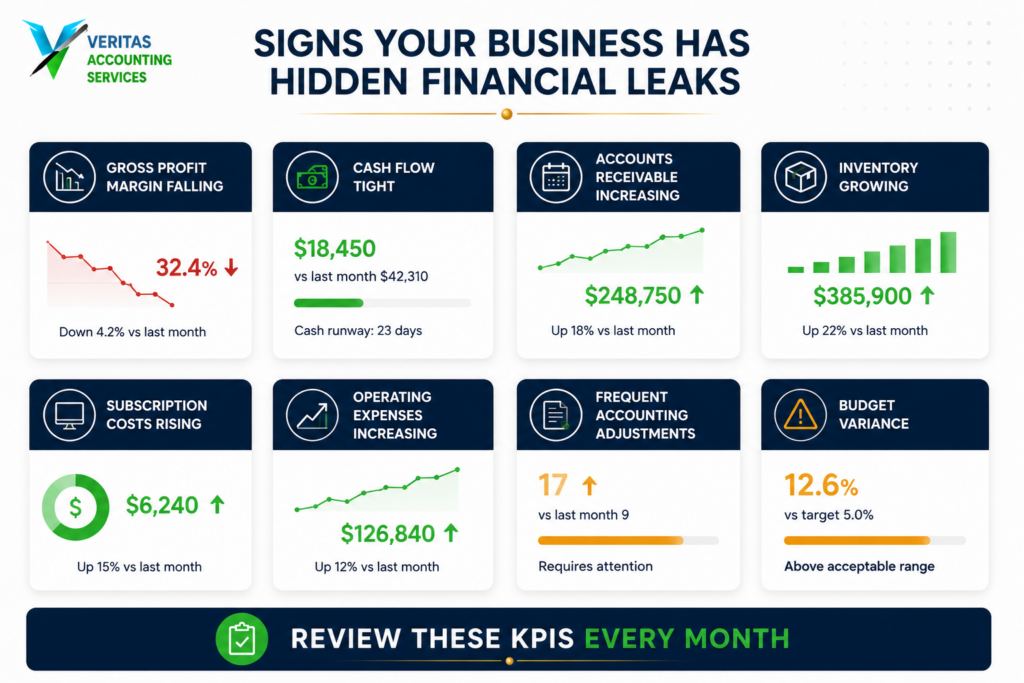
- A gradual increase in software expenses.
- Declining gross profit margins.
- Slow customer collections.
- Rising inventory levels.
- Increasing payroll costs.
By identifying these issues early, businesses can take corrective action before they significantly reduce profitability.
Regular financial reviews are one of the most effective ways to eliminate hidden financial leaks.
Building a Business That Keeps More of What It Earns
Growing revenue is important.
Keeping more of that revenue is equally important.
Many businesses focus heavily on generating new customers while overlooking opportunities to improve profitability through better financial management.
Small improvements made consistently often produce significant long-term results.
Examples include:
- Reviewing pricing annually.
- Monitoring cash flow monthly.
- Reconciling bank accounts regularly.
- Removing unnecessary subscriptions.
- Improving inventory turnover.
- Following up on overdue invoices.
- Comparing actual results with budgets.
These improvements may appear modest individually, but together they strengthen financial performance and support sustainable growth.
Frequently Asked Questions
What are hidden financial leaks?
Hidden financial leaks are unnecessary expenses, inefficient processes, or weak financial controls that gradually reduce business profitability without being immediately obvious.
Why do businesses fail to identify hidden financial leaks?
Many financial leaks develop slowly over time.
Without regular financial reporting, budgeting, and performance reviews, they often become part of normal business operations.
Can better bookkeeping reduce hidden financial leaks?
Yes.
Accurate bookkeeping provides reliable financial information that helps businesses identify duplicate expenses, cash flow issues, pricing problems, and operational inefficiencies.
How often should businesses review their finances?
Monthly financial reviews are generally recommended.
Regular monitoring allows businesses to identify trends early and make informed decisions before small issues become major financial problems.
What is the easiest financial leak to fix?
Unused software subscriptions, duplicate services, and delayed customer collections are often among the quickest and easiest opportunities to improve profitability.
Conclusion
Every business has opportunities to improve profitability.
The challenge is that many of those opportunities remain hidden beneath everyday operations.
Pricing that has not been reviewed.
Inventory sitting in storage.
Unused software subscriptions.
Delayed customer payments.
Bookkeeping inaccuracies.
Uncontrolled spending.
Individually, these issues may seem insignificant.
Collectively, they become hidden financial leaks that quietly reduce profits and limit business growth.
The most successful businesses do not simply focus on increasing sales.
They regularly review their finances, strengthen internal controls, monitor performance, and continuously improve their financial systems.
By identifying and eliminating hidden financial leaks, businesses can improve profitability without necessarily increasing revenue.
Call to Action
At Veritas Accounting Services, we help businesses identify financial inefficiencies through professional bookkeeping, financial reporting, budgeting, cash flow management, and Virtual CFO services.
If you’re looking to improve profitability, strengthen financial controls, and build a healthier business, our team is ready to help.
Contact us today to discover where your business may be losing money—and how to stop it.
GET IN TOUCH
Schedule a FREE Call