Should You Hire Another Employee or Improve Your Systems First?
Growth often creates a familiar problem for small business owners.
Sales are increasing. Customers need more attention. Administrative work keeps piling up. Employees are working longer hours, and the owner feels pulled in every direction.
The immediate reaction is often simple:
“We need another person.”
Sometimes that is exactly right. But hiring employees too quickly can also add permanent costs without fixing the real reason your team is overwhelmed.
Before adding another salary to payroll, ask a more important question:
Do we actually need another employee, or do we need better systems?
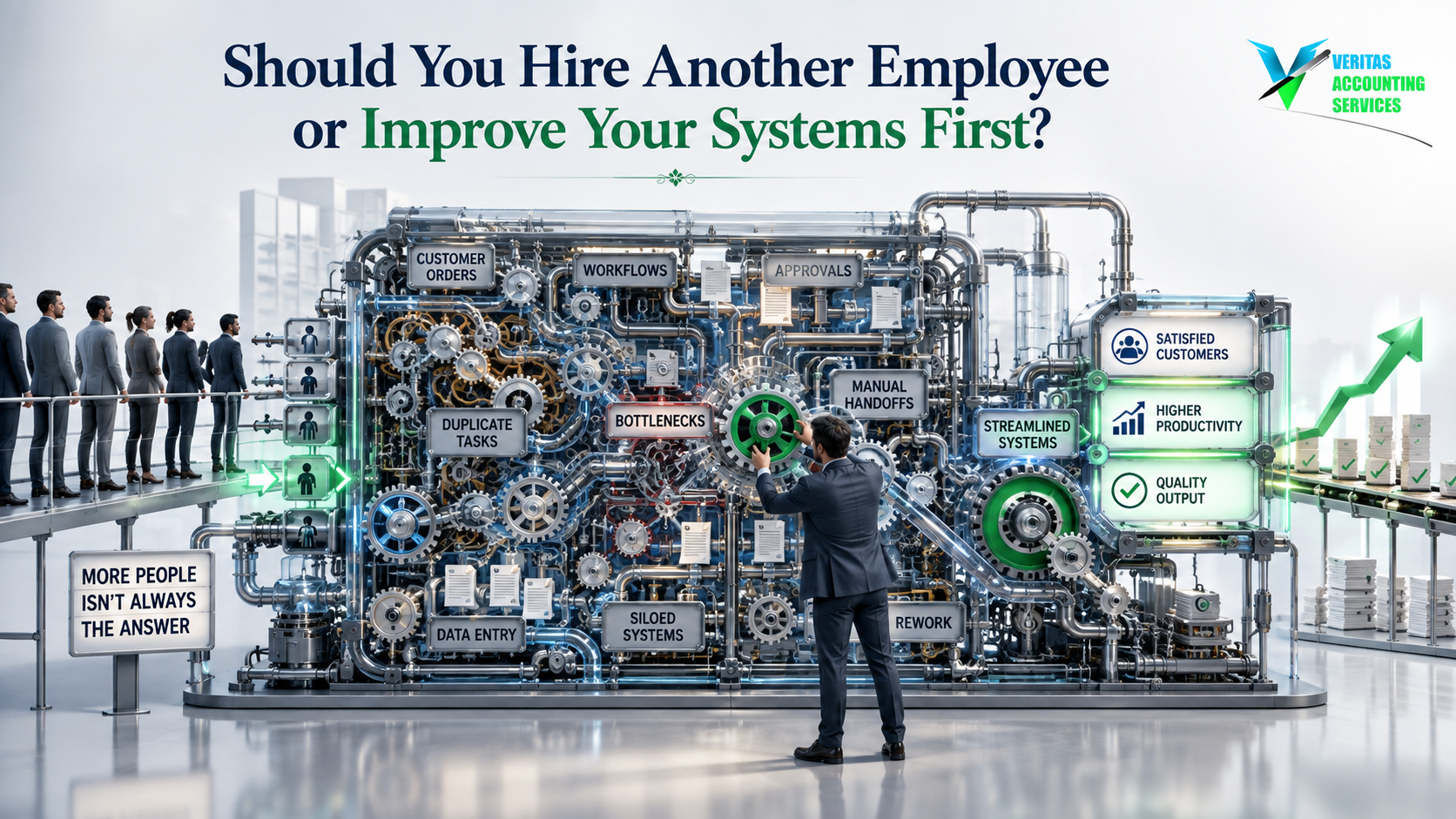
This distinction matters. An inefficient process does not automatically become efficient because another person is added to it. In many cases, improving workflows, eliminating unnecessary tasks, using automation, and creating clearer responsibilities can unlock significant capacity within the existing team.
For a growing company, hiring employees should therefore be an investment decision—not an automatic response to everyone feeling busy.
Here is how to decide whether your next investment should be another employee or a better way of working.
Being Busy Does Not Always Mean You Need More People
A busy team can certainly indicate a capacity problem.
But it can also indicate a process problem.
Consider how much time employees may spend every week:
Entering the same information into multiple systems
Searching emails for documents
Preparing repetitive spreadsheets
Following up manually for approvals
Correcting avoidable errors
Producing reports nobody uses
Copying information between applications
Attending unnecessary meetings
If this is happening across your organization, hiring employees may temporarily reduce pressure, but it will not remove the inefficiency.
The new employee enters the same broken workflow.
Soon, that person becomes overloaded too.
Then management begins considering another hire.
Payroll grows faster than productivity.
Before hiring employees, understand exactly where your team’s time is going and which activities genuinely create value.
Veritas Expert Insight
Headcount should solve a genuine capacity shortage, not hide inefficient processes. Understand why your team is overloaded before committing to another permanent payroll cost.
Before Hiring Employees, Find the Real Bottleneck
Every growing business eventually develops bottlenecks.
The challenge is identifying them correctly.
Imagine your accounting department cannot complete month-end reporting on time.
Management may conclude that another accountant is required.
But look deeper.
Perhaps employees are waiting for bank statements. Receipts arrive through emails, messaging apps, and paper files. Sales information must be exported manually. Invoices require several approvals. Reconciliations are delayed because transactions have not been categorized correctly.
In this situation, hiring employees may address the symptom rather than the cause.
Centralized document management, integrated software, automated transaction feeds, clearer approval procedures, and standardized month-end processes could save many hours.
Once the workflow has been improved, you may discover that the existing team has enough capacity.
If the workload remains too high even after those improvements, you now have stronger evidence that another employee is genuinely needed.
Understand the True Cost of Hiring Employees
Salary is only one part of employment cost.
Depending on your location and circumstances, additional costs can include:
Employer payroll taxes
Employee benefits
Insurance
Recruitment
Training
Equipment
Software subscriptions
Workspace
Bonuses
Paid leave
Management and supervision
Suppose a business plans to hire someone at an annual salary of $60,000.
The real financial commitment can be considerably higher after these additional costs are included.
That does not make hiring a bad decision.
It simply means management should evaluate the full investment.
Before hiring employees, prepare a realistic 12-month cost estimate and determine what additional revenue, capacity, savings, or strategic value the position is expected to create.
Ask What the New Employee Will Actually Do
Before approving a position, write down what that employee will do during a normal week.
Then separate those responsibilities into three groups.
Work That Requires Human Expertise
This may include customer relationships, leadership, negotiations, professional judgment, creative work, complex problem-solving, and strategic decision-making.
These activities often justify additional talent.
Work That Could Be Automated
Routine data entry, recurring reports, document collection, scheduling, reminders, transaction matching, and basic approval workflows may be candidates for automation.
Work That Could Be Eliminated
Some tasks exist only because nobody has questioned them.
If a report is produced every Friday but nobody uses it, stop producing it.
If the same information is entered into three applications, redesign the workflow.
If five people approve a routine transaction when two approvals provide adequate control, reconsider the process.
This exercise should happen before hiring employees because it reveals how much of the apparent workload is actually necessary.
Improve Business Systems Before Hiring Employees
Good systems allow talented employees to spend more time doing valuable work.
A system does not have to mean expensive software.
It could be:
A documented Standard Operating Procedure
A standardized template
A clear approval workflow
An automated reminder
Integrated applications
A centralized document system
A management dashboard
Clearly assigned responsibilities
Small improvements can produce substantial results.
Imagine ten employees each save five hours per week through better workflows.
That creates 50 hours of additional weekly capacity.
You have effectively recovered more than one full-time working week without immediately increasing headcount.
This is why improving systems before hiring employees can have such a powerful financial impact.
Automation Should Improve Productivity, Not Simply Reduce Headcount
Automation is sometimes presented as a way to replace employees.
That misses much of its value.
The better objective is to remove repetitive work so employees can spend more time on activities requiring experience, judgment, and relationships.
Suppose an employee spends 15 hours every week manually compiling management reports.
Better integrations and automated reporting reduce that work to three hours.
The company has recovered 12 hours of productive capacity every week.
Those hours could now support:
Customers
Sales
Financial analysis
Quality control
Business development
Strategic projects
When considering hiring employees, first identify whether technology can free your existing team to perform higher-value work.
Automation should make good employees more productive, not simply make the organization smaller.
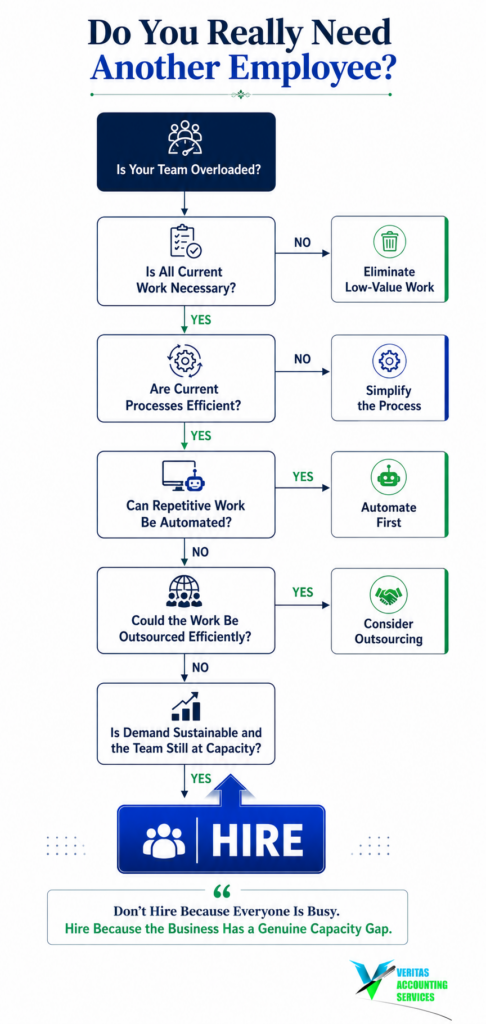
When Hiring Employees Is the Right Decision
Improving systems does not mean avoiding recruitment.
Sometimes the business genuinely needs additional people.
Hiring employees makes sense when:
Existing processes are already efficient.
The workload cannot reasonably be automated.
Customer demand is sustainable.
Existing employees consistently operate near practical capacity.
Service quality is beginning to suffer.
The new role supports revenue or essential operations.
The business can comfortably absorb the cost.
Responsibilities for the position are clearly defined.
Consider a professional services firm whose consultants are fully utilized and regularly turning away profitable client work.
If its workflows are efficient and demand is sustainable, adding another consultant may generate significantly more value than the employment cost.
In this situation, hiring is not fixing inefficiency.
It is expanding productive capacity.
Use Financial KPIs Before Making the Decision
Hiring decisions should not be based solely on how busy everyone feels.
Financial and operational data can provide a clearer picture.
One useful metric is revenue per employee:
Revenue ÷ Number of Employees
If revenue rises 10% while headcount increases 30%, management should understand why.
Other useful measures include:
Gross profit per employee
Payroll cost as a percentage of revenue
Employee utilization
Revenue per billable employee
Overtime hours
Customer response times
Output per employee
Gross margin
No single metric should decide whether hiring employees is appropriate.
Together, however, these measures can show whether the company has a genuine capacity shortage or simply needs better productivity.
Consider the Cash Flow Impact Before Hiring Employees
A new employee creates a recurring financial commitment.
That distinction is important.
A software implementation may involve an upfront investment, but salary and employment costs continue every month.
Prepare a cash flow forecast before hiring employees and ask:
What will the role cost over the next 12 months?
When will the employee become fully productive?
How much additional revenue can the position support?
What happens if revenue falls below forecast?
Do we have enough working capital?
How long can the business support the position without additional revenue?
A company can be profitable and still experience cash flow pressure.
Expanding payroll faster than sustainable revenue growth can turn an exciting period of expansion into financial stress.
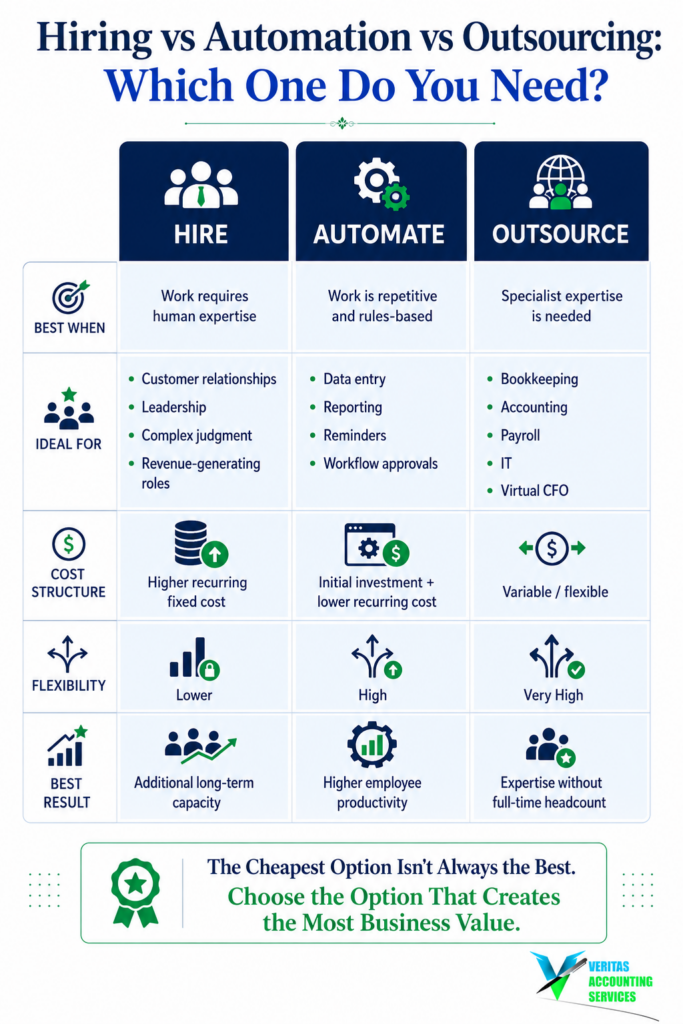
Outsourcing Can Be the Third Option
The choice is not always between improving systems and hiring employees.
There may be a third option: outsourcing.
Businesses can outsource functions such as bookkeeping, accounting, payroll, IT, marketing, HR, and financial management.
This can be particularly useful when specialist expertise is required but there is not enough ongoing work to justify a full-time position.
For example, a growing business may need sophisticated budgeting, forecasting, KPI analysis, and cash flow management.
That does not necessarily mean it needs a full-time CFO.
Virtual CFO services can provide strategic financial support without adding a full executive salary to payroll.
Before hiring employees for specialized roles, compare the cost, flexibility, expertise, and control offered by both employment and outsourcing.
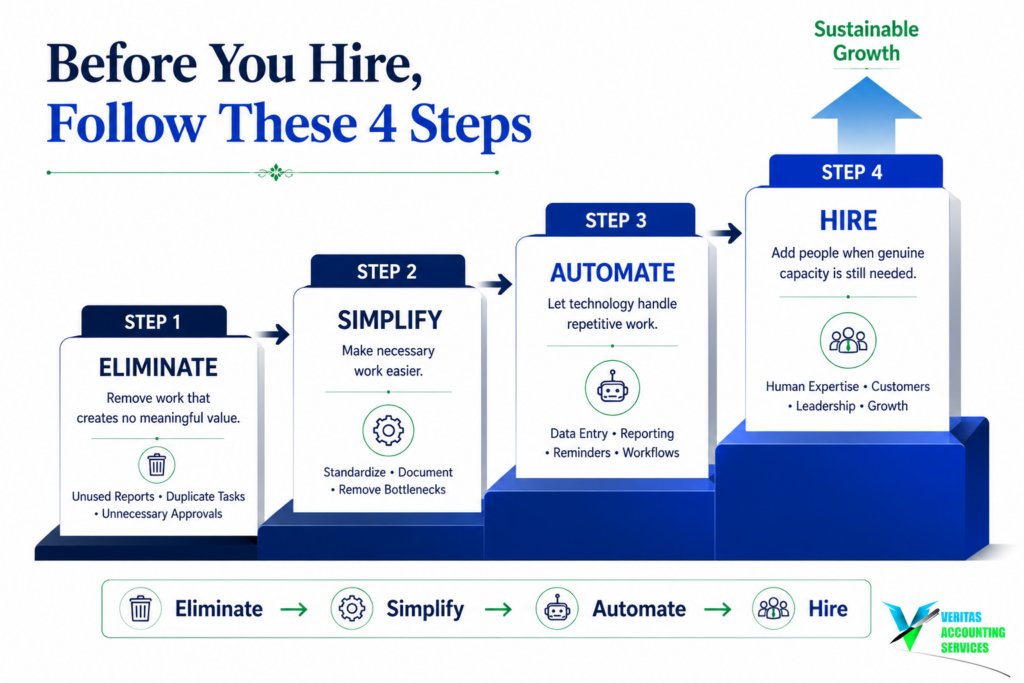
Follow This Framework: Eliminate, Simplify, Automate, Hire
Before increasing headcount, work through four stages.
1. Eliminate
Remove activities that no longer create meaningful value.
2. Simplify
Reduce unnecessary steps, approvals, reports, and handoffs.
3. Automate
Use technology for repetitive, rules-based activities where it genuinely saves time and reduces errors.
4. Hire
After completing the first three stages, evaluate the remaining workload.
If your team is still operating at sustainable maximum capacity, hiring employees becomes much easier to justify.
The order matters.
Hiring first can lock inefficient processes into the organization.
Improving the system first ensures that new employees enter an environment where they can become productive faster.
The CFO Perspective on Hiring Employees
Business owners often ask:
“Can we afford another employee?”
A CFO asks a broader set of questions.
What return should the position generate?
How will it affect gross and net margins?
How much revenue is needed to cover the total employment cost?
When will the employee reach full productivity?
How will the additional payroll affect cash flow?
Could outsourcing provide the same expertise more efficiently?
Could automation eliminate enough work to postpone recruitment?
What happens if expected revenue growth does not materialize?
This approach turns hiring employees from an emotional reaction into a financial investment decision.
For growing companies, that distinction can be extremely valuable.
Final Thoughts
When everyone is overloaded, another employee can feel like the obvious answer.
But more people do not automatically create a more productive business.
Before hiring employees, identify where the workload is coming from.
Eliminate unnecessary tasks.
Simplify complicated processes.
Automate repetitive work.
Improve accountability.
Consider outsourcing where specialist expertise is needed.
Then evaluate the remaining capacity.
If your team is still stretched and customer demand is sustainable, hiring employees may be exactly the right investment.
At Veritas Accounting Services, we help growing businesses evaluate decisions such as recruitment, outsourcing, budgeting, automation, and expansion using accurate financial information and Virtual CFO support.
The objective is not to avoid hiring.
It is to make sure every new hire strengthens the business rather than adding another person to an inefficient process.
Frequently Asked Questions
Should a small business improve systems before hiring employees?
In many cases, yes. Reviewing workflows before hiring employees can reveal unnecessary tasks, inefficient processes, and opportunities for automation. If the workload remains after those improvements, additional headcount may be justified.
How do I know when my business needs another employee?
Look for sustainable customer demand, efficient existing processes, high employee utilization, declining service capacity, and a clear financial return from the new position.
What costs should I consider when hiring employees?
Consider salary, payroll taxes, benefits, recruitment, training, equipment, software, insurance, workspace, paid leave, and management time when calculating the true cost.
Should I outsource instead of hiring?
Outsourcing can be attractive when the business needs specialist expertise or flexible capacity but does not require a full-time role. Compare cost, control, workload, expertise, and long-term requirements before deciding.
How can a Virtual CFO support hiring decisions?
A Virtual CFO can forecast payroll costs, analyze cash flow, calculate revenue requirements, evaluate workforce KPIs, compare outsourcing alternatives, and assess whether hiring employees is financially sustainable.
Before You Add Another Salary, Look at the Numbers
Hiring employees can accelerate growth when the timing is right. But adding permanent payroll costs to inefficient processes can make a growing business less profitable rather than more productive.
Veritas Accounting Services helps businesses evaluate hiring, outsourcing, automation, and growth decisions through accurate accounting, financial reporting, and Virtual CFO services.