How to Manage Multiple Currencies in an International Business
Expanding into international markets opens the door to exciting growth opportunities. Businesses can reach new customers, work with overseas suppliers, and build a global presence without establishing offices in every country. However, as international operations grow, so does financial complexity.
Receiving payments in Euros, paying suppliers in British Pounds, maintaining a bank account in U.S. Dollars, and reporting financial statements in another currency can quickly become overwhelming if the right systems are not in place.
Many businesses assume that converting one currency into another is all that is required. In reality, managing multiple currencies involves much more than simple exchange rate calculations. Every foreign currency transaction affects revenue recognition, expenses, cash flow, financial reporting, and profitability.
Without proper multi-currency accounting, businesses may experience inaccurate financial reports, unexpected exchange gains or losses, reconciliation issues, and poor financial decision-making.
Fortunately, these challenges can be managed with the right accounting processes, technology, and financial expertise.
In this guide, we’ll explore how international businesses can effectively manage multiple currencies while maintaining accurate financial records and making better business decisions.
Why Multi-Currency Management Matters More Than Ever
International business is no longer limited to large multinational corporations.
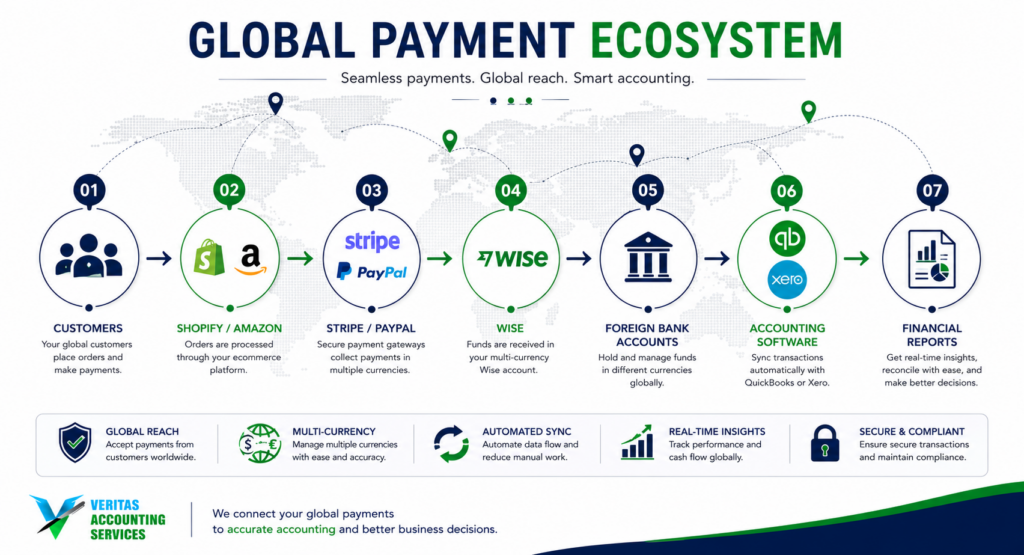
Today, even small businesses regularly sell products through Shopify, Amazon, Etsy, and WooCommerce to customers around the world. Service-based companies invoice overseas clients, while importers purchase inventory from international suppliers using different currencies.
As a result, businesses often deal with:
Customers paying in multiple currencies.
International suppliers issuing invoices in foreign currencies.
Overseas bank accounts.
Payment gateways such as Stripe and PayPal.
Global money transfer platforms like Wise.
Currency fluctuations affecting profitability.
Managing all these transactions manually increases the likelihood of errors and consumes valuable time.
This is why multi-currency accounting has become an essential part of modern financial management rather than an optional feature.
When businesses maintain accurate multi-currency accounting, they gain a clearer understanding of profitability, improve cash flow management, and make better financial decisions based on reliable information.
Veritas Expert Insight
Many businesses focus only on exchange rates when dealing with international transactions. In reality, accurate multi-currency accounting also depends on proper bookkeeping, timely reconciliations, consistent reporting, and understanding how foreign currency movements affect overall profitability.
Understanding the Challenges of Multi-Currency Accounting
Managing multiple currencies introduces several accounting challenges that domestic businesses rarely encounter.
Recognizing these challenges is the first step toward building an efficient financial system.
Exchange Rate Fluctuations
Currency values change continuously.
A payment received today may have a different value tomorrow simply because exchange rates have moved.
For example, an invoice issued in Euros may convert into more or fewer U.S. Dollars by the time the customer pays.
Without proper multi-currency accounting, these differences may be overlooked, leading to inaccurate financial statements and incorrect profit calculations.
Multiple Bank Accounts
Many international businesses maintain bank accounts in different currencies.
For example:
U.S. Dollar account
Euro account
British Pound account
Australian Dollar account
Each account requires separate reconciliation, accurate currency conversion, and proper financial reporting.
Trying to manage these accounts manually often results in reconciliation differences and reporting inconsistencies.
Payment Gateways Create Additional Complexity
Modern businesses rarely receive payments directly into their primary bank account.
Instead, payments may flow through:
Stripe
PayPal
Wise
Amazon
Shopify Payments
Each platform applies its own settlement schedules, processing fees, currency conversions, and exchange rates.
For example, a customer may pay €1,000 through Stripe, but after processing fees and currency conversion, the amount deposited into your U.S. Dollar bank account may be significantly different.
Without proper multi-currency accounting, reconciling these transactions becomes increasingly difficult.
Currency Gains and Losses
One of the most misunderstood aspects of international accounting is exchange gains and losses.
Suppose your business invoices a customer for £10,000.
When the invoice is issued, it converts to $13,000.
Thirty days later, the customer pays when the exchange rate has changed, and the payment now converts to $13,350.
Your business hasn’t earned additional revenue.
Instead, it has experienced a foreign exchange gain created solely by changes in currency values.
Similarly, if exchange rates move in the opposite direction, the business records an exchange loss.
Understanding these adjustments is an important part of accurate multi-currency accounting and helps businesses present reliable financial statements.
Best Practices for Managing Multiple Currencies
Managing international finances becomes much easier when businesses establish clear accounting procedures from the beginning.
Here are some of the most effective practices.
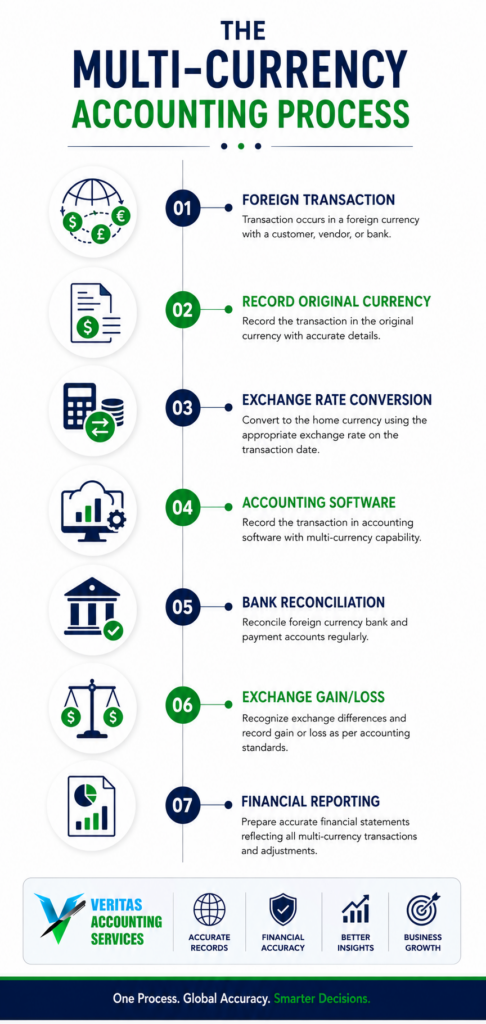
Record Every Transaction in Its Original Currency
One of the biggest mistakes businesses make is converting transactions before recording them.
Instead, every invoice, bill, expense, and receipt should first be recorded in the original transaction currency.
Modern accounting software automatically converts amounts into the business’s reporting currency while preserving the original transaction details.
This approach improves accuracy, simplifies audits, and makes reconciliation significantly easier.
Use Accounting Software That Supports Multi-Currency Accounting
Managing multiple currencies using spreadsheets may work temporarily, but it becomes increasingly risky as transaction volumes grow.
Modern accounting platforms such as QuickBooks Online and Xero include built-in multi-currency accounting features that automatically:
Track exchange rates.
Convert foreign transactions.
Calculate exchange gains and losses.
Generate consolidated financial reports.
Support multiple foreign currency bank accounts.
These capabilities reduce manual work and improve the accuracy of financial reporting.
Each foreign currency bank account, payment gateway, and digital wallet should be reconciled against accounting records to identify:
Missing transactions.
Duplicate entries.
Incorrect exchange rates.
Unrecorded bank charges.
Currency conversion differences.
Regular reconciliation ensures that financial statements remain accurate and that issues are identified before they become significant problems.
Monitor Exchange Rates Regularly
Exchange rates can change several times throughout the day, and even small fluctuations can significantly affect businesses with high transaction volumes.
For example, an exporter receiving payments in Euros may see a noticeable difference in the amount converted into U.S. Dollars simply because the exchange rate changed between the invoice date and the payment date.
Rather than relying on outdated or manually entered rates, businesses should use accounting software that updates exchange rates automatically or establish a consistent process for reviewing them regularly.
Accurate exchange rates improve financial reporting, reduce reconciliation differences, and provide a more realistic picture of business performance.
Separate Exchange Gains and Losses from Operating Income
Currency fluctuations should never distort the true performance of your business.
A profitable month shouldn’t appear even more profitable simply because exchange rates moved in your favour. Likewise, a temporary currency loss shouldn’t hide the fact that your operations performed well.
Good multi-currency accounting separates foreign exchange gains and losses from normal operating income.
Doing so allows management to understand whether profitability improved because the business performed better or simply because currencies moved in a favourable direction.
This distinction is particularly important when reviewing financial performance, preparing budgets, or making strategic decisions.
Review Cash Flow by Currency
Many international businesses focus only on total cash balances.
However, knowing you have $200,000 in total cash doesn’t tell the whole story if those funds are spread across several currencies.
For example:
USD Account – $90,000
EUR Account – €45,000
GBP Account – £20,000
AUD Account – AU$30,000
Each currency may be required for different suppliers, payroll obligations, taxes, or operating expenses.
Monitoring cash flow by currency helps businesses avoid unnecessary conversion costs and maintain sufficient balances where they are needed most.
This is one of the most practical benefits of effective multi-currency accounting.
Veritas Expert Insight
Businesses often lose money through unnecessary currency conversions rather than exchange rate movements. Holding the right currency for future payments can reduce banking fees, minimise conversion costs, and improve cash flow efficiency.
How Technology Simplifies Global Finance
Managing international finances manually is no longer practical for growing businesses.
Today’s accounting platforms integrate with banks, payment gateways, and business applications to automate much of the work involved in multi-currency accounting.
Cloud accounting software such as QuickBooks Online and Xero automatically records foreign currency transactions, calculates exchange gains and losses, updates exchange rates, and produces consolidated financial reports.
Businesses using platforms like Shopify and Amazon can integrate sales data directly into their accounting systems, while payment processors such as Stripe, PayPal, and Wise simplify international collections and settlements.
Automation offers several advantages:
Faster bookkeeping.
Reduced manual errors.
Automatic exchange rate calculations.
Easier bank reconciliations.
Improved financial reporting.
Better visibility across multiple currencies.
Technology doesn’t eliminate the need for professional accounting advice, but it significantly improves efficiency and accuracy.
Common Multi-Currency Accounting Mistakes
Even experienced businesses can make mistakes when managing international finances.
Avoiding these common errors can save considerable time and money.
Recording Transactions in the Wrong Currency
Every transaction should be recorded in the currency in which it originally occurred.
Converting amounts before recording them often creates reconciliation issues later.
Mixing Different Currencies in One Bank Account
Each foreign currency account should be maintained separately within the accounting system.
Combining different currencies into a single account makes reconciliation difficult and reduces reporting accuracy.
Ignoring Exchange Gains and Losses
Some businesses record only the amount deposited into their bank account.
This approach overlooks exchange gains or losses and results in inaccurate financial statements.
Proper multi-currency accounting recognises these adjustments automatically.
Delaying Bank Reconciliations
Waiting several months before reconciling foreign currency accounts often creates larger problems.
Monthly reconciliations help identify missing transactions, duplicate entries, bank fees, and exchange differences before they become difficult to resolve.
Depending on Manual Spreadsheets
While spreadsheets remain useful for analysis, they should not be the primary system for managing international accounting.
As transaction volumes increase, manual calculations become time-consuming and more susceptible to errors.
Managing multiple currencies successfully requires more than good software.
It requires consistent accounting processes, regular reconciliations, and an understanding of international financial reporting.
An experienced accounting professional can help businesses:
Maintain accurate multi-currency accounting records.
Reconcile foreign bank accounts and payment gateways.
Record exchange gains and losses correctly.
Prepare reliable financial statements.
Monitor international cash flow.
Improve profitability through better financial reporting.
Support tax compliance across multiple jurisdictions.
As international operations grow, having professional financial guidance becomes increasingly valuable.
Instead of spending hours resolving reconciliation issues or investigating currency differences, business owners can focus on expanding their business with confidence.
Final Thoughts
Expanding internationally creates exciting opportunities, but it also introduces financial complexity that cannot be managed with basic bookkeeping alone.
Successful global businesses understand that multi-currency accounting is more than converting one currency into another. It involves managing exchange rate fluctuations, reconciling foreign currency accounts, monitoring international cash flow, recording exchange gains and losses accurately, and producing reliable financial reports that support informed decision-making.
By combining strong accounting processes with modern cloud accounting software and experienced financial guidance, businesses can reduce risk, improve reporting accuracy, and operate confidently across international markets.
At Veritas Accounting Services, we help international businesses simplify complex financial processes through accurate bookkeeping, multi-currency accounting, financial reporting, and Virtual CFO services—allowing business owners to focus on growth while we manage the numbers.
Frequently Asked Questions
What is multi-currency accounting?
Multi-currency accounting is the process of recording, managing, and reporting financial transactions conducted in different currencies while maintaining accurate financial statements in the company’s reporting currency.
Which accounting software supports multi-currency accounting?
Popular platforms such as QuickBooks Online and Xero include built-in multi-currency accounting features that automatically handle exchange rates, foreign currency transactions, and exchange gains or losses.
What is the difference between realized and unrealized exchange gains?
A realized exchange gain or loss occurs when a foreign currency transaction is settled. An unrealized exchange gain or loss represents the change in value of an outstanding foreign currency balance before it is paid or received.
How often should foreign currency accounts be reconciled?
Foreign currency bank accounts, payment gateways, and digital wallets should ideally be reconciled every month to ensure accurate financial reporting and identify discrepancies promptly.
Why is multi-currency accounting important for international businesses?
Multi-currency accounting helps businesses maintain accurate financial records, manage exchange rate fluctuations, improve cash flow visibility, comply with accounting standards, and make better business decisions.
Ready to Simplify Your International Accounting?
Managing multiple currencies doesn’t have to be complicated. At Veritas Accounting Services, we help international businesses maintain accurate multi-currency accounting, reconcile global payment platforms, manage foreign currency bank accounts, and produce reliable financial reports that support smarter decisions.
Whether you sell globally, work with overseas suppliers, or operate across multiple countries, our team can help streamline your international accounting processes.