






Who Should Be on Your Small Business Financial Team?
Running a small business often means wearing several hats at once. You may be responsible for sales in the morning, operations in the afternoon, and reviewing cash flow before the day ends.
But as a business grows, one area becomes increasingly difficult to manage alone: finance.
Accurate bookkeeping, payroll, taxes, financial reporting, budgeting, cash flow management, and strategic planning require different skills. Expecting one person—or the business owner—to handle everything can eventually create gaps.
That is why building the right small business financial team matters.
The good news is that you do not necessarily need a large finance department or several full-time employees. Modern businesses can combine internal staff with outsourced specialists and Virtual CFO services to access the expertise they need at each stage of growth.
The real question is not whether you need financial support but small business financial team.
It is: who should be on your financial team, and what should each person actually do?
Why One Accountant Cannot Always Do Everything
Many small business owners use the word “accountant” to describe almost every financial role.
But bookkeeping, accounting, taxation, payroll, and financial strategy are different responsibilities.
A bookkeeper may be excellent at maintaining accurate records but may not provide advanced tax strategy.
A tax professional may prepare an accurate return but may not monitor weekly cash flow.
And an accountant who prepares monthly financial statements may not necessarily provide the forecasting and strategic advice expected from a CFO.
An effective small business financial team brings these different responsibilities together.
Think about it like building a management team. You would not expect your marketing manager to also manage IT, operations, and legal matters simply because all of those functions support the same company.
Finance works the same way.
Understanding each role helps you avoid both unnecessary costs and dangerous gaps in financial management.
Veritas Expert Insight
A strong financial team is not about hiring more people. It is about making sure every important financial responsibility has the right person accountable for it.
The Bookkeeper: Building the Financial Foundation
Every strong financial system starts with accurate bookkeeping.
Your bookkeeper is responsible for keeping day-to-day financial records organized and reliable.
Depending on the business, responsibilities may include:
- Recording and categorizing transactions
- Reconciling bank and credit card accounts
- Maintaining accounts payable and receivable
- Recording loans and fixed assets
- Supporting month-end closing
- Maintaining supporting documentation
- Helping keep accounting software accurate
Bookkeeping may appear operational, but its impact reaches much further.
If transactions are incorrectly categorized, reconciliations are incomplete, or balances are unreliable, every report produced afterward may also be unreliable.
That affects tax preparation, financial analysis, cash flow forecasting, and management decisions.
For this reason, the bookkeeper is often the foundation of the small business financial team.
Good bookkeeping does not simply tell you where money was spent. It creates trustworthy financial data that everyone else can use. That is why building the right small business financial team matters.
The Accountant: Turning Records Into Financial Information
If the bookkeeper maintains the financial engine, the accountant helps make sense of what it produces.
An accountant generally works at a higher reporting and review level.
Responsibilities can include:
- Reviewing financial records
- Preparing or reviewing financial statements
- Making adjusting entries
- Reviewing balance sheet accounts
- Managing accruals and prepayments
- Monitoring accounting policies
- Supporting year-end closing
- Coordinating with tax professionals
A growing business needs more than a Profit & Loss Statement generated directly from accounting software.
Management needs confidence that the numbers are complete, properly classified, and meaningful.
The accountant helps provide that confidence.
Within a small business financial team, this role creates an important bridge between transactional bookkeeping and higher-level financial decision-making.
The Tax Advisor: Planning Before the Deadline
Tax professionals are often contacted only when a return needs to be filed.
That approach misses much of their potential value.
A good tax advisor should help the business understand not only what it owes, but also how current business decisions may affect future tax liabilities.
Depending on the jurisdiction and circumstances, this may involve reviewing:
- Business structure
- Estimated tax obligations
- Available deductions and credits
- Capital expenditure decisions
- Owner compensation
- Tax payment timing
- Business expansion
- Year-end planning opportunities
The key word is planning.
Tax compliance looks backward. Tax planning looks forward.
Your small business financial team should therefore involve the tax advisor before major decisions are finalized—not months afterward when the tax return is being prepared.
Proactive communication between your accountant, CFO, and tax professional can prevent situations where a financially sensible decision creates an unexpected tax consequence.
The Payroll Specialist: Getting a Sensitive Area Right
Payroll can appear straightforward until something goes wrong.
Businesses must calculate compensation accurately, maintain employee information, process deductions, meet filing requirements, and make payments on time.
Errors can affect employees directly and may also create compliance problems.
A payroll specialist or reliable payroll provider helps manage this process consistently.
Depending on the business, the role may cover:
- Payroll processing
- Employee and contractor records
- Payroll tax calculations
- Required filings
- Deductions and benefits
- Year-end payroll reporting
As the number of employees increases, payroll becomes an increasingly important part of the small business financial team.
It should also connect properly with bookkeeping.
Payroll reports need to reconcile with accounting records, payroll liabilities should be reviewed, and payments should match what actually leaves the bank.
Treating payroll as an isolated system can create unnecessary reconciliation problems later. That is why building the right small business financial team matters.
The Virtual CFO: Looking Beyond Today’s Numbers
Bookkeeping tells you what happened.
Accounting helps explain what happened.
A CFO asks what should happen next.
This is where financial management moves from record keeping into strategy.
A Virtual CFO may help management with:
- Cash flow forecasting
- Budgeting
- KPI development
- Profitability analysis
- Scenario planning
- Pricing decisions
- Working capital management
- Financing decisions
- Expansion planning
- Management reporting
This role becomes particularly valuable as the company grows and financial decisions become more complicated.
For example, suppose revenue is increasing rapidly.
The business owner sees growth.
The Virtual CFO may see something else: gross margins are declining, receivables are taking longer to collect, inventory is increasing, and available cash will become tight within four months.
That perspective can change management decisions before a problem develops.
Adding strategic financial leadership can therefore transform a small business financial team from a reporting function into a decision-support function.
Your Banker and Lender Also Matter
Not every member of your financial network works inside your accounting system.
A strong banking relationship can become important when a company needs working capital, equipment financing, credit facilities, or funding for expansion.
The worst time to build that relationship is when the business urgently needs money.
Keeping your banker informed about the company’s progress and maintaining reliable financial statements can make future financing conversations easier.
Your accountant and CFO can also help prepare the financial information lenders typically want to understand.
This is another reason financial records should remain current throughout the year rather than being cleaned up only when someone requests them.
Do You Need All These People as Employees?
Usually, no.
This is one of the biggest misconceptions about building a small business financial team.
A company might need bookkeeping support every week but tax advice only periodically. It may need payroll processing each pay cycle and CFO guidance several hours each month.
Hiring full-time specialists for every function would be unnecessary for many SMEs.
Instead, businesses can build a hybrid model.
For example, you might have an internal administrator working with an outsourced bookkeeping team, an external tax advisor, a payroll platform or provider, and a Virtual CFO who joins management meetings monthly.
The objective is not to create the largest finance department.
It is to create the right one.
When Should Your Financial Team Expand?
The financial support needed by a two-person startup is very different from what a growing multi-million-dollar company requires.
Your small business financial team should evolve with the business.
Some warning signs that additional financial expertise may be needed include:
- Financial statements are consistently late.
- Bank accounts are not reconciled regularly.
- Tax bills frequently come as a surprise.
- You cannot confidently forecast cash flow.
- Revenue is growing but cash remains tight.
- Management does not know which products or services are most profitable.
- Major decisions are being made without financial analysis.
- The owner spends too much time handling accounting tasks.
- Lenders or investors are requesting better reporting.
These are not simply accounting problems.
They often indicate that the financial infrastructure has not kept pace with business growth. That is why building the right small business financial team matters.
How the Financial Team Should Work Together
Having the right professionals is only half the solution.
They also need to communicate.
Your bookkeeper may notice unusual transactions.
Your accountant may identify declining margins.
Your tax advisor may see a planning opportunity.
Your CFO may recognize that the company needs additional working capital.
When these professionals operate independently, valuable information can remain fragmented.
A connected small business financial team creates a continuous flow:
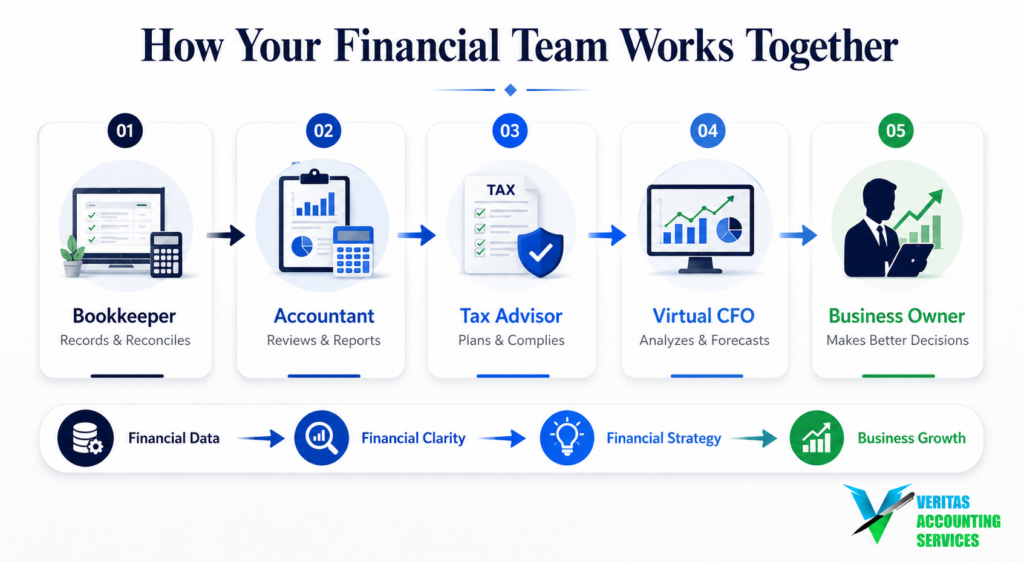
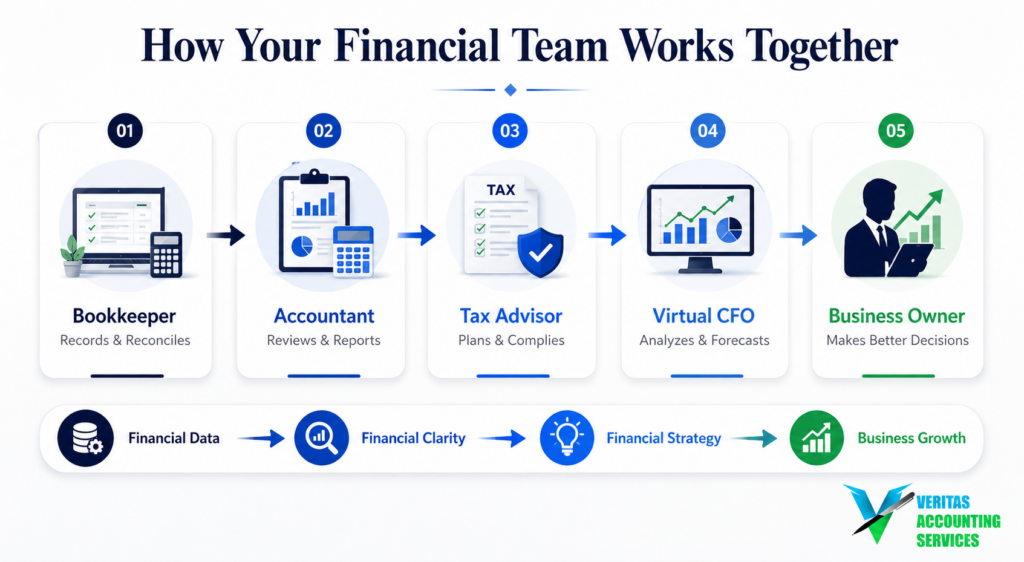
Accurate records → Reliable reports → Financial analysis → Tax planning → Strategic decisions
This is where technology can help.
Cloud accounting platforms, document management systems, integrated payroll applications, and real-time reporting can allow different professionals to work from consistent financial information.
But technology does not replace responsibility.
Someone still needs to review the information, challenge unusual results, and ensure decisions are being made from accurate data.
What Should the Business Owner Do?

The business owner remains one of the most important members of the financial team.
You do not need to become an accountant.
But you should understand the financial drivers of your business.
At minimum, owners should regularly understand:
- Revenue trends
- Gross margin
- Operating profit
- Cash position
- Accounts receivable
- Accounts payable
- Debt obligations
- Working capital
- Tax obligations
- Key business KPIs
Your advisors can explain the numbers, but management must ultimately make the decisions.
The strongest small business financial team therefore does not remove the owner from finance.
It gives the owner better information with which to lead.
Final Thoughts
As a business grows, financial management becomes too important to depend on one person doing everything.
Bookkeepers maintain accurate records.
Accountants strengthen reporting.
Tax advisors support compliance and planning.
Payroll specialists manage an important employee and compliance function.
Bankers provide access to financial resources.
And Virtual CFOs turn financial information into forward-looking strategy.
Together, these professionals create a small business financial team capable of supporting better decisions and sustainable growth.
But remember: building the right team does not mean putting everyone on payroll.
For many small and medium-sized businesses, outsourced and fractional expertise provides a more flexible way to access experienced professionals while controlling costs.
At Veritas Accounting Services, we help businesses connect accurate bookkeeping and accounting with meaningful financial reporting and strategic Virtual CFO support.
Because as your business grows, your financial support should grow with it.
Frequently Asked Questions
Who should be on a small business financial team?
A small business financial team commonly includes a bookkeeper, accountant, tax advisor, payroll specialist, and, as the business becomes more complex, a CFO or Virtual CFO. Banking and other specialist advisors may also play important roles.
Does a small business really need a CFO?
Not every small business needs a full-time CFO but a small business financial team. However, growing businesses can benefit from Virtual CFO support when they need cash flow forecasting, budgeting, KPI analysis, profitability reviews, financing support, or strategic financial guidance.
What is the difference between a bookkeeper and an accountant?
A bookkeeper primarily maintains day-to-day financial records, while an accountant typically reviews those records, handles adjustments, supports financial reporting, and helps ensure the accounts accurately represent the business.
Can accounting and bookkeeping be outsourced?
Yes. Many businesses outsource bookkeeping, accounting, payroll, and CFO functions instead of employing separate full-time professionals. The appropriate model depends on transaction volume, complexity, internal resources, and management needs.
When should I expand my small business financial team?
Consider expanding your financial support when reporting becomes delayed, cash flow is difficult to predict, tax liabilities regularly surprise you, accounting takes too much management time, or business decisions require more sophisticated financial analysis with small business financial team
Build the Financial Team Your Business Actually Needs
Your business does not need more financial reports sitting unread in an inbox. It needs accurate information, clear responsibilities, and experienced professionals who can turn the numbers into better decisions.
Veritas Accounting Services supports growing businesses with bookkeeping, accounting, financial reporting, and Virtual CFO services designed to provide the financial clarity management needs.
GET IN TOUCH
Schedule a FREE Call