📩 Get A Quote : hello@veritasaccountingservices.com
A freelance business owner holding a tape measure stands in the doorway of a dedicated home office lit by morning sunlight.

Your Simple Guide to Home Office Mistakes and Better Records

A home office deduction may be available when a qualifying part of your home is used for business. Owning a desk, working remotely or paying household bills does not establish eligibility by itself. Check how the space is used, why it qualifies and which calculation method fits the facts before putting an amount on the return.

For a US sole proprietor, the main questions are practical: Is this an actual business area? Is its use regular and, where required, exclusive? Does it meet a qualifying business-use test? After those questions, you can compare the simplified option with actual expenses and apply the relevant income limitation.

This guide focuses on a sole proprietor filing Schedule C. It does not treat a corporate shareholder, partner, employee, daycare provider or landlord as having identical rules. The examples are hypothetical and the discussion covers federal tax. State treatment and unusual arrangements need their own review.

Table of contents

Home office deduction: start with eligibility

The IRS business-use-of-home overview describes several ways a home can qualify. For an ordinary office, these include exclusive and regular use as a principal place of business or as a place to meet clients in the normal course of business. A separate unattached structure has another qualifying route.

A home office deduction also has special rules for certain inventory storage and daycare uses. Those exceptions have conditions; they are not a general waiver for every room with a laptop. Identify the relevant route before comparing amounts or choosing a tax-software category.

Imagine a consultant who sends proposals from a dining table that the family uses for meals. The work may be genuine, but the same area also serves a personal purpose. Contrast that with a separately identifiable area used only and regularly for the consultant’s business. The second arrangement still needs the remaining tests reviewed, but the space-use facts are different.

For the home office deduction, describe what happens in the space rather than relying on the room’s name. A room labeled office on a floor plan can still be used personally. Conversely, qualifying space need not be an entire enclosed room with a permanent wall around it.
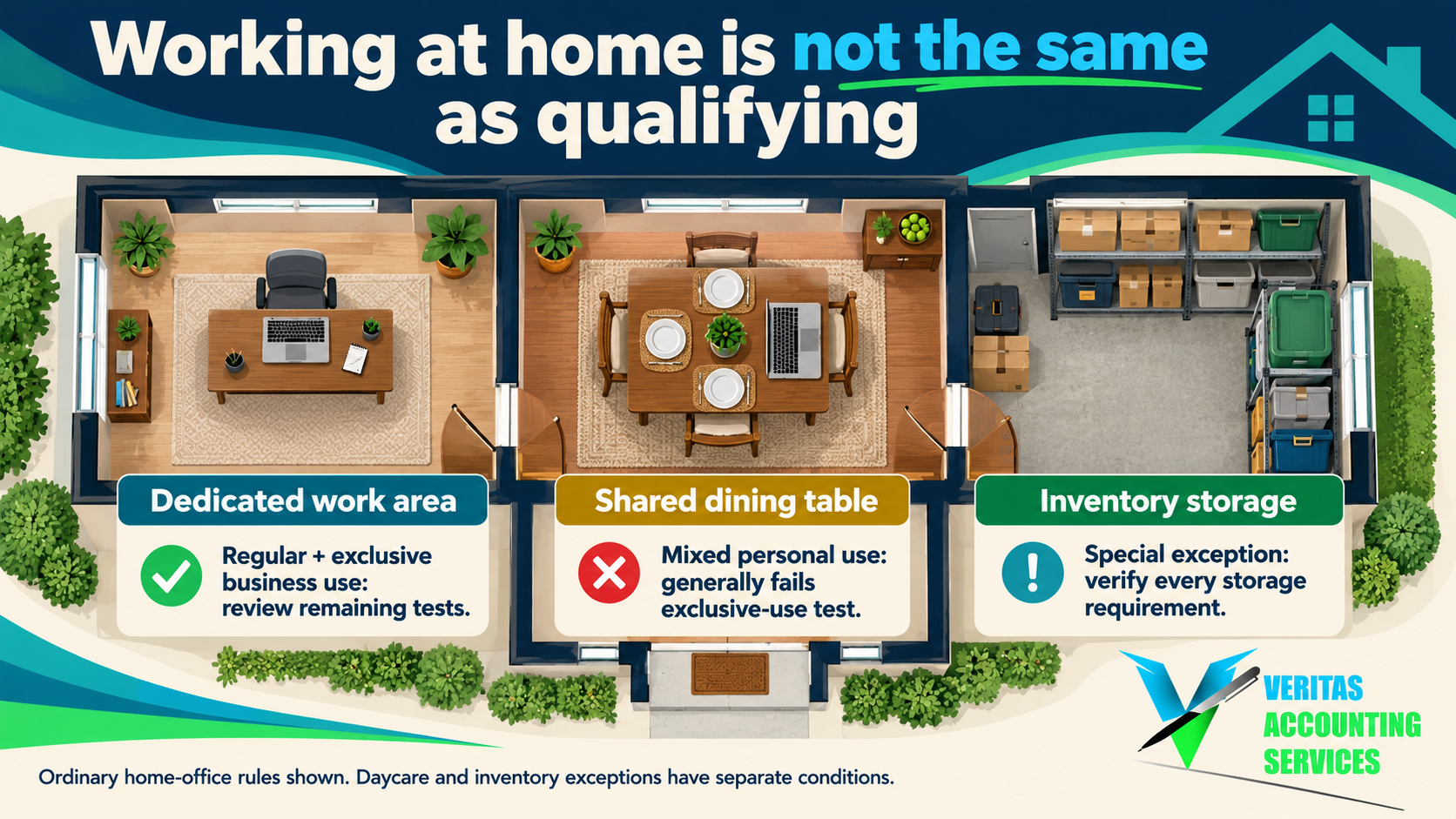
Illustrative floor-plan comparison for the home office deduction showing a dedicated work area, a mixed-use dining table and inventory storage with separate exception requirements.

The IRS Publication 587 provides more detail. The currently available edition is for 2025. This article uses its general eligibility, allocation and recordkeeping principles alongside current IRS topic and simplified-option guidance; it does not apply an old annual equipment limit to a later return.

Five checks before choosing a method

1. Identify the business and the person claiming the expense

A home office deduction begins with a trade or business, not simply an activity performed at home. Make clear which business uses the area and who is preparing the claim. Managing personal investments or handling household paperwork should not be mixed into the explanation of an operating business.

If you operate through a corporation, do not copy a sole proprietor’s Schedule C entry into your personal return. Reimbursements and entity arrangements raise separate issues. Partners also have specific reporting and reimbursement considerations. The correct starting point is the actual legal and tax structure.

The simplified option does not create a personal deduction for ordinary employee home-office expenses. The IRS simplified-option page specifically distinguishes employee expenses from qualifying self-employment use. Someone can have wages and a separate business, so identify which activity actually uses the space instead of deciding from employment status alone.

Our accountable plan guide explains the separate employer reimbursement process. Use it for that question rather than assuming a corporate reimbursement and an owner’s home office deduction follow the same filing route.

2. Confirm regular use and the exclusive-use requirement

For the home office deduction, regular use requires more than occasional or incidental business activity. Explain the normal pattern: what work happens there, when it happens and how the area supports the business. The IRS evaluates the facts and circumstances; there is no universal shortcut based on owning a particular desk.

Exclusive use means the identified area is used only for the business when that requirement applies. A shared family recreation space generally fails this test even if substantial work also happens there. A photo taken with personal items removed does not change the actual pattern of use.

The IRS allows a room or another separately identifiable area, without requiring a permanent partition. Measure the area you can support. Do not claim an entire bedroom merely because a small work area occupies one corner while the rest continues to serve personal purposes.

For a home office deduction involving inventory or product samples, check the exception carefully. Publication 587 describes requirements including a wholesale or retail selling business, regular storage, a suitable separately identifiable area and the home as the business’s only fixed location. Daycare has its own rules. Ask about the applicable exception instead of assuming exclusivity never matters.

3. Explain why the location qualifies

Regular and exclusive use does not complete every home office deduction test. An ordinary office also needs a qualifying business-use basis, such as being the principal place of business. The IRS considers the importance of activities at different locations and the time spent at those locations.

A home office can qualify as the principal place of business when it is used exclusively and regularly for administrative or management activities and there is no other fixed location where substantial administrative or management activities are conducted for that business. This can matter for an owner who performs customer work elsewhere.

Examples of administrative work include billing, maintaining records, ordering supplies and arranging appointments. Keep the description specific to the business. The important question is not whether the home contains the biggest workspace, but whether the relevant legal conditions fit the actual activities and locations.

For the home office deduction, tell the preparer about any outside office, workshop or recurring business location. Using a home address on invoices is not conclusive. Meeting clients at home and using a separate structure are additional routes with their own conditions, rather than reasons to ignore the eligibility analysis.

4. Measure the space and document changes

The home office deduction calculation needs defensible measurements. Keep a simple sketch showing the qualifying area and explain the measurement method. Under actual expenses, you also need an appropriate business-use allocation. Do not copy a percentage from a previous return after the layout or use has changed.

Dates matter as well as area. Record when qualifying use began, ended or changed. If a former office becomes a guest room, or you move during the year, the prior full-year calculation may no longer fit. Give those dates to the preparer before the worksheet is finalized.

For the simplified home office deduction, part-year use or area changes involve average monthly allowable square footage. IRS guidance limits the area counted for any month to 300 square feet and counts a month only when there are at least 15 days of qualified use. A full-year example should not be applied automatically to a room first used near year-end.

If another person or another qualifying business uses the space, flag that too. The same square feet cannot simply be claimed twice. Publication 587 discusses allocation and multiple-business situations; a shared household does not multiply the available area without regard to actual use.

5. Review the method, income limit and earlier claims together

A home office deduction is not necessarily the largest amount produced by a calculator. Compare the available methods only after eligibility is established. Then review income limitations, prior actual-expense carryovers and any depreciation history that could affect the decision.

The IRS allows a choice between simplified and actual-expense methods for a tax year. Its guidance says the choice is made on a timely filed original return and cannot later be changed to the other method for that same year. A different method may be chosen for a subsequent year.

For the home office deduction, explain any previous claims before deciding that a simpler worksheet solves everything. The simplified method has different carryover and depreciation treatment. A preparer needs the earlier records to understand those effects, even if the current year’s area measurement seems straightforward.

Compare simplified and actual expenses

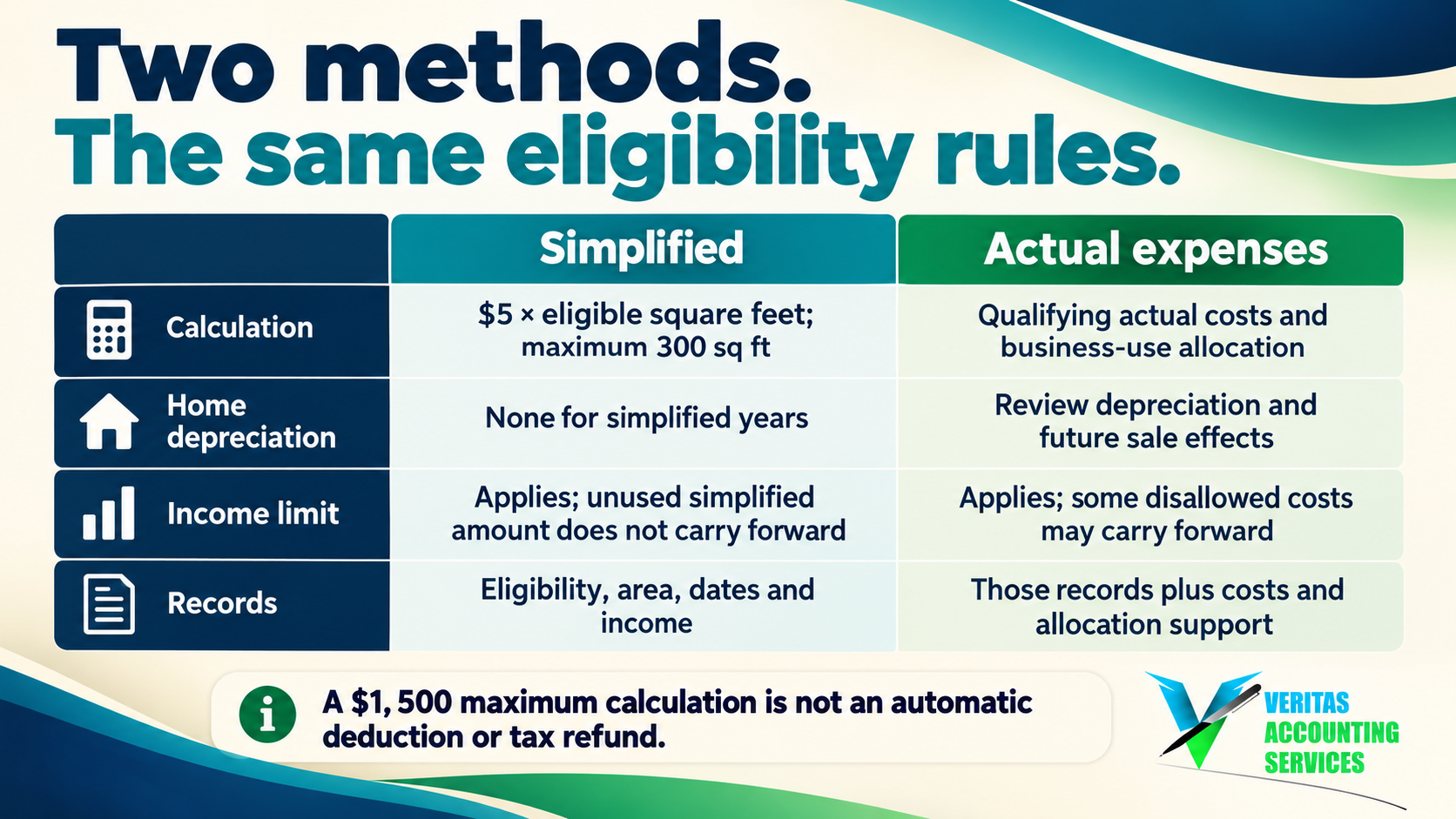
The IRS simplified-option comparison explains the central difference. The simplified calculation generally uses $5 for each eligible square foot, with a maximum of 300 square feet. This creates a maximum full-year calculation of $1,500 before the income limit and other applicable adjustments.

The simplified home office deduction changes the calculation and recordkeeping burden; it does not relax eligibility. A personally used area does not become qualifying because the standard rate is easy to apply. For the home office deduction, keep the space, dates and business-use explanation even if you do not allocate household bills under this method.

Actual expenses use qualifying costs and an appropriate business allocation. Direct costs relating only to the qualifying business area and indirect costs benefiting the home generally receive different treatment. An expense unrelated to the business part should not be included merely because it appears on the same household statement.

QuestionSimplified optionActual-expense method
Starting calculation$5 times eligible area, subject to the 300-square-foot cap and adjustmentsQualifying actual costs and supported business allocation
EligibilityBusiness-use tests still applyBusiness-use tests still apply
Depreciation of the homeNo home depreciation for simplified yearsReview business-use depreciation and later sale effects
Income limitationApplies; unused simplified amount does not carry forwardApplies; some disallowed expenses may carry forward
RecordsSupport eligibility, area, dates and incomeAlso support actual costs, allocation and relevant property history
Comparison of simplified and actual-expense home office deduction methods, covering calculation, home depreciation, income limits and required records.

For the home office deduction under the simplified option, do not also deduct the actual home-use costs it replaces. Otherwise allowable home-related itemized deductions remain subject to their own rules. Business equipment, supplies and other costs unrelated to the use of the home itself require separate analysis; they are not automatically absorbed into the area calculation.

The actual-expense home office deduction can involve depreciation and consequences when the home is sold. The simplified option does not generate depreciation for the years it is used, but it does not erase earlier actual-method history. Avoid treating a method switch as permission to discard old property records.

Our expense classification article explains why a clear category matters. For a home office deduction, keep household costs, ordinary operating expenses and equipment purchases distinguishable so the preparer can review each under the correct rules.

See how the income limit changes an example

Suppose an eligible sole proprietor uses 200 square feet exclusively and regularly for a qualifying business throughout the year. Assume all other requirements are met and the simplified option is properly selected. The initial calculation is 200 multiplied by $5, or $1,000.

Now assume gross income attributable to the qualified business use, reduced by business deductions unrelated to use of the home, leaves $700. The home office deduction under the simplified method cannot exceed that remaining amount. In this illustration, the allowable deduction is $700 rather than the initial $1,000 calculation.
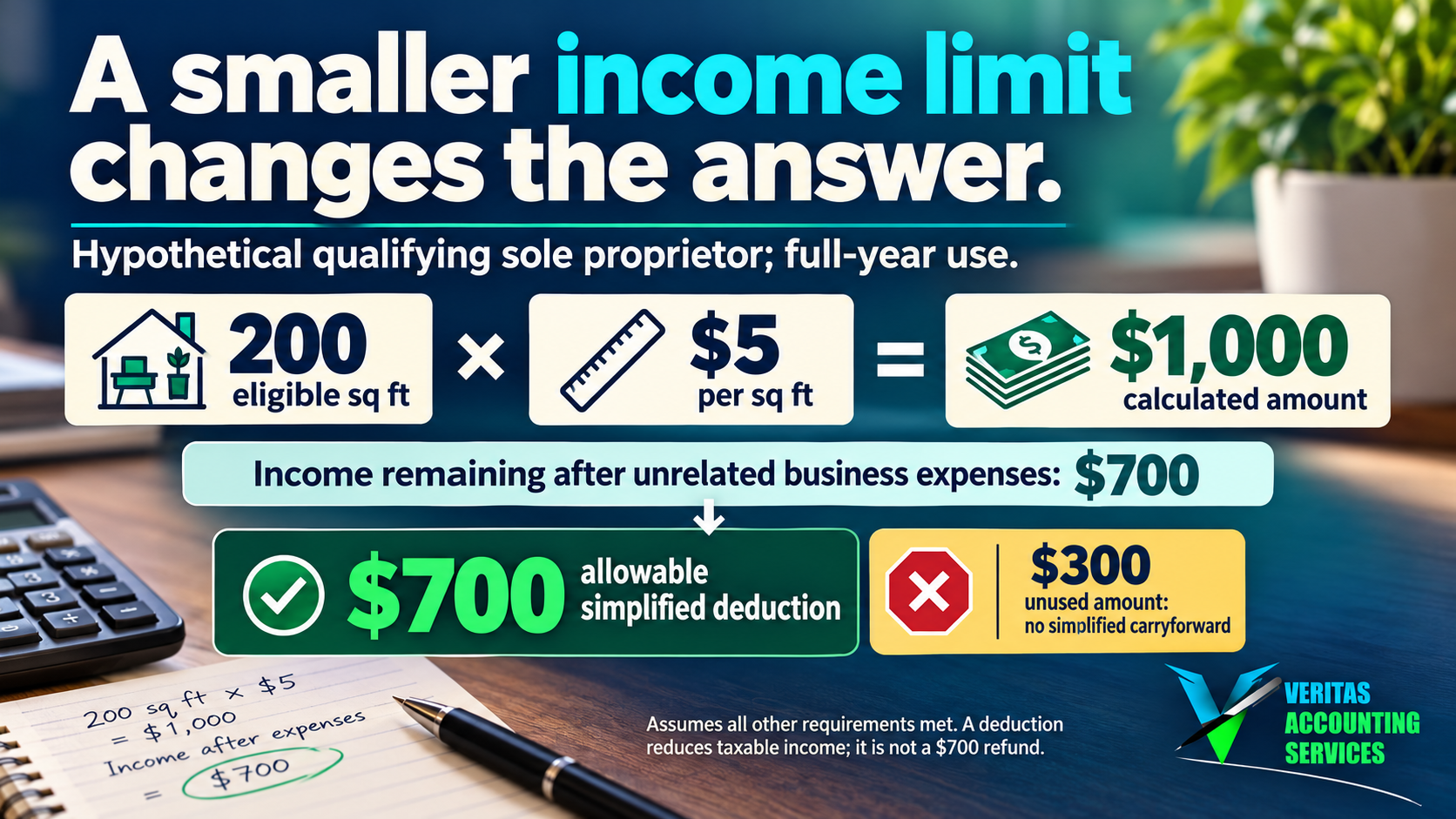
Hypothetical simplified deduction calculation showing 200 eligible square feet times $5 equals $1,000, reduced by a $700 income limitation to a $700 deduction with $300 unused and no simplified carryforward.

The $300 difference does not become a simplified-method carryforward. That is different from the possibility of carrying forward certain disallowed actual-method expenses. The example does not establish that the simplified option is better or worse for this owner; a proper comparison requires the alternative calculation and relevant history.

A home office deduction is a deduction, not a dollar-for-dollar tax refund. The final tax effect depends on the entire return and applicable rules. No tax rate is assumed here, and the $700 result should not be described as $700 cash saved.

If the area qualified for only part of the year, the initial amount would need an area-and-date adjustment before considering the income limit. If the space failed eligibility, the arithmetic would not rescue the claim. Check the facts in the same order used in the example.

Build a useful evidence file

For the home office deduction, keep one short explanation of the business use with the measurements and dates. Include what work occurs there, how personal use is excluded where required and why the location qualifies. A reviewer should be able to understand the claim without recreating the whole year from memory.

Under actual expenses, retain the bills and supporting calculation for the amounts claimed. Distinguish a payment from an invoice, and distinguish an expense from an improvement needing different treatment. When the household pays one combined amount, document how the business portion was determined instead of posting the whole charge as business.

Keep earlier home office deduction worksheets and relevant depreciation records available. Purchase, improvement and basis documents can remain important for later calculations. Do not apply a casual document-deletion rule to property history simply because the current year uses a simplified method.

Our bookkeeping and tax records guide provides related operating context. A tidy folder helps, but the evidence must explain the business facts as well as the amount. Label uncertain items so the adviser can resolve them before filing.

Separate household cash flow from tax treatment

A home office deduction does not make a rent payment, utility bill or renovation free. The household still needs enough cash to pay the full bill. Keep the tax calculation separate from the decision about what the household and business can afford.

Before expanding the work area, identify the practical reason: more capacity, better concentration or a genuinely useful business setup. Then consider the cash commitment. Buying a larger home or remodeling solely to pursue a deduction can create costs far beyond any possible tax benefit.

For the home office deduction, avoid transferring money between personal and business accounts without a clear explanation of what it represents. The accounting entry should match the arrangement and entity. Ask the preparer how the approved deduction or reimbursement should be reflected rather than assuming every transfer is rent or an expense.

Our tax savings versus cash flow article discusses the broader distinction. Use a household budget for payment decisions and a supported tax worksheet for the deduction. Neither replaces the other.

Questions to resolve before filing

Review the home office deduction before the return is ready for signature. Confirm the business identity, actual use, qualifying route, measured area, dates and selected method. Discuss income limitations and previous claims with the person responsible for the return.

Tell that person about changes that could alter the answer: a move, shared use, another fixed office, a new entity or a room returning to personal use. These are facts to assess, not automatic disqualifications in every case. Early disclosure leaves time to choose the correct treatment.

The IRS simplified-method FAQs address elections, area changes and income limits. Use the current instructions for the return being filed. A general guide should help identify the right questions, while the final claim reflects your own facts.

Frequently asked questions

Can I claim a home office deduction for a shared dining table?

Under the ordinary exclusive-use rule, using the same area personally and for business generally prevents a claim for that area. Working many hours there does not remove the personal use. Inventory storage and daycare exceptions have separate requirements and should not be assumed to cover ordinary desk work.

Do I need a separate room?

Not necessarily. IRS guidance recognizes another separately identifiable space and does not require a permanent partition. The claimed area must still satisfy regular use, exclusive use where required and the applicable qualifying business-use test.

Is the simplified option an automatic $1,500 deduction?

No. It generally starts at $5 per eligible square foot, capped at 300 square feet. Eligibility, qualified-use dates, area changes and the income limitation can reduce or eliminate the amount. A smaller qualifying area produces a smaller starting calculation.

Can I deduct actual home-use expenses as well as the simplified amount?

You cannot combine the simplified amount with the actual home-use costs it replaces. Otherwise allowable itemized deductions and business costs unrelated to use of the home need separate treatment under their own rules. Keep those categories clear when supplying records.

Can I change methods after filing?

The IRS says the method chosen on a timely filed original return cannot later be changed to the other method for that same year. A different home office deduction method may be selected for another year. Review the decision and earlier history before filing.

Conclusion

A supportable home office deduction starts with the use of the space, not the largest possible calculation. Confirm eligibility, measure the qualifying area, document dates and compare the methods with income limits and earlier claims in view.

Start today with a simple sketch and a short description of what actually happens in the work area. Add the relevant records and take unresolved questions to your preparer before the return is finalized.

This article provides general US federal tax information reviewed November 2, 2026. It is not individualized advice. Confirm the rules for the relevant tax year, entity and facts, and review state treatment separately.

GET IN TOUCH

Schedule a FREE Call

Contact us

Connect on our Socials!

An emerald magnifying lens examines a stylized invoice beside separate payment tokens, representing a review of uncollected customer balances.

Your Simple Guide to Unpaid Invoice Mistakes and Better Records

Business bad debts can sometimes produce a federal tax deduction, but an unpaid invoice is not automatically deductible. The first question is whether the uncollected amount was already included in taxable income. A cash-method service business generally cannot deduct a fee it never received or reported as income. An accrual-method business may have a different result, subject to the other requirements.

The IRS bad-debt overview explains this starting point and the need to establish worthlessness. An old invoice, a disappointed owner and a bookkeeping write-off do not, by themselves, answer the tax question. You need to connect the debt, the income history, collection evidence and the relevant year.

This guide focuses on ordinary unpaid customer service invoices in US businesses. It explains five practical checks, a worked example and a review file you can discuss with your tax preparer. Loans, guarantees, purchased receivables, inventory transactions and personal debts can require different analysis.

Table of contents

What business bad debts mean

A business bad debt generally arises from a debt created or acquired in a trade or business, or closely related to it when the debt becomes partly or completely worthless. The business connection and the existence of a genuine debt both matter. An invoice entry is evidence to investigate, not a substitute for those facts.

For ordinary customer receivables, business bad debts concern amounts the customer owes for an actual transaction. Keep the contract, invoice, delivery or service evidence and the payment terms together. If the customer disputes whether the work was accepted or the amount is correct, resolve that issue before treating the whole balance as an uncollectible debt.

There is a difference between correcting an invoice and recognizing a bad debt. A duplicate invoice should be corrected as an error. A legitimate agreed price adjustment needs its own documentation. Neither should be disguised as a collection loss simply to clear a report.

The distinction also protects your customer relationships. A reminder based on an incorrect balance wastes time and can create avoidable disputes. Before reviewing business bad debts, make sure payments, credits and adjustments have been applied to the right customer account.

Our accounts receivable aging guide explains how to organize overdue balances for follow-up. Aging helps you identify which invoices deserve attention. It does not establish a deduction or prove that a particular debt has become worthless.

Why your tax accounting method matters

Under the cash method, income is generally reported when received, including amounts constructively received under the applicable rules. Under the accrual method, income is generally reported when earned, subject to the relevant tax rules. Your tax accounting method determines the timing; the setting on a management report is not conclusive.

The IRS accounting-methods publication explains these general differences. Its available edition is dated January 2022, so this article uses it for the basic method distinction, not for current inflation-adjusted eligibility limits. Confirm the actual method used on your return with the preparer.

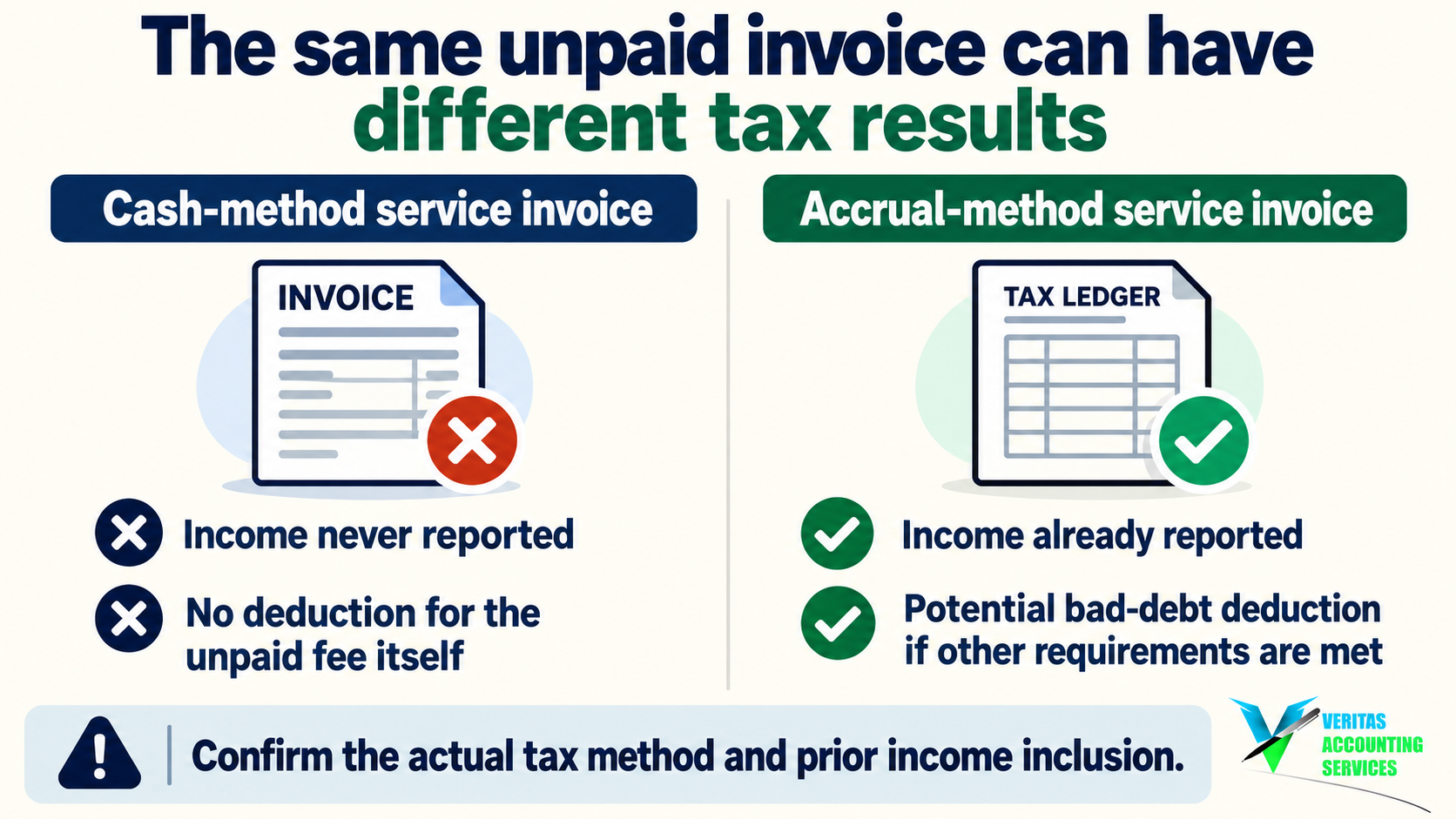
For business bad debts from a cash-method service invoice, the unpaid fee itself generally has not entered taxable income. You cannot create an additional deduction for that missing fee merely because you spent time doing the work. Any actual business costs need their own normal treatment; do not count them again through the invoice balance.

For business bad debts, an accrual-method service business may already have included the fee in income even though the customer has not paid. If that receivable later becomes uncollectible, a deduction may be available after reviewing the debt, evidence, timing and applicable requirements. Prior inclusion is one condition, not the entire test.

Comparison of business bad debts for a cash-method service invoice never included in income and an accrual-method invoice previously included, with other deduction conditions preserved.

Your financial books and tax return may also use different treatments. Ask for the tax reconciliation instead of assuming a book expense automatically appears as a deduction on the return. This article addresses federal income tax treatment, not a complete financial-reporting standard or an instruction to change accounting methods.

When examining business bad debts, identify the year and amount previously included in income. A statement that “we use accrual” is less useful than a clear connection to the particular receivable. Mixed transactions and changes in method should go to the preparer for specific review.

Five checks before claiming a deduction

1. Confirm the genuine debt and business connection

Identify who owes the money, why it is owed and which business owns the receivable. Match the invoice to the underlying agreement and service records. An amount that was never legitimately due cannot be made deductible by issuing an invoice after the fact.

Business bad debts are different from personal loans that happen to involve a business owner. Family arrangements, advances to related parties, guarantees and amounts that may actually be capital contributions require their own analysis. Do not copy the customer-invoice conclusion to those transactions.

Ask the reviewer to record the scope of the decision. For example, the file might cover a specific unpaid consulting invoice rather than every balance connected with the customer. Clear scope helps prevent another account from being written off without review.

2. Reconcile the amount and prior income inclusion

Start with the original invoice and subtract payments and valid credits. Confirm that a deposit has not been posted to a different account and that a payment has not been overlooked. A current customer statement should agree with the detail being reviewed.

For business bad debts, trace the remaining receivable to its tax history. Ask whether the unpaid portion was included in gross income for the current or an earlier year. Preserve the relevant return workpaper or preparer’s confirmation rather than relying only on a software label.

If the invoice includes several different components, identify them before calculating a potential deduction. This guide’s example assumes a simple service fee without sales tax, interest or other adjustments. Real invoices may require separate treatment of amounts that were never your taxable income.

3. Establish worthlessness from the facts

Being overdue and being worthless are different conditions. The IRS describes worthlessness by reference to the surrounding facts and circumstances and the absence of a reasonable expectation of repayment. The evidence needs to explain why collection is no longer reasonably expected, not merely why the owner is frustrated.

When reviewing business bad debts, retain reasonable collection steps and the outcome. Depending on the case, the record might include reminders, responses, failed payment arrangements and verified information about the debtor’s position. No single generic checklist guarantees a conclusion for every customer.

The IRS says a court action is not necessary if you can show that a judgment would be uncollectible. That is different from a blanket statement that collection efforts are unnecessary. Discuss the facts with the appropriate adviser, including legal issues where relevant, instead of automatically suing every debtor or abandoning every difficult account.

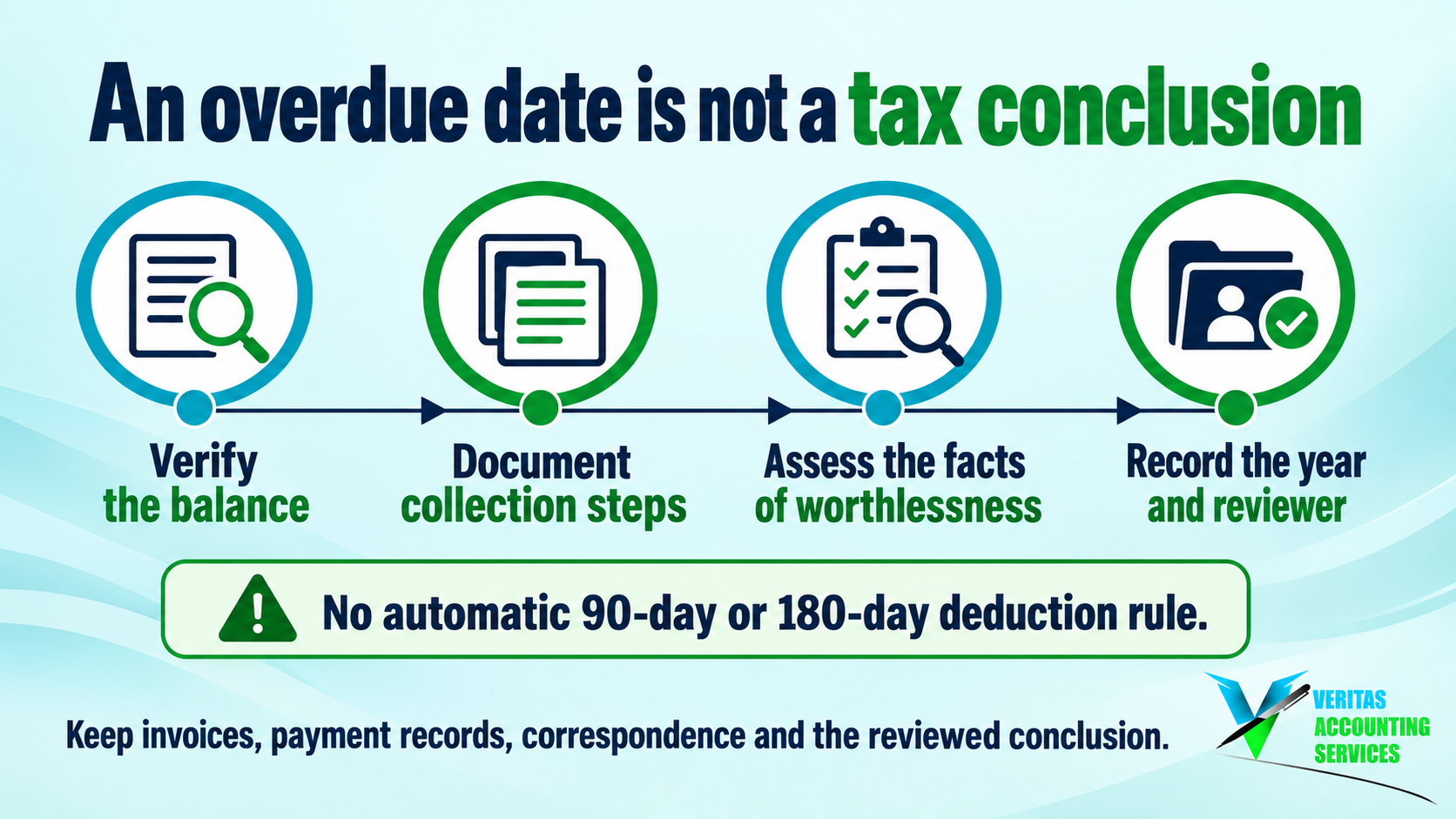
Evidence timeline moving from balance verification through collection records and worthlessness assessment to the reviewed tax year, noting that no automatic 90-day or 180-day deduction rule applies.

Business bad debts do not become deductible simply because a report moves them into a 90-day or 180-day bucket. Aging is a prompt to investigate. Record the events supporting the conclusion and the date the reviewer assessed them.

4. Review the year and charge-off requirements

The timing of a deduction for business bad debts matters. A totally worthless debt generally belongs in the year it becomes worthless, rather than whichever year produces the largest benefit. If a potential loss relates to an earlier year, ask the preparer about the correct return and applicable claim procedures.

The IRS small-business tax guide explains the general specific charge-off method for business bad debts. Under that method, a deduction for a partly worthless business debt is limited to the amount charged off on the books during the year. A general estimate or reserve is not the same as identifying and reviewing a specific debt.

The guide distinguishes totally worthless debts: an actual book charge-off is not required in the same way, although recording one may be useful and partial-worthlessness findings can affect the result. Do not turn that distinction into permission to leave the books unexplained. Have the preparer coordinate the tax conclusion and the accounting entry.

Business bad debts can involve partial losses, later total losses or prior deductions. Keep a history of amounts previously deducted so the same loss is not claimed twice. Specialized methods and exceptions exist; this guide does not establish eligibility for them.

5. Coordinate the books, return and later receipts

For business bad debts, give the bookkeeper an approved adjustment and keep the reason with it. Give the tax preparer the same supporting schedule and identify any book-to-tax difference. The two teams should not independently calculate different losses from different versions of the customer ledger.

Business bad debts also need a recovery process. If money arrives later, identify the original invoice and any earlier deduction before deciding how to record it. A closed customer account should not cause a real bank receipt to be ignored or posted to an unexplained suspense account.

IRS guidance says recovery of a previously deducted bad debt may need to enter gross income, subject to the tax-benefit rule. The amount previously deducted and whether it reduced tax affect the result. Keep that history available so a later receipt can be reviewed accurately.

A worked unpaid-invoice example

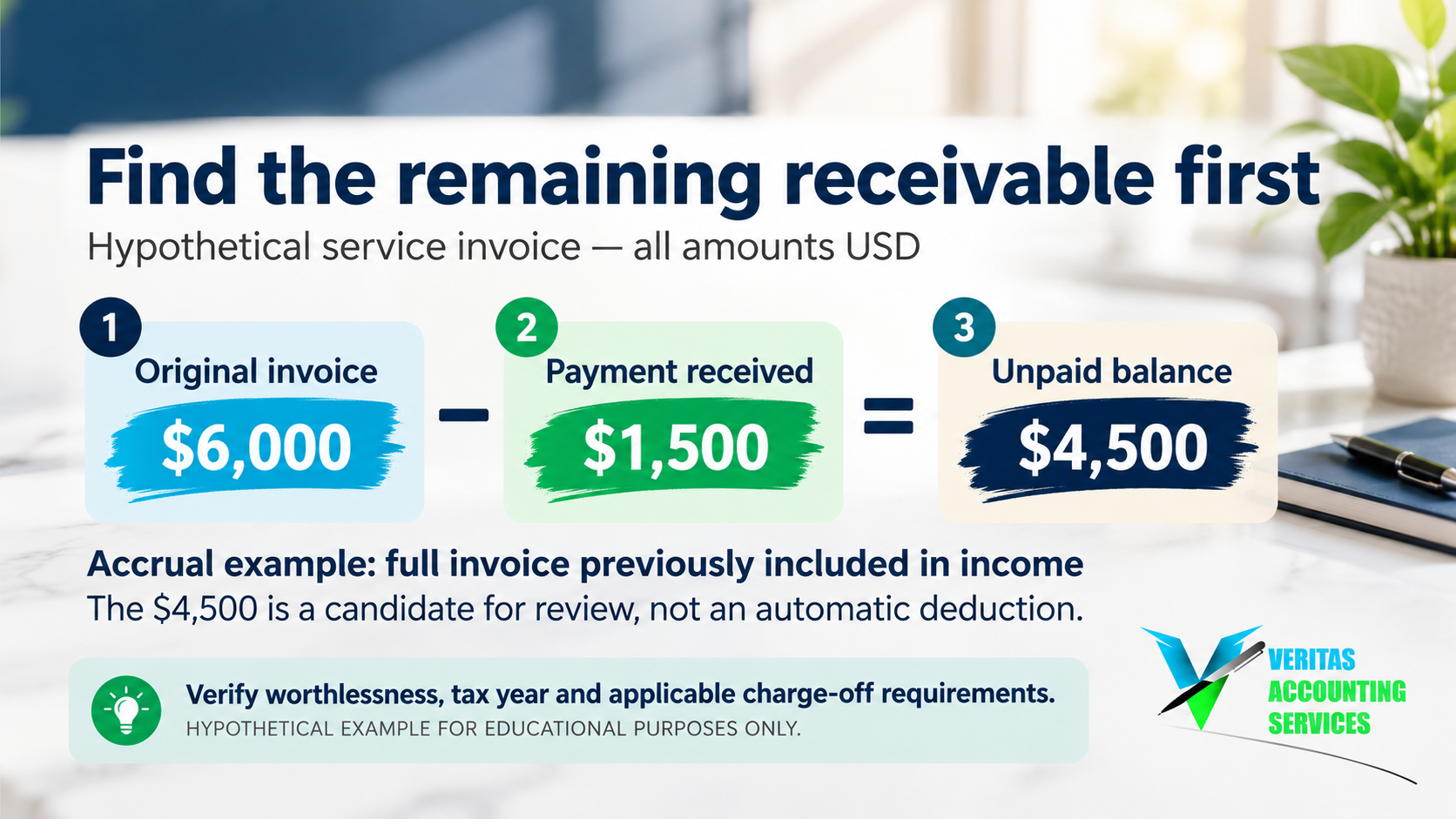
Suppose a US service business sends a genuine $6,000 invoice for completed work. The customer pays $1,500, leaving $4,500 unpaid. Assume there are no credits, sales taxes, financing charges, insurance recoveries or other adjustments. These are hypothetical amounts, not details from a client file.

In the accrual-method version of this example, assume the business previously included the full $6,000 in taxable income. The payment reduces the receivable to $4,500: $6,000 minus $1,500. That remaining amount is the starting point for reviewing business bad debts, not an automatic deduction.

Hypothetical USD subtraction bridge for business bad debts showing a $6,000 service invoice less a $1,500 payment, leaving $4,500 for a separate deduction review.

The reviewer of business bad debts must still decide whether the remaining debt became worthless, in whole or in part, in the relevant year and whether the applicable requirements are satisfied. If only part is supportably uncollectible, treating the entire $4,500 as worthless would overstate the conclusion. Prior deductions also need to be considered.

Now change the tax method. Suppose the business instead uses the cash method and has never included the unpaid $4,500 in taxable income. Under that assumption, there is no bad-debt deduction for the missing fee itself. The $1,500 actually received and any separately deductible costs follow their own rules.

The commercial loss feels similar in both versions: the business expected more cash than it collected. The tax starting point differs because the income history differs. Business bad debts cannot be analyzed from the bank shortfall alone.

A deduction also does not put the missing $4,500 into the bank. Any tax effect depends on the complete return and the applicable rules. Do not reduce next month’s collection effort or increase spending on the assumption that a write-off will reimburse the lost sale.

Build a useful evidence file

Create one review schedule for each specific customer balance being considered. Include the business entity, customer reference, invoice date, original amount, payments, credits and remaining amount. Link each total to the supporting detail so another reviewer can reproduce it.

For business bad debts, add the tax method, prior income inclusion, collection history, facts supporting worthlessness, proposed tax year and any charge-off. Identify who prepared the schedule and who approved the conclusion. Leave unresolved questions visible rather than converting them into an unexplained final number.

The IRS recordkeeping guidance emphasizes records that support income, expenses and return items. Choose a filing system suited to your business, but make the connection between evidence and tax treatment easy to follow. An attachment named “old invoices” is less useful than a clear reviewed schedule.

Our bookkeeping and tax records guide provides related operating context. Keep source documents, collection correspondence and the approved decision accessible to the people responsible. Limit broad sharing of customer information when a status summary will do.

Do not delete the original invoice or payment history merely because the balance is written off. Later collections, corrections and tax questions may still refer to it. Apply a record-retention policy based on the actual documents and applicable requirements, not a universal deletion date copied from another business.

Keep the cash-flow decision separate

When reviewing business bad debts, the owner needs two decisions: what to expect in the cash forecast and what tax treatment is supportable. A doubtful customer balance may deserve conservative cash planning before a tax deduction is established. Document the planning assumption without presenting it as a completed tax conclusion.

Business bad debts can expose weaknesses in customer approval, deposits, payment terms or follow-up. Use the review to identify a practical process change. For instance, decide who will resolve disputed work promptly and who can authorize new services for a customer with an unresolved old balance.

There is no need to turn the tax review into a promise of a new credit policy or a particular collection result. Different customers and contracts need different decisions. What matters is that someone owns the next action and that the cash forecast reflects a realistic expectation.

Our tax savings and cash-flow discussion explains why a potential tax reduction and available cash are different measures. Keep the proposed deduction separate from the amount you need to collect to meet payroll, rent or supplier payments.

Common mistakes to avoid

One mistake is writing off every invoice older than a chosen number of days. For business bad debts, replace that automatic rule with a review of the specific balance, collection evidence and relevant tax year. A payment that is late can still be collectible.

A second mistake is deducting unpaid cash-method service income that was never reported. Check the income history before computing the loss. Time spent on a project is commercially valuable, but an expected fee is not automatically a tax basis that can be deducted.

A third mistake is counting an already recorded cost again inside the unpaid fee. Review actual expenses separately under their own rules. Our expense classification guide explains why clear categories help prevent confusion about what an entry represents.

A fourth mistake is using a bookkeeping reserve as proof of a tax deduction. Business bad debts generally require the applicable specific-debt analysis, not simply a percentage applied to the whole aging report. Keep financial-reporting estimates and the tax calculation distinguishable.

Finally, do not ignore later collections. Match receipts to the original customer record and tell the preparer about any earlier deduction. A documented recovery process helps the books and return reflect what actually happened.

Frequently asked questions

Can a cash-method business deduct an unpaid service invoice?

Generally not for the unpaid fee itself if that amount was never included in taxable income. Actual paid or incurred costs need separate review under the business’s applicable rules. Do not claim the same expense twice by including it again in a proposed invoice write-off.

Are business bad debts deductible after 90 days?

There is no automatic deduction based only on that aging category. Review the genuine debt, prior income inclusion, collection steps, worthlessness and tax year. A report’s age column is an operating signal, not a tax determination.

Must I sue the customer first?

Not necessarily. The IRS says court action is unnecessary when a judgment would be uncollectible, but reasonable collection steps and evidence still matter. Review the particular facts and any legal issues with the appropriate adviser rather than assuming a lawsuit is always required or never useful.

Can only part of a business debt be deducted?

Potentially. Under the general specific charge-off method, partly worthless business bad debts have a charge-off limitation and other requirements. Nonbusiness debts follow different rules. Give the preparer reviewing business bad debts the specific facts and any prior deductions before deciding on an amount.

What if the customer pays after the write-off?

Record the receipt, identify the original debt and review the earlier tax treatment. A recovery of a previously deducted bad debt may be taxable, subject to the tax-benefit rule. The bookkeeping label alone does not determine the answer.

Conclusion

Business bad debts require more than an overdue invoice. Confirm the actual balance, the tax method and prior income inclusion, the evidence of worthlessness, the correct year and any charge-off requirements. Coordinate the approved result between the books and the return, and keep a process for later collections.

The useful next step is to select one doubtful customer balance and assemble its supporting file. Resolve the missing facts with your preparer before treating an accounting write-off as a tax deduction.

This article provides general federal tax information reviewed October 30, 2026. It is not individualized advice. Apply the guidance for the relevant tax year, business entity and specific debt, and review state treatment separately.

GET IN TOUCH

Schedule a FREE Call

Contact us

Connect on our Socials!