








Tax Bracket Mistakes: A Simple Guide to Better Planning
The 2027 tax brackets are now available following the IRS announcement on November 5, 2026. For business owners, the useful response is to update the assumptions in a personal tax projection, rather than apply a new percentage to business revenue. Start with the correct year, filing status and taxable income, then review the result alongside other taxes and payments.
This guide focuses on federal ordinary individual income tax. It explains a single-filer example and five practical checks for an owner’s planning worksheet. It does not calculate a company’s complete tax liability or assume that every owner has the same filing status, income sources or deductions.
Understanding the 2027 tax brackets matters when planning cash. A clear estimate can support decisions about reserves and owner withdrawals. A spreadsheet using an outdated table, the wrong income figure or one flat rate can make an apparently precise answer unreliable.
Table of contents
- What changed in the IRS announcement
- Read the 2027 tax brackets correctly
- A worked example with separate income layers
- Five checks before updating your worksheet
- Turn the estimate into a cash discussion
- Give your adviser a useful handoff
- Frequently asked questions
- Conclusion
What changed in the IRS announcement
The November 5 IRS announcement sets out annual inflation adjustments for tax year 2027. The IRS says these amounts generally affect returns filed in 2028. Publication in 2026 does not turn the figures into 2026 tax-year amounts.
For 2027 tax brackets, treat that date distinction as the first control in the file. A worksheet labeled next return can be misunderstood by a bookkeeper, an owner and a preparer. Put the actual income year in the heading and retain the source date beside the assumptions.
The release also lists basic standard deductions of $16,600 for single filers and married individuals filing separately, $33,200 for married filing jointly, and $24,925 for heads of household. Those are starting reference amounts; individual eligibility and additional amounts require their own review.
The IRS standard deduction guidance explains that the deduction reduces income subject to tax and is unavailable in some circumstances. It is not a credit that reduces the tax bill dollar for dollar. Do not automatically subtract it without checking the person’s situation.
Our year-end tax planning discussion describes a wider review of business results and planned transactions. Here, the narrower task is to refresh the bracket assumptions while keeping the current-year close and next-year forecast clearly separated.
Read the 2027 tax brackets correctly
The 2027 tax brackets apply different rates to successive layers of taxable income. Moving into a higher layer does not make that higher rate apply to every dollar below it. The IRS explanation of marginal rates describes this layered approach.
The following table of 2027 tax brackets is for single filers, using the unmarried-individual table in Revenue Procedure 2026-35. It covers ordinary income under that schedule. Do not substitute this table for a different filing status or for income subject to special rates.
| Rate | 2027 taxable income layer for a single filer |
|---|---|
| 10% | Up to $12,800 |
| 12% | Over $12,800 through $52,025 |
| 22% | Over $52,025 through $109,125 |
| 24% | Over $109,125 through $208,325 |
| 32% | Over $208,325 through $264,550 |
| 35% | Over $264,550 through $661,375 |
| 37% | Over $661,375 |
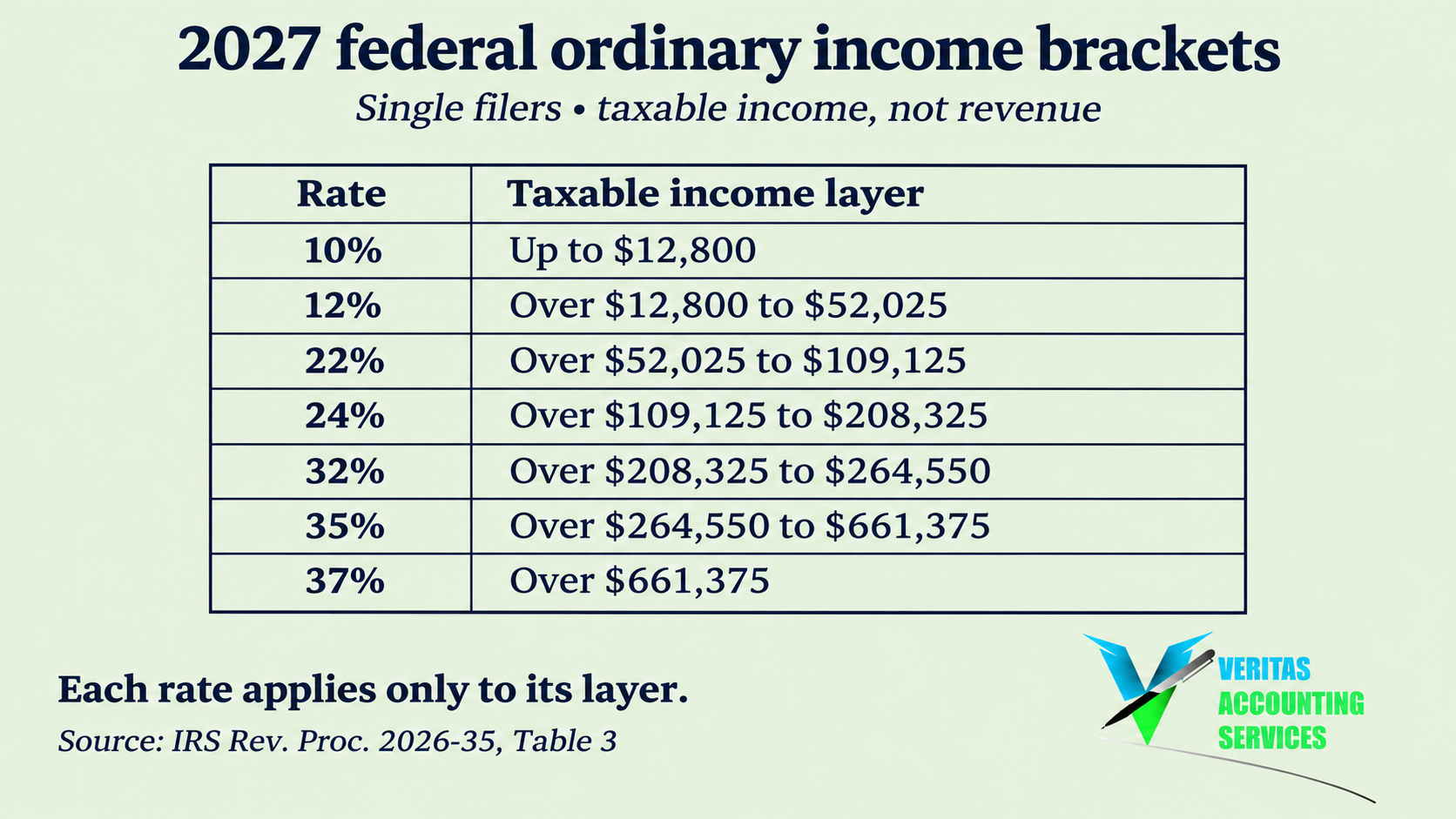
When using 2027 tax brackets, distinguish a marginal rate from an average calculation. The marginal rate describes the rate on the next dollar within the relevant layer. Dividing a calculated tax amount by the income used in the example answers a different question.
Also distinguish taxable income from sales, bank deposits and bookkeeping profit. Before relying on a figure, ask where it came from and what adjustments it includes. A number can be correctly copied from the profit and loss statement yet still be the wrong input for an individual bracket calculation.
The 2027 tax brackets table is a reference, not an instruction to multiply an owner’s draws by a rate. Mark its scope on any exported worksheet. That short label helps prevent the same figures from being reused later for a corporation, a different filing status or a different year.
A worked example with separate income layers
Suppose an individual is a single filer with exactly $60,000 of taxable ordinary income for 2027. Assume the appropriate deductions and adjustments have already been reflected in that taxable-income figure. The example is hypothetical, not a Veritas client case or a complete return calculation.
Using the 2027 tax brackets, the first $12,800 produces $1,280 at 10%. The next $39,225, from $12,800 to $52,025, produces $4,707 at 12%. The remaining $7,975 produces $1,754.50 at 22%.
The sum is $7,741.50 of illustrative regular federal income tax before credits. The example excludes self-employment tax, alternative minimum tax, special-rate income and any other taxes or adjustments. It demonstrates the layers; it does not establish what a particular owner should pay.
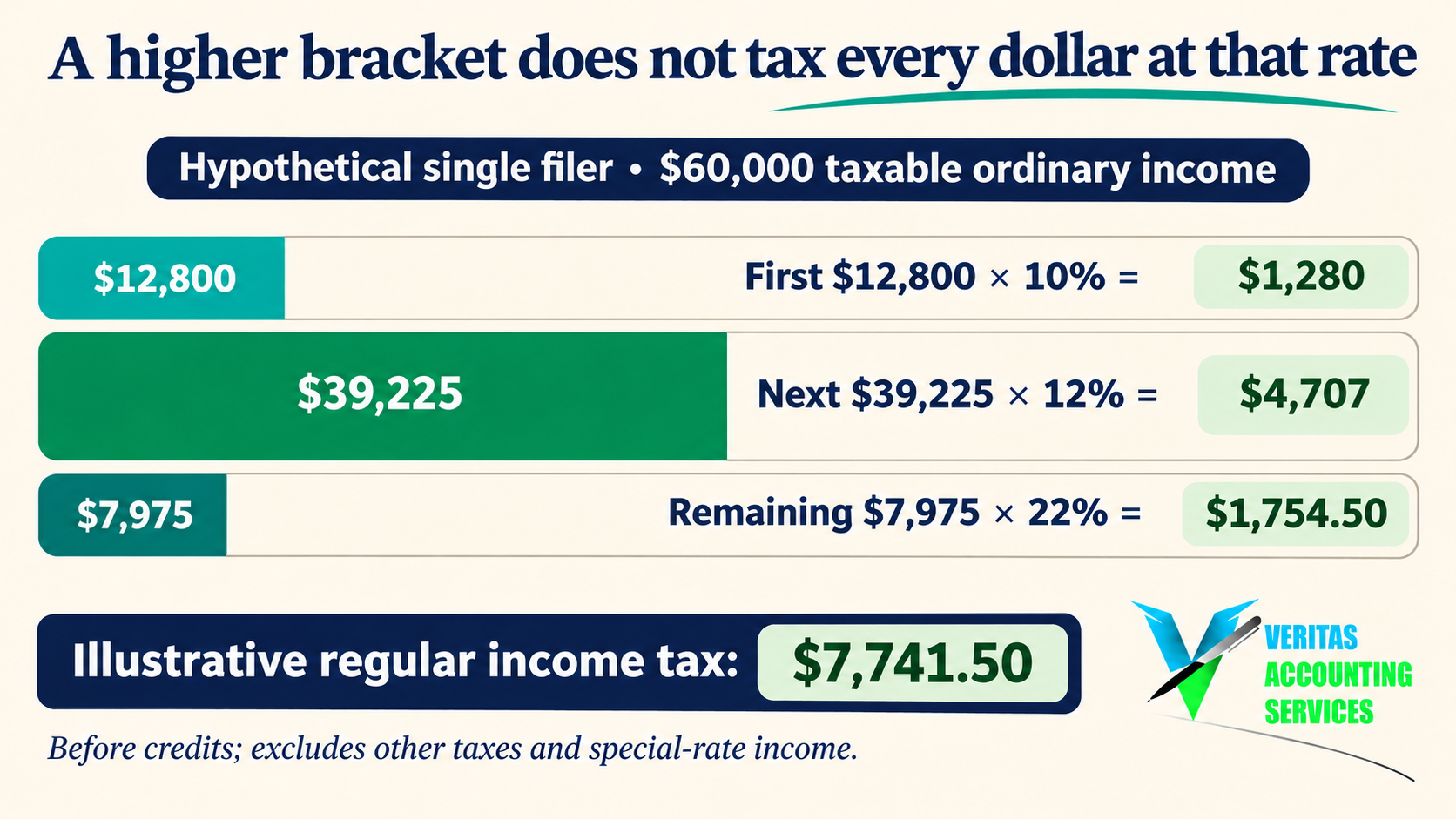
Compare that with multiplying all $60,000 by 22%, which gives $13,200. The difference is $5,458.50. That difference illustrates an incorrect calculation, not an available tax saving or a refund someone can claim.
For 2027 tax brackets, keep the calculation visible rather than hiding it inside a single percentage cell. A reviewer should be able to follow the layer widths, rates and total. Clear arithmetic makes a discussion about the remaining assumptions much easier.
When reviewing the 2027 tax brackets example, do not subtract the standard deduction again. The starting figure is already taxable income, after the assumed relevant deductions. If a worksheet starts with income before those deductions, it needs a different sequence and a documented reconciliation.
This example also shows why a bracket label alone cannot set a cash reserve. Before choosing a transfer amount, the owner and adviser still need to consider the rest of the projection, payments already made and the timing of available cash.
Five checks before updating your worksheet
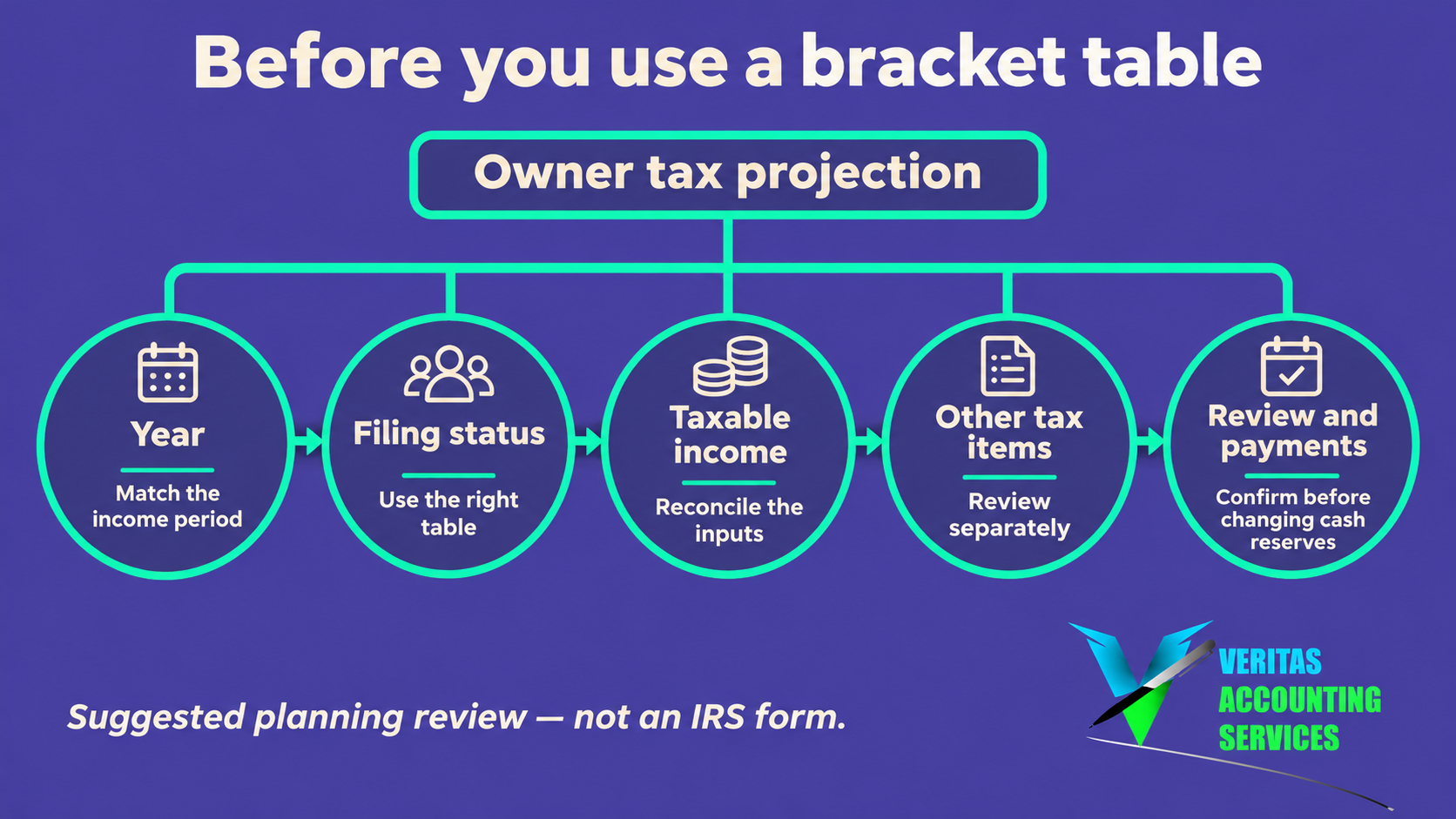
1. Lock the income year and source
Build the 2027 tax brackets into a separately identified 2027 assumptions sheet. Keep the 2026 model intact so current-year questions can still be answered using its own assumptions. Changing every rate cell in a shared workbook can silently alter an earlier forecast.
Record the source document, table number, date checked and person who checked it. These are suggested internal review fields, not an IRS-prescribed worksheet. They give the next reviewer a short route back to the underlying authority.
If a spreadsheet contains both actual results and projections, make the boundary visible. A November actual-results column and a full-year forecast column answer different questions. Their labels should remain clear when the page is printed or attached to an email.
For the 2027 tax brackets, a useful change note states which assumption changed and which calculations depend on it. Avoid a vague updated for IRS changes note that leaves the reviewer searching through the entire file to understand the revision.
2. Match the individual and filing status
Confirm whose projection you are preparing before choosing a table. A business with two owners may need two separate individual analyses. One owner’s personal assumptions should not be copied across simply because both people receive information from the same accounting file.
The 2027 tax brackets shown above are specifically for a single filer. Record the applicable status and ask the preparer to resolve uncertainty. Do not use the single-filer thresholds as a convenient substitute while leaving the worksheet labeled final.
Keep personal information proportionate to the task. A working budget may need a named owner and an agreed filing-status assumption without circulating a complete prior-year return to everyone involved in bookkeeping. Give detailed tax documents only to the people who need them.
If family circumstances or ownership arrangements are changing, note the question rather than guessing its treatment. The purpose of the planning file is to make important assumptions visible so that a qualified reviewer can resolve them.
3. Reconcile the taxable-income input
Before applying 2027 tax brackets, build a clear bridge from the financial information available to the taxable-income figure being modeled. Label the bridge as a projection and identify which adjustments are confirmed, estimated or awaiting professional review.
Our bookkeeping cleanup guide explains why incomplete books create extra work later. For this worksheet, the immediate question is whether the financial starting point can be reconciled to a dated report and whether unresolved entries are visible.
Separate recurring operations from unusual transactions in the discussion. A sale, distribution, reimbursement or bank transfer may need explanation before its tax significance can be determined. The fact that an item appears as a cash movement does not settle the individual tax calculation.
For 2027 tax brackets, use a dedicated taxable-income input rather than pointing the formula directly at a revenue total. That design makes the review step explicit. It also reduces the risk that a later bookkeeping layout change feeds a different number into the model.
Keep the estimated deduction assumptions readable. Show what has already been included, so a reviewer can spot double counting. A separate notes column is often more useful than embedding a long explanation inside a formula that only its author understands.
4. Review taxes and payments outside the bracket result
The 2027 tax brackets do not calculate every part of an owner’s tax position. The IRS estimated-tax guidance explains that estimated payments can cover income tax and other taxes, including self-employment tax. A regular income-tax subtotal is therefore only one part of a payment review.
Keep separate lines for other items the adviser identifies as relevant. Also record withholding and estimated payments with their periods and supporting confirmations. Do not mix a projected annual liability with cash already paid and call the combined number tax expense.
Federal individual thresholds do not establish state tax treatment. Mark state questions for a separate review using the relevant official state authority. This article supplies no state calculation and should not be used as evidence that any state follows these amounts.
For 2027 tax brackets, the practical safeguard is a clear subtotal label. Regular federal income tax before credits and other items is much more informative than total taxes when the remaining work has not been completed.
Our estimated tax payments guide addresses payment-method and timing questions separately. Keep that review distinct from selecting an annual bracket table; the right table alone does not prove that payments are sufficient or timely.
5. Review the result before changing cash reserves
Use the 2027 tax brackets as part of a reviewed forecast, then agree what the owner will do with the result. A change to a workbook is not the same as an approved change to withdrawals, reserves or payment instructions.
Show the reviewer the prior forecast, revised forecast and explanation for the difference. Separate the effect of updated thresholds from changes in expected income or deductions. Otherwise, a lower estimate may be credited to the announcement when the real driver is a weaker sales assumption.
Set a practical review date and name the person responsible for refreshing the inputs. A projection prepared before a major contract is signed may need another look afterward. The review date is a management choice, not a filing deadline created by this article.
Keep a brief approval record explaining which version the owner used. It should be possible to reconnect a cash decision with the assumptions available at the time. That is more useful than retaining several files named latest without a clear sequence.
Turn the estimate into a cash discussion
The 2027 tax brackets can help organize a forecast, but cash planning needs a second conversation. Ask when income is expected to be collected, which operating payments are committed and which amounts the owner is considering withdrawing. Keep those timing assumptions beside the reviewed tax estimate.
Consider an owner looking at a profitable quarter while a large customer invoice remains unpaid. The projection might indicate a future tax reserve need, but the bank balance may not yet support the proposed transfer. Identify that gap explicitly instead of treating accounting profit as cash available today.
For 2027 tax brackets, avoid a universal reserve percentage presented as advice to every reader. Different household income, deductions, payments and other tax items can change the answer. Agree a method with the adviser and explain when the assumptions should be refreshed.
A useful meeting ends with a small number of decisions: which facts remain open, which version is approved, what action is planned and who will check again. Our compliance calendar guide offers a related way to organize owners, dates and evidence without confusing a reminder with completion.
Give your adviser a useful handoff
Send the reviewed worksheet with the supporting report date, individual assumptions and unresolved questions. Explain that the 2027 tax brackets have been refreshed, then identify what has not yet been decided. A narrow question usually receives a clearer answer than a request to confirm the entire file without context.
For example, ask whether the taxable-income bridge includes the expected deduction correctly, or whether an unusual transaction needs separate treatment. Keep operational assumptions, such as expected collections, distinguishable from tax conclusions that require professional judgment.
If the adviser changes an assumption, record the reason and update the dependent calculations together. Reconcile the new total before distributing a revised version. This prevents the narrative in an email from disagreeing with the figures used in the next cash meeting. When sharing the model, export the assumption page with the calculation, so the recipient receives the context as well as the final estimate.
Frequently asked questions
Do the 2027 tax brackets apply to my 2026 income?
No. These are tax-year 2027 figures, announced in November 2026. The IRS says they generally concern returns filed in 2028. Keep a separate, correctly labeled calculation for 2026 income.
Does reaching a higher bracket raise the rate on all income?
No. Rates apply by layer. The higher rate affects the income within that higher layer under the applicable schedule, rather than replacing the rates on every lower layer.
Can I multiply business sales by my personal bracket?
That is not a reliable individual tax projection. Reconcile the appropriate taxable-income input first. Business revenue, bookkeeping profit and the owner’s taxable income should not be treated as interchangeable labels.
Do the 2027 tax brackets tell me my complete tax bill?
No. The example shows regular federal ordinary income tax before credits and other items. Other taxes, special-rate income, payments and individual circumstances need separate review before a payment decision.
Should I change my tax payments immediately?
Review the complete projection and applicable payment rules with your adviser first. A newly available table is a reason to refresh assumptions, not evidence that a specific person’s required payment has fallen.
What should I keep with my 2027 tax brackets worksheet?
Retain the official source, year, filing-status assumption, taxable-income reconciliation, review notes and approved version. These are suggested planning controls. Protect the underlying personal documents and limit access to people involved in the review.
Conclusion
Use the 2027 tax brackets to improve the quality of a planning conversation: identify the year, choose the right individual table, reconcile taxable income, separate other tax items and review the result before changing cash decisions. The most useful forecast shows its assumptions as clearly as its total.
Start by opening the current planning file and checking those five points. If an assumption is unresolved, name it and assign the next action. That gives the owner and adviser a practical basis for moving from a new IRS announcement to a more dependable budget.
This article provides general US federal tax information reviewed November 6, 2026. Examples are illustrative and do not calculate an individual’s complete liability. Confirm current IRS guidance and circumstances with your tax adviser before acting.
GET IN TOUCH
Schedule a FREE Call
Connect on our Socials!
