







Your Simple Guide to Estimated Tax Mistakes With Uneven Income
Estimated tax payments deserve a closer look when your business earns most of its profit in a few busy months. Dividing an annual estimate into equal installments is one approach, but an annualized income calculation may better reflect when income arose. It does not automatically lower your final tax bill or erase a missed payment.
The IRS’s October 23, 2026 year-round planning reminder encourages small-business owners and self-employed taxpayers to review estimated tax payments before filing season. That reminder is timely guidance to review your position, rather than a new exemption or a new annualization rule.
This guide focuses on individual federal income tax planning for owners with uneven income. Corporate estimates, special farming and fishing rules, nonresident situations and state requirements need their own review. The practical goal is to bring your adviser a clear income timeline, an accurate payment history and enough information to compare methods.
Table of contents
- Why income timing matters
- Understand estimated tax payments
- Regular and annualized methods
- Five practical checks
- A seasonal business example
- Build a useful review file
- Avoid common mistakes
- Frequently asked questions
- Conclusion
Why income timing matters
A business can finish the year with healthy profit even though its first few months were quiet. A wedding photographer, summer repair business or consultant receiving a large project payment may have a very different income pattern from an owner receiving steady monthly fees.
Federal income tax generally works on a pay-as-you-go basis. That means the timing of tax paid during the year matters alongside the final annual total. A large payment near year-end may reduce an outstanding balance, but it does not necessarily remove a penalty for an earlier installment.
The IRS explanation of underpayment penalties says people receiving income unevenly may be able to vary installments using the annualized method. The word “may” matters: the result depends on the calculation and the records behind it.
Before changing estimated tax payments, separate three questions. What is your expected final tax? What amount needs to have been paid by each relevant installment date? How much cash can the business and household set aside to meet those obligations? The answers are connected, but they are not interchangeable.
Understand estimated tax payments
For many individual owners, these payments cover income that is not adequately covered by withholding. The calculation can include self-employment tax as well as income tax. A sole proprietor’s business results are only part of the picture if the household also has wages, investment income or other taxable items.
The IRS estimated tax overview describes who may need to pay and how to estimate an amount. Do not decide that no payment is needed simply because your business has no employees or you have not received an information return.
For most individuals, the general underpayment protection compares 90% of current-year tax with 100% of prior-year tax, using the smaller applicable amount. The prior return must cover a full twelve months. Higher-income taxpayers generally substitute 110% for the prior-year percentage when prior-year adjusted gross income exceeds $150,000, or $75,000 for married filing separately.
Other exceptions and special rules apply. For example, the IRS describes a general exception where tax owed after withholding and refundable credits is less than $1,000. These are screening rules, not a substitute for completing the relevant worksheet. A prior-year comparison also does not guarantee that the remaining tax bill will be small.
If the required protection amount is lower than your expected final liability, plan for the difference after estimated tax payments. Keeping a cash reserve for that balance helps prevent a mistaken assumption that “penalty protection” means “nothing more to pay.” Our discussion of tax savings and cash flow explains why the two need separate attention.
Regular and annualized methods
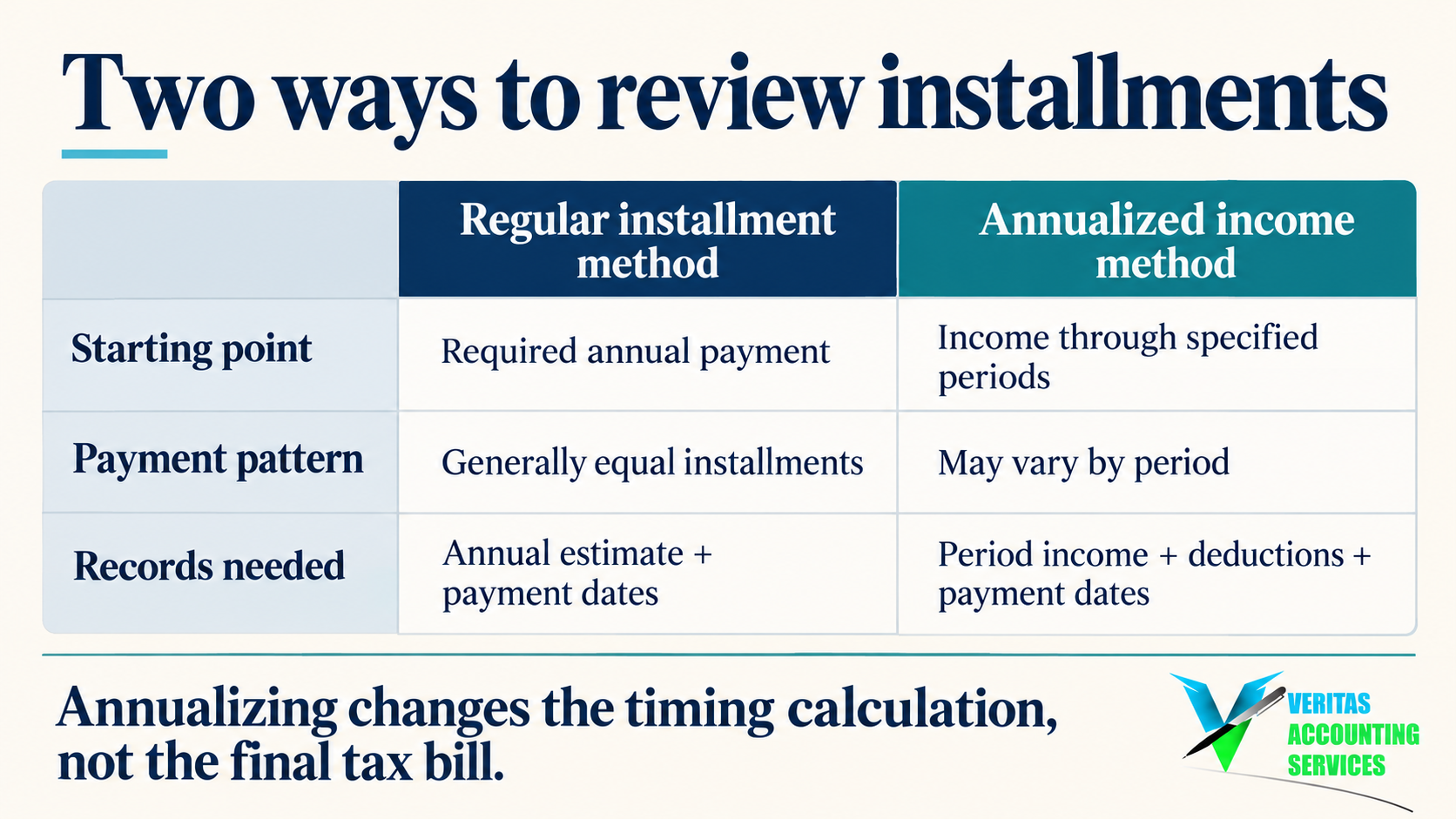
Under the regular installment method, the required annual payment is generally divided into equal installments. This can be straightforward when income is reasonably stable or a reliable prior-year amount provides the relevant benchmark. Equal payments are not inherently wrong for a seasonal business; compare the actual results before choosing a more complicated approach.
The annualized income installment method looks at income and relevant deductions through specified periods. It converts those period results into an annualized calculation and works through the applicable tax worksheet. An owner with little early income may have a lower required early installment than under a simple equal-payment approach.
The 2026 edition of Publication 505 includes the annualized estimated tax worksheet for current-year planning. It accounts for much more than multiplying business revenue by a flat percentage. Credits, deductions, self-employment tax and other items can affect the answer.
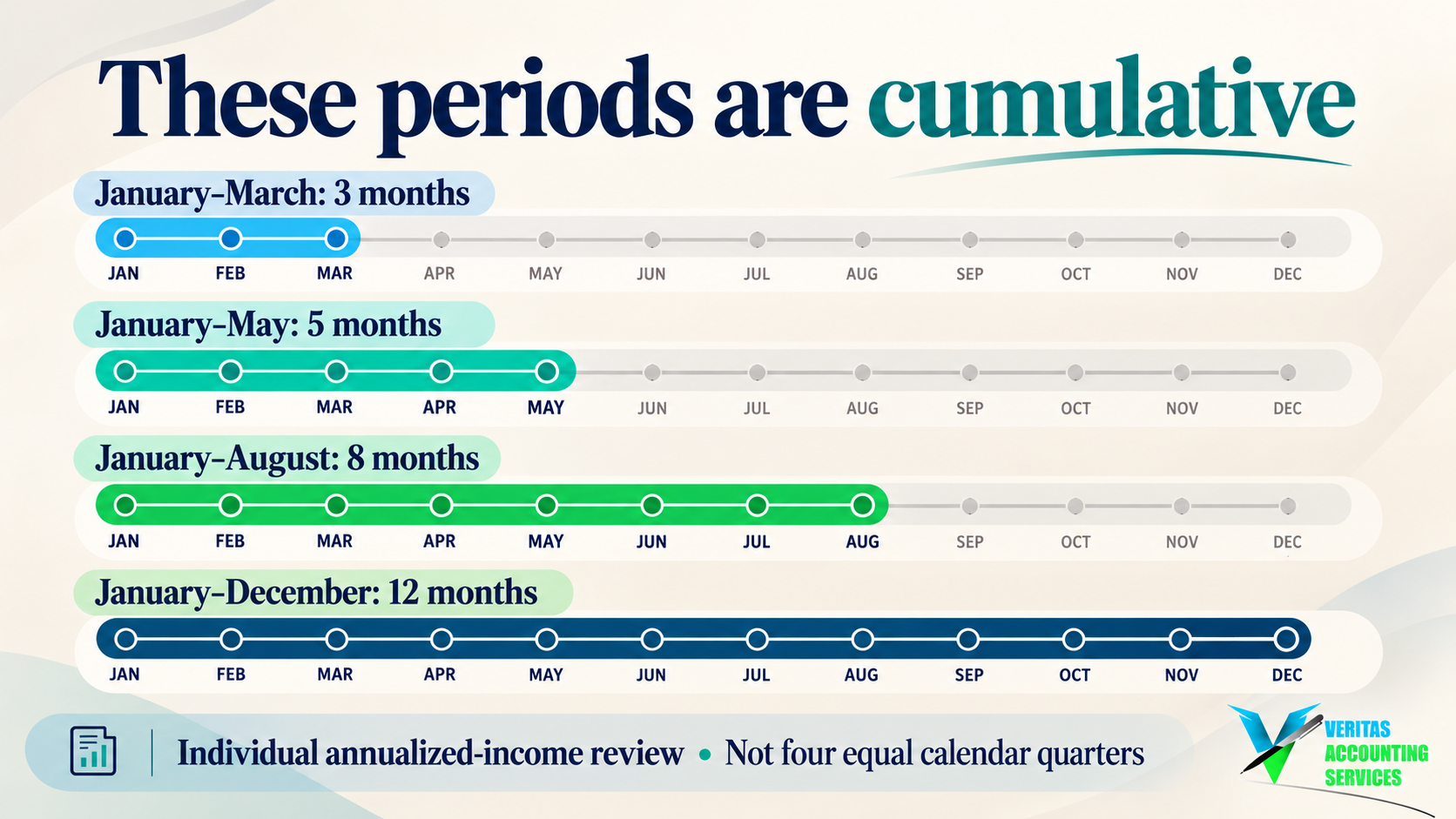
For individual calendar-year annualization, the cumulative periods end in March, May, August and December. These are not four equal calendar quarters. A report for April through June alone cannot replace the cumulative January-through-May information needed for the second annualized period.
When evaluating estimated tax payments, keep the period covered and the payment due date in separate columns. This avoids using a familiar quarter-end date for the wrong purpose. Check the current year’s official schedule, along with any applicable postponement, before instructing a payment.
Annualizing estimated tax payments does not let you select only the most favorable month. It is a structured method with cumulative calculations and interaction between installments. Prior-period differences can affect later required amounts, so the whole sequence needs to be reviewed together.
Five practical checks
1. Identify whose tax you are reviewing
Start with the taxpayer and return involved. A single-owner business’s bank account, a partnership’s books and an individual owner’s return are different records. An owner’s federal individual estimated tax payments should not be confused with payroll deposits or a company’s separate corporate income tax obligation.
If you own a partnership or S corporation, include your share of relevant pass-through items in the review. A cash distribution does not by itself establish the taxable income for the period. Ask the preparer which interim information is needed rather than substituting money withdrawn from the business.
For a household filing jointly, coordinate estimated tax payments with both spouses’ other income and withholding. Reviewing one business in isolation can miss a large part of the actual annual liability. Keep private household details in the secure adviser file, rather than in routine team reports.
2. Put income into the correct periods
Reconcile your books before extracting the cumulative reports. Confirm the tax accounting method and any adjustments your adviser needs. Bank deposits can include loans, transfers and owner contributions, so a bank balance or deposit total alone is not a taxable-profit calculation.
For estimated tax payments, the purpose is to identify the income and deductions properly attributable to each required period. Do not move an item into a later month merely to produce a smaller installment. Preserve the underlying transaction dates and let the applicable tax rules determine treatment.
Flag unusual items separately. A large asset sale, investment gain, cancellation of debt or change in the business can require analysis beyond the ordinary operating report. A short explanation and supporting document are more useful than burying the item in a miscellaneous account.
3. Reconcile payments and withholding
List federal estimated tax payments with their actual dates, amounts, tax year and confirmations. Check whether a prior-year overpayment was applied forward. A payment recorded in the bookkeeping file should also be matched to the available payment evidence, rather than assumed to have reached the intended taxpayer’s account.
Withholding has its own timing rules. It is generally treated as paid evenly through the year for the underpayment calculation, unless actual withholding dates are used under the applicable rules. Do not automatically treat an estimated payment and additional wage withholding made on the same day as identical for penalty purposes.
If withholding may be adjusted, review the household’s facts and payroll arrangements before acting. This is not permission to run an unsupported payroll entry or relabel an owner withdrawal as wages. The adviser should compare lawful options and their practical deadlines.
4. Compare the calculations before changing cash plans
Ask for a comparison of regular installments, any applicable prior-year protection and annualized results. The calculation should show required amounts, amounts paid and remaining exposure by period. The lowest-looking percentage on a summary sheet may not be the method that applies to your facts.
Once estimated tax payments have been calculated, translate them into a cash forecast. Include operating costs, debt payments, owner needs and the remaining expected tax balance. A separate reserve can make the obligation visible without suggesting that moving money between accounts itself satisfies a tax payment.
Revisit estimated tax payments and the forecast after a major change in income. A strong autumn can alter the full-year picture, while a project delay can change available cash. Our business compliance calendar can help organize responsibility and reminders around the agreed review process.
5. Plan the filing support and state review
Current-year planning and the eventual return filing are linked. Keep the worksheet used to determine estimated tax payments, the supporting period reports and the payment confirmations together. Explain any later change in the figures so the preparer can reconcile the planning file with the final return.
Publication 505 states that using the annualized income installment method for estimated tax payments requires filing Form 2210 with the 2026 return. Its Schedule AI procedure applies across all installment dates when used for the penalty calculation; do not present just the most favorable column in isolation.
The currently available Form 2210 instructions explain the annualized method and the situations requiring the form. The version reviewed for this article is labeled 2025; it supports the procedural background, not an assertion that the final 2026 filing instructions have already been released. Use the correct final tax-year forms when preparing the return.
State estimated tax payments require a separate check against the relevant state’s official guidance. Do not copy a federal result, percentage, timing assumption or exception into a state worksheet without verifying it. Multistate owners may need more than one separate review.
A seasonal business example
Suppose a calendar-year sole proprietor has an illustrative $10,000 of business profit from January through March, another $15,000 in April and May, another $35,000 from June through August, and $60,000 during September through December. The full-year business profit is $120,000.
The cumulative business figures are therefore $10,000, $25,000, $60,000 and $120,000. The second figure includes the first period; it is not just the $15,000 earned during April and May. Those cumulative amounts are a useful starting file for the adviser.
This example deliberately does not turn the four profit figures into estimated tax payments. The owner’s filing status, other income, deductions, credits, self-employment tax, prior-year tax and withholding have not been supplied. Applying an invented flat rate would make the example look precise while leaving out facts needed for a valid answer.
What can the owner learn without that missing information? The business has an uneven income pattern, a cumulative reporting file is necessary, and a comparison of methods is worth requesting. The example establishes a review question, rather than promising a particular saving or penalty reduction.
If the adviser finds lower early estimated tax payments under annualization, later installments still need attention. The money retained earlier is not automatically permanent extra spending money. Build the later payment and final balance into the forecast before committing to equipment or additional owner withdrawals.
Build a useful review file
Give the adviser a clean package instead of a collection of screenshots. Begin with the prior-year return and the current-year cumulative reports covering the required periods. Add a short list of changes in household income, filing circumstances and business activity that may affect the result.
For estimated tax payments, the most useful supporting records usually include the following:
- Reconciled income and expense reports, with their exact coverage dates.
- A clear description of the accounting method and unresolved adjustments.
- Pass-through estimates or other relevant owner income information.
- Withholding details and federal payment confirmations.
- Unusual transactions, expected remaining income and important assumptions.
Keep this file secure. It may contain tax identifiers, account information and personal household details. Give the operating team only the information needed to manage cash and deadlines; the complete return package belongs in the agreed secure process.
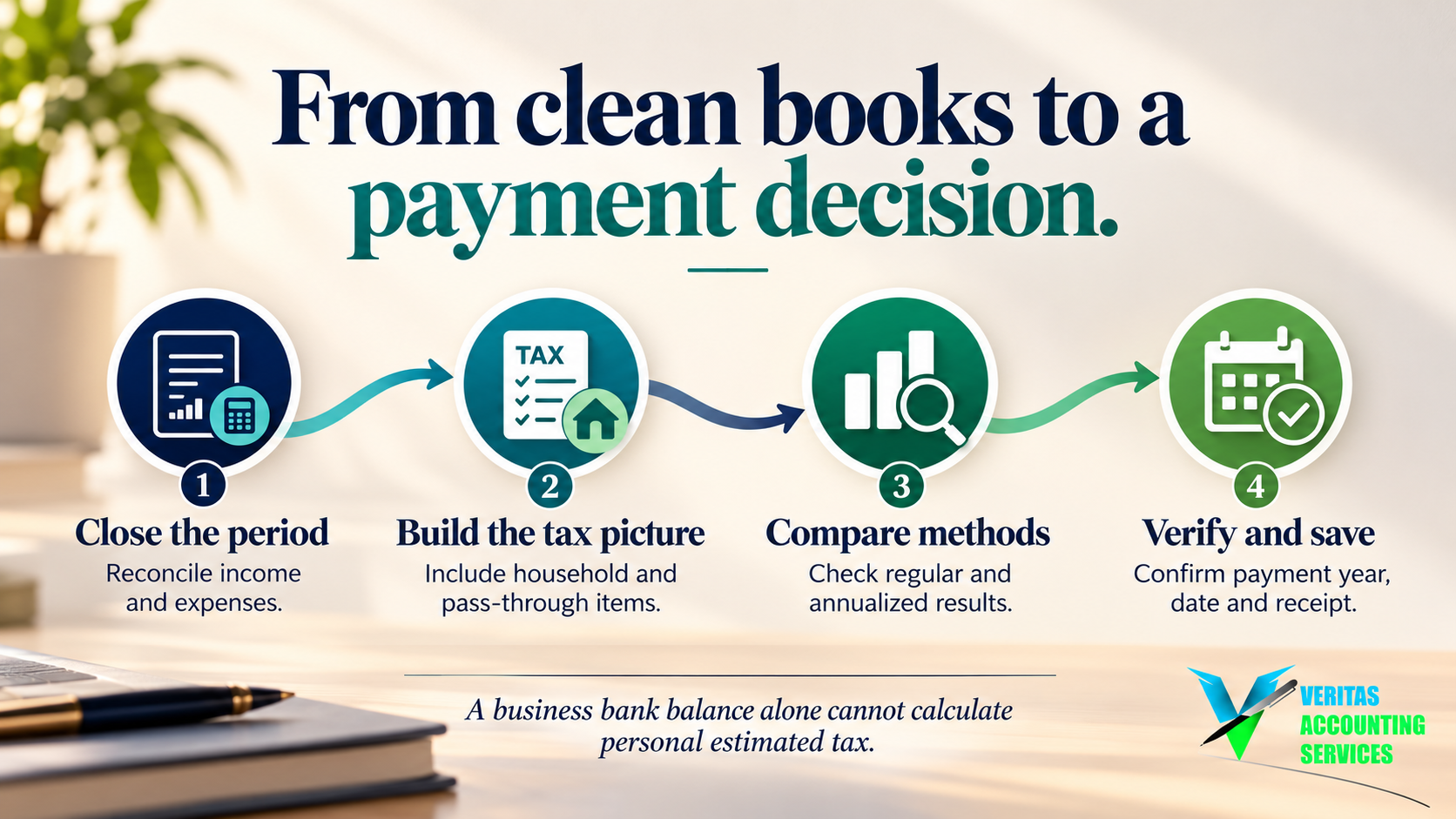
A simple review log for estimated tax payments can record the date, reports used, assumptions, person responsible and next review trigger. Mark forecasts as forecasts and keep the final calculation distinct from an earlier draft. That helps everyone understand why a payment instruction changed.
Good records support the comparison, but software cannot resolve missing facts by itself. Our guide to bookkeeping and tax records explains the connection between reconciled information and a more reliable tax handoff. The objective is fewer unanswered questions, not a larger stack of documents.
Avoid common mistakes
The first mistake is treating a late catch-up payment as a complete repair. The IRS calculates underpayment separately for required installments. Paying more now may be sensible, but review earlier periods rather than assuming they have disappeared from the calculation.
The second is confusing revenue, profit and taxable income. Revenue does not subtract business expenses; bookkeeping profit may still need tax adjustments; personal taxable income includes other items. Estimated tax payments need the appropriate tax picture, not whichever number is easiest to find.
The third is assuming annualization always wins. A regular method may be simpler or already provide the relevant protection. Compare the result and the recordkeeping effort before adding complexity that does not improve the decision.
The fourth is confusing the reserve with the payment. A transfer to a savings account is an internal cash-management action. The actual payment requires the correct taxpayer, tax year, payment designation and completion evidence.
Finally, do not ignore an IRS notice because the spreadsheet looks right. Compare the notice with filed information and verified estimated tax payments. Our guide to responding to an IRS notice can help frame that separate task, but the notice’s actual instructions and response deadline remain important.
Frequently asked questions
Can estimated tax payments vary during the year?
Yes. When income is uneven, the annualized income installment method may produce different required amounts for different periods. The result must come from the applicable calculation. It is not a general permission to pay only in profitable months or postpone every obligation until the year ends.
Does annualizing reduce my final income tax?
It addresses estimated tax payments and the installment calculation, including potential underpayment exposure. It does not create a deduction or credit and does not by itself reduce the final annual income tax. Review the full-year liability separately from the timing of payments.
Are the annualized periods the same as calendar quarters?
No. For the individual calendar-year worksheet discussed here, they are cumulative periods ending March, May, August and December. Use the specific worksheet and year that apply to the taxpayer. Do not substitute ordinary quarterly profit reports without checking their coverage.
Should I use last year’s return to calculate everything?
The prior-year amount can be an important benchmark, subject to the applicable conditions and higher-income rule. Current-year changes still matter for forecasting the ultimate balance. An installment protection calculation and a realistic final-tax forecast serve different purposes.
What if my business is an LLC?
The LLC label alone does not identify its federal tax treatment. Confirm how the entity is taxed and whose obligation is being calculated. Estimated tax payments for an individual owner should not be substituted for a separate corporate tax or payroll obligation.
Should I wait for filing season to review estimated tax payments?
Review the position while there is still time to make informed payment and cash decisions. Preserve the period records now and use the final applicable forms at filing. A later return preparation appointment does not make earlier payment timing irrelevant.
Conclusion
Uneven business income calls for a better timeline, rather than a guess based on the year-end bank balance. Reconcile the required cumulative periods, assemble the wider tax picture and ask for a comparison of methods before changing estimated tax payments.
The useful next step is practical: gather period reports and payment confirmations, identify unresolved items and set a review date with your adviser. Keep the final liability, installment timing and available cash visible as separate parts of one plan.
This article provides general federal tax information reviewed October 27, 2026. It is not individualized advice. Confirm the applicable tax year, entity, current forms, special rules and state requirements before acting.
GET IN TOUCH
Schedule a FREE Call
Connect on our Socials!
