






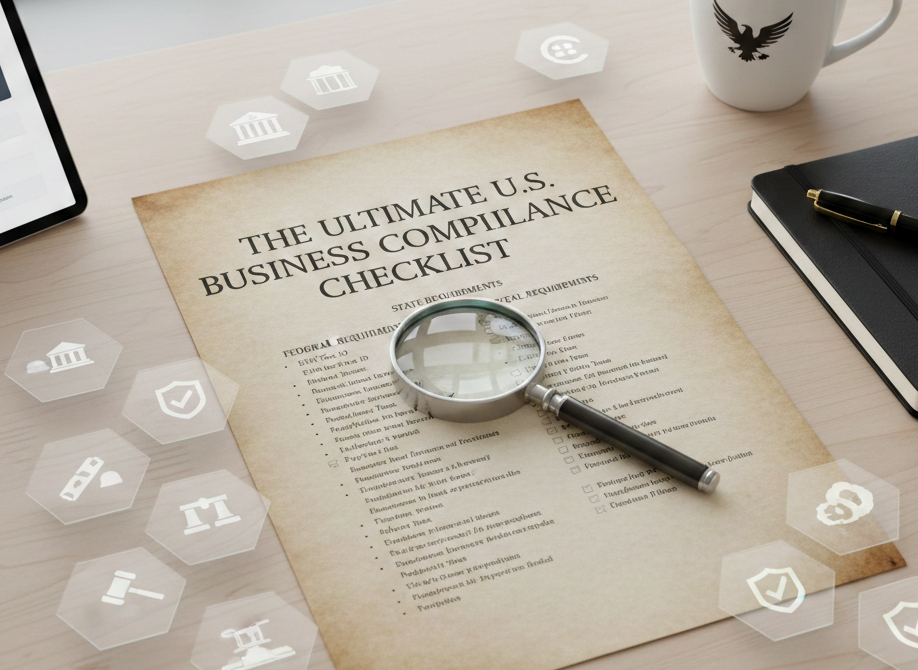

The Ultimate U.S. Business Compliance Checklist: 7 Areas Founders Can’t Ignore
Compliance isn’t admin work—it’s risk management.
Most founders don’t fail because of bad ideas. They fail because they ignore compliance until it’s too late.
In the U.S., running a business comes with layered responsibilities—federal, state, and local. Add tax rules, hiring regulations, and data protection requirements, and compliance quickly becomes complex.
That’s why every founder needs a structured US business compliance checklist—not as a formality, but as a system to protect growth, avoid penalties, and maintain credibility.
Below are the 7 critical compliance areas every founder must understand and actively manage.
1. Federal Compliance: Establishing Your Business Identity
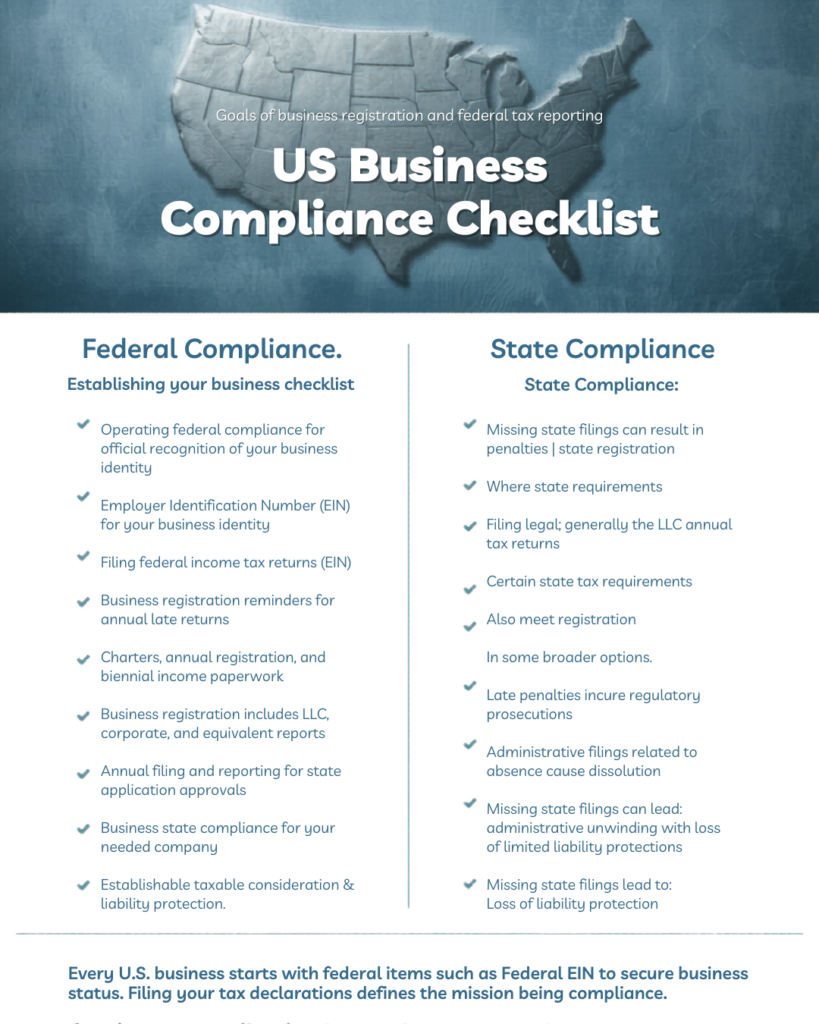
Every U.S. business starts with federal compliance. This is where your company gains official recognition for tax and regulatory purposes.
Your checklist should include:
- Obtaining an Employer Identification Number (EIN)
- Filing federal income tax returns
- Understanding federal labor laws (FLSA)
- Maintaining financial records and documentation
- Without federal compliance, your business cannot legally function in key areas like banking, hiring, or taxation.
Many founders underestimate this step, especially early-stage businesses that are not yet generating revenue. However, ignoring federal obligations can create complications later when scaling or seeking funding.
2. State Compliance: Where Your Business Is Registered
While federal compliance gives your business identity, state compliance defines where your business legally exists.
Each state has its own requirements, including:
- Business registration (LLC, Corporation)
- Annual or biennial reports
- State-level taxes (including franchise tax)
- Licensing requirements
For example, a Delaware-registered company may still need to register in another state if it operates there.
A strong US business compliance checklist ensures you are compliant not only where you formed your business but also where you operate.
Missing state filings can lead to:
- Late penalties
- Administrative dissolution
- Loss of limited liability protection
3. Local Compliance: The Overlooked Layer
Local compliance is often ignored—but it can stop your business operations instantly if not handled properly.
Depending on your city or county, requirements may include:
- Business licenses
- Zoning approvals
- Health and safety inspections
- Operational permits
Even digital or remote businesses may need local registrations if they operate from a physical address.
This layer is critical because local authorities can enforce compliance more directly and quickly than federal agencies.
Including local requirements in your US business compliance checklist ensures you don’t face unexpected shutdowns or penalties.
4. Tax Compliance: The Highest Risk Area
Tax compliance is the most sensitive and high-risk area for any business.
Your checklist should include:
Federal Tax Obligations
- Income tax filing
- Payroll tax deposits
- Estimated tax payments
State Tax Obligations
- State income tax
- Franchise taxes
Sales Tax (Nexus Rules)
Sales tax is where many founders make costly mistakes.
If your business has nexus (a presence in a state), you must:
- Register for sales tax
- Collect tax from customers
- File periodic returns
Nexus can be triggered by:
- Physical presence
- Employees
- Economic thresholds (sales volume)
Ignoring this can result in:
- Backdated tax liabilities
- Penalties and interest
- Audit exposure
A well-maintained US business compliance checklist always prioritizes tax compliance because errors here are expensive.
5. Hiring & Payroll Compliance: Getting People Matters Right
Once you hire employees or contractors, compliance becomes more complex.
You must manage:
- Payroll tax withholding and filings
- Worker classification (employee vs contractor)
- Wage laws and overtime rules
- Workplace safety standards (OSHA)
Misclassification is one of the most common and costly mistakes.
For example, treating an employee as an independent contractor may result in:
- IRS penalties
- Back taxes
- Legal disputes
Your US business compliance checklist should clearly define hiring processes and documentation to avoid these risks.
6. Data & Privacy Compliance: A Growing Priority
As businesses become more digital, data compliance is no longer optional—it is expected.
You should have:
- A clear privacy policy
- Secure data storage practices
- Access control systems
- A breach response plan
Depending on your business, you may need to comply with:
- State-level privacy laws
- Industry-specific data standards
Failing to protect customer data can result in:
- Legal penalties
- Loss of customer trust
- Reputational damage
Adding data protection to your US business compliance checklist ensures long-term credibility.
7. Industry-Specific Compliance: Tailored to Your Business
Every industry has unique regulatory requirements.
Examples include:
- SaaS → data security and subscription regulations
- Healthcare → patient data protection
- Financial services → reporting and compliance standards
- E-commerce → consumer protection laws
Generic compliance is not enough.
Your US business compliance checklist must include industry-specific obligations relevant to your operations.
Ignoring this layer can lead to serious regulatory issues even if general compliance is in place.
Where Most Founders Go Wrong
Even with a checklist, mistakes happen—often due to lack of awareness or systems.
Common issues include:
- Missing filing deadlines
- Mixing personal and business finances
- Misclassifying employees
- Ignoring sales tax obligations
- Failing to implement data privacy measures
These problems usually don’t appear immediately—but they accumulate over time and become costly.
Why Early Compliance Is Always Cheaper
Fixing compliance later is always more expensive than doing it correctly from the start.
Late-stage corrections often involve:
- Penalties and interest
- Legal costs
- Operational disruptions
- Time-consuming audits
On the other hand, early compliance provides:
- Financial clarity
- Risk reduction
- Investor confidence
- Smooth scalability
A proactive US business compliance checklist saves both time and money.
How to Build a Practical Compliance System
Compliance should not depend on memory or last-minute action.
Instead, founders should:
- Create a compliance calendar
- Set automated reminders
- Maintain organized financial records
- Use accounting and compliance tools
- Work with professionals when needed
Turning compliance into a system ensures consistency and reduces risk.
The Bottom Line
Compliance does not slow your business—it protects it.
A structured US business compliance checklist ensures your business:
- Operates legally
- Avoids penalties
- Builds credibility
- Scales confidently
Founders who treat compliance seriously don’t just survive—they build resilient businesses.
Final Thought
Ask yourself:
Are you managing compliance proactively—or reacting to problems later?
Because in business, prevention is always cheaper than correction.
GET IN TOUCH
Schedule a FREE Call








Connect on our Socials!
