








The 4 Powerful Pillars That Protect Your Financial Success: Accounting, Bookkeeping, Finance & Audit
Accounting bookkeeping finance audit functions are the foundation of every financially successful business. When these four disciplines work together, they create clarity, compliance, control, and long-term growth. When ignored, they expose companies to risk, mismanagement, and financial instability.
These four functions are not interchangeable. Each serves a distinct role. When aligned properly, they create clarity, control, compliance, and strategic direction. When misunderstood or neglected, they expose businesses to risk, inefficiency, and costly surprises.
Understanding these four powerful pillars is essential for business owners, CFOs, and finance leaders who want sustainable financial success.
Pillar 1: Bookkeeping — The Foundation of Financial Accuracy
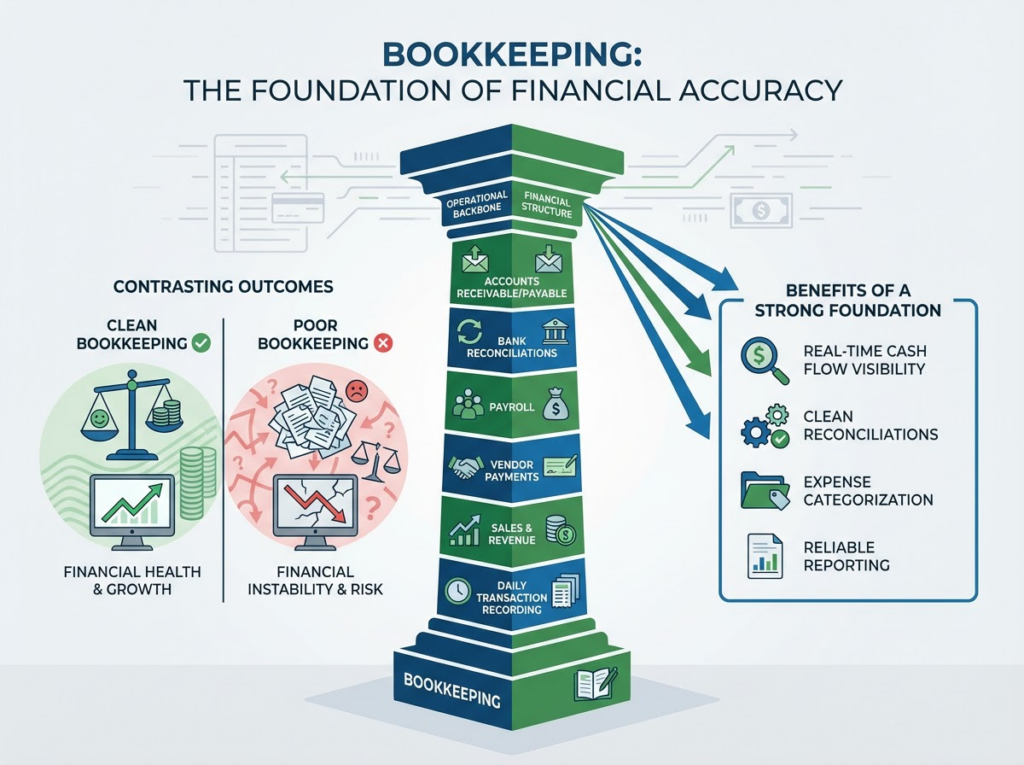
Bookkeeping is the operational backbone of every financial system. It involves the systematic recording of daily financial transactions, including:
- Sales and revenue entries
- Vendor payments
- Payroll expenses
- Bank reconciliations
- Accounts receivable and payable tracking
Without clean bookkeeping, everything else collapses.
Why Bookkeeping Matters
Accurate bookkeeping ensures:
- Real-time visibility into cash flow
- Clean bank and credit card reconciliations
- Proper categorization of expenses
- Reliable financial reporting
Poor bookkeeping creates distorted financial statements, missed tax deductions, cash flow blind spots, and compliance issues.
For growing businesses, scalable bookkeeping systems prevent operational chaos. For established companies, it ensures financial transparency and audit readiness.
Bookkeeping is not strategy — it is structure. But without structure, strategy fails.
Pillar 2: Accounting — Turning Data Into Financial Clarity

While bookkeeping records transactions, accounting interprets them.
Accounting transforms raw financial data into meaningful insights through:
- Financial statement preparation
- Accrual adjustments
- Revenue recognition
- Expense matching
- Asset depreciation
- Tax compliance alignment
In simple terms:
Bookkeeping records what happened.
Accounting explains what it means.
The Role of Accounting in Business Stability
Strong accounting ensures:
- Accurate profit and loss statements
- Reliable balance sheets
- Compliance with accounting standards
- Proper tax positioning
- Informed business decision-making
Accounting also ensures businesses adhere to GAAP (Generally Accepted Accounting Principles) or relevant reporting frameworks when applicable.
Without accounting oversight, businesses risk:
- Misstated earnings
- Compliance penalties
- Cash flow mismanagement
- Tax exposure
Accounting is the bridge between operations and strategic leadership.
Pillar 3: Finance — Driving Strategy and Growth

Finance goes beyond reporting. It focuses on planning, forecasting, capital management, and strategic decision-making.
While bookkeeping and accounting look at historical performance, finance focuses on the future.
Core Finance Functions Include:
- Budgeting and forecasting
- Cash flow modeling
- Capital allocation decisions
- Debt and equity management
- Risk assessment
- Financial scenario planning
Finance answers critical questions:
- Can we afford expansion?
- How much working capital do we need?
- Should we reinvest profits or reduce debt?
- What is our break-even threshold?
Strong financial management protects businesses from liquidity crises and ensures long-term sustainability.
A company may be profitable on paper but fail due to poor cash flow management. Finance prevents that disconnect.
Pillar 4: Audit — Safeguarding Integrity and Compliance
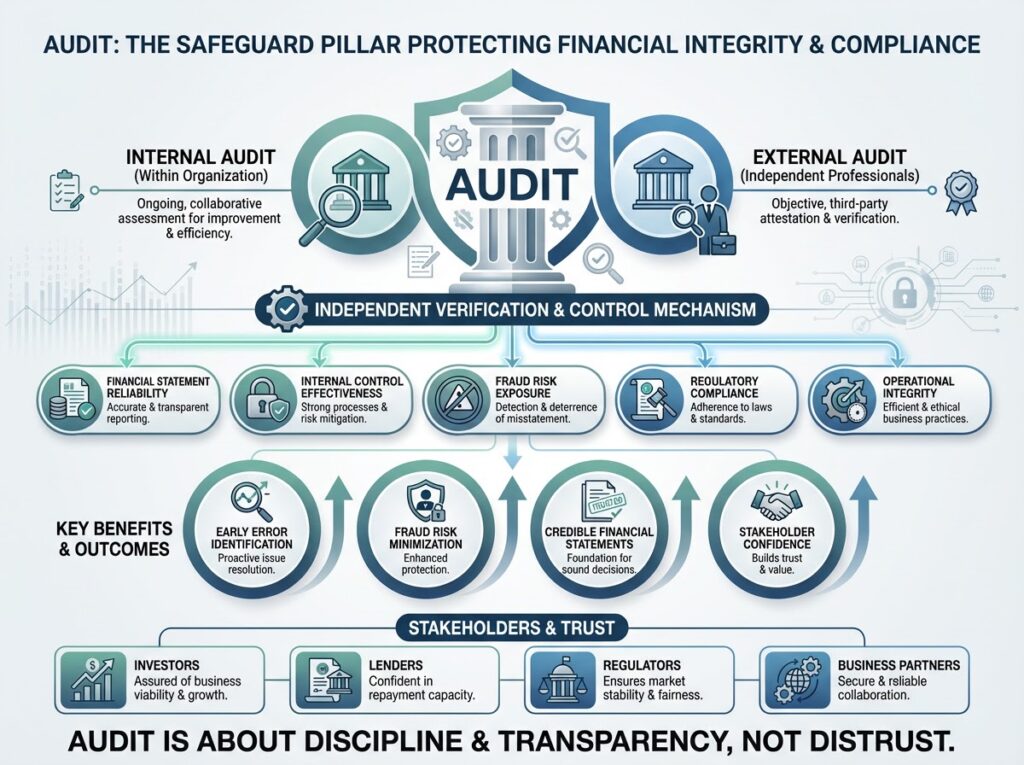
Audit serves as the independent safeguard of financial accuracy and internal controls.
Auditing evaluates:
- Financial statement reliability
- Internal control effectiveness
- Fraud risk exposure
- Regulatory compliance
- Operational integrity
Audit can be internal (conducted within the organization) or external (performed by independent professionals).
Why Audit Protects Financial Success
Audit ensures:
- Errors are identified early
- Fraud risks are minimized
- Financial statements are credible
- Stakeholders maintain confidence
Investors, lenders, regulators, and business partners rely on audited financial data for trust.
Even businesses not legally required to undergo audits benefit from periodic internal reviews to strengthen controls and prevent leakage.
Audit is not about distrust — it is about discipline and transparency.
How the 4 Pillars Work Together
These four pillars are interconnected:
- Bookkeeping supplies clean data.
- Accounting ensures accurate reporting.
- Finance turns reports into strategy.
- Audit verifies integrity and compliance.
When any one pillar weakens, the entire structure becomes unstable.
For example:
- Weak bookkeeping leads to inaccurate accounting.
- Inaccurate accounting distorts financial planning.
- Poor financial planning creates liquidity risk.
- Weak controls increase audit findings.
True financial success depends on alignment across all four.
Common Misconceptions Businesses Have
1. “Bookkeeping and accounting are the same.”
They are not. Bookkeeping records. Accounting analyzes.
2. “Finance is only for large corporations.”
Every business needs financial planning, regardless of size.
3. “Audit is only required when legally mandated.”
Proactive audits protect businesses from internal breakdowns.
4. “Profit equals financial success.”
Profit without cash flow management and compliance can lead to failure.
Understanding these distinctions strengthens leadership decisions.
Risks of Ignoring Any One Pillar
Neglecting bookkeeping:
- Inaccurate tax filings
- Missed deductions
- Cash flow misstatements
Neglecting accounting:
- Misleading financial statements
- Regulatory risk
- Poor business decisions
Neglecting finance:
- Over-leveraging
- Poor capital allocation
- Expansion miscalculations
Neglecting audit:
- Internal fraud exposure
- Compliance failures
- Investor distrust
Each pillar protects against a different type of risk.
The Strategic Advantage of Integration
Forward-thinking businesses integrate all four pillars through:
- Cloud-based accounting systems
- Automated reconciliation tools
- Financial dashboards
- Internal control frameworks
- Regular financial reviews
Technology enhances efficiency, but expertise ensures accuracy.
Automation can streamline bookkeeping.
Professional accounting ensures compliance.
Strategic finance drives growth.
Independent audit protects credibility.
The integration of systems and expertise defines modern financial leadership.
When to Strengthen Each Pillar
You should reassess your financial structure when:
- Revenue growth accelerates
- Investor funding is introduced
- International operations expand
- Regulatory complexity increases
- Cash flow volatility emerges
Growth without financial infrastructure creates fragility.
Strengthening accounting, bookkeeping, finance, and audit early prevents future crises.
The Leadership Perspective
For CEOs and founders, these four pillars are not administrative burdens — they are strategic assets.
Strong financial foundations:
- Increase valuation
- Improve investor confidence
- Support scalable growth
- Reduce compliance risk
- Strengthen operational clarity
Financial success is not accidental. It is engineered through disciplined systems.
The Bottom Line
The 4 Powerful Pillars That Protect Your Financial Success — accounting, bookkeeping, finance, and audit — are not optional functions. They are essential safeguards.
Bookkeeping ensures accuracy.
Accounting provides clarity.
Finance drives strategy.
Audit protects integrity.
Together, they create financial resilience.
Businesses that respect and invest in these pillars do more than survive — they build sustainable, scalable, and trustworthy enterprises.
In a competitive environment, financial strength is not just about generating profit. It is about protecting it.
And protection begins with these four powerful pillars.
GET IN TOUCH
Schedule a FREE Call









Connect on our Socials!
