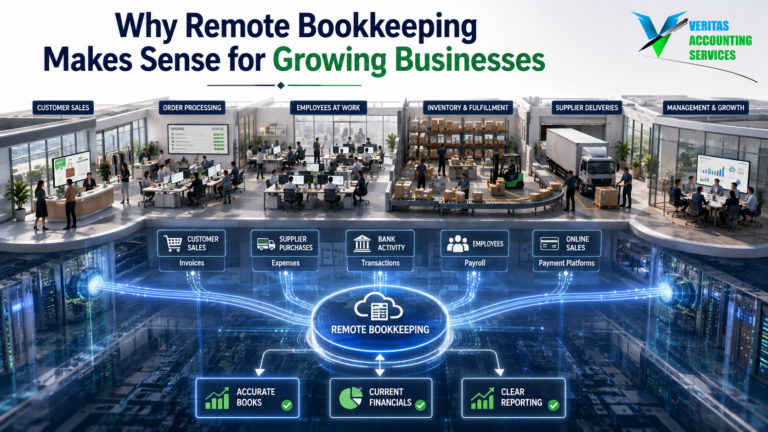







Operations Without Numbers Is Guesswork: Turn Business Data into Better Decisions
Every successful business is built on decisions.
Whether you’re hiring a new employee, investing in marketing, purchasing equipment, expanding into a new market, or launching a new product, every decision influences your company’s financial future. While experience and intuition certainly play a role, relying solely on instinct can expose your business to unnecessary risks.
Surprisingly, many businesses still operate this way.
Business owners often believe they know how their company is performing because sales appear healthy, customers seem satisfied, or bank balances look positive. However, these observations rarely reveal the complete picture. Without reliable data, it’s impossible to know whether profits are improving, operating costs are increasing, or cash flow is becoming a concern.
This is where business performance metrics become invaluable.
They transform assumptions into facts, helping business owners understand what is really happening inside the business. Instead of reacting to problems after they occur, you can identify trends early, make informed decisions, and build a stronger, more profitable organisation.
Think of your business like an aircraft. A skilled pilot doesn’t rely on instinct alone—they depend on instruments that provide accurate information about speed, altitude, direction, and fuel levels. Likewise, business owners need reliable business performance metrics to navigate challenges and achieve sustainable growth.
Why Every Business Needs Measurable Data
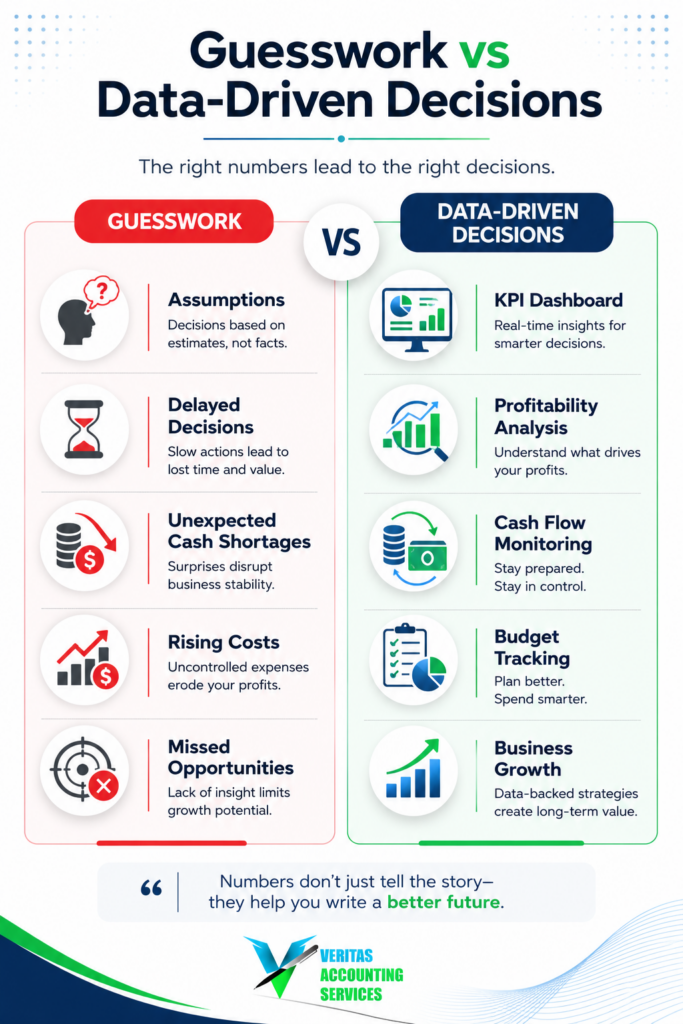
Every day, business owners make decisions that affect profitability, operations, employees, and customers. Some decisions are small, while others can influence the future of the company for years to come.
The challenge is that many of these decisions are based on opinions rather than evidence.
Questions like these should always have clear, measurable answers:
- Is our profit improving every month?
- Which products generate the highest margin?
- Are operating expenses increasing faster than revenue?
- Which customers contribute the most profit?
- How much cash do we actually have available?
Without business performance metrics, these questions often receive responses such as “I think so” or “It feels like it.”
Successful organisations don’t manage their business based on feelings. They establish measurable indicators that reveal exactly where the business stands and where improvement is needed.
Numbers eliminate uncertainty and allow management teams to focus on solving real problems instead of reacting to assumptions.
Revenue Alone Doesn’t Define Success
One of the most common mistakes business owners make is using revenue as the primary measure of success.
While growing sales is important, revenue alone doesn’t guarantee a healthy business.
Imagine two companies generating the same annual sales. One maintains healthy profit margins, strong cash flow, and controlled expenses. The other struggles with rising costs, excessive discounts, and delayed customer payments.
Although their revenue is identical, their financial health is completely different.
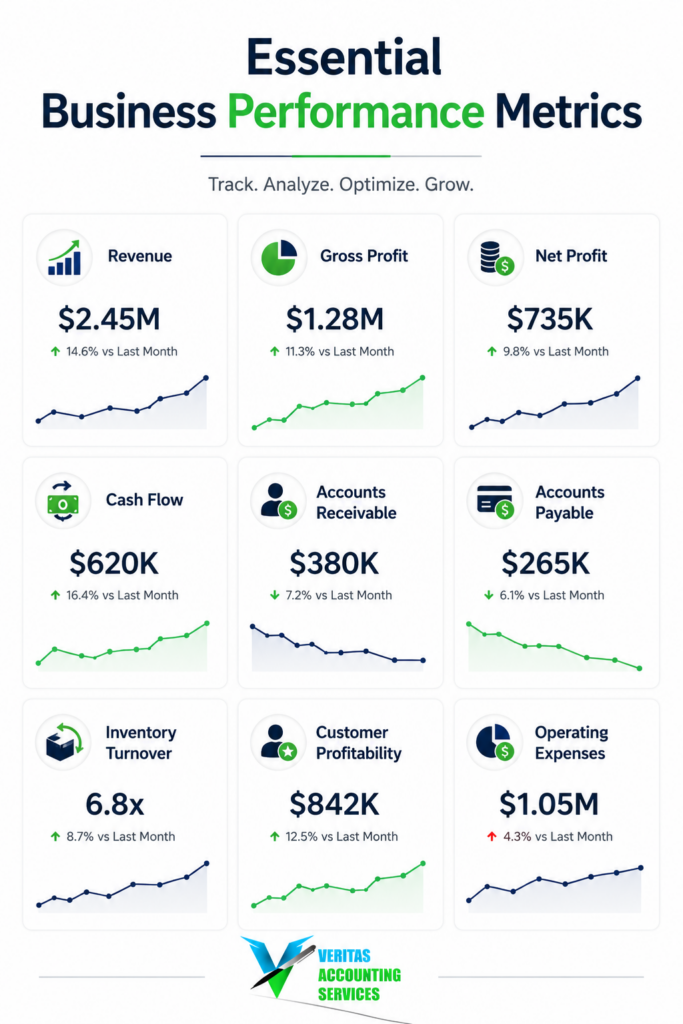
This is why businesses should monitor revenue alongside other business performance metrics that provide greater insight into financial performance.
Some valuable revenue indicators include:
- Monthly revenue growth
- Revenue by product or service
- Revenue by customer
- Average sales value
- Revenue by business location
These figures help identify where growth is occurring and whether that growth is sustainable.
Instead of celebrating sales alone, businesses should evaluate whether additional revenue is creating additional value.
Profitability Tells the Real Story
Revenue creates activity.
Profit creates sustainability.
Many businesses proudly announce record sales while quietly experiencing declining profitability. Rising supplier costs, increased labour expenses, excessive overheads, or poor pricing decisions can gradually reduce profit without immediately affecting sales.
Monitoring profitability allows business owners to understand whether the company is becoming stronger or simply becoming busier.
Important profitability indicators include:
- Gross Profit Margin
- Net Profit Margin
- Operating Margin
- Cost of Goods Sold
- Operating Expenses as a percentage of revenue
These business performance metrics help identify pricing opportunities, unnecessary expenses, and operational inefficiencies before they become significant financial problems.
Businesses that regularly analyse profitability are better positioned to improve margins, invest confidently, and remain competitive even during challenging economic conditions.
Cash Flow Deserves Daily Attention
Profit may appear on financial statements, but cash keeps a business operating.
Many profitable businesses experience financial stress because they cannot convert profits into available cash quickly enough. Customer payment delays, inventory purchases, loan repayments, and tax obligations can all place pressure on working capital.
For this reason, every business owner should monitor cash flow consistently rather than waiting until the end of the month.
Key cash flow indicators include:
- Operating Cash Flow
- Available Cash Balance
- Accounts Receivable Days
- Accounts Payable Days
- Cash Conversion Cycle
These business performance metrics provide early warning signs of liquidity issues, allowing management to take corrective action before cash shortages disrupt operations.
Healthy cash flow provides flexibility, supports future investment, and enables businesses to respond confidently to unexpected challenges.
Customer Profitability Matters More Than Customer Volume
Many businesses focus heavily on acquiring new customers, believing that a growing customer base automatically leads to higher profits. While customer growth is important, not every customer contributes equally to the success of your business.
Some customers place frequent orders, pay on time, and require minimal support. Others negotiate lower prices, demand additional resources, make repeated service requests, or delay payments. Although both customers generate revenue, their profitability can be dramatically different.
This is why customer-focused business performance metrics deserve regular attention.
Consider tracking:
- Customer Lifetime Value (CLV)
- Customer Acquisition Cost (CAC)
- Average Revenue per Customer
- Gross Profit by Customer
- Customer Retention Rate
- Average Collection Period
Understanding these metrics helps businesses identify their most valuable customers, improve pricing strategies, and allocate marketing budgets more effectively.
Instead of asking, “How many customers do we have?” ask, “Which customers contribute the most value to our business?”
That single shift in thinking often leads to smarter decisions and stronger profitability.
Operational Efficiency Drives Sustainable Growth
Growth isn’t always about selling more. Often, it’s about doing more with the resources you already have.
Operational efficiency measures how effectively your business converts time, labour, and resources into profitable outcomes. Inefficient processes increase costs, delay customer service, and reduce overall productivity.
Imagine two businesses with identical revenue. One completes projects faster, manages staff efficiently, and minimises waste. The other experiences delays, duplicate work, and constant rework.
Although their revenue is similar, their profits won’t be.
Useful business performance metrics for measuring operational efficiency include:
- Revenue per Employee
- Employee Utilisation Rate
- Project Completion Time
- Order Fulfilment Time
- Cost per Transaction
- Labour Cost Percentage
Monitoring these indicators allows business owners to identify bottlenecks, improve workflows, and maximise the return on every resource invested.
Operational excellence rarely happens by accident. It is achieved by consistently measuring performance and making continuous improvements.
Inventory Can Become an Expensive Liability
For businesses that buy, manufacture, or sell products, inventory represents a significant investment. While maintaining sufficient stock is necessary to meet customer demand, excessive inventory can quietly reduce profitability.
Every product sitting on a shelf ties up cash that could otherwise be invested in marketing, technology, expansion, or business development.
Poor inventory management can also lead to:
- Higher storage costs
- Product obsolescence
- Damaged goods
- Slow-moving stock
- Cash flow constraints
Important business performance metrics for inventory management include:
- Inventory Turnover Ratio
- Days Inventory Outstanding
- Slow-Moving Inventory Value
- Dead Stock Percentage
- Stock-Out Frequency
Regular monitoring helps businesses maintain the right balance between customer service and efficient use of working capital.
Inventory should support growth—not become a financial burden.
Forecasting Helps You Stay Ahead
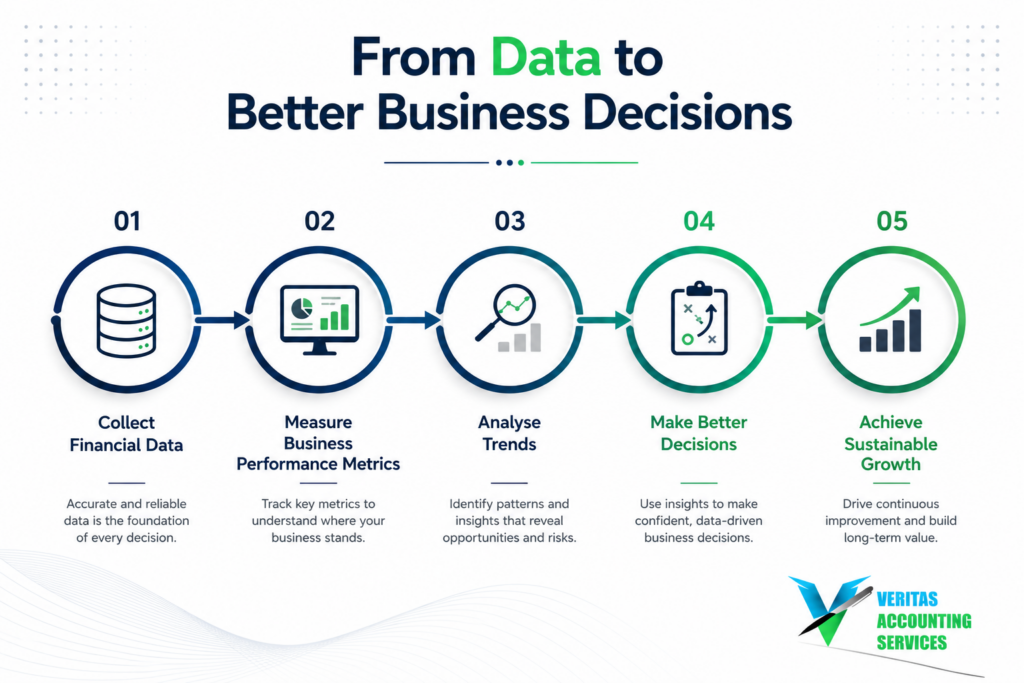
Looking at historical reports tells you where your business has been.
Forecasting helps you understand where it is heading.
One of the biggest advantages of reviewing business performance metrics regularly is the ability to predict future outcomes before problems arise.
For example, if operating expenses are increasing faster than revenue, management can take corrective action before profitability declines. If customer payment cycles are lengthening, steps can be taken to improve collections before cash flow becomes critical.
Every growing business should prepare forecasts for:
- Revenue
- Operating Expenses
- Cash Flow
- Staffing Requirements
- Capital Expenditure
- Seasonal Sales Trends
Forecasting is not about predicting the future with perfect accuracy. It is about preparing for different scenarios so that better decisions can be made today.
Businesses that forecast consistently are generally more resilient, more profitable, and better prepared for economic uncertainty.
Create a Dashboard That Supports Better Decisions
Business owners don’t need dozens of reports every week.
They need one dashboard that highlights the numbers that matter most.
An effective management dashboard provides an instant overview of financial performance, operational efficiency, and business health. Rather than searching through spreadsheets, decision-makers can quickly identify trends and respond accordingly.
A practical dashboard might include:
- Monthly Revenue
- Gross Profit Margin
- Net Profit Margin
- Operating Cash Flow
- Accounts Receivable
- Accounts Payable
- Customer Retention Rate
- Inventory Turnover
- Budget vs Actual Performance
- Monthly Operating Expenses
When reviewed consistently, these business performance metrics become an early warning system for the business.
Instead of reacting to problems after they occur, leaders can identify opportunities, manage risks, and make confident decisions backed by reliable information.
Conclusion
Every successful business relies on information to make informed decisions. Experience, intuition, and industry knowledge remain valuable, but they are most effective when supported by accurate data.
Without meaningful measurements, business owners risk making important decisions based on assumptions rather than facts. Over time, this can affect profitability, cash flow, customer relationships, and long-term growth.
Business performance metrics provide the visibility needed to understand what is working, what needs attention, and where opportunities exist. They replace uncertainty with confidence and transform financial reports into practical management tools.
Whether you’re running a startup, a growing business, or an established company, measuring the right indicators will help you make smarter decisions, improve operational efficiency, and build a stronger business for the future.
Remember, businesses don’t improve simply because owners work harder. They improve because owners measure what matters.
Frequently Asked Questions
What are business performance metrics?
Business performance metrics are measurable indicators that evaluate the financial and operational health of a business. They help business owners monitor profitability, cash flow, efficiency, customer performance, and overall business growth.
Why are business performance metrics important?
Business performance metrics provide reliable information that supports informed decision-making. They help identify trends, improve profitability, manage risks, and ensure the business remains financially healthy.
Which business performance metrics should every business monitor?
Most businesses should regularly track revenue growth, gross profit margin, net profit margin, operating cash flow, accounts receivable, customer profitability, operating expenses, and inventory turnover.
How often should business performance metrics be reviewed?
Critical indicators such as cash flow should be reviewed weekly, while financial and operational metrics are typically reviewed monthly. Businesses preparing for rapid growth may monitor certain KPIs even more frequently.
Call to Action
Are you managing your business with facts—or relying on assumptions?
At Veritas Accounting Services, we help businesses transform financial data into meaningful insights through bookkeeping, management reporting, KPI dashboards, budgeting, forecasting, and Virtual CFO services. By tracking the right business performance metrics, you gain the clarity needed to improve profitability, strengthen cash flow, and make confident business decisions.
Contact us today to discover how better financial reporting can help your business grow with confidence.
GET IN TOUCH
Schedule a FREE Call