







What to Do When You Pay for Business Expenses Personally
The company card is back at the office, but you need a replacement part before your next appointment. You pay with your own card, tuck the receipt in your pocket, and get back to work. A week later the bookkeeper sees no charge on the company statement. If the business transfers money to you, the bank feed shows the repayment but gives little clue about what you originally bought. Owner-paid expenses need a short record that connects the purchase, the person who paid, and any money the business later sends back.
This guide to owner-paid expenses follows one purchase from the checkout counter through the monthly close. The five checks are simple: identify who paid, capture the evidence, agree how to record it, match any repayment, and clear open items. Use the same checks for an occasional supply run or when sorting through a small pile of receipts at month-end.
Table of contents
- Identify who paid
- Save proof of owner-paid expenses
- Agree on the bookkeeping treatment
- Match repayment to the purchase
- Review open items at month-end
- Frequently asked questions
- Conclusion
Identify who paid
Start with two questions. What did the business receive, and whose money went to the seller? For a store purchase, you can often answer the first from the itemized receipt. The payment method, the payer’s name, or a matching transaction from a personal account can answer the second. A supplier may put the company’s name on the receipt even though the owner used a personal card. Write both facts down so the bookkeeper can match the receipt to the right account.
Owner-paid expenses can include materials for a job, an emergency replacement part, or a small software charge that renewed on an old card. For example, a repair company owner uses a personal credit card to buy $84 of replacement parts for a service call. The hardware store received one $84 payment from the owner. The business checking account had no activity at the register. If the owner simply hands over the receipt, the bookkeeper may spend time looking for a payment that will never appear in the company’s bank feed.
For owner-paid expenses, capture the person, payment method, purchase date, and amount in the same place as the receipt. A note such as “Jordan paid personally, $84, parts for Job 217” helps someone who was away from the checkout counter understand the purchase. If the owner plans to request repayment, say so. If repayment is undecided, mark it for review. This gives the business a clearer view of cash it may need to set aside.
For recurring owner-paid expenses, find out why the personal payment keeps happening. A card that expired, a saved checkout profile, and a subscription tied to an old email account are different problems. Ask someone to update the payment method with the seller and confirm the next charge. Keep the first clean business-card receipt so the bookkeeper can tell where the change took effect. The IRS guidance on keeping records explains how reliable records support business monitoring and financial statements.
Save proof of owner-paid expenses
Save the itemized receipt or invoice, evidence of payment, and a short description of why the purchase was made. Together, those records help explain what the business received, who paid, and how the purchase relates to the business. The IRS guide to business records lists documents that can support expense entries and notes that more than one document may be needed to establish all the relevant details.
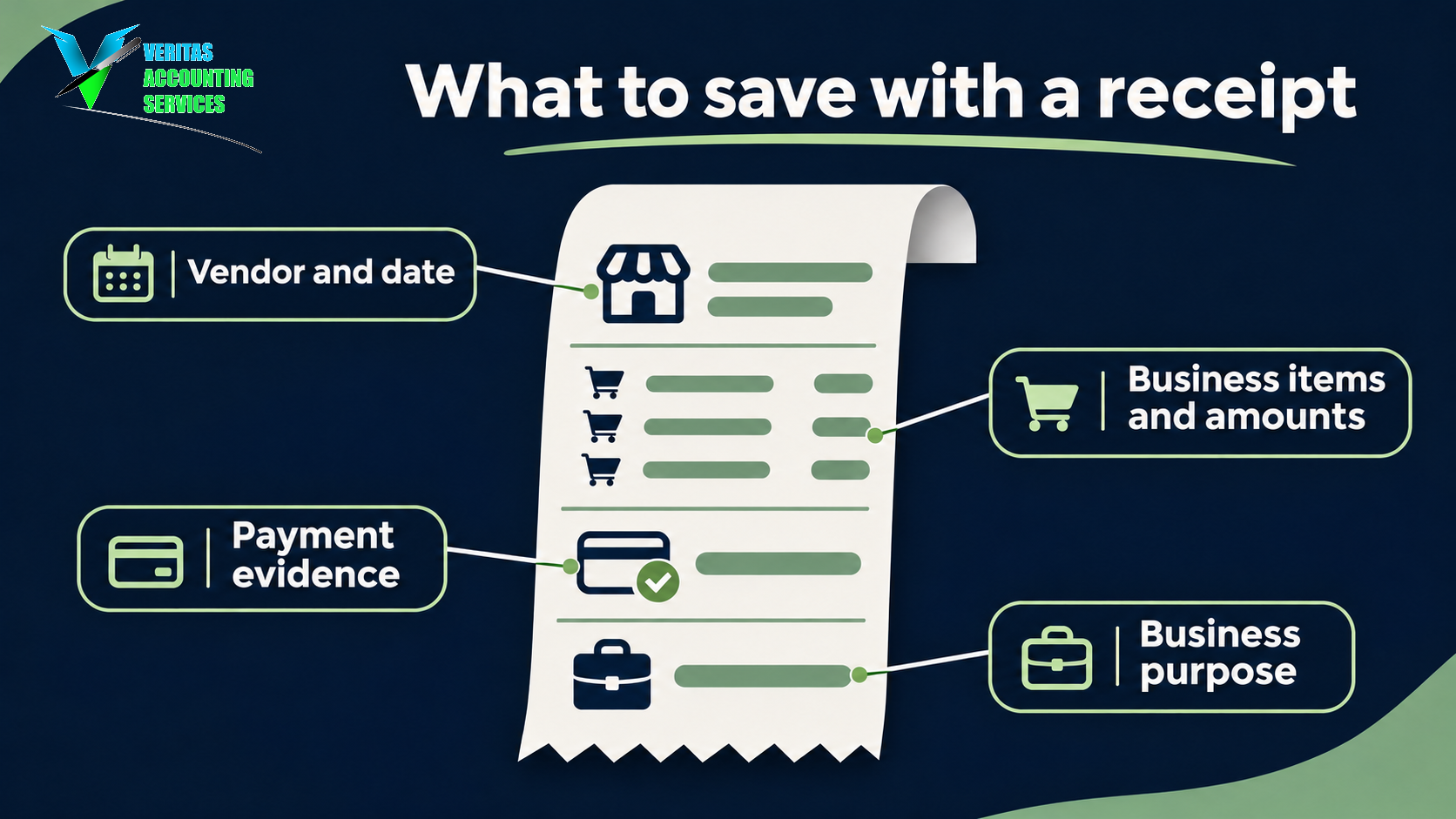
For online owner-paid expenses, the vendor may send an order confirmation with no itemized invoice attached. Log into the vendor portal and save the actual receipt when available. Add a note for anyone who needs to interpret the charge later. “Twelve months of scheduling software for the dispatch team” gives the bookkeeper more information than “software.” If a card statement lists the payment processor instead of the seller, save the confirmation number or another reference that connects the two.
Avoid sharing an entire personal statement when a matching line and appropriate supporting records will do. Use your secure bookkeeping channel and ask which details your team needs to retain. Keep the vendor, date, transaction amount and relevant account reference visible where needed. If a receipt is hard to read, take a clearer photo or request a replacement while the transaction is fresh. Save the supporting evidence with the record instead of relying on a copy that might expire in a messaging app.
Owner-paid expenses need extra care when a receipt also includes personal items. Suppose the owner purchases $36 of business shipping supplies and $24 of personal items in a single $60 transaction, with the example amounts already including applicable charges. Save the $60 receipt and mark the $36 of business items. Record the split visibly so the reviewer can tie the business portion to the whole receipt. If tax, shipping or a coupon applies to the order as a whole, flag the allocation for review before anyone enters a business amount. For broader context on grouping costs in the books, see Veritas’s guide to classifying business expenses.
If the vendor later refunds part of an owner-paid expense to the owner’s card, attach the refund to the original record. Ask whether the refund arrived before or after the business repaid the owner. A refund can change the amount still to be settled, so bring both dates and both amounts to the reviewer. An open note is useful while waiting for a return to clear, especially if the owner and the bookkeeper work in different places.
Agree on the bookkeeping treatment
A receipt answers what was bought. It rarely answers how the books should reflect the owner’s payment. Give the bookkeeper enough information to choose the entry for your business, including whether the company is expected to pay the owner back, what was purchased, and whether the transaction is already recorded. The appropriate entry depends on the business structure and the nature of the item. For example, a supply purchase and a deposit on equipment may need different treatment even if the same personal card paid for both.
When handing off owner-paid expenses, ask the reviewer to keep the purchase evidence and the owner funding information together. If an invoice already exists in the system, have them start there. A common source of confusion is entering the original invoice from the inbox and then creating a second purchase from the receipt. Compare the vendor, amount, invoice number and items before approving a new record. If a payment reference can be added to the existing entry, that makes the history easier to follow.
If repayment is expected, agree where the open item will be tracked and who can approve it. If the owner intends to fund the business without repayment, document that decision for the bookkeeper. Avoid moving an item between “to repay” and “owner funded” without an explanation. A dated decision helps the people preparing the financial reports or taking over the file later.
For owner-paid expenses involving more than one business, identify which entity actually received the goods or service. If a supply order covers jobs for two companies, give the reviewer both names and explain the allocation. Simply entering the full order in whichever file is open can distort costs and make it harder to see what each business owes. Flag unusual or material items and ask your accountant about the appropriate classification and any related tax questions. The IRS guide to starting a business and keeping records includes general guidance on business records and keeping business and personal accounts separate.
Make the handoff easy to review
For owner-paid expenses, use one row per purchase or a single identifiable record in your bookkeeping software. Add the vendor, purchase date, gross receipt amount, business amount, purpose, payer, and receipt reference. Include a project or customer code if your company tracks those costs. Let the reviewer record a decision and link the bookkeeping entry in the same record. The person who enters the transaction should be able to tell when a question is still open.
Consider owner-paid expenses across a busy week. A staff member sends in a printed invoice, the owner forwards a card receipt, and the vendor sends an email marked “paid.” Give the reviewer a way to see that all three documents relate to one order. If multiple locations bought the same item at the same price, distinguish the receipts by order number, purchase date or store. A match needs evidence, since equal amounts alone can belong to separate purchases.
Match repayment to the purchase
The $84 repair company example shows how to match repayment for owner-paid expenses. Once the business approves the claim and repays the owner, its bank feed shows $84 going out. Ask the reviewer to link that transfer to the existing purchase record using the claim reference and repayment date. The owner-to-vendor payment and the business-to-owner payment answer different questions. One shows that the parts were paid for. The other shows that the business settled with the owner.
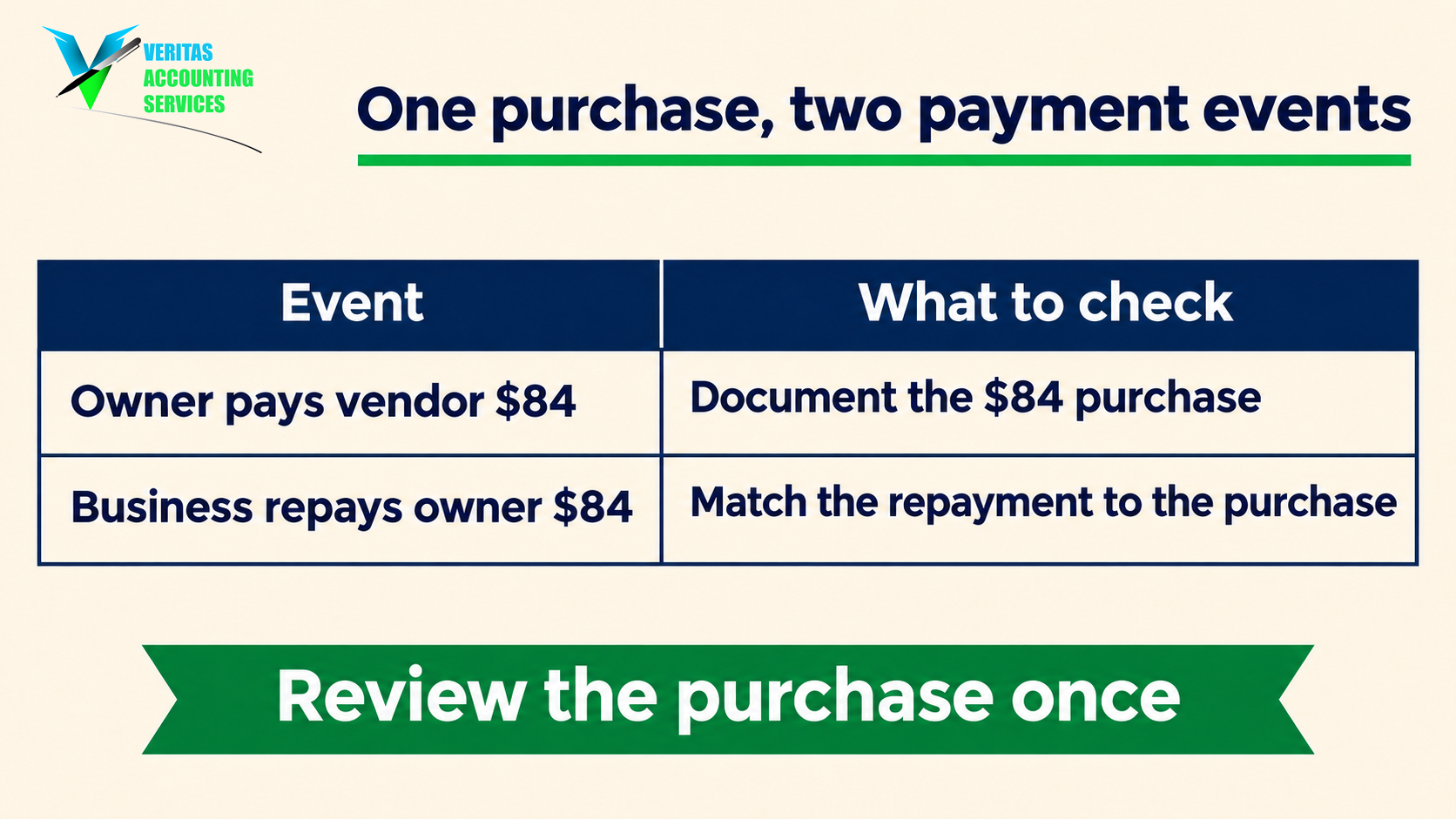
| Event | What the reviewer looks for |
|---|---|
| Owner pays the vendor $84 | Itemized receipt, payment evidence and a purpose note for Job 217 |
| Bookkeeper reviews the purchase | A single purchase record and a documented decision about the owner’s payment |
| Company sends the owner $84 | Bank transaction linked to the reviewed purchase and approval |
| Monthly review | The purchase appears once and the repayment status agrees with the bank |
The example assumes a full repayment of a single approved purchase with no fees or refunds. If the business pays $50 first and $34 later, keep both payment references on the record and track the remaining $34 until it clears. If the business sends a combined payment for three approved owner-paid expenses, give the reviewer a list of the three purchase references with amounts adding to the transfer. The list is especially helpful when the bank displays the owner’s name and nothing else.
Duplicate entries for owner-paid expenses can distort how a job performed. If the $84 purchase has already been recorded as a job expense and a second $84 expense is entered when the owner is repaid, the job report could show $168 for one set of parts. Compare the transaction history before correcting a duplicate. A reviewer can check which entry is linked to an invoice, bank match, or closed period and preserve the useful audit trail. For a related routine on checking amounts and payment timing, see Veritas’s vendor bill review guide.
Review open items at month-end
At close, sort owner-paid expenses by status. A small business might use “evidence needed,” “awaiting review,” “approved and unpaid,” and “settled.” Give each open item a person and a follow-up date. If an owner can’t find a receipt or the vendor hasn’t processed a promised refund, keep the question visible and update the note when the answer arrives. A one-line status can save time the next month because the reviewer can pick up from the last documented action.
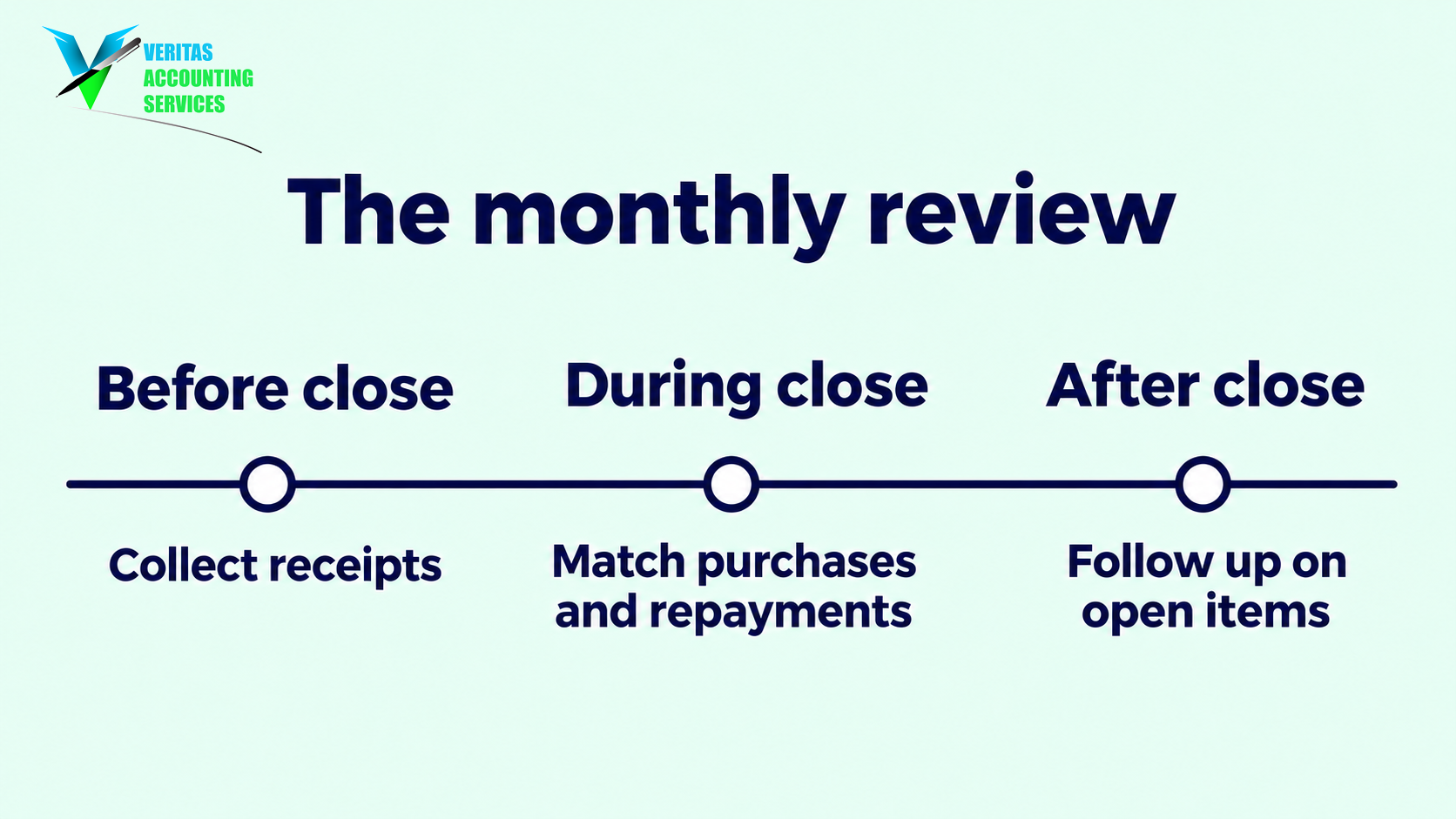
Before the close, ask for owner-paid expenses missing from the business accounts. During the close, compare the list with recorded purchases and repayments. After the close, follow up on unresolved evidence or approvals. Keep your policy for regular reporting and approvals short enough that people use it. Agree where receipts go, who can approve a repayment, and how to label the bank transfer. Veritas’s guide to good bookkeeping and tax records covers the wider recordkeeping routine.
Give the cash forecast something specific to show
Approved but unpaid owner-paid expenses are worth bringing to the cash planning discussion if the business expects to pay them soon. Say the business has approved $240 for an owner’s recent purchases and expects to pay next Friday. Put the $240 on the expected payment date in the cash forecast. When the bank transfer clears, mark it paid and remove it from future expected outflows. This helps the owner see how much cash is likely to be available for the next round of supplier bills.
If repayments build up, review the outstanding list before assuming the business has a healthy cash cushion. Also ask whether owners are regularly covering costs that should be paid from the company account. One fix might be issuing an existing authorized company card to the person who buys supplies. Another might be moving vendor autopay to the correct business account. The aim is to make owner-paid expenses occasional exceptions with a clear trail.
Check late receipts and unusual payments
If a receipt for owner-paid expenses turns up after close, save the original dates and send it to the reviewer. Explain when the purchase was made, when it came to your attention and whether any repayment has already occurred. Let your accounting team determine the right period and whether a closed report needs an adjustment. Changing the date on a document to match the month you found it makes the next review harder.
Pay particular attention to owner-paid expenses from an account used for several businesses, recurring charges that continued after an account change, and repayments for a rounded amount. A reviewer can compare the transfer with the receipts and ask what accounts for any difference. Treat the gap as an open question until it has an explanation. Keeping a short exception list helps the business spot problems without combing through every settled item again.
Frequently asked questions
Can I use a personal card for an occasional business purchase?
Start by checking your business’s policy and the card terms. If you have already made the purchase, save the receipt, evidence of payment and business purpose, then tell the bookkeeper how it was paid. For routine purchases, the IRS recommends keeping business and personal accounts separate. Keeping owner-paid expenses visible also makes it easier to move recurring charges to the business account when practical.
Is a statement line enough to explain the expense?
A statement line helps establish that a payment occurred. The vendor’s itemized receipt and a short purpose note can explain what you bought and how you used it. Keep the pieces together for owner-paid expenses. If a document is missing, request a copy and flag the item for review. Requirements can vary with the type of expense.
What if I leave the cost in the business and decide against repayment?
Tell the bookkeeper that you funded the purchase personally and currently expect no repayment. Provide the same supporting information you would give for a reimbursed purchase. Ask the bookkeeper to document that decision and apply the appropriate treatment for the entity. If the plan later changes, provide a dated update.
Should the full charge go into the books when a receipt includes personal items?
Identify the business items and record how you worked out the business portion. Save the full receipt so the reviewer can reconcile the split to the vendor total. Ask for help allocating shared charges if the receipt does not make the split clear.
What if I have already repaid myself for owner-paid expenses?
Give the reviewer both the vendor receipt and the business bank transfer. Say who approved the repayment if an approval exists. The bookkeeper can check whether the purchase already appears and whether the transfer was matched. If the bank feed recorded a second expense, have the reviewer trace it back before making a correction.
Does documenting a purchase make it deductible?
Documentation helps establish what happened. Deductibility depends on the applicable tax rules and facts about the purchase. For owner-paid expenses that raise a tax question, share the records and business context with your adviser so they can evaluate it.
Conclusion
Owner-paid expenses are easier to handle when each purchase has one clear record. Capture who paid and why, save the receipt and proof, let the reviewer decide how it belongs in the books, and link any repayment to the purchase. Check open items at month-end so a missing document or pending transfer gets a named owner and a follow-up date.
Try the routine with one of your recent owner-paid expenses. Pull the receipt and the transaction evidence, write one line about the business purpose, and ask whether it is already in the books. That gives your bookkeeper enough to start and gives you a concrete example to share the next time someone pays out of pocket.
GET IN TOUCH
Schedule a FREE Call
Connect on our Socials!
