








Vendor Bills and a Simple Routine for Better Cash Planning
A vendor payment review gives a small business owner one place to answer a deceptively simple question: which bills should leave the bank this week? The answer takes more than opening the latest supplier emails. Some invoices are already paid, some are due before your next review, and some need a delivery check or a credit before you send money. Meanwhile, a healthy bank balance on Monday can look very different after payroll on Wednesday.
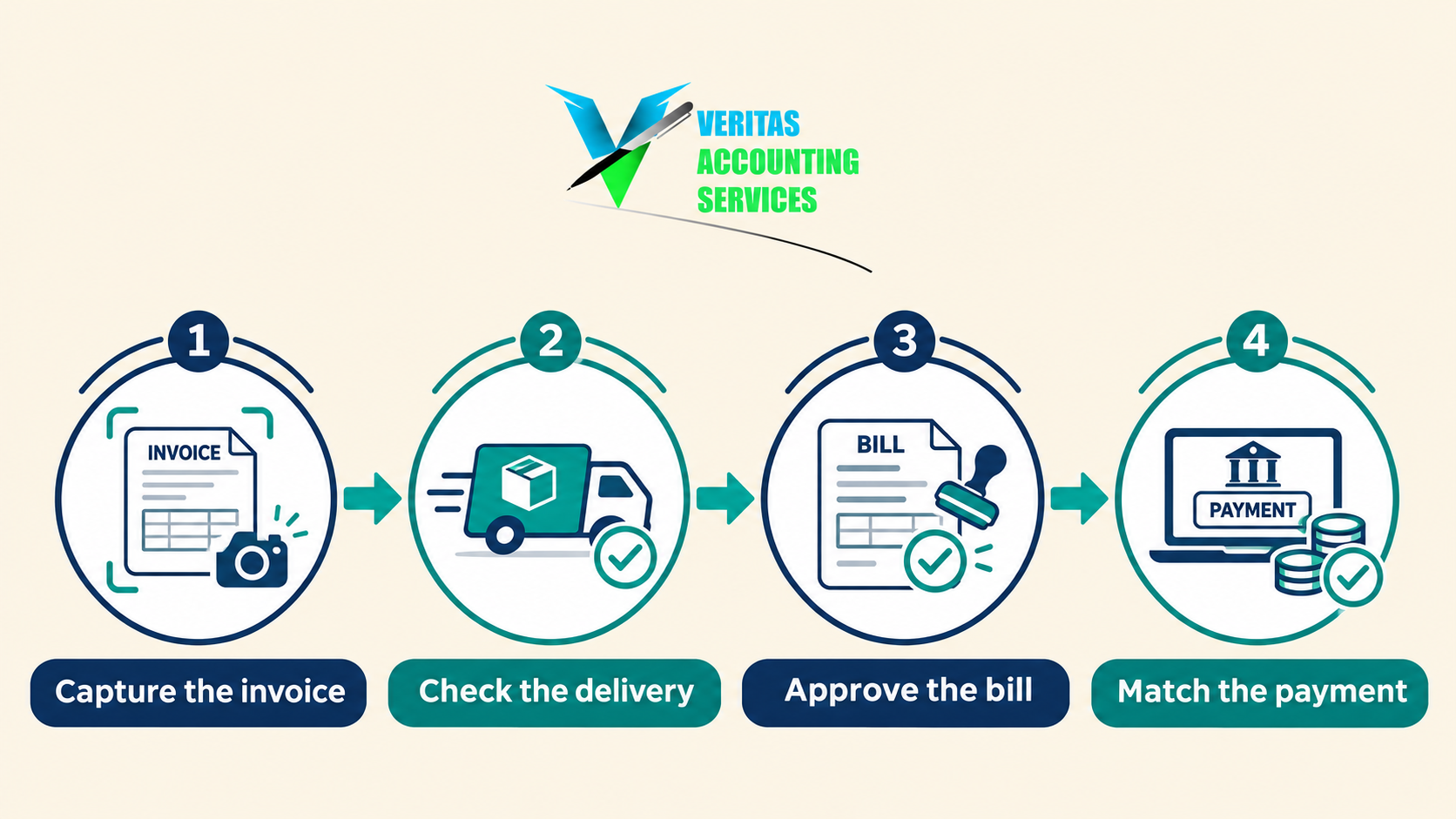
You can build a weekly routine around five checks: collect the bills, verify what you owe, sort the list, test the batch against available cash and match each payment afterward. The goal is to know what is due, who owns each exception and what cash remains after the run. The examples below use a fictional US hardware shop, but the routine also works for a service business that buys materials or pays subcontractors.
Table of contents
- Collect the bills in one place
- Verify what you owe
- Sort the vendor payment review
- Test the batch against available cash
- Match payments and close the loop
- Frequently asked questions
- Conclusion
Collect the bills in one place
Start the vendor payment review with a complete list. Give suppliers a single billing address or portal and have anyone who receives a bill elsewhere route it there. Decide who checks that inbox when the usual person is out. If a supplier emails a bill and later mails a paper copy, attach the copy to the existing record so the second arrival doesn’t become a second payable.
For each bill, capture the vendor, invoice number, invoice date, due date, amount, open balance and the person who can confirm the purchase. Include a status that tells the next person what to do: awaiting receipt, ready to approve, approved, scheduled, paid or disputed. If you rely on a spreadsheet, give each row a link or file reference to the actual bill and keep one shared working copy. If you use bookkeeping software, check whether a bill is already in the system before entering it from email.
An open bill list is only as complete as your intake process. Add a short check for recurring bills expected before the next run, such as a lease or a regular supplier delivery. If you expect a bill and can’t find it, put the expected amount in your cash forecast as an estimate and assign someone to request the invoice. Keep the forecast entry distinguishable from an approved bill. This makes the missing invoice visible without turning an estimate into permission to pay it.
Keep the invoice with its supporting documents as you go. The IRS guide to business records explains how supporting records identify the business expense and document payment. Your vendor payment review can make those records easier to find later by linking them to the bill while the people who received the goods still remember the details. For more on making this habit part of ordinary bookkeeping, see why good tax records start with good bookkeeping.
Verify what you owe
Before a bill joins the vendor payment review batch, compare what the supplier billed with what you ordered and what arrived. A hardware shop could match the invoice to a purchase order and the signed receiving slip. A service business might match it to a statement of work and a manager’s confirmation that a milestone was delivered. Smaller purchases may have fewer documents, but someone should still be able to explain what was bought and confirm that the amount is right.
For example, suppose the shop ordered 20 boxes of fasteners and received 18. The invoice lists 20. Ask the supplier whether the other two boxes are on the way or whether it will issue a corrected bill or credit. Record the reason for the hold, who contacted the supplier and when to follow up. If you and the supplier agree to pay the undisputed amount first, record that agreement and keep the remaining amount visible until it is resolved. Don’t silently clear the entire balance when a partial payment goes out.
Check the supplier statement for credits and prior payments as well. The statement helps you identify what the supplier thinks is open. Your records can reveal a payment in transit, a credit they haven’t applied or a missing invoice. Follow up on the mismatch with supporting documents. If the vendor payment review leaves someone responsible for the follow-up and gives them a date, the same unresolved item is less likely to show up week after week without explanation.
Treat a request to change the payee or bank details as a separate exception. Use a phone number or contact you already trust to confirm the change independently. If possible, have another person review the change and the first payment. A familiar logo and email signature do not verify the destination. The FBI’s business email compromise guidance specifically recommends verifying changes to payment procedures or account numbers. A routine bill can stay open while you confirm where the money should go.
Sort the vendor payment review
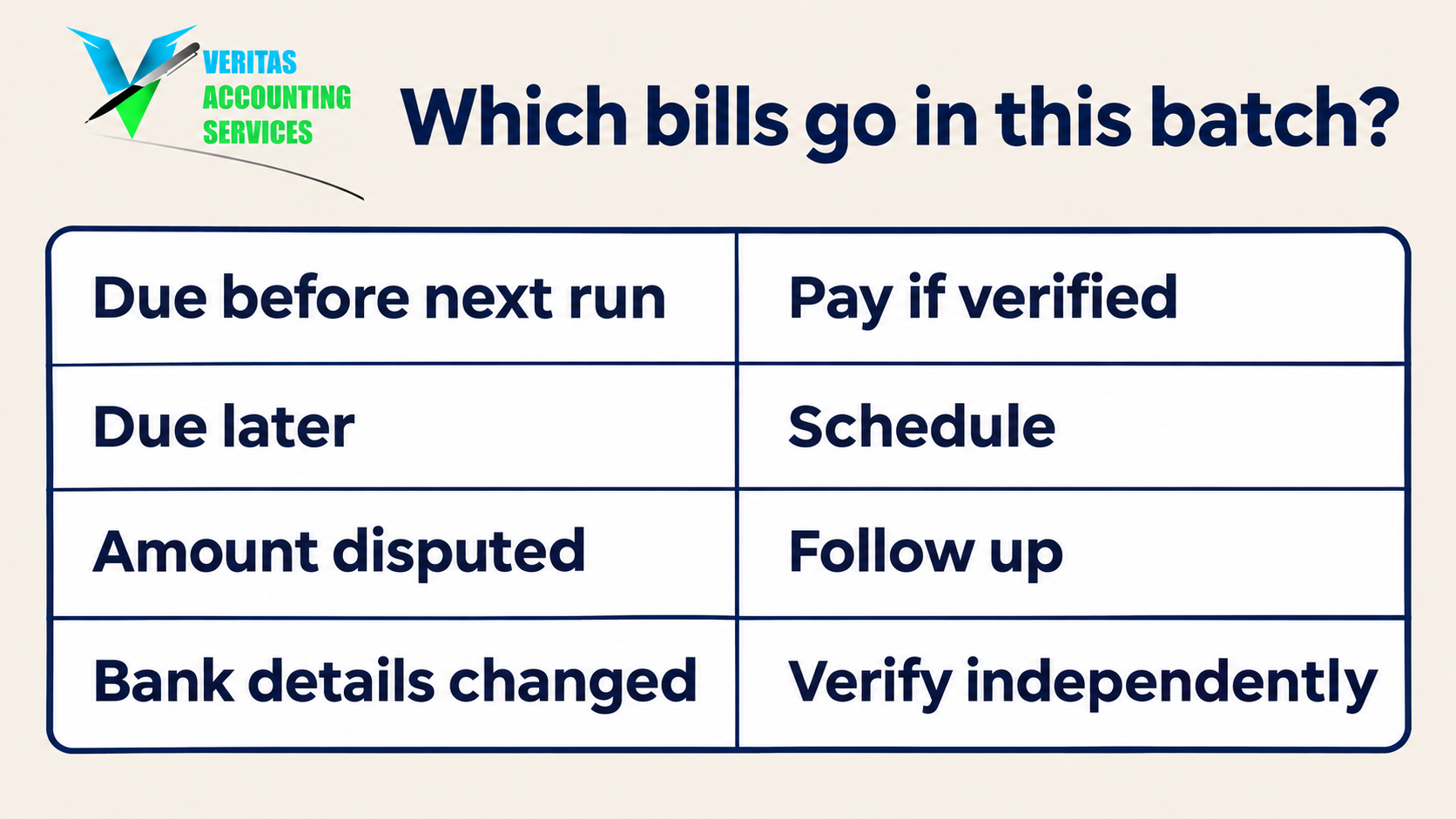
Build your list around due dates and the next payment run. A bill due next Tuesday may belong in Friday’s run if you only pay on Fridays. Consider how long each payment method takes and whether your terms require the vendor to receive payment by the due date. Leave time for weekends, holidays and the approval process. Keep a separate exception list so that a disputed bill or suspicious account change doesn’t accidentally enter the approved batch.
A simple way to organize a vendor payment review is to give every open item one next action:
| What you see | What to do |
|---|---|
| Due before the next run | Pay in this batch if verified, approved and funded. |
| Due after the next run | Schedule the bill and confirm the next review date. |
| Amount or delivery disputed | Document the issue and follow up with the vendor. |
| Payment details changed | Verify the destination independently before release. |
An overdue balance deserves a look, even if you can’t pay it today. First check whether it is genuinely unpaid or simply unmatched. If it’s unpaid and you need more time, contact the supplier early, propose a specific plan and document any agreement. Record the amount and date promised so the next vendor payment review reflects what you told the supplier. Don’t assume that changing a due date in your books changes the contract.
There may be trade-offs among bills that are all due soon. One supplier could provide the materials you need to finish a customer job. Another might offer an early payment discount. A practical vendor payment review records the reason for each decision and considers the cost of postponement, the supplier relationship and the effect on near-term cash. Treat an early payment discount as an option to evaluate. Check the actual terms, how much cash the early payment uses and whether that leaves enough for commitments that arrive first.
If the list seems to change every time you open it, separate status from payment date. For example, a verified $700 invoice can be approved today and scheduled for next Thursday. A $500 invoice with a quantity dispute stays on hold, with its original due date visible and a separate follow-up date. Keeping those dates distinct helps you explain to a teammate why two invoices due on the same day are moving through the vendor payment review differently.
Test the batch against available cash
A vendor payment review needs a cash check before you release the batch. Start with cash you can actually use and look ahead to the next scheduled review. Account for pending withdrawals, payroll, rent and other commitments that fall in that window. Check whether pending withdrawals already affect the balance you’re using so you don’t subtract them twice. Treat expected deposits separately and ask what happens if a large receipt arrives a few days late. The SBA guide to managing business finances discusses using financial information to manage cash flow. For a broader view, see Veritas’s guide to cash flow management.
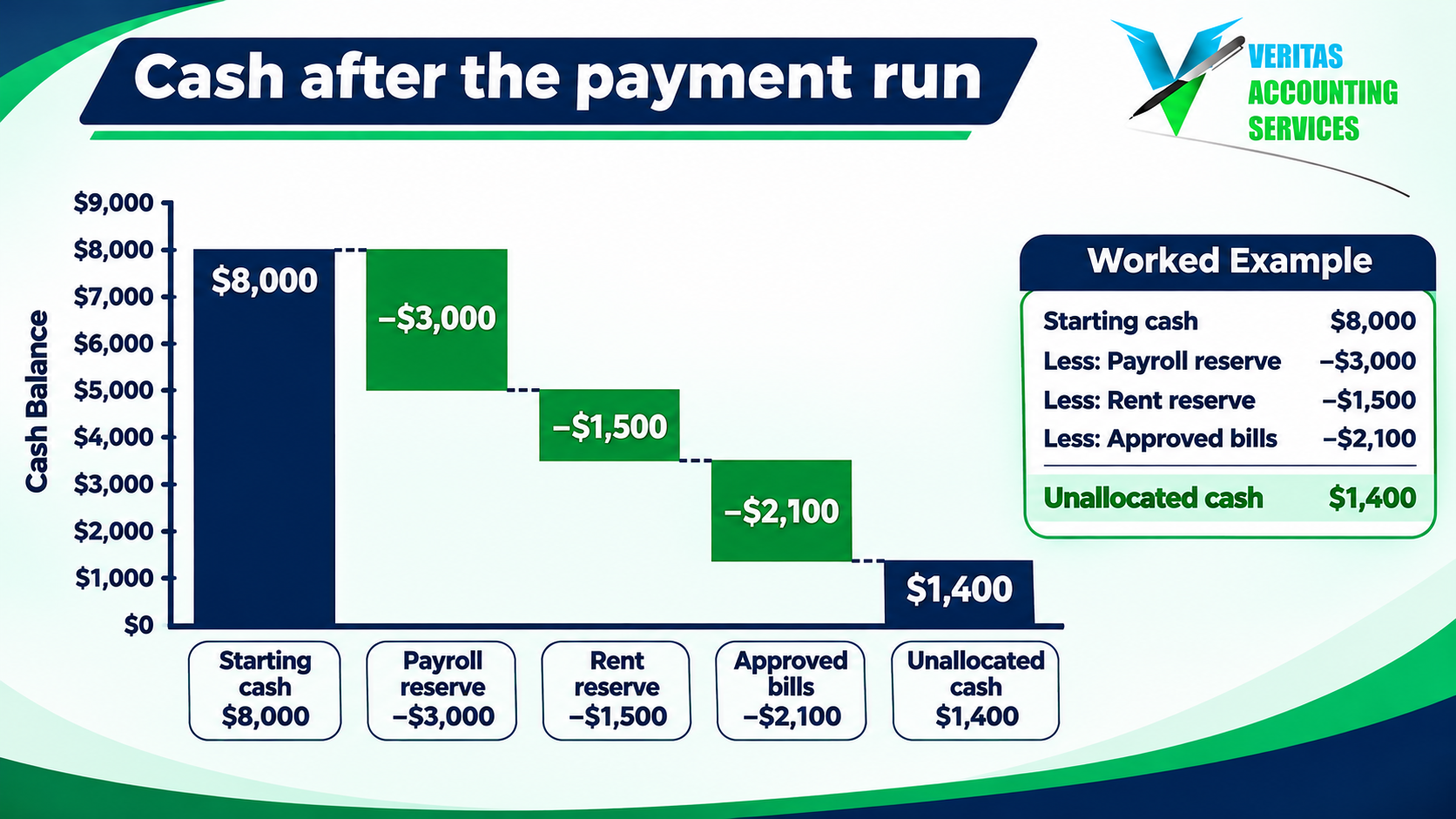
Suppose the hardware shop has $8,000 of usable cash on Monday. Before the next review, it plans to reserve $3,000 for payroll and $1,500 for rent. The verified bills in this run total $2,100. It has $1,400 left unallocated after setting aside those amounts. That figure is a planning balance for the commitments shown. If a $900 utility payment was omitted, the revised balance would be $500. If the owner requires a $1,000 buffer, the batch as shown meets it, but the revised plan with utilities falls short by $500.
Give the owner an actionable cash decision
Use the vendor payment review to show both the amounts and the timing. The shop might expect a $2,400 customer receipt later in the week. Show the plan with that receipt arriving on time and with it arriving late. If the batch only works with money that hasn’t arrived, the owner needs to decide whether to wait for cleared funds, ask a supplier for agreed terms or change the batch. Make those decisions before releasing payments and check what each one means for the actual due date and delivery schedule.
Also distinguish a current cash forecast from an accounting report. The open bills list answers what you owe and when it falls due. A cash forecast also includes expected receipts and commitments that may not appear as vendor bills. A profit report answers a different question about business performance for a period. The vendor payment review brings the first two views together for a particular decision. It won’t explain every reason why cash and profit differ. The Veritas article on tax savings and cash flow explores another example of why a cash decision needs its own analysis.
For the first few runs, write down what surprised you. Maybe freight invoices normally arrive after the goods, or a payment platform deducts a recurring fee on a different date from the invoice. Add a reminder for predictable omissions and keep one owner for each uncertain item. A reliable vendor payment review becomes easier to run once you’ve resolved the recurring causes of last-minute changes.
Match payments and close the loop
Before releasing a batch, have the approver review the actual payees, amounts and dates against the approved list. If one person runs the business alone, take a separate pass after preparation and check the final bank screen against the list before submitting. Make sure a bill marked scheduled hasn’t already been set up in the bank portal. Save the payment confirmation and record which invoices the payment covers. When one transfer pays several invoices, the reference should make it possible to trace each invoice to its share of that transfer.
After release, use the next vendor payment review to check which transactions cleared. Match a bank-feed payment to the existing bill payment in your bookkeeping system when appropriate. Creating a new expense from an imported withdrawal after the bill and its payment have already been recorded can double count the cost. Follow up on returned transfers and uncleared checks, keep their status clear and check with your bank or supplier before issuing a replacement. The IRS guide to starting a business and keeping records discusses supporting documents and bank reconciliation. Veritas also covers the problems that build up when bookkeeping falls behind.
Give exceptions their own short handoff. A useful line might read: “Invoice 1843, missing two boxes, Taylor to contact supplier Monday, review again Tuesday.” If the supplier confirms a credit, link the confirmation to the original bill and check how the credit is applied in the books. If a payment failed, keep a record of both the original attempt and the corrected payment. The next person should be able to tell which amount remains open without reading an entire email thread.
Make the vendor payment review easy to hand over
Set a recurring time for the vendor payment review and designate a backup. A lean routine can start with a brief meeting or an approval note that shows cash available, proposed payments, exceptions and decisions needed. Give the owner a batch total and enough detail to understand any unusual payment. The person checking the list should know who approves a new vendor, how to confirm changed instructions and where to find the confirmation afterward.
At month-end, compare open bills and major supplier statements, and look for old deposits, unapplied credits, repeat invoice numbers and balances that seem out of date. The vendor payment review handles the weekly decisions; a month-end look can uncover older items that never make it into the current run. If the cleanup gets complicated, bring the invoice, statement and bank record together before making adjustments. That’s more useful to your bookkeeper than an instruction to clear all old balances.
When you start, keep a short record of what you changed in each vendor payment review. For example, an owner might move the normal run from Friday to Thursday after learning that a supplier needs a full business day for processing. Update the schedule, tell the backup and keep the old confirmation available for matching. If the vendor payment review still generates repeated urgent requests, sort them by cause. Missing invoices call for better intake, while late approvals may call for a clearer cutoff. A single adjustment based on a recurring cause can save more effort than adding another sign-off to every routine bill.
Frequently asked questions
Do I need accounting software for a vendor payment review?
You can start with a shared list if it captures the bill, open balance, due date, approval and payment reference. Decide who edits it and where the supporting documents live. As invoice volume or the number of approvers grows, software can make it easier to control access, track changes and match payments. Keep a process for reviewing what the software imports or suggests.
How should a vendor payment review handle possible duplicates?
Search the supplier name, invoice number and amount, and check your payment history before entering or paying it. Differences in formatting can hide duplicates, such as a leading zero in the invoice number. Conversely, recurring bills can have the same amount and still be separate obligations. Check the service dates and documents. Mark a potential duplicate for investigation so the vendor payment review doesn’t silently drop a legitimate bill or pay the same obligation twice.
Should I track unpaid bills if I use cash basis bookkeeping?
An owner can keep an operational list of bills due even when payments drive the timing of many entries under the business’s accounting method. The list supports scheduling and cash planning. Ask your bookkeeper how to enter and report those bills in your system so that your management list and financial or tax reports are used for the right purpose. The vendor payment review itself does not determine whether or when an item is deductible.
How often should I do a vendor payment review?
Weekly is a starting point if it gives you enough time to meet your terms and review approvals. A business with daily replenishment, tight cash or frequent urgent purchases may need a shorter cycle. Keep a clear exception process for bills that can’t wait, and apply the same verification and approval steps to those payments. A payment outside the normal run should still appear in your records before the next person prepares a batch.
Conclusion
A vendor payment review works when every bill has an owner, a status and a next action. Start with the bills due before the next run. Confirm what you received, resolve mismatches, set aside cash for other commitments and check the final payment details. After the batch goes out, keep the confirmations and match the transactions as they clear. This gives the owner a clear view of which suppliers have been paid, what remains open and how much cash is available for the next decision.
GET IN TOUCH
Schedule a FREE Call
Connect on our Socials!
