







Your Simple Guide to Retirement Plan Mistakes and New Rules
Retirement plan corrections can help a business address an administration mistake while protecting the plan’s tax-favored treatment. The first step is to identify the error, preserve the records and choose an appropriate correction route with your plan adviser.
There is a timely reason to review your process. On October 22, 2026, Treasury and the IRS announced updated employer-plan correction guidance and a separate new IRA correction program. These programs have different start dates and purposes. An owner should not treat the announcement as permission to fix every problem with a simple payroll adjustment.
This guide explains the announcement and offers five practical checks for US small-business employers. It focuses on organizing a sound response rather than calculating an individual employee’s corrective contribution.
Table of contents
- What changed in October
- How retirement plan corrections work
- Five checks before making a correction
- A payroll example
- Why deposit timing needs separate attention
- Build a useful correction file
- Frequently asked questions
- Conclusion
What changed in October
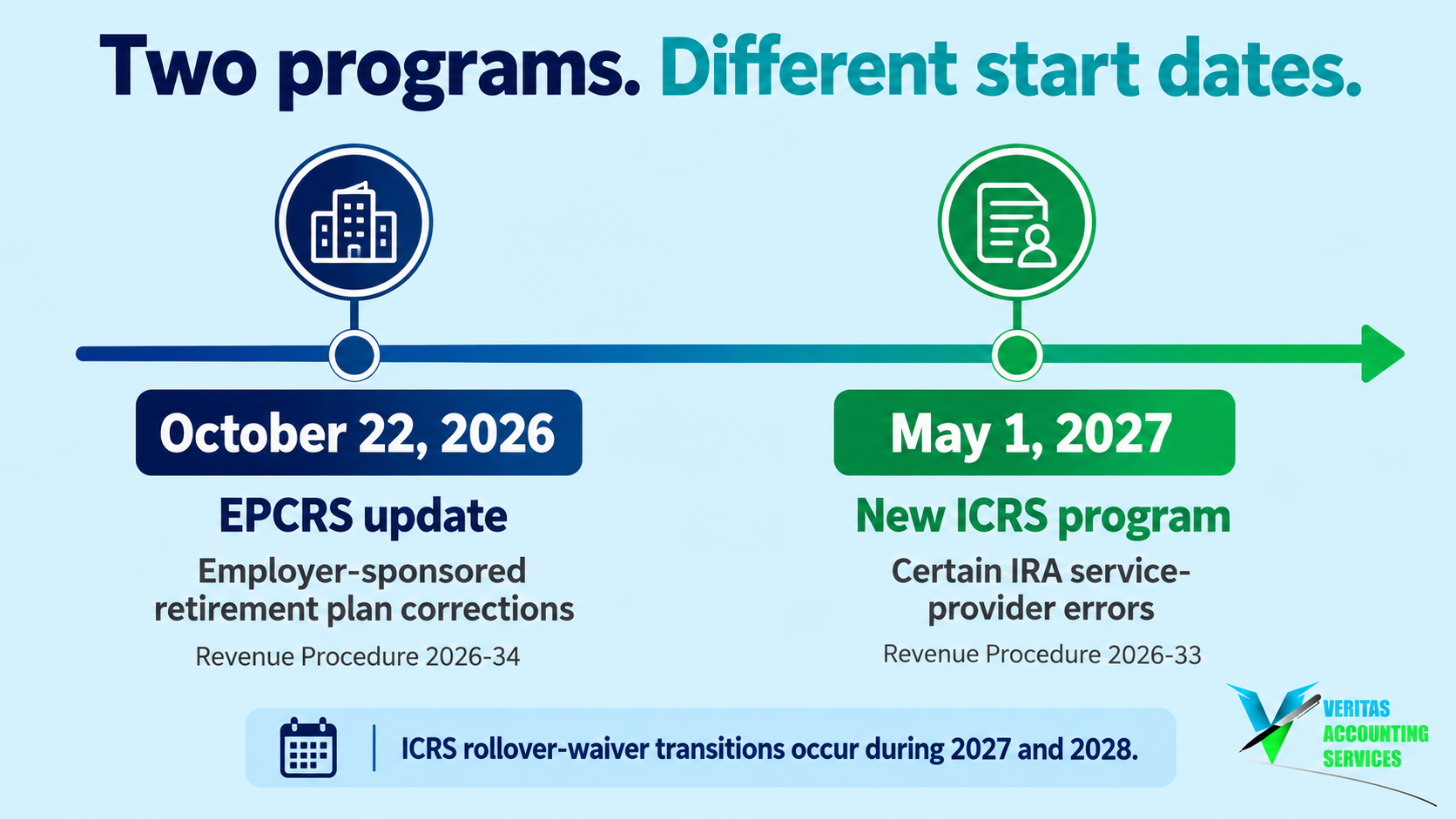
The IRS announcement dated October 22, 2026 identifies two separate procedures. Revenue Procedure 2026-34 updates the Employee Plans Compliance Resolution System, or EPCRS, generally effective October 22, 2026. It replaces Revenue Procedure 2021-30 and consolidates subsequent changes.
For employers, retirement plan corrections under EPCRS concern eligible employer-sponsored arrangements, including qualified plans, 403(b) plans, SEPs and SIMPLE IRA plans. Availability still depends on the particular failure and program requirements.
Revenue Procedure 2026-33 establishes the IRA Compliance Resolution System, or ICRS, effective May 1, 2027. It addresses certain eligible inadvertent failures caused by service-provider errors. Rollover-waiver requests will transition into that system during 2027 and 2028; existing qualifying automatic-waiver and self-certification routes remain available.
These are issued procedures, not merely proposed rules. However, the publication date does not make the future IRA program immediately available. The guidance on retirement plan corrections does not create a new blanket deduction or change every plan’s contribution limit.
How retirement plan corrections work
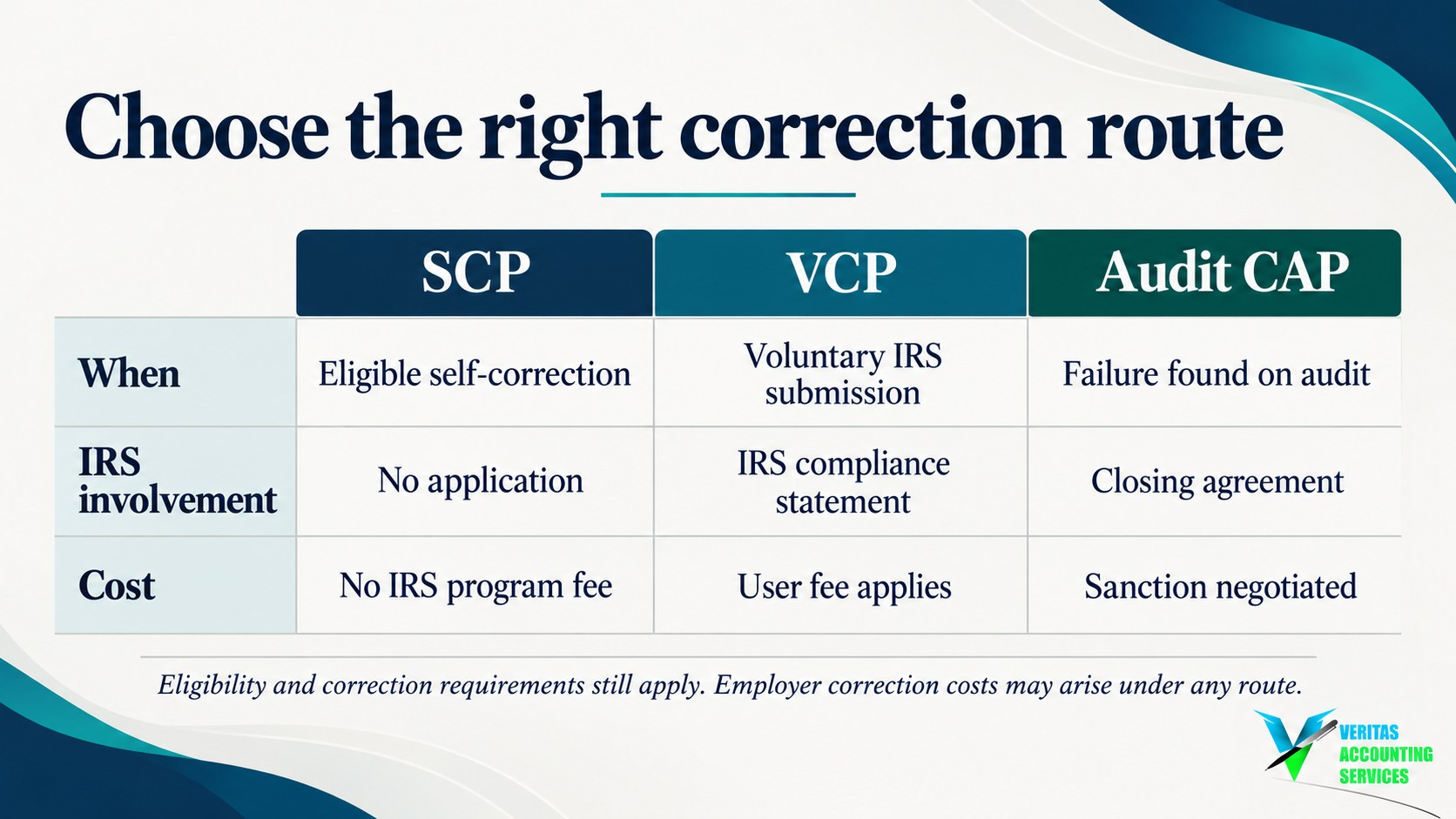
Think of EPCRS as a framework for addressing eligible failures, with different levels of IRS involvement. The main routes are summarized below, based on Revenue Procedure 2026-34.
| Route | Basic approach | IRS program cost |
|---|---|---|
| Self-Correction Program, or SCP | Correct an eligible failure without an IRS application | No IRS program fee or sanction |
| Voluntary Correction Program, or VCP | Seek IRS approval through a voluntary submission before examination | User fee applies |
| Audit Closing Agreement Program, or Audit CAP | Resolve a failure identified during examination through a closing agreement | Sanction applies |
The distinction matters when budgeting for retirement plan corrections. No IRS program fee does not mean no employer expense: contributions, earnings adjustments or professional work may still be necessary.
Self-correction has conditions. Established compliance practices matter; simply possessing a plan document does not establish that those practices existed. Eligible inadvertent failures must be corrected within a reasonable period, with special rules and exclusions. Examination can also affect availability.
Avoid assuming that every mistake qualifies or that an IRS correction resolves obligations under other laws. Ask your adviser to identify the route and the specific authority supporting it before funds move.
Five checks before making a correction
Use these checks to prepare for retirement plan corrections. They are a practical review sequence, not a substitute for the correction rules governing your particular plan.
Check the plan and the affected period
Confirm whether the arrangement is a 401(k), SEP, SIMPLE IRA or another plan. Gather the signed document, adoption agreement and relevant amendments. Identify the plan year and the payroll periods under review.
Write a short problem statement: what should have happened, what actually happened and when someone discovered the difference. Separate confirmed facts from questions. A clear description lets the administrator assess the problem without reconstructing it from scattered emails.
Check who may be affected
Compare the employee roster with plan participation records. Look at hire dates, service information, elections and changes in employment status. Do not assume that someone working reduced hours is automatically excluded.
The IRS guide on excluded eligible employees emphasizes checking plan eligibility provisions and accurate employee information. The remedy for a missed opportunity to defer can involve an employer corrective contribution; it should not be guessed from a single payroll figure.
For retirement plan corrections, one employee’s complaint can be a starting point for checking whether the same configuration affected others. Review the relevant population instead of closing the issue after the first account is repaired.
Check payroll against the actual plan terms
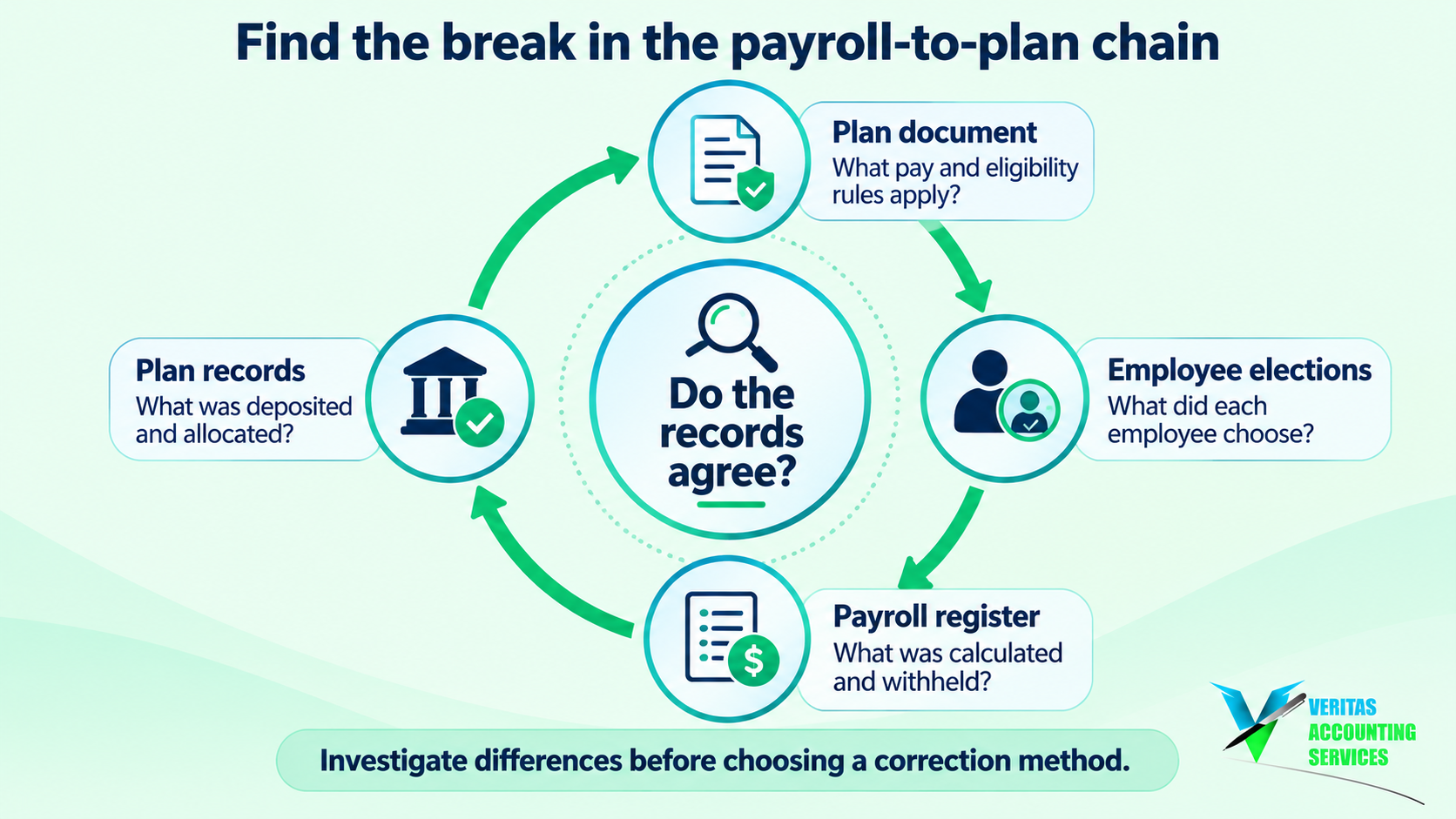
A payroll system’s default settings may not match the plan’s definition of compensation. Before calculating retirement plan corrections, compare relevant pay codes, employee elections, calculated amounts and plan records. Investigate bonuses or irregular payments separately where needed.
Our discussion of avoiding payroll pitfalls explains why a repeatable payroll process matters. Here, the immediate goal is a documented reconciliation that a plan specialist can use to determine the correct response.
Check the route and timing with the adviser
Ask the administrator which method applies to the retirement plan corrections, whether IRS approval is needed and which deadlines or notices govern it. Record the discovery date accurately. Do not treat a general program summary as a universal deadline.
If an examination notice has arrived, share it promptly. Retirement plan corrections require a response based on the actual status of the plan and employer. A vague intention to deal with a problem later is a poor operational plan.
Check funding, responsibilities and completion evidence
Prepare a correction budget showing amounts confirmed by the adviser, amounts awaiting calculation and professional fees. Assign responsibility for calculations, funding, employee communications and evidence of completion.
Add the agreed actions to your business compliance calendar. Give each task an owner and a review date. Mark it complete when supporting evidence is saved, rather than when someone sends an instruction to another provider.
A payroll example
Suppose a small business discovers that a pay code was omitted from the compensation data sent for plan administration. The owner sees a difference between payroll and the administrator’s worksheet and wants to transfer the apparent shortfall immediately.
Start by defining the difference. Assume, purely for illustration, that one employee’s review shows the following:
| Reconciliation item | Illustrative amount |
|---|---|
| Pay included in the worksheet | $48,000 |
| Additional pay requiring review under the plan terms | $4,000 |
| Total pay to investigate | $52,000 |
The arithmetic is $48,000 plus $4,000, or $52,000. It does not establish that all $52,000 is plan compensation, nor does it calculate a corrective contribution. Those answers depend on the document and the facts.
For retirement plan corrections, give the adviser the underlying payroll register, pay-code description, election records and original worksheet. Ask whether the issue affected deferrals, employer contributions, testing or reporting, and whether other employees require review.
Well-documented retirement plan corrections produce a useful decision trail. This approach also avoids turning an unexplained difference into a second error through an unsupported transfer or a retrospective payroll deduction.
Why deposit timing needs separate attention
Money withheld from employees deserves a separate check. The Department of Labor’s retirement-plan FAQ explains that employee contributions must be deposited as soon as they can reasonably be separated from the employer’s assets. A seven-business-day safe harbor applies to qualifying small plans with fewer than 100 participants.
Do not use the general outside limit discussed in that FAQ as a routine waiting period. If deposits appear late, ask about the applicable Labor Department obligations as well as the IRS tax issues. EPCRS does not automatically resolve ERISA fiduciary violations.
Operationally, compare the payday, withholding amount, transfer initiation and actual plan receipt. A bank debit alone may not answer when the plan received or allocated the money.
When planning retirement plan corrections, maintain a separate cash forecast for required employer funding. Do not treat employee withholdings as working capital. Tracking the issue openly makes the business’s available cash easier to understand.
Build a useful correction file
Keep a controlled folder for retirement plan corrections with a short index. Include the original discrepancy, relevant documents, adviser instructions, calculation versions, approvals, payment confirmations and any required communications.
Save both the original report and the corrected report. Overwriting the first spreadsheet can make it harder to explain what changed. Label working estimates clearly so a draft amount is not mistaken for an approved funding instruction.
This is a practical extension of good bookkeeping and tax records. Source records support the decision; the final reconciliation explains how the team reached it. Give payroll, accounting and the plan administrator a consistent version to work from.
After completing the work, identify the process change that will prevent recurrence. For example, require a plan-compensation review when a new pay code is introduced, or a roster review when employees change status. Our article on systems for a growing workforce discusses why informal handoffs become harder as a business expands.
The best outcome from retirement plan corrections includes both a resolved issue and a clearer routine for the next payroll cycle.
Frequently asked questions
Can every employer use self-correction?
No. Eligibility depends on the plan, failure, established practices and applicable exclusions. Ask the adviser to document why SCP is available rather than assuming that a small dollar amount makes the problem eligible.
Are retirement plan corrections always free?
No. SCP has no IRS program fee or sanction, but an employer may still need to fund corrective amounts and professional work. VCP has a user fee, and Audit CAP involves a sanction. Budget only after the method and calculations are established.
Does the new IRA program start immediately?
No. Revenue Procedure 2026-33 is effective May 1, 2027. The employer EPCRS update has a different effective date. An owner’s personal IRA issue should be evaluated separately from the employer plan’s administration problem.
Should we wait until year-end to investigate?
A practical response is to investigate when the discrepancy is found. Preserve the records, tell the administrator and confirm the relevant timing requirements. Early fact gathering is especially useful when several payroll periods or employees may be involved.
Conclusion
The October update makes this a useful moment to review how your business handles retirement plan corrections. Begin with the plan document and a reliable reconciliation, then confirm eligibility, timing, funding and completion with the appropriate adviser.
Your next action can be small: compare one recent payroll cycle with its plan records and identify who investigates any difference. A clear owner, complete records and a documented resolution are more useful than an unexplained adjustment.
This article provides general federal information checked October 23, 2026. Plan-specific advice and separate legal, reporting or state obligations may require additional review.
GET IN TOUCH
Schedule a FREE Call
Connect on our Socials!
