






When Does a Small Business Actually Need a CFO?
Many entrepreneurs assume that hiring a Chief Financial Officer (CFO) is something only multinational corporations or large enterprises need. After all, if the bookkeeping is accurate, the taxes are filed on time, and the financial statements are prepared every month, why would a small business need another financial expert?
It’s a reasonable question—but it’s also one that many growing businesses ask a little too late.
As your business expands, financial decisions become more complex. Revenue increases, operating expenses rise, cash flow becomes harder to predict, and opportunities for growth require larger investments. At this stage, simply knowing your bank balance or monthly profit is no longer enough.
Business owners need someone who can interpret financial data, identify potential risks, forecast future performance, and provide strategic advice before important decisions are made.
That is where a small business CFO becomes invaluable.
A CFO isn’t responsible for recording transactions or preparing tax returns. Their role is to transform financial information into business intelligence that helps owners make confident decisions.
Whether you’re planning to hire more employees, expand into new markets, purchase equipment, or improve profitability, having strategic financial leadership can significantly reduce risk and increase the likelihood of long-term success.
The good news is that today’s small businesses don’t necessarily need to hire a full-time executive. Virtual CFO services have made high-level financial expertise accessible and affordable, allowing businesses to benefit from experienced financial leadership without the cost of a permanent executive.
So, how do you know when it’s time to bring a CFO into your business?
Let’s explore the signs.
Why Many Business Owners Delay Hiring a CFO
Most business owners begin with a straightforward financial structure.
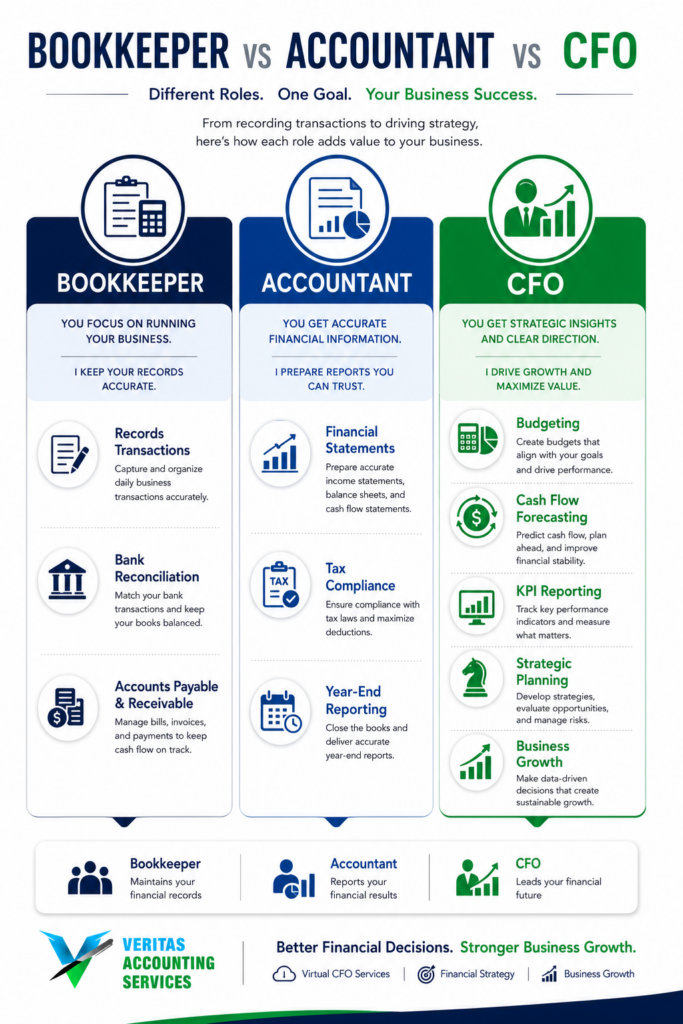
A bookkeeper records transactions.
An accountant prepares financial statements and tax returns.
Everything appears to be under control.
As long as sales continue to grow and bills are paid on time, it feels unnecessary to invest in additional financial support.
The challenge is that growth often creates financial complexity much faster than business owners expect.
More customers mean more invoices.
More employees increase payroll obligations.
Higher sales require greater inventory investment.
Multiple products, services, or business locations introduce additional reporting requirements.
Loans, equipment financing, and expansion plans add new financial responsibilities.
Without strategic financial oversight, owners often find themselves making important business decisions based on instinct rather than reliable financial analysis.
By the time cash flow becomes tight or profits begin to decline, correcting the problem is usually more expensive than preventing it.
A small business CFO helps businesses stay ahead of these challenges by providing forward-looking financial guidance instead of simply reviewing historical results.
Veritas Expert Insight
One of the most common mistakes we see is business owners seeking strategic financial advice only after experiencing cash flow issues or declining profits. The most successful businesses use financial planning to prevent problems—not just solve them.
Bookkeeping Keeps You Compliant, a CFO Helps You Grow
Bookkeeping and accounting are the foundation of every successful business.
Without accurate records, financial decisions become unreliable.
However, accurate records alone don’t create growth.
Think of bookkeeping as a rear-view mirror.
It tells you where your business has been.
A CFO acts more like a GPS.
They help you determine where you’re going and identify the best route to get there.
For example, your monthly Profit and Loss Statement might show a healthy increase in revenue.
At first glance, that seems like excellent news.
But a closer review could reveal that marketing costs have increased at a faster rate than sales, gross margins have declined because of rising supplier prices, or customer payment delays are creating cash flow pressure.
The financial statements provide information.
A CFO provides interpretation.
Instead of asking, “How much profit did we make last month?” they ask:
- Why did profitability change?
- Which products generate the strongest margins?
- Where are unnecessary expenses increasing?
- Can the business afford expansion?
- What will cash flow look like over the next six months?
These are the questions that influence the future of a business.
Strategic financial leadership helps business owners make informed decisions based on data rather than assumptions.
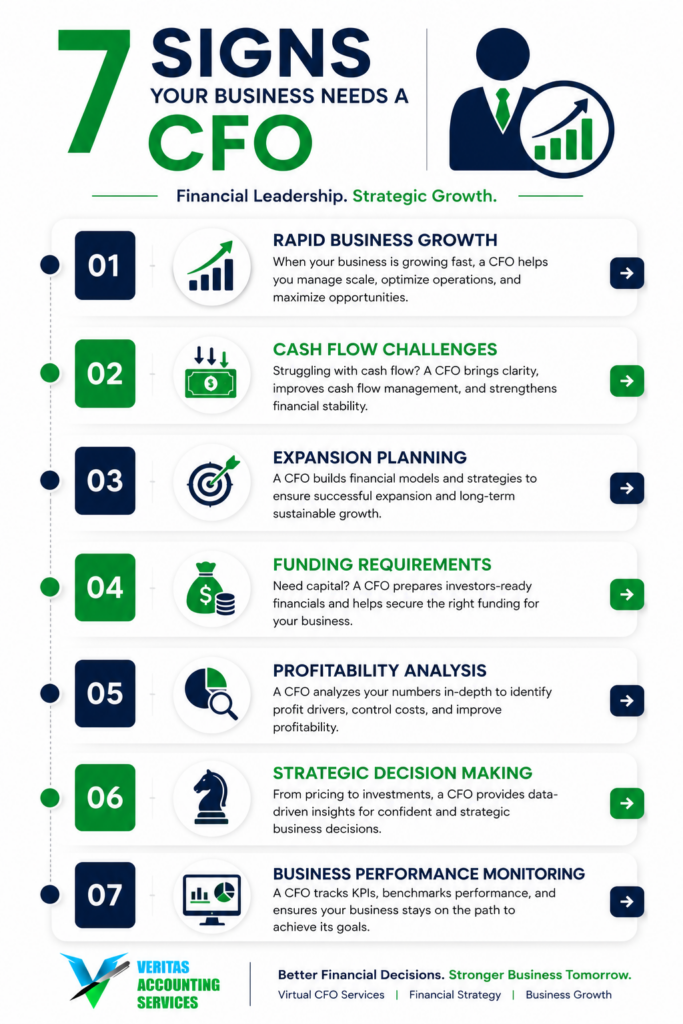
Signs Your Business Needs a Small Business CFO
Every business reaches a stage where basic accounting support is no longer enough.
If any of the following situations sound familiar, it may be time to consider bringing in a small business CFO.
Your Business Is Growing Faster Than Expected
Growth is exciting, but it also increases financial complexity.
More revenue usually means more inventory, additional employees, higher operating expenses, larger supplier commitments, and increased working capital requirements.
Without careful planning, rapid growth can actually create financial pressure instead of improving profitability.
A small business CFO develops financial forecasts that help ensure growth remains sustainable.
Rather than reacting to challenges as they arise, business owners gain the confidence to plan ahead.
Cash Flow Is Becoming More Difficult to Manage
Many businesses are profitable on paper but still struggle to pay suppliers, employees, or loan instalments on time.
Why?
Because profit and cash flow are not the same.
Customer payment delays, inventory purchases, tax liabilities, loan repayments, and seasonal fluctuations all affect available cash.
A small business CFO prepares detailed cash flow forecasts, helping businesses identify potential shortages before they occur.
This allows owners to make informed decisions about financing, spending, and investment instead of responding to unexpected cash flow problems.
You’re Making Major Business Decisions Without Financial Analysis
Every growing business eventually faces important decisions.
Should you hire another salesperson?
Can you afford a second office?
Is it the right time to invest in new equipment?
Should prices be increased?
Would taking a business loan improve growth or create unnecessary risk?
These decisions should never rely solely on intuition.
A small business CFO evaluates multiple financial scenarios, measures potential risks, and provides objective recommendations that support long-term business success.
Instead of relying on guesswork, every significant decision is supported by reliable financial analysis.
Your Financial Reports Raise More Questions Than They Answer
Receiving monthly financial statements is important.
Understanding what those numbers actually mean is even more valuable.
Many business owners review their Profit and Loss Statement and Balance Sheet every month but still struggle to answer questions like:
- Why is profit decreasing even though sales are increasing?
- Which products or services generate the highest margins?
- Are overhead costs growing too quickly?
- How much cash will the business have three months from now?
- Which customers are the most profitable?
Financial reports should provide clarity, not confusion.
A small business CFO doesn’t just prepare reports—they explain what the numbers mean, identify trends, and recommend actions that improve business performance.
Instead of looking backward, your business starts making decisions based on where it’s heading.
Banks, Investors, or Lenders Need Better Financial Information
As your business grows, there may come a time when you need external funding.
Whether you’re applying for a bank loan, attracting investors, or negotiating with lenders, historical financial statements alone are rarely enough.
Financial institutions often expect:
- Cash flow forecasts
- Financial projections
- Budgets
- Key Performance Indicators (KPIs)
- Business growth plans
- Profitability analysis
Preparing these documents requires strategic financial expertise.
A small business CFO helps present your financial position professionally, improves credibility with lenders, and ensures your business is financially prepared before seeking funding.
Being proactive can significantly increase your chances of securing financing on favourable terms.
You’re Spending More Time Managing Finances Than Running Your Business
Every entrepreneur starts by wearing multiple hats.
You’re the salesperson, operations manager, customer service representative, and finance manager—all at the same time.
While this works in the early stages, it eventually becomes unsustainable.
If you find yourself spending evenings reviewing reports, worrying about cash flow, or trying to understand financial data instead of focusing on customers and growth, it’s a clear sign your business needs stronger financial leadership.
A small business CFO takes ownership of financial strategy, allowing you to concentrate on growing the business rather than constantly managing the numbers.
After all, your time is one of your company’s most valuable assets.
Veritas Expert Insight
The most successful business owners don’t try to become financial experts themselves. They surround themselves with specialists who provide the insights needed to make confident business decisions.
How a Small Business CFO Creates Long-Term Value
Hiring a CFO isn’t simply about solving today’s financial challenges.
It’s about preparing your business for tomorrow’s opportunities.
A small business CFO helps build a stronger financial foundation by introducing processes and strategies that support sustainable growth.
Some of the key areas where a CFO adds value include:
- Preparing realistic budgets that align with business goals.
- Forecasting cash flow to avoid unexpected shortages.
- Improving profitability through cost and margin analysis.
- Building KPI dashboards that monitor business performance.
- Supporting pricing and investment decisions with financial data.
- Identifying financial risks before they become costly problems.
- Developing long-term financial strategies for expansion.
Rather than reacting to financial issues, businesses become proactive and make decisions with greater confidence.
This shift often results in better profitability, healthier cash flow, and stronger financial stability.
Why a Virtual CFO Is the Smart Choice for Small Businesses
Many business owners assume hiring a CFO requires a significant investment.
Fortunately, that is no longer the case.
A Virtual CFO provides the same strategic expertise as a traditional CFO but on a flexible, cost-effective basis.
Instead of paying a full-time executive salary, businesses receive experienced financial leadership tailored to their specific needs.
A Virtual CFO can assist with:
- Financial planning and budgeting
- Cash flow forecasting
- Management reporting
- KPI development
- Business performance reviews
- Strategic planning
- Funding support
- Growth planning
This approach allows small businesses to access executive-level financial expertise without increasing fixed overhead costs.
As a result, a small business CFO becomes an affordable investment rather than an expensive luxury.
Final Thoughts
Many businesses believe they need a CFO only after reaching a certain revenue target.
In reality, the right time to bring in strategic financial leadership is when financial decisions become more complex than routine bookkeeping can support.
If your business is experiencing rapid growth, managing tighter cash flow, planning expansion, seeking financing, or simply struggling to understand what your financial reports are telling you, it may be time to consider working with a small business CFO.
Strategic financial guidance helps businesses move beyond compliance and focus on long-term success.
At Veritas Accounting Services, we believe finance should do more than record the past—it should help shape the future.
Whether you need budgeting, forecasting, cash flow management, management reporting, or Virtual CFO services, our goal is to provide the financial insights that help your business grow with confidence.
Frequently Asked Questions
What does a small business CFO do?
A small business CFO provides strategic financial leadership by helping business owners with budgeting, cash flow forecasting, financial analysis, KPI reporting, profitability improvement, and long-term business planning. small business CFO
When should a small business hire a CFO?
A business should consider hiring a CFO when financial decisions become more complex, cash flow is difficult to manage, rapid growth creates new challenges, or external funding requires detailed financial planning and small business CFO planning.
What is the difference between a bookkeeper and a CFO?
A bookkeeper records financial transactions and maintains accurate records. A CFO analyses financial information, develops strategies, forecasts future performance, and supports important business decisions.
Is a Virtual CFO better than a full-time CFO?
For many SMEs, a Virtual CFO offers the same strategic expertise as a full-time small business CFO at a significantly lower cost, making it a practical and cost-effective solution. small business CFO
Can startups benefit from a small business CFO?
Yes. Startups can benefit from financial forecasting, budgeting, investor reporting, and strategic planning long before they are ready to hire a full-time finance executive.
Call to Action
Ready to Take Your Business Beyond Bookkeeping?
As your business grows, so do your financial challenges. At Veritas Accounting Services, our Virtual CFO services help business owners make smarter decisions through strategic financial planning, cash flow forecasting, budgeting, KPI reporting, and management insights.
Whether you’re preparing for expansion, improving profitability, or seeking better financial visibility, we’re here to help.
Contact Veritas Accounting Services today and discover how expert financial leadership can support your next stage of growth.
GET IN TOUCH
Schedule a FREE Call