If you’re drowning in credit cards, loans, or medical bills, you’re not alone—but you can Crush Your Debt Faster with a clear plan. The problem for most people isn’t a lack of effort; it’s a lack of strategy. You pay a little here, a little there, and it feels like nothing ever changes.
Two proven methods can turn that around:
The Debt Snowball Method
The Debt Avalanche Method
Both are powerful debt repayment strategies that help you stay focused and make real progress. In this guide, you’ll learn how each method works, who they’re best for, and how to choose the one that helps you Crush Your Debt Faster without burning out.
What Is the Debt Snowball Method?
The Debt Snowball Method is built around small, fast wins. Instead of worrying about interest rates, you focus on paying off your smallest debts first and create momentum.
How the Snowball Method Works
List all your debts from smallest balance to largest.
Pay the minimum on every debt.
Put all extra money toward the smallest debt.
Once that debt is gone, “snowball” its payment into the next smallest debt.
Repeat until every debt is paid off.
Even though this method isn’t always mathematically perfect, it helps you Crush Your Debt Faster because it keeps you emotionally engaged.
Why the Snowball Method Works
You eliminate entire balances quickly.
Each win builds motivation and confidence.
The plan is simple, so you’re less likely to quit.
Best for: people who feel overwhelmed, emotional spenders, and anyone who needs quick proof that their efforts are working.
What Is the Debt Avalanche Method?
The Debt Avalanche Method is focused on saving the most money in interest and often paying off everything in less time overall. Instead of looking at balance size, you look at interest rates.
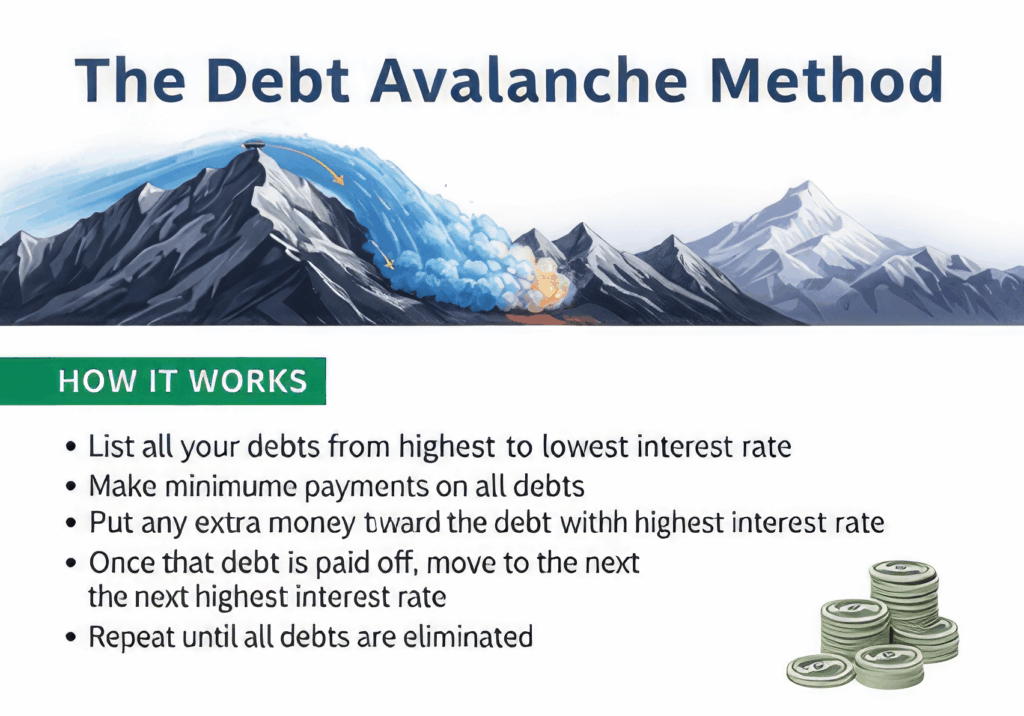
How the Avalanche Method Works
List all your debts from highest interest rate to lowest.
Pay the minimum on all debts.
Put all extra money toward the highest-interest debt.
Once it’s paid off, move to the next highest rate.
Continue until you’re completely debt-free.
This approach helps you Crush Your Debt Faster from a financial perspective, even if early progress is less visible.
Why the Avalanche Method Works
You pay less total interest.
You usually finish your debt-free journey sooner.
It’s especially powerful for high-interest credit cards.
Best for: disciplined people who like numbers, want to minimize interest, and don’t need immediate emotional wins.
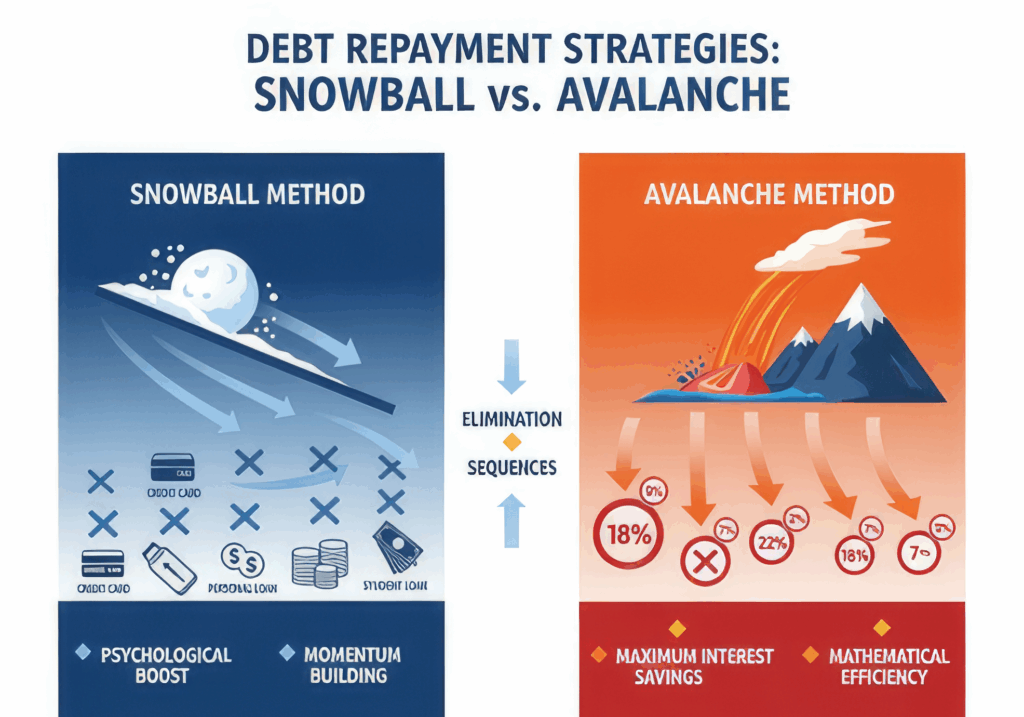
Snowball vs. Avalanche: Key Differences
Use this in a Table block in WordPress:
Feature
Debt Snowball
Debt Avalanche
Main Focus
Smallest balance first
Highest interest rate first
Motivation
Fast emotional wins
Long-term savings
Interest Saved
Less
More
Speed Overall
Sometimes slower
Often faster
Complexity
Very simple
Requires tracking rates
Best For
Motivation & momentum
Efficiency & savings
In simple terms:
Snowball is emotion-first, math-second.
Avalanche is math-first, emotion-second.
To Crush Your Debt Faster, you need the one that aligns with how you think and behave.
Which Strategy Will Help You Crush Your Debt Faster?
The “best” strategy is the one you actually stick with.
Ask yourself:
Do I lose motivation when progress is slow?
Do I care more about paying less interest or feeling progress sooner?
Do I like simple, no-math plans or detailed, optimized ones?
Choose the Snowball Method If…
You’ve started and stopped debt payoff plans before.
You feel better when you see entire accounts hit zero.
You want an easy way to Crush Your Debt Faster through motivation.
Choose the Avalanche Method If…
You’re patient and disciplined.
You want to save the most money on interest.
You’re okay waiting longer for the first “big win.”
There’s no wrong answer. The real mistake is staying stuck and using no system at all.
Can You Combine Both Strategies?
Absolutely. You don’t have to pick one and stay with it forever. A hybrid approach can help you Crush Your Debt Faster while balancing emotion and efficiency.
Start with a mini Snowball: Pay off one or two tiny debts first to create quick momentum.
Switch to Avalanche: Once you feel focused and confident, reorder your remaining debts by interest rate and attack the highest one.
Reset when needed: If you feel stuck again, temporarily use the Snowball on a small balance to regain motivation.
This blended method gives you the emotional wins of Snowball and the interest savings of Avalanche.
Real-Life Example: Which Method Wins?
Meet Sam. Sam has these debts:
Debt Type
Balance
Interest Rate
Credit Card A
$1,500
22%
Credit Card B
$800
18%
Personal Loan
$3,000
10%
Medical Bill
$500
0%
Sam can put $450 per month toward debt.
With the Debt Snowball
Order from smallest balance:
Medical Bill – $500
Credit Card B – $800
Credit Card A – $1,500
Personal Loan – $3,000
Sam wipes out the medical bill in just over one month, then Credit Card B a few months later. These fast wins make Sam feel powerful and in control—and that feeling helps Sam Crush Debt Faster because the plan doesn’t get abandoned.
With the Debt Avalanche
Order by highest interest rate:
Credit Card A – 22%
Credit Card B – 18%
Personal Loan – 10%
Medical Bill – 0%
Sam needs more time before one entire account disappears, but pays much less interest overall and finishes the total payoff sooner than with Snowball.
Takeaway:
Snowball helps Sam stay emotionally committed.
Avalanche helps Sam save more and mathematically Crush Debt Faster.
You choose which “faster” matters more: faster emotionally, or faster financially.
Final Thoughts: Start Crushing Your Debt Today
You don’t need perfect timing, a big income, or a miracle. You just need a plan you’ll actually follow.
Use Debt Snowball if motivation is your biggest challenge.
Use Debt Avalanche if interest savings and efficiency matter most.
Use a hybrid strategy if you want both.
Most importantly, take action. The sooner you start, the sooner you’ll Crush Your Debt Faster and free up your income for saving, investing, and building the life you actually want.
Pick your strategy today and start your debt-free journey.
📞 Ready to Finally Crush Your Debt Faster and Take Control of Your Financial Future?
If you need expert guidance on budgeting, debt repayment planning, or complete financial management, Veritas Accounting Services is here to support you every step of the way.
Contact Veritas Accounting Services:
📧 Email:hello@veritasaccountingservices.com 📞 Phone: +1 (678) 723-6003 | +91 97255 52243 🏢 US Office: 8735 Dunwoody Place – 4549, Atlanta, GA 🏢 India Office: C-305, The Imperial Heights, 150ft Ring Road, Rajkot
We proudly serve clients across the US, UK, UAE, Singapore, Ireland, and Malaysia, offering personalized bookkeeping, debt planning, tax filing, and CFO-level financial
In an increasingly volatile business environment, the ability to maintain operations during unexpected disruptions has become a critical competitive advantage. With over a decade of professional excellence and 1000+ completed projects across 6+ countries, Veritas Accounting has guided businesses through numerous crises, from economic downturns to global pandemics. Our experience has shown that businesses with robust financial continuity plans are not only more likely to survive disruptions but often emerge stronger than their competitors.
Understanding Business Continuity in the Financial Context
Business continuity planning extends far beyond operational procedures—it requires comprehensive financial strategies that ensure your business can weather any storm. Financial uncertainty and compliance issues can quickly escalate during disruptions, making timely and strategic financial management absolutely critical for survival.
At Veritas, we’ve observed that businesses operating across multiple countries face unique continuity challenges. Currency fluctuations, varying regulatory responses, and different market conditions during crises require sophisticated financial planning that accounts for global complexities. Our presence in the USA, UK, Australia, and other markets provides us with firsthand experience in managing these multi-jurisdictional challenges.
The Financial Foundation of Business Continuity
Emergency Cash Flow Management The cornerstone of any business continuity plan is maintaining adequate cash flow during disruptions. This goes beyond simply having cash reserves—it requires understanding your cash conversion cycle, identifying potential cash flow bottlenecks, and creating multiple scenarios for different disruption levels.
Our Virtual CFO services help businesses develop comprehensive cash flow forecasting models that account for various disruption scenarios. Using our expertise with QuickBooks, Xero, Wave, and Zoho Books, we create real-time cash flow monitoring systems that provide early warning signals when financial stress begins to emerge.
Strategic Reserve Management While traditional advice suggests maintaining 3-6 months of operating expenses in reserves, our experience shows that businesses need more sophisticated reserve strategies. This includes diversifying reserve locations, maintaining multi-currency reserves for international operations, and establishing credit facilities before they’re needed.
We help businesses optimize their reserve strategies by analyzing historical cash flow patterns, identifying seasonal variations, and stress-testing financial models against various disruption scenarios. This approach ensures reserves are adequate without tying up excessive capital during normal operations.
Crisis-Proofing Your Financial Systems
Technology Resilience and Remote Access The shift to remote work during recent global disruptions highlighted the critical importance of cloud-based financial systems. Businesses with outdated, location-dependent accounting systems faced significant operational challenges when physical offices became inaccessible.
Our seamless integration expertise with top accounting software ensures businesses can maintain full financial operations regardless of physical location. Cloud-based solutions like QuickBooks Online and Xero provide the accessibility and security needed for continuous financial management during disruptions.
Financial Process Automation Manual financial processes become major vulnerabilities during disruptions when key personnel may be unavailable. Automation not only improves efficiency during normal operations but provides critical continuity capabilities during crises.
We help businesses identify and automate key financial processes, from invoice generation to payment processing, ensuring essential financial functions continue even when staffing is disrupted. This automation also reduces the risk of errors during high-stress periods when manual oversight may be limited.
Multi-Country Continuity Strategies
Regulatory Compliance During Disruptions Businesses operating in multiple countries must navigate varying regulatory responses during crises. Some jurisdictions may offer tax relief or compliance extensions, while others maintain strict deadlines regardless of circumstances.
Our global expertise across 6+ countries enables us to help businesses understand and leverage available regulatory relief while maintaining compliance where flexibility isn’t available. This includes managing tax obligations, employment law requirements, and financial reporting standards across different jurisdictions.
Currency Risk Management in Crisis Situations Economic disruptions often trigger significant currency volatility, which can severely impact businesses with international operations. Companies that don’t actively manage currency risk may find their financial position deteriorating rapidly during crises.
We provide comprehensive currency risk management strategies that include hedging techniques, natural hedging through operational adjustments, and scenario planning for different currency movement patterns. These strategies help businesses maintain financial stability even when currency markets become highly volatile.
Stress Testing and Scenario Planning
Financial Stress Testing Methodologies Effective business continuity planning requires understanding how your business would perform under various stress scenarios. This goes beyond simple “what if” discussions to include quantitative analysis of different disruption levels and durations.
Our ratio analysis expertise helps businesses identify key financial vulnerabilities and stress test their business models against various scenarios. This includes analyzing debt service capabilities, working capital requirements, and profitability thresholds under different operating conditions.
Dynamic Scenario Planning Static business continuity plans quickly become obsolete as conditions change. Effective continuity planning requires dynamic scenario modeling that can be updated as new information becomes available during a crisis.
We help businesses develop flexible scenario planning frameworks that can be quickly adjusted as disruptions evolve. This includes creating decision trees for different response options and establishing trigger points for implementing various contingency measures.
Financial Communication During Crises
Stakeholder Communication Strategies During disruptions, clear and timely communication with financial stakeholders becomes critical. This includes investors, lenders, suppliers, and customers who all need to understand how the business is managing through the crisis.
Our financial reporting expertise helps businesses develop crisis communication protocols that provide transparency while maintaining confidence. This includes preparing standardized reports that can be quickly updated and distributed to different stakeholder groups.
Investor Relations During Disruptions Businesses with external investors face additional communication challenges during crises. Investors need regular updates on financial performance, cash flow projections, and management actions being taken to address the disruption.
We help businesses develop investor communication frameworks that provide appropriate transparency while managing expectations. This includes preparing financial projections that account for uncertainty and clearly communicating the assumptions underlying these projections.
Post-Crisis Financial Recovery Planning Business continuity planning must extend beyond simply surviving the crisis to include strategies for recovery and growth. Businesses that plan for recovery during the crisis often emerge in stronger competitive positions.
Our strategic financial planning services help businesses identify recovery opportunities and develop financial strategies to capitalize on them. This includes assessing acquisition opportunities, planning for market share gains, and optimizing capital structure for post-crisis growth.
Building Resilience for Future Disruptions Each crisis provides valuable lessons that can be incorporated into improved continuity planning. Businesses that learn from each disruption become increasingly resilient over time.
We help businesses conduct post-crisis financial reviews that identify areas for improvement in their continuity planning. This includes analyzing what worked well, what could be improved, and how financial systems and processes can be strengthened for future disruptions.
Technology and Innovation in Continuity Planning
AI and Predictive Analytics Advanced technologies are increasingly being used to improve business continuity planning. AI-powered analytics can identify early warning signals and predict potential disruptions before they fully materialize.
We help businesses leverage technology to enhance their continuity planning capabilities. This includes implementing predictive analytics for cash flow forecasting and using AI to identify potential risk factors that might not be apparent through traditional analysis.
Blockchain and Financial Security Emerging technologies like blockchain offer new possibilities for maintaining financial security and continuity during disruptions. These technologies can provide enhanced security and transparency for financial transactions even when traditional systems are compromised.
Industry-Specific Continuity Considerations
Manufacturing and Supply Chain Finance Manufacturing businesses face unique continuity challenges related to inventory management, supplier financing, and production scheduling. Financial continuity planning must account for these operational complexities.
Professional Services Continuity Professional services firms must balance client service continuity with financial management during disruptions. This often requires flexible billing arrangements and modified service delivery models.
Technology and Software Companies Tech companies may face different continuity challenges related to subscription revenue models, development costs, and rapid scaling requirements during and after disruptions.
Measuring Continuity Plan Effectiveness
Key Performance Indicators for Continuity Effective continuity planning requires measurable objectives and regular assessment of plan effectiveness. This includes financial metrics like cash flow stability, operational metrics like service delivery continuity, and strategic metrics like market position maintenance.
Regular Plan Testing and Updates Business continuity plans must be regularly tested and updated to remain effective. This includes conducting financial stress tests, reviewing scenario assumptions, and updating response procedures based on changing business conditions.
The Veritas Advantage in Continuity Planning
Our decade of experience with 1000+ successful projects provides unique insights into what works in business continuity planning. We’ve helped businesses navigate various types of disruptions, from economic downturns to regulatory changes to global pandemics.
Our global presence across multiple countries gives us firsthand experience in managing continuity challenges across different regulatory environments and market conditions. This experience enables us to help businesses develop truly comprehensive continuity strategies that account for global complexities.
Implementation Framework
Phase 1: Risk Assessment and Gap Analysis We begin by conducting comprehensive risk assessments that identify potential disruption sources and evaluate current continuity preparedness. This includes analyzing financial vulnerabilities, operational dependencies, and regulatory requirements.
Phase 2: Strategy Development Based on the risk assessment, we develop customized continuity strategies that address identified vulnerabilities while maintaining operational efficiency during normal conditions.
Phase 3: Implementation and Testing We provide hands-on support during strategy implementation and help businesses conduct regular testing to ensure plans remain effective.
Phase 4: Ongoing Monitoring and Improvement Continuity planning is an ongoing process that requires regular review and updates. We provide continuous monitoring and improvement services to ensure plans evolve with changing business conditions.
Conclusion: Building Unshakeable Financial Resilience
In today’s uncertain business environment, robust financial continuity planning isn’t optional—it’s essential for long-term success. Businesses that invest in comprehensive continuity strategies not only survive disruptions but often emerge stronger and more competitive.
At Veritas Accounting, we combine global expertise with local market knowledge to help businesses build unshakeable financial resilience. Our comprehensive approach addresses all aspects of financial continuity, from emergency cash flow management to post-crisis recovery planning.
Don’t wait for the next disruption to test your business’s resilience. Contact Veritas Accounting today to develop a comprehensive financial continuity plan that protects your business and positions it for long-term success.
Contact Veritas Accounting:
Headquarters: C-305, The Imperial Heights, 150ft Ring Road, Rajkot
US Office: 8735 Dunwoody Place – 4549, Atlanta, GA
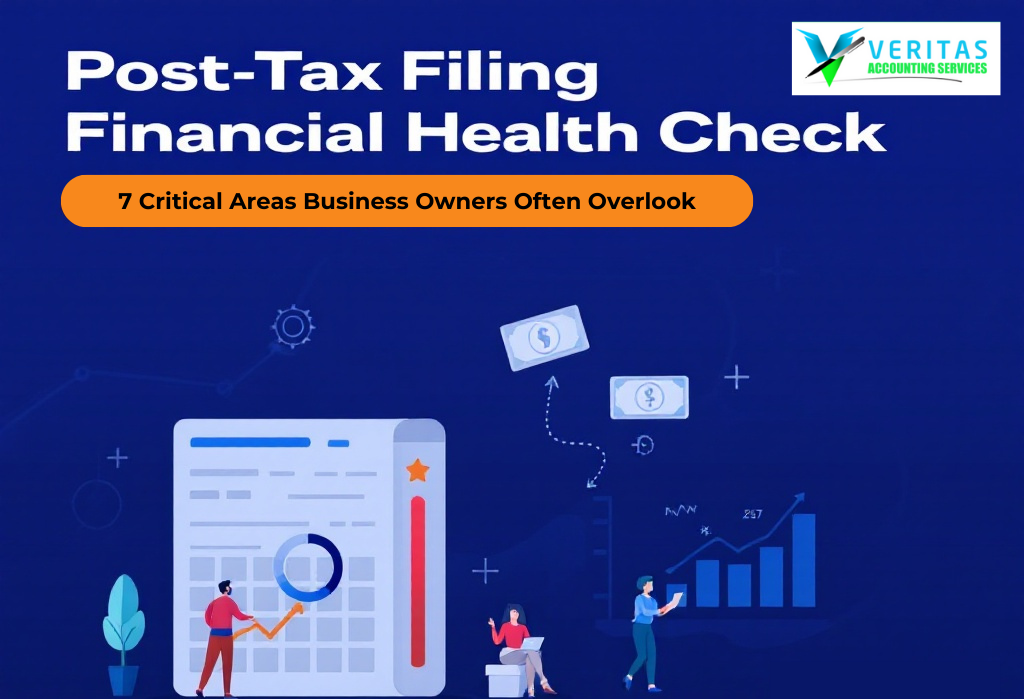
As the dust settles on another tax season, smart business owners know that this is the perfect time to leverage their tax filing insights and financial health for strategic growth. At Veritas Accounting Services, with over a decade of experience serving clients across six countries and completing over 1,000 projects, we’ve observed that the post-tax period offers unique opportunities for financial optimization that many businesses overlook.
While tax filing is an essential yearly responsibility, it is not the end of the road. In fact, it is the beginning of a critical phase in your financial journey. Post-tax season is the ideal time to take a comprehensive look at your business’s finances, optimize operations, and prepare for the future. By using tax filing insights as a springboard for growth, you can drive your business toward more sustainable, long-term success.
The Tax Season Reality Check
While meeting tax obligations is crucial, it is merely a snapshot of your business’s financial health. The real value lies in using this annual checkpoint as a springboard for comprehensive financial planning. Certified experts, well-versed in leading accounting software like QuickBooks, Xero, Wave, and Zoho Books, have identified seven critical areas that demand immediate attention after tax filing.
1. Cash Flow Management: Beyond Basic Bookkeeping
For many businesses, managing cash flow is more than just about ensuring there is enough money in the bank to cover expenses. Post-tax season often reveals cash flow patterns that were not immediately apparent during day-to-day operations. This is where effective cash flow management can significantly impact your bottom line.
Our virtual CFO services have helped numerous clients across the Globe identify:
Seasonal fluctuations affecting working capital
Hidden cash flow bottlenecks
Opportunities for improving collection cycles
International payment optimization strategies
The key is not just tracking cash flow but understanding the stories behind the numbers. With real-time monitoring through integrated accounting software, businesses can make proactive decisions rather than reactive adjustments. Understanding your cash flow allows you to forecast future expenses, manage unexpected changes, and position your company for more predictable growth.
2. Financial Ratios: Your Business’s Vital Signs
Just as a doctor checks your vital signs, your business needs regular ratio analysis to ensure optimal health. Financial ratios provide a clear picture of your company’s overall financial health, liquidity, profitability, and operational efficiency.
Critical ratios to monitor include:
Liquidity ratios for short-term solvency (e.g., current ratio, quick ratio)
Efficiency ratios for resource utilization (e.g., asset turnover, inventory turnover)
Profitability ratios for business performance (e.g., return on assets, return on equity)
Leverage ratios for long-term stability (e.g., debt-to-equity ratio)
Regular ratio analysis helps businesses benchmark against industry standards, measure progress, and identify areas for improvement. Working with an experienced team of professionals can ensure your financial ratios align with your growth goals and industry best practices.
3. Compliance Calendar: Staying Ahead of Deadlines
Tax season might be over, but compliance is a year-round responsibility. As tax laws, fiscal year deadlines, and regulatory requirements change, businesses need to stay ahead of the curve to avoid penalties and ensure smooth operations.
For businesses operating across multiple countries, keeping track of different fiscal year deadlines, international regulations, and proper documentation can become overwhelming. However, staying compliant is non-negotiable.
Key actions include:
Tracking varying fiscal year deadlines
Monitoring changing international regulations
Maintaining proper documentation
Planning for upcoming financial obligations
Our global experience ensures clients never miss crucial deadlines across different jurisdictions. A well-managed compliance calendar allows businesses to stay organized and minimize the risk of late fees, fines, or legal issues.
4. Growth Planning: Turning Insights into Action
Post-tax analysis often reveals growth opportunities that might have been overlooked during regular operations. Whether it is identifying new markets or scaling operations, this is the time to reassess your business strategies and explore avenues for expansion.
Key considerations for growth planning include:
Market expansion possibilities (domestic and international)
Investments in technology or infrastructure to enhance productivity
Hiring needs and timing
International market entry strategies
Our virtual CFO services provide the strategic insight needed to turn these opportunities into actionable plans. Growth planning not only includes assessing current opportunities but also preparing your business to scale and take advantage of market trends.
In today’s fast-paced digital landscape, businesses must embrace technology to stay competitive. Leveraging the latest accounting software and business management tools can drive significant improvements in efficiency, accuracy, and decision-making.
At Veritas, our expertise with leading accounting software enables businesses to:
Automate routine transactions
Generate real-time reports for better decision-making
Integrate multiple financial platforms to streamline workflows
Access financial data securely from anywhere
This technological integration is particularly crucial for businesses operating across different time zones and currencies. With automation, businesses can reduce manual errors, increase productivity, and make data-driven decisions in real-time.
6. Risk Management: Protecting Your Future
The post-tax period is ideal for reviewing and updating risk management strategies. In today’s interconnected global economy, businesses face a variety of risks that can threaten profitability and growth. It is critical to proactively address potential risks before they evolve into major issues.
Key areas for risk management include:
Currency fluctuation risks for international transactions
Our international experience helps businesses anticipate and mitigate risks before they become problems. With a solid risk management plan, businesses can weather economic downturns, regulatory changes, and unexpected crises with resilience.
7. Profit Optimization: Beyond Cost Cutting
While cost reduction is important, sustainable growth requires a balanced approach to profit optimization. Focusing on increasing revenue and improving operational efficiency can provide higher long-term returns than simply cutting costs.
Key areas to focus on for profit optimization include:
Revenue diversification opportunities to expand income streams
Pricing strategy reviews to ensure your prices reflect market demand
Operational efficiency improvements to reduce waste and improve margins
Strategic investment planning to support long-term growth initiatives
At Veritas, we help businesses identify opportunities for profit growth that go beyond cost-cutting. With the right strategy, your business can boost profitability and create a more resilient financial structure.
Taking Action: Your Next Steps
The key to maximizing these insights lies in taking prompt action. Here is how to get started:
Schedule a Comprehensive Review: Begin with a thorough analysis of your tax filing and financial statements. Our team at Veritas can help identify key areas for improvement.
Develop an Action Plan: Create a prioritized list of improvements based on your review. Focus on quick wins while building toward long-term goals.
Implement Regular Monitoring: Set up systematic reviews using integrated accounting software to track progress and identify new opportunities.
Seek Expert Guidance: With offices in Rajkot and Atlanta, our team provides global expertise with local understanding. Whether you need bookkeeping, virtual CFO services, or strategic financial planning, we’re here to help.
Conclusion
The post-tax period presents a unique opportunity to transform your financial management approach. By focusing on these seven critical areas, businesses can build a stronger foundation for growth and success. At Veritas Accounting Services, we combine our decade of experience, global reach, and technical expertise to help businesses thrive in an increasingly complex financial landscape.
Schedule your comprehensive financial health check. With our QuickBooks and Xero certified experts, we will help you turn tax season insights into year-round business success.
Cash flow is the foundation of every successful business. Yet, many startups, small businesses, and mid-sized enterprises struggle with cash shortages, delayed payments, and unexpected expenses that threaten their stability.
According to a recent study, 82% of business failures are due to poor cash flow management. Whether you’re a new business owner or an established entrepreneur, managing cash flow effectively is key to long-term success.
At Veritas Accounting Services, we help businesses like yours take control of cash flow, avoid financial pitfalls, and build a strategy for long-term success. In this guide, we’ll explore the biggest cash flow pain points businesses face and how Veritas Accounting Services can provide tailored solutions to overcome them.
Understanding Cash Flow Management: Why It Matters?
Before diving into the pain points and solutions, let’s define cash flow management.
Cash flow refers to the movement of money in and out of your business. A positive cash flow means you have more money coming in than going out, while a negative cash flow indicates you are spending more than you are earning.
Poor cash flow management can lead to:
Missed payroll and late vendor payments
Debt accumulation and high-interest expenses
Lack of funds for growth and investment
By monitoring, forecasting, and optimizing cash flow, businesses can avoid financial crises and ensure long-term stability.
The Biggest Cash Flow Pain Points and How to Solve Them!
1. Late Payments from Customers
📌 Pain Point:
Many businesses experience delayed payments, affecting their ability to cover operating expenses and payroll. Chasing payments is time-consuming and frustrating.
✅ How Veritas Helps:
We set up automated invoicing with reminders to speed up collections.
We help implement early payment incentives to encourage faster payments.
We assist with invoice financing, so you get cash upfront instead of waiting for customers.
Pro Tip: Offer a discount for early payments or charge penalties for late payments to encourage on-time settlements.
2. High Operational Costs Draining Cash Flow
📌 Pain Point:
Uncontrolled expenses, high rent, and unnecessary spending deplete cash reserves, leaving little room for growth.
✅ How Veritas Helps:
We conduct a cost-reduction audit to identify where you can save money.
We help re-negotiate vendor contracts for better payment terms.
We provide budgeting strategies to ensure cash is used efficiently.
Pro Tip: Regularly review your subscription-based expenses (e.g., SaaS tools, memberships) and cut those that don’t add value.
3. Seasonal Revenue Fluctuations
📌 Pain Point:
Many businesses, especially retail and service-based industries, struggle with inconsistent income, leading to cash shortages in off-seasons.
✅ How Veritas Helps:
We create custom cash flow forecasts to plan for slow months.
We help businesses introduce recurring revenue models to stabilize income.
We assist in building emergency funds to manage seasonal downturns.
Pro Tip: Diversify your income streams to maintain revenue during off-seasons.
4. Overstocking Inventory & Cash Flow Blockage
📌 Pain Point:
Businesses that tie up too much cash in inventory struggle with liquidity. This leads to excess stock, wasted capital, and storage costs.
✅ How Veritas Helps:
We optimize inventory management strategies using demand forecasting.
We recommend just-in-time inventory practices to free up cash.
We analyze which products are slow-moving and help you liquidate excess stock efficiently.
Pro Tip: Use inventory management software to track and forecast product demand accurately.
We create debt repayment plans that don’t disrupt cash flow.
Pro Tip: Use a business line of credit instead of high-interest loans for short-term cash flow needs.
7. Unexpected Tax Liabilities
📌 Pain Point:
Many businesses fail to plan for tax payments, leading to last-minute cash shortages and hefty penalties.
✅ How Veritas Helps:
We provide proactive tax planning to avoid surprises.
We identify tax-saving opportunities to reduce liability.
We ensure compliance with all business tax regulations to prevent fines.
Pro Tip: Set aside 15-30% of your profits in a separate tax savings account.
8. Lack of Real-Time Cash Flow Visibility
📌 Pain Point:
Many business owners don’t track their cash flow effectively, leading to poor financial decisions and unexpected shortfalls.
✅ How Veritas Helps:
We integrate cloud-based accounting software for real-time financial tracking.
We generate customized cash flow reports for better decision-making.
We provide expert guidance on financial planning and sustainability.
Pro Tip: Review your cash flow statements weekly to catch potential issues early.
How Veritas Accounting Services Can Help Your Business Thrive?
At Veritas Accounting Services, we don’t just offer generic solutions—we provide tailored financial strategies to help businesses take control of their cash flow, reduce expenses, and plan for future growth.
Why Choose Us?
✔ Customized Financial Strategies: We analyze your business and develop a plan that works for your specific industry and challenges.
✔ Automated Financial Solutions: We help implement cutting-edge financial tools to improve cash flow visibility and efficiency.
✔ Dedicated Support: Our team of experts provides ongoing guidance, so you’re never alone in managing your finances.
✔ Tax & Compliance Assistance: We ensure you stay compliant while maximizing tax-saving opportunities..
Cash flow problems don’t have to hold your business back. With expert guidance, smart strategies, and the right tools, you can achieve financial stability and long-term success.