


📩 Get A Quote : hello@veritasaccountingservices.com
S corporation accounting and taxation

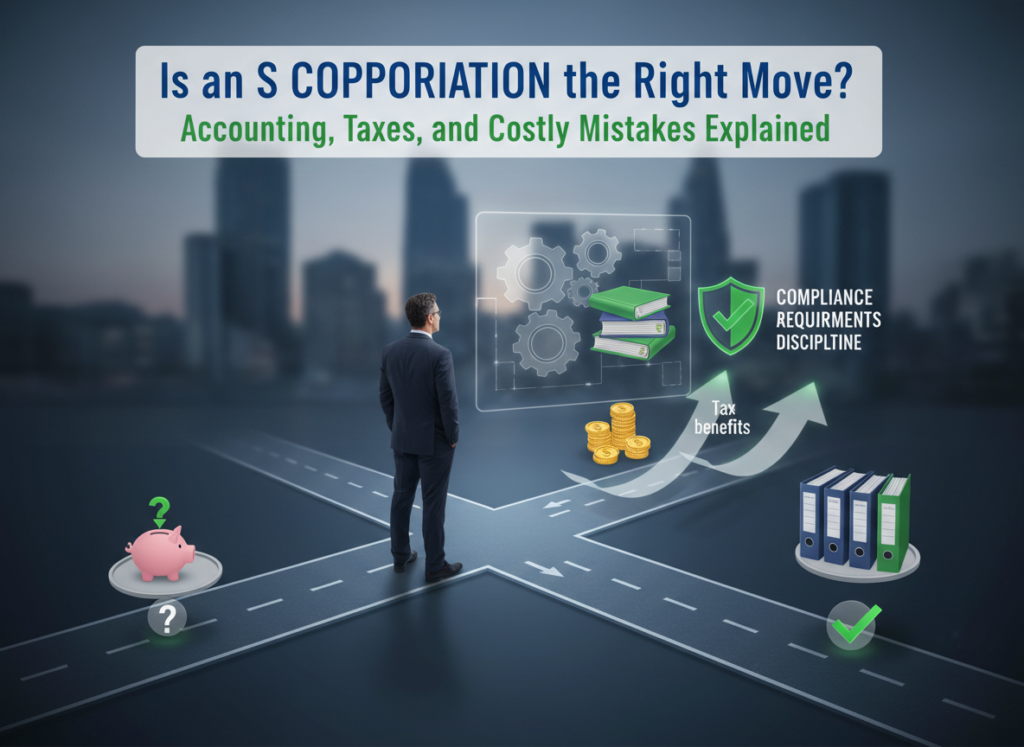
Is an S Corporation the Right Move? Accounting, Taxes, and Costly Mistakes Explained

Choosing the right business structure is one of the most impactful decisions a business owner can make. Many entrepreneurs are drawn to the S corporation because of its potential tax savings, but fewer understand the accounting discipline and compliance rules that come with it. An S corporation can be a smart move—but only when it is set up and maintained correctly.

Without proper S corporation accounting and taxation, the benefits that attract business owners can quickly turn into IRS scrutiny, penalties, and expensive corrections. This guide explains how S corporations work, how they are taxed, what accounting requirements matter most, and the costly mistakes business owners should avoid.


What Is an S Corporation?
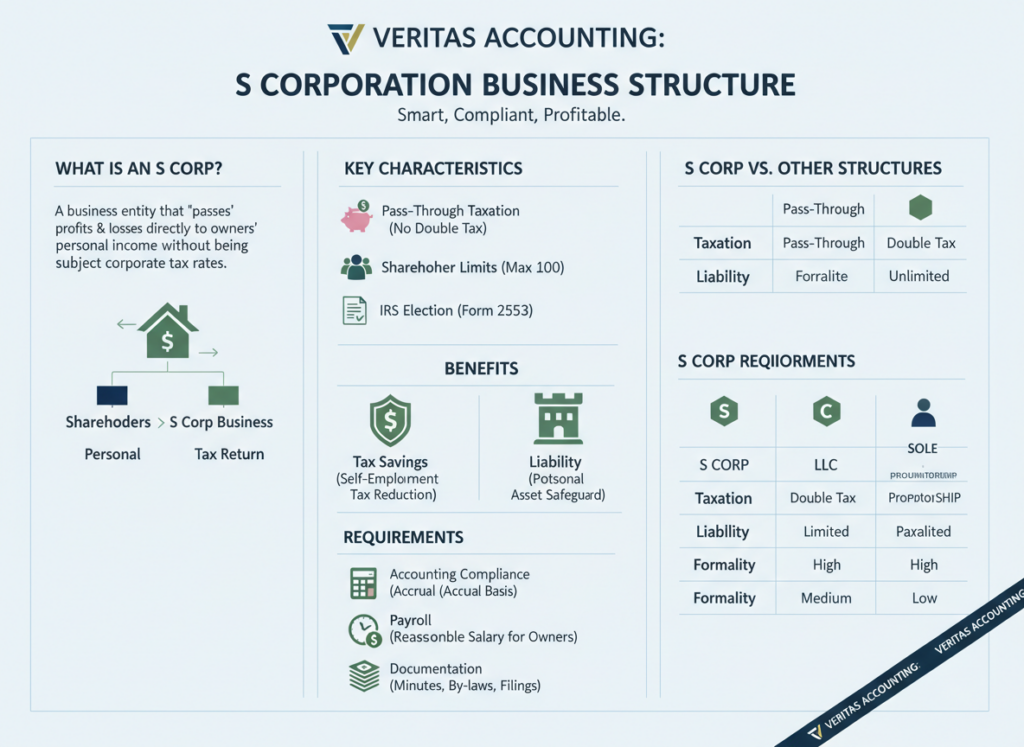
S corporation accounting and taxation

An S corporation is a business entity that allows income, losses, deductions, and credits to pass through to shareholders for federal tax purposes. While it is legally formed as a corporation—or an LLC that elects S status—it avoids the double taxation associated with C corporations.

To become an S corporation, a business must file Form 2553 with the IRS and meet eligibility requirements. Once approved, the entity files an annual Form 1120-S, and shareholders report their share of income on their personal returns through Schedule K-1.

Understanding S corporation accounting and taxation starts with recognizing that tax savings depend on strict compliance.


Who Can Own an S Corporation?

The IRS places firm restrictions on who can own an S corporation. Violating these rules can automatically terminate S status.

Key ownership requirements include:

  • A maximum of 100 shareholders
  • Shareholders must generally be US citizens or resident individuals
  • Only one class of stock is permitted
  • Certain trusts and estates may qualify, but partnerships and corporations usually do not

Ownership changes should always be reviewed in advance to protect S corporation status.


How S Corporation Taxation Works
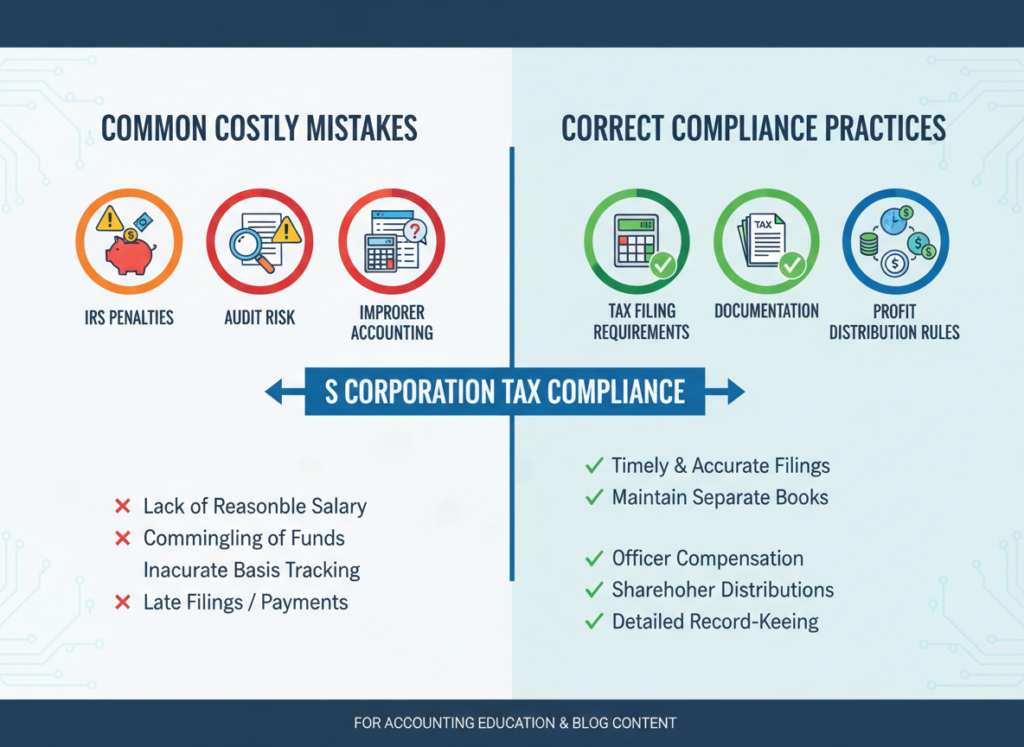
S corporation accounting and taxation

Pass-Through Income

An S corporation does not pay federal income tax at the entity level. Instead, profits and losses pass through to shareholders, who report them on their individual tax returns.

One of the most misunderstood aspects of S corporation accounting and taxation is that shareholders pay tax on their share of income even if no cash is distributed. Distributions are not required for income to be taxable.


Reasonable Compensation: A Critical IRS Rule

The IRS requires shareholders who actively work in the business to receive reasonable compensation as wages. This rule exists to prevent owners from avoiding payroll taxes.

Reasonable compensation must:

  • Be paid through payroll
  • Be subject to Social Security and Medicare taxes
  • Reflect industry standards and job duties

Any remaining profits may be distributed and are generally not subject to payroll taxes. However, underpaying salary is one of the most common audit triggers for S corporations. Proper handling of reasonable compensation is central to compliant S corporation accounting and taxation.


Distributions and Shareholder Basis

Distributions are often viewed as “tax-free,” but that is only true up to the shareholder’s basis. Basis is the shareholder’s investment in the company and determines:

  • Whether losses are deductible
  • Whether distributions are taxable
  • Gain or loss upon sale of shares

Accurate basis tracking is essential. Without it, distributions may be incorrectly reported, leading to unexpected taxes.


Accounting Requirements for S Corporations

Choosing an Accounting Method
Most S corporations use either the cash or accrual method of accounting. The selected method must be applied consistently and accurately. Proper S corporation accounting and taxation depends on correct income recognition and expense timing.


Tracking Shareholder Basis Correctly

Shareholder basis increases with:

  • Capital contributions
  • Pass-through income

It decreases with:

  • Distributions
  • Pass-through losses

Many S corporations fail to track basis annually, which can create problems even when bookkeeping appears accurate.


Reconciling Book and Tax Differences

Financial accounting income does not always equal taxable income. Differences arise from depreciation methods, limitations on meals, and timing differences. These must be reconciled properly on Form 1120-S to ensure accurate reporting.


Payroll and State Compliance Considerations

S corporations must comply with:

  • Federal and state payroll filings
  • Unemployment insurance
  • Workers’ compensation requirements
  • State income or franchise taxes

Some states impose entity-level taxes on S corporations or do not fully follow federal S corp rules. Multi-state operations require careful income sourcing and compliance planning.


Costly S Corporation Mistakes to Avoid

Many S corporation problems stem from avoidable errors, including:

  • Paying distributions without payroll
  • Underpaying owner salary
  • Missing payroll tax filings
  • Violating shareholder eligibility rules
  • Ignoring shareholder basis tracking

These mistakes can result in penalties, interest, and loss of S corporation status.


When an S Corporation Makes Sense—and When It Doesn’t
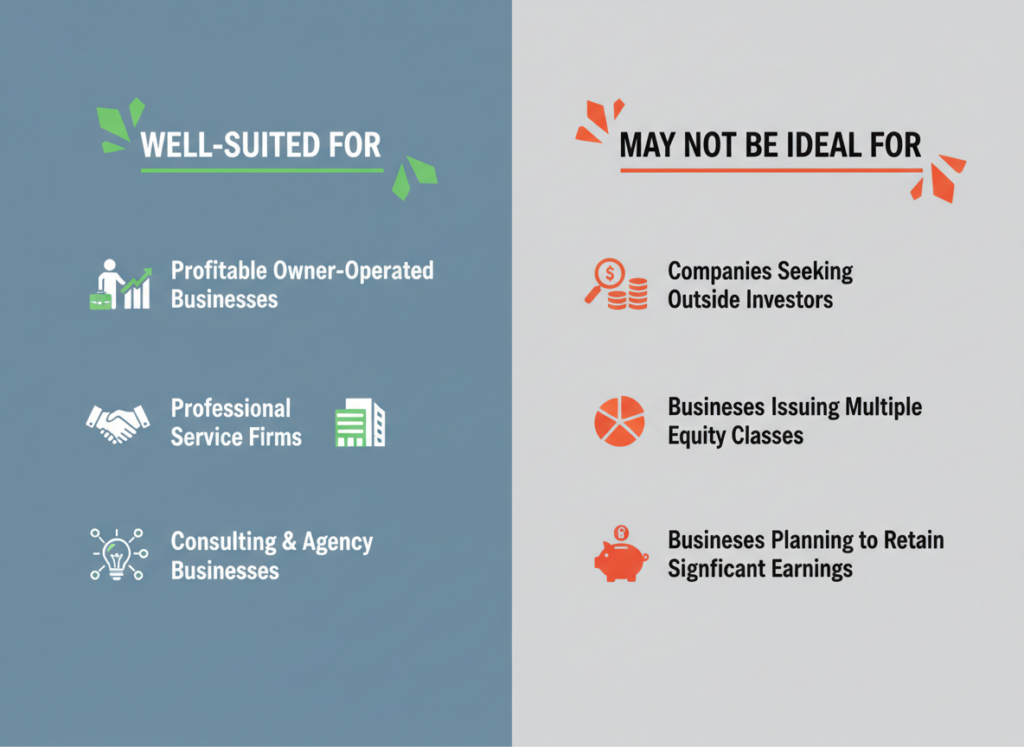
An S corporation is often well-suited for:

  • Profitable owner-operated businesses
  • Professional service firms
  • Consulting and agency businesses

It may not be ideal for:

  • Companies seeking outside investors
  • Businesses issuing multiple equity classes
  • Businesses planning to retain significant earnings

Entity selection should be revisited as income, ownership, and goals evolve.


Tax Planning Opportunities for S Corporations

When managed properly, S corporation accounting and taxation can support:

  • Reduced self-employment taxes
  • Optimized owner compensation
  • Strategic distribution planning
  • Retirement contribution strategies

Proactive planning turns compliance into a financial advantage rather than a burden.


Final Thoughts

An S corporation can be a powerful structure—but it is not automatically the right move for every business. The benefits only materialize when accounting, payroll, and tax rules are followed carefully.

Business owners who understand S corporation accounting and taxation and work with experienced professionals are far more likely to capture tax savings while avoiding costly mistakes. When handled correctly, an S corporation becomes not just a tax strategy, but a stable foundation for long-term growth.

GET IN TOUCH

Schedule a FREE Call

The 4 Essential Pillars Behind Strong Financial Management

Accounting, bookkeeping, finance, and audit form the core of a financially well-managed business…

Stop Chasing New Customers: Grow Revenue From the Ones You Have

Getting new customers is important, but it is not the only way to grow a business. Many companies…

Beyond Zoom: How to Build a Strong Remote Company Culture

Remote work has changed where people work, but it has not changed what people expect from a good…

SOP vs Checklist: Which One Does Your Business Need?

As a business grows, work becomes harder to manage consistently. A small team can rely on verbal…

From 5 to 50 Employees: What Changes as Your Business Grows?

Going from 5 employees to 50 is a major milestone. It means more customers, more revenue, more…

Your Books Are More Than Records—They’re Business Intelligence

Most business owners think of accounting as a process that happens in the background. Sales are…

Are Marketplace Fees Quietly Destroying Your Profit Margins?

Selling on an online marketplace can make a business look extremely successful. Orders are coming…

Still Doing Everything Yourself? Here’s Why Founders Need Financial Experts

When most businesses are just getting started, founders wear every hat imaginable. You’re the…

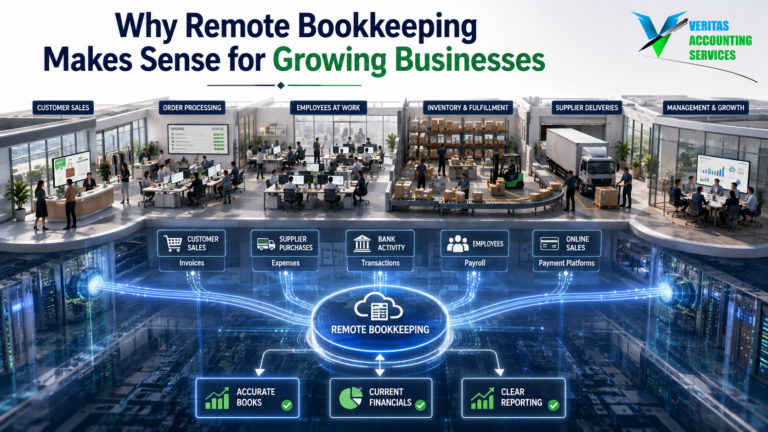
Why Remote Bookkeeping Makes Sense for Growing Businesses

Growth is exciting, but it also creates more financial work. More customers mean more invoices. More…

Connect on our Socials!
Business entity selection comparison for year-end tax planning

Right Business Entity Selection: Year-End Special Strategies for 2026 Planning

Business entity selection is one of the most impactful decisions a business owner can make, yet it is often left untouched for years. As 2025 draws to a close and the tax landscape prepares for meaningful changes in 2026, year-end planning offers a critical opportunity to reassess whether a company’s current structure still supports its financial, tax, and long-term goals.

Entity selection affects far more than tax rates. It shapes how income is taxed, how losses are used, how compensation is structured, and how a business prepares for growth, retirement, or succession. A thoughtful review before year-end allows tax professionals and business owners to align structure with strategy—before deadlines pass and options narrow.


Business entity selection comparison for year-end tax planning

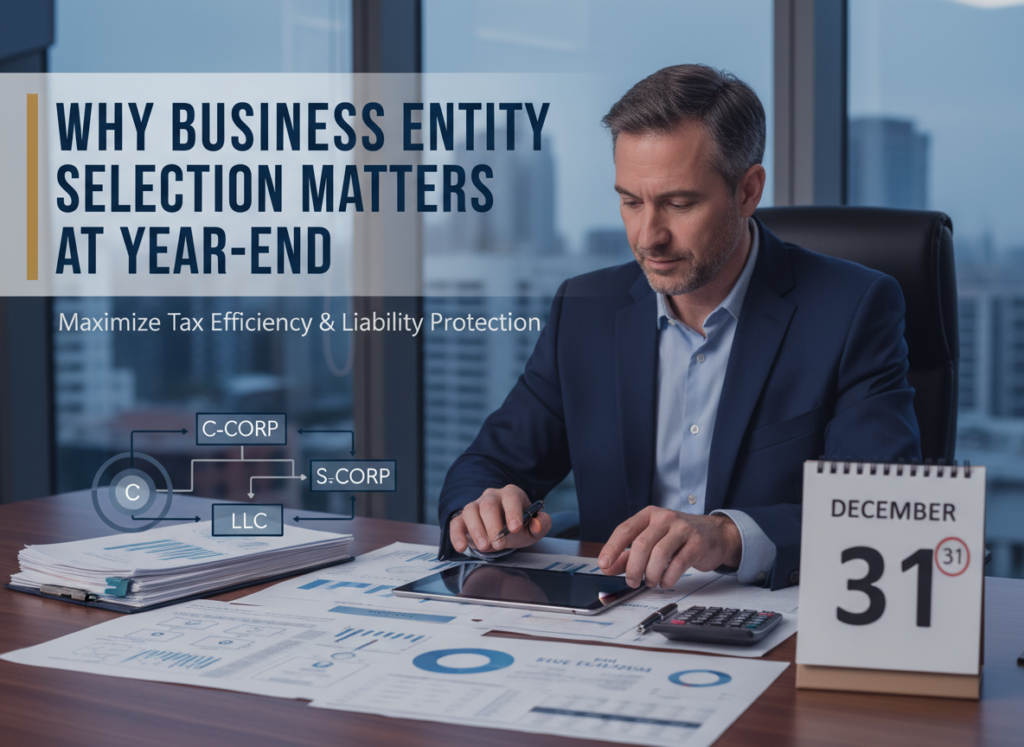
Why Business Entity Selection Matters at Year-End

Year-end is when income levels become clear, ownership changes are finalized, and planning for the coming year begins. This timing makes business entity selection especially important. Decisions made now can influence tax outcomes not only for the current year but well into 2026 and beyond.

Expected rate adjustments, evolving compliance requirements, and shifting business goals mean that a structure that worked in prior years may no longer be optimal. Reviewing entity choice at year-end allows advisors to identify whether staying the course makes sense or whether restructuring could deliver meaningful tax or operational benefits.


Understanding Business Entity Selection Across Common Structures

Effective business entity selection requires understanding how each entity type operates under current law and how it may be affected by upcoming changes.

C Corporations

C corporations offer a flat corporate tax rate and a familiar legal framework. They are often well-suited for businesses that plan to reinvest profits, pursue outside investors, or prepare for equity-based growth. However, double taxation remains a central consideration. Profits taxed at the corporate level may be taxed again when distributed to shareholders, which can reduce overall tax efficiency for owners seeking regular distributions.

S Corporations

S corporations provide pass-through taxation while allowing flexibility in managing compensation and distributions. For many closely held businesses, this balance can be attractive. That said, eligibility rules—such as limits on shareholders, ownership restrictions, and the single-class-of-stock requirement—must be reviewed regularly. Reasonable compensation remains a key compliance issue and should be part of any year-end evaluation.

Partnerships and Multi-Member LLCs

Partnerships and multi-member LLCs offer the greatest flexibility in business entity selection. Special allocations, tiered ownership, and customized economic arrangements make them ideal for complex or evolving businesses. However, this flexibility comes with added administrative responsibility, including basis tracking, capital account maintenance, and careful handling of self-employment tax exposure.


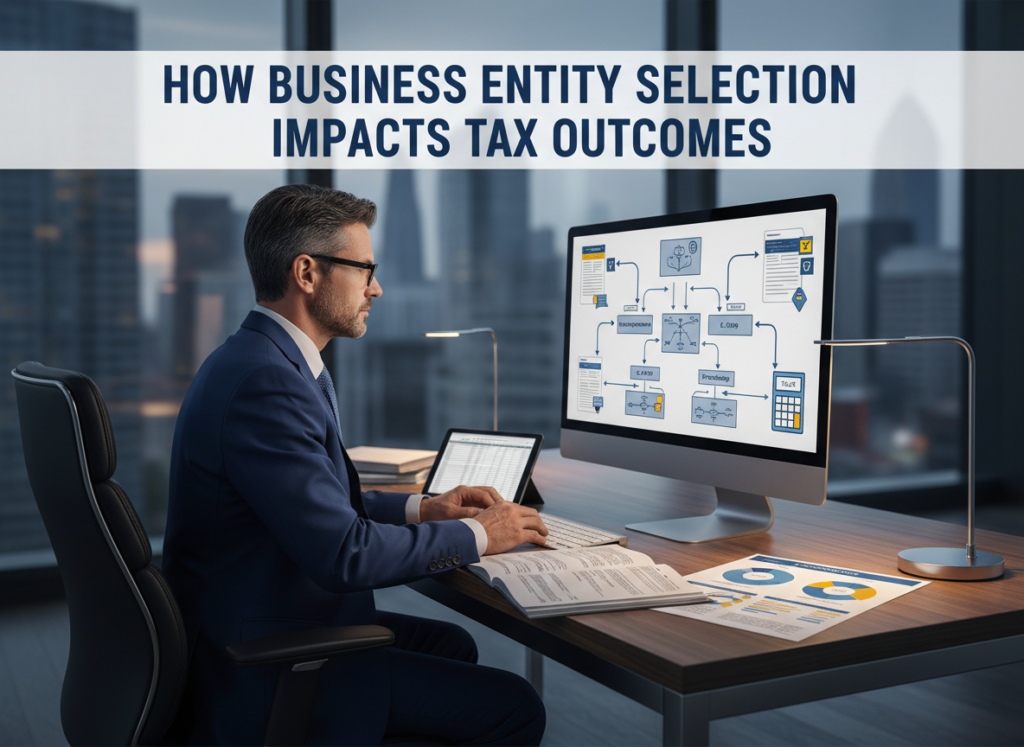
How Business Entity Selection Impacts Tax Outcomes

Choosing the right entity structure affects how income and losses flow to owners. As income increases or business activity shifts, the tax efficiency of one entity compared to another can change significantly.

Year-end planning allows professionals to model how 2026 tax rules may affect pass-through income, corporate earnings, or owner compensation. A structure that minimizes tax under current conditions may become less favorable as thresholds, rates, or limitations change.


Year-End Planning Tools That Affect Business Entity Selection

Several planning tools can influence business entity selection, but many come with strict timing requirements. Late S elections, check-the-box classifications, or restructuring transactions may be available only if action is taken before year-end or within specific election windows.

Missing these deadlines can delay a desired strategy by an entire year, potentially resulting in higher taxes or lost planning opportunities. Reviewing entity options before year-end ensures that clients do not miss critical elections that could support their 2026 objectives.


Business Entity Selection and Long-Term Planning Goals

Entity choice does not exist in isolation. Business entity selection interacts closely with retirement planning, succession strategies, and compensation design.

A business planning for a future sale or generational transfer may benefit from the flexibility offered by partnership structures. Owners seeking to maximize retirement contributions may find different opportunities depending on whether they operate as an S corporation or C corporation. Evaluating entity choice with a long-term lens helps ensure that today’s structure does not limit tomorrow’s options.


Communicating Business Entity Selection Decisions to Clients

Many business owners find business entity selection confusing, especially when an LLC can be taxed in multiple ways. Clear communication is essential. Explaining how distributions, wages, basis, and compliance obligations differ between entities empowers clients to participate in the decision-making process.

When clients understand the trade-offs involved, they are more likely to feel confident in the chosen structure and committed to long-term planning strategies. Year-end conversations provide a natural opportunity to revisit these topics and reinforce proactive planning.


Preparing for 2026 Through Smart Business Entity Selection

As 2026 approaches, tax professionals should encourage clients to view business entity selection as an evolving strategy rather than a one-time decision. Economic conditions change, tax laws evolve, and business goals shift. Regular reviews ensure that entity choice remains aligned with both current operations and future plans.

Proactive evaluation at year-end allows businesses to enter the new tax year with clarity, confidence, and a structure designed to support growth and compliance.


Key Takeaway

Business entity selection is a foundational element of effective tax and business planning. Year-end offers the ideal moment to reassess whether a company’s current structure still supports its goals in light of upcoming 2026 changes.

By reviewing entity choice now—before deadlines pass—business owners and advisors can position the business for tax efficiency, operational flexibility, and long-term success. A well-timed evaluation today can prevent costly adjustments tomorrow and ensure the business is built for what lies ahead to support sustainable growth.

Final Thoughts

Business entity selection is not a decision that should be made once and forgotten. As tax laws evolve and business goals change, the structure that once worked well may no longer deliver the best results. Reviewing entity choice at year-end allows business owners to step into the next tax year with clarity, confidence, and a structure aligned to both current operations and future plans.

Taking time now to reassess entity selection can help avoid missed opportunities, reduce tax inefficiencies, and support long-term growth. A proactive review before year-end ensures that your business enters the new year prepared, compliant, and strategically positioned for what lies ahead.

Get In Touch

Schedule A Free Call

The 4 Essential Pillars Behind Strong Financial Management

Accounting, bookkeeping, finance, and audit form the core of a financially well-managed business…

Stop Chasing New Customers: Grow Revenue From the Ones You Have

Getting new customers is important, but it is not the only way to grow a business. Many companies…

Beyond Zoom: How to Build a Strong Remote Company Culture

Remote work has changed where people work, but it has not changed what people expect from a good…

SOP vs Checklist: Which One Does Your Business Need?

As a business grows, work becomes harder to manage consistently. A small team can rely on verbal…

From 5 to 50 Employees: What Changes as Your Business Grows?

Going from 5 employees to 50 is a major milestone. It means more customers, more revenue, more…

Your Books Are More Than Records—They’re Business Intelligence

Most business owners think of accounting as a process that happens in the background. Sales are…

Are Marketplace Fees Quietly Destroying Your Profit Margins?

Selling on an online marketplace can make a business look extremely successful. Orders are coming…

Still Doing Everything Yourself? Here’s Why Founders Need Financial Experts

When most businesses are just getting started, founders wear every hat imaginable. You’re the…

Why Remote Bookkeeping Makes Sense for Growing Businesses

Growth is exciting, but it also creates more financial work. More customers mean more invoices. More…

Connect With Us!

first-time abatement 2026

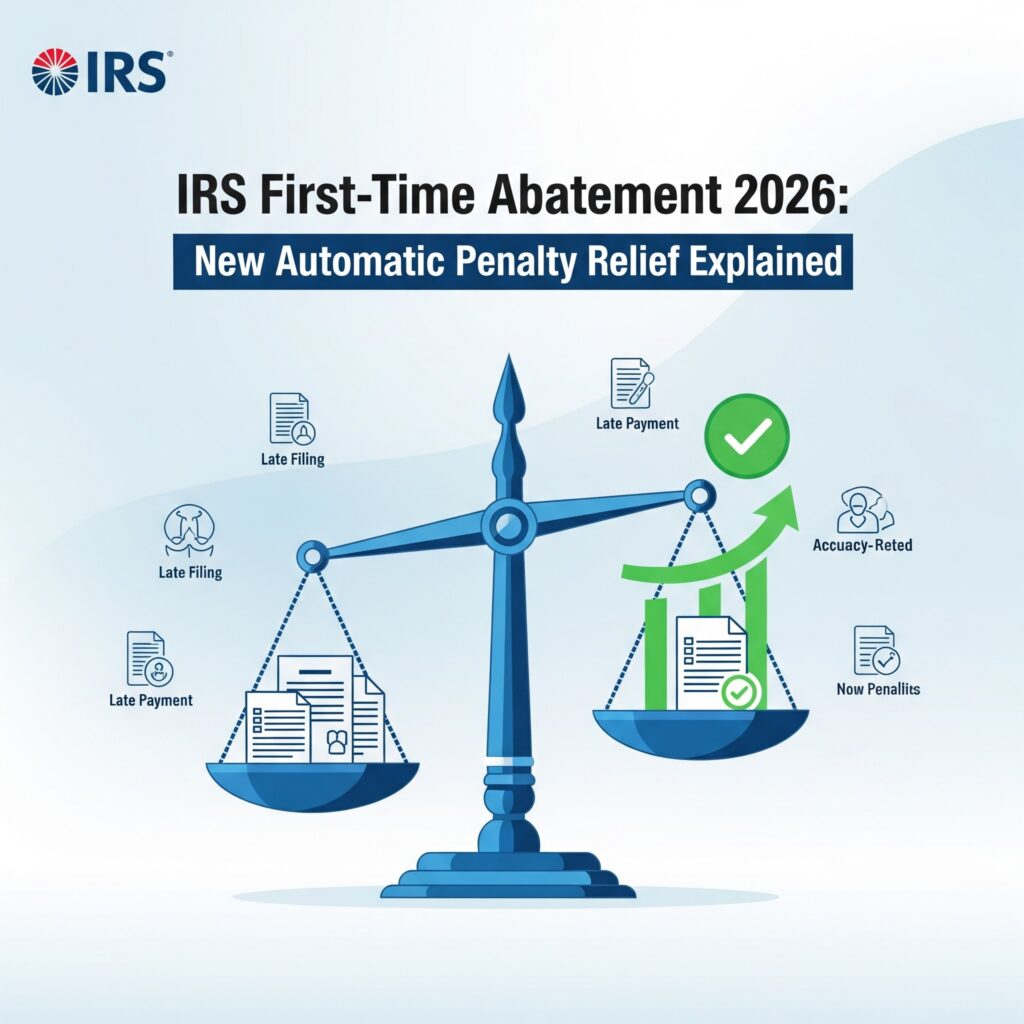
IRS First-Time Abatement 2026: New Automatic Penalty Relief Explained

The first-time abatement 2026 update marks a major shift in how the IRS administers penalty relief for taxpayers. For years, taxpayers struggled with penalty notices—many not knowing that the IRS offered a First-Time Abatement (FTA) program at all. The IRS required taxpayers or tax professionals to call, write, or file a request to receive the penalty waiver.

Starting in 2026, the IRS will automatically apply first-time abatement 2026 relief when a taxpayer qualifies. This is one of the most significant modernization steps in recent IRS history.

This blog breaks down what first-time abatement 2026 means, who qualifies, how the automatic waiver works, and what tax professionals must do to prepare.


⭐ What Is First-Time Abatement (FTA)?

First-Time Abatement (FTA) has existed since 2001 and is one of the most widely applicable forms of IRS penalty relief. FTA is available for taxpayers who have a good compliance history and need relief from certain penalties.

Under first-time abatement 2026, the IRS will shift from a request-based model to an automatic system—helping millions of taxpayers who previously missed out due to lack of awareness.

FTA applies only to penalties related to:

  • Failure to file
  • Failure to pay
  • Failure to deposit (for payroll taxes)

These penalties can be substantial, and first-time abatement 2026 may prevent financially strained taxpayers from paying unnecessary penalties.

IRS First-Time Abatement automatic penalty relief overview

📌 Penalties Eligible Under First-Time Abatement 2026

FTA continues to apply to only three penalty categories. Under the first-time abatement 2026 system, these penalties will be reviewed automatically:

✔ Failure to File Penalty

Assessed when a taxpayer submits a return after the due date.

✔ Failure to Pay Penalty

Applied when taxes remain unpaid by the deadline.

✔ Failure to Deposit Penalty

Relevant to employers who do not deposit payroll taxes on time.

Under first-time abatement 2026, these penalties may no longer require taxpayers to call the IRS or file Form 843 to request relief.

first-time abatement 2026

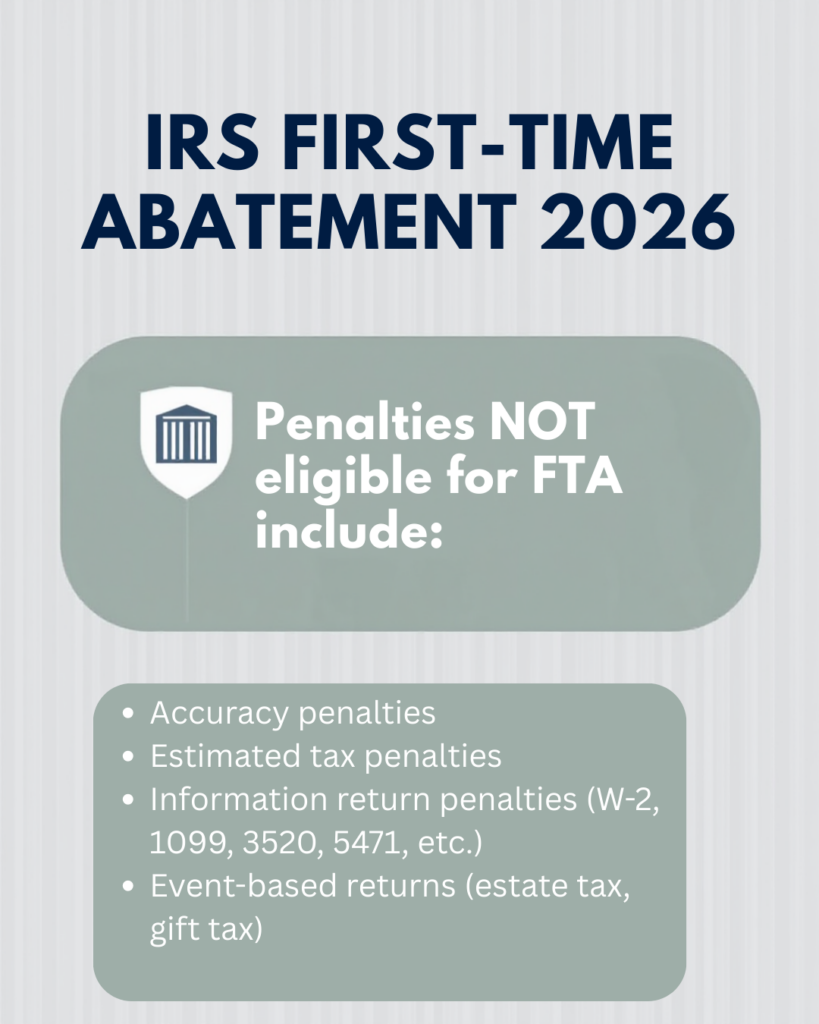
❌ Penalties NOT eligible for FTA include:

  • Accuracy penalties
  • Estimated tax penalties
  • Information return penalties (W-2, 1099, 3520, 5471, etc.)
  • Event-based returns (estate tax, gift tax)

🧾 Who Qualifies for First-Time Abatement 2026?

To qualify for first-time abatement 2026, taxpayers must meet existing FTA rules. These requirements remain unchanged.

🔹 1. Eligible Return Types

FTA applies only to:

  • Individual: Form 1040 series
  • Business: Form 1120, Form 1065
  • Payroll: Form 940, 941, 944, 945

Not eligible under first-time abatement 2026:
Form 990 series, gift tax returns, estate tax returns, international forms.


🔹 2. Clean Compliance History

Taxpayer must have:

  • No disqualifying penalties in the three years prior to the penalty year
  • Estimated tax penalties do NOT disqualify
  • For joint returns: BOTH spouses must meet the criteria
  • For payroll taxes: must not have more than three prior Failure to Deposit waivers

Even under first-time abatement 2026, the IRS will evaluate compliance history before applying automatic relief.


🔹 3. Filing Compliance

All required tax returns for the previous three years must be filed.

This rule is unchanged under the first-time abatement 2026 automatic system.


🔹 4. Good Standing on Balances

Taxpayers must be current with IRS agreements or payment plans.

Automatic FTA in first-time abatement 2026 will be blocked if a taxpayer is not in good standing.


first-time abatement 2026

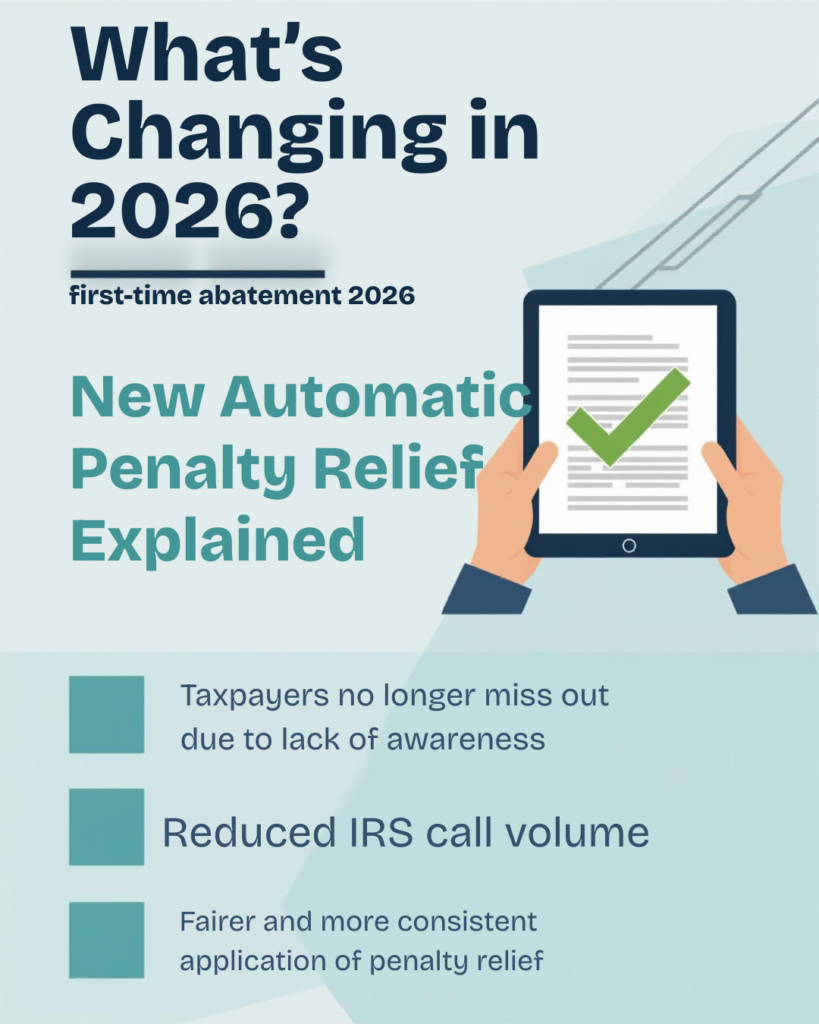
🚀 What’s Changing in 2026?

Currently, taxpayers must manually request FTA by:

  • Calling the IRS
  • Writing a letter
  • Filing Form 843

Beginning in first-time abatement 2026, the IRS will automatically issue the waiver when all criteria are met.

This modernization comes after years of recommendations from:

  • Treasury Inspector General for Tax Administration (TIGTA)
  • National Taxpayer Advocate (NTA)
  • Industry tax associations

In November 2025, Erin Collins (NTA) confirmed that the IRS will be implementing the automatic first-time abatement 2026 capability.

🌟 Benefits of Automatic FTA:

  • Taxpayers no longer miss out due to lack of awareness
  • Reduced IRS call volume
  • Faster processing
  • Fairer and more consistent application of penalty relief

🧠 Why First-Time Abatement 2026 Matters

Millions of taxpayers qualify for FTA every year, but only a small percentage receive the waiver. Reasons include:

  • Not knowing the program existed
  • Difficulty contacting the IRS
  • Confusion about eligibility
  • Filing delays that complicate penalty removal

With first-time abatement 2026, the IRS aims to eliminate these barriers.

This change especially benefits:

  • First-time filers
  • Taxpayers facing temporary financial hardship
  • Small businesses with payroll deposit issues
  • Tax professionals who handle high call volumes during tax season

🛠️ Action Steps for Tax Professionals

Even though first-time abatement 2026 becomes automatic, tax professionals must remain vigilant.

🔍 1. Review Client Accounts for Missed Past FTA Opportunities

Clients may still qualify for relief for earlier years (before 2026).
Tax pros can:

  • Obtain Form 2848
  • Call the IRS Practitioner Priority Service
  • File Form 843 when appropriate

first-time abatement 2026

📅 2. Watch for IRS Implementation Guidance

Key details will be published as the IRS finalizes:

  • System automation rules
  • Exception-handling processes
  • How to address cases where automatic FTA is not applied
  • Employer deposit penalty workflows

📝 3. Ensure Clients Maintain Filing Compliance

Missing returns automatically disqualify taxpayers from first-time abatement 2026.

Encourage clients to catch up before penalties hit.


💡 4. Understand Prior COVID-Era Penalty Relief Coding

The IRS provided administrative penalty waivers for:

  • 2019–2020 late filing
  • 2020–2021 failure to pay

These do NOT disqualify taxpayers from first-time abatement 2026, but IRS coding inconsistencies may require manual intervention.


🔚 Final Thoughts

The introduction of first-time abatement 2026 represents a major IRS modernization that brings more fairness and access to penalty relief. Millions of taxpayers will benefit from automatic evaluations rather than needing to request relief through complex processes.

Tax professionals should stay informed, monitor IRS publications, and proactively review client accounts to ensure no qualified taxpayer misses out on penalty relief.


📞 Need Help Navigating IRS Penalties or Compliance?

Veritas Accounting Services is here to support you.

📧 hello@veritasaccountingservices.com
📞 +1 (678) 723-6003 | +91 97255 52243

US Office: 8735 Dunwoody Place – 4549, Atlanta, GA
India Office: C-305, The Imperial Heights, Rajkot

Serving clients in the US, UK, UAE, Singapore, Ireland & Malaysia with expert tax and compliance solutions.

Schedule a FREE Call

Contact us on social

The 4 Essential Pillars Behind Strong Financial Management

Accounting, bookkeeping, finance, and audit form the core of a financially well-managed business…

Stop Chasing New Customers: Grow Revenue From the Ones You Have

Getting new customers is important, but it is not the only way to grow a business. Many companies…

Beyond Zoom: How to Build a Strong Remote Company Culture

Remote work has changed where people work, but it has not changed what people expect from a good…

SOP vs Checklist: Which One Does Your Business Need?

As a business grows, work becomes harder to manage consistently. A small team can rely on verbal…

From 5 to 50 Employees: What Changes as Your Business Grows?

Going from 5 employees to 50 is a major milestone. It means more customers, more revenue, more…

Your Books Are More Than Records—They’re Business Intelligence

Most business owners think of accounting as a process that happens in the background. Sales are…

Are Marketplace Fees Quietly Destroying Your Profit Margins?

Selling on an online marketplace can make a business look extremely successful. Orders are coming…

Still Doing Everything Yourself? Here’s Why Founders Need Financial Experts

When most businesses are just getting started, founders wear every hat imaginable. You’re the…

Why Remote Bookkeeping Makes Sense for Growing Businesses

Growth is exciting, but it also creates more financial work. More customers mean more invoices. More…
Crush Your Debt Faster

Crush Your Debt Faster with These 2 Powerful Repayment Strategies: Snowball vs. Avalanche

Introduction

If you’re drowning in credit cards, loans, or medical bills, you’re not alone—but you can Crush Your Debt Faster with a clear plan. The problem for most people isn’t a lack of effort; it’s a lack of strategy. You pay a little here, a little there, and it feels like nothing ever changes.

Two proven methods can turn that around:

  • The Debt Snowball Method
  • The Debt Avalanche Method

Both are powerful debt repayment strategies that help you stay focused and make real progress. In this guide, you’ll learn how each method works, who they’re best for, and how to choose the one that helps you Crush Your Debt Faster without burning out.


What Is the Debt Snowball Method?

The Debt Snowball Method is built around small, fast wins. Instead of worrying about interest rates, you focus on paying off your smallest debts first and create momentum.

How the Snowball Method Works

  1. List all your debts from smallest balance to largest.
  2. Pay the minimum on every debt.
  3. Put all extra money toward the smallest debt.
  4. Once that debt is gone, “snowball” its payment into the next smallest debt.
  5. Repeat until every debt is paid off.

Even though this method isn’t always mathematically perfect, it helps you Crush Your Debt Faster because it keeps you emotionally engaged.

Why the Snowball Method Works

  • You eliminate entire balances quickly.
  • Each win builds motivation and confidence.
  • The plan is simple, so you’re less likely to quit.

Best for: people who feel overwhelmed, emotional spenders, and anyone who needs quick proof that their efforts are working.


What Is the Debt Avalanche Method?

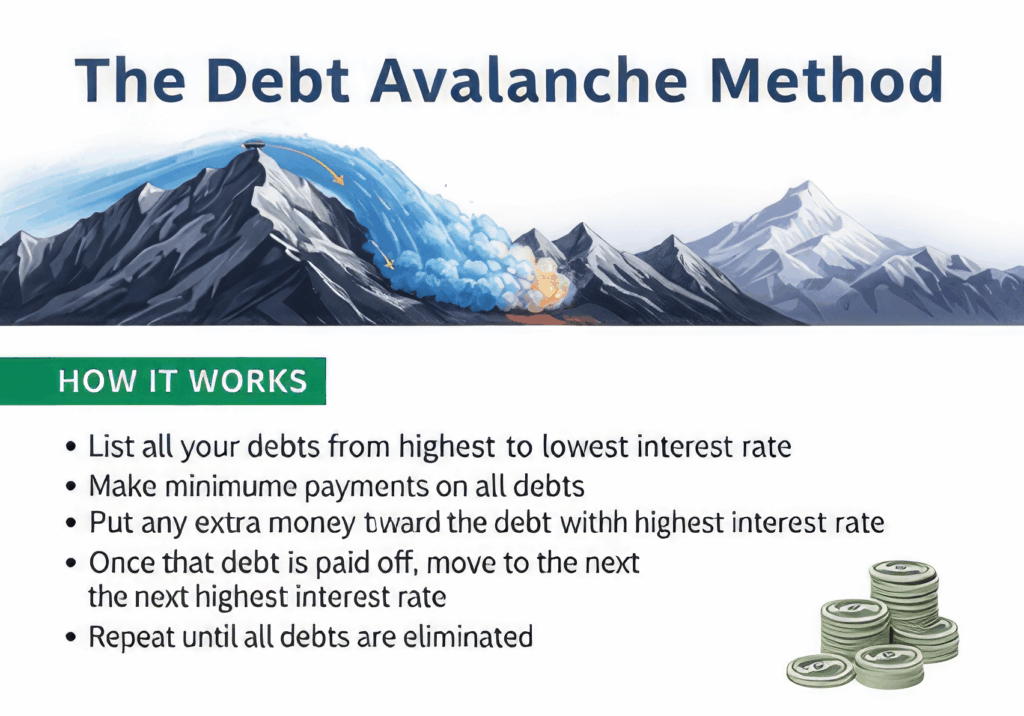
The Debt Avalanche Method is focused on saving the most money in interest and often paying off everything in less time overall. Instead of looking at balance size, you look at interest rates.

How the Avalanche Method Works

  1. List all your debts from highest interest rate to lowest.
  2. Pay the minimum on all debts.
  3. Put all extra money toward the highest-interest debt.
  4. Once it’s paid off, move to the next highest rate.
  5. Continue until you’re completely debt-free.

This approach helps you Crush Your Debt Faster from a financial perspective, even if early progress is less visible.

Why the Avalanche Method Works

  • You pay less total interest.
  • You usually finish your debt-free journey sooner.
  • It’s especially powerful for high-interest credit cards.

Best for: disciplined people who like numbers, want to minimize interest, and don’t need immediate emotional wins.


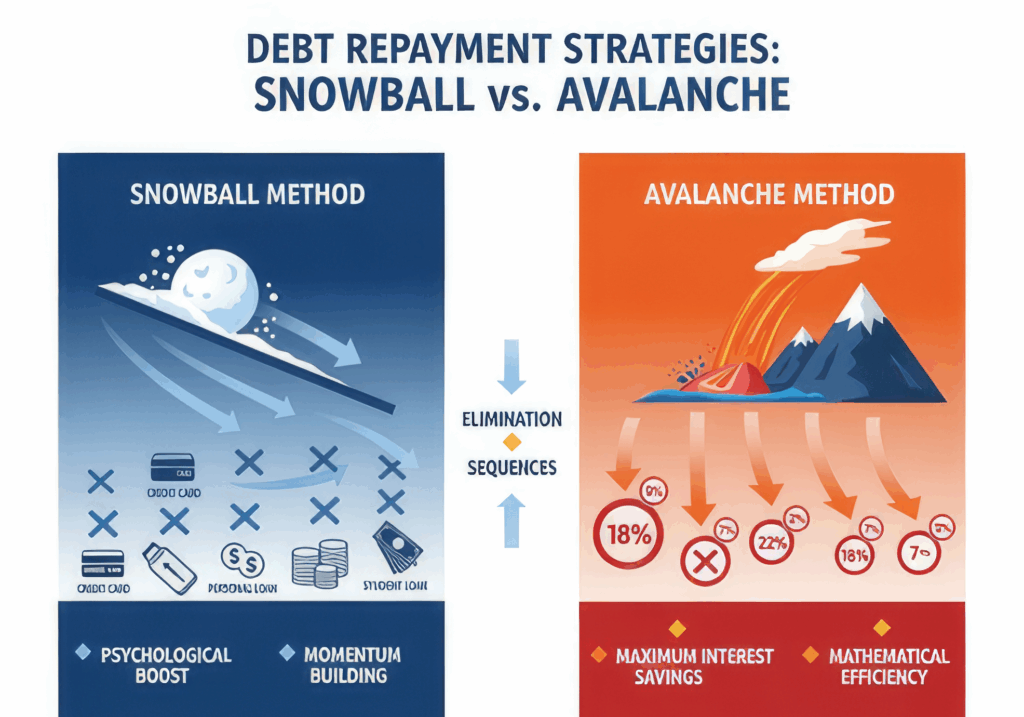
Snowball vs. Avalanche: Key Differences

Use this in a Table block in WordPress:

FeatureDebt SnowballDebt Avalanche
Main FocusSmallest balance firstHighest interest rate first
MotivationFast emotional winsLong-term savings
Interest SavedLessMore
Speed OverallSometimes slowerOften faster
ComplexityVery simpleRequires tracking rates
Best ForMotivation & momentumEfficiency & savings

In simple terms:

  • Snowball is emotion-first, math-second.
  • Avalanche is math-first, emotion-second.

To Crush Your Debt Faster, you need the one that aligns with how you think and behave.


Which Strategy Will Help You Crush Your Debt Faster?

The “best” strategy is the one you actually stick with.

Ask yourself:

  • Do I lose motivation when progress is slow?
  • Do I care more about paying less interest or feeling progress sooner?
  • Do I like simple, no-math plans or detailed, optimized ones?

Choose the Snowball Method If…

  • You’ve started and stopped debt payoff plans before.
  • You feel better when you see entire accounts hit zero.
  • You want an easy way to Crush Your Debt Faster through motivation.

Choose the Avalanche Method If…

  • You’re patient and disciplined.
  • You want to save the most money on interest.
  • You’re okay waiting longer for the first “big win.”

There’s no wrong answer. The real mistake is staying stuck and using no system at all.


Can You Combine Both Strategies?

Absolutely. You don’t have to pick one and stay with it forever. A hybrid approach can help you Crush Your Debt Faster while balancing emotion and efficiency.

How to Use a Hybrid Strategy

  1. Start with a mini Snowball:
    Pay off one or two tiny debts first to create quick momentum.
  2. Switch to Avalanche:
    Once you feel focused and confident, reorder your remaining debts by interest rate and attack the highest one.
  3. Reset when needed:
    If you feel stuck again, temporarily use the Snowball on a small balance to regain motivation.

This blended method gives you the emotional wins of Snowball and the interest savings of Avalanche.


Real-Life Example: Which Method Wins?

Meet Sam. Sam has these debts:

Debt TypeBalanceInterest Rate
Credit Card A$1,50022%
Credit Card B$80018%
Personal Loan$3,00010%
Medical Bill$5000%

Sam can put $450 per month toward debt.

With the Debt Snowball

Order from smallest balance:

  1. Medical Bill – $500
  2. Credit Card B – $800
  3. Credit Card A – $1,500
  4. Personal Loan – $3,000

Sam wipes out the medical bill in just over one month, then Credit Card B a few months later. These fast wins make Sam feel powerful and in control—and that feeling helps Sam Crush Debt Faster because the plan doesn’t get abandoned.

With the Debt Avalanche

Order by highest interest rate:

  1. Credit Card A – 22%
  2. Credit Card B – 18%
  3. Personal Loan – 10%
  4. Medical Bill – 0%

Sam needs more time before one entire account disappears, but pays much less interest overall and finishes the total payoff sooner than with Snowball.

Takeaway:

  • Snowball helps Sam stay emotionally committed.
  • Avalanche helps Sam save more and mathematically Crush Debt Faster.

You choose which “faster” matters more: faster emotionally, or faster financially.


Final Thoughts: Start Crushing Your Debt Today

You don’t need perfect timing, a big income, or a miracle. You just need a plan you’ll actually follow.

  • Use Debt Snowball if motivation is your biggest challenge.
  • Use Debt Avalanche if interest savings and efficiency matter most.
  • Use a hybrid strategy if you want both.

Most importantly, take action. The sooner you start, the sooner you’ll Crush Your Debt Faster and free up your income for saving, investing, and building the life you actually want.

Pick your strategy today and start your debt-free journey.

📞 Ready to Finally Crush Your Debt Faster and Take Control of Your Financial Future?

If you need expert guidance on budgeting, debt repayment planning, or complete financial management, Veritas Accounting Services is here to support you every step of the way.

Contact Veritas Accounting Services:

📧 Email: hello@veritasaccountingservices.com
📞 Phone: +1 (678) 723-6003 | +91 97255 52243
🏢 US Office: 8735 Dunwoody Place – 4549, Atlanta, GA
🏢 India Office: C-305, The Imperial Heights, 150ft Ring Road, Rajkot

We proudly serve clients across the US, UK, UAE, Singapore, Ireland, and Malaysia, offering personalized bookkeeping, debt planning, tax filing, and CFO-level financial

GET IN TOUCH

Schedule a FREE Consultation

The 4 Essential Pillars Behind Strong Financial Management

Accounting, bookkeeping, finance, and audit form the core of a financially well-managed business…

Stop Chasing New Customers: Grow Revenue From the Ones You Have

Getting new customers is important, but it is not the only way to grow a business. Many companies…

Beyond Zoom: How to Build a Strong Remote Company Culture

Remote work has changed where people work, but it has not changed what people expect from a good…

SOP vs Checklist: Which One Does Your Business Need?

As a business grows, work becomes harder to manage consistently. A small team can rely on verbal…

From 5 to 50 Employees: What Changes as Your Business Grows?

Going from 5 employees to 50 is a major milestone. It means more customers, more revenue, more…

Your Books Are More Than Records—They’re Business Intelligence

Most business owners think of accounting as a process that happens in the background. Sales are…

Are Marketplace Fees Quietly Destroying Your Profit Margins?

Selling on an online marketplace can make a business look extremely successful. Orders are coming…

Still Doing Everything Yourself? Here’s Why Founders Need Financial Experts

When most businesses are just getting started, founders wear every hat imaginable. You’re the…

Why Remote Bookkeeping Makes Sense for Growing Businesses

Growth is exciting, but it also creates more financial work. More customers mean more invoices. More…

Connect With Us On Socials!

tax-free investment income

Tax-Free Investment Income: The Hidden Opportunity Your Portfolio May Be Missing

In the complex world of investment planning, one of the most overlooked strategies is maximizing tax-free investment income. While many investors focus solely on returns, the smartest wealth builders understand that it’s not what you earn—it’s what you keep after taxes that truly matters.

What is Tax-Free Investment Income?

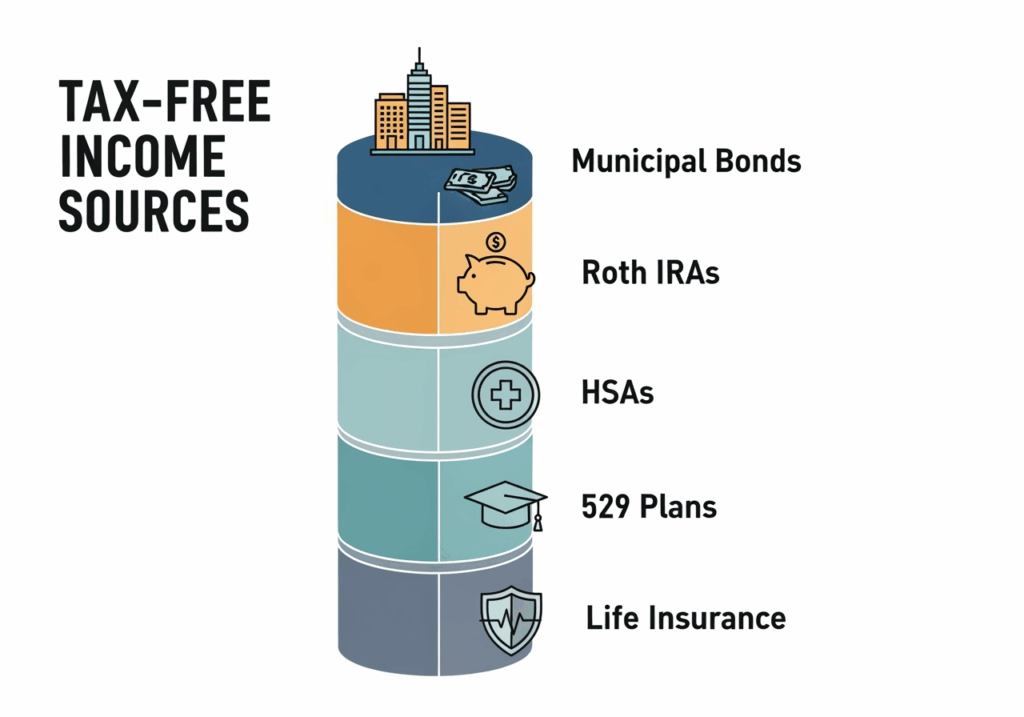
tax-free investment incomeInfographic showing five types of tax-free income, including municipal bonds, Roth IRAs, and HSAs.

Tax-free investment income refers to earnings from specific investment vehicles that are exempt from federal income taxes, and in some cases, state and local taxes as well. The three primary sources include:

1. Municipal Bonds

Municipal bonds, or “munis,” are debt securities issued by state and local governments to fund public projects. The interest earned from these bonds is typically exempt from federal income tax and may also be exempt from state and local taxes if you live in the issuing state.

Types of Municipal Bonds to Consider:

  • General Obligation Bonds: Backed by the full faith and credit of the issuing municipality
  • Revenue Bonds: Secured by specific revenue streams from projects like toll roads or utilities
  • Private Activity Bonds: May be subject to AMT but offer higher yields
  • Build America Bonds: Federally subsidized municipal bonds with taxable interest

2. Roth IRAs

Unlike traditional IRAs, Roth IRA contributions are made with after-tax dollars. However, qualified withdrawals in retirement—including both contributions and earnings—are completely tax-free, making them a powerful long-term wealth-building tool.

Advanced Roth Strategies:

  • Roth Ladder Conversions: Systematic conversions over multiple years to manage tax brackets
  • Mega Backdoor Roth: For high earners with 401(k) plans allowing after-tax contributions
  • Roth IRA Inheritance Planning: Tax-free wealth transfer to beneficiaries

3. Life Insurance Payouts

Certain life insurance policies, particularly permanent life insurance with cash value components, can provide tax-free income through policy loans and withdrawals up to your basis in the policy.

Life Insurance Tax Strategies:

  • Modified Endowment Contract (MEC) Avoidance: Structuring policies to maintain tax advantages
  • Private Placement Life Insurance (PPLI): For ultra-high-net-worth individuals
  • Corporate-Owned Life Insurance (COLI): Business tax planning applications

Additional Tax-Free Income Sources

Health Savings Accounts (HSAs)

Often called the “triple tax advantage” account, HSAs offer:

  • Tax-deductible contributions
  • Tax-free growth
  • Tax-free withdrawals for qualified medical expenses
  • After age 65, withdrawals for non-medical purposes are taxed as ordinary income (like a traditional IRA)

529 Education Savings Plans

While contributions aren’t federally deductible, earnings grow tax-free and withdrawals for qualified education expenses are tax-free. Recent expansions allow:

  • K-12 tuition payments up to $10,000 annually
  • Student loan repayments up to $10,000 lifetime
  • Beneficiary changes to family members

Why Tax-Free Investment Income Matters More Than Ever

Chart showing municipal bond yield vs taxable bond yield with tax-equivalent calculation.

Protecting Your Overall Tax Picture

Tax-free investment income doesn’t just save you money on taxes—it provides strategic advantages that many investors overlook:

  • No impact on taxable income calculations: This income won’t push you into higher tax brackets
  • Medicare surcharge protection: High-income earners can avoid additional Medicare premiums triggered by modified adjusted gross income (MAGI)
  • Alternative Minimum Tax (AMT) benefits: Tax-free municipal bond interest generally doesn’t trigger AMT calculations
  • Social Security taxation: Lower taxable income may reduce the taxation of your Social Security benefits

The Compound Effect of Tax Efficiency

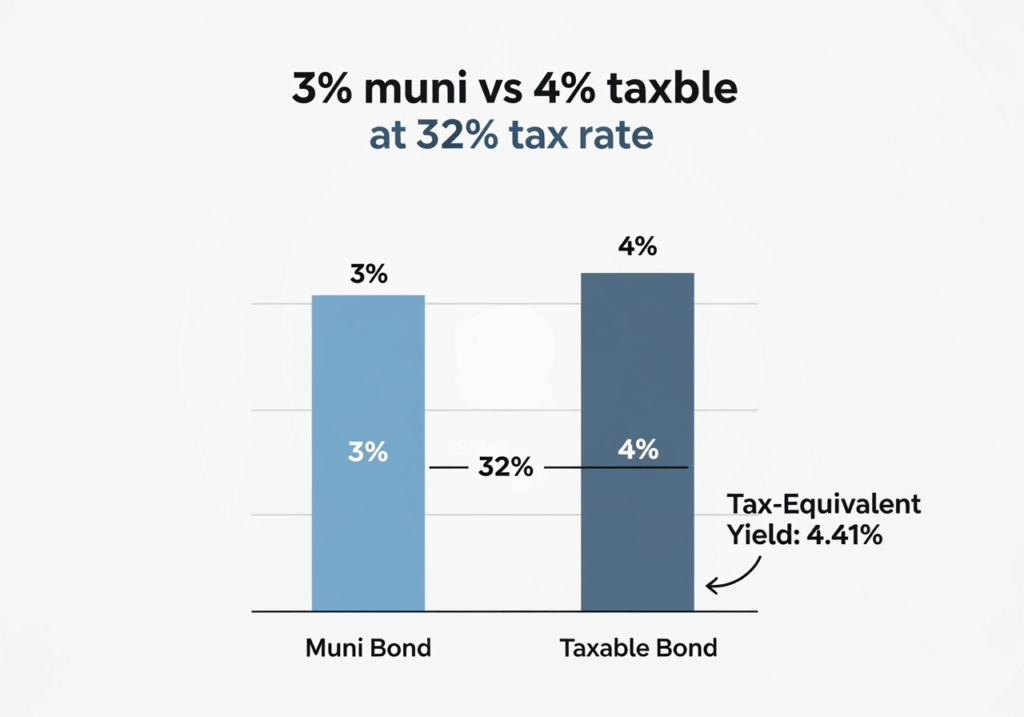
Consider this scenario: An investor in the 32% tax bracket earning 4% on taxable bonds nets only 2.72% after taxes. Meanwhile, a municipal bond yielding 3% provides the full 3% return—effectively outperforming the taxable investment while reducing risk.

Tax-Equivalent Yield Formula: Tax-Free Yield ÷ (1 – Tax Rate) = Tax-Equivalent Yield

For a 3% municipal bond and 32% tax bracket: 3% ÷ (1 – 0.32) = 4.41% tax-equivalent yield

Current Market Dynamics

In today’s rising interest rate environment, tax-free investments offer additional benefits:

  • Interest rate sensitivity: Shorter-duration municipal bonds provide protection against rate increases
  • Credit quality improvements: Many municipalities have strengthened their financial positions post-pandemic
  • Supply and demand imbalances: Limited municipal bond issuance has created attractive opportunities

The Missed Opportunity: Why Many Portfolios Aren’t Optimized

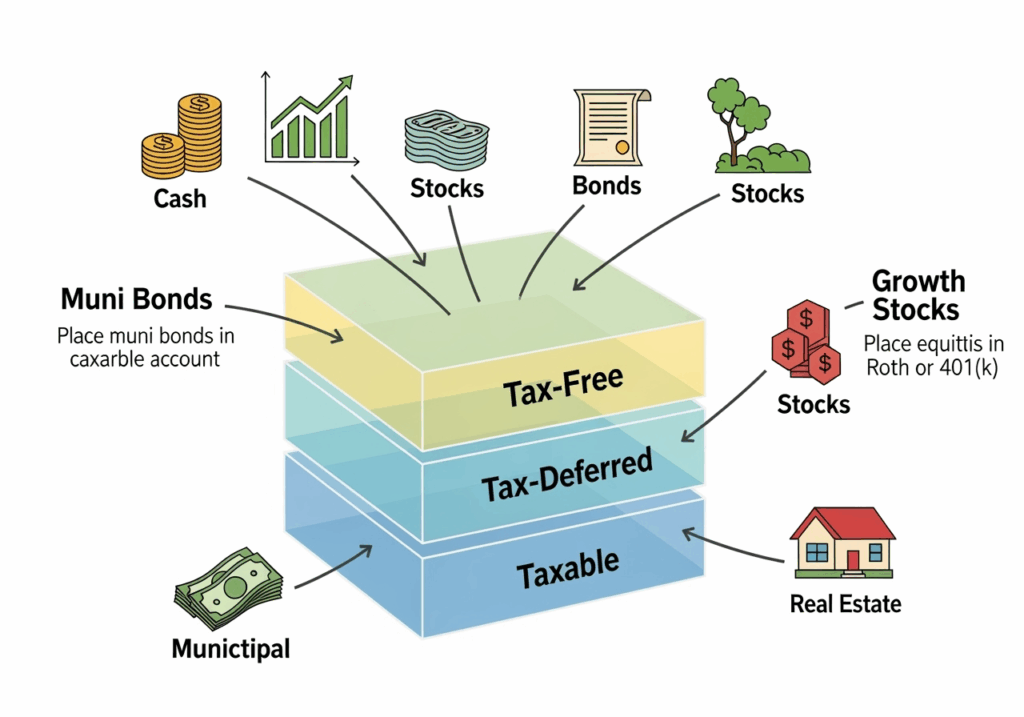
Diagram showing optimal placement of investments for tax efficiency across different account types.

Common Portfolio Oversights

Many investors and their advisors focus primarily on gross returns without considering the tax implications. This oversight becomes particularly costly for:

  • High-income earners in top tax brackets
  • Retirees managing required minimum distributions
  • Business owners with fluctuating income levels
  • Investors in high-tax states
  • Dual-income households approaching higher tax thresholds

The Cost of Inaction

Without proper tax-efficient investment planning, investors may:

  • Pay unnecessary taxes on investment income
  • Trigger Medicare surcharges
  • Face higher Social Security taxation
  • Miss opportunities for tax-free wealth accumulation
  • Fail to optimize asset location strategies

Behavioral Barriers to Tax-Efficient Investing

Common psychological obstacles include:

  • Yield chasing: Focusing on nominal returns rather than after-tax returns
  • Complexity avoidance: Avoiding strategies that seem complicated
  • Status quo bias: Maintaining existing allocations without optimization
  • Tax procrastination: Delaying tax planning until year-end

The Cost of Inaction

Without proper tax-efficient investment planning, investors may:

  • Pay unnecessary taxes on investment income
  • Trigger Medicare surcharges
  • Face higher Social Security taxation
  • Miss opportunities for tax-free wealth accumulation

GET IN TOUCH

Schedule a FREE Consultation

Strategic Implementation: Making Tax-Free Income Work for You

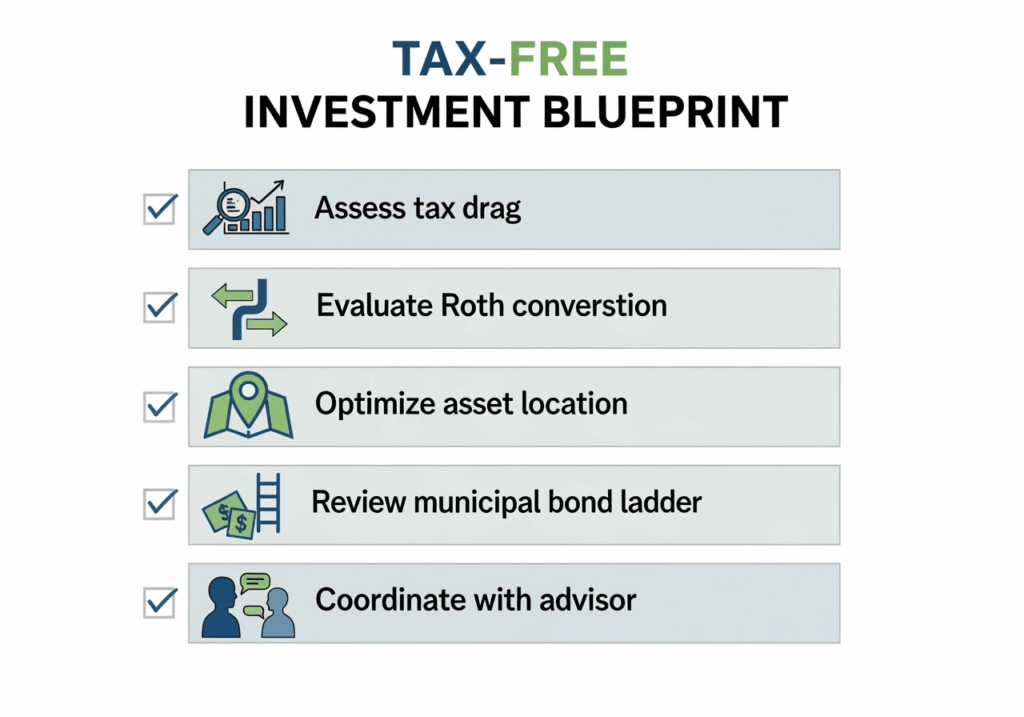
Checklist graphic with actionable steps for implementing tax free investment strategies.

1. Portfolio Assessment and Rebalancing

The first step is conducting a comprehensive analysis of your current investment allocation. This involves:

  • Evaluating your current tax burden from investments
  • Identifying opportunities to shift from taxable to tax-advantaged accounts
  • Analyzing the after-tax returns of your current holdings

2. Municipal Bond Strategy

For investors in higher tax brackets, municipal bonds can be particularly attractive:

  • General obligation bonds backed by the full faith and credit of the issuer
  • Revenue bonds supported by specific project income
  • Tax-exempt bond funds for diversification and professional management

3. Maximizing Roth IRA Benefits

Strategic Roth IRA planning includes:

  • Roth conversions during lower-income years
  • Backdoor Roth strategies for high-income earners
  • Long-term planning to maximize tax-free growth

4. Advanced Tax-Free Strategies

Asset Location Optimization:

  • Hold tax-inefficient investments in tax-advantaged accounts
  • Place tax-efficient investments in taxable accounts
  • Coordinate across multiple account types for maximum benefit

5. Tax-Loss Harvesting Coordination:

  • Realize losses in taxable accounts while maintaining tax-free growth elsewhere
  • Avoid wash sale rules when rebalancing across account types
  • Use tax-free income to reduce the need for taxable rebalancing

Global Considerations for International Investors

At Veritas Accounting Services, we understand that tax-efficient investing becomes even more complex for international investors and expatriates. Our global expertise across the US, UK, UAE, Singapore, Ireland, and Malaysia ensures that your tax-free investment strategy considers:

  • Treaty benefits between countries
  • Foreign tax credit optimization
  • Cross-border retirement planning
  • Compliance requirements in multiple jurisdictions

International Tax-Free Opportunities

Different countries offer unique tax-advantaged investment vehicles:

  • UK ISAs (Individual Savings Accounts): Tax-free growth and withdrawals
  • Singapore CPF: Comprehensive retirement and healthcare savings
  • UAE investment structures: Tax-efficient wealth accumulation strategies
  • Irish life assurance bonds: Tax-deferred growth opportunities

The Veritas Advantage: Comprehensive Tax-Efficient Planning

With over a decade of experience and 1000+ successful projects, Veritas Accounting Services specializes in creating holistic financial strategies that maximize after-tax returns. Our certified QuickBooks and Xero experts work closely with your investment advisors to ensure your portfolio is optimized for tax efficiency.

Our Integrated Approach Includes:

  • Tax planning consultations to identify optimization opportunities
  • Investment income analysis and tax impact assessments
  • Retirement planning coordination with tax-free income strategies
  • Ongoing monitoring to ensure continued tax efficiency

Technology-Driven Solutions

Our seamless integration with leading accounting platforms ensures:

  • Real-time tax impact monitoring of investment decisions
  • Automated reporting of tax-free income sources
  • Coordinated planning between business and personal finances
  • Compliance tracking across multiple jurisdictions

Take Action: Don’t Let Tax Inefficiency Erode Your Wealth

The opportunity cost of maintaining a tax-inefficient portfolio compounds over time. Every year you delay implementing tax-free investment strategies is another year of unnecessary tax payments and missed wealth accumulation.

Immediate Action Items:

  • Calculate your current tax drag: Determine how much you’re paying in unnecessary investment taxes
  • Assess your tax bracket trajectory: Plan for future income changes
  • Review your asset location: Ensure tax-efficient placement of investments
  • Evaluate conversion opportunities: Consider Roth conversions during low-income periods

Next Steps:

  • Schedule a consultation to review your current investment tax burden
  • Analyze your portfolio for tax-efficiency opportunities
  • Develop a strategic plan to maximize tax-free income
  • Implement and monitor your optimized investment strategy

Conclusion

Tax-free investment income isn’t just about avoiding taxes—it’s about building a more efficient, sustainable wealth accumulation strategy. In today’s complex tax environment, the difference between tax-efficient and tax-inefficient investing can mean hundreds of thousands of dollars over a lifetime.

Don’t let this opportunity pass by. Contact Veritas Accounting Services today to discover how tax-free investment income strategies can transform your financial future.

Ready to optimize your investment portfolio for maximum tax efficiency?

Contact Veritas Accounting Services:

•             Email: hello@veritasaccountingservices.com

•             Phone: +1(678) 723-6003 | +91 9725552243

•             US Office: 8735 Dunwoody Place – 4549, Atlanta, GA

•             India Office: C-305, The Imperial Heights, 150ft Ring Road, Rajkot

Serving clients globally across the US, UK, UAE, Singapore, Ireland, and Malaysia with expert tax planning and accounting solutions.

GET IN TOUCH

Schedule a FREE Consultation

The 4 Essential Pillars Behind Strong Financial Management

Accounting, bookkeeping, finance, and audit form the core of a financially well-managed business…

Stop Chasing New Customers: Grow Revenue From the Ones You Have

Getting new customers is important, but it is not the only way to grow a business. Many companies…

Beyond Zoom: How to Build a Strong Remote Company Culture

Remote work has changed where people work, but it has not changed what people expect from a good…

SOP vs Checklist: Which One Does Your Business Need?

As a business grows, work becomes harder to manage consistently. A small team can rely on verbal…

From 5 to 50 Employees: What Changes as Your Business Grows?

Going from 5 employees to 50 is a major milestone. It means more customers, more revenue, more…

Your Books Are More Than Records—They’re Business Intelligence

Most business owners think of accounting as a process that happens in the background. Sales are…

Are Marketplace Fees Quietly Destroying Your Profit Margins?

Selling on an online marketplace can make a business look extremely successful. Orders are coming…

Still Doing Everything Yourself? Here’s Why Founders Need Financial Experts

When most businesses are just getting started, founders wear every hat imaginable. You’re the…

Why Remote Bookkeeping Makes Sense for Growing Businesses

Growth is exciting, but it also creates more financial work. More customers mean more invoices. More…

Connect With Us On Socials!

Classify Business Expenses

How to Correctly Classify Business Expenses & Avoid Common Mistakes

To correctly classify business expenses is foundational to solid bookkeeping and financial decision-making. Yet, many business owners and freelancers trip up in this area—leading to lost deductions, inaccurate reporting, and extra stress during tax season. Let’s change that!

In this guide, you’ll learn:

  • What counts as a business expense (with real examples)
  • Why classification matters so much
  • Common and costly mistakes (and how to sidestep them)
  • Pro tips for flawless, stress-free accounting
  • Answers to the most frequent questions
  • A printable, actionable checklist to keep you organized

What Counts as a Business Expense? (With Real-World Examples)

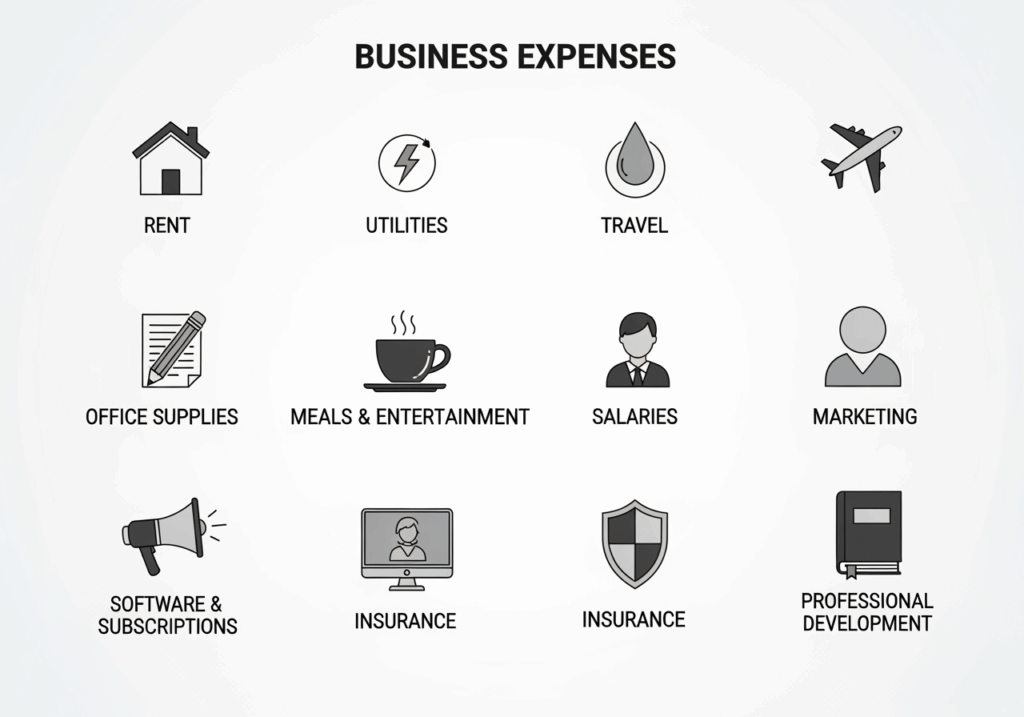
Infographic showing categorized examples of business expenses like rent, software, and travel.

Business expenses are the ordinary and necessary costs of running your company. But what does that mean in practice?

Here are popular categories and real examples for each:

  • Rent/Lease: Office space, retail location rental, co-working memberships
  • Utilities: Electricity, water, gas, internet, phone for your office
  • Office Supplies: Stationery, computers, software subscriptions, printers, postage
  • Travel: Airfare, mileage, taxis/rideshares, hotels, meals on work trips
  • Meals and Entertainment: Taking clients out for lunch, company event catering (subject to strict limits)
  • Salaries and Wages: Staff pay, bonuses, payroll taxes
  • Professional Services: Legal, accounting, consulting fees
  • Insurance: Business liability, workers comp, property insurance
  • Marketing and Advertising: Website fees, online ads, print materials
  • Depreciation: Gradual cost deduction for major purchases like machinery or vehicles

Pro Tip: If you’re ever unsure if an expense qualifies, ask yourself—”Is this cost directly related to earning business income?” If the answer’s yes, it likely qualifies.

Why Correct Classification Matters

Classifying business expenses correctly doesn’t just make life easier for your accountant. Here’s why it truly matters:

  • Maximize Tax Deductions: Many allowable business expenses directly reduce taxable income, meaning less money owed to the government (and more in your pocket).
  • Financial Insights: Accurate expense tracking reveals which parts of your business are costing the most—and where you can cut back.
  • Audit Readiness: Clean, careful records make audits quick and painless if you ever get selected.
  • Credibility with Investors/Banks: Lenders or investors like to see well-organized, easy-to-explain financials.

Common Expense Classification Mistakes (With Solutions)

Comparison of messy vs organized bookkeeping habits to show the importance of proper expense classification.

Let’s explore mistakes in detail, with real-world fixes:

1. Mixing Personal and Business Finances

  • Example: You grab a coffee using your business card, but it’s not a work-related purchase.
  • Fix: Set up separate bank accounts and credit cards. If you make a mistake, note the transaction as an owner draw or personal reimbursement.

2. Misclassifying Expenses

  • Example: Coding a business lunch with a client as “Office Supplies,” or putting software under “Equipment.”
  • Fix: Use accounting software with preset categories. Review transactions monthly for accuracy.

3. Missing Out on Small Deductions

  • Example: Ignoring small subscriptions or petty cash expenses; assuming they’re “too minor.”
  • Fix: Track every expense, even $2 ones. Digital tools make this frictionless; use expense scanning apps or file receipts in Google Drive.

4. Lost or Incomplete Documentation

  • Example: Tossing receipts or not collecting itemized bills.
  • Fix: Go digital—scan with your phone, save PDFs, or use receipt-management platforms like Expensify or Dext.

5. Over- or Underclaiming Deductions

  • Example: Claiming the full cost of your personal mobile as a business expense, or not claiming your home office at all.
  • Fix: Claim only the business-use portion. For mixed-use items (like utilities at home), use a percentage based on actual use.

6. Not Updating Categories as Business Grows

  • Example: Sticking to overly simple categories (“other expenses,” “miscellaneous”) as your business expands.
  • Fix: Update your chart of accounts yearly. Add new categories for better clarity as business evolves.

GET IN TOUCH

Schedule a Free Call

Pro Tips for Foolproof Expense Management

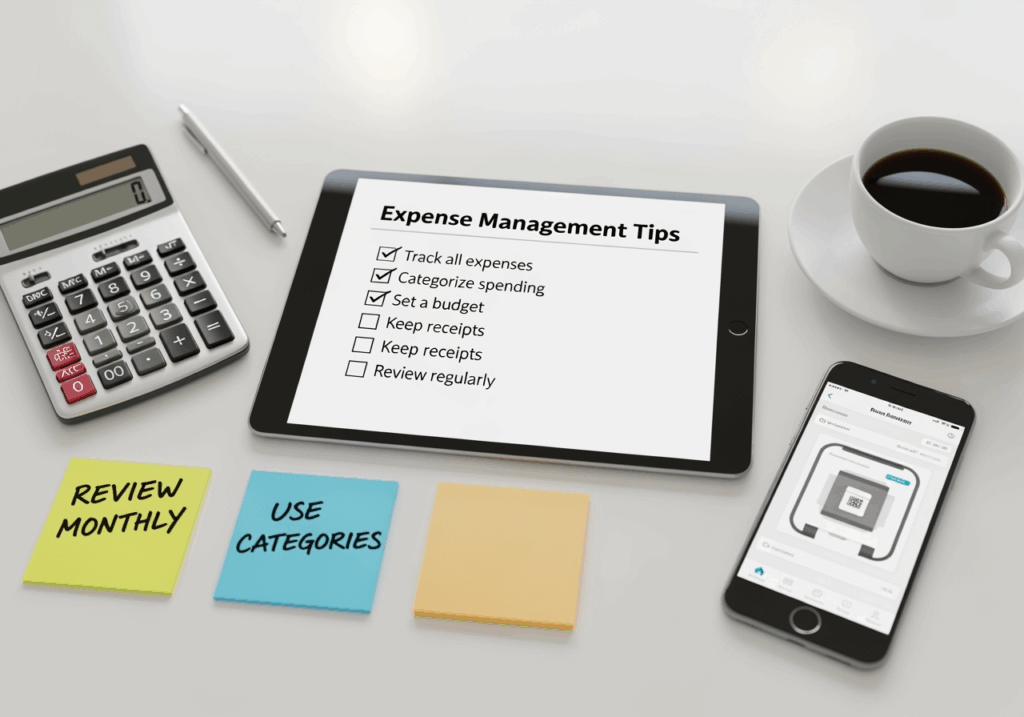
Tablet displaying a checklist of expense tracking tips with accounting tools around it.

  1. Leverage Accounting Technology
    • Use cloud-based software like QuickBooks, Xero, Zoho, or Wave, which auto-categorizes common expenses (and syncs with your bank!).
    • Set up rules so recurring transactions (like your internet bill) are always coded to the right category.
  2. Be Consistent
    • Define your categories clearly and always use them the same way.
    • If you have a team, create a simple one-pager explaining what belongs where.
  3. Schedule a Monthly “Money Date”
    • Take 30 minutes at the end of each month to review your transactions, match receipts, and fix any uncategorized expenses.
  4. Educate the Whole Team
    • Train employees on proper receipt submission and expense types.
    • Use an approval system for purchases, so random expenses don’t slip through.
  5. Document Your Expense Policy
    • Put your rules in writing! This helps if you ever hire a bookkeeper or get audited.
  6. Ask for Professional Help
    • An accountant or bookkeeper can review your setup, optimize your categories, and ensure you’re maximizing deductions.

FAQs: Business Expense Classification

Q: Can I deduct all meals with clients?
A: Not always. Many tax authorities cap meal deductions at 50%, and receipts/documentation are required. Casual or non-business meals don’t qualify.

Q: What if I work from a home office—how do I classify those expenses?
A: Calculate the percentage of your home used for business (by area or time) and claim that portion of rent, utilities, and insurance as a business expense.

Q: Is my car a business expense if I also use it personally?
A: Only claim the percentage of car expenses related to business miles. Use a mileage log or mileage-tracking app.

Q: What if I make a mistake?
A: Adjust the transaction and document the change. Most software allows easy recategorization.

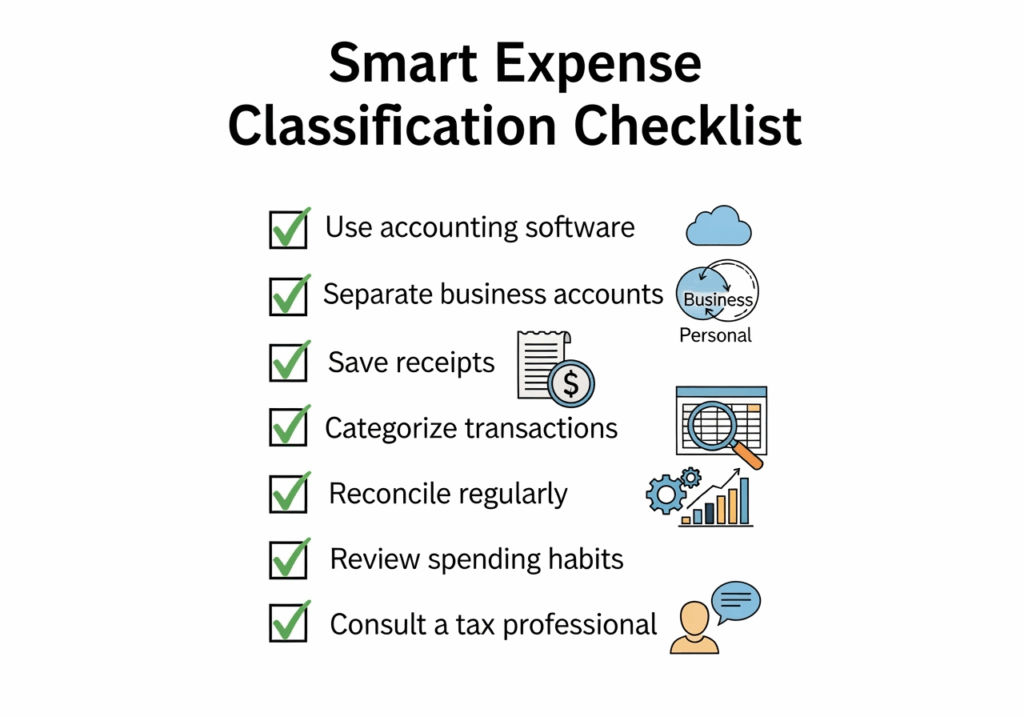
Actionable Checklist for Smarter Expense Classification

Visual checklist for correctly classifying and managing business expenses.

Feel free to print or bookmark this!

Setup

✅ Open designated business bank accounts
✅ Choose accounting or expense tracking software
✅ Create a clear chart of accounts (categories)

Ongoing Process

✅ Always use the business account for business purchases
✅ Save digital or physical receipts for all transactions
✅ Enter all expenses into your accounting system
✅ Review uncategorized/“miscellaneous” expenses each month
✅ Match bank and credit card transactions to entries
✅ Update categories as business grows

At Year-End

✅ Reconcile all accounts
✅ Check for missed deductions
✅ Provide clear records to your accountant
✅ Adjust categories for the new year’s goals

Final Thoughts

Getting business expense classification right isn’t just about tax season—it’s about taking charge of your business finances and making smarter decisions year-round. The more consistent (and organized) you are, the less likely you are to miss deductions, make costly errors, or panic during audits.

By using technology, documenting your process, and reviewing transactions regularly, you’ll build a system that works for you—not against you.

Need help setting up or reviewing your expense categories? Drop your questions in the comments or connect with our bookkeeping pros for a no-obligation consultation. Your future self—and your bottom line—will thank you!

GET IN TOUCH

Schedule a Free Call

The 4 Essential Pillars Behind Strong Financial Management

Accounting, bookkeeping, finance, and audit form the core of a financially well-managed business…

Stop Chasing New Customers: Grow Revenue From the Ones You Have

Getting new customers is important, but it is not the only way to grow a business. Many companies…

Beyond Zoom: How to Build a Strong Remote Company Culture

Remote work has changed where people work, but it has not changed what people expect from a good…

SOP vs Checklist: Which One Does Your Business Need?

As a business grows, work becomes harder to manage consistently. A small team can rely on verbal…

From 5 to 50 Employees: What Changes as Your Business Grows?

Going from 5 employees to 50 is a major milestone. It means more customers, more revenue, more…

Your Books Are More Than Records—They’re Business Intelligence

Most business owners think of accounting as a process that happens in the background. Sales are…

Are Marketplace Fees Quietly Destroying Your Profit Margins?

Selling on an online marketplace can make a business look extremely successful. Orders are coming…

Still Doing Everything Yourself? Here’s Why Founders Need Financial Experts

When most businesses are just getting started, founders wear every hat imaginable. You’re the…

Why Remote Bookkeeping Makes Sense for Growing Businesses

Growth is exciting, but it also creates more financial work. More customers mean more invoices. More…

Connect With Us!

The Hidden Consequences of Delayed Financial Reporting: How to Overcome Costs and Drive Business Growth in 2025

“But we just closed our books last week!”

That’s what Sarah, a Singapore-based business owner, told me during our recent consultation. She was shocked to learn that her company had been consistently under-pricing their services in the UK market for the past three months. By the time her quarterly reports revealed the impact of currency fluctuations and increased supplier costs, she had already lost nearly $30,000 in potential profits in delayed financial reporting.

“If only I had known earlier,” she sighed. It’s a phrase we hear far too often in our line of work.

James, a US-based entrepreneur expanding into the UAE market, shared a similar story: “I thought monthly financial reporting was enough until we missed a crucial pricing adjustment opportunity during Ramadan. That single delay cost us more than what we would have paid for real-time financial services for an entire year.”

Does this scenario sound familiar? If you’re running a global business, chances are you’ve experienced similar situations where delayed financial insights have cost you more than just money – they’ve cost you opportunities, growth, and peace of mind.

In the fast-paced world of international business, delayed financial reporting isn’t just an inconvenience—it’s a silent profit killer. While many businesses focus on obvious costs like transaction fees and exchange rates, the hidden expenses of delayed financial insights often go unnoticed until they’ve already impacted the bottom line. Drawing from our decade of professional excellence and over 1,000 successful projects across the US, UK, UAE, Singapore, Ireland, and Malaysia, we’ve identified how delayed reporting creates a domino effect of financial challenges that can cripple even the most promising businesses.

The Global Impact of Delayed Reporting

financial reporting delays business impact

The most immediate impact of delayed financial reporting manifests in day-to-day operations, particularly in inventory management and pricing strategies. Consider a recent case we encountered with a UAE-based retailer who lost $50,000 due to delayed stock reporting. Without real-time insights, their inventory management became a costly guessing game, leading to both overstock situations and missed sales opportunities. This scenario plays out repeatedly across different markets, where businesses operate with outdated information, making crucial pricing decisions based on stale data. In today’s volatile market, even a week-old report can lead to significant pricing misalignments and eroded profit margins.

Cross-Border Complexities

international business reporting

The ripple effects of delayed reporting become even more pronounced in cross-border operations. When businesses operate across multiple time zones, from Singapore to Ireland, the complexity multiplies exponentially. Currency fluctuations can dramatically impact profitability, yet many businesses discover these impacts weeks or months after the fact. We’ve witnessed countless situations where companies miss favorable exchange rate windows or fail to hedge against currency risks simply because they lack timely financial visibility.

Consider this real-world example: An Irish manufacturing company exporting to Malaysia was operating with a two-week reporting delay. During this period, a significant currency fluctuation occurred, affecting their profit margins by 12%. By the time they received their updated financial reports, they had already committed to several large orders at the old pricing structure, effectively eating into their profits for the next quarter.

Curious how this could work for your business?

The Strategic Cost

global financial visibility

Perhaps the most significant impact of delayed reporting lies in strategic decision-making. Recently, we worked with an Irish company that postponed its market expansion plans due to uncertainty about their financial position. By the time they received their updated financial reports and felt confident to move forward, their competitors had already established a strong presence in their target market. This scenario illustrates how delayed reporting creates a form of decision paralysis, where businesses either make uninformed choices or, worse, make no decisions at all.

Technology as a Solution

real-time financial reporting

The technology solution to these challenges exists, but implementation requires careful consideration. Modern cloud-based systems can provide real-time financial visibility across multiple countries, with automatic currency conversions and reconciliation. At Veritas Accounting, we leverage our expertise with QuickBooks, Xero, Wave, and Zoho Books to create comprehensive financial ecosystems that support quick, informed decision-making.

Our approach includes:

  1. Real-Time Integration Systems
    • Multi-currency transaction tracking
    • Automated reconciliation processes
    • Instant financial position updates
    • Cross-border payment monitoring
  2. Advanced Reporting Frameworks
    • Custom dashboard creation
    • Real-time profit and loss tracking
    • Currency impact analysis
    • Regional performance comparisons
  3. Predictive Analytics
    • Cash flow forecasting
    • Market trend analysis
    • Risk assessment tools
    • Opportunity identification systems

Implementation Strategy

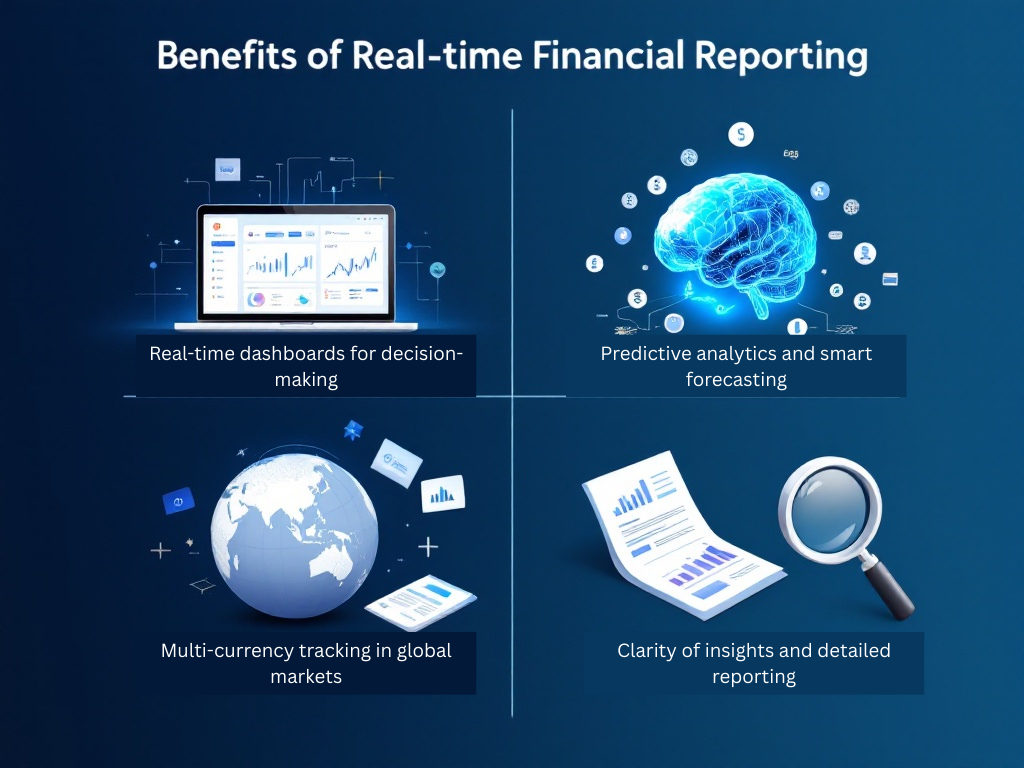
Real-time dashboard for decesion-making
Predictive analytics and smart forecasting
multi-currency tracking in global markets
clarity of insights and detailed reporting

Creating this real-time financial ecosystem begins with a thorough assessment of current reporting lags and their impact on your business. We work closely with clients to design custom reporting frameworks that address their specific needs across different markets. The implementation process is carefully phased to ensure minimal disruption to ongoing operations while maximizing the benefits of real-time reporting.

Our implementation process includes:

  • Comprehensive system audit
  • Custom solution design
  • Phased integration approach
  • Team training and support
  • Continuous monitoring and optimization

The Reality of Modern Business

In today’s interconnected business world, delayed financial reporting isn’t just about late numbers—it’s about missed opportunities and hidden costs that directly impact your bottom line. With offices in Rajkot, Gujarat, India (C-305, The Imperial Heights, 150ft Ring Road) and Atlanta, United States (8735 Dunwoody Place – 4549), Veritas Accounting Services brings global expertise to help you achieve real-time financial visibility.

Success Story

a group of accountants celebrating success of Reduced reporting delays from weeks to hours
Improved profit margins by 23%
Captured market opportunities 40% faster
Decreased currency-related losses by 65%

One of our recent success stories involves a US-based e-commerce company operating across our six service regions. By implementing our real-time reporting system, they:

  • Reduced reporting delays from weeks to hours
  • Improved profit margins by 23%
  • Captured market opportunities 40% faster
  • Decreased currency-related losses by 65%

Looking Ahead

As we move through 2025, the importance of real-time financial reporting continues to grow. Markets are becoming more interconnected, currency fluctuations more frequent, and business opportunities more time-sensitive. The question isn’t whether to implement real-time financial reporting, but rather how quickly you can make the transition.

Don’t let delayed reporting cost you another opportunity. Contact our team of certified experts today at hello@veritasaccountingservices.com or call us at +1(678) 723-6003 (US) or +91 9725552243 (India). Let us help you transform your financial reporting system into a competitive advantage that drives your business forward.

Schedule a FREE Consultation Call

The 4 Essential Pillars Behind Strong Financial Management

Accounting, bookkeeping, finance, and audit form the core of a financially well-managed business…

Stop Chasing New Customers: Grow Revenue From the Ones You Have

Getting new customers is important, but it is not the only way to grow a business. Many companies…

Beyond Zoom: How to Build a Strong Remote Company Culture

Remote work has changed where people work, but it has not changed what people expect from a good…

SOP vs Checklist: Which One Does Your Business Need?

As a business grows, work becomes harder to manage consistently. A small team can rely on verbal…

From 5 to 50 Employees: What Changes as Your Business Grows?

Going from 5 employees to 50 is a major milestone. It means more customers, more revenue, more…

Your Books Are More Than Records—They’re Business Intelligence

Most business owners think of accounting as a process that happens in the background. Sales are…

Are Marketplace Fees Quietly Destroying Your Profit Margins?

Selling on an online marketplace can make a business look extremely successful. Orders are coming…

Still Doing Everything Yourself? Here’s Why Founders Need Financial Experts

When most businesses are just getting started, founders wear every hat imaginable. You’re the…

Why Remote Bookkeeping Makes Sense for Growing Businesses

Growth is exciting, but it also creates more financial work. More customers mean more invoices. More…

Connect with us here!