








7 Powerful Year-End Tax Planning Free Tips to Reduce Your Painful Tax Bill Before Dec 31
Introduction
As the year draws to a close, year-end tax planning should be at the top of every taxpayer’s financial checklist. Preparing early gives you the power to reduce what you owe, avoid unnecessary penalties, and maximize tax-saving opportunities that disappear once the calendar resets on January 1. Whether you are an employee, business owner, investor, or self-employed professional, the steps you take now can make tax season smoother, cheaper, and far less stressful.
Below are seven powerful and practical year-end tax planning tips that every taxpayer should act on before December 31.
1. Get Organized Early
Good year-end tax planning starts with good organization. Gather all essential financial documents in one place to avoid scrambling at the last minute. This includes:
- Pay stubs and W-2 forms
- 1099 forms for contractors or side gigs
- Receipts for deductible expenses
- Bank and credit card statements
- Investment statements
- Business income and expense records
- Charitable donation receipts
- Medical expense records
Use digital folders, cloud storage, or an envelope system—whatever helps you keep everything accessible and secure. Tracking deductible expenses throughout the year such as mortgage interest, student loan interest, or medical bills will make filing much easier if you plan to itemize deductions.
2. Review Your Withholding and Estimated Payments

A quick review of your withholding could save you from an unwanted shock in April. Life changes—marriage, divorce, a new baby, a second job, or higher pay—can significantly affect your tax liability.
Before year-end:
✔ Check your most recent pay stub
✔ Use the IRS withholding calculator
✔ Adjust form W-4 if needed
✔ Review your quarterly estimated taxes if you’re self-employed
Correcting underpayments now helps you avoid penalties. Correcting overpayments helps you avoid giving the government an interest-free loan.
3. Maximize Retirement Contributions
One of the smartest year-end tax planning strategies is contributing to tax-advantaged retirement accounts:
Traditional IRA
Contributions may be tax-deductible depending on income and filing status.
401(k), 403(b), and similar plans
Increasing your pre-tax contributions reduces your taxable income today while boosting long-term savings.
Health Savings Accounts (HSAs)
HSAs offer a triple tax advantage for year-end tax planning:
- Contributions are tax deductible
- Growth is tax-free
- Withdrawals for qualified medical expenses are tax-free
Flexible Spending Accounts (FSAs)
Review your FSA balance—many plans follow a “use-it-or-lose-it” rule.
If needed, schedule healthcare visits or buy approved items before year-end.
4. Make Year-End Charitable Contributions

If you plan to itemize your deductions, year-end charitable giving is a powerful way to reduce taxable income.
You can donate:
- Cash
- Stock or appreciated assets
- Clothing or household items
- Donor-advised fund contributions
Important: Donations must be made by December 31 to count for the current tax year.
Keep receipts, acknowledgment letters, or IRS Form 8283 for non-cash contributions.
Donating appreciated stock provides an added tax benefit:
✔ You avoid paying capital gains tax
✔ You deduct the fair market value of the donated asset
Just make sure the organization is a qualified §501(c)(3) charity.
5. Review Your Investment Portfolio (Tax-Loss Harvesting)
Year-end is the perfect time to evaluate your investment gains and losses.
If you sold assets at a profit, consider selling underperforming assets to offset those gains—this is known as tax-loss harvesting.
Key rules:
- Capital losses offset capital gains
- Excess losses (up to $3,000) can offset ordinary income
- Unused losses carry forward to future years
- Avoid violating the IRS “wash-sale rule” (selling and rebuying the same asset within 30 days)
Thoughtful investment adjustments now can improve your overall tax outcome and strengthen your portfolio for the next year and also year-end tax planning.
6. Check Your Eligibility for Valuable Credits and Deductions

Many taxpayers unintentionally leave money on the table by overlooking eligible tax credits and deductions.
Common Tax Credits:
- Child Tax Credit
- Earned Income Tax Credit
- American Opportunity Credit
- Lifetime Learning Credit
Common Deduction Opportunities:
- Student loan interest (up to $2,500)
- Teacher expense deduction (up to $300)
- Home office deduction
- Business expenses for freelancers
If you’re self-employed, maintain detailed records of:
- Mileage
- Supplies
- Equipment
- Software
- Continuing education
- Home office expenses
These deductions lower taxable income and increase your refund potential.
7. Strategically Manage Income and Expenses
Timing matters when it comes to tax planning.
If you expect lower income next year:
- Defer income (bonuses, invoices, freelance payments) to next year
- Accelerate deductible expenses into this year
If you expect higher income next year:
- Accelerate income into this year
- Delay some deductions to next year when they are more valuable
You can also prepay deductible expenses like property taxes, mortgage interest (if eligible), or qualified medical bills for better year-end tax planning.
Prepare for Upcoming Tax Law Changes
Tax laws evolve regularly. Stay updated on changes to:
- Standard deductions
- Income tax brackets
- Retirement contribution limits
- Energy-efficient home credits
- Child tax credit rules
A short consultation with a tax professional can help you avoid costly mistakes and ensure that you’re maximizing every available tax benefit.
Plan Ahead for the New Year
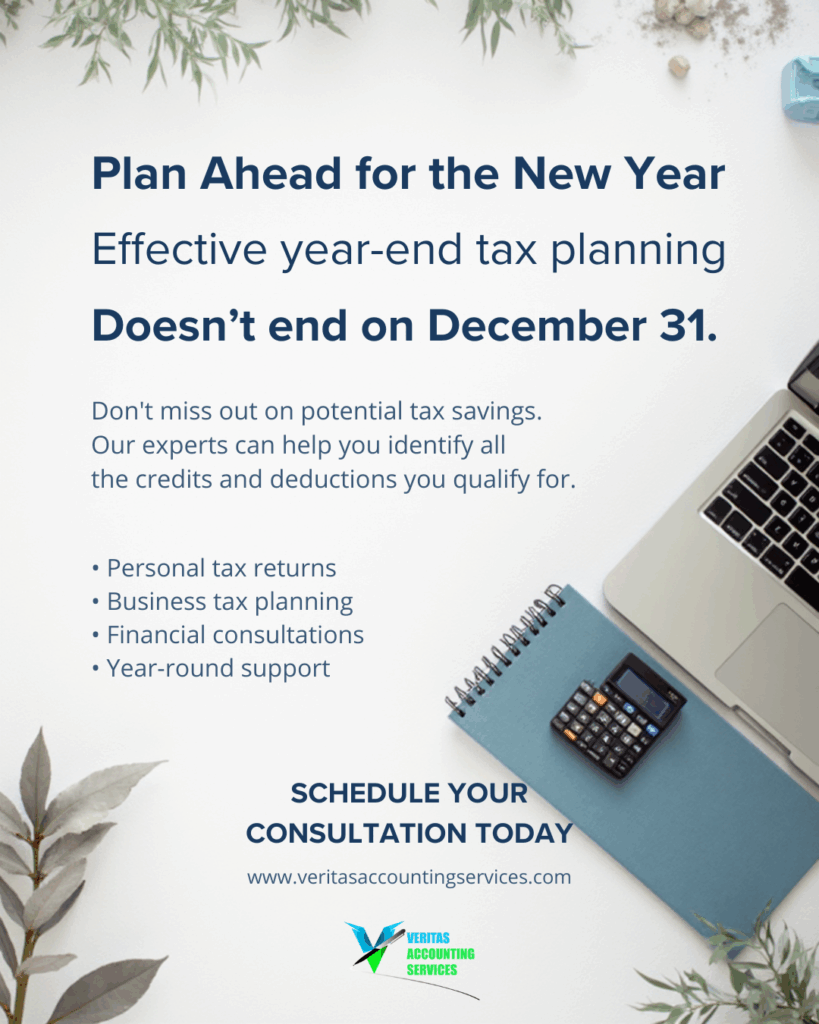
Effective year-end tax planning doesn’t end on December 31.
Set up a system for next year:
✔ Digital document storage
✔ Quarterly financial reviews
✔ Estimated tax reminders
✔ Mileage and expense tracking apps
✔ Organized business records
These small habits build a smoother, more predictable tax season.
Final Thoughts
Year-end tax planning is one of the smartest financial moves you can make. By organizing your documents, adjusting withholding, maximizing contributions, reviewing investments, and planning your income and deductions strategically, you can enter the new year with confidence and peace of mind.
Don’t wait until tax season to get ready—start today and set yourself up for a successful filing season.
📞 Need Expert Tax Planning Help Before the Year Ends?
Let professionals handle the complexity of year-end tax planning so you can focus on your financial goals.
Contact Veritas Accounting Services
📧 Email: hello@veritasaccountingservices.com
📞 Phone: +1 (678) 723-6003 | +91 97255 52243
🏢 US Office: 8735 Dunwoody Place – 4549, Atlanta, GA
🏢 India Office: C-305, The Imperial Heights, 150ft Ring Road, Rajkot
We proudly serve clients across the US, UK, UAE, Singapore, Ireland, and Malaysia, offering expert tax planning, filing, and financial management solutions.
Schedule Your FREE Consultation Today
Start the new year with clarity, confidence, and do your year-end tax planning that truly supports your financial success.









Connect With Us On Socials!
