








How Poor Bookkeeping Can Lead to Serious Tax Problems
Many business owners think bookkeeping is simply the process of recording income and expenses. In reality, bookkeeping forms the foundation of a company’s financial reporting, tax preparation, cash flow management, and business decision-making.
When records are incomplete, transactions are misclassified, bank accounts are not reconciled, or supporting documents are missing, the problem can extend far beyond an inaccurate profit and loss statement. Poor bookkeeping can result in missed deductions, understated or overstated income, incorrect tax filings, delayed compliance, and avoidable penalties.
The Internal Revenue Service expects businesses to maintain records that clearly show income and expenses and support the amounts reported on tax returns. Proper records also help businesses prepare financial statements, identify deductible expenses, and respond to questions during an examination.
For this reason, bookkeeping should not be treated as an administrative task that can be postponed until tax season. Reliable bookkeeping is an important part of tax risk management.
What Is Poor Bookkeeping?
Poor bookkeeping occurs when a business does not maintain complete, accurate, timely, and properly supported financial records. It may arise from a lack of accounting knowledge, insufficient review procedures, rapid business growth, poor software setup, or simply leaving financial work until the end of the year.
Common examples include:
- Recording transactions in the wrong account.
- Failing to reconcile bank and credit card accounts.
- Mixing personal and business expenses.
- Omitting cash, online, or payment-platform income.
- Recording loan proceeds as revenue.
- Treating asset purchases as ordinary expenses.
- Failing to record unpaid bills or customer receivables.
- Losing invoices, receipts, and other supporting documents.
- Ignoring old unreconciled transactions.
- Failing to record owner contributions and distributions correctly.
- Using incorrect opening balances.
- Making year-end adjustments without proper documentation.
A business may appear to be operating normally while these issues accumulate in the accounting records. The tax consequences often become visible only when the annual return is prepared or when a tax authority requests supporting documentation.
How Poor Bookkeeping Creates Tax Problems
Tax returns are prepared using financial information. If the underlying books are incorrect, the tax return may also be incorrect.
The relationship is straightforward:
Incomplete transactions → inaccurate financial statements → incorrect taxable information → tax exposure
Poor bookkeeping does not always mean that a business has intentionally violated tax rules. Errors can occur because records are incomplete or because the accounting treatment was not properly reviewed. However, the outcome may still include additional tax, interest, penalties, or the loss of deductions.
The IRS identifies several types of tax penalties, including failure-to-file penalties, failure-to-pay penalties, information-return penalties, and accuracy-related penalties. Accuracy-related penalties may apply when income is not properly reported or when deductions or credits are claimed without sufficient eligibility or support.
The following are some of the most common ways bookkeeping problems can develop into tax problems.
1. Missed Business Income
One of the most serious bookkeeping risks is failing to record all business income.
Businesses may receive money through multiple channels, including:
- Business bank accounts.
- Credit card processors.
- Payment platforms.
- E-commerce marketplaces.
- Cash collections.
- Checks.
- Wire transfers.
- Digital payment applications.
- Third-party delivery or booking platforms.
When a business relies only on bank-feed transactions or reviews one bank account, some income may be missed. A payment may be deposited into another account, recorded in a different accounting file, or incorrectly treated as a transfer.
For example, an online seller may receive sales proceeds through a marketplace and record only the net deposit received in the bank account. If the marketplace withheld commissions, payment-processing fees, refunds, or reserves, recording only the net deposit may result in incomplete sales reporting and inaccurate expense recognition.
The correct accounting treatment depends on the transaction details, but the underlying principle is consistent: the books should capture the appropriate gross income, related fees, refunds, and other adjustments.
Missing income can create several problems. It may understate revenue, distort gross profit, affect sales-tax reporting, and result in an inaccurate income tax return. Businesses should regularly compare accounting records with bank statements, payment-platform reports, sales systems, and third-party information returns.
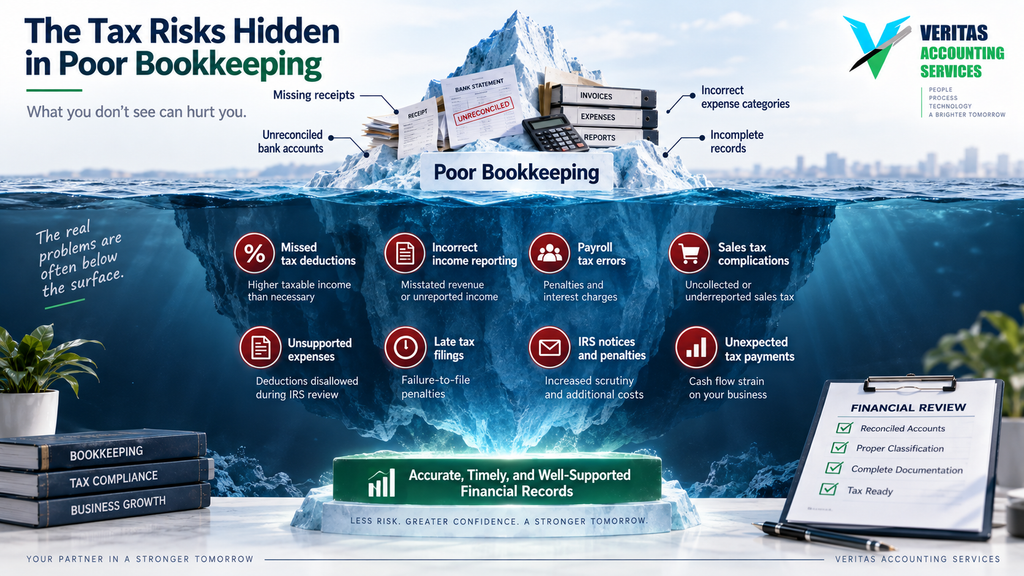
2. Lost or Disallowed Tax Deductions
Poor bookkeeping can also increase taxes by causing legitimate business expenses to be overlooked.
A business may incur deductible expenses throughout the year, but those expenses can be missed when:
- Receipts are not collected.
- Credit card transactions are not reviewed.
- Bills are not entered.
- Expenses are posted to suspense accounts.
- Reimbursements are not recorded.
- Business mileage is not tracked.
- Subscription and software expenses are overlooked.
- Expenses are recorded in the wrong accounting period.
The IRS explains that good records help businesses identify deductible expenses and support the items reported on their tax returns. However, a bank or credit card statement alone may not always establish that an expense is deductible. Additional documentation may be needed to show the business purpose, nature of the expense, and connection to the business.
For example, a business owner may pay for professional consulting services using a personal credit card. If the transaction is never reported to the bookkeeper, the business may lose the opportunity to claim an otherwise allowable expense.
Missing deductions can increase taxable income even when the business actually incurred the costs. This is one reason why accurate bookkeeping is not only about preventing errors; it is also about ensuring that the business receives the tax treatment it is entitled to receive.
3. Incorrect Expense Classification
Not every payment made by a business is an immediate tax-deductible expense. Incorrect classification can change the timing and amount of deductions.
Common classification mistakes include recording:
- Loan proceeds as income.
- Loan principal repayments as expenses.
- Owner distributions as business expenses.
- Equipment purchases as office supplies.
- Personal expenses as business expenses.
- Capital improvements as ordinary repairs.
- Security deposits as expenses.
- Refundable deposits as revenue reductions.
- Prepaid expenses as fully incurred expenses.
- Inventory purchases directly as operating expenses.
The correct treatment depends on the facts, the entity type, the accounting method, the applicable tax rules, and the nature of the transaction.
For instance, a business that purchases equipment may need to record the asset on its balance sheet and claim depreciation or another applicable tax treatment rather than deducting the entire payment as an ordinary expense. Similarly, loan principal repayments generally reduce a liability rather than representing an operating expense, while interest may require separate treatment.
When these items are incorrectly classified, the profit and loss statement becomes unreliable. The tax preparer may then need to spend additional time reconstructing the transactions and making adjustments before the return can be completed.
4. Payroll and Employment Tax Errors
Payroll bookkeeping requires particular attention because payroll transactions affect employees, employers, tax authorities, and sometimes benefit providers.
Errors may occur when a business:
- Records gross payroll instead of the correct payroll expense and liability structure.
- Fails to record payroll tax liabilities.
- Does not reconcile payroll reports with the general ledger.
- Omits employer payroll taxes.
- Records employee deductions as business expenses.
- Fails to distinguish employee wages from contractor payments.
- Misses payroll-related adjustments.
- Does not maintain payroll tax payment records.
Payroll errors can result in incorrect wage reporting, inaccurate employment tax filings, unpaid liabilities, and penalties. The IRS advises businesses to retain employment tax records for at least four years, subject to the applicable requirements.
A monthly reconciliation between payroll reports, payroll liabilities, bank payments, and the accounting ledger can help identify errors before they become larger compliance problems.
Businesses should also review worker classification carefully. Treating an employee as an independent contractor may create tax and reporting consequences if the classification is incorrect.
5. Problems With Sales Tax and Other Indirect Taxes
Income tax is not the only tax area affected by bookkeeping quality. Poor bookkeeping can also create problems with sales tax, use tax, franchise tax, excise tax, and other state or local obligations.
For example, a business may fail to properly track:
- Taxable and nontaxable sales.
- Sales by state or jurisdiction.
- Exempt customer transactions.
- Sales-tax collected.
- Marketplace facilitator activity.
- Taxable shipping or delivery charges.
- Purchases subject to use tax.
- Tax refunds and credits.
- Tax payments and outstanding liabilities.
If sales are recorded without sufficient detail, the business may not be able to determine where tax was collected or whether additional registration and filing obligations exist.
Bookkeeping software may show total sales, but tax compliance often requires more detailed information. Businesses operating across multiple states should maintain records that allow sales to be analyzed by location, product or service type, customer status, and applicable tax treatment.
A tax preparer or indirect-tax professional may need to review the business model and jurisdictional requirements separately. Bookkeeping alone cannot determine every tax obligation, but accurate transaction-level records make the review possible.
6. Incorrect Financial Statements and Tax Returns
Tax professionals depend on reliable financial statements to prepare business tax returns. If the trial balance, income statement, or balance sheet contains errors, the tax return may require significant adjustments.
Examples include:
- Incorrect retained earnings or equity balances.
- Missing depreciation entries.
- Unreconciled cash accounts.
- Negative accounts receivable balances.
- Incorrect inventory balances.
- Unrecorded accounts payable.
- Unexplained suspense accounts.
- Incorrect loan balances.
- Missing accrued expenses.
- Inconsistent opening balances.
For partnerships and multi-member LLCs, additional risks may involve partner contributions, distributions, capital accounts, ownership percentages, liability allocations, and profit or loss allocations.
For corporations, errors may affect shareholder distributions, retained earnings, fixed assets, loans from or to shareholders, and book-to-tax adjustments.
The tax return may not simply reproduce the accounting records. Tax rules can require adjustments, elections, reconciliations, and separate schedules. Nevertheless, the books must provide a reliable starting point.
When poor bookkeeping results in a large number of unexplained adjustments, the risk of omissions and inconsistent reporting increases.
7. Cash Flow and Estimated Tax Problems
Bookkeeping errors can affect tax payments even when the final tax return has not yet been prepared.
Business owners often use monthly or quarterly financial reports to estimate taxable income and plan tax payments. If revenue is understated or expenses are overstated, the business may underestimate its tax liability and fail to set aside sufficient funds.
On the other hand, if income is overstated or expenses are omitted from the books, the owner may reserve more cash than necessary or make inaccurate business decisions.
Businesses and individuals may have estimated tax obligations depending on their structure, income, and applicable rules. The IRS describes federal income tax as a pay-as-you-go system and explains that taxpayers may need to make estimated payments when withholding is insufficient.
Poor bookkeeping can therefore create two related problems:
- The tax calculation may be inaccurate.
- The business may not have enough cash available when tax payments are due.
Accurate monthly reporting helps business owners monitor profitability, forecast cash requirements, and coordinate with their tax adviser before payment deadlines.
8. Missing Records During an IRS Examination
A tax return is not fully protected simply because it has been filed. Businesses should retain records that support income, deductions, credits, assets, liabilities, and other reported items.
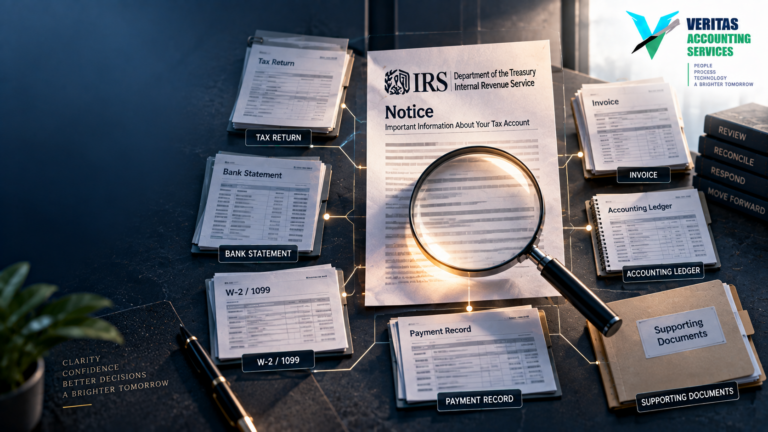
During an examination, the IRS may ask the business to explain specific transactions. If invoices, receipts, contracts, bank reconciliations, mileage records, loan documents, or other supporting materials are missing, the business may struggle to substantiate its position.
The IRS states that taxpayers have the responsibility to support entries, deductions, and statements made on their tax returns. Records should be retained for as long as they are needed to establish the income or deductions reported.
A lack of documentation does not automatically mean that every item will be disallowed, but it can make the business’s position more difficult to defend. It may also increase professional fees because the accountant must reconstruct records or investigate transactions that should have been documented during the year.
9. Late Filings and Missed Tax Deadlines
Poor bookkeeping can delay tax preparation. When financial records are incomplete, the tax preparer may not be able to finalize the return on time.
Common causes of delay include:
- Missing bank statements.
- Unreconciled accounts.
- Unrecorded payroll transactions.
- Incomplete inventory information.
- Missing fixed-asset details.
- Unresolved shareholder or partner transactions.
- Unavailable loan statements.
- Incomplete sales reports.
- Unclear tax notices.
- Unorganized supporting documents.
A filing extension may provide additional time to submit a return, but it generally does not extend the time to pay taxes that are due. The IRS specifically distinguishes between an extension of time to file and an extension of time to pay.
When bookkeeping is delayed until the filing deadline approaches, the business may have fewer options to identify missing information, correct errors, obtain documents, and coordinate with its tax adviser.
10. Increased Professional Fees and Business Disruption
The financial cost of poor bookkeeping is not limited to additional tax.
When records are disorganized, accountants and tax professionals may need to spend additional time on:
- Transaction reconstruction.
- Bank and credit card reconciliation.
- Duplicate removal.
- Reclassification of expenses.
- Payroll liability investigation.
- Review of payment-platform reports.
- Fixed-asset reconstruction.
- Loan balance verification.
- Partner or shareholder account analysis.
- Preparation of missing schedules.
- Responses to tax notices.
This additional work may increase accounting fees and delay the preparation of financial statements and tax returns.
Poor bookkeeping can also affect lenders, investors, business buyers, and management. A business may find it difficult to demonstrate profitability, calculate reliable margins, obtain financing, or evaluate a potential acquisition when its financial information is incomplete.
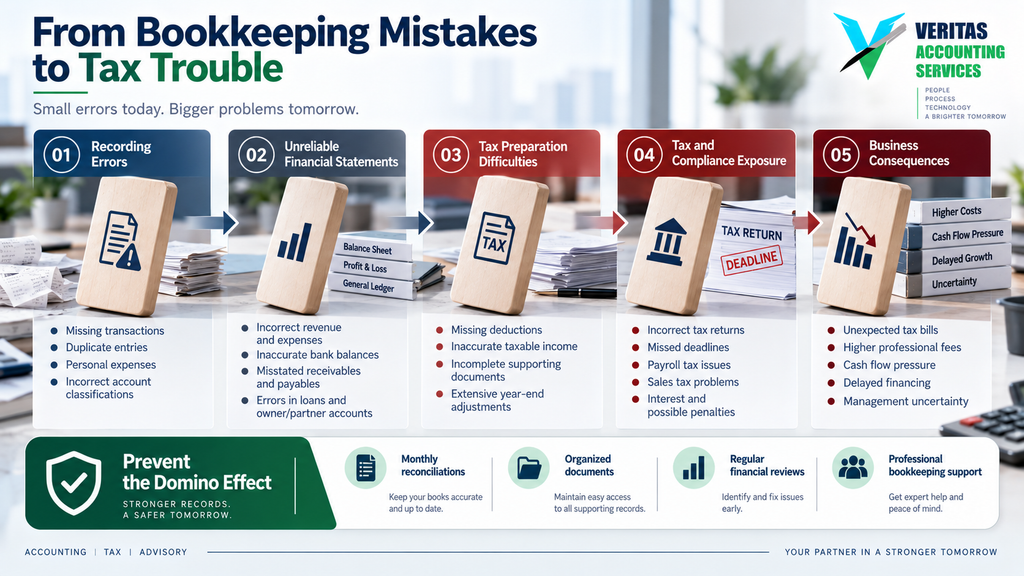
How to Prevent Tax Problems Caused by Poor Bookkeeping
Businesses can reduce tax risk by treating bookkeeping as an ongoing control process rather than a year-end task.
Reconcile Accounts Monthly
Bank, credit card, payment-platform, loan, and payroll accounts should be reconciled regularly. Reconciliations help identify missing transactions, duplicate entries, bank charges, incorrect transfers, and unusual balances.
Maintain Separate Business and Personal Accounts
Separate accounts make it easier to identify business transactions and reduce confusion over owner-related payments. Personal expenses should not be recorded as business deductions merely because they were paid from a business account.
Keep Supporting Documents
Invoices, receipts, contracts, bills, payroll reports, loan statements, and payment confirmations should be stored in an organized digital or paper system. Documents should be linked to the relevant accounting transactions whenever possible.
Review the Chart of Accounts
The chart of accounts should reflect the nature and complexity of the business. Accounts should be reviewed periodically to ensure that expenses, assets, liabilities, equity, and income are being classified consistently.
Review Financial Statements
Business owners should review the profit and loss statement and balance sheet every month. Unusual changes in revenue, margins, expenses, receivables, payables, and liabilities should be investigated promptly.
Track Assets and Loans Separately
Maintain a fixed-asset register with purchase dates, costs, improvements, disposals, and depreciation information. Loan accounts should be reconciled to lender statements, with principal and interest recorded appropriately.
Prepare for Tax Season Throughout the Year
Businesses should maintain a tax-ready file containing prior-year returns, current-year financial statements, payroll reports, fixed-asset details, loan statements, ownership information, and other documents required by the tax preparer.
Coordinate With the Tax Adviser
Bookkeepers and tax professionals should communicate about unusual transactions, new business activities, ownership changes, asset purchases, loans, distributions, international transactions, and significant changes in profitability.
When a Bookkeeping Cleanup Is Necessary
A bookkeeping cleanup may be necessary when the business has accumulated unresolved accounting issues or when financial statements cannot be relied upon.
Warning signs include:
- Bank accounts have not been reconciled for several months.
- The balance sheet contains unexplained balances.
- Accounts receivable or payable are inaccurate.
- Loan balances do not match lender statements.
- Owner or shareholder accounts are unclear.
- The business cannot explain large deposits or withdrawals.
- Tax returns contain repeated book-to-tax adjustments.
- Supporting documents are missing.
- Financial reports change significantly after year-end adjustments.
- The tax preparer repeatedly requests the same information.
A proper cleanup should begin with an assessment of the accounting file, bank and credit card reconciliations, transaction classification, balance sheet review, supporting documentation, and prior tax returns.
The objective should not be merely to make the accounting software balance. The objective is to create financial records that are complete, explainable, and suitable for tax preparation and management decisions.
Frequently Asked Questions
Can poor bookkeeping increase business taxes?
Yes. Poor bookkeeping may cause legitimate deductions to be missed, income to be incorrectly reported, or expenses to be classified improperly. These errors can increase taxable income or result in additional tax adjustments.
Can bookkeeping errors result in IRS penalties?
They can. If bookkeeping errors lead to inaccurate tax returns, missing income, unsupported deductions, or late filings, the business may face additional tax, interest, or applicable penalties. The outcome depends on the facts, the type of error, and the applicable tax rules.
Is a bank statement enough to support a tax deduction?
Not always. A bank or credit card statement may prove that a payment occurred, but additional records may be needed to establish the business purpose, nature of the expense, and eligibility for a deduction.
How often should business books be reconciled?
Monthly reconciliation is a practical minimum for many businesses. Businesses with high transaction volumes, multiple payment platforms, or complex operations may benefit from more frequent reviews.
Can a tax preparer correct poor bookkeeping?
A tax preparer may be able to make tax adjustments or help identify accounting issues, but extensive bookkeeping cleanup may require a separate process. Businesses should not assume that the tax preparer will reconstruct every transaction without complete documentation.
What should a business do if its books are several months behind?
The business should first identify the period affected, gather bank statements and supporting documents, reconcile accounts, review the balance sheet, and prioritize unresolved items. It may be appropriate to engage a bookkeeping professional before preparing the tax return.
Does an extension solve bookkeeping problems?
No. An extension may provide additional time to file a tax return, but it does not correct inaccurate books and generally does not extend the time to pay taxes due.
Can poor bookkeeping affect business financing?
Yes. Lenders and investors often require reliable financial statements, cash flow information, and supporting schedules. Inaccurate or incomplete books can delay financing decisions or reduce confidence in the business’s financial position.
Conclusion
Poor bookkeeping can create serious tax problems because tax returns depend on the quality of the underlying financial records. Missing income, lost deductions, incorrect classifications, payroll errors, incomplete documentation, and unreconciled accounts can all increase tax risk.
The best way to reduce these risks is to maintain accurate books throughout the year. Monthly reconciliations, organized supporting documents, proper account classification, regular financial statement reviews, and communication with tax professionals can help businesses identify issues before they become expensive problems.
Bookkeeping should be viewed as an important financial control, not simply a recordkeeping obligation. Reliable records support accurate tax filings, better cash flow planning, stronger financial decisions, and greater confidence when responding to questions from tax authorities, lenders, or other stakeholders.
If your business records are incomplete, outdated, or difficult to understand, a structured bookkeeping review and cleanup can help establish a more reliable foundation for tax compliance and long-term growth.
How Veritas Accounting Services Can Help
At Veritas Accounting Services, we help businesses maintain organized, accurate, and tax-ready financial records through professional bookkeeping, accounting cleanup, reconciliations, financial reporting, and outsourced accounting support.
Our team can assist with transaction classification, bank and credit card reconciliations, accounts receivable and payable, payroll accounting, fixed-asset records, loan reconciliations, management reports, and year-end preparation support.
To reduce the risks associated with poor bookkeeping and improve the reliability of your financial information, visit Veritas Accounting Services or explore our virtual bookkeeping services.
GET IN TOUCH
Schedule a FREE Call







Connect on our Socials!
