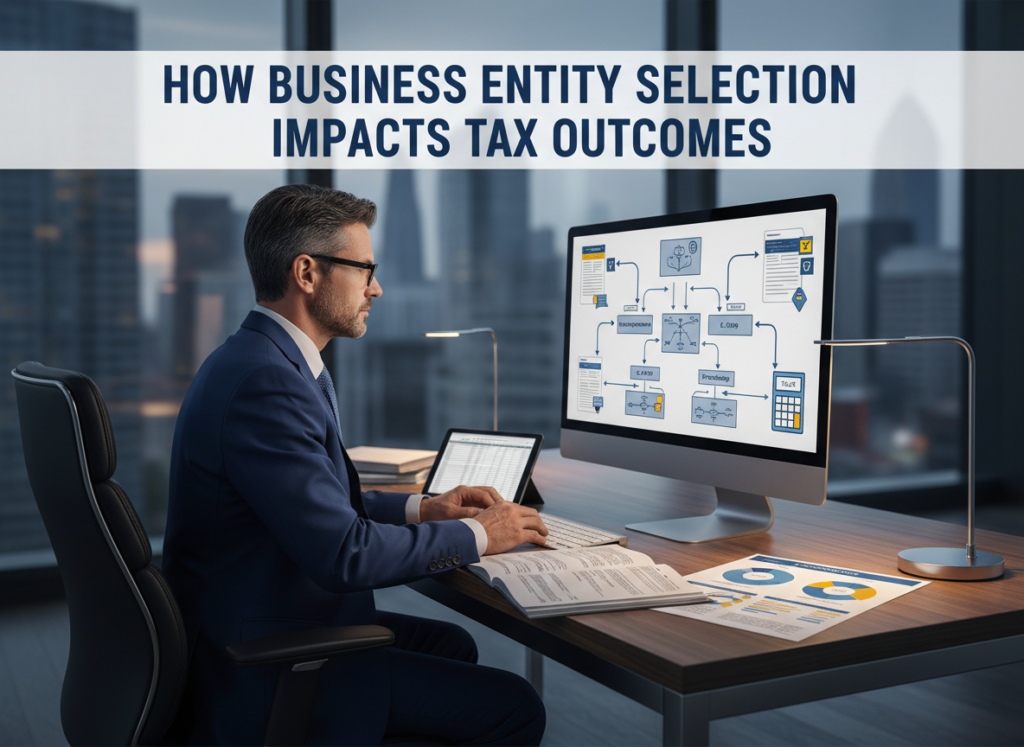
Business entity selection is one of the most impactful decisions a business owner can make, yet it is often left untouched for years. As 2025 draws to a close and the tax landscape prepares for meaningful changes in 2026, year-end planning offers a critical opportunity to reassess whether a company’s current structure still supports its financial, tax, and long-term goals.
Entity selection affects far more than tax rates. It shapes how income is taxed, how losses are used, how compensation is structured, and how a business prepares for growth, retirement, or succession. A thoughtful review before year-end allows tax professionals and business owners to align structure with strategy—before deadlines pass and options narrow.
Why Business Entity Selection Matters at Year-End
Year-end is when income levels become clear, ownership changes are finalized, and planning for the coming year begins. This timing makes business entity selection especially important. Decisions made now can influence tax outcomes not only for the current year but well into 2026 and beyond.
Expected rate adjustments, evolving compliance requirements, and shifting business goals mean that a structure that worked in prior years may no longer be optimal. Reviewing entity choice at year-end allows advisors to identify whether staying the course makes sense or whether restructuring could deliver meaningful tax or operational benefits.
Understanding Business Entity Selection Across Common Structures
Effective business entity selection requires understanding how each entity type operates under current law and how it may be affected by upcoming changes.
C Corporations
C corporations offer a flat corporate tax rate and a familiar legal framework. They are often well-suited for businesses that plan to reinvest profits, pursue outside investors, or prepare for equity-based growth. However, double taxation remains a central consideration. Profits taxed at the corporate level may be taxed again when distributed to shareholders, which can reduce overall tax efficiency for owners seeking regular distributions.
S Corporations
S corporations provide pass-through taxation while allowing flexibility in managing compensation and distributions. For many closely held businesses, this balance can be attractive. That said, eligibility rules—such as limits on shareholders, ownership restrictions, and the single-class-of-stock requirement—must be reviewed regularly. Reasonable compensation remains a key compliance issue and should be part of any year-end evaluation.
Partnerships and Multi-Member LLCs
Partnerships and multi-member LLCs offer the greatest flexibility in business entity selection. Special allocations, tiered ownership, and customized economic arrangements make them ideal for complex or evolving businesses. However, this flexibility comes with added administrative responsibility, including basis tracking, capital account maintenance, and careful handling of self-employment tax exposure.
How Business Entity Selection Impacts Tax Outcomes
Choosing the right entity structure affects how income and losses flow to owners. As income increases or business activity shifts, the tax efficiency of one entity compared to another can change significantly.
Year-end planning allows professionals to model how 2026 tax rules may affect pass-through income, corporate earnings, or owner compensation. A structure that minimizes tax under current conditions may become less favorable as thresholds, rates, or limitations change.
Year-End Planning Tools That Affect Business Entity Selection
Several planning tools can influence business entity selection, but many come with strict timing requirements. Late S elections, check-the-box classifications, or restructuring transactions may be available only if action is taken before year-end or within specific election windows.
Missing these deadlines can delay a desired strategy by an entire year, potentially resulting in higher taxes or lost planning opportunities. Reviewing entity options before year-end ensures that clients do not miss critical elections that could support their 2026 objectives.
Business Entity Selection and Long-Term Planning Goals
Entity choice does not exist in isolation. Business entity selection interacts closely with retirement planning, succession strategies, and compensation design.
A business planning for a future sale or generational transfer may benefit from the flexibility offered by partnership structures. Owners seeking to maximize retirement contributions may find different opportunities depending on whether they operate as an S corporation or C corporation. Evaluating entity choice with a long-term lens helps ensure that today’s structure does not limit tomorrow’s options.
Communicating Business Entity Selection Decisions to Clients
Many business owners find business entity selection confusing, especially when an LLC can be taxed in multiple ways. Clear communication is essential. Explaining how distributions, wages, basis, and compliance obligations differ between entities empowers clients to participate in the decision-making process.
When clients understand the trade-offs involved, they are more likely to feel confident in the chosen structure and committed to long-term planning strategies. Year-end conversations provide a natural opportunity to revisit these topics and reinforce proactive planning.
Preparing for 2026 Through Smart Business Entity Selection
As 2026 approaches, tax professionals should encourage clients to view business entity selection as an evolving strategy rather than a one-time decision. Economic conditions change, tax laws evolve, and business goals shift. Regular reviews ensure that entity choice remains aligned with both current operations and future plans.
Proactive evaluation at year-end allows businesses to enter the new tax year with clarity, confidence, and a structure designed to support growth and compliance.
Key Takeaway
Business entity selection is a foundational element of effective tax and business planning. Year-end offers the ideal moment to reassess whether a company’s current structure still supports its goals in light of upcoming 2026 changes.
By reviewing entity choice now—before deadlines pass—business owners and advisors can position the business for tax efficiency, operational flexibility, and long-term success. A well-timed evaluation today can prevent costly adjustments tomorrow and ensure the business is built for what lies ahead to support sustainable growth.
Final Thoughts
Business entity selection is not a decision that should be made once and forgotten. As tax laws evolve and business goals change, the structure that once worked well may no longer deliver the best results. Reviewing entity choice at year-end allows business owners to step into the next tax year with clarity, confidence, and a structure aligned to both current operations and future plans.
Taking time now to reassess entity selection can help avoid missed opportunities, reduce tax inefficiencies, and support long-term growth. A proactive review before year-end ensures that your business enters the new year prepared, compliant, and strategically positioned for what lies ahead.
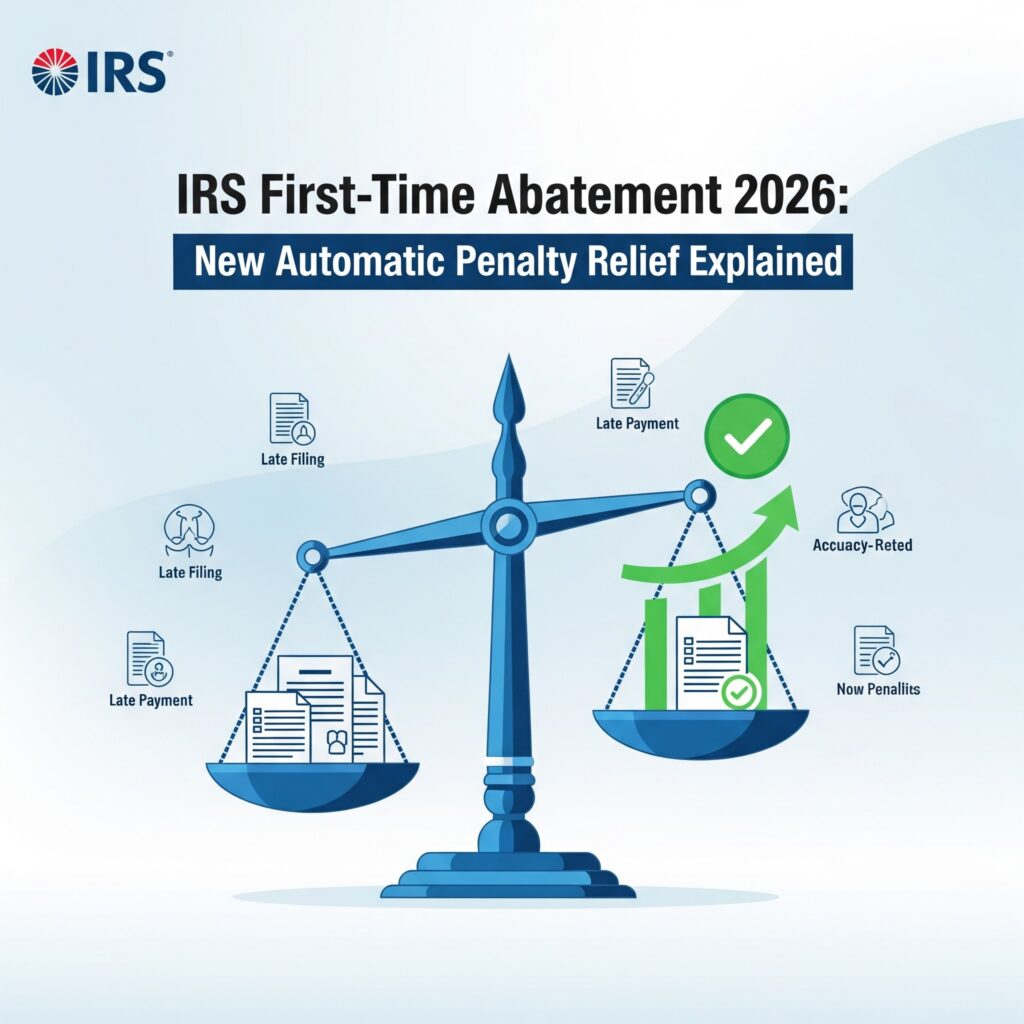
The first-time abatement 2026 update marks a major shift in how the IRS administers penalty relief for taxpayers. For years, taxpayers struggled with penalty notices—many not knowing that the IRS offered a First-Time Abatement (FTA) program at all. The IRS required taxpayers or tax professionals to call, write, or file a request to receive the penalty waiver.
Starting in 2026, the IRS will automatically apply first-time abatement 2026 relief when a taxpayer qualifies. This is one of the most significant modernization steps in recent IRS history.
This blog breaks down what first-time abatement 2026 means, who qualifies, how the automatic waiver works, and what tax professionals must do to prepare.
⭐ What Is First-Time Abatement (FTA)?
First-Time Abatement (FTA) has existed since 2001 and is one of the most widely applicable forms of IRS penalty relief. FTA is available for taxpayers who have a good compliance history and need relief from certain penalties.
Under first-time abatement 2026, the IRS will shift from a request-based model to an automatic system—helping millions of taxpayers who previously missed out due to lack of awareness.
FTA applies only to penalties related to:
Failure to file
Failure to pay
Failure to deposit (for payroll taxes)
These penalties can be substantial, and first-time abatement 2026 may prevent financially strained taxpayers from paying unnecessary penalties.
📌 Penalties Eligible Under First-Time Abatement 2026
FTA continues to apply to only three penalty categories. Under the first-time abatement 2026 system, these penalties will be reviewed automatically:
✔ Failure to File Penalty
Assessed when a taxpayer submits a return after the due date.
✔ Failure to Pay Penalty
Applied when taxes remain unpaid by the deadline.
✔ Failure to Deposit Penalty
Relevant to employers who do not deposit payroll taxes on time.
Under first-time abatement 2026, these penalties may no longer require taxpayers to call the IRS or file Form 843 to request relief.
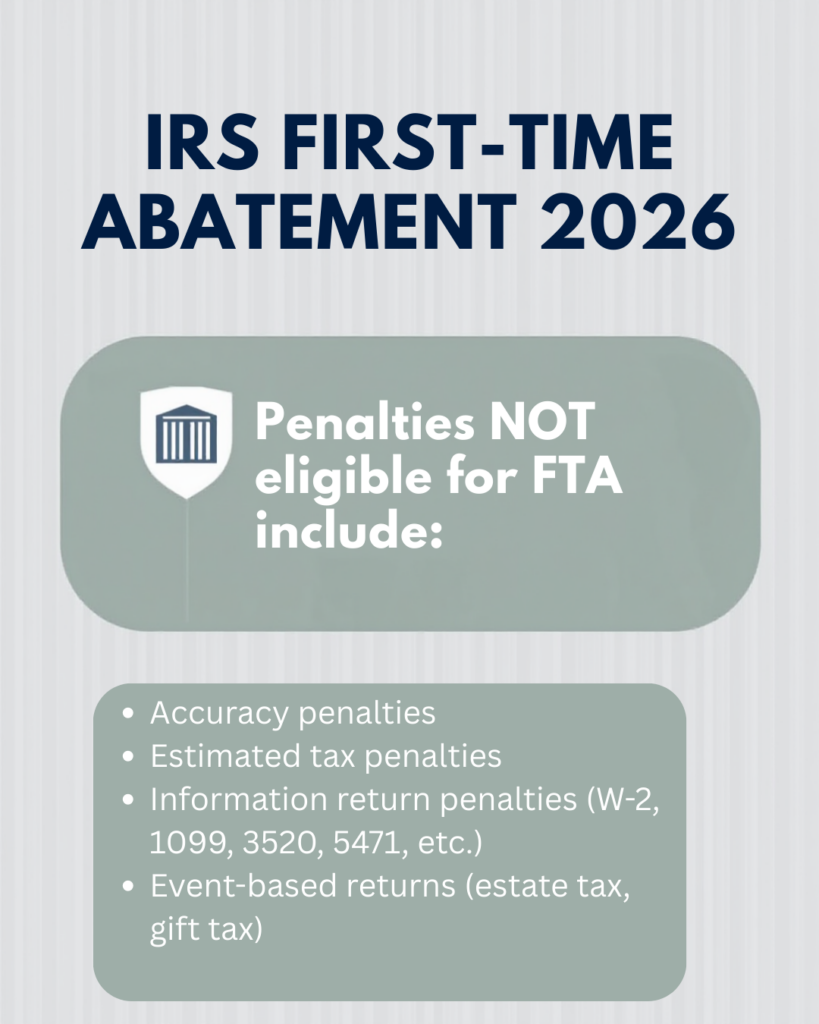
❌ Penalties NOT eligible for FTA include:
Accuracy penalties
Estimated tax penalties
Information return penalties (W-2, 1099, 3520, 5471, etc.)
Event-based returns (estate tax, gift tax)
🧾 Who Qualifies for First-Time Abatement 2026?
To qualify for first-time abatement 2026, taxpayers must meet existing FTA rules. These requirements remain unchanged.
🔹 1. Eligible Return Types
FTA applies only to:
Individual: Form 1040 series
Business: Form 1120, Form 1065
Payroll: Form 940, 941, 944, 945
Not eligible under first-time abatement 2026: Form 990 series, gift tax returns, estate tax returns, international forms.
🔹 2. Clean Compliance History
Taxpayer must have:
No disqualifying penalties in the three years prior to the penalty year
Estimated tax penalties do NOT disqualify
For joint returns: BOTH spouses must meet the criteria
For payroll taxes: must not have more than three prior Failure to Deposit waivers
Even under first-time abatement 2026, the IRS will evaluate compliance history before applying automatic relief.
🔹 3. Filing Compliance
All required tax returns for the previous three years must be filed.
This rule is unchanged under the first-time abatement 2026 automatic system.
🔹 4. Good Standing on Balances
Taxpayers must be current with IRS agreements or payment plans.
Automatic FTA in first-time abatement 2026 will be blocked if a taxpayer is not in good standing.
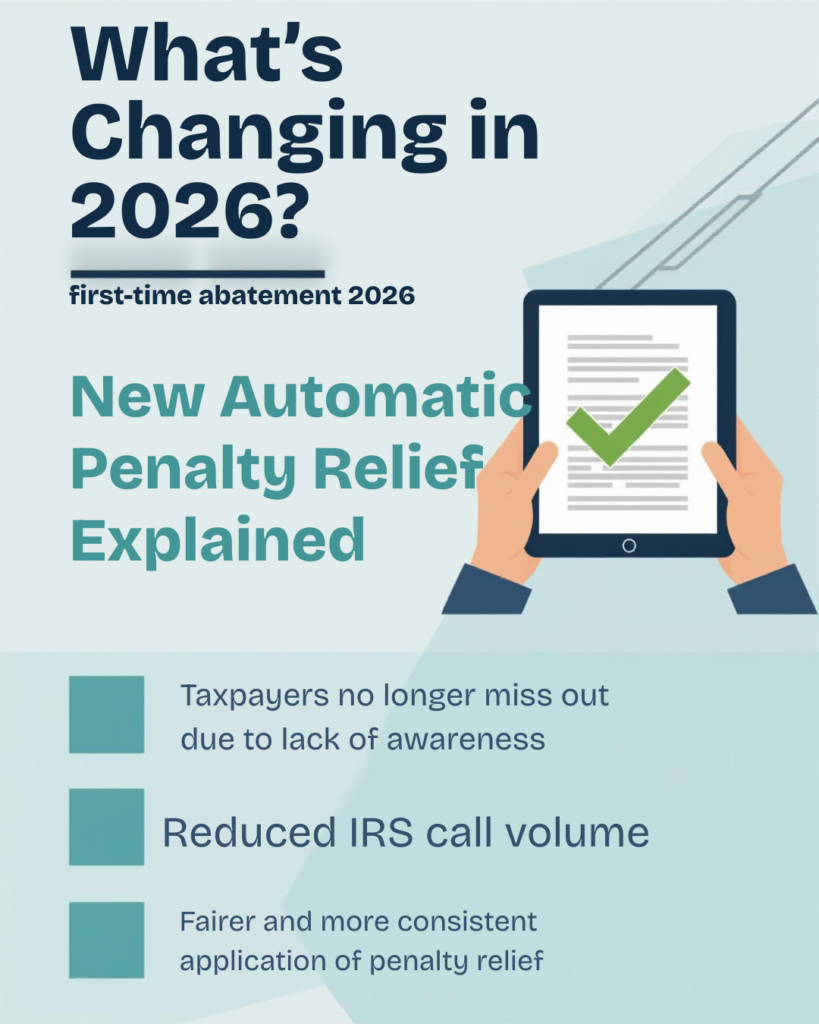
🚀 What’s Changing in 2026?
Currently, taxpayers must manually request FTA by:
Calling the IRS
Writing a letter
Filing Form 843
Beginning in first-time abatement 2026, the IRS will automatically issue the waiver when all criteria are met.
This modernization comes after years of recommendations from:
Treasury Inspector General for Tax Administration (TIGTA)
National Taxpayer Advocate (NTA)
Industry tax associations
In November 2025, Erin Collins (NTA) confirmed that the IRS will be implementing the automatic first-time abatement 2026 capability.
🌟 Benefits of Automatic FTA:
Taxpayers no longer miss out due to lack of awareness
Reduced IRS call volume
Faster processing
Fairer and more consistent application of penalty relief
🧠 Why First-Time Abatement 2026 Matters
Millions of taxpayers qualify for FTA every year, but only a small percentage receive the waiver. Reasons include:
Not knowing the program existed
Difficulty contacting the IRS
Confusion about eligibility
Filing delays that complicate penalty removal
With first-time abatement 2026, the IRS aims to eliminate these barriers.
This change especially benefits:
First-time filers
Taxpayers facing temporary financial hardship
Small businesses with payroll deposit issues
Tax professionals who handle high call volumes during tax season
🛠️ Action Steps for Tax Professionals
Even though first-time abatement 2026 becomes automatic, tax professionals must remain vigilant.
🔍 1. Review Client Accounts for Missed Past FTA Opportunities
Clients may still qualify for relief for earlier years (before 2026). Tax pros can:
Obtain Form 2848
Call the IRS Practitioner Priority Service
File Form 843 when appropriate
📅 2. Watch for IRS Implementation Guidance
Key details will be published as the IRS finalizes:
System automation rules
Exception-handling processes
How to address cases where automatic FTA is not applied
Employer deposit penalty workflows
📝 3. Ensure Clients Maintain Filing Compliance
Missing returns automatically disqualify taxpayers from first-time abatement 2026.
Encourage clients to catch up before penalties hit.
The IRS provided administrative penalty waivers for:
2019–2020 late filing
2020–2021 failure to pay
These do NOT disqualify taxpayers from first-time abatement 2026, but IRS coding inconsistencies may require manual intervention.
🔚 Final Thoughts
The introduction of first-time abatement 2026 represents a major IRS modernization that brings more fairness and access to penalty relief. Millions of taxpayers will benefit from automatic evaluations rather than needing to request relief through complex processes.
Tax professionals should stay informed, monitor IRS publications, and proactively review client accounts to ensure no qualified taxpayer misses out on penalty relief.
📞 Need Help Navigating IRS Penalties or Compliance?
Veritas Accounting Services is here to support you.
If you’re drowning in credit cards, loans, or medical bills, you’re not alone—but you can Crush Your Debt Faster with a clear plan. The problem for most people isn’t a lack of effort; it’s a lack of strategy. You pay a little here, a little there, and it feels like nothing ever changes.
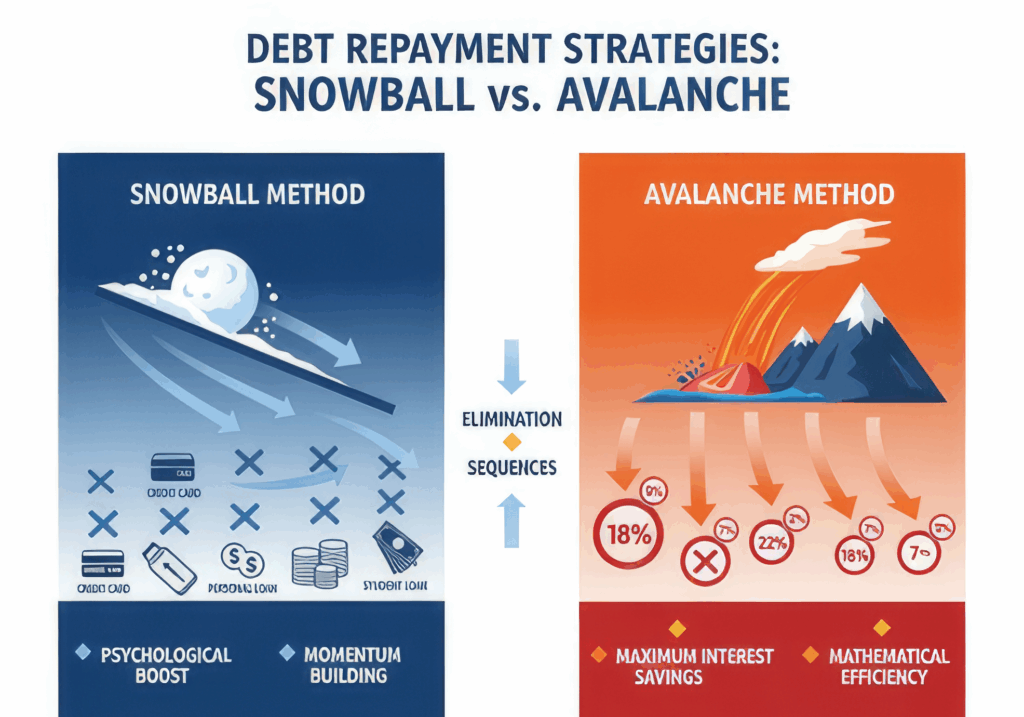
Two proven methods can turn that around:
The Debt Snowball Method
The Debt Avalanche Method
Both are powerful debt repayment strategies that help you stay focused and make real progress. In this guide, you’ll learn how each method works, who they’re best for, and how to choose the one that helps you Crush Your Debt Faster without burning out.
What Is the Debt Snowball Method?
The Debt Snowball Method is built around small, fast wins. Instead of worrying about interest rates, you focus on paying off your smallest debts first and create momentum.
How the Snowball Method Works
List all your debts from smallest balance to largest.
Pay the minimum on every debt.
Put all extra money toward the smallest debt.
Once that debt is gone, “snowball” its payment into the next smallest debt.
Repeat until every debt is paid off.
Even though this method isn’t always mathematically perfect, it helps you Crush Your Debt Faster because it keeps you emotionally engaged.
Why the Snowball Method Works
You eliminate entire balances quickly.
Each win builds motivation and confidence.
The plan is simple, so you’re less likely to quit.
Best for: people who feel overwhelmed, emotional spenders, and anyone who needs quick proof that their efforts are working.
What Is the Debt Avalanche Method?
The Debt Avalanche Method is focused on saving the most money in interest and often paying off everything in less time overall. Instead of looking at balance size, you look at interest rates.
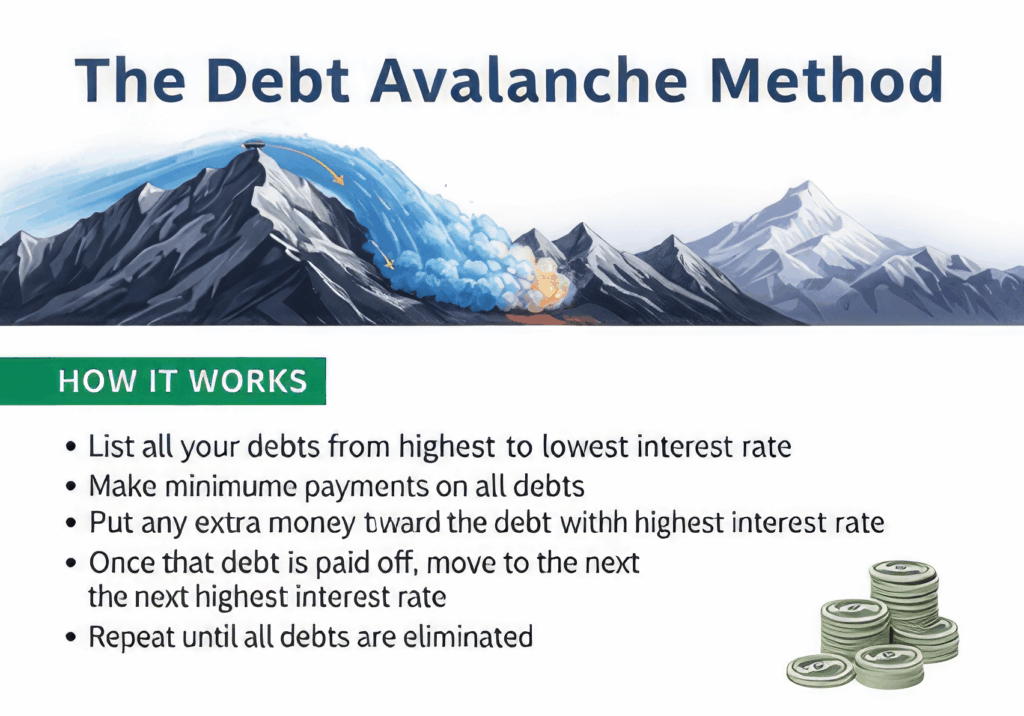
How the Avalanche Method Works
List all your debts from highest interest rate to lowest.
Pay the minimum on all debts.
Put all extra money toward the highest-interest debt.
Once it’s paid off, move to the next highest rate.
Continue until you’re completely debt-free.
This approach helps you Crush Your Debt Faster from a financial perspective, even if early progress is less visible.
Why the Avalanche Method Works
You pay less total interest.
You usually finish your debt-free journey sooner.
It’s especially powerful for high-interest credit cards.
Best for: disciplined people who like numbers, want to minimize interest, and don’t need immediate emotional wins.
Snowball vs. Avalanche: Key Differences
Use this in a Table block in WordPress:
Feature
Debt Snowball
Debt Avalanche
Main Focus
Smallest balance first
Highest interest rate first
Motivation
Fast emotional wins
Long-term savings
Interest Saved
Less
More
Speed Overall
Sometimes slower
Often faster
Complexity
Very simple
Requires tracking rates
Best For
Motivation & momentum
Efficiency & savings
In simple terms:
Snowball is emotion-first, math-second.
Avalanche is math-first, emotion-second.
To Crush Your Debt Faster, you need the one that aligns with how you think and behave.
Which Strategy Will Help You Crush Your Debt Faster?
The “best” strategy is the one you actually stick with.
Ask yourself:
Do I lose motivation when progress is slow?
Do I care more about paying less interest or feeling progress sooner?
Do I like simple, no-math plans or detailed, optimized ones?
Choose the Snowball Method If…
You’ve started and stopped debt payoff plans before.
You feel better when you see entire accounts hit zero.
You want an easy way to Crush Your Debt Faster through motivation.
Choose the Avalanche Method If…
You’re patient and disciplined.
You want to save the most money on interest.
You’re okay waiting longer for the first “big win.”
There’s no wrong answer. The real mistake is staying stuck and using no system at all.
Can You Combine Both Strategies?
Absolutely. You don’t have to pick one and stay with it forever. A hybrid approach can help you Crush Your Debt Faster while balancing emotion and efficiency.
Start with a mini Snowball: Pay off one or two tiny debts first to create quick momentum.
Switch to Avalanche: Once you feel focused and confident, reorder your remaining debts by interest rate and attack the highest one.
Reset when needed: If you feel stuck again, temporarily use the Snowball on a small balance to regain motivation.
This blended method gives you the emotional wins of Snowball and the interest savings of Avalanche.
Real-Life Example: Which Method Wins?
Meet Sam. Sam has these debts:
Debt Type
Balance
Interest Rate
Credit Card A
$1,500
22%
Credit Card B
$800
18%
Personal Loan
$3,000
10%
Medical Bill
$500
0%
Sam can put $450 per month toward debt.
With the Debt Snowball
Order from smallest balance:
Medical Bill – $500
Credit Card B – $800
Credit Card A – $1,500
Personal Loan – $3,000
Sam wipes out the medical bill in just over one month, then Credit Card B a few months later. These fast wins make Sam feel powerful and in control—and that feeling helps Sam Crush Debt Faster because the plan doesn’t get abandoned.
With the Debt Avalanche
Order by highest interest rate:
Credit Card A – 22%
Credit Card B – 18%
Personal Loan – 10%
Medical Bill – 0%
Sam needs more time before one entire account disappears, but pays much less interest overall and finishes the total payoff sooner than with Snowball.
Takeaway:
Snowball helps Sam stay emotionally committed.
Avalanche helps Sam save more and mathematically Crush Debt Faster.
You choose which “faster” matters more: faster emotionally, or faster financially.
Final Thoughts: Start Crushing Your Debt Today
You don’t need perfect timing, a big income, or a miracle. You just need a plan you’ll actually follow.
Use Debt Snowball if motivation is your biggest challenge.
Use Debt Avalanche if interest savings and efficiency matter most.
Use a hybrid strategy if you want both.
Most importantly, take action. The sooner you start, the sooner you’ll Crush Your Debt Faster and free up your income for saving, investing, and building the life you actually want.
Pick your strategy today and start your debt-free journey.
📞 Ready to Finally Crush Your Debt Faster and Take Control of Your Financial Future?
If you need expert guidance on budgeting, debt repayment planning, or complete financial management, Veritas Accounting Services is here to support you every step of the way.
Contact Veritas Accounting Services:
📧 Email:hello@veritasaccountingservices.com 📞 Phone: +1 (678) 723-6003 | +91 97255 52243 🏢 US Office: 8735 Dunwoody Place – 4549, Atlanta, GA 🏢 India Office: C-305, The Imperial Heights, 150ft Ring Road, Rajkot
We proudly serve clients across the US, UK, UAE, Singapore, Ireland, and Malaysia, offering personalized bookkeeping, debt planning, tax filing, and CFO-level financial
In the complex world of investment planning, one of the most overlooked strategies is maximizing tax-free investment income. While many investors focus solely on returns, the smartest wealth builders understand that it’s not what you earn—it’s what you keep after taxes that truly matters.
What is Tax-Free Investment Income?
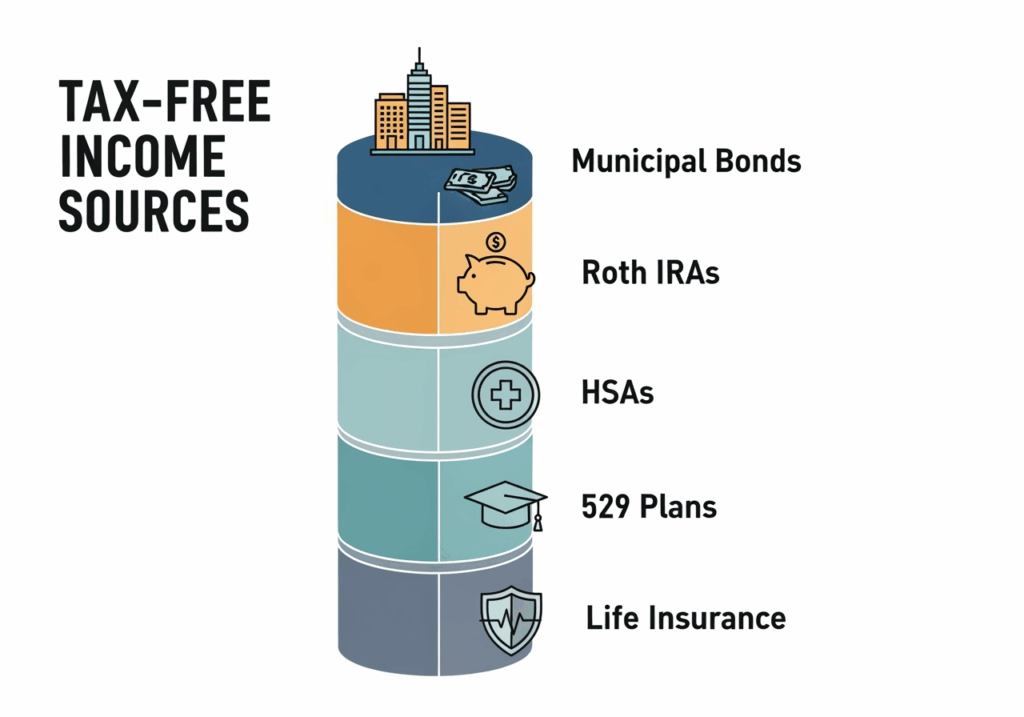
Tax-free investment income refers to earnings from specific investment vehicles that are exempt from federal income taxes, and in some cases, state and local taxes as well. The three primary sources include:
1. Municipal Bonds
Municipal bonds, or “munis,” are debt securities issued by state and local governments to fund public projects. The interest earned from these bonds is typically exempt from federal income tax and may also be exempt from state and local taxes if you live in the issuing state.
Types of Municipal Bonds to Consider:
General Obligation Bonds: Backed by the full faith and credit of the issuing municipality
Revenue Bonds: Secured by specific revenue streams from projects like toll roads or utilities
Private Activity Bonds: May be subject to AMT but offer higher yields
Build America Bonds: Federally subsidized municipal bonds with taxable interest
2. Roth IRAs
Unlike traditional IRAs, Roth IRA contributions are made with after-tax dollars. However, qualified withdrawals in retirement—including both contributions and earnings—are completely tax-free, making them a powerful long-term wealth-building tool.
Advanced Roth Strategies:
Roth Ladder Conversions: Systematic conversions over multiple years to manage tax brackets
Mega Backdoor Roth: For high earners with 401(k) plans allowing after-tax contributions
Roth IRA Inheritance Planning: Tax-free wealth transfer to beneficiaries
3. Life Insurance Payouts
Certain life insurance policies, particularly permanent life insurance with cash value components, can provide tax-free income through policy loans and withdrawals up to your basis in the policy.
Private Placement Life Insurance (PPLI): For ultra-high-net-worth individuals
Corporate-Owned Life Insurance (COLI): Business tax planning applications
Additional Tax-Free Income Sources
Health Savings Accounts (HSAs)
Often called the “triple tax advantage” account, HSAs offer:
Tax-deductible contributions
Tax-free growth
Tax-free withdrawals for qualified medical expenses
After age 65, withdrawals for non-medical purposes are taxed as ordinary income (like a traditional IRA)
529 Education Savings Plans
While contributions aren’t federally deductible, earnings grow tax-free and withdrawals for qualified education expenses are tax-free. Recent expansions allow:
K-12 tuition payments up to $10,000 annually
Student loan repayments up to $10,000 lifetime
Beneficiary changes to family members
Why Tax-Free Investment Income Matters More Than Ever
Protecting Your Overall Tax Picture
Tax-free investment income doesn’t just save you money on taxes—it provides strategic advantages that many investors overlook:
No impact on taxable income calculations: This income won’t push you into higher tax brackets
Medicare surcharge protection: High-income earners can avoid additional Medicare premiums triggered by modified adjusted gross income (MAGI)
Alternative Minimum Tax (AMT) benefits: Tax-free municipal bond interest generally doesn’t trigger AMT calculations
Social Security taxation: Lower taxable income may reduce the taxation of your Social Security benefits
The Compound Effect of Tax Efficiency
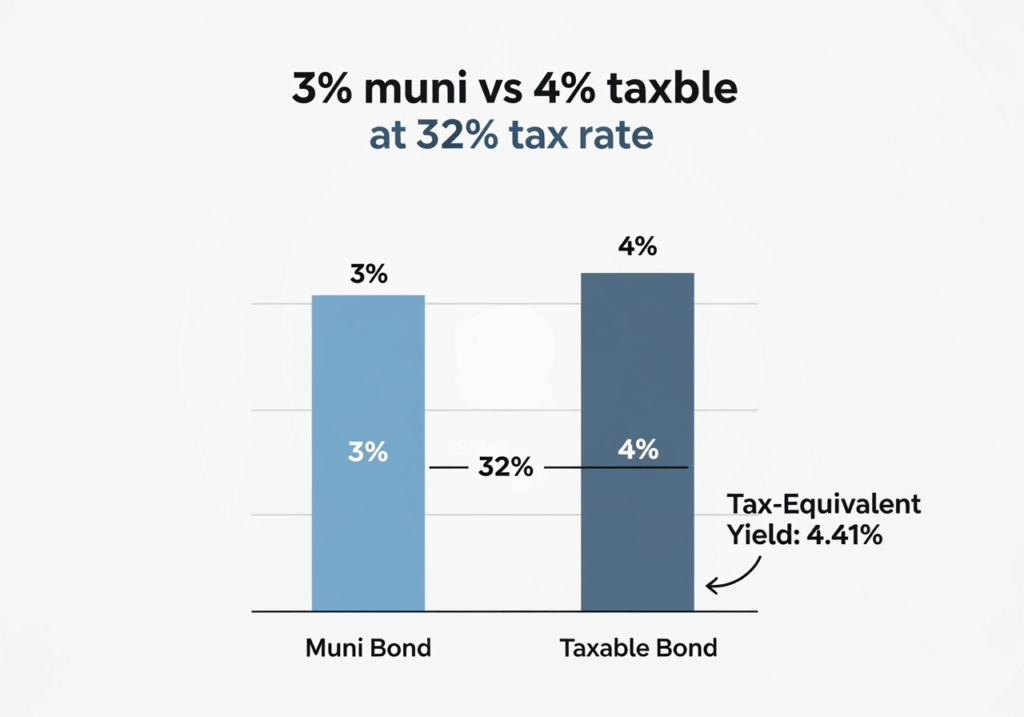
Consider this scenario: An investor in the 32% tax bracket earning 4% on taxable bonds nets only 2.72% after taxes. Meanwhile, a municipal bond yielding 3% provides the full 3% return—effectively outperforming the taxable investment while reducing risk.
Interest rate sensitivity: Shorter-duration municipal bonds provide protection against rate increases
Credit quality improvements: Many municipalities have strengthened their financial positions post-pandemic
Supply and demand imbalances: Limited municipal bond issuance has created attractive opportunities
The Missed Opportunity: Why Many Portfolios Aren’t Optimized
Common Portfolio Oversights
Many investors and their advisors focus primarily on gross returns without considering the tax implications. This oversight becomes particularly costly for:
Strategic Implementation: Making Tax-Free Income Work for You
1. Portfolio Assessment and Rebalancing
The first step is conducting a comprehensive analysis of your current investment allocation. This involves:
Evaluating your current tax burden from investments
Identifying opportunities to shift from taxable to tax-advantaged accounts
Analyzing the after-tax returns of your current holdings
2. Municipal Bond Strategy
For investors in higher tax brackets, municipal bonds can be particularly attractive:
General obligation bonds backed by the full faith and credit of the issuer
Revenue bonds supported by specific project income
Tax-exempt bond funds for diversification and professional management
3. Maximizing Roth IRA Benefits
Strategic Roth IRA planning includes:
Roth conversions during lower-income years
Backdoor Roth strategies for high-income earners
Long-term planning to maximize tax-free growth
4. Advanced Tax-Free Strategies
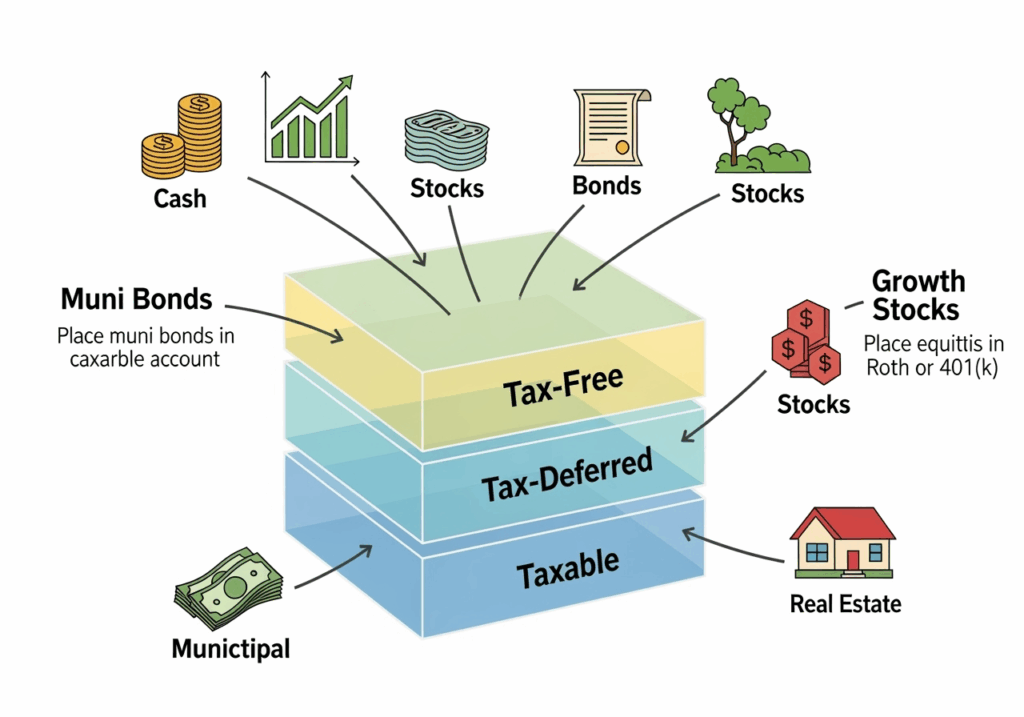
Asset Location Optimization:
Hold tax-inefficient investments in tax-advantaged accounts
Place tax-efficient investments in taxable accounts
Coordinate across multiple account types for maximum benefit
5. Tax-Loss Harvesting Coordination:
Realize losses in taxable accounts while maintaining tax-free growth elsewhere
Avoid wash sale rules when rebalancing across account types
Use tax-free income to reduce the need for taxable rebalancing
Global Considerations for International Investors
At Veritas Accounting Services, we understand that tax-efficient investing becomes even more complex for international investors and expatriates. Our global expertise across the US, UK, UAE, Singapore, Ireland, and Malaysia ensures that your tax-free investment strategy considers:
Treaty benefits between countries
Foreign tax credit optimization
Cross-border retirement planning
Compliance requirements in multiple jurisdictions
International Tax-Free Opportunities
Different countries offer unique tax-advantaged investment vehicles:
UK ISAs (Individual Savings Accounts): Tax-free growth and withdrawals
Singapore CPF: Comprehensive retirement and healthcare savings
Irish life assurance bonds: Tax-deferred growth opportunities
The Veritas Advantage: Comprehensive Tax-Efficient Planning
With over a decade of experience and 1000+ successful projects, Veritas Accounting Services specializes in creating holistic financial strategies that maximize after-tax returns. Our certified QuickBooks and Xero experts work closely with your investment advisors to ensure your portfolio is optimized for tax efficiency.
Our Integrated Approach Includes:
Tax planning consultations to identify optimization opportunities
Investment income analysis and tax impact assessments
Retirement planning coordination with tax-free income strategies
Ongoing monitoring to ensure continued tax efficiency
Technology-Driven Solutions
Our seamless integration with leading accounting platforms ensures:
Real-time tax impact monitoring of investment decisions
Automated reporting of tax-free income sources
Coordinated planning between business and personal finances
Compliance tracking across multiple jurisdictions
Take Action: Don’t Let Tax Inefficiency Erode Your Wealth
The opportunity cost of maintaining a tax-inefficient portfolio compounds over time. Every year you delay implementing tax-free investment strategies is another year of unnecessary tax payments and missed wealth accumulation.
Immediate Action Items:
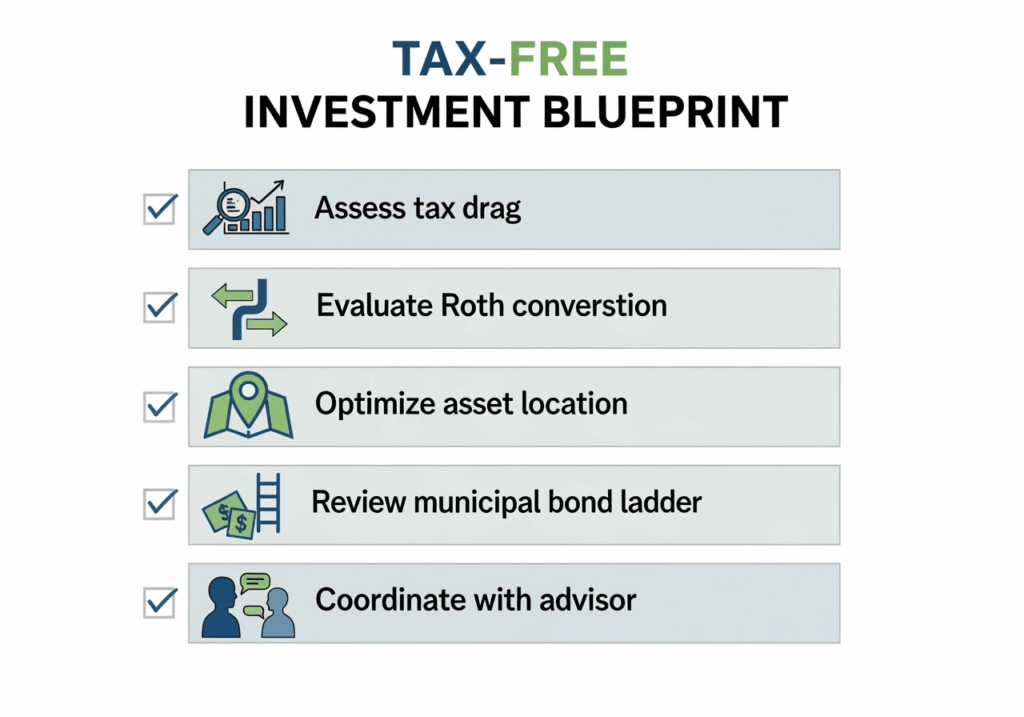
Calculate your current tax drag: Determine how much you’re paying in unnecessary investment taxes
Assess your tax bracket trajectory: Plan for future income changes
Review your asset location: Ensure tax-efficient placement of investments
Evaluate conversion opportunities: Consider Roth conversions during low-income periods
Next Steps:
Schedule a consultation to review your current investment tax burden
Analyze your portfolio for tax-efficiency opportunities
Develop a strategic plan to maximize tax-free income
Implement and monitor your optimized investment strategy
Conclusion
Tax-free investment income isn’t just about avoiding taxes—it’s about building a more efficient, sustainable wealth accumulation strategy. In today’s complex tax environment, the difference between tax-efficient and tax-inefficient investing can mean hundreds of thousands of dollars over a lifetime.
Don’t let this opportunity pass by. Contact Veritas Accounting Services today to discover how tax-free investment income strategies can transform your financial future.
Ready to optimize your investment portfolio for maximum tax efficiency?
Tax-Free Investment Income Tax-Free Investment Income Tax-Free Investment Income Tax-Free Investment Income Tax-Free Investment Income Tax-Free Investment Income Tax-Free Investment Income
To correctly classify business expenses is foundational to solid bookkeeping and financial decision-making. Yet, many business owners and freelancers trip up in this area—leading to lost deductions, inaccurate reporting, and extra stress during tax season. Let’s change that!
In this guide, you’ll learn:
What counts as a business expense (with real examples)
Why classification matters so much
Common and costly mistakes (and how to sidestep them)
Pro tips for flawless, stress-free accounting
Answers to the most frequent questions
A printable, actionable checklist to keep you organized
What Counts as a Business Expense? (With Real-World Examples)
Business expenses are the ordinary and necessary costs of running your company. But what does that mean in practice?
Here are popular categories and real examples for each:
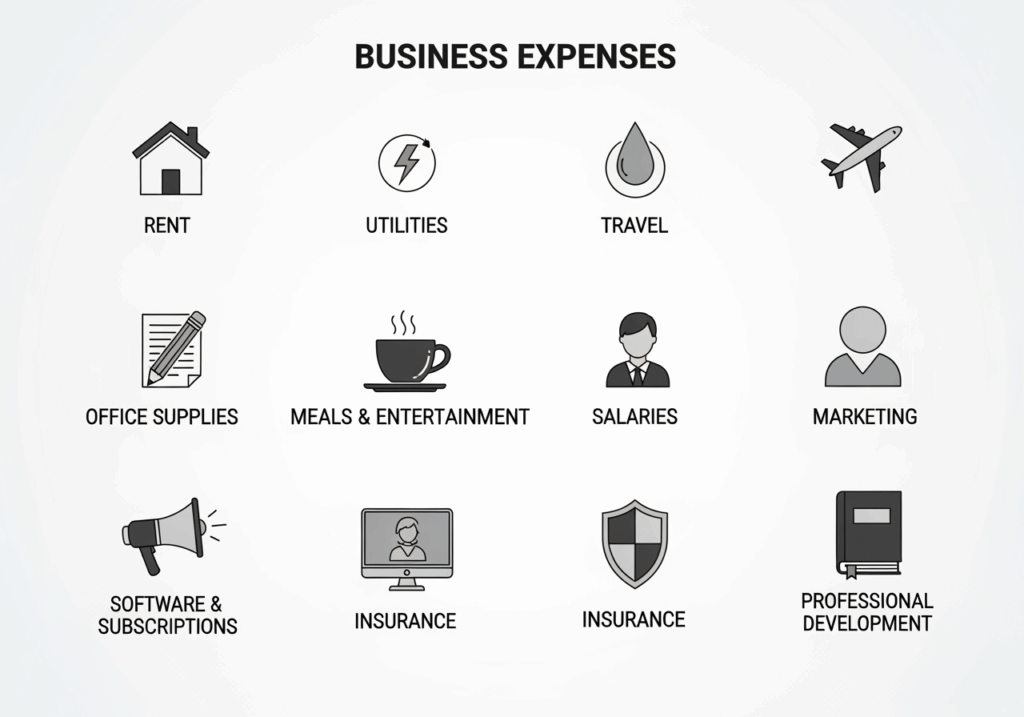
Travel: Airfare, mileage, taxis/rideshares, hotels, meals on work trips
Meals and Entertainment: Taking clients out for lunch, company event catering (subject to strict limits)
Salaries and Wages: Staff pay, bonuses, payroll taxes
Professional Services: Legal, accounting, consulting fees
Insurance: Business liability, workers comp, property insurance
Marketing and Advertising: Website fees, online ads, print materials
Depreciation: Gradual cost deduction for major purchases like machinery or vehicles
Pro Tip: If you’re ever unsure if an expense qualifies, ask yourself—”Is this cost directly related to earning business income?” If the answer’s yes, it likely qualifies.
Why Correct Classification Matters
Classifying business expenses correctly doesn’t just make life easier for your accountant. Here’s why it truly matters:
Maximize Tax Deductions: Many allowable business expenses directly reduce taxable income, meaning less money owed to the government (and more in your pocket).
Financial Insights: Accurate expense tracking reveals which parts of your business are costing the most—and where you can cut back.
Audit Readiness: Clean, careful records make audits quick and painless if you ever get selected.
Credibility with Investors/Banks: Lenders or investors like to see well-organized, easy-to-explain financials.
Common Expense Classification Mistakes (With Solutions)
Let’s explore mistakes in detail, with real-world fixes:
1. Mixing Personal and Business Finances
Example: You grab a coffee using your business card, but it’s not a work-related purchase.
Fix: Set up separate bank accounts and credit cards. If you make a mistake, note the transaction as an owner draw or personal reimbursement.
2. Misclassifying Expenses
Example: Coding a business lunch with a client as “Office Supplies,” or putting software under “Equipment.”
Fix: Use accounting software with preset categories. Review transactions monthly for accuracy.
3. Missing Out on Small Deductions
Example: Ignoring small subscriptions or petty cash expenses; assuming they’re “too minor.”
Fix: Track every expense, even $2 ones. Digital tools make this frictionless; use expense scanning apps or file receipts in Google Drive.
4. Lost or Incomplete Documentation
Example: Tossing receipts or not collecting itemized bills.
Fix: Go digital—scan with your phone, save PDFs, or use receipt-management platforms like Expensify or Dext.
5. Over- or Underclaiming Deductions
Example: Claiming the full cost of your personal mobile as a business expense, or not claiming your home office at all.
Fix: Claim only the business-use portion. For mixed-use items (like utilities at home), use a percentage based on actual use.
6. Not Updating Categories as Business Grows
Example: Sticking to overly simple categories (“other expenses,” “miscellaneous”) as your business expands.
Use cloud-based software like QuickBooks, Xero, Zoho, or Wave, which auto-categorizes common expenses (and syncs with your bank!).
Set up rules so recurring transactions (like your internet bill) are always coded to the right category.
Be Consistent
Define your categories clearly and always use them the same way.
If you have a team, create a simple one-pager explaining what belongs where.
Schedule a Monthly “Money Date”
Take 30 minutes at the end of each month to review your transactions, match receipts, and fix any uncategorized expenses.
Educate the Whole Team
Train employees on proper receipt submission and expense types.
Use an approval system for purchases, so random expenses don’t slip through.
Document Your Expense Policy
Put your rules in writing! This helps if you ever hire a bookkeeper or get audited.
Ask for Professional Help
An accountant or bookkeeper can review your setup, optimize your categories, and ensure you’re maximizing deductions.
FAQs: Business Expense Classification
Classify Business Expenses
Q: Can I deduct all meals with clients? A: Not always. Many tax authorities cap meal deductions at 50%, and receipts/documentation are required. Casual or non-business meals don’t qualify.
Q: What if I work from a home office—how do I classify those expenses? A: Calculate the percentage of your home used for business (by area or time) and claim that portion of rent, utilities, and insurance as a business expense.
Q: Is my car a business expense if I also use it personally? A: Only claim the percentage of car expenses related to business miles. Use a mileage log or mileage-tracking app.
Q: What if I make a mistake? A: Adjust the transaction and document the change. Most software allows easy recategorization.
Actionable Checklist for Smarter Expense Classification
Feel free to print or bookmark this!
Setup
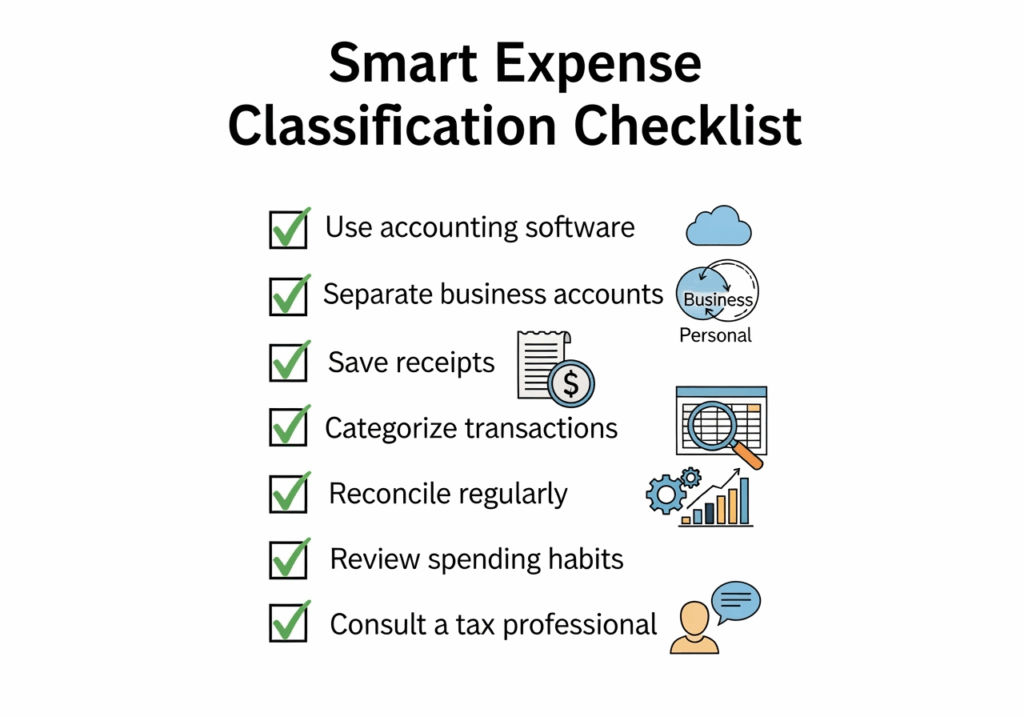
✅ Open designated business bank accounts ✅ Choose accounting or expense tracking software ✅ Create a clear chart of accounts (categories)
Ongoing Process
✅ Always use the business account for business purchases ✅ Save digital or physical receipts for all transactions ✅ Enter all expenses into your accounting system ✅ Review uncategorized/“miscellaneous” expenses each month ✅ Match bank and credit card transactions to entries ✅ Update categories as business grows
At Year-End
✅ Reconcile all accounts ✅ Check for missed deductions ✅ Provide clear records to your accountant ✅ Adjust categories for the new year’s goals
Final Thoughts
Getting business expense classification right isn’t just about tax season—it’s about taking charge of your business finances and making smarter decisions year-round. The more consistent (and organized) you are, the less likely you are to miss deductions, make costly errors, or panic during audits.
By using technology, documenting your process, and reviewing transactions regularly, you’ll build a system that works for you—not against you.
Need help setting up or reviewing your expense categories? Drop your questions in the comments or connect with our bookkeeping pros for a no-obligation consultation. Your future self—and your bottom line—will thank you!
classify business expenses classify business expenses classify business expenses classify business expenses classify business expenses classify business expenses classify business expenses classify business expenses classify business expenses classify business expenses classify business expenses classify business expenses classify business expenses classify business expenses classify business expenses classify business expenses classify business expenses classify business expenses
Navigating sales tax compliance as a marketplace seller can be overwhelming, especially with constantly evolving regulations across 45 US states. With marketplace facilitator laws now generating over $13.7 billion annually and economic nexus thresholds affecting 2.4 million e-commerce businesses, knowing what to prioritize—and what to skip—has never been more critical. Prioritizing the right compliance strategies protects both your bottom line and your peace of mind.
Recent data from the sales tax Institute reveals a startling reality: 67% of marketplace sellers are either over-complying, wasting valuable resources on unnecessary tasks, or under-complying, risking substantial penalties. The average penalty for non-compliance reached $4,200 per business in 2024, while businesses that over-comply spend an unnecessary $2,400 annually on redundant compliance activities. This comprehensive guide will help you focus your efforts where they matter most while avoiding common compliance traps that drain time and resources without adding value.
Understanding Your Marketplace Coverage: The Foundation of Smart Compliance
Before diving into any compliance activities, you must understand your specific situation as a marketplace seller. Data-backed approach, 87% process reduction determines approximately 80% of your compliance obligations and can save you from countless hours of unnecessary work. The landscape has changed dramatically since marketplace facilitator laws took effect, with platforms now handling the vast majority of sales tax collection and remittance on behalf of their sellers.
Amazon, the largest marketplace, now collects tax in all 45 sales tax compliance states for FBA transactions, covering 89% of third-party seller obligations automatically. This means if you’re exclusively selling through Amazon FBA, your compliance burden has been reduced by nearly 90% compared to just five years ago. However, FBM (Fulfilled by Merchant) sellers still need to conduct separate analysis for transactions not covered by Amazon’s collection system.
eBay has similarly revolutionized compliance for its sellers through eBay Managed Payments, which covers 94% of transactions on the platform. Since implementation, seller registration requirements have been reduced by 67%, simplified the compliance landscape significantly for millions of sellers. Etsy handles collection in all applicable states for its craft and handmade sellers, maintaining a 91% compliance rate across its platform and providing small seller protection for transactions under $600 annually.
The key insight here is that many sellers are registering in states where their marketplace already handles everything, creating unnecessary filing obligations and ongoing costs. Data shows that 34% of marketplace sellers over-register, spending an average of $1,200 annually on compliance activities that provide no value. Understanding your platform’s coverage is the first step toward efficient compliance management.
Economic Nexus: Focusing on What Actually Matters
Economic nexus thresholds determine when you’re required to collect and remit sales tax in each state, but many sellers either over-monitor their obligations or focus on outdated metrics. The landscape has simplified significantly, with 67% of states eliminating transaction count requirements in favor of revenue-only thresholds.
California leads the pack with $891 million collected in 2024 from economic nexus enforcement, maintaining a $500,000 threshold with no transaction count requirement. Texas generated an additional $312 million through nexus enforcement, recently eliminating its transaction count requirement in January 2025. New York continues its aggressive enforcement approach with a $500,000 threshold and 100 transaction requirement, averaging $4,200 in penalties per non-compliant business. Florida has implemented a new automated nexus detection system, resulting in an 89% increase in penalty collections throughout 2024.
The smart approach to nexus monitoring involves tracking only revenue-based thresholds in states where you have realistic potential to reach them. Most marketplace sellers trigger nexus in an average of 3.2 states, making it counterproductive to monitor all 45 states if you’re only generating $200,000 in annual sales across all platforms. Setting alerts at 75% of relevant thresholds provides adequate planning time while avoiding the administrative burden of constant monitoring.
Transaction count tracking has become largely obsolete, with states like North Carolina, South Dakota, Wyoming, and Vermont eliminating these requirements in 2024-2025. This trend has resulted in an average 18% reduction in compliance costs for affected businesses and 4.2 hours of monthly time savings per business. The focus should be on states representing 80% of your sales volume rather than attempting to track every possible nexus scenario.
Strategic Registration: Avoiding the Over-Compliance Trap
Registration strategy is one of the most critical compliance decisions for marketplace sellers. Done correctly, it can save thousands annually. Done prematurely, it creates ongoing costs and filing burdens.
Home State vs. Multi-State Registration
Home State: Registration in your business’s home state is always required, even if your marketplace handles sales tax. Many sellers overlook this basic obligation.
Multi-State: Only register in other states if:
You’ve crossed economic nexus thresholds
Your marketplace doesn’t collect in those states
You conduct direct sales (non-marketplace)
Avoid registering in states just because they’re “potential” markets. Every registration triggers recurring obligations—even if you have no sales.
When Not to Register
Marketplace Handles Everything: If Amazon, Etsy, or eBay covers all tax collection and remittance in a state, registration is usually unnecessary.
No Nexus: If you’re far below the economic nexus threshold and not growing in that region, it’s inefficient to register.
No Sales Tax States: Alaska, Delaware, Montana, New Hampshire, and Oregon have no sales tax. Avoid unnecessary filings here.
Cost of unnecessary registration: $150–300 per year in filing fees per state, plus administrative costs and time.
Use Voluntary Disclosure When Appropriate
If you’ve operated without registering in a state where you had a tax obligation:
Consider Voluntary Disclosure Agreements (VDAs) in 38 states.
These can reduce penalties by up to 67% if addressed proactively.
Particularly helpful if you’re more than 6 months non-compliant.
Special Rules for International Marketplace Sellers
International sellers face additional complexity when selling in U.S. marketplaces. From tax IDs to banking and compliance gaps, the risks—and penalties—can be high.
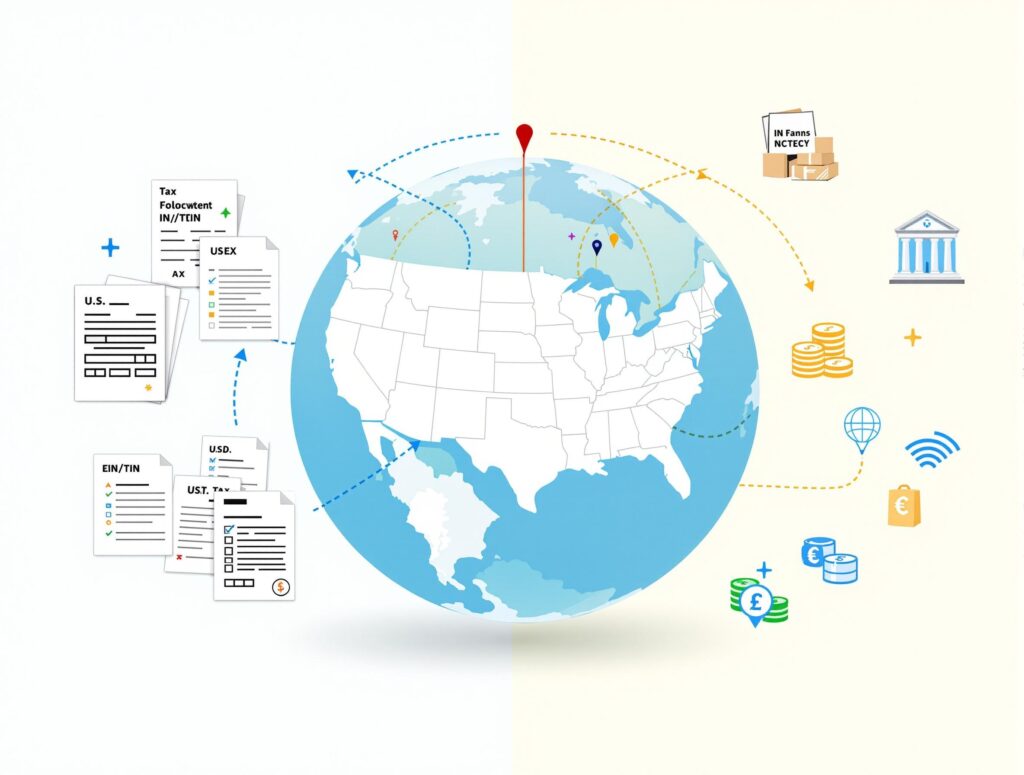
Tax Identification & Entity Setup
Most U.S. states require either:
An Employer Identification Number (EIN) or
An Individual Taxpayer Identification Number (ITIN)
Choose the correct entity type (e.g., sole proprietor, LLC, corp) to avoid double taxation and classification issues.
Banking & Payment Infrastructure
Opening a U.S. bank account simplifies remittance and improves compliance.
Track currency conversions, international fees, and wire transfers to maintain a clean audit trail.
Use multi-currency accounting tools (e.g., Xero, Zoho Books) with U.S. tax integration.
Common Mistakes to Avoid
Applying home country VAT rules to U.S. sales tax
Assuming marketplace coverage applies in every state
Delaying U.S. compliance due to perceived complexity
Not realizing that marketplace coverage varies by state
Why Professional Guidance Helps
84% of international sellers use U.S.-based experts
Setup time reduced by 67%
Prevents costly errors that often cost $3,000+ to fix later
Unlocks cross-border tax efficiencies not visible to DIY sellers
Record Keeping: Essential Documentation Without Excessive Overhead
Effective record keeping strikes a balance between audit preparedness and operational efficiency. The key is maintaining critical documentation while avoiding the trap of over-documentation that consumes resources without adding protection value.
Essential documentation includes monthly sales reports broken down by state and jurisdiction, with clear separation between marketplace and direct sales. This information should categorize taxable versus non-taxable sales and maintain a clear audit trail for all transactions. Valid exemption certificates, including resale certificates, non-profit exemption documentation, and government entity exemptions, must be maintained for the full statutory period, typically four years or more.
Tax collection records deserve special attention, documenting the amount collected by jurisdiction, remittance confirmations, and complete audit trail documentation. For marketplace sellers, maintaining marketplace facilitator confirmations becomes crucial, including platform tax collection confirmations, coverage verification documents, and gap analysis documentation that clearly shows which transactions are covered by the platform versus requiring direct compliance.
The temptation to over-document can be counterproductive and expensive. Consider changing to: Daily sales tracking offers minimal audit advantage compared to monthly summaries, while individual transaction documentation for marketplace-collected sales creates unnecessary administrative burden. Detailed product categorization is only necessary when selling exempt items, and customer address verification is handled by the marketplace for platform sales.
Modern accounting software integration eliminates much of the manual documentation burden while providing superior audit trails. QuickBooks integration is used by 67% of small businesses, while Xero maintains a 23% market share with 91% satisfaction rates. Wave integration has become popular among startups due to its free tier availability, and Zoho Books continues growing at 45% annually with comprehensive feature sets.
Technology and Automation: Smart Investments for Long-Term Success
Technology investment in sales tax compliance delivers measurable returns when properly implemented. Sales tax automation tools provide an average ROI of 340% in the first year, with 94% error reduction in calculation mistakes and 87% reduction in manual processes. The key is selecting appropriate tools for your business size and complexity rather than over-engineering solutions.
Nexus monitoring systems provide real-time threshold tracking with 24-hour alert systems, maintaining 100% accuracy in nexus determination when properly configured. These systems integrate seamlessly with popular accounting platforms, creating automated workflows that eliminate manual tracking requirements. The time savings alone justify the investment, with businesses reporting reductions from 12 hours monthly to 1.5 hours monthly for compliance management.
However, technology mistakes can be costly and counterproductive. Multiple overlapping software solutions create confusion and duplicate costs, while enterprise-level tools often provide unnecessary complexity for small operations. Custom development should be avoided when proven off-the-shelf solutions exist, and manual spreadsheet tracking becomes counterproductive when automation is readily available and affordable.
The comparison between manual and automated approaches is stark. Manual tracking requires 12 hours monthly with a 23% error rate, while automated systems reduce this to 1.5 hours monthly with only a 3.2% error rate. Professional management services can reduce this further to 0.2 hours monthly with a 0.3% error rate, making the cost-benefit analysis clear for many businesses.
Audit Preparation: Focused Defense Without Paranoia
Audit preparation should focus on realistic risks rather than theoretical possibilities. High-risk audit triggers include rapid growth patterns with 200% or more year-over-year growth, sudden expansion into new states, and platform diversification. Compliance gaps such as late registrations, inconsistent filing patterns, and marketplace coverage gaps also increase audit likelihood.
Industry targeting affects audit probability, with electronics and technology sellers facing 34% higher audit rates, clothing and accessories sellers experiencing 28% higher rates, and health and beauty sellers seeing 31% higher audit rates. Understanding these patterns helps prioritize preparation efforts where they’re most likely to be needed.
Effective audit defense preparation involves maintaining organized digital records, documenting marketplace facilitator coverage clearly, keeping nexus analysis documentation current, and establishing professional representation relationships before they’re needed. The goal is creating a defensible position without excessive preparation for unlikely scenarios.
Over-preparation for audits wastes resources on low-probability events. Over-preparing for audits in states with minimal sales, focusing on historical periods fully covered by marketplace facilitators, and treating routine compliance reviews as formal audits all represent misallocation of compliance resources. The key is proportional preparation based on actual risk assessment.
International Marketplace Sellers: Navigating Cross-Border Complexity
International sellers face unique challenges when operating in US marketplaces, with 84% utilizing professional services to navigate the complexity. Sellers from the UK, UAE, Singapore, Malaysia, and Ireland must address US tax ID requirements, including EIN (Employer Identification Number) for tax purposes or ITIN (Individual Taxpayer Identification Number) for individuals, along with proper entity classification.
Banking and remittance considerations become critical for international sellers. US bank accounts are recommended for tax payments, requiring currency conversion tracking and international wire transfer documentation. The complexity of managing both home country obligations and US state requirements makes professional guidance particularly valuable for international operations.
Common mistakes include applying home country VAT logic to US sales tax, ignoring US state-level requirements, assuming marketplace coverage is universal across all jurisdictions, and delaying US compliance due to perceived complexity. These mistakes can result in significant penalties and sales tax compliance gaps that become expensive to correct.
Professional services show particular value for international sellers, with average setup time reduction of 67% when expert help is utilized. Cross-border tax optimization opportunities often exist that can offset service costs through improved tax efficiency and reduced sales tax compliance burden.
Cost-Benefit Analysis: Making Smart Investment Decisions
The decision between DIY compliance and professional services should be based on clear cost-benefit analysis rather than assumptions about complexity or cost. Professional services make sense when annual marketplace sales exceed $500,000, when selling in five or more states with nexus obligations, when facing audit or compliance issues, when operating internationally with US sales, or when time costs exceed service costs.
Veritas Accounting Services demonstrates the value proposition with a 99.7% compliance success rate across managed accounts, average penalty avoidance of $8,400 per client annually, 72% faster multi-state registration than industry average, and 94% client retention rate over five years. These results reflect the measurable benefits of professional management for appropriate situations.
DIY approaches work effectively when operating through a single marketplace with full coverage, generating annual sales under $200,000, operating in one to two states only, having strong accounting background, and maintaining adequate time for compliance management. The key is honest assessment of capabilities and time availability.
The investment analysis shows typical professional service ranges from $1,200-2,400 for basic nexus analysis and setup, $200-500 monthly for ongoing compliance management, $150-300 per state for multi-state registration and filing, and $2,400-4,800 for international seller setup. Measurable returns include $8,400-15,600 annually in penalty avoidance, $3,200-6,400 annually in time savings value, and $1,200-3,600 annually in over-compliance elimination, resulting in net annual benefits of $12,800-25,600.
State-Specific Priorities: Strategic Focus for Maximum Impact
Effective compliance management requires prioritizing states based on actual impact rather than theoretical obligations. Tier 1 priority states demand immediate attention and include California with $891 million collected in 2024 and aggressive enforcement, Texas with $312 million additional revenue from nexus and 45% audit increases, New York with $4,200 average penalties per non-compliant business, and Florida with new automated detection systems and 89% penalty increases.
Tier 2 priority states require close monitoring and include Illinois with strong enforcement and marketplace facilitator gaps, Pennsylvania with complex local tax requirements, Washington with destination-based sourcing complexities, and Ohio with frequent threshold changes. These states represent the next level of compliance priority for most marketplace sellers.
Lower priority states for most sellers include those with minimal sales volume, comprehensive marketplace coverage, higher thresholds of $500,000 or more, and infrequent enforcement actions. Allocating equal attention to all states wastes resources that could be better focused on high-impact jurisdictions.
The strategic approach involves analyzing your specific sales patterns and growth trajectory to identify which states will require attention over the next 12-18 months. This forward-looking analysis prevents reactive compliance while avoiding unnecessary preparation for unlikely scenarios.
Seasonal Planning: Timing Your Compliance Activities
Seasonal considerations significantly impact compliance efficiency and cost-effectiveness. The Q4 compliance rush from October through December requires close monitoring of threshold proximity, preparation for year-end nexus triggers, advance planning for January registrations, and coordination with tax season preparation. Many sellers cross nexus thresholds during holiday sales periods, making proactive planning essential.
Q1 planning from January through March provides optimal timing for annual nexus analysis and planning, registration updates and renewals, system upgrades and integrations, and professional service evaluations. This period offers the best opportunity for strategic compliance planning before the business year accelerates.
Mid-year reviews in June and July enable threshold monitoring and projections, compliance gap analysis, technology performance review, and cost-benefit reassessment. This timing allows course corrections before year-end complications arise.
Avoiding last-minute compliance rushes prevents costly mistakes and penalties. Common timing mistakes include waiting until December to check nexus status, delaying registration until after threshold breach, ignoring mid-year planning opportunities, and taking reactive rather than proactive approaches to compliance management.
Common Mistakes: Learning from Others’ Expensive Errors
The top five marketplace seller mistakes cost businesses thousands of dollars annually in unnecessary expenses and penalties. Double registration, where sellers register in states where their marketplace already handles tax collection, creates ongoing filing obligations without benefit. Threshold miscalculation, including marketplace-collected sales in nexus calculations, leads to premature registration and unnecessary costs.
Filing when not required, submitting returns in marketplace-covered states, creates administrative burden and potential audit triggers. Ignoring available exemptions and deductions increases tax liability unnecessarily. Poor record keeping inadequately prepares businesses for audit defense while creating operational inefficiencies.
The financial impact of these mistakes is substantial. Over-compliance results in average annual costs of $2,400 per seller, while under-compliance penalties average $4,200 per incident. Professional correction costs range from $1,800-3,600 per mistake, making prevention significantly more cost-effective than correction.
Time-wasting activities that don’t add value include daily sales tax monitoring, registering in every state “just in case,” manual calculation when automation is available, excessive documentation for covered transactions, and constant regulation monitoring without strategic focus. Eliminating these activities frees resources for value-adding business activities.
Your Path Forward: Strategic Implementation
Success in marketplace seller compliance comes from strategic focus rather than comprehensive coverage. Understanding your specific situation, prioritizing high-impact activities, leveraging appropriate technology, and maintaining proportional preparation creates sustainable compliance without excessive burden.
At Veritas Accounting Services, our decade of professional excellence across 6+ countries has helped over 1,000 marketplace sellers navigate these complexities with measurable results. Our 99.7% compliance success rate, combined with average annual savings of $15,600 in avoided penalties and over-compliance costs, demonstrates the value of strategic professional partnership.
The choice between DIY and professional management should be based on clear analysis of your specific situation, growth trajectory, and resource availability. Whether you choose independent management or professional partnership, the key is taking action based on strategic priorities rather than reactive responses to regulatory complexity.
Need help with compliance? Schedule a free 30-minute consultation with Veritas Accounting Services to assess your Sales Tax Compliance strategy and avoid costly mistakes.
For marketplace sellers ready to optimize their compliance approach, Veritas Accounting Services offers comprehensive analysis and strategic guidance. Contact us at hello@veritasaccountingservices.com or +1(678) 723-6003 to discuss your specific situation and explore how strategic compliance management can support your business growth while minimizing regulatory burden.
The marketplace selling landscape continues evolving, but the principles of strategic compliance remain constant: focus on what matters, avoid what doesn’t, and maintain proportional preparation for realistic scenarios. Your Sales Tax Compliance approach should support business growth rather than constraining it, creating sustainable systems that scale with your success.
The landscape of US sales tax compliance has undergone dramatic transformations in recent years, with marketplace facilitator laws and economic nexus thresholds creating new challenges for businesses nationwide. As we navigate through 2025, understanding these evolving regulations has become critical for maintaining compliance and avoiding costly penalties. Whether you’re a local startup or an international business operating in the US market, staying informed about these changes can make the difference between seamless operations and regulatory nightmares.
Understanding Economic Nexus: The Foundation of Modern Sales Tax Compliance
Economic nexus represents a fundamental shift in how states determine tax obligations for businesses. Unlike traditional physical nexus, which required a business to have a physical presence in a state, economic nexus is triggered purely by sales volume or transaction count thresholds. This concept emerged from the landmark 2018 South Dakota v. Wayfair Supreme Court decision, which revolutionized sales tax collection across the United States.
The standard economic nexus threshold adopted by most states is $100,000 in annual sales revenue or 200 separate transactions within the state. However, this seemingly straightforward rule has evolved significantly, with many states now eliminating transaction count requirements and focusing solely on revenue thresholds.
Recent State-by-State Changes: The 2024–2025 Evolution
· North Carolina’s Significant Update
Effective July 1, 2024, North Carolina eliminated the 200-transaction count from its economic nexus threshold. Businesses now only need to monitor their revenue threshold of $100,000, simplifying compliance tracking and aligning with trends toward reduced administrative burdens.
· Alaska’s Threshold Adjustments
Although Alaska doesn’t have a statewide sales tax, many local jurisdictions enforce tax through the Alaska Remote Seller Sales Tax Commission. Starting January 1, 2025, the state will eliminate the 200-transaction threshold, requiring registration only for businesses exceeding $100,000 in gross sales.
· South Dakota’s Transaction Count Elimination
As the original state behind the Wayfair decision, South Dakota has followed the simplification trend. In 2025, the state will be eliminating its 200-transaction threshold, relying solely on a $100,000 revenue threshold to determine nexus.
· Utah’s Planned Elimination in 2025
Utah currently uses both the revenue and transaction thresholds, but Senate Bill 47, passed in early 2024, will eliminate the 200-transaction requirement effective July 1, 2025. Remote sellers will then only need to track the $100,000 revenue threshold, reducing compliance complexity.
Marketplace Facilitator Laws: The Game Changer
All US states with sales tax now have marketplace facilitator laws in place, fundamentally changing how online sales tax is collected and remitted. These laws require platforms like Amazon, eBay, Etsy, Toast, and others to collect and remit sales tax on behalf of their third-party sellers.
What Qualifies as a Marketplace Facilitator?
A marketplace facilitator is typically defined as a business that:
Contracts with sellers to make sales through the platform
Collects payment from customers
Charges fees for use of the marketplace
Provides customer service or return processing
Common Platforms Affected:
Amazon and Amazon FBA
eBay (Managed Payments)
Etsy
Toast (for restaurants)
Shopify (in certain configurations)
Facebook Marketplace
Google Shopping
State Variations in Implementation
While the concept is consistent, states differ in their specific definitions and thresholds for marketplace facilitators. Some states have distinct rules for different types of marketplaces, while others apply blanket laws. Businesses must understand these variations, especially if they operate in multiple states.
The Compliance Challenge: 30-Day Implementation Windows
One of the most pressing challenges of economic nexus laws is the rapid implementation timeline. Most states require businesses to register and begin collecting sales tax within 30 days of crossing the nexus threshold. This tight window can cause serious issues for businesses experiencing rapid growth or seasonal spikes.
What Businesses Must Track:
Sales revenue by state
Transaction counts (where still applicable)
Proximity to nexus thresholds
Registration deadlines
Filing requirements
Who’s Affected Most?
· E-commerce Retailers
Online sellers are often the most impacted, as they may meet nexus thresholds in multiple states simultaneously. The combination of economic nexus and marketplace facilitator laws creates a multi-layered compliance environment.
· International Sellers in the US
Businesses from the UK, UAE, Singapore, Malaysia, and Ireland selling to US customers must be especially diligent. They need to manage compliance with US state laws while balancing local tax obligations.
· Service-Based Businesses
Service businesses are not exempt—especially those providing digital services, software-as-a-service (SaaS), or operating through online platforms. Some states have expanded taxability to include these categories.
Technology and Automation: A Compliance Necessity
Given the complexity, sales tax automation tools are now essential. These tools can:
Businesses that wait to register after crossing a threshold face penalties and back tax assessments.
2. Inadequate Recordkeeping
Maintaining detailed records of sales, exemptions, and tax collected is essential for audit defense.
3. Marketplace Misunderstandings
Many businesses misunderstand when they must collect tax themselves versus when the marketplace handles it. This can lead to double-taxation or undercollection.
The Role of Professional Accounting Services
Given the complexities, many companies are turning to professional accounting services for:
Nexus analysis and monitoring
Multi-state registration
Sales tax automation setup
Filing and remittance support
Strategic tax planning and audit defense
Veritas Accounting Services: Your Compliance Partner
At Veritas Accounting Services, we specialize in multi-jurisdictional sales tax compliance. With over 1,000 completed projects across 6+ countries, our team helps businesses:
Determine and monitor nexus across states
Implement automation tools
Register accurately and on time
Stay audit-ready with robust reporting
Whether you’re a growing US-based business or an international seller expanding into the American market, Veritas can ensure you stay compliant, competitive, and penalty-free.
The landscape of marketplace facilitator laws and economic nexus continues to evolve rapidly. Businesses that treat compliance as a strategic priority—supported by automation and professional guidance—will avoid costly penalties and gain a competitive edge.
Stay proactive. Stay informed. Stay compliant—with Veritas Accounting Services by your side.
In an increasingly volatile business environment, the ability to maintain operations during unexpected disruptions has become a critical competitive advantage. With over a decade of professional excellence and 1000+ completed projects across 6+ countries, Veritas Accounting has guided businesses through numerous crises, from economic downturns to global pandemics. Our experience has shown that businesses with robust financial continuity plans are not only more likely to survive disruptions but often emerge stronger than their competitors.
Understanding Business Continuity in the Financial Context
Business continuity planning extends far beyond operational procedures—it requires comprehensive financial strategies that ensure your business can weather any storm. Financial uncertainty and compliance issues can quickly escalate during disruptions, making timely and strategic financial management absolutely critical for survival.
At Veritas, we’ve observed that businesses operating across multiple countries face unique continuity challenges. Currency fluctuations, varying regulatory responses, and different market conditions during crises require sophisticated financial planning that accounts for global complexities. Our presence in the USA, UK, Australia, and other markets provides us with firsthand experience in managing these multi-jurisdictional challenges.
The Financial Foundation of Business Continuity
Emergency Cash Flow Management The cornerstone of any business continuity plan is maintaining adequate cash flow during disruptions. This goes beyond simply having cash reserves—it requires understanding your cash conversion cycle, identifying potential cash flow bottlenecks, and creating multiple scenarios for different disruption levels.
Our Virtual CFO services help businesses develop comprehensive cash flow forecasting models that account for various disruption scenarios. Using our expertise with QuickBooks, Xero, Wave, and Zoho Books, we create real-time cash flow monitoring systems that provide early warning signals when financial stress begins to emerge.
Strategic Reserve Management While traditional advice suggests maintaining 3-6 months of operating expenses in reserves, our experience shows that businesses need more sophisticated reserve strategies. This includes diversifying reserve locations, maintaining multi-currency reserves for international operations, and establishing credit facilities before they’re needed.
We help businesses optimize their reserve strategies by analyzing historical cash flow patterns, identifying seasonal variations, and stress-testing financial models against various disruption scenarios. This approach ensures reserves are adequate without tying up excessive capital during normal operations.
Crisis-Proofing Your Financial Systems
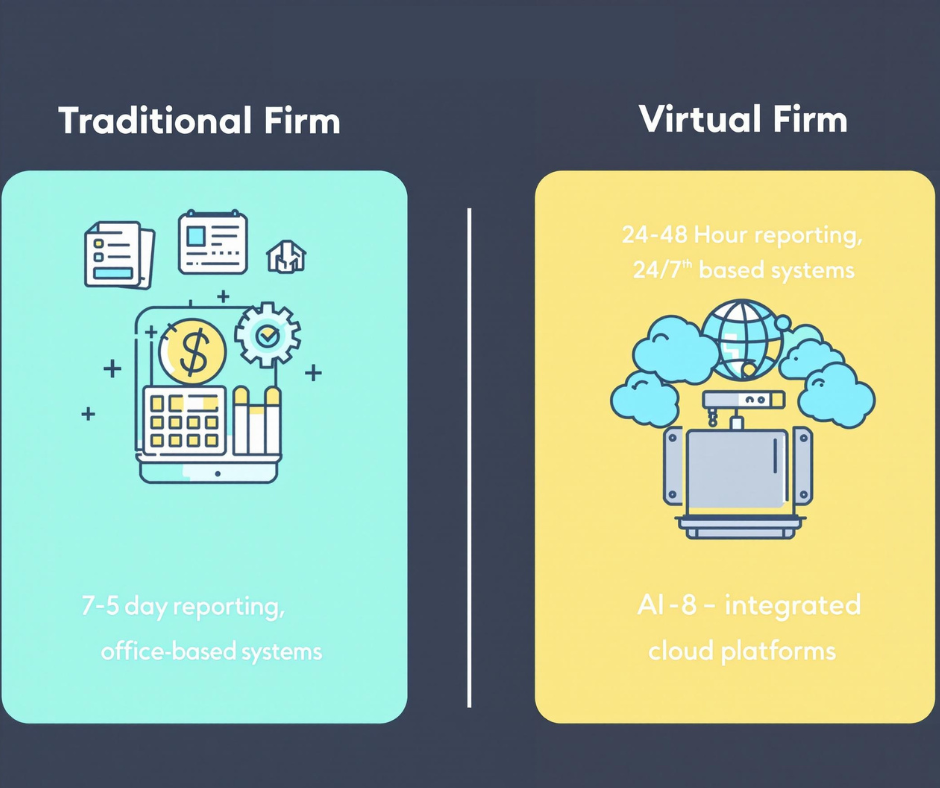
Technology Resilience and Remote Access The shift to remote work during recent global disruptions highlighted the critical importance of cloud-based financial systems. Businesses with outdated, location-dependent accounting systems faced significant operational challenges when physical offices became inaccessible.
Our seamless integration expertise with top accounting software ensures businesses can maintain full financial operations regardless of physical location. Cloud-based solutions like QuickBooks Online and Xero provide the accessibility and security needed for continuous financial management during disruptions.
Financial Process Automation Manual financial processes become major vulnerabilities during disruptions when key personnel may be unavailable. Automation not only improves efficiency during normal operations but provides critical continuity capabilities during crises.
We help businesses identify and automate key financial processes, from invoice generation to payment processing, ensuring essential financial functions continue even when staffing is disrupted. This automation also reduces the risk of errors during high-stress periods when manual oversight may be limited.
Multi-Country Continuity Strategies
Regulatory Compliance During Disruptions Businesses operating in multiple countries must navigate varying regulatory responses during crises. Some jurisdictions may offer tax relief or compliance extensions, while others maintain strict deadlines regardless of circumstances.
Our global expertise across 6+ countries enables us to help businesses understand and leverage available regulatory relief while maintaining compliance where flexibility isn’t available. This includes managing tax obligations, employment law requirements, and financial reporting standards across different jurisdictions.
Currency Risk Management in Crisis Situations Economic disruptions often trigger significant currency volatility, which can severely impact businesses with international operations. Companies that don’t actively manage currency risk may find their financial position deteriorating rapidly during crises.
We provide comprehensive currency risk management strategies that include hedging techniques, natural hedging through operational adjustments, and scenario planning for different currency movement patterns. These strategies help businesses maintain financial stability even when currency markets become highly volatile.
Stress Testing and Scenario Planning
Financial Stress Testing Methodologies Effective business continuity planning requires understanding how your business would perform under various stress scenarios. This goes beyond simple “what if” discussions to include quantitative analysis of different disruption levels and durations.
Our ratio analysis expertise helps businesses identify key financial vulnerabilities and stress test their business models against various scenarios. This includes analyzing debt service capabilities, working capital requirements, and profitability thresholds under different operating conditions.
Dynamic Scenario Planning Static business continuity plans quickly become obsolete as conditions change. Effective continuity planning requires dynamic scenario modeling that can be updated as new information becomes available during a crisis.
We help businesses develop flexible scenario planning frameworks that can be quickly adjusted as disruptions evolve. This includes creating decision trees for different response options and establishing trigger points for implementing various contingency measures.
Financial Communication During Crises
Stakeholder Communication Strategies During disruptions, clear and timely communication with financial stakeholders becomes critical. This includes investors, lenders, suppliers, and customers who all need to understand how the business is managing through the crisis.
Our financial reporting expertise helps businesses develop crisis communication protocols that provide transparency while maintaining confidence. This includes preparing standardized reports that can be quickly updated and distributed to different stakeholder groups.
Investor Relations During Disruptions Businesses with external investors face additional communication challenges during crises. Investors need regular updates on financial performance, cash flow projections, and management actions being taken to address the disruption.
We help businesses develop investor communication frameworks that provide appropriate transparency while managing expectations. This includes preparing financial projections that account for uncertainty and clearly communicating the assumptions underlying these projections.
Post-Crisis Financial Recovery Planning Business continuity planning must extend beyond simply surviving the crisis to include strategies for recovery and growth. Businesses that plan for recovery during the crisis often emerge in stronger competitive positions.
Our strategic financial planning services help businesses identify recovery opportunities and develop financial strategies to capitalize on them. This includes assessing acquisition opportunities, planning for market share gains, and optimizing capital structure for post-crisis growth.
Building Resilience for Future Disruptions Each crisis provides valuable lessons that can be incorporated into improved continuity planning. Businesses that learn from each disruption become increasingly resilient over time.
We help businesses conduct post-crisis financial reviews that identify areas for improvement in their continuity planning. This includes analyzing what worked well, what could be improved, and how financial systems and processes can be strengthened for future disruptions.
Technology and Innovation in Continuity Planning
AI and Predictive Analytics Advanced technologies are increasingly being used to improve business continuity planning. AI-powered analytics can identify early warning signals and predict potential disruptions before they fully materialize.
We help businesses leverage technology to enhance their continuity planning capabilities. This includes implementing predictive analytics for cash flow forecasting and using AI to identify potential risk factors that might not be apparent through traditional analysis.
Blockchain and Financial Security Emerging technologies like blockchain offer new possibilities for maintaining financial security and continuity during disruptions. These technologies can provide enhanced security and transparency for financial transactions even when traditional systems are compromised.
Industry-Specific Continuity Considerations
Manufacturing and Supply Chain Finance Manufacturing businesses face unique continuity challenges related to inventory management, supplier financing, and production scheduling. Financial continuity planning must account for these operational complexities.
Professional Services Continuity Professional services firms must balance client service continuity with financial management during disruptions. This often requires flexible billing arrangements and modified service delivery models.
Technology and Software Companies Tech companies may face different continuity challenges related to subscription revenue models, development costs, and rapid scaling requirements during and after disruptions.
Measuring Continuity Plan Effectiveness
Key Performance Indicators for Continuity Effective continuity planning requires measurable objectives and regular assessment of plan effectiveness. This includes financial metrics like cash flow stability, operational metrics like service delivery continuity, and strategic metrics like market position maintenance.
Regular Plan Testing and Updates Business continuity plans must be regularly tested and updated to remain effective. This includes conducting financial stress tests, reviewing scenario assumptions, and updating response procedures based on changing business conditions.
The Veritas Advantage in Continuity Planning
Our decade of experience with 1000+ successful projects provides unique insights into what works in business continuity planning. We’ve helped businesses navigate various types of disruptions, from economic downturns to regulatory changes to global pandemics.
Our global presence across multiple countries gives us firsthand experience in managing continuity challenges across different regulatory environments and market conditions. This experience enables us to help businesses develop truly comprehensive continuity strategies that account for global complexities.
Implementation Framework
Phase 1: Risk Assessment and Gap Analysis We begin by conducting comprehensive risk assessments that identify potential disruption sources and evaluate current continuity preparedness. This includes analyzing financial vulnerabilities, operational dependencies, and regulatory requirements.
Phase 2: Strategy Development Based on the risk assessment, we develop customized continuity strategies that address identified vulnerabilities while maintaining operational efficiency during normal conditions.
Phase 3: Implementation and Testing We provide hands-on support during strategy implementation and help businesses conduct regular testing to ensure plans remain effective.
Phase 4: Ongoing Monitoring and Improvement Continuity planning is an ongoing process that requires regular review and updates. We provide continuous monitoring and improvement services to ensure plans evolve with changing business conditions.
Conclusion: Building Unshakeable Financial Resilience
In today’s uncertain business environment, robust financial continuity planning isn’t optional—it’s essential for long-term success. Businesses that invest in comprehensive continuity strategies not only survive disruptions but often emerge stronger and more competitive.
At Veritas Accounting, we combine global expertise with local market knowledge to help businesses build unshakeable financial resilience. Our comprehensive approach addresses all aspects of financial continuity, from emergency cash flow management to post-crisis recovery planning.
Don’t wait for the next disruption to test your business’s resilience. Contact Veritas Accounting today to develop a comprehensive financial continuity plan that protects your business and positions it for long-term success.
Contact Veritas Accounting:
Headquarters: C-305, The Imperial Heights, 150ft Ring Road, Rajkot
US Office: 8735 Dunwoody Place – 4549, Atlanta, GA
The accounting firms industry is experiencing its most dramatic shift in decades, and the numbers tell a compelling story. As we reach the midpoint of 2025, data reveals that traditional accounting firms are hemorrhaging clients to virtual accounting services at an unprecedented rate. This isn’t just a temporary trend—it’s a fundamental transformation that’s reshaping how businesses approach financial management.
Recent industry analysis shows that 68% of small to medium enterprises have either switched to virtual accounting services or are actively considering the transition. This massive shift represents more than just cost considerations; it reflects changing business expectations, technological advancement, and evolving work patterns that traditional firms have struggled to accommodate.
The Great Migration: Understanding the Numbers
The accounting industry is undergoing a rapid transformation—and recent trends show just how significant the shift has become. Virtual accounting services are experiencing exponential growth, especially among businesses with annual revenues between $1 million and $10 million. Industry observers note a sharp increase in adoption rates, driven by a growing dissatisfaction with the limitations of traditional accounting firms.
One of the clearest indicators of this shift is client retention. While traditional firms often see average retention rates hovering around 70%, virtual accounting providers are reportedly maintaining much higher loyalty levels, thanks to faster service, integrated technology, and flexible communication models. This growing retention gap is a clear signal: more businesses are not just trying virtual solutions—they’re sticking with them.
The geographic distribution of this trend is particularly interesting. While initially concentrated in tech-forward markets like California and New York, the adoption of virtual accounting services has spread globally. Countries like the UK, Australia, Singapore, and the UAE are experiencing similar migration patterns, with businesses increasingly seeking accounting partners who can operate across multiple jurisdictions seamlessly.
Service Delivery Speed: The New Competitive Battleground
One of the most significant factors driving client migration is the stark difference in service delivery timelines. Traditional accounting firms, constrained by physical office limitations and conventional business hours, typically require 5-7 business days for standard bookkeeping tasks and up to 15 days for comprehensive financial reporting.
Virtual accounting services have revolutionized these timelines through cloud-based operations and strategic global workforce distribution. Tasks that once took a week can now be completed within 24-48 hours, with some routine processes handled in real-time. This acceleration isn’t just about speed—it’s about enabling businesses to make timely decisions based on current financial data rather than outdated information.
The impact extends beyond mere convenience. In today’s volatile economic environment, businesses need agile financial management that can adapt quickly to market changes. A company facing cash flow challenges can’t afford to wait two weeks for updated financial statements. They need immediate insights that enable rapid decision-making and course correction.
Consider the experience of a typical e-commerce business managing inventory across multiple platforms. Traditional accounting firms often struggle with the complexity of multi-platform revenue tracking, currency conversions, and real-time inventory valuation. Virtual accounting services, equipped with advanced software integrations and specialized expertise, can provide daily financial snapshots that enable dynamic inventory management and pricing strategies.
Technology Integration: Beyond Basic Software
The technology gap between traditional and virtual accounting services has widened significantly throughout 2025. While many traditional firms have adopted cloud-based software, their implementation often lacks the sophisticated integration capabilities that modern businesses require.
Virtual accounting services leverage comprehensive software ecosystems that seamlessly connect QuickBooks, Xero, Wave, and Zoho Books with banking platforms, payment processors, inventory management systems, and customer relationship management tools. This integration creates a unified financial ecosystem where data flows automatically between systems, reducing manual entry errors and providing real-time financial visibility.
The certification advantage is particularly pronounced in this area. While traditional firms may have basic software knowledge, virtual accounting services often maintain advanced certifications across multiple platforms. This expertise enables them to optimize software configurations for specific business needs, implement advanced automation workflows, and troubleshoot complex integration challenges that would stump less specialized providers.
Artificial intelligence integration represents another significant differentiator. Virtual accounting services are at the forefront of AI implementation, using machine learning algorithms for expense categorization, fraud detection, and predictive cash flow analysis. Traditional firms, often constrained by legacy systems and resistance to change, lag significantly in AI adoption, leaving their clients without access to these powerful analytical tools.
Global Reach vs. Local Limitations
The globalization of business has created accounting needs that traditional local firms simply cannot address effectively. A business operating across multiple countries faces complex challenges including multi-currency transactions, varying tax regulations, international compliance requirements, and cross-border financial reporting standards.
Traditional accounting firms, typically focused on local markets, lack the infrastructure and expertise to handle international complexities. They often resort to partnering with foreign firms, creating communication delays, coordination challenges, and increased costs that ultimately burden their clients.
Virtual accounting services, particularly those with established operations across multiple countries, offer seamless international support. They understand the nuances of different regulatory environments, maintain current knowledge of international tax treaties, and can provide unified reporting across multiple jurisdictions. This global perspective enables businesses to expand internationally with confidence, knowing their accounting partner can support their growth.
The time zone advantage cannot be understated. While traditional firms operate within standard business hours, virtual accounting services can provide round-the-clock support through strategically distributed teams. A business in New York can have their books updated overnight by a team in India, with reports ready for review first thing in the morning. This continuous operation model accelerates business processes and enables faster decision-making.
Cost Efficiency Without Compromise
The cost comparison between traditional and virtual accounting services reveals significant advantages for virtual providers, but the story goes beyond simple price differences. Traditional accounting firms carry substantial overhead costs including office rent, utilities, local staff salaries, and physical infrastructure maintenance. These costs are inevitably passed on to clients through higher service fees.
Virtual accounting services operate with dramatically lower overhead costs while maintaining high service quality through strategic global workforce utilization. This cost efficiency enables them to offer comprehensive services at 30-50% lower rates than traditional firms without compromising quality or service levels.
The value proposition extends beyond hourly rates to include service comprehensiveness. Many virtual accounting services include advanced reporting, multi-software support, and strategic consultation as standard offerings, while traditional firms often charge separately for these services. When calculating total cost of ownership, the advantage of virtual services becomes even more pronounced.
Additionally, virtual accounting services typically offer more flexible pricing models, including fixed monthly rates that enable better budget predictability. Traditional firms often rely on hourly billing that can create unexpected cost fluctuations, particularly during busy periods or complex project work.
The Virtual CFO Revolution
Perhaps nowhere is the competitive advantage of virtual services more evident than in the Virtual CFO market. Traditional accounting firms have struggled to adapt their service models to provide strategic financial leadership, often lacking the expertise or infrastructure to deliver comprehensive CFO-level services to smaller businesses.
Virtual accounting services have revolutionized access to strategic financial guidance through Virtual CFO offerings that provide executive-level financial leadership at a fraction of the cost of hiring a full-time CFO. These services include strategic planning, financial forecasting, performance analysis, and growth strategy development—capabilities that were previously accessible only to large corporations.
The market response has been overwhelming. Businesses that previously operated without strategic financial guidance now have access to experienced financial professionals who can provide insights that drive growth and improve profitability. This democratization of strategic financial services represents a fundamental shift in how businesses approach financial management.
Recent client satisfaction surveys reveal telling differences between traditional and virtual accounting service experiences. Virtual accounting clients report higher satisfaction rates across multiple metrics including responsiveness (94% vs. 76%), service comprehensiveness (91% vs. 69%), and value for money (96% vs. 71%).
The communication advantage of virtual services is particularly noteworthy. While traditional firms often rely on scheduled meetings and phone calls, virtual services typically offer multiple communication channels including real-time chat, video conferencing, email support, and collaborative online platforms. This accessibility creates stronger client relationships and enables more responsive service delivery.
Client testimonials consistently highlight the proactive nature of virtual accounting services compared to the reactive approach of traditional firms. Rather than simply processing transactions and preparing reports, virtual services actively monitor financial performance, identify potential issues, and recommend strategic improvements.
Looking Forward: The Future Landscape
As we progress through 2025, the trends favoring virtual accounting services show no signs of slowing. Traditional firms face a critical decision point: adapt to the new competitive landscape or risk continued client erosion. Those that successfully transition to virtual service models may survive, but those that cling to outdated approaches will likely face continued decline.
The businesses that recognize this shift early and partner with established virtual accounting services position themselves for competitive advantage. They gain access to advanced technology, global expertise, cost efficiencies, and strategic guidance that enable growth and success in an increasingly complex business environment.
For businesses still relying on traditional accounting firms, the question isn’t whether to consider virtual alternatives—it’s how quickly they can make the transition to avoid falling behind competitors who have already embraced the future of accounting services.
Ready to experience the virtual accounting advantage? Contact Veritas Accounting Services at hello@veritasaccountingservices.com or +1(678) 723-6003 to discover how our global expertise and advanced technology can transform your financial management.
Launching a startup is an exciting yet financially demanding journey. One of the most critical milestones in this journey is securing funding. From angel investments to venture capital and government grants, the funding landscape in 2025 has become more sophisticated, requiring startups to present not just innovative ideas but solid financial groundwork.
At Veritas Accounting, we have helped hundreds of startups across the US, UK, UAE, Singapore, and other global markets prepare for funding with confidence. We provide practical, strategic financial solutions tailored for early-stage businesses.
Understanding the Startup Funding Landscape
In today’s funding environment, financial discipline matters as much as innovation. Investors expect startups to demonstrate financial maturity from day one. They evaluate compliance, accounting systems, and growth forecasts with a level of scrutiny that leaves no room for error.
Veritas helps startups establish the financial credibility investors look for through accurate bookkeeping, transparent financial reporting, and real-time visibility into cash flow. With our support, startups are well-positioned to attract funding while avoiding common financial pitfalls.
Phase 1: Pre-Funding Financial Preparation
1. Establishing Professional Accounting Systems
Moving beyond spreadsheets to robust platforms such as QuickBooks Online or Xero is critical. These systems offer automation, scalability, and audit-ready documentation.
At Veritas, we hold certifications in leading cloud accounting software, enabling seamless setup and integration tailored to your startup’s specific needs.
2. Creating Investor-Ready Financial Statements
Startups must prepare key financial documents including:
Profit and Loss (P&L) Statements
Balance Sheets
Cash Flow Statements
Detailed Financial Projections
Our team prepares investor-ready financials that meet the expectations of venture capitalists, angel investors, and institutional funders.
3. Developing Realistic Financial Projections
Investors are quick to spot overly optimistic projections. Veritas helps startups craft balanced, data-backed financial models that include:
Revenue and cost assumptions
Market sizing
Growth forecasting
Scenario and sensitivity analysis
Our Virtual CFO services ensure financial projections are both credible and compelling.
Phase 2: Types of Startup Funding & How to Prepare
Angel Investment Preparation
Angel investors offer initial funding from $25,000 to $100,000. However, they still expect:
Clear financial discipline
Basic internal controls
Transparent revenue tracking
We help you track expenses, recognise revenue correctly, and prepare valuation models that make equity discussions easier.
Venture Capital Readiness
Venture capital demands thorough financial and operational transparency. We assist with:
Due diligence checklists
Multi-jurisdiction tax compliance
Financial audits and documentation
Our venture capital preparation includes preemptive identification and resolution of financial risks that could delay funding.
Government Grants and Incentives
Many startups overlook non-dilutive capital in the form of government funding. Veritas helps:
Identify grant opportunities globally
Manage complex reporting requirements
Maximize incentive-based financing without giving up equity
Phase 3: Managing Finances During the Funding Process
Cash Flow Forecasting & Optimization
Funding rounds can take months to complete. During this time, poor cash flow management can put operations at risk. We support:
13-week rolling cash flow forecasts
Burn rate optimization
Strategic cost management
Our startup clients benefit from detailed cash flow modeling that ensures runway stability.
Regulatory Compliance and Risk Management
Operating across jurisdictions increases regulatory exposure. Veritas helps startups navigate:
International tax laws
Industry-specific compliance
Risk identification and mitigation frameworks
With our support, startups create strong internal controls that earn investor confidence.
Financial Controls & Governance
Professional investors want to see:
Segregation of duties
Financial oversight policies
Transparent board reporting
We implement scalable governance frameworks that align with your startup’s current size and growth trajectory.
Phase 4: Post-Funding Financial Strategy
Investor Reporting
Funding is just the beginning of financial accountability. Investors expect regular reporting, including:
Monthly or quarterly financial statements
Budget vs. actual analyses
KPI tracking and updates
We set up automated investor reporting workflows to reduce administrative overhead while maintaining transparency.
Scaling Financial Operations
Rapid growth introduces complexities:
Multi-currency accounting
Multiple revenue streams
Global expense management
Veritas helps implement scalable financial systems that grow with your business. Our cloud-based tools and process optimization ensure efficiency without compromising accuracy.
Strategic Financial Planning
After receiving funding, strategic planning becomes essential. We support startups with:
Budgeting and capital allocation
Strategic hiring and expansion modeling
Risk-adjusted scenario analysis
Our Virtual CFO support provides executive-level insight without the overhead of a full-time CFO.
Common Startup Funding Mistakes (And How Veritas Helps Avoid Them)
Inadequate Documentation: We implement systems that ensure all financial data is audit-ready and easy to access.
Unrealistic Valuation: Our market-aligned financial analysis tools help avoid overvaluation that turns off investors.
Poor Cash Flow Management: Veritas helps you extend your runway and allocate funds efficiently.
Ignoring Tax Compliance: We ensure you meet obligations across local and global jurisdictions.
Integrating Technology and Global Insight
Automation
We leverage tools for:
Predictive analytics
Automated categorization
Smart budgeting
This enhances decision-making and reduces manual error.
Global Financial Management
Startups operating internationally need:
Currency conversion automation
Compliance across jurisdictions
Multi-entity consolidation
Our global team provides cross-border financial management with deep local knowledge.
Building Sustainable Success and Planning for Exit
From inception, startups should prepare for future exits:
Clean financial records
Transparent ownership structures
Regulatory readiness
Veritas supports startups in preparing for M&A, IPOs, or other exit strategies, starting from day one.
Certified experts in QuickBooks, Xero, and cloud accounting systems
Virtual CFO and financial modeling services
Comprehensive support across funding stages, compliance, and scaling
Whether you are raising your first angel round or scaling post-Series A, Veritas delivers tailored startup accounting services that help you fund and grow confidently.
Let Veritas Be Your Financial Co-Founder
Ready to build a strong financial foundation and attract the right investors?
Contact Veritas Accounting Services: US Office: 8735 Dunwoody Place – 4549, Atlanta, GA Email: hello@veritasaccountingservices.com Phone: +1(678) 723-6003 (US), +91 9725552243 (India)
Let’s transform your vision into a funded, scalable business.