






Family Business Succession: How to Transfer Leadership Without Disrupting the Business
Building a family business can take decades.
The founder may have started with a small operation, built relationships with customers and employees, reinvested profits, survived difficult economic periods and gradually created an organization that supports an entire family.
Eventually, however, every successful family business faces an important question:
What happens when the person who built the business is ready to step away?
This is where family business succession becomes important.
A leadership transition is much more than changing the name of the person at the top. It can affect employees, customers, suppliers, ownership, financial decisions and the overall direction of the company.
If the transition is rushed, the business can lose valuable knowledge and create uncertainty among employees and customers.
If it is planned properly, the next generation can gradually take responsibility while the founder continues to provide guidance during the transition.
The objective is not simply to replace one leader with another.
It is to create a business that can continue performing successfully after the founder’s role changes.
Table of Contents
- Why Succession Planning Should Start Early
- Leadership and Ownership Are Different
- Choosing the Right Successor
- Preparing the Next Generation
- Create a Gradual Leadership Transition
- Protect Employees and Customer Relationships
- Prepare the Business Financially
- Review Ownership and Tax Considerations
- Document the Founder’s Knowledge
- What If the Next Generation Is Not Ready?
- The Role of Professional Advisors
- A Practical Succession Roadmap
- FAQ
- Conclusion
Why Succession Planning Should Start Early
One of the biggest mistakes families make is waiting until the founder is ready to retire before starting the conversation.
At that point, there may be limited time to train a successor, restructure ownership, document processes or resolve disagreements among family members.
Good family business succession planning can begin years before an actual transition.
Starting early gives the business time to:
- Identify potential successors
- Develop leadership capabilities
- Improve financial reporting
- Document critical processes
- Clarify ownership expectations
- Review tax considerations
- Communicate with important stakeholders
- Create contingency plans
Starting early also gives the founder an opportunity to test the transition gradually.
A potential successor can take responsibility for a department, major customer relationship or strategic project while the founder remains available as a mentor.
This creates a much more controlled transition than simply announcing a new leader on a particular date.
Leadership and Ownership Are Different
One of the most important considerations in family business succession is understanding that ownership and leadership do not have to be transferred together.
For example, parents may transfer ownership interests to their children while an experienced family member or non-family executive manages daily operations.
Another possibility is that one family member becomes CEO while another remains an owner but does not participate in management.
This distinction creates flexibility.
The best person to inherit ownership may not necessarily be the best person to manage employees, customers and operations.
Similarly, the strongest operational leader may not need to hold the majority ownership interest.
A well-designed family business succession plan should therefore answer two separate questions:
Who should own the business?
Who should run the business?
Sometimes the answer will be the same person.
Sometimes it should not be.
Choosing the Right Successor
Family relationships can make this decision difficult.
Parents may naturally want their children to continue the business. However, leadership should ultimately be based on capability, commitment and readiness.
Potential successors should be evaluated on:
- Leadership ability
- Industry knowledge
- Financial understanding
- Communication skills
- Strategic thinking
- Decision-making
- Employee management
- Customer relationships
- Ability to handle pressure
- Commitment to the long-term business
Being a family member does not automatically make someone ready to become the CEO.
A son or daughter may eventually become an excellent leader but still require additional experience and development.
A strong family business succession process identifies these gaps early instead of discovering them after the founder has already stepped away.
Preparing the Next Generation
A successor should understand more than the part of the company they currently manage.
If someone is expected to lead the entire organization, they should understand how different functions work together.
That includes:
- Sales
- Operations
- Finance
- Human resources
- Customer service
- Technology
- Cash flow
- Profitability
- Risk management
Financial understanding is especially important.
Future leaders should know how to read financial statements and understand the difference between revenue, gross profit, operating profit and cash flow.
They should also understand working capital, accounts receivable, debt and major business expenses.
This makes family business succession more than a leadership-development exercise. It becomes an opportunity to build the next generation of financially informed decision-makers.

Create a Gradual Leadership Transition
A sudden change at the top can create uncertainty.
Employees may ask whether their responsibilities will change. Customers may wonder whether service will remain consistent. Suppliers and lenders may want reassurance.
A gradual transition can reduce these concerns.
A practical approach may include four stages.
Stage 1: Observe
The successor works closely with the founder and learns how major decisions are made.
Stage 2: Participate
The successor takes responsibility for selected departments, customers or projects.
Stage 3: Lead
The successor begins making important operational decisions while the founder becomes less involved in daily activities.
Stage 4: Transition
The successor assumes primary leadership while the founder moves into an advisory, ownership or board role.
This approach gives everyone time to adjust.
It also allows the founder to discover whether the successor is genuinely ready before making the final transition.
Protect Employees and Customer Relationships
A business transition is not only an internal family matter.
Employees, customers, suppliers and other stakeholders may have strong relationships with the founder.
Some customers may have worked with the company for decades. Employees may have joined because they trusted the founder personally.
Therefore, communication should be part of the family business succession strategy.
Management should consider:
- When employees should be informed
- Which customers need personal communication
- How responsibilities will change
- Who will manage important relationships
- How customer service will remain consistent
- How employee concerns will be addressed
The objective is to create confidence.
The message should be that the business is changing leadership while preserving the strengths that made it successful.
Prepare the Business Financially
Financial readiness is one of the most overlooked aspects of succession planning.
Before a leadership or ownership transition, the company’s financial records should be reliable and current.
That includes:
- Accurate bookkeeping
- Reconciled bank accounts
- Properly recorded liabilities
- Updated accounts receivable
- Clear debt information
- Reliable financial statements
- Current budgets
- Cash-flow forecasts
- Management reporting
A successor should not have to depend entirely on the founder’s memory to understand the financial position of the company.
This is why financial preparation is an important part of family business succession.
Good financial records create institutional knowledge that stays with the organization even when people change.
They also help the family and its advisors evaluate the company’s value, financial capacity and future requirements.
Review Ownership and Tax Considerations
Ownership transfers can create significant financial, legal and tax considerations.
The appropriate structure depends on factors such as the country, business entity, ownership arrangement and method of transfer.
Potential areas to review may include:
- Business valuation
- Sale or transfer of ownership
- Gift considerations
- Estate planning
- Capital gains
- Tax basis
- Buy-sell agreements
- Financing arrangements
- Insurance
- Shareholder agreements
These matters should not be handled informally simply because the parties are family members.
The accounting team can provide financial information and support valuation analysis, while qualified legal and tax professionals can advise on the applicable structure and requirements.
Bringing these professionals into the family business succession process early can give the family more time to evaluate alternatives.
Document the Founder’s Knowledge
Founders often possess knowledge that never appears in the company’s manuals.
They know:
- Which customers require special attention
- Which suppliers are reliable
- How important relationships were established
- Why certain decisions were made
- Which employees have specialized knowledge
- How unusual operational problems are handled
This knowledge can disappear quickly when a founder steps away.
The solution is documentation.
Important processes should be written down and transferred gradually to the next generation.
Consider documenting:
- Customer onboarding
- Vendor management
- Financial approvals
- Billing and collections
- Banking procedures
- Payroll processes
- Month-end closing
- Tax coordination
- Key operating procedures
Documenting these processes makes the company less dependent on one individual.
It also makes the family business succession process significantly more manageable.
What If the Next Generation Is Not Ready?
Sometimes the preferred successor is simply not prepared.
That does not mean the business must be transferred immediately.
The family may consider:
- Extending the development period
- Hiring a non-family executive
- Creating a co-leadership arrangement
- Bringing in an external CEO
- Maintaining family ownership while professional managers run operations
- Selling the business in the future
The objective of family business succession should always be the long-term health of the company.
Family ownership can continue even if daily management is handled by an experienced non-family professional.
In some cases, that may actually protect both the business and family relationships.
The Role of Professional Advisors
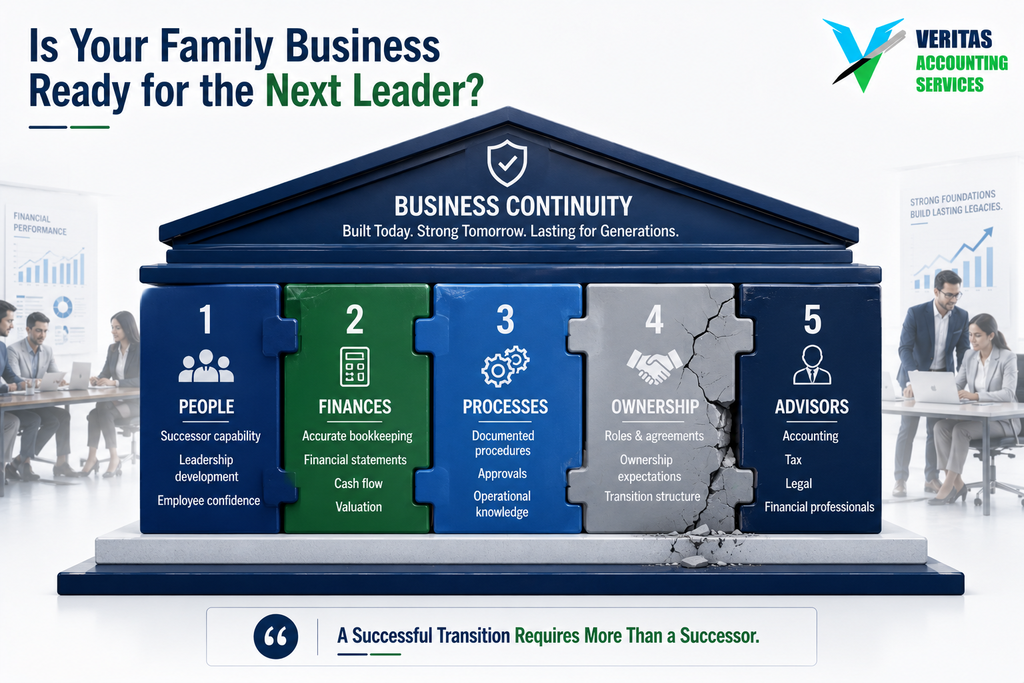
A successful transition often requires several different types of expertise.
An accountant can help ensure that the financial records are accurate and up to date.
A tax professional can evaluate the tax implications of potential ownership transfers.
A lawyer can assist with agreements and legal documentation.
A financial advisor can help with personal wealth and estate considerations.
A CFO or financial consultant can help management understand profitability, cash flow, valuation drivers and future financial requirements.
At Veritas Accounting Services, we support businesses with bookkeeping, accounting, financial reporting, budgeting, forecasting, tax support and CFO-related services.
During a transition, our role can include maintaining clean financial records, preparing management reports, analyzing business performance and giving the incoming leadership team reliable financial information.
This support can make family business succession less dependent on the founder’s personal knowledge.
The objective is not to replace the family’s role.
It is to give the family and incoming management better information for better decisions.
A Practical Succession Roadmap
A family business can begin preparing with this practical roadmap.
Step 1: Start the Conversation
Discuss long-term ownership and leadership expectations before an immediate transition becomes necessary.
Step 2: Identify Potential Successors
Evaluate family members and other potential leaders based on capability, interest and readiness.
Step 3: Develop the Successor
Provide exposure to different areas of the business and gradually increase responsibility.
Step 4: Strengthen Financial Reporting
Ensure bookkeeping, financial statements, cash-flow reports and management information are reliable.
Step 5: Document Critical Processes
Transfer important institutional knowledge from the founder to the organization.
Step 6: Review Legal and Tax Structures
Work with qualified professionals to evaluate ownership transfers and related considerations.
Step 7: Communicate With Stakeholders
Prepare employees, customers, suppliers and other key parties for the transition.
Step 8: Transfer Responsibility Gradually
Allow the successor to take increasing responsibility while the founder reduces day-to-day involvement.
Step 9: Define the Founder’s Future Role
The founder may become an advisor, board member, shareholder or completely step away.
Step 10: Review the Plan Regularly
Business conditions and family circumstances change, so the plan should be revisited periodically.
FAQ
What is family business succession?
Family business succession is the process of preparing for the future transfer of leadership, management and potentially ownership from one generation or group of family members to another.
When should a family business start succession planning?
Ideally, planning should begin several years before the expected transition. Early preparation gives the family time to develop successors, strengthen systems and address financial, legal and tax considerations.
Does the next generation have to run the business?
No. Ownership and management can be separated. A family can retain ownership while appointing a qualified family member or external professional to manage operations.
Why are financial records important during succession?
Accurate financial records help the incoming leadership team understand profitability, cash flow, assets, liabilities and the overall financial position of the business.
Can an accounting firm help with family business succession?
Yes. An experienced accounting firm can maintain accurate books, prepare financial statements, support business-performance analysis and provide management reporting. Tax and legal matters should be coordinated with the appropriate qualified professionals.
Conclusion
A family business represents more than financial assets.
It often represents decades of work, relationships, reputation and a family’s long-term financial future.
That is why family business succession should be approached as a planned business transition rather than a last-minute handover.
The strongest plans do not focus only on who will inherit the company.
They consider who should lead it, how that person will be prepared, how employees and customers will be protected, and whether the company’s financial and operational systems are ready for the next stage.
Start early.
Develop the next generation.
Separate ownership from management when appropriate.
Document important processes.
Strengthen financial reporting.
And involve qualified accounting, tax and legal professionals before major decisions are finalized.
At Veritas Accounting Services, we help businesses maintain accurate bookkeeping, accounting, financial reporting, budgeting, forecasting and outsourced finance support.
This gives current and future leaders reliable information to understand the business and make informed decisions.
Ultimately, successful family business succession is not about replacing one person with another.
It is about building an organization strong enough to succeed when the founder is no longer running the day-to-day business.
GET IN TOUCH
Schedule a FREE Call