






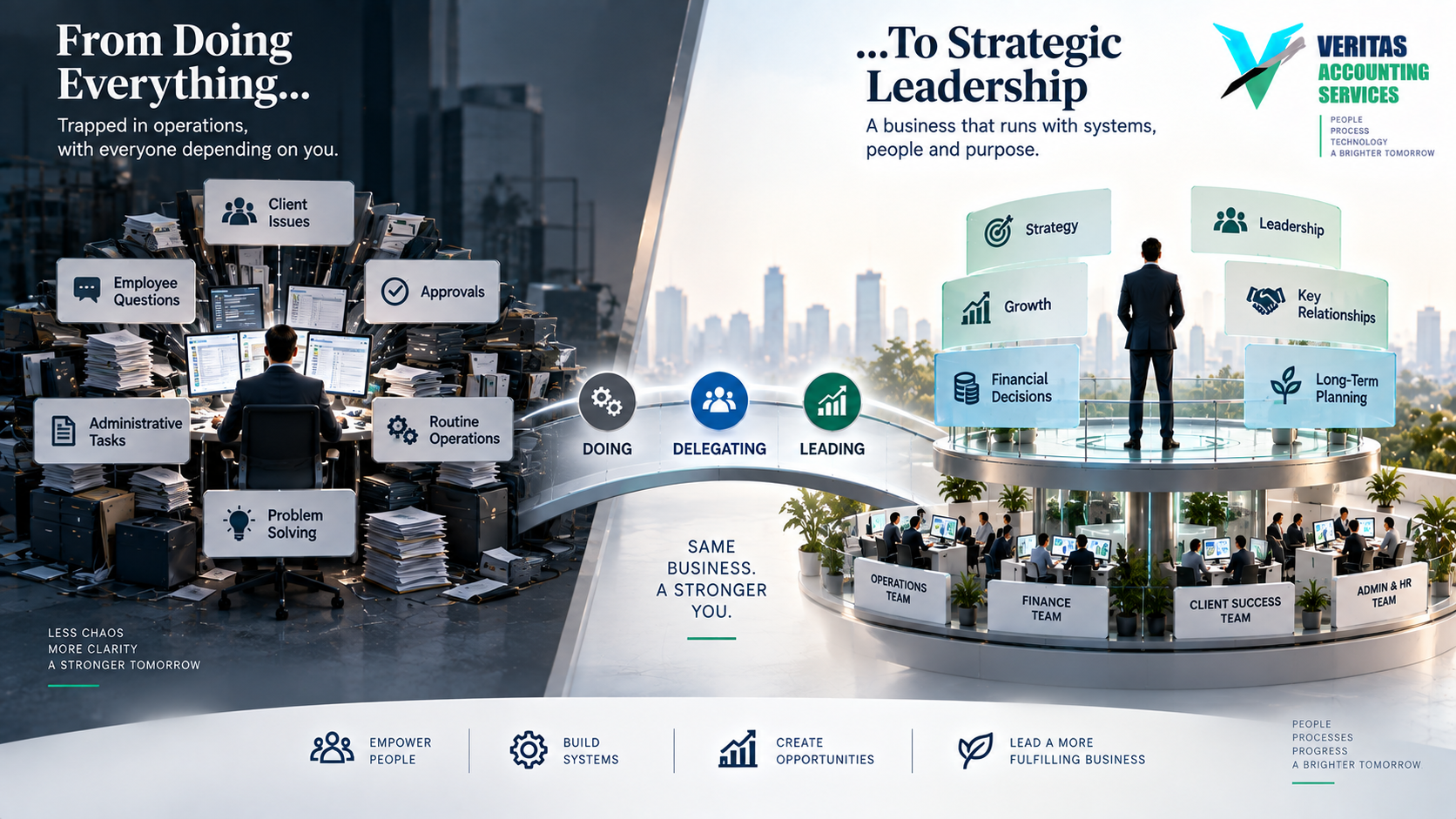

From Overworked Founder to Strategic Leader: How to Avoid Burnout
Building a business often starts with the founder doing almost everything.
You sell to the first clients, answer emails, manage employees, review accounts, solve customer problems, handle finances, make hiring decisions, and sometimes even take care of tasks that could easily be delegated.
In the early stages, this may be necessary.
But as the business grows, the same approach can become a problem.
The founder becomes the person everyone depends on. Every decision comes back to the owner. Every difficult client needs the founder’s attention. Every important approval waits for the founder. Even when the business is performing well, the person who built it may feel increasingly exhausted.
This is where founder burnout can begin.
The solution is not simply to work fewer hours. For many founders, the deeper issue is that the business has become too dependent on them personally.
Moving from an overworked founder to a strategic leader requires a change in how you spend your time, how decisions are made, how responsibilities are delegated, and how the organization operates when you are not involved in every detail.
What Founder Burnout Really Looks Like
Founder burnout is not always obvious.
It does not necessarily mean that someone has stopped working or completely lost interest in the business.
Sometimes it looks like constant availability.
You may find yourself checking messages late at night, thinking about unresolved problems during weekends, jumping into employee issues that should have been handled by managers, or repeatedly switching between strategic work and small operational tasks.
Another warning sign is that you are busy all day but struggle to identify what important progress you actually made.
The founder may also become the bottleneck for the organization. Employees wait for approvals, clients expect direct access, and routine decisions keep coming back to the same person.
This creates a cycle:
More growth → More responsibility → More dependence on the founder → Less strategic time → Greater exhaustion.
Breaking that cycle requires more than taking a weekend off.

The Real Problem: The Business Depends Too Much on You
One of the biggest causes of founder burnout is a business model built around the founder’s constant involvement.
If every important decision requires your approval, you have not really built a scalable organization. You have created a larger job for yourself.
Ask yourself:
What happens if I am unavailable for three days?
Can my team handle routine client questions?
Can someone approve ordinary expenses without me?
Can employees solve common problems without asking me?
Can a manager review work and maintain quality?
Can the business continue operating if I step away for a week?
Your answers can reveal how dependent the business has become on you.
Founder burnout often becomes less about the number of hours worked and more about the number of decisions carried personally by the founder.
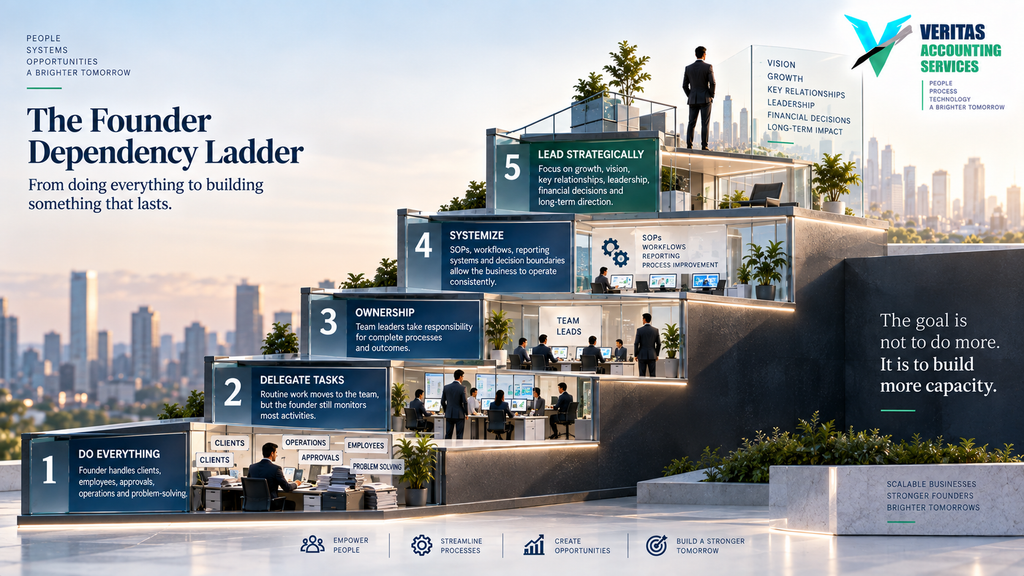
1. Separate Founder Work From Employee Work
The first step toward becoming a strategic leader is understanding what only you should be doing.
Not every task deserves your attention simply because you can do it.
A founder’s responsibilities should increasingly move toward areas such as:
- Vision and business direction
- Key client relationships
- Strategic partnerships
- Major financial decisions
- Leadership and culture
- Hiring key people
- Business development
- Risk management
- Long-term planning
Routine bookkeeping, scheduling, follow-ups, data entry, basic reporting, administrative work, and repetitive approvals may be important, but they do not necessarily require the founder.
When founders continue doing work that someone else could reasonably handle, they reduce the time available for decisions that can actually move the business forward.
This is one of the most important ways to reduce founder burnout.
2. Stop Being the Approval Department
Many founders unintentionally create an organization where almost everything requires their approval.
A small expense needs approval.
A client email needs review.
An employee wants to make a decision.
A vendor needs confirmation.
A routine accounting issue comes back to the owner.
Individually, these decisions seem small. Collectively, they consume enormous amounts of attention.
Create clear decision boundaries instead.
For example, a manager might be authorized to resolve client issues within a defined scope. An accounts manager might approve routine expenses up to a specific threshold. Team leaders may be responsible for reviewing work before it reaches the founder.
The goal is not to remove control.
The goal is to move control from individual decisions to clear systems.
That shift can significantly reduce founder burnout because the founder no longer needs to be involved in every operational choice.
3. Build Systems Before You Need Them
Founders often rely on personal knowledge.
You know how a client prefers their report.
You know which employee handles a particular task.
You remember how a recurring problem was solved six months ago.
You may even have a mental checklist for processes that nobody else can see.
That knowledge feels efficient when the company is small. But it becomes a risk as the organization grows.
Document recurring processes.
Create simple standard operating procedures for important activities such as:
Client onboarding
Monthly closing
Quality review
Invoice approval
Employee onboarding
Customer communication
Escalation procedures
Reporting
Tax document collection
When processes are documented, employees can operate with greater independence.
This does not eliminate the founder’s role. It changes the role from solving the same problem repeatedly to improving the system that prevents the problem.
That is a healthier approach to founder burnout.
4. Delegate Outcomes, Not Just Tasks
Delegation is often misunderstood.
A founder may say, “Please prepare this report,” and then continue checking every step.
That is not really delegation. It is task assignment with the founder still carrying the responsibility.
Effective delegation means giving someone ownership of an outcome.
Instead of:
“Prepare this report.”
Try:
“Own the monthly reporting process. Make sure the report is accurate, completed by the fifth business day, reviewed internally, and delivered to the client.”
The second approach creates accountability.
It also gives the employee room to determine how the work should be completed.
The founder should then review results rather than controlling every action.
This is one of the most practical ways to move away from founder burnout.
5. Create a Management Layer
A business can only scale so far when the founder directly manages everyone.
As the team grows, a management layer becomes increasingly important.
This does not necessarily mean hiring a large number of managers.
Even one capable team leader or manager can change the founder’s workload significantly if that person can:
- Assign work
- Review quality
- Answer routine questions
- Monitor deadlines
- Coach employees
- Escalate genuine problems
- Report meaningful issues to the founder
The founder should increasingly receive exceptions and decisions, rather than every individual problem.
This creates leverage.
Instead of managing ten people directly, the founder may manage two or three leaders who manage their respective areas.
6. Protect Strategic Thinking Time
One of the biggest problems with founder burnout is that the entire day gets consumed by operational work.
A founder may spend eight hours answering messages and solving immediate problems, then try to think about strategy at 10 p.m.
That is not sustainable.
Strategic work requires uninterrupted thinking.
Block time during the week for activities such as:
- Reviewing financial performance
- Planning growth
- Developing new services
- Evaluating pricing
- Building partnerships
- Reviewing hiring needs
- Improving processes
- Thinking about the next 12 months
Treat this time as a business responsibility, not personal free time.
If strategic work is always postponed until everything else is finished, it will rarely happen.
Protecting thinking time is therefore an important defense against founder burnout.
7. Learn to Say No
As the business grows, opportunities increase.
New clients.
New services.
New partnerships.
New markets.
New software.
New projects.
Not every opportunity deserves a yes.
Founders often say yes because they are afraid of missing growth opportunities. But every commitment consumes time, money, management attention, or organizational capacity.
Before accepting a new opportunity, ask:
Does this support our strategy?
Do we have the capacity?
Will this distract the team?
Is the expected return worth the complexity?
Does this move the business closer to where we want it to be?
Strategic leadership requires choosing what not to do.
Learning to say no can protect the founder’s time and reduce unnecessary founder burnout.
8. Build a Business That Can Function Without You
A useful test of leadership is what happens when you step away.
Take a short break and observe.
Do employees continue working?
Do clients receive responses?
Are deadlines met?
Are routine decisions handled?
Does someone know what needs to be escalated?
If everything stops when the founder leaves, the business has a dependency problem.
The objective is not to make the founder irrelevant.
A strong founder should remain important for vision, leadership, relationships, and major decisions.
But the organization should not require the founder to personally operate every process.
The more the business can function without constant founder intervention, the more valuable the founder’s time becomes.
9. Measure Results Instead of Activity
Founders can easily fall into the trap of measuring productivity by hours worked.
But working 12 hours does not necessarily mean creating more value than working eight focused hours.
Instead, monitor outcomes.
Ask:
Did revenue improve?
Did client retention improve?
Did the team become more productive?
Did margins improve?
Did quality improve?
Did a process become more efficient?
Did the business become less dependent on one person?
This shift from activity to outcomes can help founders spend less time being busy and more time being effective.
It is also a practical way to address founder burnout without simply reducing ambition.
10. Take Recovery Seriously
Systems and delegation matter, but the founder also needs time to recover.
Taking breaks is not a sign that the business is less important.
In fact, continuous exhaustion can reduce decision quality, patience, creativity, and leadership effectiveness.
Recovery can take different forms.
It may mean taking a full weekend away from work, exercising regularly, spending uninterrupted time with family, taking a vacation, or simply creating periods when business communication is intentionally paused.
The specific approach will differ from one person to another.
The important principle is that recovery should be treated as part of sustainable leadership rather than something that happens only after the business reaches a crisis point.
The Shift From Founder to Strategic Leader
The transition can be summarized simply.
An overworked founder asks:
“What needs me today?”
A strategic leader asks:
“What should only I be doing?”
That is a powerful difference.
The founder’s job gradually changes from personally completing work to building an organization capable of producing results consistently.
Instead of solving the same problem every week, build a process.
Instead of answering every question, develop capable people.
Instead of approving everything, establish decision limits.
Instead of reacting to today’s problems all day, protect time for tomorrow’s opportunities.
That is how a founder creates leverage.
A Practical Weekly Framework
A simple weekly structure can help founders begin the transition.
Start the week by reviewing the most important business priorities.
Then identify which decisions genuinely require founder involvement.
Delegate operational responsibilities to the appropriate team members.
Reserve uninterrupted time for strategic work.
At the end of the week, review what consumed your time.
Ask yourself:
What did I do that someone else could have handled?
What decision came to me unnecessarily?
What recurring problem needs a better process?
What important strategic work did I postpone?
Those answers can reveal where the next delegation or system improvement should happen.
Over time, these small changes can significantly reduce founder burnout.
Frequently Asked Questions
Is founder burnout only caused by working long hours?
No. Long hours can contribute, but burnout can also result from constant decision-making, lack of delegation, operational dependency, unclear priorities, and the inability to disconnect from the business.
How do I know what to delegate first?
Start with repetitive tasks that consume significant time but do not require the founder’s unique expertise. Then gradually delegate responsibilities where a capable team member can own the outcome.
Will delegating reduce my control?
Good delegation should not mean losing control. Clear responsibilities, approval limits, reporting systems, and quality checks can provide visibility without requiring involvement in every decision.
How can a small business reduce founder dependency?
Start by documenting recurring processes, assigning ownership, creating clear decision boundaries, training team members, and developing at least one person who can handle routine operational matters.
Can a founder still be deeply involved without experiencing burnout?
Yes. The objective is not complete withdrawal. It is to ensure that the founder spends more time on high-value leadership activities and less time on work that can be handled by the team.
Conclusion
The journey from an overworked founder to a strategic leader does not happen overnight.
It begins with recognizing that personal effort cannot be the primary engine of growth forever.
As the business becomes larger, the founder must gradually move away from being the person who solves every problem and toward being the person who builds the people, systems, and decisions that prevent those problems from repeatedly reaching the top.
Reducing founder burnout is therefore not simply about taking more time off. It is about building a business that does not require the founder’s constant presence to function.
Delegate outcomes. Document processes. Build capable managers. Protect strategic thinking time. Measure results instead of hours. And create enough organizational strength that you can step away without everything stopping.
At Veritas Accounting Services, we believe sustainable growth requires more than working harder. Strong systems, reliable financial processes, capable teams, and clear management responsibilities allow business owners to spend more time leading the business and less time being trapped inside its daily operations.
The goal is not to build a business that needs you every hour. The goal is to build a business that grows because you are leading it well.
GET IN TOUCH
Schedule a FREE Call








Connect on our Socials!
