








IRS Notice vs IRS Audit: How to Understand the Difference
Receiving communication from the Internal Revenue Service can make any business owner pause. However, an IRS notice and an IRS audit are not the same thing. They can involve very different questions, levels of review, and responses.
Understanding the difference can help you determine what needs immediate attention, what documents to gather, and when professional assistance may be appropriate.
An IRS notice is generally a written communication about a taxpayer’s account or return. It may address a balance due, a change to a return, a refund, a request for information, or another tax matter. An audit, also called an examination, is a formal review of information reported on a tax return and supporting records. The IRS conducts audits by mail or in person.
For business owners, the key is not to react simply because a letter comes from the IRS. Instead, read the communication carefully, identify what the IRS is asking, and respond according to the specific instructions.
Table of Contents
- What Is an IRS Notice?
- What Is an IRS Audit?
- IRS Notice vs IRS Audit: The Key Difference
- Common Reasons You May Receive an IRS Notice
- What Happens During an IRS Audit?
- Does an IRS Notice Always Lead to an Audit?
- How Should You Respond to an IRS Notice?
- How Should You Prepare for an IRS Audit?
- When Should You Involve a Tax Professional?
- Common Mistakes to Avoid
- Frequently Asked Questions
- Conclusion
What Is an IRS Notice?
An IRS notice is a written communication sent to a taxpayer about a specific tax account or issue. The IRS may send a notice because there is a balance due, a refund has changed, the agency has a question about a return, information needs to be verified, or a return has been corrected.
The notice normally identifies the taxpayer, tax period, issue involved, and any action required. Some notices require no response if the taxpayer agrees with the information. Others ask for payment, documentation, clarification, or a response by a stated date.
This means an IRS notice can be relatively straightforward. For example, the IRS may notify a business that information reported on a return does not match information received from another source. The appropriate response may be to review the notice against the accounting records and tax return.
The important point is that receiving an IRS notice does not automatically mean the taxpayer is being audited.
What Is an IRS Audit?
An IRS audit is an examination of a tax return to determine whether income, expenses, deductions, credits, and other reported items are accurate and properly supported.
The IRS may conduct an audit by correspondence, generally through written requests for supporting information, or through an office or field examination. The initial contact for an audit is by mail, and the letter provides instructions about the records or information requested.
An audit can focus on particular items rather than every transaction on a return. For example, the IRS may request documentation supporting a deduction, credit, business expense, income item, or other tax position.
Being selected for an audit does not by itself mean the taxpayer did something wrong. The IRS explains that returns can be selected using methods that include random sampling, computerized screening, and comparison with information received from other sources.
IRS Notice vs IRS Audit: The Key Difference
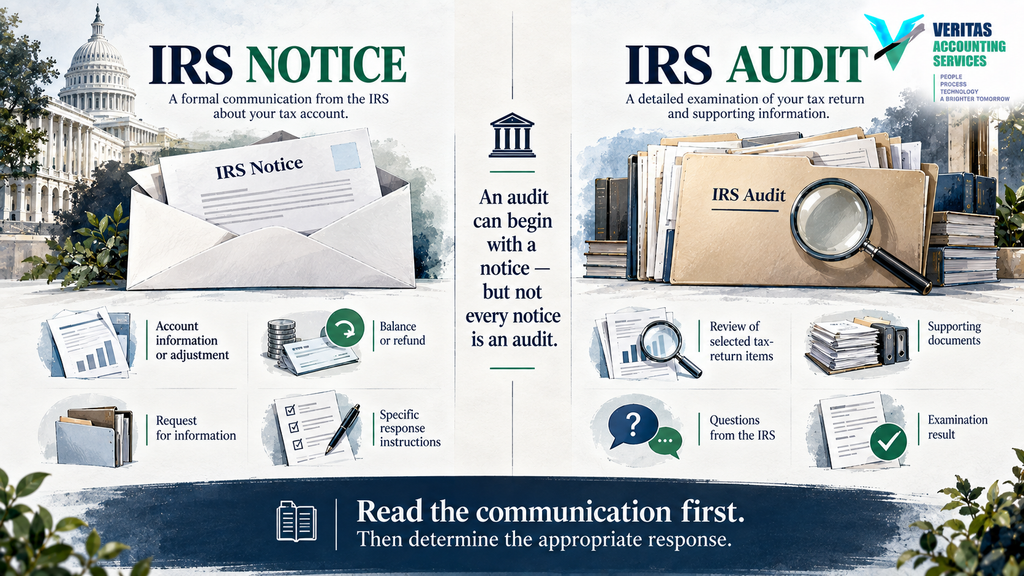
The simplest way to understand the distinction is to look at the purpose and scope of the communication.
An IRS notice is a broad category of IRS correspondence. It can inform you about an account change, request information, explain a balance, or ask you to take a specific action.
An audit is a specific examination process. Its purpose is to review selected items on a return and determine whether they are correctly reported and supported.
In practical terms, an IRS notice may be the starting point for many different tax matters, while an audit involves a defined examination of tax-return information.
There is another important point: an audit can begin with an IRS notice. In other words, an audit notice is still an IRS notice, but not every IRS notice is an audit notice.
This distinction matters because the response strategy should depend on what the communication actually says rather than the taxpayer’s assumption about what it means.
Common Reasons You May Receive an IRS Notice
Businesses and individuals can receive an IRS notice for many reasons. The specific reason depends on the taxpayer’s account and the tax period involved.
One common situation is a discrepancy between information reported on a tax return and information the IRS received from another source. Another may involve a balance due, a refund adjustment, identity verification, or a question about a particular item.
A notice may also explain that the IRS changed or corrected information on a return. In that situation, the taxpayer should compare the notice with the original return and supporting records before deciding what to do.
For example, a business owner may receive an IRS notice concerning reported income. Before responding, the owner should compare the amount with the bookkeeping records, bank deposits, payment processor reports, invoices, and filed tax return.
The safest approach is to focus on the exact notice number, tax year, issue, and response instructions rather than assuming every IRS letter represents an audit.
What Happens During an IRS Audit?
The audit process depends on the type of examination.
Correspondence Audit
A correspondence audit is handled primarily through written communication. The IRS letter identifies the items being reviewed and requests supporting documents. The taxpayer generally provides copies of the requested records according to the instructions.
For example, if a tax credit is being examined, the IRS may request documents supporting eligibility for that credit. The taxpayer should provide relevant documentation rather than unrelated records.
Office Audit
An office audit involves an interview at an IRS office. The taxpayer may be asked to bring specific books, records, receipts, statements, or other documentation.
The taxpayer should organize the records before the meeting and understand which items are being examined.
Field Audit
A field audit is generally conducted at the taxpayer’s home, place of business, or representative’s office. This type of examination can involve a broader review of business records and operations.
The IRS states that an audit can conclude with no change, with agreed changes, or with proposed changes that the taxpayer disagrees with. Taxpayers have rights during the process, including the right to representation and the right to appeal certain disagreements.
Does an IRS Notice Always Lead to an Audit?
No. An IRS notice does not automatically mean that an audit will follow.
The IRS sends notices for many ordinary administrative and tax-account matters. Some require a response, while others are simply informational.
However, certain notices can be connected to an examination. For example, an IRS notice may request documentation to verify particular income, deductions, or credits. If the requested information does not substantiate the item under review, the IRS may propose changes and issue an examination report.
That is why the taxpayer should identify the exact purpose of the communication before deciding how serious the situation is.
An IRS notice requesting supporting documentation may require more attention than a simple informational letter, but the taxpayer should still rely on the actual wording and instructions in the communication.
How Should You Respond to an IRS Notice?
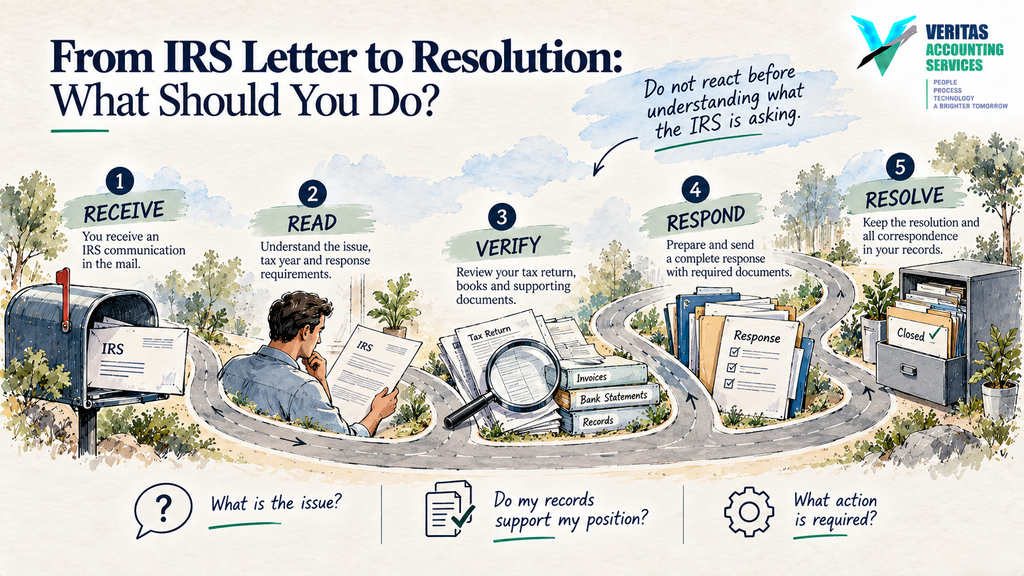
The first step is to slow down and read the entire communication. Do not respond based only on the amount shown or the first paragraph.
Start by confirming the tax year, notice number, taxpayer name, and reason for the communication. Then determine whether the IRS is asking for payment, documentation, clarification, or simply notifying you of a change.
Next, compare the notice with the filed tax return and your accounting records. If the issue involves business income or expenses, review the relevant general ledger, bank statements, invoices, payroll records, and supporting documents.
If you agree with the IRS notice, follow the instructions provided. If you disagree, gather documentation that supports your position and respond according to the stated procedure and deadline.
The IRS advises taxpayers to respond by the due date when a response is required. If the taxpayer disagrees with the information and wants to preserve applicable rights, responding within the stated timeframe is particularly important.
Keep a complete copy of the notice, your response, supporting documents, and proof of submission.
How Should You Prepare for an IRS Audit?
An audit requires more structured preparation than a routine account notice.
First, identify exactly which tax year and tax-return items are being examined. Avoid sending large quantities of unrelated documents simply because you have them available.
Second, build a documentation package around each item under examination. For a business expense, for example, that may include invoices, receipts, bank or credit-card records, contracts, and a clear explanation of the business purpose.
Third, reconcile the information to the filed return. If your accounting records do not agree with the return, identify the reason before communicating with the IRS.
Finally, maintain an organized record of all correspondence and submissions. If you use a CPA, enrolled agent, or attorney as your representative, coordinate communications so that responses are consistent and complete.
Good bookkeeping becomes particularly important during an audit. If the business maintains organized records throughout the year, locating supporting documents becomes much easier when the IRS asks questions later.
When Should You Involve a Tax Professional?
Not every IRS notice requires professional representation. A straightforward informational notice may be something a taxpayer can review independently.
Professional assistance becomes more useful when the issue involves significant tax exposure, complex business transactions, multiple years, disputed deductions, unclear accounting records, or an examination.
A tax professional can help interpret the issue, organize supporting documentation, reconcile accounting records with the return, prepare a response, and communicate with the IRS when properly authorized.
Taxpayers also have a right to retain an authorized representative when dealing with the IRS.
For business owners, getting help early can also reduce the risk of sending incomplete or inconsistent information.
The goal is not necessarily to have a professional handle every IRS notice. The goal is to recognize when the complexity or potential financial impact makes professional review worthwhile.
Common Mistakes to Avoid
One of the biggest mistakes is ignoring an IRS notice because the taxpayer assumes it is only informational. Another is paying immediately without first understanding why the amount is due.
Businesses should also avoid sending documents without reviewing them. A large collection of records is not necessarily a strong response. The better approach is to provide relevant documentation that directly addresses the issue.
Another common mistake is changing a tax return automatically. An IRS notice does not always mean an amended return is required. First determine what the IRS is asking and whether the information in the notice agrees with your records.
Taxpayers should also avoid assuming that an audit means the IRS has already determined that the return is incorrect. An examination is a review process, and the IRS can conclude an audit with no change.
Finally, do not miss the response deadline. If you need professional assistance, address the situation before the deadline rather than waiting until it has passed.

Frequently Asked Questions
Is every IRS notice an audit?
No. An IRS notice can relate to many matters, including balances, refunds, corrections, verification requests, and questions about a return. An audit is a specific examination of selected tax-return items.
Is an IRS audit always serious?
An audit should be taken seriously because it requires a taxpayer to substantiate the items being examined. However, an audit does not automatically mean the IRS has determined that the taxpayer made an error or acted improperly.
Can an IRS audit be done by mail?
Yes. The IRS conducts some audits by correspondence. Other audits may take place at an IRS office or at a taxpayer’s business, home, or representative’s office.
What happens if I disagree with an audit result?
Taxpayers have options to challenge proposed changes. Depending on the circumstances and stage of the case, this can include requesting a conference with an IRS manager, using available alternative dispute resolution procedures, or pursuing an appeal.
Should I amend my tax return after receiving an IRS notice?
Not automatically. First understand what the notice says and compare it with your filed return and records. An amended return may or may not be appropriate depending on the facts.
Can a CPA respond to the IRS for me?
An authorized representative, such as a CPA, enrolled agent, or attorney, may represent a taxpayer before the IRS when properly authorized.
Conclusion
The difference between an IRS notice and an IRS audit becomes much clearer when you look at the purpose of the communication.
An IRS notice is a broad form of written communication that can cover many tax-account matters. An audit is a formal examination of selected information reported on a tax return.
If you receive an IRS notice, do not assume the worst and do not ignore it. Read the communication carefully, identify the exact issue, compare it with your records, and follow the instructions and deadline.
If the communication starts an audit or involves significant tax exposure, organized records and professional guidance can make the process much easier to manage. Good bookkeeping and documentation also make it easier to explain and support the numbers reported on a tax return.
The goal is not simply to respond quickly. It is to respond accurately, with the right documentation and a clear understanding of what the IRS is asking.
For businesses, the best preparation starts before an IRS notice ever arrives: maintain accurate books, reconcile accounts regularly, preserve supporting documents, and make sure the tax return agrees with the underlying financial records.
GET IN TOUCH
Schedule a FREE Call










Connect on our Socials!
