






Due Diligence for Business Owners: How to Get Your Financial House in Order
Most business owners do not think seriously about financial scrutiny until a buyer, investor, lender or strategic partner asks for detailed records.
Suddenly, questions start appearing.
Are the books accurate? Are all bank accounts reconciled? Can the company explain its revenue growth? Are tax returns available? Are there outstanding liabilities? Which customers generate the most revenue? Are contracts properly documented?
These questions are not necessarily a sign that something is wrong.
They are part of understanding the business before an important financial decision is made.
For owners, the real lesson is simple: a business should be organized before someone asks to inspect it.
Good preparation can reduce delays, uncover problems early and give management greater confidence in its own numbers.
It can also reveal weaknesses that may affect the value of the company, even if a sale or investment is not currently being considered.
Table of Contents
- What Is Due Diligence?
- Why Financial Records Matter
- Start With Your Bookkeeping
- Reconcile Bank and Credit Card Accounts
- Review Accounts Receivable and Payable
- Organize Tax Records
- Review Revenue and Expenses
- Identify Debt and Other Liabilities
- Organize Contracts and Business Documents
- Strengthen Internal Controls
- Prepare Management Reporting
- Common Red Flags
- How Accounting Professionals Can Help
- A Practical Readiness Checklist
- FAQ
- Conclusion
What Is Due Diligence?
Due diligence is a structured review of a business before a major financial or commercial decision.
A potential buyer may use it to verify the company’s financial performance and understand its risks. An investor may want to evaluate whether the business is worth funding. A lender may examine its ability to repay debt.
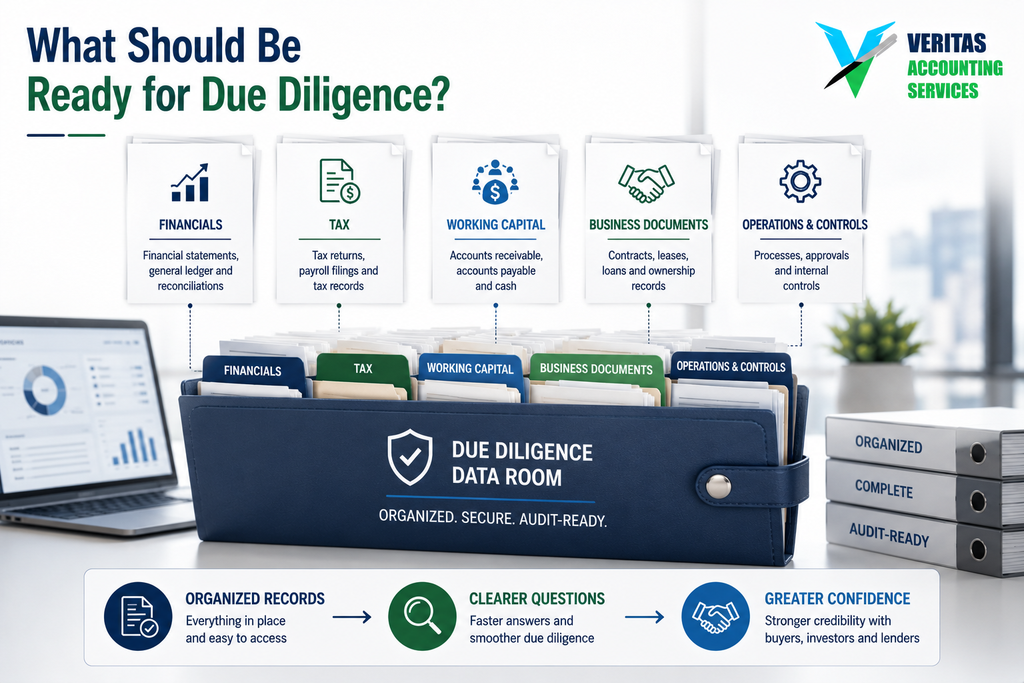
The scope varies by situation, but a review can include:
- Financial statements
- Bank accounts
- General ledger
- Revenue
- Expenses
- Accounts receivable
- Accounts payable
- Tax records
- Payroll
- Debt
- Contracts
- Assets
- Legal obligations
- Internal controls
The purpose is not to prove that a business has no weaknesses.
Very few businesses are completely free of risks.
The purpose is to understand those risks, verify the information presented by management and determine whether anything could materially affect the proposed transaction.
Why Financial Records Matter
Financial records tell the story of a business.
If the accounting records are accurate, consistent and well supported, an outside reviewer can understand how the company generates revenue, where it spends money and how cash moves through the organization.
Consider two businesses with similar revenue and profitability.
The first has reconciled accounts, organized supporting documents, consistent financial statements and clearly documented liabilities.
The second has old reconciliation items, inconsistent expense classifications, missing documents and unclear balances.
Both may be economically healthy, but the first business will generally be easier to evaluate.
This is why due diligence preparation should not begin when a buyer appears.
It should be part of normal financial management.
Start With Your Bookkeeping
The general ledger is one of the first areas management should review.
Ask some basic questions:
- Are all bank accounts included?
- Are credit cards properly recorded?
- Are transactions categorized consistently?
- Are old suspense balances still outstanding?
- Are owner transactions clearly identified?
- Are loans correctly recorded?
- Are fixed assets up to date?
- Are intercompany balances properly accounted for?
Small bookkeeping errors can accumulate.
For example, if personal expenses are regularly mixed with company expenses, profitability may be distorted. If loan payments are recorded incorrectly, liabilities and interest expenses may not be accurate.
A clean ledger makes financial reporting more reliable and reduces the amount of explanation required later.
Professional bookkeeping is therefore more than transaction entry. It creates a financial record that management and external stakeholders can understand.

Reconcile Bank and Credit Card Accounts
Bank reconciliation is a fundamental financial control.
Every business bank account should be reconciled regularly. Credit cards and other financial accounts should receive the same attention.
Look for:
- Old outstanding checks
- Unidentified deposits
- Duplicate transactions
- Unusual transfers
- Bank fees
- Old reconciling items
- Incorrect credit card balances
An old reconciliation difference may seem insignificant, but unexplained balances can raise questions about the reliability of the accounting records.
During due diligence, reviewers may want to understand why the cash reported on the balance sheet differs from the bank records.
Resolving these issues before an external review is much easier than trying to explain years of unresolved differences later.
Review Accounts Receivable and Payable
Accounts receivable deserves particular attention.
A company may report a large receivable balance, but that does not necessarily mean all of the money will be collected.
Management should review:
- Current invoices
- Overdue balances
- Long-outstanding accounts
- Disputed invoices
- Related-party balances
- Potential bad debts
Accounts payable should also be reviewed.
Identify unpaid vendor invoices, disputed amounts, old balances and obligations that may not be obvious from a quick review of the financial statements.
A realistic view of working capital helps management understand the company’s actual financial position.
It also makes due diligence discussions more straightforward because management can explain the quality of its receivables and obligations.
Organize Tax Records
Tax documentation should be easy to locate.
Depending on the business and jurisdictions involved, relevant records may include:
- Federal or national tax returns
- State or local filings
- Sales tax or VAT returns
- Payroll tax filings
- Information returns
- Tax payment records
- Tax registrations
- Notices from tax authorities
- Open tax matters
Missing documentation does not necessarily mean the company has a tax problem.
However, it can create uncertainty.
Business owners should maintain a clear record of filings, payments, notices and outstanding matters.
Tax records should also agree with the underlying accounting records wherever appropriate.
If the financial statements report one position while tax records suggest another, management should be able to explain the difference.
Review Revenue and Expenses
Revenue is normally one of the most important areas for an external reviewer.
Business owners should be able to explain:
- Where revenue comes from
- Which customers contribute the most
- Whether revenue is recurring
- Whether pricing has changed
- Whether unusual one-time transactions occurred
- Whether customer concentration is significant
Expenses deserve similar attention.
Review major expense categories and investigate unusual changes.
Ask whether costs are:
- Recurring or one-time
- Properly classified
- Business-related
- Supported by documentation
- Consistent with previous periods
A business should be able to explain its own financial story.
If revenue increased significantly, management should know why.
If gross margin declined, management should understand the cause.
If cash decreased despite higher profits, management should be able to explain the working-capital movement.
This level of understanding demonstrates financial discipline.
Identify Debt and Other Liabilities
A company’s financial health cannot be evaluated by looking only at revenue and profit.
Management should understand all significant obligations.
Review:
- Bank loans
- Lines of credit
- Equipment financing
- Credit cards
- Lease commitments
- Tax liabilities
- Accrued expenses
- Customer deposits
- Employee-related obligations
- Guarantees
- Other contractual commitments
Some obligations may not be immediately obvious from a basic profit-and-loss report.
A complete review helps management identify its actual financial exposure.
During due diligence, undisclosed or poorly understood liabilities can become a major source of concern.
Transparency is therefore important.
Organize Contracts and Business Documents
Financial statements tell only part of the story.
Important contracts and legal documents should also be organized.
These may include:
- Customer agreements
- Supplier contracts
- Lease agreements
- Employment agreements
- Insurance policies
- Loan documents
- Licensing agreements
- Intellectual property records
- Partnership or shareholder agreements
Management should know which agreements are active, when they expire and whether they contain obligations that could affect the business.
Customer concentration is another important consideration.
If one customer represents a substantial percentage of revenue, the business should understand the contractual relationship and the potential risk if that customer leaves.
Good documentation makes the business easier to understand.
Strengthen Internal Controls
As businesses grow, financial controls become increasingly important.
Review who has authority to:
- Access bank accounts
- Approve payments
- Create vendors
- Process refunds
- Modify accounting records
- Approve expenses
- Process payroll
- Post journal entries
A small company may initially operate largely on trust.
That can work for a period of time, but growing organizations need clear responsibilities and appropriate checks.
Internal controls do not need to create unnecessary bureaucracy.
The objective is to reduce errors, limit fraud risk and ensure that important financial activities have appropriate oversight.
Strong controls can also demonstrate that the business is professionally managed.
Prepare Management Reporting
Historical financial statements are important, but management should also understand what is happening today.
Useful management reports can include:
- Monthly profit and loss
- Balance sheet
- Cash-flow report
- Budget versus actual
- Accounts receivable aging
- Accounts payable aging
- Gross-margin analysis
- Revenue by customer
- Revenue by product or service
- Key performance indicators
The numbers should not simply be produced.
Management should understand them.
For example, if revenue increased by 20%, what caused the increase?
If profitability declined, was the reason pricing, labor, materials or overhead?
If cash flow weakened, was it caused by lower sales or slower collections?
This analytical understanding can make due diligence much more efficient because the owner can answer questions with confidence.
Common Red Flags
Not every issue will stop a transaction, but certain patterns can attract additional scrutiny.
Unreconciled Accounts
Old differences can suggest weaknesses in financial controls.
Large Owner Transactions
Personal and business expenses that are not clearly separated can complicate financial analysis.
Old Receivables
Long-outstanding invoices may not represent realistic future cash collections.
Missing Tax Records
Incomplete documentation can create uncertainty about potential liabilities.
Unusual Revenue Patterns
Large one-time transactions may require additional explanation.
Customer Concentration
Heavy dependence on one customer can create business risk.
Poor Documentation
If management cannot quickly locate supporting records, the review may take longer.
The purpose of identifying these issues is not to hide them.
It is to find them early, understand their impact and correct them where possible.
How Accounting Professionals Can Help
Financial preparation can require considerable time.
Business owners are already managing customers, employees, operations and growth. As a result, accounting cleanup can remain on the priority list without receiving enough attention.
An experienced accounting team can help bring structure to the financial side of the business.
Support may include:
- Bookkeeping cleanup
- Bank reconciliation
- Credit-card reconciliation
- General ledger review
- Accounts receivable analysis
- Accounts payable review
- Financial statement preparation
- Management reporting
- Cash-flow forecasting
- Tax record organization
- Financial analysis
At Veritas Accounting Services, we work with businesses and professional firms that need bookkeeping, accounting, tax support, financial reporting and outsourced finance services.
Our role is not simply to make the books look organized when a transaction is approaching.
The objective is to establish reliable financial processes throughout the year.
That approach makes due diligence less stressful because the company is maintaining its financial records continuously instead of reconstructing several years of information at the last minute.
Professional support can also help management identify accounting issues that may otherwise remain hidden.
A Practical Readiness Checklist
Business owners can use the following checklist to evaluate their preparedness.
Financial Records
☐ Books are current
☐ Bank accounts are reconciled
☐ Credit cards are reconciled
☐ General ledger has been reviewed
☐ Old balances have been investigated
☐ Fixed assets are properly recorded
Working Capital
☐ Accounts receivable aging is reviewed
☐ Uncollectible balances are identified
☐ Accounts payable is current
☐ Customer deposits are understood
☐ Working-capital trends are documented
Tax and Compliance
☐ Tax returns are organized
☐ Payroll filings are available
☐ Sales tax or VAT records are available where applicable
☐ Tax liabilities are reconciled
☐ Tax notices are documented
Business Documents
☐ Customer contracts are organized
☐ Supplier agreements are available
☐ Loan documents are current
☐ Lease agreements are accessible
☐ Insurance documents are available
☐ Ownership documents are organized
Management Information
☐ Monthly financial statements are available
☐ Cash-flow reporting is current
☐ Budgets and forecasts are maintained
☐ Major revenue changes are understood
☐ Major expense changes are understood
☐ Key performance indicators are tracked
Completing this checklist does not guarantee a successful transaction.
It does, however, put management in a stronger position to respond to questions and demonstrate control over the company.
FAQ
What is due diligence in a business transaction?
It is the process of examining a company’s financial, operational, legal and other relevant information before a transaction, investment, financing arrangement or major business decision.
How far back can a review go?
The period varies depending on the transaction, industry and circumstances. Buyers and investors may examine several years of financial information.
What financial records should a business maintain?
Businesses should maintain organized financial statements, general ledgers, bank reconciliations, accounts receivable and payable records, tax documentation, debt information and supporting transaction records.
Can bookkeeping problems affect a business sale?
Yes. Inaccurate or incomplete books can make financial performance difficult to verify, create additional questions and potentially delay negotiations.
Should owners wait until a buyer asks for records?
No. Maintaining accurate books and organized documentation throughout the year is much more efficient than attempting to reconstruct records when an external review begins.
Can an accounting firm help prepare a business?
Yes. An experienced accounting firm can help clean up bookkeeping, reconcile accounts, organize financial records, prepare management reports and identify potential financial issues. Legal and tax matters should be reviewed with the appropriate qualified professionals.
Conclusion
A well-managed business should not need a crisis to discover what is happening inside its own financial records.
Preparing for external scrutiny is valuable even when no sale or investment is currently planned.
Clean bookkeeping, reconciled accounts, organized tax records, documented contracts, understood liabilities and consistent management reporting create a stronger business.
They also improve everyday decision-making.
When owners know their numbers, they can identify profitable customers, manage expenses, improve collections and make better decisions about hiring and investment.
This is one of the biggest benefits of preparing for due diligence before it becomes necessary.
At Veritas Accounting Services, we help businesses and professional firms maintain accurate bookkeeping, accounting, tax support, financial reporting, budgeting, forecasting and outsourced finance functions.
The objective is not simply to make a business look prepared for an external reviewer.
It is to help create a business that is financially organized, transparent and ready for its next opportunity.
Whether that opportunity is a new investor, a bank relationship, an acquisition, a strategic partnership or simply the next stage of growth, preparation creates options.
The best time to get your financial house in order is before someone asks to inspect it.
GET IN TOUCH
Schedule a FREE Call