







September Tax Deadlines Are Approaching: A Practical Guide for U.S. Businesses
Introduction
September is one of the most important months on the U.S. tax calendar for many businesses. While April is widely recognized as the main tax season, September brings another significant filing period, particularly for partnerships and S corporations that received extensions.
For business owners, September is not simply about submitting a tax return. It is also a time to review accounting records, confirm estimated tax payments, resolve outstanding bookkeeping issues, gather missing documents, and make sure federal and state obligations have been considered.
The September tax deadlines can create considerable pressure when financial records are incomplete or tax documents arrive late. A return may technically have an extension, but that does not mean the business has unlimited time to organize its records.
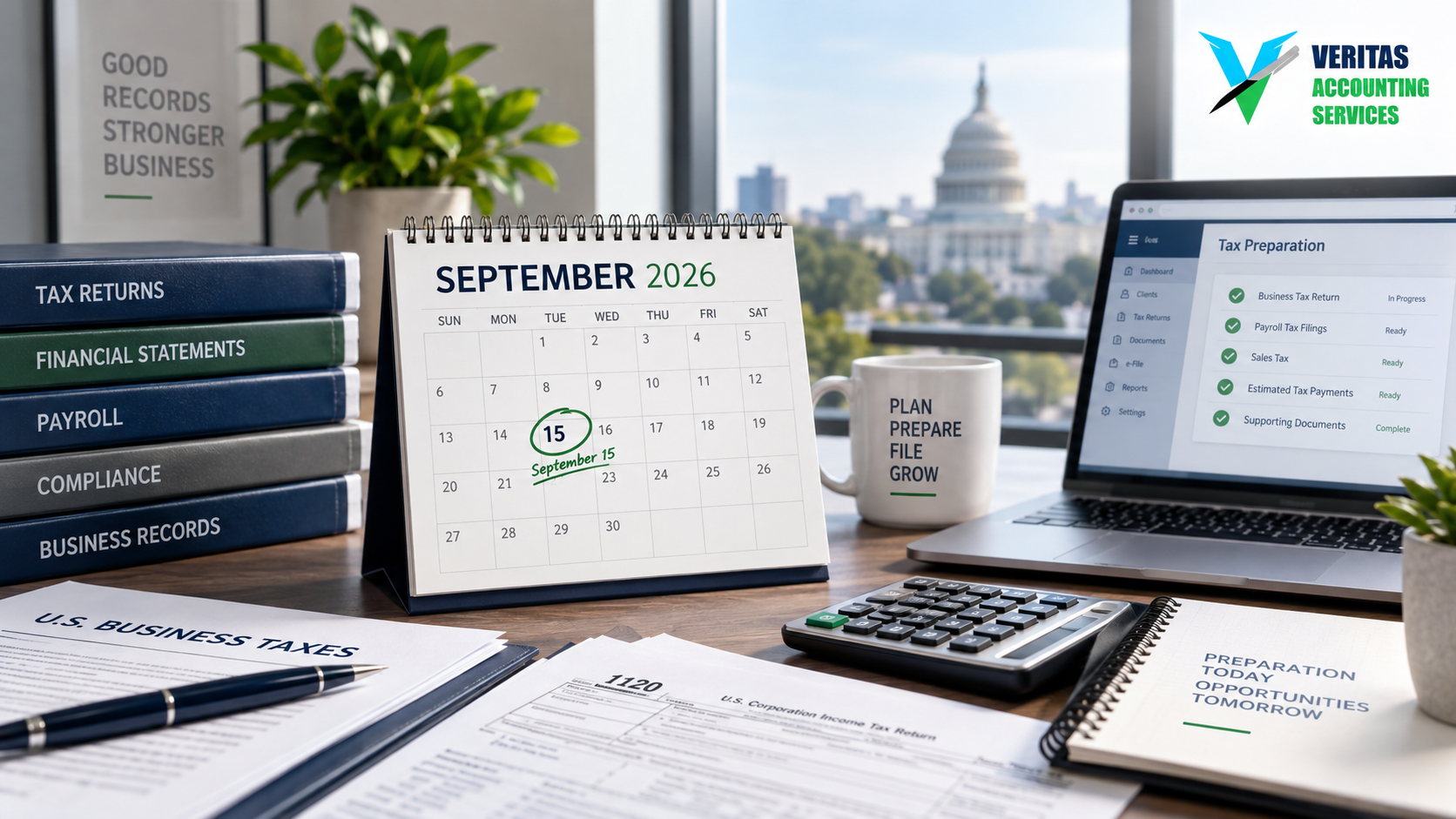
For calendar-year businesses, September 15, 2026, is particularly important. The IRS lists that date for extended calendar-year Form 1065 and Form 1120-S returns when a timely six-month extension was requested. It is also an estimated tax payment date for individuals and corporations under the applicable rules.
Understanding what is due and preparing early can make the difference between a controlled filing process and a last-minute scramble.
Table of Contents
- Why September Is Important for U.S. Businesses
- Key September Tax Deadlines for 2026
- Form 1065 and Partnership Returns
- Form 1120-S and S Corporation Returns
- Estimated Tax Payments
- Other September Tax and Compliance Obligations
- Why Bookkeeping Matters Before Filing
- Common Problems That Delay Tax Returns
- How Businesses Can Prepare for September
- How CPA Firms Can Manage September Workload
- Frequently Asked Questions
- Conclusion
Why September Is Important for U.S. Businesses
The U.S. tax system operates on different deadlines depending on the entity type, tax year, filing requirement, and taxpayer circumstances.
For many calendar-year partnerships and S corporations, the original filing deadline occurs earlier in the year. If the business properly requested an extension, the extended filing deadline generally moves to September.
That creates a concentrated workload for business owners and CPA firms.
The September tax deadlines are also important because tax filing is connected to other financial responsibilities. A business may need to make estimated tax payments, provide Schedule K-1 information to owners or partners, complete state filings, make payroll-related deposits, or address specialized federal reporting requirements.
The IRS 2026 tax calendar specifically identifies September 15 as a major date for several business-related filings and payments.
The important point is that an extension should be viewed as additional preparation time, not as a reason to postpone preparation until September.
Key September Tax Deadlines for 2026
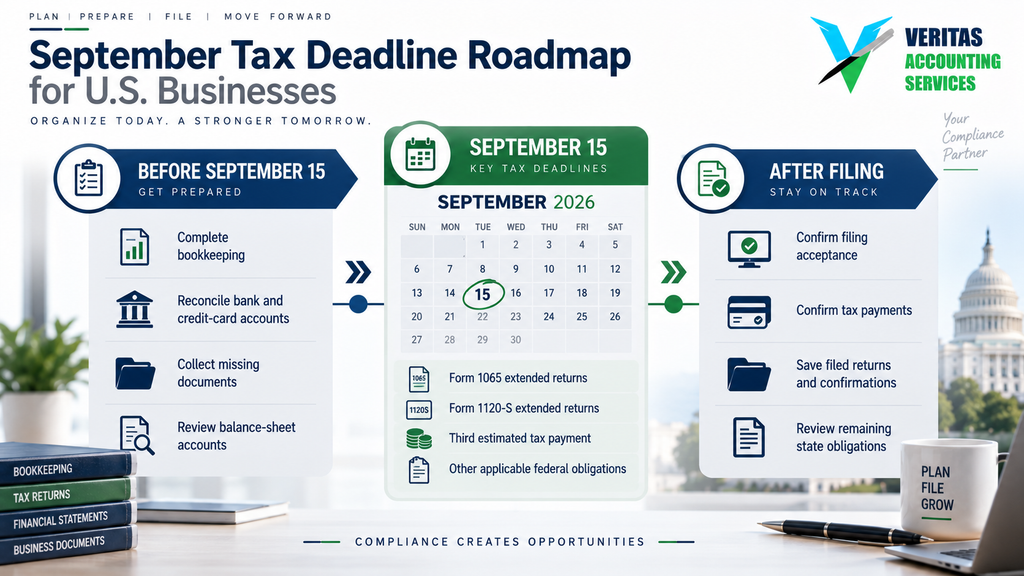
For calendar-year taxpayers, September 15, 2026, is one of the most significant dates on the tax calendar.
The IRS lists the following obligations for September 15, subject to the taxpayer’s circumstances:
Form 1065
Calendar-year partnerships that timely requested a six-month extension generally need to file their 2025 Form 1065 by September 15, 2026.
Form 1120-S
Calendar-year S corporations that timely requested an extension generally need to file their 2025 Form 1120-S by September 15, 2026.
Estimated tax payments
September 15 is also the third estimated tax payment date for 2026 under the standard calendar-year schedule. The IRS identifies June 1 through August 31 as the third estimated-tax payment period, with payment generally due September 15.
These are not the only September obligations. Depending on the business, there can be additional federal filings, withholding requirements, payroll deposits, and state-level obligations.
Therefore, businesses should create a deadline calendar based on their specific entity structure and activities rather than relying on one generic tax date.
Form 1065 and Partnership Returns
Partnerships are particularly important during the September filing period.
Form 1065 reports the partnership’s income, deductions, gains, losses, and other relevant information. The partnership generally does not pay federal income tax at the entity level in the same way a C corporation does. Instead, income and other tax information generally flow through to the partners.
That makes accurate bookkeeping especially important.
If the partnership’s bank accounts have not been reconciled, partner contributions and distributions are unclear, or balance-sheet accounts contain unexplained transactions, the tax preparer may have to spend additional time resolving accounting issues before completing the return.
Schedule K-1 information is also important because partners generally need it for their own tax reporting.
For businesses approaching the September tax deadlines, the best practice is to make sure the accounting records are substantially complete before the tax preparation process reaches its final stage.
A good review should include bank reconciliations, credit-card accounts, accounts receivable, accounts payable, loans, fixed assets, owner transactions, and unusual income or expenses.
Form 1120-S and S Corporation Returns
S corporations are another major part of the September filing cycle.
The IRS states that Form 1120-S is generally due on the 15th day of the third month following the end of the corporation’s tax year. A timely Form 7004 can generally provide an automatic six-month extension.
For an S corporation, tax preparation often requires careful review of shareholder activity, compensation, distributions, loans, fixed assets, business expenses, and other transactions.
Bookkeeping errors can complicate that process.
For example, a shareholder distribution may have been recorded as an expense. A shareholder loan may have been posted incorrectly. Payroll records may not agree with the accounting system. Fixed assets may not have been properly classified.
These issues may not be obvious when simply reviewing the profit and loss statement.
That is why September preparation should include a balance-sheet review, not just a review of income and expenses.
Estimated Tax Payments
One of the most important September tax deadlines is the third estimated tax payment date.
For 2026, the IRS lists September 15 as the due date for the third estimated tax installment under the standard calendar-year schedule.
Estimated tax requirements can apply to individuals who receive income without sufficient withholding, including certain self-employed individuals, partners, and S corporation shareholders. Corporations may also have estimated tax obligations when they expect to owe sufficient tax.
The amount of the payment should be considered carefully.
A business owner whose income has increased significantly during the year may need to reassess estimated payments. The same can apply when profitability has declined, a major deduction has occurred, or the business has experienced a significant change in operations.
The IRS notes that insufficient estimated payments can result in a penalty even when a taxpayer ultimately receives a refund when filing the annual return.
Current financial statements therefore have value beyond management reporting. They can provide the tax professional with better information for estimating the year’s tax position.
Other September Tax and Compliance Obligations
The September tax deadlines extend beyond Forms 1065 and 1120-S.
The IRS September calendar includes a range of other federal obligations depending on the taxpayer’s circumstances. These include certain payroll tax deposits, Form 1042 filings, partnership Forms 8804 and 8805, Form 8813 payments, Form 2290 filings, and other specialized requirements.
For example, Form 2290 may apply to businesses operating certain heavy highway vehicles. The IRS calendar lists September 30, 2026, as the filing and payment date for vehicles first used during August.
International businesses may also have additional reporting or withholding obligations.
State compliance requires separate attention. A federal filing extension does not automatically mean that every state filing, estimated payment, franchise tax, or other state obligation follows exactly the same rules.
Businesses operating across multiple states should therefore review each state’s requirements independently.
Why Bookkeeping Matters Before Filing
Tax preparation starts with accounting records.
If the books are incomplete, the tax preparer may have to spend significant time determining what happened before even beginning the tax review.
This becomes particularly important during the September tax deadlines because CPA firms often manage a large volume of extended returns at the same time.
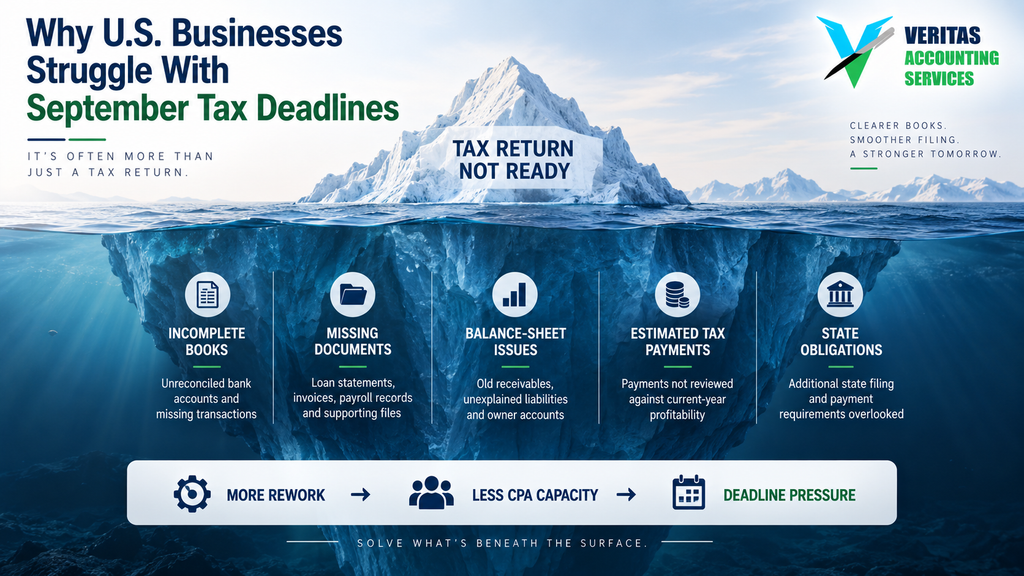
Common bookkeeping issues include unreconciled bank accounts, uncategorized transactions, missing loan statements, incorrect owner transactions, old accounts receivable, duplicate expenses, and unexplained balance-sheet balances.
A tax professional can resolve these issues, but doing so consumes time and can increase the cost of preparing the return.
A stronger approach is to maintain the books throughout the year.
Monthly reconciliation, timely document collection, and regular financial review allow businesses to identify problems much earlier. When September arrives, the accounting records should ideally require review and adjustment rather than reconstruction.
For CPA firms, this also protects valuable professional capacity. CPAs can spend more time on tax analysis, planning, client communication, and advisory work when they are not spending deadline week rebuilding a client’s bookkeeping records.
Common Problems That Delay Tax Returns
Several problems repeatedly create pressure during the September filing period.
Incomplete financial records
Businesses sometimes provide their tax preparer with books that have not been fully reconciled. This creates additional work before the tax return can be finalized.
Missing supporting documents
Loan statements, fixed-asset invoices, expense records, payroll reports, and other documents may still be outstanding.
Unexplained balance-sheet accounts
Old receivables, stale checks, unidentified liabilities, shareholder loans, and clearing accounts can require investigation.
Incorrect owner transactions
Owner draws, distributions, capital contributions, and loans may be recorded incorrectly, particularly in small businesses.
Late responses from clients
Even when the accounting records are ready, tax preparation can be delayed because the preparer is waiting for answers to important questions.
State filing confusion
Businesses operating in several states may overlook state-specific filing or payment requirements because they focus only on the federal return.
These problems are manageable when identified early. They become much more difficult when discovered immediately before a deadline.
How Businesses Can Prepare for September
Businesses approaching the September tax deadlines should begin with a practical review of their financial records.
Start by confirming the exact tax forms that apply to the business and whether an extension was properly filed.
Next, review the accounting records through the latest completed month. Make sure bank and credit-card accounts have been reconciled and investigate significant unexplained balances.
Then gather supporting documents. Tax preparers should not have to repeatedly request basic information that could have been organized in advance.
The business should also review estimated payments made during the year and discuss the current-year tax position with its tax professional.
Finally, prepare a separate list of federal, state, payroll, and industry-specific obligations. This reduces the risk of focusing on one deadline while overlooking another.
A simple checklist can turn a stressful tax period into a manageable workflow.
How CPA Firms Can Manage September Workload
For CPA firms, September can be one of the busiest periods of the year.
The challenge is not simply the number of returns. It is the amount of cleanup and follow-up required before those returns can be completed.
A CPA firm can reduce pressure by establishing clear client deadlines well before the filing date.
It can also separate bookkeeping from tax preparation. Recurring bookkeeping, reconciliations, transaction classification, and financial reporting can be handled by a dedicated bookkeeping team while CPAs focus on tax review and advisory responsibilities.
Outsourced bookkeeping can be particularly useful when a CPA firm has seasonal demand but does not want to carry the full cost of additional year-round employees.
The right outsourcing partner should understand U.S. accounting practices, follow documented procedures, maintain confidentiality, communicate clearly, and work within the CPA firm’s existing review process.
For firms preparing for the September tax deadlines, the goal should not be simply to complete the current workload. It should be to build a process that makes the next filing season easier.
Frequently Asked Questions
What is the main September tax deadline for U.S. businesses?
September 15 is a major deadline in 2026. It includes extended calendar-year Form 1065 and Form 1120-S returns for taxpayers that timely requested extensions, along with certain estimated tax payments.
Does filing an extension mean taxes can be paid later?
Generally, an extension of time to file does not automatically provide an extension of time to pay tax that is due. Businesses should determine their payment obligations separately.
Who needs to make estimated tax payments?
Estimated tax rules can apply to individuals, self-employed taxpayers, partners, S corporation shareholders, and corporations depending on their expected tax liability and circumstances.
Are federal and state tax deadlines the same?
No. State filing and payment requirements can differ from federal requirements. Businesses should review the rules applicable to every state in which they have filing obligations.
Why should businesses complete bookkeeping before tax preparation?
Clean and reconciled accounting records reduce the amount of time required to investigate transactions and allow tax professionals to focus on tax reporting, review, and planning.
Can a CPA firm outsource bookkeeping work?
Yes. CPA firms can outsource recurring bookkeeping, cleanup, reconciliations, and accounting support to an experienced provider. The arrangement should include clear responsibilities, quality controls, secure information handling, and appropriate review procedures.
Conclusion
The September tax deadlines are an important reminder that U.S. tax compliance is a year-round process.
For many businesses, September brings together extended partnership and S corporation returns, estimated tax payments, payroll obligations, state requirements, and specialized federal filings.
The businesses that handle September smoothly generally do not start preparing in September. They maintain their books throughout the year, organize supporting documents, monitor tax obligations, and communicate with their tax professionals before deadlines become urgent.
For CPA firms, the same principle applies.
Reliable bookkeeping processes can reduce cleanup work, improve turnaround times, protect CPA capacity, and create more room for tax planning and advisory services.
If your business or CPA firm is preparing for the September tax deadlines, now is the time to review your accounting records, identify missing information, and resolve outstanding questions.
Veritas Accounting Services supports U.S. businesses and CPA firms with bookkeeping, accounting, U.S. tax preparation, tax support, and outsourced accounting services.
Important: Tax deadlines can vary based on entity type, tax year, extension status, state requirements, and individual circumstances. Businesses should verify their specific obligations with the IRS, applicable state tax authorities, or a qualified tax professional. The IRS 2026 tax calendar should be consulted for current federal deadlines.
GET IN TOUCH
Schedule a FREE Call









Connect on our Socials!
