






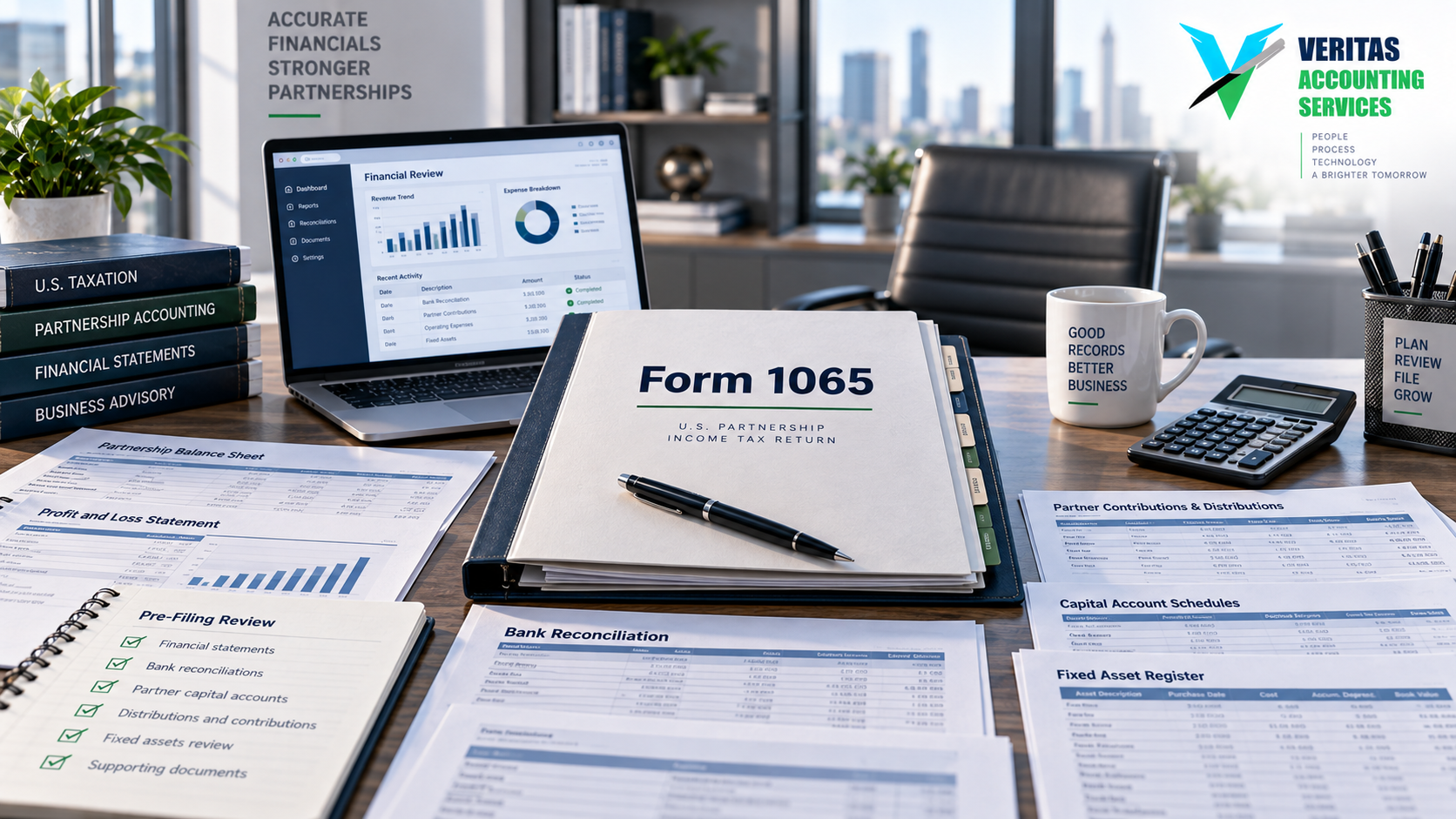

Beyond the Form 1065 Filing: The Financial Checks Every Partnership Should Complete
Preparing a partnership tax return involves much more than entering figures into tax software. Before a partnership can complete its Form 1065 filing, its financial records must be reviewed carefully to ensure that income, expenses, assets, liabilities, capital accounts, and partner transactions are properly reported.
Form 1065 is an information return used by partnerships to report income, gains, losses, deductions, credits, and other relevant information. The partnership generally does not pay federal income tax on its income at the entity level. Instead, income and other tax items are generally passed through to the partners. Each partner then uses the information reported on Schedule K-1 when preparing their own tax return. IRS
This pass-through structure makes accuracy especially important. An error in the partnership’s books can affect not only the partnership return but also the tax reporting of every partner.
For calendar-year partnerships that properly requested an extension, September 15 is generally an important deadline for completing the extended return. However, meeting the deadline should not be the only objective. The partnership should also ensure that its financial records are complete, consistent, and supported by appropriate documentation.
A strong Form 1065 filing process begins with a detailed financial review. This article explains the key checks every partnership should complete before the return is finalized.
Table of Contents
- Confirm the Partnership’s Tax and Filing Details
- Reconcile All Bank and Credit-Card Accounts
- Review Income and Expense Classification
- Examine Accounts Receivable and Accounts Payable
- Review Fixed Assets and Depreciation
- Verify Loans and Other Liabilities
- Reconcile Partner Contributions and Distributions
- Review Partner Capital Accounts
- Confirm Profit and Loss Allocations
- Review Schedule K-1 Information
- Identify International and State Tax Issues
- Maintain Supporting Documentation
- Final Form 1065 Filing Review
- Frequently Asked Questions
- Conclusion
1. Confirm the Partnership’s Tax and Filing Details
Before reviewing the numbers, confirm that the partnership’s basic tax information is correct.
The preparer should verify the legal name, Employer Identification Number, business address, accounting period, tax year, and entity classification.
The partnership should also confirm whether it uses a calendar year or a fiscal year. The filing deadline depends on the partnership’s tax year. Under IRS guidance, Form 1065 is generally due on the 15th day of the third month following the end of the partnership’s tax year. Form 7004 is generally used to request an automatic six-month extension of time to file eligible business returns. IRS
For a Form 1065 filing, the preparer should also confirm whether the partnership has experienced any significant changes during the year, such as:
- Admission of a new partner
- Withdrawal or retirement of a partner
- Transfer of a partnership interest
- Change in ownership percentages
- Change in business activity
- Merger, restructuring, or dissolution activity
- Change in accounting method
These details can affect the preparation of the return and the information reported to the partners.
2. Reconcile All Bank and Credit-Card Accounts
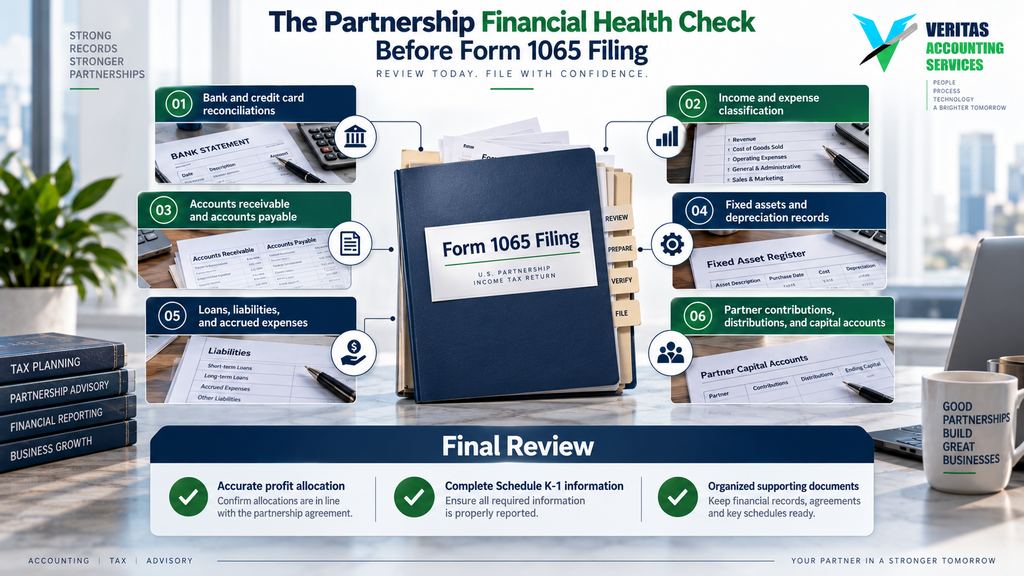
Bank reconciliation is one of the most important steps in the Form 1065 filing process.
The partnership should reconcile every business bank account, credit-card account, loan account, and payment platform through the end of the tax year.
Unreconciled accounts may contain duplicate transactions, missing deposits, incorrect withdrawals, bank charges, or transactions recorded in the wrong period.
The review should identify:
- Outstanding checks
- Deposits in transit
- Duplicate transactions
- Unidentified bank withdrawals
- Unrecorded bank fees
- Transfers between accounts
- Personal transactions
- Incorrectly dated transactions
A bank balance that agrees with the accounting system does not automatically mean that the books are accurate. The underlying transactions must also be reviewed.
For example, a transfer between two partnership bank accounts should not be recorded as income or an expense. Similarly, a partner’s personal payment of a business expense may need to be recorded as a contribution or payable rather than as an ordinary bank transaction.
A complete reconciliation process gives the tax preparer a more reliable starting point.
3. Review Income and Expense Classification
A partnership’s income and expenses should be reviewed for accuracy, consistency, and proper classification.
The profit and loss statement should be compared with the prior year and with internal management reports. Significant fluctuations should be investigated before the Form 1065 filing is completed.
For example, a sudden increase in repairs and maintenance may actually include equipment purchases that should be reviewed as fixed assets. A large legal expense may require additional documentation. A payment to a partner may have been recorded as an operating expense even though it represents a distribution or another type of transaction.
The partnership should review whether:
- Revenue has been recorded in the correct period
- Customer refunds and credits are properly reflected
- Personal expenses have been excluded or correctly classified
- Capital expenditures have been separated from operating expenses
- Meals and travel expenses have appropriate documentation
- Payroll and contractor expenses agree with supporting records
- Interest, rent, insurance, and professional fees are correctly classified
A clean income statement is essential, but the tax preparer should not rely on the income statement alone. Some of the most important partnership tax issues arise from balance-sheet accounts and partner transactions.
4. Examine Accounts Receivable and Accounts Payable
Accounts receivable and accounts payable should be reviewed before the Form 1065 filing is finalized.
The accounts receivable aging report can identify old customer balances, disputed invoices, credit balances, and amounts that may require further investigation.
The partnership should determine whether receivables are valid and whether any balances have been collected after year-end. If the partnership uses the accrual method, the timing of revenue recognition and related adjustments may require particular attention.
Accounts payable should also be reviewed for duplicate bills, unpaid expenses, incorrect vendors, and transactions recorded in the wrong accounting period.
The preparer should investigate:
- Old outstanding customer balances
- Unusual credit balances
- Duplicate vendor bills
- Unrecorded liabilities
- Large year-end invoices
- Payments made after year-end
- Expenses relating to the wrong tax year
These checks help ensure that the financial statements reflect the partnership’s actual position and that relevant tax adjustments are not overlooked.
5. Review Fixed Assets and Depreciation
Fixed assets require special attention because they can affect both the balance sheet and the tax return.
The partnership should compare its fixed-asset register with the general ledger and supporting invoices. Any major purchases, disposals, transfers, or improvements should be reviewed.
The review should cover:
- Equipment purchases
- Vehicles
- Furniture and fixtures
- Computers and technology
- Leasehold improvements
- Buildings and other property
- Asset disposals
- Insurance proceeds
- Trade-ins
- Depreciation schedules
The book value of an asset may differ from its tax basis. Therefore, the tax preparer should have access to the relevant purchase documents, prior depreciation schedules, disposal information, and any applicable elections.
A missing asset invoice or incorrectly recorded disposal can affect depreciation, gain or loss calculations, and partner reporting.
Before the Form 1065 filing, the partnership should ensure that the fixed-asset records agree with the accounting records and that all significant changes have been communicated to the tax preparer.
6. Verify Loans and Other Liabilities
Loans and liabilities should be reviewed carefully because they can affect both the partnership’s financial position and the information provided to partners.
The partnership should obtain year-end loan statements and reconcile the principal balance, accrued interest, and payments recorded in the accounting system.
The review should distinguish between:
- Principal repayments
- Interest expense
- New borrowings
- Refinancing transactions
- Loan fees
- Related-party loans
- Partner loans
- Debt forgiveness
- Current and long-term portions
A common bookkeeping problem occurs when the entire loan payment is recorded as an expense. Generally, the principal portion reduces the liability, while the interest portion may be recorded separately, subject to applicable tax rules.
Partner loans also require careful documentation. A transaction involving a partner may represent a loan, capital contribution, distribution, or another type of activity. The correct classification depends on the facts and supporting agreement.
These balances should be resolved before the Form 1065 filing is submitted.
7. Reconcile Partner Contributions and Distributions
Partner contributions and distributions are among the most important accounts to review in a partnership.
The accounting records should identify the amount contributed by each partner during the year and the amount distributed to each partner.
The partnership should also distinguish between cash contributions, property contributions, distributions, reimbursements, guaranteed payments, and loans.
The preparer should review:
- Cash contributions
- Property contributions
- Partner draws
- Cash distributions
- Property distributions
- Reimbursements
- Guaranteed payments
- Partner-paid expenses
- Partner loans
- Transfers of partnership interests
A payment made to a partner is not automatically a deductible business expense. It may instead be a distribution, guaranteed payment, loan repayment, or another transaction.
Incorrect classification can affect the partnership’s taxable income, capital accounts, partner basis information, and Schedule K-1 reporting.
The partnership agreement should be reviewed whenever the allocation or treatment of a transaction is unclear.
8. Review Partner Capital Accounts
Partner capital accounts require a detailed review before the Form 1065 filing.
The partnership should confirm beginning capital balances, current-year contributions, allocations of income or loss, distributions, and ending capital balances.
The preparer should also verify that the accounting records are consistent with the partnership agreement and the method used to report capital accounts.
The IRS instructions explain that Schedule K-1 includes information about a partner’s capital account. However, the capital account reported by the partnership should not automatically be treated as the partner’s adjusted tax basis. Partners have their own responsibility to track the basis of their partnership interests. IRS
This distinction is important.
A partner’s outside basis may be affected by contributions, distributions, income, losses, and the partner’s share of partnership liabilities. The information shown on Schedule K-1 may support the partner’s analysis, but it does not replace the partner’s complete basis calculation.
Before the Form 1065 filing is completed, the partnership should identify unusual capital account changes and communicate any unresolved issues to the tax preparer.
9. Confirm Profit and Loss Allocations
Partnership income, deductions, gains, losses, and credits must be allocated according to the partnership agreement and applicable tax rules.
The allocation process should be reviewed whenever the partnership has:
- Different ownership percentages
- Special allocations
- New or departing partners
- Mid-year ownership changes
- Preferred returns
- Guaranteed payments
- Nonstandard distribution arrangements
- Changes to the partnership agreement
The partnership should not assume that every item is divided according to the same percentage.
For example, ordinary business income may be allocated according to one arrangement while a specific item may require a different allocation under the partnership agreement and applicable tax rules.
The Form 1065 filing should reflect the correct total amounts on Schedule K and the correct partner-specific amounts on each Schedule K-1.
Any special allocation should be supported by the partnership agreement, relevant calculations, and appropriate documentation.
10. Review Schedule K-1 Information
Schedule K-1 is one of the most important components of a partnership tax return.
The partnership uses Schedule K-1 to report each partner’s share of income, deductions, credits, and other relevant tax information. The partnership generally must provide a Schedule K-1 to each partner by the due date of the partnership return, including applicable extensions. IRS
Before finalizing the Form 1065 filing, the preparer should verify each partner’s:
- Legal name
- Address
- Taxpayer identification number
- Ownership percentage
- Profit-sharing percentage
- Loss-sharing percentage
- Capital account information
- Share of liabilities
- Allocated income and deductions
- Distributions
- Specially allocated items
The partnership should also consider whether Schedule K-2 and Schedule K-3 reporting applies. These schedules may be relevant when a partnership has international tax information or certain other activities requiring additional reporting.
Errors in Schedule K-1 information can create problems for partners when they prepare their individual returns. Therefore, the partnership should provide partners with accurate and timely information and establish a process for resolving questions.
11. Identify International and State Tax Issues
A partnership may have tax obligations beyond the federal Form 1065 filing.
State filing requirements can apply based on the partnership’s activities, income, ownership, property, employees, or presence in a particular state. A federal filing extension does not automatically provide the same extension for every state obligation.
The partnership should review whether it has responsibilities involving:
- State income tax filings
- Franchise taxes
- Gross receipts taxes
- Sales and use tax
- Payroll tax
- Nonresident partner withholding
- Composite tax returns
- Local tax filings
- Foreign partners
- Foreign financial accounts
- International transactions
Partnerships with foreign partners may have additional withholding and reporting responsibilities. The correct treatment depends on the partnership’s facts and the nature of the partner’s income.
The Form 1065 filing process should therefore include a review of the partnership’s domestic and international activities rather than focusing only on the federal income statement.
12. Maintain Supporting Documentation
Financial figures reported on a partnership tax return should be supported by appropriate records.
The partnership should retain bank statements, invoices, receipts, loan documents, payroll records, fixed-asset records, partnership agreements, ownership records, and other documents supporting the reported amounts.
The IRS instructions state that partnerships generally must keep records for as long as they may be needed for the administration of the Internal Revenue Code. Records supporting an item of income, deduction, or credit are generally kept for a specified period, while records supporting property basis may need to be retained for longer. IRS
A well-organized document system helps the partnership respond to questions from the tax preparer, partners, lenders, auditors, or tax authorities.
It also reduces the risk of repeated document requests and makes future tax preparation more efficient.
Businesses can use secure digital storage, organized folders, standardized file names, and monthly document collection procedures to keep records accessible throughout the year.
13. Final Form 1065 Filing Review
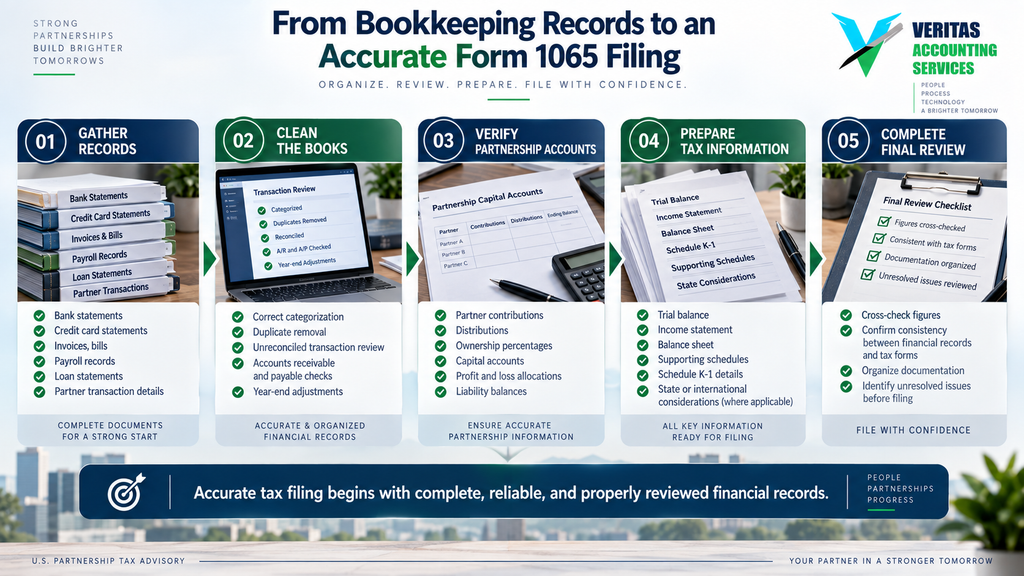
Before the return is submitted, the partnership should complete a final review that connects the financial statements to the tax forms.
A practical final checklist should include the following steps:
- Confirm the partnership’s legal name, EIN, address, and tax year.
- Confirm the original filing deadline and extension status.
- Reconcile all bank, credit-card, loan, and payment-platform accounts.
- Review revenue and expenses for unusual transactions or incorrect classifications.
- Confirm accounts receivable and accounts payable balances.
- Reconcile fixed assets and depreciation schedules.
- Verify loans, accrued liabilities, and related-party balances.
- Review partner contributions, distributions, loans, and reimbursements.
- Confirm beginning and ending partner capital accounts.
- Review income, loss, deduction, and credit allocations.
- Verify partner ownership information and Schedule K-1 details.
- Determine whether Schedule K-2 or Schedule K-3 reporting applies.
- Review state, local, international, and withholding obligations.
- Confirm that supporting documents are complete and properly stored.
- Obtain final approval from the partnership and submit the return through the appropriate process.
This final review can help identify inconsistencies before they become filing problems.
Frequently Asked Questions
What is the purpose of Form 1065?
Form 1065 is used by partnerships to report income, gains, losses, deductions, credits, and other information to the IRS. Partnership income and other tax items generally pass through to the partners.
When is Form 1065 generally due?
Form 1065 is generally due on the 15th day of the third month after the end of the partnership’s tax year. Calendar-year partnerships generally have a March filing deadline, while an eligible extension can move the filing deadline later in the year. IRS
Does a partnership extension provide more time to pay tax?
A partnership generally does not pay federal income tax on its income at the entity level in the same way as a C corporation. However, partners may have individual tax obligations relating to their shares of partnership income. Other partnership-level taxes, withholding obligations, and state liabilities may still apply.
Why are partner capital accounts important?
Partner capital accounts help track contributions, allocations, and distributions. They are important for financial reporting and Schedule K-1 preparation, although a partner’s capital account is not automatically the same as the partner’s adjusted tax basis.
What is the difference between Schedule K and Schedule K-1?
Schedule K reports the partnership’s total distributive shares of income, deductions, credits, and other items. Schedule K-1 reports each individual partner’s share of those items.
Can bookkeeping errors affect a partnership tax return?
Yes. Incorrect bookkeeping can affect taxable income, balance-sheet accounts, partner capital accounts, distributions, liabilities, depreciation, and Schedule K-1 information.
Should a partnership review state requirements separately?
Yes. State filing and payment requirements can differ from federal rules. A partnership should review the requirements of every state and locality where it has relevant activities or obligations.
Conclusion
A successful Form 1065 filing depends on more than completing the tax forms before the deadline. It requires reliable accounting records, accurate partner information, appropriate allocations, complete documentation, and a careful review of financial accounts.
Partnerships should reconcile their books, review income and expenses, verify fixed assets and liabilities, examine partner contributions and distributions, and confirm that capital accounts and Schedule K-1 information are accurate.
The process should also include a review of state, local, international, and withholding responsibilities where applicable.
For CPA firms, completing these checks early can reduce last-minute questions, minimize rework, and improve the quality of the final tax return. For partnerships, it can provide greater confidence that the information delivered to the IRS and the partners is complete and consistent.
At Veritas Accounting Services, we support businesses and CPA firms with bookkeeping, accounting, financial reporting, tax preparation support, and outsourced accounting services. Reliable bookkeeping throughout the year can make the Form 1065 filing process more efficient and help tax professionals focus on review, compliance, and advisory work.
To prepare for your next partnership tax return, begin with the financial records rather than the tax software. A well-reviewed set of books is the foundation of a more accurate and efficient filing process.
Important: Tax requirements can vary depending on the partnership’s structure, tax year, ownership, activities, state obligations, international transactions, and other circumstances. This article is intended for general educational purposes and should not replace advice from a qualified U.S. tax professional.
GET IN TOUCH
Schedule a FREE Call






Connect on our Socials!
