








September Is the Right Time to Start Your 2026 Year-End Tax Planning
September is an important month for business owners who want to approach the end of 2026 with a clear tax strategy. By this point in the year, most businesses have enough financial information to understand how the year is developing, while there is still time to make decisions before December 31.
Many businesses wait until December to think about taxes. The problem is that December is often too late to properly evaluate major transactions, retirement contributions, equipment purchases, compensation decisions, estimated payments, and other planning opportunities.
Effective year-end tax planning is not about finding ways to avoid taxes at the last minute. It is about understanding your expected tax position and making financially sensible decisions while you still have time to act.
For business owners, September can therefore be the starting point for a structured review of profitability, cash flow, tax exposure, and year-end opportunities.
Why Start Tax Planning in September?
The value of September comes down to timing.
Earlier in the year, there may not be enough financial information to make a reliable full-year projection. By September, however, you typically have several months of actual revenue and expense data.
At the same time, you still have the final quarter to make decisions.
Consider a business that expected to generate $700,000 in revenue during 2026. By the end of August, it has already generated $750,000 and is experiencing stronger-than-expected margins.
That business may finish the year with substantially higher taxable income than originally expected.
Without an early review, the owner may discover the additional tax liability only when the return is prepared. With proper planning, the owner has several months to review the numbers, consider available strategies, and prepare the necessary cash.
This is the fundamental reason year-end tax planning should begin before the year actually ends.
Start With Accurate Financial Statements
Tax planning is only as reliable as the financial information behind it.
Before making any tax-related decisions, review the company’s bookkeeping through at least August or September.
Your accounting records should include properly reconciled bank and credit card accounts, recorded expenses, updated accounts receivable and payable, accurate payroll information, and properly classified business transactions.
Then review your:
- Profit and loss statement
- Balance sheet
- Cash flow
- Accounts receivable
- Accounts payable
- Fixed assets
- Loans and liabilities
- Owner transactions
Compare current results with the prior year and the original budget.
Look for significant changes in revenue, gross margins, payroll, contractor expenses, interest, and other operating costs.
If the books are incomplete, tax projections may be misleading. Cleaning up accounting records should therefore be one of the first steps in year-end tax planning.
Prepare a Preliminary 2026 Tax Projection
Once the books are reasonably current, prepare a preliminary projection of your 2026 tax position.
The purpose is to estimate where taxable income may finish and determine whether current tax payments are consistent with that estimate.
A projection may consider expected annual revenue, operating expenses, owner compensation, depreciation, retirement contributions, estimated payments, state taxes, and other relevant items.
It can also be useful to prepare more than one scenario.
For example, a business might compare its expected tax position under these circumstances:
- Revenue continues at the current pace.
- Revenue increases during the fourth quarter.
- The business makes a planned capital purchase.
- The owner changes retirement contributions.
This type of analysis provides more useful information than simply looking at the previous year’s tax bill.
Year-end tax planning becomes much more effective when business owners understand how potential decisions could affect both taxes and cash flow.
Review Estimated Tax Payments
Estimated tax payments should be reviewed as part of your September planning process.
If your income has increased substantially during 2026, payments based on an older income estimate may no longer reflect your current position.
Similarly, if business activity has declined, your projected tax liability may be different from what you originally expected.
Review payments already made and compare them with your preliminary annual tax projection. Your tax professional can then determine whether additional payments or other steps should be considered under the applicable rules.
The goal is to reduce the possibility of an unexpected tax balance and make sure sufficient cash is available when taxes become due.
This is particularly important for business owners because tax payments can compete with payroll, inventory purchases, debt payments, and other operating requirements.
A tax liability that is identified in September can be incorporated into the cash-flow forecast. A liability discovered after year-end can be much harder to manage.
Evaluate Capital Expenditures
September is also a good time to review planned purchases for the final quarter.
Businesses may be considering new equipment, computers, vehicles, machinery, furniture, software, or other assets.
Before making a purchase, consider both the business purpose and the tax consequences.
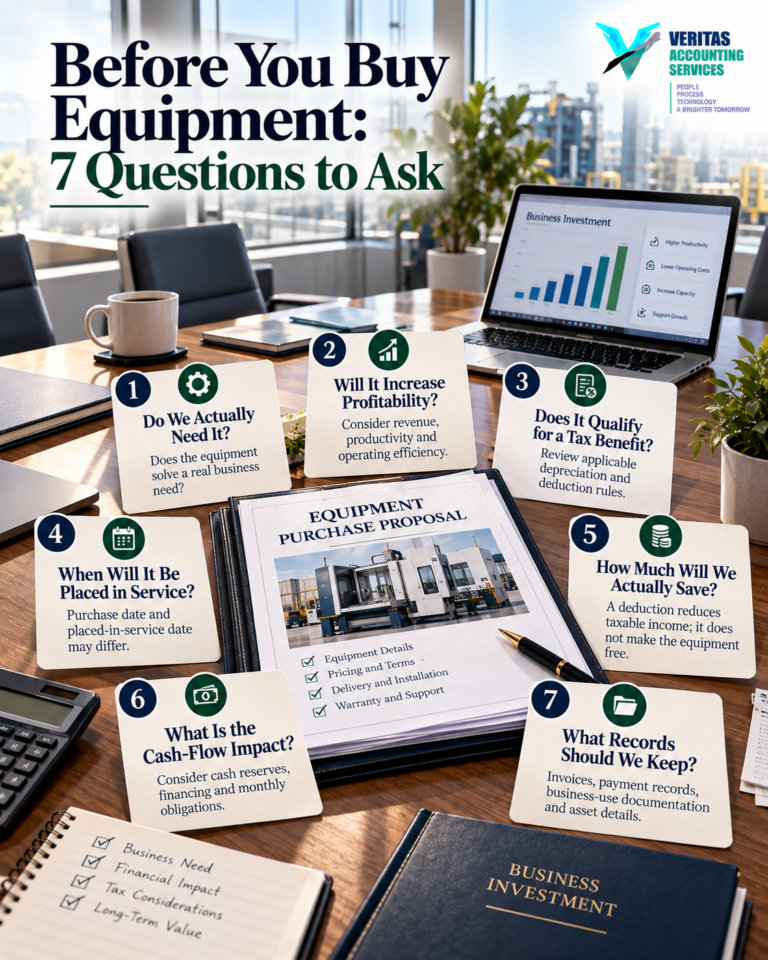
Ask:
Does the business genuinely need the asset?
Will the purchase improve operations or productivity?
Can the business comfortably fund the purchase?
When will the asset be placed in service?
What depreciation or other tax treatment may apply?
The tax treatment of an asset depends on the type of property, its business use, when it is placed in service, and the rules applicable to the tax year.
A business should not spend $50,000 simply because the purchase may produce a tax deduction.
If the business already needs the asset, however, the timing of the purchase may be worth evaluating as part of year-end tax planning.
The tax benefit should support the business decision, not replace it.
Review Retirement Contributions
Retirement planning should also be included in the year-end review.
For 2026, the employee elective deferral limit for many 401(k) plans is $24,500. The standard catch-up contribution limit for participants age 50 and older is $8,000, while eligible participants ages 60 through 63 have a higher catch-up limit of $11,250.
The 2026 IRA contribution limit is $7,500, with an $8,600 catch-up limit for eligible individuals age 50 and older, subject to applicable rules.
Business owners may also have access to employer retirement plans depending on their entity structure, employees, compensation, and circumstances.
The important consideration is timing.
Some retirement strategies require decisions or administrative steps before the end of the year. Waiting until the last week of December may leave limited time to evaluate the available options.
A September review provides an opportunity to coordinate retirement planning with projected business income and personal financial objectives.
Review Owner Compensation
Business owners should also review compensation before year-end.
The appropriate approach depends heavily on the business structure.
For an S corporation, shareholder compensation and distributions should be reviewed in light of the company’s financial performance and applicable tax requirements.
Partnerships may need to consider guaranteed payments, allocations, distributions, and partner-level consequences.
Owners of other entities may have different considerations based on how the business is taxed.
A significant change in profitability may also justify reviewing the existing compensation approach.
The objective is not to change compensation simply to produce a tax result. Instead, the business should determine whether compensation remains appropriate given its operations, profitability, and tax position.
This makes owner compensation an important component of year-end tax planning for closely held businesses.
Consider Your Business Structure
A growing business should periodically review whether its current tax structure remains appropriate.
An LLC, S corporation, partnership, and C corporation can have different federal tax consequences. An entity that made sense when the business was small may require another review after significant growth.
Consider whether there have been changes in:
- Ownership
- Revenue
- Profitability
- Number of employees
- State operations
- Investment activity
- Owner compensation
- Business objectives
A September review gives your tax adviser time to identify issues that may require further analysis.
Business structure decisions can involve legal, accounting, payroll, and tax considerations, so they should not be made solely for the purpose of reducing one year’s tax bill.
Check State and Multi-State Tax Exposure
Businesses should not focus exclusively on federal taxes.
If your company operates in multiple states, has remote employees, maintains locations in different states, or has expanded its sales activities, review whether its state tax and compliance obligations have changed.
Potential areas include income taxes, sales and use taxes, payroll taxes, franchise taxes, registrations, and nexus considerations.
For example, hiring an employee who works remotely from another state may create additional payroll or registration requirements depending on the circumstances.
Likewise, expanding business activities into a new state may require a review of state filing obligations.
A state-by-state review should therefore be included in year-end tax planning for businesses with multi-state operations.
Review Major Transactions From 2026
Ordinary operating expenses are not the only items that deserve attention.
Large or unusual transactions can have significant accounting and tax consequences.
Review whether your business has:
- Purchased or sold real estate
- Sold equipment
- Acquired another business
- Refinanced loans
- Received insurance proceeds
- Made significant owner loans
- Completed related-party transactions
- Received settlement proceeds
- Changed ownership
- Sold investments
For example, a property sale may require analysis of the original cost, accumulated depreciation, loan balance, selling expenses, and resulting gain or loss.
These details may not be obvious from the monthly profit and loss statement.
Identifying major transactions in September or October gives your accountant time to determine the appropriate accounting and tax treatment before year-end.
Review Your Cash Flow Alongside Your Taxes
Tax planning should never be separated from cash-flow planning.
A business may have strong accounting profits but limited available cash because funds are tied up in inventory, accounts receivable, debt repayments, or expansion.
If a business expects a large tax liability, that amount should be incorporated into the cash-flow forecast.
At the same time, business owners should avoid making unnecessary expenditures simply to obtain deductions.
For example, spending $30,000 unnecessarily to potentially save a portion of that amount in taxes does not automatically improve the company’s financial position.
The better approach is to identify legitimate business needs first and then evaluate their tax consequences.
This is one of the most important principles of practical year-end tax planning.
Organize Your Tax Documents Early
Good documentation makes tax preparation significantly easier.
Start gathering documents related to significant transactions before the year closes.
These may include:
- Fixed asset invoices
- Loan statements
- Payroll records
- Retirement plan information
- Investment statements
- Property purchase or sale documents
- Insurance records
- Legal agreements
- Major contracts
- Owner transactions
Also confirm that receipts and invoices have been properly maintained throughout the year.
When documentation is organized early, your tax professional has more time to analyze the transactions rather than spending filing season trying to locate missing information.
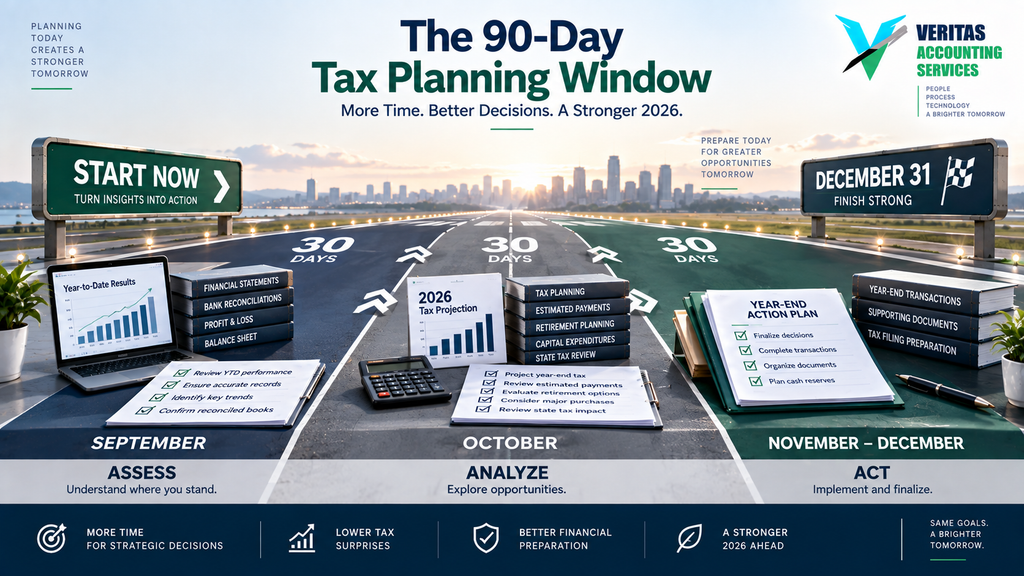
Create a September-to-December Tax Planning Timeline
A simple timeline can help keep the process organized.
September
Update the books, reconcile accounts, review year-to-date financial statements, and prepare an initial tax projection.
October
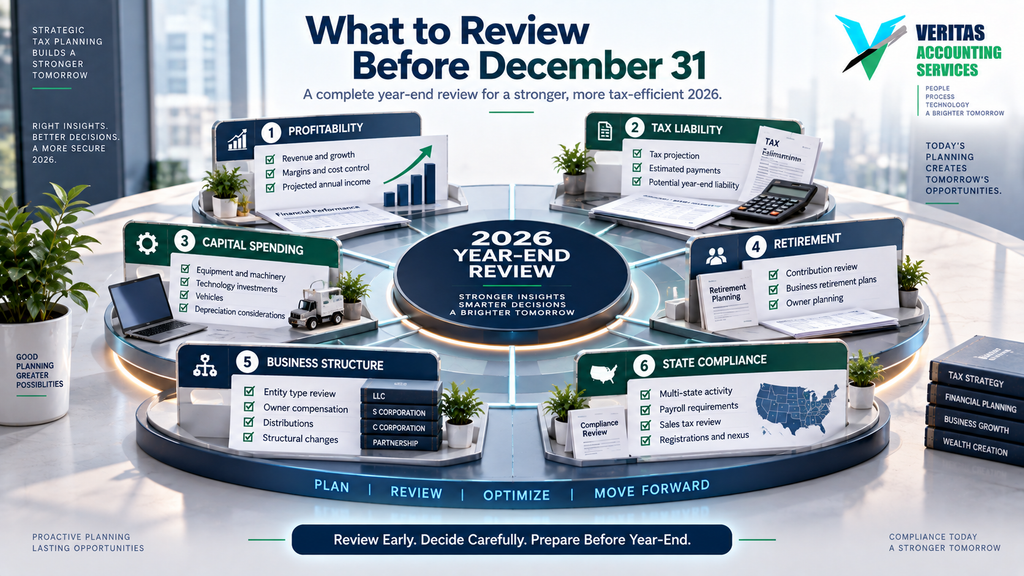
Review estimated tax payments, retirement contributions, capital expenditures, owner compensation, business structure, and state obligations.
November
Finalize the planning decisions that require action and make sure supporting documentation is available.
December
Complete eligible year-end transactions, perform a final financial review, and confirm that planned actions have been completed.
Following this timeline gives business owners a structured approach to year-end tax planning rather than forcing every decision into the final weeks of December.
Common Mistakes to Avoid
Several mistakes can reduce the effectiveness of tax planning.
One common mistake is waiting until the tax return is being prepared before reviewing the year’s financial position.
Another is relying on last year’s tax liability without considering changes in current-year income.
Some business owners also focus exclusively on deductions while ignoring cash flow.
Others make large purchases solely because they believe a deduction will reduce their taxes.
Another issue is failing to consider state obligations when the business expands across state lines.
Finally, incomplete bookkeeping can make an otherwise good tax strategy difficult to evaluate.
Starting early gives you time to identify and correct these issues.
Frequently Asked Questions
Why is September a good time to start 2026 tax planning?
September provides several months of actual financial results while leaving enough time to evaluate and implement appropriate strategies before December 31.
What information is needed for year-end tax planning?
Your accountant will generally need current financial statements, bank and credit card records, payroll information, estimated tax payments, details of major transactions, fixed asset information, and other relevant financial documents.
Should I make purchases before December 31 to reduce taxes?
Only when the purchase makes business and financial sense. The potential tax benefit should be considered alongside the business need, cash-flow impact, and applicable tax rules.
Can tax planning help prevent a large tax bill?
It can help you identify an expected liability early and evaluate legally available strategies. It also allows you to plan for the required cash rather than discovering the amount after the year ends.
Is tax planning only for large businesses?
No. Small businesses, independent owners, partnerships, S corporations, and growing companies can all benefit from reviewing their expected tax position before year-end.
Conclusion
September provides a valuable opportunity to look at your 2026 financial position before the year is over.
By updating your books, projecting annual income, reviewing estimated payments, evaluating capital expenditures, considering retirement contributions, reviewing owner compensation, checking state obligations, and analyzing major transactions, you can approach December with a much clearer understanding of what needs to be done.
Effective year-end tax planning is not about rushing to find deductions. It is about making informed financial decisions while there is still time to act.
At Veritas Accounting Services, we help businesses maintain accurate books, analyze financial performance, prepare tax projections, and identify areas that deserve attention before year-end. Starting the conversation in September can give business owners more time to plan, organize cash, and coordinate with their tax professionals.
Do not wait for tax season to understand your tax position. Start reviewing your 2026 numbers now.
GET IN TOUCH
Schedule a FREE Call









Connect on our Socials!
