








Tax Savings vs Cash Flow: The Financial Trade-Off Business Owners Often Miss
Every business owner wants to pay no more tax than necessary.
That is completely understandable. When a company has a profitable year, the owner naturally starts looking for legitimate deductions, credits, retirement planning opportunities, and other strategies that may reduce the tax bill.
But there is another number that deserves just as much attention: cash available to run the business.
A business can show a healthy profit, achieve meaningful tax savings, and still struggle to pay employees, suppliers, lenders, or other operating expenses if too much cash has been committed elsewhere.
This is where the difference between tax planning and financial planning becomes important.
Tax savings can reduce the amount of tax a business ultimately pays. Cash flow determines whether the business has enough liquidity to operate, invest, and respond to unexpected situations.
The two goals often work together, but they are not always identical.
A decision that creates a tax deduction may also require a significant cash outflow. The tax benefit may be useful, but the business owner needs to consider whether giving up the cash is worth it.
Understanding this trade-off can lead to better financial decisions.
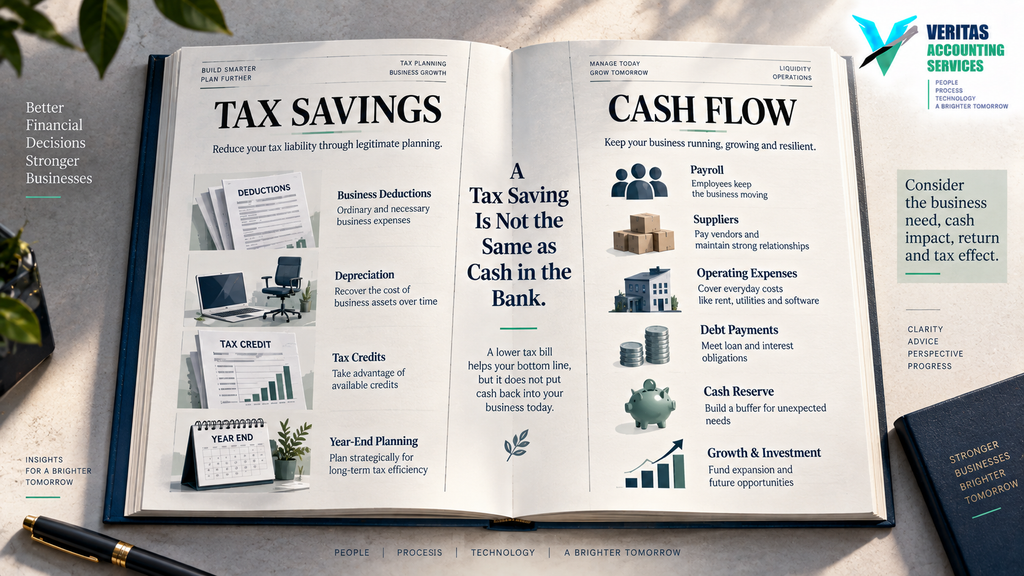
Why Tax Savings and Cash Flow Are Not the Same
Tax savings and cash flow affect a business in very different ways.
Suppose a company spends $50,000 on an eligible business expense. That expense may reduce taxable income, potentially lowering the company’s tax liability.
But the company still spent $50,000.
If the tax benefit is $12,000, the business has not made $12,000. It has simply reduced its tax cost by an amount determined by the applicable tax rules and circumstances.
The remaining cash has still left the business.
This distinction is easy to overlook when the focus is entirely on reducing taxable income.
A business owner should therefore ask two separate questions:
How much tax could this decision save?
and
How much cash will this decision require?
Good financial planning considers both answers.
When Tax Savings Make Sense
There are many situations where pursuing tax savings can be financially sensible.
For example, a business may already need new equipment because its existing machinery is outdated. It may need to hire employees, upgrade technology, purchase inventory, contribute to a retirement plan, or make another legitimate business investment.
If that transaction also receives favorable tax treatment, the tax benefit can improve the overall economics of the decision.
The important point is that the business need exists independently of the tax benefit.
Consider a company that needs a $30,000 piece of equipment to increase production. If purchasing the equipment before year-end provides an available tax benefit, the owner can evaluate both the operational value and the tax consequences.
That is very different from buying an unnecessary $30,000 asset simply because it may reduce taxable income.
Effective tax savings should support good business decisions rather than encourage unnecessary spending.
When Cash Flow Should Get More Attention
There are situations where protecting liquidity may be more important than maximizing deductions.
A growing business may need cash for:
- Payroll
- Inventory
- Accounts payable
- Loan payments
- New employees
- Marketing
- Expansion
- Emergency expenses
- Seasonal working capital
- Unexpected customer or supplier issues
Imagine a business has $100,000 of available cash but expects several large expenses during the next three months.
The owner may identify a transaction that creates a potential tax deduction but requires $40,000 of immediate cash.
Even if the transaction provides tax savings, using $40,000 of liquidity could create unnecessary pressure.
The business might need that cash more than it needs the additional deduction.
This is why cash flow should be evaluated before making a tax-driven financial decision.
The Tax Deduction Is Not Free Money
One of the most common misconceptions in business tax planning is treating deductions as if the government is paying for the expense.
It is not.
A deduction generally reduces taxable income rather than reimbursing the business for the full amount spent.
For example, if a business spends $20,000 on an expense and the applicable tax benefit effectively reduces the tax burden by $5,000, the company has not made $5,000 from the transaction.
It has spent $20,000 and potentially reduced its tax cost by $5,000.
The economic cost remains significant.
This is why business owners should never ask only, “How much can I deduct?”
A better question is:
“Does this expense make financial sense after considering both the business benefit and the tax benefit?”
That approach makes tax savings part of a broader financial decision rather than the entire decision.
Cash Flow Keeps the Business Moving
Profitability and cash flow are closely related, but they are not the same.
A company can report a profit while experiencing a cash shortage.
For example, a business may have $200,000 in outstanding customer invoices. Those invoices may be recorded as revenue, but the business does not necessarily have the cash in its bank account yet.
At the same time, payroll, rent, suppliers, loan payments, and taxes may need to be paid immediately.
This is why a business owner should monitor:
- Accounts receivable
- Accounts payable
- Inventory
- Debt payments
- Payroll
- Operating expenses
- Tax obligations
- Available cash reserves
A tax strategy that looks attractive on the income statement may create pressure on the cash-flow statement.
Understanding this relationship is critical when evaluating tax savings.
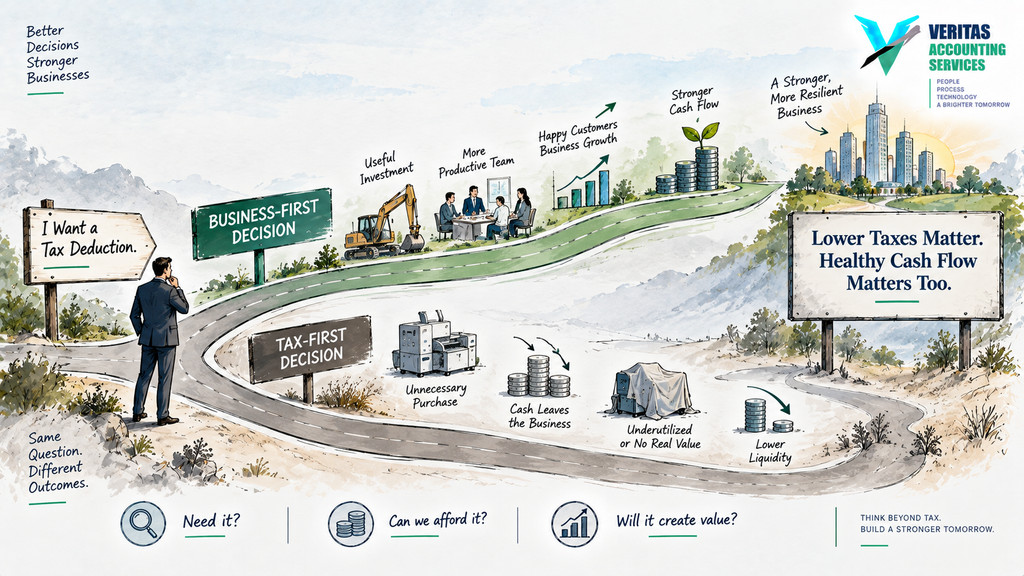
Use a Simple Decision Framework
Before making a major year-end tax decision, use a simple three-part framework.
First: Is the Expense Necessary?
Ask whether the business genuinely needs the product, service, equipment, investment, or other expenditure.
If the answer is no, the potential tax benefit alone may not justify the transaction.
Second: What Is the Cash Impact?
Determine how much cash will leave the business and when.
A transaction requiring $50,000 today may have a very different impact from an expense that can be paid over several months.
Third: What Is the Actual Tax Benefit?
Estimate the realistic tax effect based on the applicable rules and the company’s circumstances.
Do not assume that every dollar spent creates an equal dollar of tax benefit.
This framework helps business owners evaluate tax savings in the context of the entire financial picture.
Build a Tax Projection Before Making Large Decisions
A tax projection can make this process much more practical.
Instead of waiting until the tax return is prepared, estimate your expected taxable income during the year.
Then model different scenarios.
For example:
Scenario A: Continue operating without major changes.
Scenario B: Purchase planned equipment.
Scenario C: Increase retirement contributions where appropriate.
Scenario D: Preserve cash and postpone a non-essential purchase.
Compare the potential tax liability, cash position, and operational impact under each scenario.
This does not mean the tax projection will be exact. It is a planning tool.
The objective is to understand the trade-offs before committing cash.
Keep a Cash Reserve
Businesses should also consider maintaining an appropriate cash reserve.
The right amount varies by industry, business model, seasonality, customer payment patterns, debt obligations, and risk profile.
A company with highly predictable recurring revenue may have different liquidity needs from a construction company with large project cycles or an e-commerce business that needs to purchase inventory ahead of peak seasons.
Before using excess cash for a tax-driven transaction, consider how much liquidity the business needs to remain comfortable.
A tax benefit that leaves the company unable to meet an unexpected expense may create more problems than it solves.
This is where tax savings should be evaluated alongside business resilience.
Consider the Timing of Expenses
Timing can also matter.
Some expenses may be incurred earlier or later depending on business needs and applicable accounting and tax rules.
A business owner may be tempted to accelerate every possible expense into December.
But that approach is not always appropriate.
If the company needs the expense anyway and has sufficient liquidity, accelerating it may deserve consideration.
If the company is trying to preserve cash for January payroll, inventory, or debt payments, delaying a non-essential expense may be more sensible.
The correct timing depends on the facts.
This is why tax savings should be considered as one component of a broader year-end financial strategy.
Do Not Let Taxes Drive Every Business Decision
Taxes matter, but they should not control every decision.
Business owners make decisions for many reasons:
- Customer demand
- Profitability
- Capacity
- Employee needs
- Market opportunities
- Operational efficiency
- Technology
- Financing
- Long-term growth
Tax treatment is one consideration among these factors.
If a business needs new technology, the owner should evaluate productivity and return on investment first. The potential tax treatment can then be added to the analysis.
If a company is considering hiring an employee, the decision should be based on workload, expected revenue, and long-term capacity rather than simply on the deductibility of wages.
This approach produces better decisions than chasing tax savings without considering the underlying economics.
A Practical Example
Consider two business owners, each with $100,000 available at the end of the year.
Owner A spends $70,000 on assets and expenses that are not immediately necessary because the business wants to maximize deductions.
Owner B identifies a $25,000 equipment purchase that the business genuinely needs and keeps the remaining cash available for payroll, working capital, and unexpected expenses.
The second approach may result in a different tax position, but it also leaves the business with greater liquidity.
The example illustrates an important principle: the largest deduction is not automatically the best financial decision.
Business owners should evaluate the tax benefit, the cash requirement, the operational purpose, and the expected return together.
How Bookkeeping Helps With This Decision
Accurate bookkeeping makes the tax-versus-cash-flow analysis much easier.
Your accounting records should provide a clear view of:
Current cash balances
Expected receivables
Upcoming payables
Year-to-date revenue
Operating expenses
Outstanding debt
Fixed assets
Owner transactions
Tax payments
When these numbers are current, your accountant or financial adviser can build a more useful projection.
Poor bookkeeping can make a profitable business appear stronger or weaker than it actually is, making tax decisions more difficult.
This is why financial reporting and bookkeeping should be part of tax planning rather than separate activities.
Tax Savings Should Support Business Strategy
The strongest approach is not to choose between taxes and cash flow as if one must always win.
Instead, business owners should look for decisions that support both.
For example, investing in technology that improves efficiency may strengthen operations while providing applicable tax benefits.
Hiring an employee who is genuinely needed may increase capacity while creating a deductible business expense.
Purchasing equipment that will generate additional revenue may improve productivity while receiving available tax treatment.
In each case, the business decision comes first. The tax consequence then becomes part of the overall analysis.
That is a healthier way to approach tax savings.
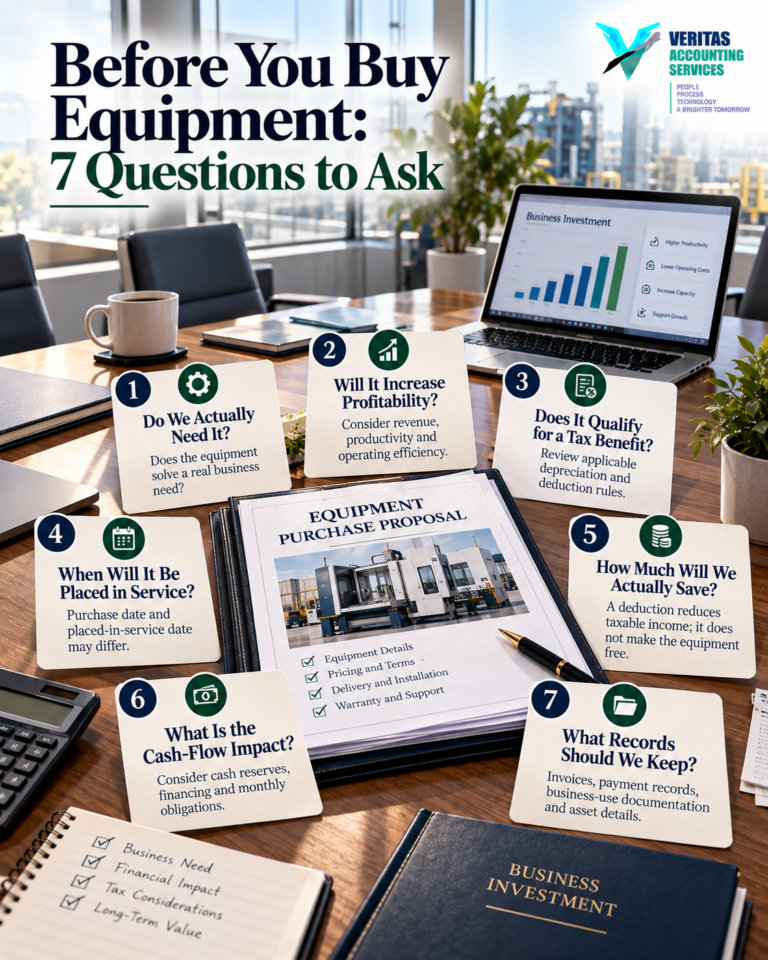
Questions to Ask Before a Major Year-End Expense
Before approving a significant purchase or expense, ask:
- Does the business actually need this?
- What problem will it solve?
- How much cash will leave the business?
- When will the cash leave?
- What return should the business expect?
- What is the potential tax treatment?
- Will the transaction affect working capital?
- What happens if revenue is lower than expected?
- Will the business still have an adequate cash reserve?
- Have the accounting and tax implications been reviewed?
These questions help prevent a common mistake: making a financial decision primarily because of its tax treatment.
Frequently Asked Questions
Should a business always prioritize cash flow over tax savings?
Not necessarily. The right balance depends on the company’s profitability, liquidity, growth plans, debt obligations, and financial needs. Both should be evaluated together.
Is spending money to reduce taxes a good strategy?
Not by itself. An expense should have a genuine business purpose and make financial sense. A tax benefit should be considered as part of the overall decision.
Can a profitable business still have cash-flow problems?
Yes. Timing differences between revenue and collections, inventory purchases, debt payments, payroll, and other obligations can create cash-flow pressure even when the business reports a profit.
How can a business owner compare tax savings with cash flow?
Start with an updated financial statement and tax projection. Then compare the expected tax benefit with the cash required, operational benefit, return on investment, and remaining liquidity.
When should I review these decisions?
Year-end planning should begin well before December. Starting early provides more time to update the books, prepare projections, evaluate options, and make informed decisions.
Conclusion
Tax planning is an important part of running a profitable business, but reducing the tax bill should not become the only financial objective.
A business needs cash to pay employees, suppliers, lenders, taxes, and operating expenses. It also needs liquidity to respond to opportunities and unexpected challenges.
The most effective approach is to evaluate tax savings alongside cash flow, profitability, business needs, and long-term strategy.
Before making a major year-end expense, ask whether the business genuinely needs it, how much cash it will consume, what return it may generate, and what tax treatment applies.
A good tax decision should fit the financial health of the business rather than work against it.
At Veritas Accounting Services, we help businesses maintain accurate books, prepare financial projections, review cash flow, and evaluate tax planning opportunities in the context of their broader financial position.
The goal is not simply to pay less tax. The goal is to make financial decisions that leave the business stronger after taxes are paid.
GET IN TOUCH
Schedule a FREE Call






Connect on our Socials!
