






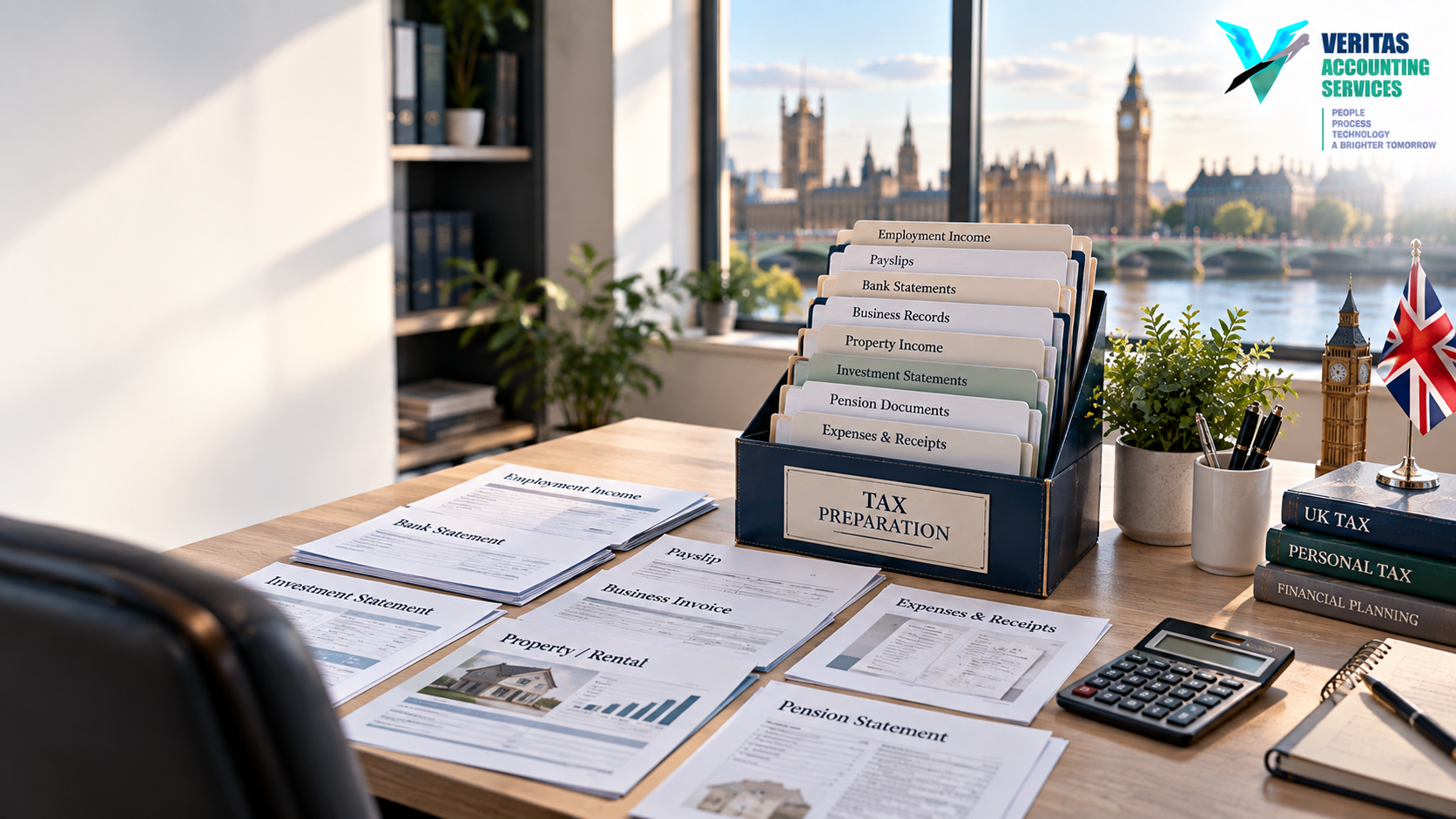

UK Tax Return Preparation: What Documents and Records Do You Need?
Preparing a UK tax return is much easier when the underlying records are organized before you start. Trying to reconstruct income, expenses, bank transactions and tax information at the last minute can create unnecessary errors and make the filing process more stressful.
HMRC requires taxpayers who need to complete Self Assessment to keep records that allow them to prepare an accurate return. These records may also need to be produced if HMRC checks the information reported. Records can generally be kept on paper, digitally or using bookkeeping software, provided they are accurate, complete and readable.
The exact documents you need depend on your circumstances. An employee with some additional income will have a different checklist from a sole trader, landlord or investor.
For the 2025/26 tax year, which ran from 6 April 2025 to 5 April 2026, the online Self Assessment filing deadline is 31 January 2027. That gives taxpayers time to organize their records well before filing.
What Records Do You Need for a UK Tax Return?
There is no single document checklist that applies to every taxpayer. Instead, you should build your records around the sources of income, deductions, reliefs and gains that apply to you.
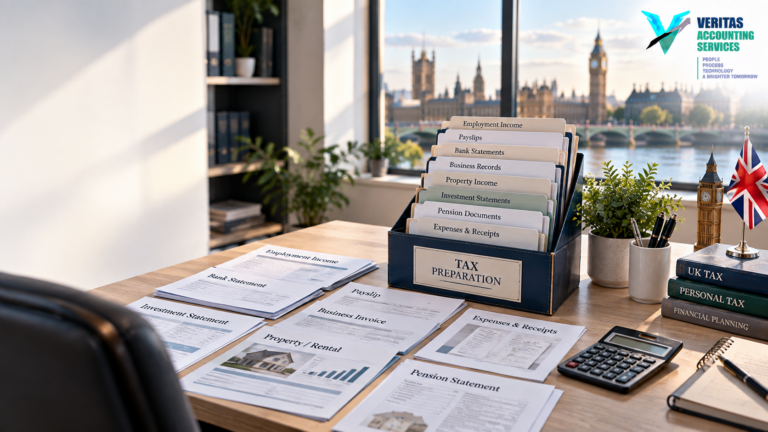
A useful starting point is to separate your information into five broad categories:
- Income records
- Business and expense records
- Bank and financial records
- Property and investment records
- Tax relief and supporting records
The more organized these records are, the easier it becomes to prepare a UK tax return accurately.
1. Employment Income Records
If you were employed during the tax year, start with your employment records.
Your main document will usually be your P60, which shows your pay and tax deducted for the tax year. If you left or changed employment during the year, you may also have P45 records.
You should also collect information about taxable employment benefits where relevant. These might include benefits provided by an employer that need to be reported on the tax return.
If you had more than one employer during the year, make sure you have records for each employment.
It is important to compare the figures with your PAYE records rather than relying on memory. If your employment details have changed during the year, missing one employer can result in an incomplete return.
2. Self-Employment Income Records
For sole traders and other self-employed individuals, the records are more extensive.
HMRC states that self-employed taxpayers should keep records of all sales and income, business expenses, VAT records where applicable, PAYE records if they employ people, personal income and relevant grants. Supporting evidence can include sales invoices, receipts, bank statements, till records and bank slips.
You should therefore prepare:
- Sales invoices
- Customer receipts
- Payment processor records
- Business bank statements
- Cash sales records
- Other business income
- Expense receipts
- Supplier invoices
- Business mileage records
- VAT records, if applicable
- Payroll records, if applicable
If you use accounting software, make sure the bookkeeping is complete before starting the tax return.
Do not simply export a profit figure and assume it is ready for filing. Review the underlying transactions and identify unusual, personal or incorrectly classified items.
3. Business Expense Records
Business expenses are an important part of preparing a UK tax return for a sole trader or partner.
You should gather records showing what was purchased, when it was purchased, the amount paid and the business purpose where relevant.
Examples can include:
Office costs, software subscriptions, professional fees, insurance, business travel, telephone and internet costs, advertising, equipment and other qualifying operating expenses.
The fact that money left your bank account does not automatically mean the expense is allowable for tax purposes.
This is why supporting documentation matters. A receipt or invoice helps establish what the payment was for and provides evidence for the amount included in the accounts.
HMRC says businesses must keep records that allow them to work out their profit or loss and demonstrate the figures if HMRC asks for them.
4. Bank Statements and Financial Records
Bank statements are one of the most useful sources when preparing a UK tax return.
For business owners, review the business bank account and reconcile it with the bookkeeping records. For individuals, review personal accounts where they contain taxable income or payments relevant to the return.
Bank records can help identify:
Interest received, business income, rental payments, investment income, transfers, significant expenses and transactions that may otherwise have been forgotten.
Do not assume that the bank statement alone is sufficient evidence for every transaction. For important expenses or transactions, retain the relevant invoice, receipt, contract or other supporting documentation.
If you have multiple bank accounts, investment platforms or payment services, gather information from all of them before finalizing the return.
5. Savings and Interest Income
Interest income is another area that taxpayers should review carefully.
Collect annual statements from banks and building societies showing interest received during the tax year.
If you have accounts with several financial institutions, make sure you obtain information from each one.
You should also review savings accounts and other interest-bearing products rather than relying only on your main current account.
The objective is to identify the total relevant income for the tax year and ensure it is treated correctly on the return.
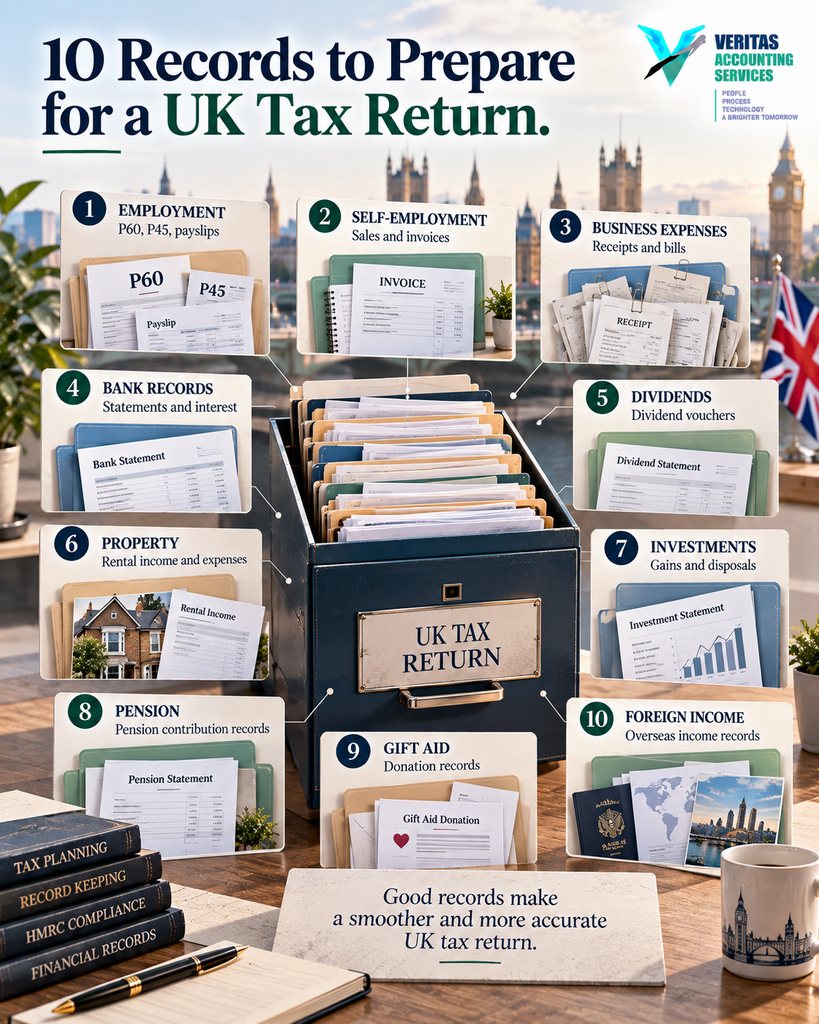
6. Dividend and Investment Records
If you received dividends from shares or investments, collect your dividend statements or vouchers.
For a UK tax return, you may need information such as:
Dividend amount, date received, company or investment source and any relevant tax information.
Investment platforms may provide annual tax statements that make this process easier.
If you hold investments through multiple platforms, gather the information from each platform before preparing the return.
It is also important to distinguish dividend income from gains arising when investments are sold. They are different tax matters and require different calculations.
7. Property and Rental Income Records
Landlords should prepare a separate property file for the tax year.
This should normally include rental income records and relevant property expenses.
Depending on the circumstances, records may include:
Rental statements, tenancy agreements, letting-agent statements, repairs, insurance, property management fees, professional fees, utilities paid by the landlord and other relevant costs.
Mortgage and finance information should also be gathered, but taxpayers should not assume that every mortgage payment is treated as a deductible expense in the same way. The tax treatment of residential property finance costs has specific rules.
If you own more than one property, keep the records separated by property. This makes it easier to identify income and expenses and explain the figures if questions arise.
HMRC’s record-keeping rules specifically treat property letting as a business activity for these purposes, meaning landlords need to retain relevant records.
8. Capital Gains Records
If you sold shares, investment property or another asset during the tax year, you may need records to calculate a capital gain or loss.
Do not wait until the tax return is being prepared to search for these documents.
For each relevant asset, keep records showing:
The original purchase price, acquisition date, purchase costs, improvement costs where relevant, selling price, selling costs and disposal date.
HMRC specifically advises taxpayers to retain receipts, bills and invoices showing amounts paid for an asset and relevant additional costs, together with contracts and valuations where applicable.
Capital gains calculations can become complicated when an asset has been held for many years or acquired through multiple transactions. Good historical records are therefore particularly important.
9. Pension and Gift Aid Records
If you made personal pension contributions or eligible Gift Aid donations, collect the relevant statements and confirmations.
These records can help establish the amounts that may need to be reported or considered when calculating tax relief.
Do not assume that every payment described as a pension contribution receives the same tax treatment. The type of pension arrangement and how the contribution was made can affect the calculation.
Similarly, keep evidence of Gift Aid donations rather than relying on bank transactions alone.
10. Foreign Income and Overseas Records
Taxpayers with overseas income need to be especially careful when preparing their records.
Examples include:
Foreign bank interest, overseas dividends, rental income from overseas property, foreign pensions and other overseas income.
You should collect statements from foreign financial institutions and property records where relevant.
If the income is reported in a foreign currency, retain information supporting the amount and exchange rate used in your calculations.
Do not assume that money received outside the UK automatically falls outside the UK tax system. The correct treatment depends on the taxpayer’s circumstances and the applicable rules.
For individuals with substantial overseas income, professional review can be particularly valuable because residence, domicile and other rules may affect the reporting position.
Keep a Separate File for Tax Reliefs
Income is only one side of preparing a UK tax return.
You should also gather records supporting tax reliefs and claims that may apply to you.
Depending on your circumstances, this might include pension contributions, charitable donations, professional subscriptions, employment expenses and other qualifying reliefs.
The important principle is simple: if you are claiming something on the return, keep evidence supporting the claim.
HMRC requires taxpayers to retain the records needed to make a correct and complete return.
What About Digital Records?
You do not have to maintain all your records in paper form.
HMRC states that records can be kept on paper, digitally or through bookkeeping software.
For taxpayers using digital bookkeeping, this can make preparation considerably easier.
Bank feeds, digital receipts, accounting software and cloud document storage can help create an organized audit trail.
However, digital records do not eliminate the need for supporting documents. HMRC’s Making Tax Digital guidance specifically notes that taxpayers still need to retain original records or supporting documents, or copies, such as bank statements and invoices.
The objective should be a system where every important figure in the tax return can be traced back to reliable source documentation.
How Long Should You Keep Your Records?
Record retention depends on the taxpayer’s circumstances.
For self-employed individuals, HMRC currently states that business records generally need to be kept for at least 5 years after the 31 January submission deadline for the relevant tax year.
For example, the online filing deadline for the 2025/26 tax year is 31 January 2027. A self-employed taxpayer would generally need to retain the relevant business records until at least the end of January 2032.
Individuals who are not carrying on a business can have different record-retention requirements. HMRC’s guidance states that records for a timely filed return generally need to be retained for at least 22 months after the end of the relevant tax year.
If HMRC opens an enquiry, records may need to be retained for longer.
This is one reason why deleting old tax files immediately after filing is not a good practice.
What If You Cannot Find a Record?
Sometimes records are lost, damaged or unavailable.
HMRC recommends trying to obtain replacement copies, such as asking banks for duplicate statements or suppliers for duplicate invoices. Where records cannot be recreated, taxpayers may need to use estimated or provisional figures and explain this in the return where required.
The important point is not to invent figures simply because a document is missing.
Instead, make reasonable efforts to reconstruct the information and maintain a clear record of how the figure was calculated.
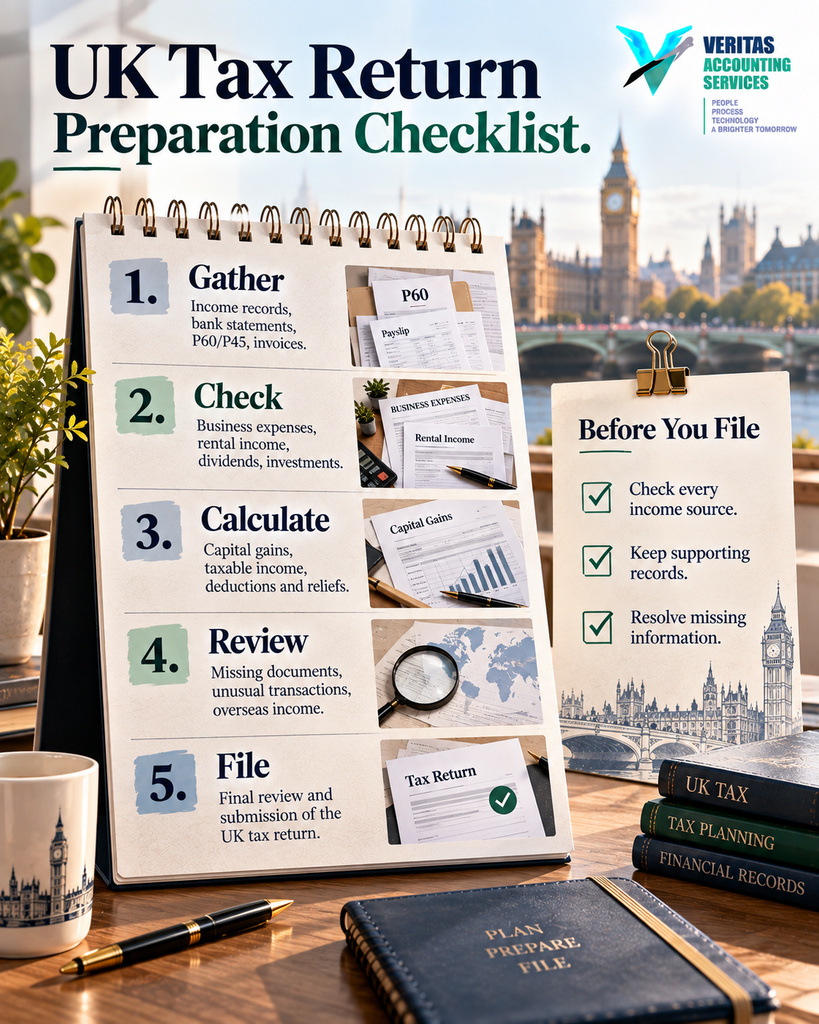
A Simple Preparation Process
Preparing a UK tax return becomes much easier if you follow a consistent process.
Start by listing every source of income you had during the tax year.
Then gather the supporting documents for each income source.
Next, organize your expenses and identify which ones may be relevant to your tax position.
Reconcile bank and accounting records so that income and expenses are not accidentally omitted or duplicated.
After that, review investments, property, pensions, charitable donations, capital transactions and overseas income where applicable.
Finally, compare the information against the previous year’s return. A year-on-year comparison can help identify unusual changes that deserve further review.
This process is especially useful for business owners because it separates record gathering from tax calculation. You first establish the facts, then determine the appropriate tax treatment.
Common Record-Keeping Mistakes
One common mistake is relying entirely on bank statements. Bank statements show transactions, but they may not explain the business purpose or tax treatment of every payment.
Another mistake is mixing personal and business expenses without maintaining supporting explanations.
A third is waiting until January to collect documents. Some records, particularly investment statements, property information and historical asset costs, can take time to obtain.
Taxpayers also sometimes keep only the final tax calculation and discard the supporting records. That is risky because HMRC may later ask how the figures were calculated.
Finally, businesses should avoid treating bookkeeping and tax preparation as two completely separate processes. Accurate bookkeeping provides the foundation for a reliable tax return.
Frequently Asked Questions
Do I need to send all my receipts to HMRC with my tax return?
Generally, you do not send your normal supporting records with the Self Assessment return. However, you must keep the records because HMRC may ask to see them.
What records should a sole trader keep?
A sole trader should keep records of sales and income, business expenses, relevant VAT and PAYE records, personal income and supporting evidence such as invoices, receipts and bank statements.
How long should a self-employed person keep tax records?
Generally, self-employed taxpayers need to keep business records for at least five years after the 31 January submission deadline for the relevant tax year.
Do I need bank statements for my tax return?
Bank statements are important evidence for income, interest and expenses, although the exact records required depend on your circumstances.
What if I lost my receipts?
Try to obtain replacement records from suppliers, banks or other sources. If records cannot be recreated, HMRC allows estimated or provisional figures in appropriate circumstances, but these should be identified correctly and supported by reasonable calculations.
Can I keep my records electronically?
Yes. HMRC allows records to be kept digitally, including through bookkeeping software, provided they meet the relevant requirements.
Conclusion
Preparing a UK tax return should not begin with opening the tax-return form. It should begin with gathering and organizing the information that supports the return.
For employees, that may mean P60s, employment information and records of additional income. For self-employed individuals, it can involve sales, expenses, bank statements, invoices and bookkeeping records. Landlords may need rental statements and property expenses, while investors may need dividend statements and capital gains calculations.
The goal is to create a clear connection between the figures in the tax return and the records behind them.
For the 2025/26 tax year, online Self Assessment returns are generally due by 31 January 2027, so there is no reason to wait until the final weeks to start preparing.
A well-organized record system can make the filing process faster, reduce the risk of missing income or reliefs, and make it easier to answer questions if HMRC later reviews the return.
Good tax preparation starts with good records. The better your records are, the easier it is to prepare an accurate UK tax return with confidence.
GET IN TOUCH
Schedule a FREE Call



Connect on our Socials!
